Reviews


FIND THE LADY. Major Pictures/J. Arthur Rank, UK, 1956. Donald Houston, Beverley Brooks, Mervyn Johns, Kay Callard, Maurice Kaufmann, Edwin Richfield, Moray Watson, Ferdy Mayne, Anne Heywood. Director: Charles Saunders.

   I’ve categorized this old obscure British movie as a crime film, but in all honesty, it’s played a lot more for comedy than it is for thrills. To summarize quickly, though: when the starring lady (Beverley Brooks, as a fashion model from London) goes to spend New Year’s Eve with her godmother out in the country, she finds that the old lady has disappeared.

   But before that she has a funny (and perhaps at the time hilarious) encounter with the local doctor (Donald Houston) when their paths cross while their automobiles traverse a watersplash (a shallow ford in a stream) in opposite directions. The end result is the doctor falling face first into the water while the young lady’s car stalls and she has to walk into the local village for help.

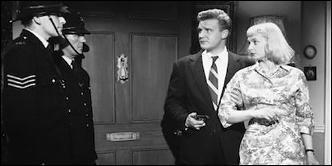
   When the missing woman’s brother-in-law (Mervyn Johns) answers the door, getting back to the kidnapping, for that is what it is from the get-go, he says that she has been taken to a nursing home for seclusion and rest. We, of course, know that something is wrong right away. The old woman’s cane is there, her dog is there, and the replacement “maid” (Kay Callard) looks more like a gangster’s moll than I imagine that any gangster’s moll in the real world ever did. (She’s the one on the far right in the photo above.)

   The young woman and the doctor hit it off very well, and they decide to investigate together. Complicating matters is Miss June Weston’s other suitor (Moray Watson) who comes down from London to add some comedy relief to the proceedings.

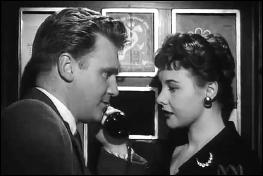
   Most of the names I have dropping are totally new to me. I’d have thought, though, that Beverley Brooks (the beautiful brunette above and up at the top crowded into the phone booth with the doctor) would have had a longer career, but she didn’t. This movie, perhaps her only starring role, was the last one of her career.

   But you may noticed Anne Heywood’s name in the credits. She plays the receptionist at the inn (see the photo above) in this, only her second film. She’s very easy on the eyes as well.

THE BACKWARD REVIEWER
William F. Deeck


JOHN FARR – The Deadly Combo. Ace Double D-301, paperback original, 1958. Bound back-to-back with Murder Isn’t Funny, by J. Harvey Bond.

   Two factors militate against this novel for me: I am not all that fond of the hard-boiled mystery and listening to jazz I find painful. Despite my biases, I must conclude that John Farr, a pseudonym of Jack Webb, has written a dandy novel.

   Mac Stewart. whose position on the Los Angeles police force I don’t quite understand — he’s a plainclothes detective who cruises just like a patrolman — has been a jazz enthusiast since he used to sit in alleys listening to tin pan in a noisy speakeasy. Stewart’s love for the music drew him to Dandy Mullens, a former jazz great, from whom he learned a great deal. When Mullens is found stabbed to death in another alley, Stewart investigates on his own.

   As I said, this is a hard-boiled novel, but Farr often approaches poetry in his writing. particularly when he is dealing with jazz. It’s somewhat fair play, also, though Stewart is helped by the murderer — at least the first one — being not too bright.

— Reprinted from MYSTERY READERS JOURNAL, Vol. 6, No. 1, Spring 1990, “Musical Mysteries.”


Bibliographic Notes:   First of all, the Jack Webb who wrote this book is not the radio-TV-movie actor Jack Webb. There was a lot of confusion about this in the early days of mystery fiction fandom (and elsewhere I’m sure). The Jack Webb who wrote this book was the author of eleven mystery novels under his own name, nine of them with the unlikely sleuthing pair of Father Joseph Shanley and Sammy Golden.

   As John Farr, Webb wrote five more crime and detective novels, two of them with a series character named Cy Clements, about whom I know nothing. The Deadly Combo was Mac Stewart’s only appearance.

JACK LISTON – Man Bait. Dell First Edition B158, paperback original, June 1960.

   Unless you’re collector of paperback books for their covers, you’ve probably never heard of Jack Liston. Man Bait may have been the only book he wrote under that name. But according to his online biography at Bowling Green University, where his literary papers are held — under his real name Ralph Maloney (1927-73) — he wrote six books and “was a contributor of short stories to The Atlantic Monthly and other periodicals. He also wrote documentary film scripts for British television.”

   The only other novel he wrote that’s included in Al Hubin’s Crime Fiction IV, though, is The Nixon Recession Caper (Norton, 1972), which sounds interesting enough, I suppose, but I don’t think it warrants a cover like the one you see above and to the right. It’s truly a work of art, and no wonder. It’s by famed artist Robert Maguire, whose covers invariable featured some of the most beautiful women in the world. (Follow the link and scroll down.)

   Unfortunately neither the title nor the cover are really all that appropriate. Bill Madden, who tells his own story, is a seaman by trade who finds himself in New York City longer than he expected. He’s recovering from an allergic reaction to a bad dose of penicillin, which was designed to cure the clap, and where he got the latter, he declines to say.

   Working as a bartender in a joint across from his hotel is Marcia, she of the “angry apple upthrust breasts,” and before the evening is over, she is up in his hotel room, staying the night. It’s an unusual type of affair. Each in their way is dependent on the other. Love may come into it, but these two are real people, with real concerns and desires, and romance is not really at the top of either of their priorities, not at first, at least.

   Marcia is not at all pretty. Bill describes her as a stringy sort, and he never sees her as attractive. But she knows the city inside and out, including some marginal underworld characters, and by association, some not so marginal. Bill’s other problem, besides hands and feet that swell when he is too active, is that he is a gambler, and gambling is no way to make a living when he can’t get back to his ship at sea.

   He hits bottom on page 110. What else is there to do but try his hand at crime? Up to now, we the reader may not have known where the story is heading, even with an itchy under-the-skin sort of suspense that’s continually been building up, but from this point one, now we know for sure, and there’s no turning back.

   As a bit of a warning, though, it may take some patience to get to this point. The downhill spiral the two almost-lovers find themselves in is developed oh-ever-so slowly and carefully. It is in their nature and the flaws in their characters that makes their destiny all the more predetermined and real — painfully so.

   I enjoyed this one. And what the heck. Here’s the cover again:

Reviewed by DAVID VINEYARD:          


A PLACE OF ONE’S OWN. 1945. Margaret Lockwood, James Mason, Barbara Mullen, Dennis Price. Screenplay by Brock Williams and Osbert Sitwell, based on the latter’s novel. Directed by Bernard Knowles.

   This quiet little British film is both a ghost story and a murder mystery, but done in such a subtle civilized style minus any melodrama that you might miss that. You shouldn’t. It is a fine subtle film that features fine performances and a strong affecting story.

   James Mason and Barbara Mullen are the Smedhursts, an older couple, he retired from business, who move into a quiet home in the country where they hire Annette, Margaret Lockwood, as a companion who soon becomes like their daughter, and when young Dr. Selbie (Dennis Price) begins to woo her it seems as if all will live happily ever after, but there is something waiting for them that cannot be ignored.

   It seems their lovely home is haunted by the spirit of a young woman who was murdered, her death unsolved, and this restless spirit soon begins to influence Annette, who grows ill, and whose life is soon at stake unless hard headed pragmatic Mr. Smedhurst and young Dr. Selbie can lay the ghost and the murderer with a bit of detective work.

   It is hard to describe how charming and low key this film is, with Mason, at the time labeled the “man women loved to hate” for his sexy dangerous leads in films like The Man in Gray, The Wicked Lady, and The Seventh Veil, heavily made up against type as a practical aging middle class businessman who applies his level head to laying a ghost and saving a young woman. Everyone is good in the film, but it is Mason who carries the weight, and carries it effortlessly.

   This is a charming drama with more than a few touches of gentle humor, far from a thriller, and certainly not scary, but none the less a fine cinematic ghost story that manages to make the haunting quite real while never indulging in the usual trappings of the ghost story.

   A Place of One’s Own may be too low key for some, but I found it an intelligent and entertaining exercise in literate, well acted, and intelligent cinematic storytelling professionally and charmingly presented by all involved. Once you get into it this film will hold you effortlessly to the final scene.

Reviewed by DAN STUMPF


BLAST OF SILENCE. Universal, 1961. Written, directed by and starring Allen Baron. With Molly McCarthy, Larry Tucker and Peter Clune.

   A Christmas movie for noir fans and nostalgia buffs alike, and one that’s hard to forget.

   Back in the late 50s/early 60s — the time of the “New Wave” in France — there were quite a few American film-makers doing meaningful, personal, sometimes daring work on the ragged fringes of Hollywood: Minimalist Westerns like Ride Lonesome and Terror in a Texas Town, off-beat horrors such as Bucket of Blood and The Tingler, and memorable low-budget thrillers like Underworld USA, Murder by Contract and Blast of Silence.

   When I say that viewing Blast of Silence is like watching a bad accident in slow motion, it sounds like a put-down, but there’s really no other way to describe the sick sensation this simple tale evokes: A hit-man arrives in New York at Christmas to carry out a contract that somehow slips out of control. We know what’s going to happen from the first shot, and there’s nothing we can do but watch, in the words of one critic, “a man playing out his role and quietly awaiting his inexorable betrayal.”

   Along the way, there are some really atmospheric moments, striking photography — including location shots of Harlem, 42nd Street and Times Square at Christmas that seem like artifacts now. There are edgy/jovial grown-up Christmas parties, 1960s-style; cold snowless streets decked out for the Holidays; and some really fine acting by performers who shoulda been contenders:

   Larry Tucker is perfectly loathsome as a rat-loving double-crosser, but his only other role of note in the movies is “Pagliacci” in Shock Corridor; Mary McCarthy projects the same sensitive, intelligent femininity she projected in The Great St. Louis Bank Robbery (another neglected treasure from the same period), and as for Allen Baron, his acting has an unforced naturalism about it that matches his writing and direction very effectively indeed.

   As far as the other credits, the only name you’d recognize is Lionel Stander, who does the voice-over narration (oddly, in the 2nd-person) which was written by Waldo Salt, who deserves a footnote here: Salt was blacklisted in the McCarthy era (he is billed here as “Mel Davenport”) but the ordeal seems to have done him some good; his pre-blacklist films are competent but unmemorable things like The Bride Wore Red and The Flame and the Arrow, but afterwards he went on to respected work like Midnight Cowboy, Serpico and Coming Home.

   No such luck for Allen Baron, however. Blast of Silence remains an intriguing but obscure film — and perhaps the bleakest Christmas Movie ever.


      PHOTO GALLERY:


Reviewed by JONATHAN LEWIS:


THE MAN FROM U.N.C.L.E. “The Project Strigas Affair.” NBC; 24 November 1964 (Season 1, Episode 9). Robert Vaughn (Napoleon Solo), David McCallum (Illya Kuryakin), Leo G. Carroll (Alexander Waverly). Guest Cast: William Shatner, Peggy Ann Garner, Werner Klemperer, Leonard Nimoy. Director: Joseph Sargent.

   Directed by Joseph Sargent (The Taking of Pelham One Two Three), “The Project Strigas Affair” surely deserves a special place in the annals of television history and popular culture. A lighthearted first season The Man from U.N.C.L.E. episode filmed in black and white, it features both William Shatner and Leonard Nimoy as guest stars. This would be the first and only time they appeared together in a scripted series prior to helming the Starship Enterprise.

   It also co-stars Werner Klemperer, who would go on to portray Colonel Klink on Hogan’s Heroes. Seeing all of these faces, along with Robert Vaughn and David McCallum (who is still going strong on CBS as Dr. Donald “Ducky” Mallard on NCIS), is a real treat for those of us who grew up watching reruns of not only this quirky spy show, but also Star Trek and aforementioned Hogan’s Heroes.

   In this episode, U.N.C.L.E. agents Napoleon Solo and Ilya Kuryakin concoct a devious plan in order to neutralize a non-Soviet Bloc Eastern European ambassador, Lalso Kurasov (Klemperer) intent on foisting the United States and the Soviet Union into an unwinnable global conflict.

   They enlist the assistance of chemist-turned-pest-exterminator, Michael Donfield (Shatner) and his wife. Solo and Kuryakin hope to employ Donfield to lure Kurasov with the promise of a chemical compound that would be highly useful to Kurasov’s country. It’s the “false secret” routine, but it works exceedingly well as a plot device.

   But things aren’t going to be so simple. First of all, Kurasov is foolish, but not quite as big a fool as Solo and Kuryakin would have hoped. More significantly, Kurasov’s deputy, Vladeck (Nimoy) has his eye on Kurasov’s job and is no pushover when it comes to dirty dealing and high stakes espionage.

   Although there are a few plot holes, “The Project Strigas Affair” is overall a successful episode and one that skillfully includes enough humor and suspense to keep you watching. Sure, it’s silly at times, but who cares. For his part, Shatner comes less like the Captain Kirk character he’d soon play on Star Trek and more like the post-Trek Shatner, the one who was more than comfortable in mocking his celebrity persona.

   It makes you wonder: how many people, upon watching the first episode of Gene Roddenberry’s legendary science fiction series, said to themselves, “wait, weren’t those two guys just on a The Man From U.N.C.L.E. episode?”

NOTE:   The episode can currently be seen online here.

KATHARINE HILL – Case for Equity. E. P. Dutton; hardcover; 1945. Digest paperback reprint: Mystery Novel Classic #74, as The Case of the Absent Corpse, 1946.

   This is the second half of a two-part series on Katharine Hill’s complete works of mystery fiction. Dear Dead Mother-in-Law (Dutton, 1944), Lorna Donahue’s first foray into fighting crime, was reported on here on this blog not too long along, and this is her second. As of yet, no additional information has been discovered about the author, but not all of the available resources have been exhausted, so there is still hope.

   The two books take place in consecutive summers, but if Katharine Hill had another summer (and another mystery to be solved) in mind, it (or they) unfortunately never materialized. Once again the red-headed suburban Connecticut widow, married four times, gets on the wrong side of the local law, in the guise of Chief of Police Starkey, first by parking in an illegal spot in front of the post office, then by calling him out to a isolated home in the country where she’s found a body – but when he gets there, there is no body to be found.

   The owner of the house is an actor, one with a role in a local play, and when he doesn’t show up later for work, it is, of course, a “Case for Equity.” But is the dead body, the one that disappeared, his? Lorna does not know, and so she goes to work, determined to show Sharkey what’s what.

   From page 20, as she finds the house empty the next day:

   And what a glorious opportunity for an amateur detective – to have the scene of the crime all to herself without any interfering officers of the law shouldering about, collecting and removing clues to be numbered exhibits later; obliterating all the subtle indications that might tell much to a perceptive woman, in their eagerness not to overlook the smallest material evidence – the dropped button, the cigar or cigarette ash, the bullet embedded in the woodwork!

   Later on, from page 33:

   Surely no professional detective had ever had such a difficult task as this self-assumed one of hers. With the corpse just briefly glimpsed once, and not available for examination, without knowledge of the nature of the wound or the weapon used – her horrified mind had merely registered that there was a lot of blood about – with no fingerprints or other regulation aids, this mystery must be solved, if at all, by psychological methods, by intuition rather than by deduction – perhaps by nothing more scientific than that leap across probabilities to the truth which is known as a hunch.

   As even the most seasoned mystery reader knows, without my reminding him or her, it is also awfully difficult to solve a murder when one does not even know who the dead man is. And to Lorna’s credit, her efforts are … not awful. There are pieces of manuscript salvaged from a fire, and a letter from the missing man (who may be the dead man) which may or may not be forgery. There are also intricate time-tables describing the whereabouts of all of the interested parties, a poker chip left fortuitously under an table, and more.

   In similar fashion to her previous mystery, Mrs. Donahue takes the missing man’s widow (?) under her wing, and simply moves in with her to facilitate her investigation. There is much of interest to the inveterate mystery buff here, and a very clever plot to be uncovered, so why it just doesn’t work is also a mystery. Part of the reason, though, may be because of the extremely narrow group of people who take an active role this time around.

   Even the old-fashioned kind of mysteries that invariably take place in isolated English country house mansions have more active suspects and/or active players than Case for Equity does. It’s a closed set, and after a while, even in the wide-open Connecticut countryside, the reading starts to feel cramped. (In Dear Dead Mother-in-Law the town of Ridgemont seemed filled with people. Not so now. It could almost be a ghost town.)

   While this book has all of the right elements, in other words, they’re not spread around thickly enough and/or they’re simply not laid out properly, without the tight Christie-like control over events. It’s another case of almost, but not quite, and with no intention of being unkind at all, that could also be easily said of Katharine Hill’s writing career. Other the other hand, you should not get me wrong. Read her if you get the chance. Neither of her works of detective fiction deserves obscurity either.
— April 2005

Reviewed by DAN STUMPF


TENNESSEE’S PARTNER. RKO, 1955. John Payne, Rhonda Fleming, Ronald Reagan and Coleen Gray. Written by Milton Krims and D. D. Beauchamp, based on the story by Bret Harte (Overland Monthly, 1869). Photography by John Alton. Directed by Alan Dwan.

   An elegant little Western: maybe a bit short on action, but fun nonetheless and even a bit poignant in parts.

   Director Alan Dwan was in the movies almost since they started, with classics to his credit from Robin Hood (1923) to Sands of Iwo Jima (1949) with stops along the way for Shirley Temple in Heidi and the Ritz Brothers in The Gorilla, but he is perhaps most fondly remembered for a series of medium-to-low-budget films he did for producer Benedict Bogeaus in the 1950s of which Tennessee’s Partner may be the most charming.

   Loosely (and I mean very loosely) based on a Bret Harte story, with the dubious charisma of John Payne and Ronald Reagan to carry it along, Partner moves a bit sluggishly at first; Payne is Tennessee, a cynical gambler who likes no one, and Reagan (looking a bit long in the tooth for the part) is a naïve cowpoke (that’s his name: Cowpoke) who likes everyone. When Cowpoke saves Tennessee’s life in a rigged gunfight and the two of them land in jail, they become unlikely friends and partners — hence the title of the piece.

   The plot gels a bit when Cowpoke’s fiancée (Coleen Gray) shows up and Payne recognizes her as a mercenary little tramp … and proceeds to run off with her, leaving Reagan in the proverbial lurch and looking something of a chump. Payne quickly dumps Gray however, and returns to settle up with his partner, since he did it all for Cowpoke’s sake anyway.

   So far so dull, and I think if I were a little kid at the movies in those days, I’d have been mighty restless by now. But then things pick up sharply, with a stolen gold claim, murder, a lynch mob out after the unpopular Tennessee, and enough chasin’ shooton’ and fightin’ to fill the quota of any B-Western.

   I should especially note the rich Technicolor photography of John Alton, a painter-with-light whose work highlighted films across the spectrum from He Walked by Night to Elmer Gantry, and makes Tennessee’s Partner a joy to look at even when there’s nothing going on.

   John Payne manages to inject a pleasing bit of rattiness into the character of Tennessee, and Coleen Gray, memorable in Red River and Nightmare Alley, makes a fine trollop, but the prize for Screen Presence here goes to Rhonda Fleming as Tennessee’s girlfriend and owner of the local brothel, an opulent establishment that advertises itself as a Matrimonial Bureau. When Coleen Gray enters and remarks, “I’ve never been in a place so beautiful!” Rhonda replies knowingly, “I think you’ll feel right at home!”

REVIEWED BY BARRY GARDNER:


JOHN MALCOLM – Sheep, Goats and Soap. Tim Simpson #8. Scribner’s, hardcover, 1992. First published in the UK by Collins Crime Club, hardcover, 1991.

   I’m a Tim Simpson fan, and it has been a continuing source of irritation to me that the American paperbacks are so far behind in the series — four books now, with this one. Simpson is an ex-rugby player who works for a London merchant bank as one of the Trustees of their Art Fund, and is resident expert`of same. He is married (finally) to Sue, who has alternated between being his lover and the bane of his existence in the earlier books in the series. She is an art historian for the Tate.

   Tim receives a letter from an old rugby acquaintance, hinting at art treasures to be acquired, and making reference to sheep, goats, and soap. These are, it develops, terms used in connection with the pre-Raphaelite group of artists. You’ll have to read the book to understand the exact relevance of the terms, assuming that you don’t already know.

   Tim and Sue hie themselves off to Hastings in search of the acquaintance, and arrive just after his cottage has been blown off a cliff. He himself is missing but there are two corpses discovered in the ruins. They encounter an old nemesis, Inspector Foster, who is less than pleased by their appearance. The plot eventually involves Simpson’s old Scotland Yard rugby chum, Nobby Roberts, and (much to Sue’s displeasure) an old one-afternoon stand of Tim’s.

   The Simpson books appeal to me on several levels. Oddly, one is the painless but quite interesting historical lore about whatever the focus of the current book happens to be. Odd because though I’m reasonably interested in the history of painting, I have almost no interest at all in sculpture and antique furniture; both of which have been the subject of earlier books.

   Malcolm is a founding member of the Antique Collector’s Club, and his love of the subject is evident. Most importantly, though, I like his way of telling a story. He keeps the action moving along while at the same time developing his characters and throwing in the odd bit of art history. And finally, of course, I like Tim Simpson as a leading man.

   It all adds up to a very good series, and a very good current offering. I recommend them all.

— Reprinted from Fireman, Fireman, Save My Books #3, September 1992.


      The Tim Simpson series —

1. A Back Room in Somers Town (1984)

2. The Godwin Sideboard (1984)
3. The Gwen John Sculpture (1985)
4. Whistler in the Dark (1986)
5. Gothic Pursuit (1987)

6. Mortal Ruin (1988)
7. The Wrong Impression (1990)
8. Sheep, Goats and Soap (1991)
9. A Deceptive Appearance (1992)

10. The Burning Ground (1993)
11. Hung over (1994)

12. Into the Vortex (1996)
13. Simpson’s Homer (2001)
14. Circles and Squares (2003)
15. Rogues’ Gallery (2005)

THE SAINT: THE BRAZILIAN CONNECTION. Made-for-TV movie, UK, ITV/LWT, 2 September 1989; US, syndicated. One hour and forty minutes. Simon Dutton (Simon Templar), Gayle Hunnicutt, David Ryall (Inspector Teal), Simon Rouse, Jenifer Landor. Based on the character created by Leslie Charteris. Screenplay: Anthony Horowitz. Director: Ian Toynton.

   This was a disappointment, to put it mildly. That this was the first of only six made-for-TV movies featuring The Saint could have been a bit of a warning — if the series had been successful, why weren’t there more?

   There are a lot of credentials involved on the production end. Among other TV productions, screenwriter Anthony Horowitz is best known now for Foyle’s War, and director Ian Toynton has an equally long list of movie he had a final say on.

   You can’t blame the story on the lead, Simon Dutton, although he seems to have only two expressions in this film, sour and dour. No, make that three. On occasion he has the temerity to look puzzled.

   No carefree sense of adventure in his portrayal of The Saint, no gleam in his eye when one of his capers is about to come to fruition. I imagine I was spoiled by Roger Moore in the role, although George Sanders was pretty good, too.

   Maybe it’s that the story in its basics is dull. Baby smuggling from Brazil, that’s the “connection” the title of this episode comes from. The opening setup has to do with two other cases before this one gets down to business: a stolen diamond tiara and a showing of ancient Chinese sculptures (fake) are far more interesting, but both are forgotten once two lower level bad guys steal a baby off a busy London street.

   There is a philosophy of film-making that is very common but which puzzles me quite a bit, and I’ll see if I can describe what I mean. When there are sequences in a film designed to set up the story and background, the pace of the movie is slow, unhurried and deliberate. But when the action starts, what happens on the screen flashes by so quickly, zip, zip, zip and what was it that just happened? Who knows. Maybe what happened will be explained in the next scene, and maybe it won’t.

   Some of what happened in The Brazilian Connection is still a mystery to me, including how on earth Templar and his lady friend find themselves running up and down inside the Thames Barrier to order to stop a yacht from making its way through. An interesting action sequence, to be sure, but as it turns out, the whole scene has nothing to do with how the bad guys are caught.

   Will I watch another. as long as I have a complete set of the first three of these movies? Well, I did like the gentleman who plays Inspector Teal (David Ryall), whose quasi-friendship simply chafes the sensibilities of his superior at New Scotland Yard (Simon Rouse).

   There were a lot of Simon’s involved in the whole production, weren’t there?

« Previous PageNext Page »