Reviews


REVIEWED BY DAN STUMPF:         


THE LONG WAIT. United Artists, 1954. Anthony Quinn, Charles Coburn, Gene Evans, Peggie Castle, Mary Ellen Kay, Shawn Smith, Dolores Donlon. Based on the book by Mickey Spillane. Director: Victor Saville.

   Victor Saville’s film of The Long Wait from the novel by Mickey Spillane, is an action-packed but mostly banal affair, bucked up somewhat by Anthony Quinn as a hard-boiled amnesiac who loses his fingerprints and memory in a fiery car crash that opens the thing.

   Wandering back to his home town, he finds himself wanted for an old murder by the local cops, and definitely unwanted by the local crooks, who find his presence somehow threatening to Organized Crime thereabouts. Indeed, the only ones with a friendly interest in Quinn are a half-dozen beautiful women who — because this is a Spillane story — fling themselves at him, knees akimbo, and — because this is a 50s movie — take him up to their apartments and dance with him.

   The story proceeds mostly by-the-numbers, competent but unremarkable, helped along by vigorous thesping from the likes of Charles Coburn, Gene Evans and Bruno VeSota as the sweatiest henchman in film noir.

   Anthony Quinn, who cut his acting teeth playing small-time hoods in Paramount “B” movies, brings a mean-spirited panache to the goings-on, and then…

   … and then for some reason there are five minutes in The Long Wait of pure, sadistic brilliance: A protracted execution, set in an abandoned warehouse, with harsh lights, minimal sets and camerawork that spreads like an expressionist dream across the screen as Gene Evans taunts and toys with his bound victims until….

   But that would be spoiling things. Suffice it to say that The Long Wait may be a more descriptive title than the producers intended, but it’s definitely worth the time.

Reviewed by JONATHAN LEWIS:         


MR. NICE GUY. A Raymond Chow/Golden Harvest Production, Hong Kong, 1997; first released as Yat goh ho yan. New Line Cinema, US, 1998 (dubbed). Jackie Chan, Richard Norton, Miki Lee, Karen McLymont, Gabrielle Fitzpatrick. Director: Sammo Kam-Bo Hung.

   I don’t think it’s going out on a limb for me to state that one usually doesn’t watch Jackie Chan movies for the intricate plots and captivating dialogue. No. One watches them for their action sequences, superbly timed humor, and their extraordinarily well-choreographed martial arts moments.

   It’s also very difficult not to like Jackie Chan as both a performer and as a person. He seems, well, like a nice guy.

   In Mr. Nice Guy, Jackie trades on that persona and portrays a fictionalized version of himself as a Melbourne-based television cooking show host. But it doesn’t take too long into the film to realize that he’s agile both with the kitchen utensils and with his fists.

   The story follows Jackie’s chivalrous attempts to protect both a television newswoman and his girlfriend from a drug cartel and a street gang. In a somewhat ludicrous plot device, Jackie accidentally ends up with a videocassette that depicts a drug deal gone awry between the two aforementioned criminal elements. The tape falls into the hands of the grandchildren of his co-host. Oh, and guess what? His co-host’s son just happens to be a cop.

   You can see where this is heading.

   But as I said at the outset, one doesn’t watch movies like this for the plot.

   It’s all about the action, the fights, the stunts, and the sheer excitement of watching Jackie Chan punch, kick, and swing his way around Melbourne’s city streets, construction sites, and apartment blocks. It’s a great, thrilling ride from beginning to end. There are some particularly amazing stunt sequences, including a lengthy chase on an apartment building top and another in a half-constructed building.

   Mr. Nice Guy isn’t a movie you need to think a lot about. It’s just a lot of fun. Look for the cameo of the Hong Kong New Wave director, Sammo Hung, as a bicycle courier. It’s a great little scene in a great little action film.

THE BACKWARD REVIEWER
William F. Deeck


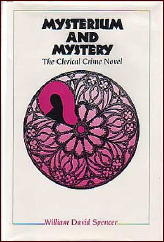
WILLIAM DAVID SPENCER – Mysterium and Mystery: The Clerical Crime Novel. UMI Research Press, hardcover, 1989, 344 pp., $49.95. Southern Illinois Press, softcover, 1992.

   Perhaps I should start with a disclaimer: my theology, such as it is — or, sadly more accurately, was — was gained from nuns at a parochial school. Now that I can look back on it with detachment, they were dear ladies but woefully inadequate in their understanding of religion. Any questions not covered in the catechism were met with “Never mind” or disappointed looks or mitigated horror.

   Thus, my understanding of Spencer’s chapter on “Modus Operandi: Mysterium into Mystery” is at best suspect, at worst completely befuddled. But I didn’t get the book so that I could learn theology; I got it to read about clerical detectives and their theology.

   Spencer says — and I have no disagreement with him — that the clerical crime novel may be divided into three classifications. The most general, he says, is any tale that involves the clergy and crime. This type of novel involves “saintly side-kicks” — “as in Jack Webb’s or Thurmin [sic] Warriner’s tales or in a lesser sense in Christopher Leach’s Blood Games or Dorothy Salisbury Davis’s Where the Dark Streets Go.”

   The second division is the novel in which a crime is committed by a cleric. Spencer provides several examples, though not the most unusual one, which I can’t name since to do so would be to give away whodunit.

   Finally, and the focus of this book, are the mysteries solved by the cleric. Part One of Spencer’s treatise is “Rabbis and Robbers,” dealing with two tales from the Apocrypha and with the novels of Harry Kemelman. Although Spencer lists Joseph Telushkin in his “Graph of the Clerical Crime Novel in English,” Rabbi David Winter is not dealt with in this study.

   Part Two is “Priests and Psychopaths,” the Roman Catholic clergy, both ordained and nonordained — in the latter case the various nuns and brothers.

   Part Three is “Ministers and Murders” — yes, as you may have gathered, Spencer does have a thing for alliteration, even when it can be somewhat misleading- representing the various Protestant clergy.

   How well does Spencer sum up the clergy characters and their theology? Quite well, I believe, in those cases in which I have read at least one of the books by an author. The only authors I haven’t read are Barbara Ninde Byfield, whom I hope to get around to shortly, and James L. Johnson, who wrote the Code Name Sebastian Series, a series, after reading Spencer’s descriptions of the novels, I feel I can skip without any loss. (Oh, all right, I merely started The Name of the Rose. Some people, I am informed, have read, enjoyed, and understood it, though I am dubious whether any one person did all three.)

   Keep in mind, of course, that Spencer is not rating the clergy characters as detectives or the novels as detective tales; he is dealing with the books as to how they reflect the characters’ theology or, in one case, the near absence of it.

   Errors? If you get as upset as I do over the misuse of “flaunt” for “flout,” you’d join me in considering that a mistake. Otherwise, except for his curious notion that Eco’s William of Baskerville chewed tobacco in fourteenth-century Europe, Spencer is, as far as I could tell, quite accurate in depicting plot and character.

   Oversights? The only clergy detective not dealt with that I know of is the Reverend Peter Eversleigh, sometimes called the Padre, featured in several of Richard Goyne’s novels. This Protestant clergyman detective seems to have been overlooked by all who have published lists of religious sleuths. Since in the one novel I have read in which the Padre appears there is nothing about theology, perhaps no great loss has been suffered from lack of knowledge about him. The Lipstick Clue (Paul, 1954) is, however, a rather decent novel of detection.

   Is Mysterium and Mysteries a fair value at $49.95? I paid that price, and I feel it was worth it. After all, there is a fair amount of information about clerical detectives as detectives but very little about their theology. Dedicated fans of the Divine Mystery, or Holy Terror, or the clerical crime novel, or whatever you want to call it, probably should own this study. Others should suggest that their public library acquire it.

— Reprinted from The MYSTERY FANcier, Vol. 12, No. 1, Winter 1990.


Reviewed by DAVID VINEYARD:         


WOMAN WANTED. MGM, 1935. Maureen O’Sullivan, Joel McCrea, Lewis Stone, Louis Calhern, Adrienne Ames, Edgar Kennedy, Robert Grieg Screenplay Leonard Fields, David Silverstein. Story by Wilson Collinson. Director: George B. Seitz.

   This one is a rapid paced comedy mystery with a much more attractive and accomplished cast than you might expect from this sort of light fare. It’s a good example of bright entertainment from the era enhanced by talent that far exceeds the material.

   Ann Grey (Maureen O’Sullivan) is a convicted criminal who finds herself freed when she escapes an accident in a car. As luck, and Hollywood screenplays, would have it the first person she runs into is Perry Mason-like fast-thinking and slick-defense attorney Tony Baxter (Joel McCrea).

   This being a movie, McCrea almost immediately decides Ann is innocent, and sets out to prove it with the help of his butler Peedy (Robert Grieg who played butlers as often as Arthur Treacher or Eric Blore), and as you might expect he has more problems than just the police: he also has to keep Ann hidden from his jealous finacee Betty (Adrienne Ames).

   Meanwhile the crooks led by Smiley (Louis Calhern), who actually did the murder Ann was convicted of, are waiting for her too, believing she knows where the $250,000 in war bonds the murder was committed for are hidden.

   This is Golden Age Hollywood and you don’t need much more than this to turn out a fast paced and entertaining little film. Woman Wanted is full of bright lines, O’Sullivan and McCrea are well matched, her innocence but underlying sensuality and his all American boy charm creating genuine chemistry on screen.

   Add to Tony’s other problems, his competitive old friend the District Attorney (Lewis Stone) suspects he has Ann and would like nothing better than to trim Tony’s sails for his habit of sailing blithely on the thin edge of the law.

   This one is in almost constant movement, and McCrea’s Tony Baxter actually proves to be as smart and quick on his feet as he is supposed to be. There are fewer really stupid acts by the hero than most film heroes display.

   Based on a story by Wilson Collinson (creator of Maisie), this little film delivers its full measure of entertainment painlessly and with a great deal of charm. McCrea and O’Sullivan are good as I said, Grieg has the priceless unshaken look of all great film butlers and valets (it seems every man in the thirties had his own butler or valet — you have to wonder why there was a depression and job shortage), and the scenes with Stone and McCrea have some of the feel of the best of Hamilton Burger and Perry Mason’s maneuvering.

   If you like bright comedy mysteries from this era, enjoy seeing stars like McCrea and O’Sullivan — attractive and young early in their career — or just want to kill an hour or so pleasantly this is the one for you.

This wouldn’t make anyone’s list of the ten best comedy mysteries of the period, but it would certainly make the list of those that were entertaining and accomplished every goal set for the form.

   This woman and this movie will be wanted by any lover of the comedy mystery form.

Reviewed by JONATHAN LEWIS:         


MALAYA. MGM, 1949. Spencer Tracy, James Stewart, Valentina Cortesa, Sydney Greenstreet, John Hodiak, Lionel Barrymore, Gilbert Roland, Roland Winters. Director: Richard Thorpe.

   Sometimes even a great cast can’t save a film bogged down with a lackluster storyline and undistinguished direction. That’s definitely the case with Malaya, an overall disappointing war movie about American smugglers working to get rubber out of Malaysia and into the hands of the Allied war effort.

   If you think I’m being too harsh, consider the all-star cast that’s bogged down by a mediocre script: Spencer Tracy, James Stewart, Sydney Greenstreet, and Lionel Barrymore. Plus there are some great character actors in this one. John Hodiak as a federal agent, DeForest Kelley as a U.S. Navy officer, Gilbert Roland as a smuggler, and Roland Winters as a German plantation owner living in Malaysia.

   And truth be told, Greenstreet really does steal the show in this one, making it worth watching for admirers of his work. In his final screen role, he portrays a character named The Dutchman, a scheming, world-weary saloon owner in Imperial Japanese-occupied Malaysia. There’s something both sad and charming about his character, a tired, obese man at war with his pet bird and, it would seem, with a life that has seemingly lost its purpose.

   But it’s not enough to make Malaya anything other than a run-of-the-mill late 1940s wartime film, one that just feels like a tired effort designed to be both patriotic and informative about a lesser-known chapter in the Second World War.

   James Stewart, of course, would soon get a new lease on celluloid life as a Western actor in Broken Arrow and in his collaborative efforts with Anthony Mann. Maybe that’s but one reason why this 1949 war melodrama isn’t very well known. But then again, there’s just no outstanding reason why it should be.

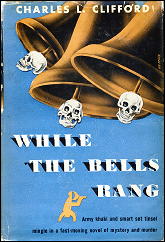
CHARLES L. CLIFFORD – While the Bells Rang. Doubleday Crime Club, hardcover, 1941. [Also published in novella form in The American Magazine, March 1941.]

   Except for one borderline item, according to Hubin, this book constitutes the extent of Clifford’s contribution to novel-length crime fiction. (According to the dust jacket, he was well known for his short stories, but if any of them were detective stories, I’m embarrassed to say I don’t know.)

   When the story begins, a great deal has already happened. A well-known columnist has been murdered on a polo-player’s ranch, and an army captain from the base adjoining has already been tried and convicted. Convinced of his innocence, however, his fiancee and his closest army buddy decide to become partners and do a little bit of undercover detective work to prove it.

   The delivery is fast and slangy — the combined effect, I imagine, of the army post background plus the presence of the fast-paced horsey set next door — while at times a little too much is left unsaid, making the whole affair seem to be taking place in another time and another place altogether. Through the faulty focus of this self-contained time-machine, it’s no great wonder the pieces of the puzzle seem continually blurred and fractionally out of place.

   And yet, before it was all over, the characters had started to show definite signs of life, and some of their romantic entanglements had begun to seem important to me as well as to them.

   If Clifford had been able to give his amateur sleuths a little more direction, if he had gathered his own material a little more tightly together, if he’d forced the plot to ramble a little less, I’m convinced he’d have had a winner.

   That’s a lot of “ifs,” I grant you. I was left in a good mood when it was over, though, and I really think he came closer than I thought for a while he was going to.

Rating:   B minus.

— Reprinted from The MYSTERY FANcier, Vol. 5, No. 3, May/June 1981.

[UPDATE] 11-10-14.   I don’t remember this one at all, not even with the review itself to jog my memory. I have it to admit it. It’s time to start over.

   One other thing. In the comments that followed David Vineyard’s recent review of a novel by Charles Williams, there was a short discussion of pairs of authors with the same name. Here’s another one for you. The real name of Robert Ames, who wrote three paperback originals for Gold Medal in the 50s, was Charles Clifford. You could look it up.

REVIEWED BY DAN STUMPF:         


RICHARD GLENDINNING – Terror in the Sun. Gold Medal #237, paperback original, 1952.

   From the back cover:

         She swept through that swamp town like original sin.

         Johnny Clayton looked at her and kissed his life good-by.

         Because of her, he suffered jail for a crime he didn’t commit.

         Because of her, he risked his life in a battle with incredible evil.

         And she cursed him for it.

   Well, I’ve had relationships like that, so I picked up Richard Glendenning’s Terror in the Sun with some interest and anticipation. And found it enjoyably routine. All the Gold Medal staples are here: working-class hero, willing women, corrupt cops, noble Indians, tough feds and loathsome furinners.

   They all strut and fret their appointed hour on the page, full of spit and vinegar, signifying a pleasant and forgettable read.

Reviewed by JONATHAN LEWIS:         


CARSON CITY. Warner Brothers, 1952. Randolph Scott, Lucille Norman, Raymond Massey, Richard Webb, James Millican, Larry Keating, George Cleveland, Don Beddoe. Director: André De Toth.

   Carson City is a good, albeit not great, Western starring Randolph Scott. Directed by Andre de Toth, whose The Stranger Wore a Gun I reviewed here, the film benefits from a solid, if standard, plot and the presence of a sinister-looking Raymond Massey as the main villain.

   Unfortunately, there just isn’t all that much in the way of outstanding cinematography or in-depth character development. That, and the fact that at times it feels as if Scott is merely going through the motions, makes Carson City less entertaining than it might have been.

   That said, the plot is easy enough to follow. Scott portrays Jeff Kincaid, an adventurer and an engineer who is tasked with building a railroad between Carson City and Virginia City, both in Nevada.

   Unfortunately, the good townsfolk of Carson City are divided on the wisdom of constructing a rail line through their small city. Local newspaper owner, Zeke Mitchell (Don Beddoe) is strongly opposed. His daughter, Susan (Lucille Norman) seems more ambivalent. Susan also figures in some family drama: Kincaid’s half-brother, Alan (Richard Webb), has romantic feelings for her, feelings that aren’t reciprocated.

   But as it turns out the real drama in this movie isn’t so much about the railroad. It’s about bandits, particularly a group called the Champagne Bandits, so named for their propensity to serve their victims bubbly. Leading these gourmand outlaws is no other than the character portrayed by Raymond Massey, Jack Davis. It’s really Massey, more than Scott, who makes this film worth watching. Massey, who like Scott served during the First World War (some historical trivia), is quite good in this film. One only wishes that the final showdown between Scott and Massey’s characters wasn’t so brief.

   While Carson City isn’t nearly among the best Western movies from the 1950s, it’s not the worst either. It’s just somewhere in the vast middle or maybe just slightly better than average.

DAY KEENE – Flight by Night. Ace Double D-170, paperback original, 1956. Published back-to-back with Black Fire, by Lawrence Goldman, reviewed here.

   This one starts out like gangbusters, more or less, but maybe you’ve heard this one before. A semi-seedy bush pilot specializing in taking bits of cargo here and there in short hops in and around Central and South America finds himself in prison and ready for execution — by firing squad — on the next day following, after the story begins.

   But it seems that there is a tradition that is common in Latin American countries. Besides a visit from a local priest, there is a time set aside once a week for all prisoners to welcome female guests, who are allowed to spend an unobserved hour alone with the ones they love. Such a guest is the young and beautiful Conchita, a girl that Jim Bishop does not know and in fact has never seen before.

   While unbuttoning her blouse, in case someone is really watching, Bishop learns that a plan is in motion, a costly one, to get him free. Why, and for what purpose, he does not know, but he is of course naturally willing to learn more.

   There is a group of former citizens from Argentina, it seems, who have left behind a fortune in gold after the fall of Juan Perón, and who have chosen Bishop to help them get it back again.

   Not all is what it seems, of course, as the plot unfolds, but it is disappointing to learn there are no really big twists along the way. Jim Bishop, on the run from a busted marriage, certainly finds romance again, as well as plenty of adventure in the pages that follow, but this relatively uninspired effort reads to me as a reject from Gold Medal, the publisher that in the 1950s Day Keene probably sent his better work to first.

Reviewed by DAVID VINEYARD:         


CHARLES WILLIAMS – Shadows of Ecstasy. Victor Gollancz, UK, hardcover, 1933. Pelligrini & Cudahy, US, hardcover, 1950. Reprinted several times in both hardcover and paperback. Available online at Project Gutenberg Australia.

   There once was a small gathering of friends, sometimes two, sometimes three, at a public house in Oxford. The three men called themselves The Inklings because they were all writers. Two of them were Oxford dons at one of the colleges that compose that ancient institution: a Catholic scholar in ancient tongues and elder sagas who would pen one of the great children’s books of the 20th Century and go on to create a literary phenomena, a trilogy that would become one of the cultural icons of the 1960’s and remain one of the world’s most read and loved volumes.

   The other don was no less successful; his conversion to Christianity would make him one of the most famous Christian apologists of his era, and he would pen a trilogy of science fiction novels that helped, along with writers like Kingsley Amis and Aldous Huxley, to drag that genre kicking and screaming out of the pulps into the literary light. His tragic late marriage would become one of the great love stories and inspire one of the key works on grief, and a series of children’s allegorical tales about a place called Narnia would become among the best loved stories in the world.

   Those names you know well, J. R. R. Tolkien and C. S. Lewis, yet the third member is not so well known today despite the fact that at that time he was far and away the most famous member of that group: poet, playwright, lecturer, radio personality, leading Christian apologist, and bestselling novelist, Charles Williams.

   Williams was the brightest star of the Inklings. He and Tolkien quietly clashed and were held together by Lewis. Tolkien, a Catholic did not agree with Williams’ Anglican views of faith, and probably resented his hold on Lewis, himself a late convert to the Church of England. Nor was Williams a particularly donnish or quiet sort. To the contrary it is difficult to imagine him in that sedate literary trio.

   No one reads Williams’ poetry much today and his plays go unproduced, but his novels are kept in print, and while not as famous or widely read as those of his fellow Inklings, they have not suffered complete obscurity. But they lack the timeless setting of Lewis’s Perelandra and Narnia and of Tolkien’s Middle Earth. Instead they are allegorical thrillers, a sometimes confusing mix of those two great friends P. G. Wodehouse and Sax Rohmer (they were clerks at the same bank in Egypt and remained life long friends and literary supporters) though his writing style is closer to the Huxley of the thirties or early Durrell.

   Christian thrillers are in vogue today, but don’t confuse them with Williams. These poorly written examples of bad pulp, intolerance, and simple-minded theology are no kin to Williams witty, deep novels of soaring imagination, vision, and ageless questions.

   The best of his works is All Hallows Eve, a novel about two people suspended between life and death in shadowy ghost of London unseen by the living around them. Here though we are concerned with one of the thrillers, Shadows Of Ecstasy, which spins a threat that would daunt James Bond, and a villain —- well, is he a villain? — you’ll have to decide for yourself: is he the Antichrist as vicar Ian Caithness holds, a hypnotic power mad genius as agnostic Sir Bernard Travers suspects (Travers and Caithness are best friends — the vicar can’t stand other people’s dogma and Travers has none), or is poet Roger Ingram right, is Nigel Considine’s blinding star to be followed at whatever cost?

    “I have wondered whether there may not be colleges and faculties of other experiences than yours, and whether even now in the far corners of other continents powers not yours are being brought to fruition.”

   Three main plot-lines tie these people and events together: in London a wealthy Jewish collector of rare gems has committed suicide shortly after a visit from Considine and left his collection, including the holy Jewels of Messia, to two relatives who plan to transport part of the collection to the temple in Jerusalem where it belongs; in Africa there are uprisings and unrest, the colonial forces are in retreat, and someone calling himself the High Executive proclaims the day of the European way is ended and a great force is rising from the past to conquer the world with love, but not without bloodshed and the threat of invasion from the great black masses,” the great age of intellect is done.”

   Meanwhile Roger, Travers, and Caithness have befriended a young black man, Inkamasi, they saved from an ugly English mob only to find he is the charming and well educated traditional king of the Zulu nation, descendent of Shaka, and exiled like the hero of Haggard’s King Solomon’s Mines. He is also key to Nigel Considine’s plans, a king must die.

   â€œ … the Second Evolution of man has begun.”

   And in London the black people are rising, the secret army of the High Executive, “ Daughters and Sons of Africa, you are called to the everlasting sacrifice.” Soon bombs fall from above, or so the populace believes, and the streets are filled with angry mobs attacking innocent blacks, Jews, and Indians. Williams is no racist; even if his views are dated, there are few demeaning stereotypes. Far and away his greatest wrath is aimed at the English mobs destroying their own city, unknowingly doing the High Executive’s bidding, he isn’t too keen on the government either.

   Is Considine the High Executive? When Travers finds a family photo of Considine taken with his grandfather by Travers as a child in 1883 he realizes Considine would have to be over a hundred years old, and Inkamasi knows him from earliest childhood as the Deathless One.

   Rounding out the cast are the male and female ingenues: Travers’ son Philip, a soldier on leave, and his fiance Rosamund, a beautiful and rather shallow young woman whom Travers has little use for, and who has the thankless job of representing the prejudice and blindness of the average upper middle class Englishwoman or man; two of Considine’s disciples. the Devotees: Nielson, the German who is ready to die and rise again, the final step in achieving the highest order of immortality, and Mottreaux, the Frenchman and Considine’s right hand man.

   Finally there is Roger’s wife Isobel, beautiful, wise, loving, and far and away the sanest person in the book. Even in Considine’s opinion, she is Roger’s anchor to sanity as the world spins into madness, and if you are wondering just who the hero of this book is, the character closest to truth let me point out again Roger is a poet with a rather sardonic tongue, just like the author: “I think you dare encounter darkness.” Considine tells him.

   Granted this is complex and confusing, and Williams, while highly literate and capable of spinning lyrical sentences and witty rapport is not an easy writer, especially for readers used to today’s choppy one-sentence paragraphs. Williams never saw a complex sentence or long paragraph he didn’t like and the book seems longer than it actually is because you have to think while you read.

   Don’t be fooled though, this is compelling page-turning reading, your imagination and intellect kept reeling and your faith or lack of it challenged. This isn’t Narnia, though I suspect Williams’ The Place of the Lion inspired Lewis Aslan.

   I used a key word earlier in relation to Considine, “disciples,” because it soon becomes clear what the allegory is here, and Williams never clearly establishes if Considine reaches too far or fails because of hubris, but the point of the allegory is made pretty clearly when Considine fails to raise Nielson from the dead and is struck down by the bullet of a greedy traitor, who covets the Jewels of Messia, at his moment of triumph:

   That this dreamer, this master of vision should have been destroyed by — by a traitor and a clergyman. He (Roger) walked back abruptly and said: “I hope you paid him better than Caiaphas did? Even at half-crowns it would only come to three pounds fifteen.”

   Who is Considine, a secular second savior, a super criminal worthy of and far more nuanced than Fu Manchu, the Antichrist, or something of all three? At several points Milton and Paradise Lost are invoked but no one quite makes the connection. In the end there are no easy answers, and this thriller bears on its shoulders a greater weight than mere conspiracy and world conquests. Roger and the reader are left wondering, pondering.

   If he returned. If he carried out the experiment of his vision, the purpose of his labours. If, first among his peers, when all believed him lost, he thrust himself from the place of shades back into immortal and transmuted life, if he held death at his disposal, if he knew how the vivid ecstasy of experience dominated all shapes and forms, all accidents of time and place… if now he came once more to threaten and deliver it. If — ah beyond, beyond belief! — but if he returned…
« Previous PageNext Page »