Reviews


FIRST YOU READ, THEN YOU WRITE
by Francis M. Nevins


   Having eaten up much of the past few weeks paginating the index for JUDGES & JUSTICE & LAWYERS & LAW, I must again rely on my dusty old files to provide raw material for this month’s column.

   Lucky for me that my files are full of the stuff. In my salad days, beginning more than half a century ago, I got into the habit of writing for-my-eyes-only reviews not only of the full-length whodunits I read but also of the shorter works variously called short novels, novelettes, novellas and novellos, the last term coined by my beloved Harry Stephen Keeler, who probably pronounced the word with the accent on the first syllable.

   From the hundred-odd paragraphs of comment on tales of this length that are moldering in my files I’ll exhume a few that strike me as not too uninteresting today.
***

MIKE NEVINS Reviews

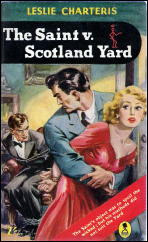
   Of all the characters who appeared frequently in novellos during the Golden Age, the two who stand tallest are Nero Wolfe and Simon Templar. Among the pile of tales of this length which the young Leslie Charteris (1907-1993) wrote about his Saintly hero, one of my favorites is “The Inland Revenue” (The Thriller, 25 April 1931, as “The Masked Menace”; collected under its better-known title in THE HOLY TERROR, Hodder & Stoughton 1932, and THE SAINT VS. SCOTLAND YARD, Doubleday Crime Club 1932), in which we follow Simon as he tries to raise enough money to pay his income tax by extorting it from a sinister mastermind calling himself the Scorpion.

   It’s a preposterously tongue-in-cheek saga with an astoundingly unfair surprise ending, but Charteris carries it off with the help of the satiric wit and brashness that were his trademarks.
***

MIKE NEVINS Reviews

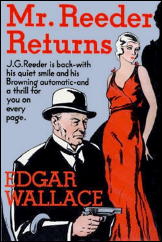
   When Charteris launched his career, by far the most popular English mystery writer was Edgar Wallace (1875-1932), who produced novels, novellos and short stories faster than a rabbit can produce baby rabbits. One of the most rousing and richly plotted of his tales at the length we’re investigating today was “The Man from Sing Sing” (The Thriller, 7 February 1931; collected in THE GUV’NOR AND OTHER STORIES, Collins 1932, U.S. title MR. REEDER RETURNS, Doubleday Crime Club 1932).

   The parlormaid of Mr. J.G. Reeder, perhaps Wallace’s best known series detective, leads her boss into a bizarre case involving a lost false mustache, a spectacular embezzlement, a murdered Eton lecturer and a fortune found in a haystack. Our sleuth connects these and other items with reasoning that runs the gamut from sketchy to non-existent, but Wallace scores with his dry wit, tantalizing plot, swift economy of movement, and loving depiction of English working-class mores.
***

MIKE NEVINS Reviews

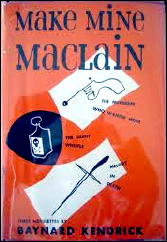
   Baynard Kendrick (1894-1977) created more than one series sleuth but his signature character was the blind detective Captain Duncan Maclain. The captain debuted in 1937 and usually appeared in novels, but during the WWII years he also turned up in three novellos, collected after the war as MAKE MINE MACLAIN (Morrow, 1947).

I don’t have a copy of that book but I do own each of its component parts, and reread one of them recently to see if my opinion of it had changed since 1968. It hadn’t.

In “The Murderer Who Wanted More” (American Magazine, January 1944) one of the potential legatees of a Staten Island matriarch’s estate is shot to death during a fierce snowstorm while traveling on the post-midnight local train from the St. George ferry terminal to the end of the line at Tottenville to visit his dying mother. Both before and after that murder come several attempts on the life of another potential legatee, a lovely young artist who had recently painted Maclain’s dogs.

   The captain’s key deduction is unconvincing and the motive Kendrick attributes to the killer shows that he didn’t know the first thing about the law of wills, but the Staten Island setting is unusual and vivid enough.
***

MIKE NEVINS Reviews

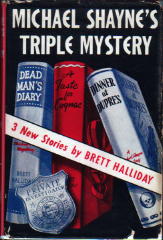
   The earliest collections of Rex Stout’s Nero Wolfe novellos appeared in 1942 and 1944 but contained only two tales apiece. Most of Wolfe’s cases at that length appeared three to a book, but only after threesomes had been published featuring other sleuths including Duncan Maclain, as we’ve just seen, and Michael Shayne, the Miami-based PI created by Brett Halliday (1904-1977).

   Fast, complex and professional are the words for “Dinner at Dupre’s” (Mystery Book Magazine, September 1946; collected in MICHAEL SHAYNE’S TRIPLE MYSTERY, Ziff-Davis 1948), in which Mike’s search for the murderer of a prospective client leads him to the hamlet of Cheepwee, Louisiana and a temptingly described Southern dinner with a nymphomaniac who has a new angle on the bigamy racket.

   Brisk pace, shrewd plotting, an honest if not startling solution, and minimal self-conscious toughness prompted me a few generations ago to give this one very high marks.
***

MIKE NEVINS Reviews

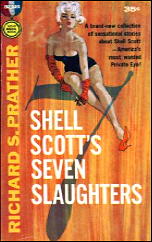
   Now we tackle a work actually written not too long before I began to set down some of these scribbles. Richard S. Prather (1921-2007) didn’t turn out a slew of novellos about his quintessentially cool PI Shell Scott, but the few he did were among the joys of my late teens.

   Take for instance “Babes, Bodies and Bullets” (Cavalier, April 1958; collected in SHELL SCOTT’S SEVEN SLAUGHTERS, Fawcett Gold Medal pb #S1072, 1961). Hired to solve a Beverly Hills attorney’s murder, which he witnessed, Scott runs into a gaggle of gruesome gangsters, an assortment of luscious wenches and a mounting heap of corpses.

   The plot is sorta thin, but Prather’s feel for action and tempo and his wild-and-woolly prose, plus a sequence of gruesome horseplay in an underworld hospital, lift this novello to the top of the heap.
***

MIKE NEVINS Reviews

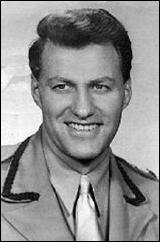
   May I stray from the month’s topic for a moment? The last living actor to portray Ellery Queen in any national medium died on March 12, a few weeks short of his 100th birthday. Richard Coogan was best known for TV work — starring in the early live sci-fi series CAPTAIN VIDEO, having a long-running role in the daytime soap LOVE OF LIFE, playing Marshal Matt Wayne on the Western series THE CALIFORNIANS — but he began his career in radio and portrayed Ellery during late 1946 and early ‘47.

   Anthony Boucher, who at that time was collaborating on the weekly scripts with EQ co-creator Manfred B. Lee, described Coogan’s performance in a letter to Lee (25 October 1946) as “not quite so smug” as his predecessor’s. Coogan’s main interest in his twilight years was golf. He was in his mid-nineties when I talked with him over the phone in connection with my book ELLERY QUEEN: THE ART OF DETECTION, but he struck me as in amazingly good health, and anyone who checks out his reminiscences of CAPTAIN VIDEO on YouTube, which date from roughly the same time, will surely get the same impression. May we all live so long and well.
IT IS PURELY MY OPINION
Reviews by L. J. Roberts


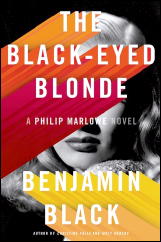
BENJAMIN BLACK [John Banville] – The Black-Eyed Blonde. Henry Holt & Co, hardcover, March 2014. Picador, softcover, February 2015. Series character: Raymond Chandler’s Philip Marlowe. Setting: California City (basically Los Angeles), 1950s.

BENJAMIN BLACK The Black-Eyed Blonde

First Sentence:   It was one of those Tuesday afternoons in summer when you wonder if the earth has stopped revolving.

   PI Philip Marlowe is hired by the lovely and, apparently, wealthy Claire Cavendish to locate her former lover. Marlowe quickly learns the man was killed in a hit-and-run; news it seems Mrs. Cavandish already knew. Yet she claims to have seen him alive in San Francisco. Marlowe runs into one unexpected event after another in his search to find out what is really going on.

   At the very beginning, the author’s voice makes you smile. Black does try to capture the feel of the Golden Age authors but it just never quite rings true. There are cracks in the veneer. Although Black uses terms that are not politically correct for today, they also weren’t accurate for the period. There were small details that were off — straight skirts weren’t called “pencil” skirts in the 50s.

   Some of the descriptions in the beginning weren’t bad… “That smile: it was like something she had set a match to a long time ago and then left to smolder on by itself…” but they soon disappeared. It was also painfully clear that this was not written by an American, and certainly not someone who lived and breathed the area as Chandler had done.

   Black does capture a bit of Chandler’s dry, ironic voice… ““Someone like who?” He seemed to wince; it was probably my grammar.”

   The plot’s not bad and there were good surprises, good lines… “The world, when you come down to it, is a scary place…”, but the further one reads, the more it turns from gold, to gold gilt, to brass, to lead, and becomes almost uncomfortable to read.

   The Black-Eyed Blonde might be a decent read for those who’ve not read the classics. However, to those who have, it really doesn’t hold together. Once again, I find myself believing that when an author dies, should their character.

Rating:   Poor.

Reviewed by JONATHAN LEWIS:         


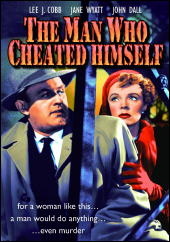
THE MAN WHO CHEATED HIMSELF

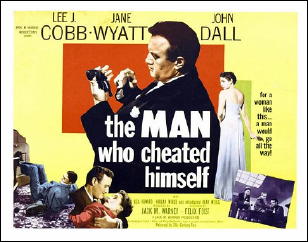
THE MAN WHO CHEATED HIMSELF. 20th Century Fox, 1950. Lee J. Cobb, Jane Wyatt, John Dall, Lisa Howard. Screenplay: Seton I. Miller & Philip MacDonald. Director: Felix E. Feist.

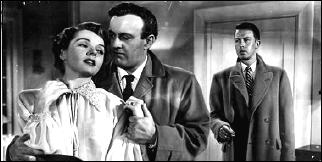
   The Man Who Cheated Himself is a 1950 film noir set in San Francisco. Directed by Felix E. Feist, the movie reunites Lee J. Cobb and Jane Wyatt, who starred together in Elia Kazan’s Boomerang (1947).

   Lt. Ed Cullen (Cobb) and his younger brother, Andy (John Dall) are cops working homicide. Ed’s been around the block for a while; he’s tough, cynical, and a committed bachelor. Andy’s new to the homicide division. The kid’s got good looks, ambition, and an inquisitive mind. He’s a Boy Scout, hardworking and perhaps a bit too pure of heart for the job. And unlike his brother who’s a notorious skirt chaser, the younger Cullen is eager to settle down with his lovely new bride.

   Andy Cullen’s first homicide case gets underway after witnesses spot a car pulling out of the airport, leaving a bullet riddled body in its wake. As it turns out, the man who was killed turns out to be the estranged husband of the woman with whom Ed Cullen is carrying on an illicit affair. Complicating matters for the enterprising young detective is that he and Ed are pretty close, both figuratively and literally. Not only do the two share an office, they also live in the same apartment.

   The movie itself begins with Howard Frazer (portrayed by Harlan Warde) sitting at his desk with a newly acquired gun. Although he’s able to hide the gun before his estranged wife, Lois Frazer (Wyatt), enters the room, Frazer accidentally lets the sales slip fall to the ground. They argue. He leaves for the airport, headed to Seattle for something to do with salmon fishing.

THE MAN WHO CHEATED HIMSELF

   After Howard Frazer leaves the house, Lois finds both the sales slip and the gun. She’s beside herself, petrified that her husband is plotting to murder her. Fortunately for her, she’s got a direct link to the police in her paramour, Lt. Ed Cullen (Cobb), who heads over to the house and tells her to calm down. That’s then things begin to go awry for Cullen, transforming the cynical cop into a corrupt one.

   Soon, Howard Frazer comes back into the house, apparently looking for his gun. It’s not exactly clear whether he came back to rob the house or to murder Lois. But in the end, it doesn’t matter. Lois has his gun and she uses it to plug her husband in the chest a couple of times, killing him. At that moment, would-be divorcee’s action hysteria prompts Lt. Ed Cullen to dispose of both the body and the gun. The thing is, he really doesn’t need much convincing.

THE MAN WHO CHEATED HIMSELF

   As one might suspect, Cullen’s plan to get rid of Howard Frazer’s body doesn’t work out quite as planned. His car is spotted leaving the airport where he dumps the body, and his attempt to throw the murder weapon off the Golden Gate Bridge into the water doesn’t work out exactly as planned, either. Making matters even worse for him is his brother who’s eager to solve the crime no matter where it leads him. Andy Cullen even postpones his honeymoon to work on the Frazer murder case.

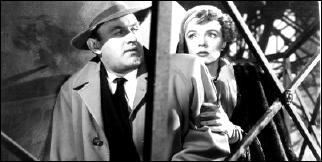
   The film’s penultimate scene features a cat-and-mouse chase between the two brothers in Fort Point, an American Civil War-era structure set underneath the Golden Gate Bridge. There’s one particularly visually stunning scene in which Andy Cullen walks through a long hallway with flanked with many open doorways. Alfred Hitchcock would go on to make ample use of Fort Point in Vertigo (1958).

THE MAN WHO CHEATED HIMSELF

   During the final scene, if not before, one begins to suspect that Lois’s hysteria was just a big act. The question of whether she was using Ed all along in a plot to get rid of her husband remains unanswered, leaving viewers to make up their own minds. Viewers likewise will have to decide for themselves whether Wyatt was a good fit for the role of Lois Frazer, who seems to be capable of only two emotional states: complete hysteria or complete control.

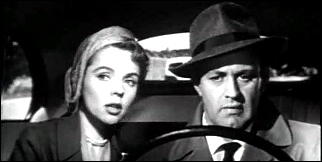
   The plot of The Man Who Cheated Himself is not particularly unique, at least within the detective or film noir genres. It’s Cobb’s acting that makes the film worth viewing. Look, in particular, for the scene in which Cullen, after dumping Frazer’s body, is driving across the bridge. Cobb’s facial expression at that moment epitomizes his all his hard-boiled character’s doubts and fears. He’s crossed several lines, and boy, does he know it.

   Given Cobb’s acting and the appealing San Francisco setting, it’s unfortunate that a remastered copy of this film isn’t available. Neither the audio and visual quality of the DVD I watched (from Alpha Video) is very good, with moments in which the sound is garbled, making it somewhat difficult to catch all of the dialogue. I also didn’t find the soundtrack to be all that memorable. That said, The Man Who Cheated Himself is a solid film noir well worth watching at least once.

THE MAN WHO CHEATED HIMSELF

REVIEWED BY DAN STUMPF:         


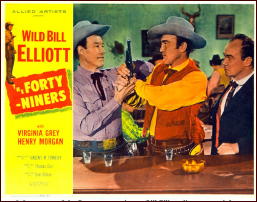
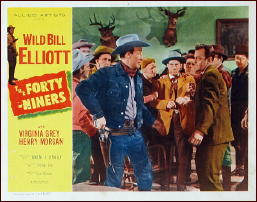
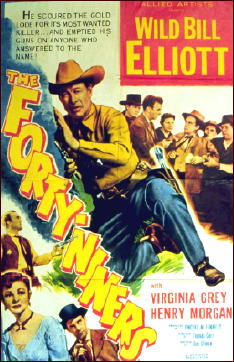
THE FORTY-NINERS

THE FORTY-NINERS. Allied Artists / formerly Monogram, 1954. “Wild Bill” Elliott, Virginia Grey, Harry Morgan, John Doucette, Lane Bradford. Written by Daniel B. Ullman. Directed by Thomas Carr.

   But first a word about Wild Bill Elliott, born Gordon Nance, who started out his career at Columbia under the name Gordon Elliott as an all-purpose and mostly uncredited supporting player until he landed the lead in the 1938 serial The Great Adventures of Wild Bill Hickok, which led to a series of low-budget westerns at Columbia, billed as Wild Bill Elliott and sometimes playing Hickok in adventures that, as you might expect, had little to do with the actual James Butler Hickok.

   Many of these were a cut above average, and a few, directed by Joseph H. Lewis, even artistic at times, but in ’43 he left Columbia for Republic. There the budgets were bigger and the films generally more fun, but it was still a loss in prestige to go from the smallest of the Major studios to the biggest of the Minors, which was Republic’s place in Hollywood’s caste system.

THE FORTY-NINERS

   Republic even tried to lift Elliott out of the “B” ranks for a time, upping his budgets, offering more “adult” story lines and dropping the “Wild” from his billing, but eventually he returned to “B” status. His last film at Republic, The Showdown, was shot entirely on studio sets with back projection, reflecting Republic’s growing disinterest in the budget prairie film in general.

   At which point Elliott moved to Monogram, which was definitely a step down, but surprisingly his films here got even more interesting — not better made, but with distinctly off-beat characterizations and story lines.

Elliott himself, billed once again as “Wild Bill Elliott” smoked and drank, cussed now and then, and wasn’t above dealing out nastiness when called for. He even played an occasional outlaw, though reformed by film’s end, and in one movie he beats information out of a bad guy while holding him at gunpoint—hardly sporting, that, and unheard of in the better class of B westerns.

THE FORTY-NINERS

   In 1955 even Monogram tired of the low-budget western and moved Elliott into a series of detective stories, but Elliott had ended his sagebrush career with a flourish of sorts, as borne out in The Forty-Niners.

   This starts out with Dragnet-style voice-over narration, and when I say “Dragnet-style” I mean you can practically hear Jack Webb’s flat monotone in Wild Bill Elliott’s voice. Her gives dates and times, tosses in cop-comments like “It was a routine assignment” and even synopsises the outcomes in Court.

   The wonder is that writer Daniel Ullman (who made kind of a specialty out of detective/westerns) still wrought a perfectly fine western out of all this.

   Wild Bill plays a U.S. Marshall cold on the trail of the owlhoots who ambushed a fellow-lawman. His only lead is a gambler (played by Harry Morgan, who also featured in Elliott’s last Republic picture) who can lead him to the baddies as long as he doesn’t realize that’s what he’s doing. Morgan plays the kind of good/bad guy later personified by the likes of Arthur Kennedy, and he does it pretty well, grinning and joking as he cheats at cards and blackmails killers who are now comfortably ensconced as respectable citizens.

   His only weakness is a soft heart for the gal he left behind and an aversion to cold-blooded murder when that becomes necessary to eliminate Elliott, whom he’s come to respect and admire. It’s an interesting part in a movie that moves along at a brisk clip, with plenty of action and enough curves in the plot to keep you guessing, even as you realize the pre-ordained outcome dictated by the genre, and reflecting that as Wild Bill took his last ride into the sunset, he did it with a certain amount of style and the quiet dignity that becomes a western hero — even a cut-rate hero ending his days in the B-movies.

THE FORTY-NINERS

IT IS PURELY MY OPINION
Reviews by L. J. Roberts


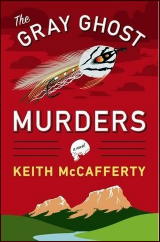
KEITH McCAFFERTY – The Gray Ghost Murders. Viking, hardcover, February 2013. Penguin, trade paperback, December 2013. PI Novel: Sean Stranahan; 2nd in series. Setting: Contemporary Montana.

KEITH McCAFFERTY The Gray Ghost Murders

First Sentence: The hands shook as the watcher adjusted the focus ring of the binoculars.

   Katie Sparrow’s search and rescue dog doesn’t find a reported lost hiker. Instead, they find a buried body which, when uncovered, was a murder victim. And then they find another.

   Fly-fishing guide, painter and PI Sean Stranahan is hired to find a lost tackle box. The box is also an entry to his being introduced to the members of the Madison River Liars and Fly Tiers Club; a group of men who bought a cabin along the river. It is they who really want to hire Stranahan to find two valuable fishing flies which have been stolen from their cabin. The trail turns very dark as Sean is asked to help the police with the murders while still searching for the flies.

   From the beginning, the author’s love of fly fishing is very apparent. Even if fishing and hunting, are not your style, don’t let that stop you from reading this book for it is the characters that carry the story.

   Stranahan may be described as extremely good looking, but that really doesn’t much play into the character. Yes, women are attracted to him, but he is anything but a womanizer, and how refreshing is that. Not only that, there is no profanity in the book; another nice change.

   And although he knows how to use a gun, he doesn’t own one. If anything, it is Sherriff Martha Ettinger who comes across as the tougher character, except where her love life is concerned. Then, she is classically vulnerable.

   Katie, the dog handler, facilitates moments of humor… “Godfrey, a schoolteacher with a scratch to itch and lay south of his belt buckle and a history of women cutting his fact out of photographs….” What’s nice is that are the characters are clearly drawn and distinct.

   McCafferty provides excellent descriptions which help the reader understand the love of fly fishers and give a desire for traveling to Montana… “Above him was one of those summer skies that people who live in the East can’t believe are real, the light over the Gravelly Range lavender bleeding to pink, the clouds rimmed with golden light from the setting sun and the river a study in pointillism, as wavelets bounced colors back and forth…”

   The plot is interesting and compelling. There are layers and twists enough to keep you going. There is a classic short story, “The Most Dangerous Game,” referenced which, if the reader is familiar with the story, gives a hint of the story’s path, but one isn’t certain quite how it’s going to play in. There are characters one suspects, but enough uncertainty to keep one guessing.

   The Gray Ghost Murders is a very good read. It kept me involved from first page to last.

Rating: Very Good.

      The Sean Stranahan series —

1. The Royal Wulff Murders (2012)
2. The Gray Ghost Murders (2013)
3. Dead Man’s Fancy (2014)

Reviewed by JONATHAN LEWIS:         


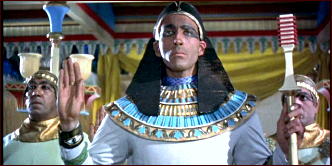
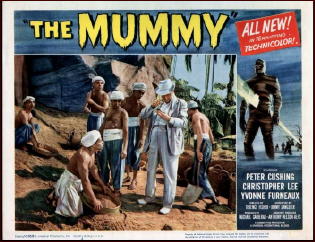
THE MUMMY. Hammer Films, UK, 1959. Peter Cushing, Christopher Lee, Yvonne Furneaux, Eddie Byrne, Felix Aylmer, Michael Ripper. Screenplay: Jimmy Sangster. Director: Terence Fisher.

THE MUMMY Christopher Lee

   Over the past fifteen years or so, film and television writers have embraced both fanged vampires and, to a lesser extent, furry werewolves. With the exception of The Mummy (1999) and the franchise it launched, mummies, those aristocrats ensconced in linen and raised from the dead, have not played prominent roles as villains. This is unfortunate.

   Not only are mummy tales, when critically unwrapped and analyzed, as terrifying as vampire yarns. They also provide a fascinating insight into how Anglo-American filmmakers have understood their particular era’s relationship to the ancient Egyptian past. From Napoleon Bonaparte’s first campaign in Egypt (1798) and British Museum’s Rosetta Stone exhibit (1802-present) to the discovery of Tutankhamun’s tomb (1922), the mysteries of long-vanished Egyptian civilizations have piqued the curiosity of western observers.

   Mummy films are the cinematic representations of this strange, enduring fascination. The two best-known mummy films are undoubtedly Universal’s The Mummy (1932) starring Boris Karloff and the aforementioned 1999 quasi-remake starring Brendan Fraser and Rachel Weisz.

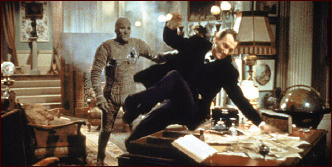
   But there’s also a 1959 mummy film that deserves ample consideration. The Mummy, starring Peter Cushing, Christopher Lee, and Yvonne Furneaux, is perhaps the least known of the three films of the same name. To varying degrees, the plot is borrowed from three previous, even lesser known, mummy movies, The Mummy’s Hand (1940), The Mummy’s Tomb (1942), and The Mummy’s Ghost (1944). Directed by Terence Fisher, The Mummy (1959) is a Technicolor Hammer Production with great horror film acting, lavish and colorful settings, and an excellent, memorable score composed by Franz Reizenstein.

THE MUMMY Christopher Lee

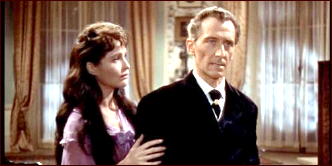
   The film begins with an archaeological dig in Egypt. It’s 1895 and three members of the same family discover the tomb of Princess Ananka, the high priestess of the ancient Egyptian deity, Karnak. Because John Banning (Peter Cushing) is injured and somewhat immobile, the English archeologist’s father, Stephen Banning (portrayed by Felix Aylmer), is tasked, along with his uncle Joseph Whemple (Raymond Huntley), with entering the tomb.

   Along comes Mehemet Bay in a red fez (portrayed by the Cypriot character actor George Pastell). He warns the two men against disturbing the dead, lest they unleash a curse against desecrators. As you might imagine, the enterprising Englishmen don’t heed the warnings of this excitable foreign fellow.

   Skip to three years later. It’s 1898 and Stephen Banning is back in England. Sadly, the poor chap’s gone completely mad. His son, the scholarly John Banning, is now ambulatory and living with his wife (Yvonne Furneaux). Life is apparently pretty good for the younger Banning, who appears to be living a plush life on an English country estate.

THE MUMMY Christopher Lee

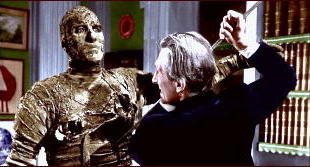
   But good things never seem to last for those who disobey warnings not to disturb the dead. We know that there’s trouble ahead when Mehemet Bay arrives in England on a quest to avenge the opening of Princess Annaka’s tomb. After Stephen Banning is found dead in his room (murdered by the mummy Kharis), a police inspector by the name of Mulrooney begins to investigate the mysterious goings on.

   Through extensive flashback scenes narrated by Peter Banning (Cushing in a quite memorable voice-over role within the film), we learn that Kharis (Lee) was the high priest of Karnak. Centuries ago, Egyptian authorities mummified Kharis and buried him alive as punishment for his attempt to bring Princess Annaka (also portrayed by Yvonne Furneaux), whom he loved, back from the dead.

   The second half of the film revolves around Mehemet Bay’s attempt to utilize Kharis to kill the other two Bannings before heading back to his native Egypt. There’s a notable scene in which Peter Banning and Mehemet Bay tensely discuss the ethics of archeology, perhaps a subtext about London’s historical meddling in Egyptian affairs.

THE MUMMY Christopher Lee

   If the plot sounds somewhat convoluted, you’ll have to trust me both when I say that it’s really not and, even if it were, it really wouldn’t matter all that much. In many ways, plot isn’t what makes this version of The Mummy a classic horror film worth watching at least once.

   It’s the filmmakers’ skillful use of color and lighting, particularly when combined with Reizenstein’s score, which transforms a film with an otherwise standard mummy-seeks-revenge plot into a captivating cinematic experience. Although the Egyptian scenes are clearly sets and not filmed on location, there’s something about them that makes them incredibly vivid.

   One final note: while watching The Mummy on DVD, I kept thinking how much I’d like to see the film in a dark movie theater, particularly one with a great sound system. Who knows? Maybe some day, I shall.

THE MUMMY Christopher Lee

THE ARMCHAIR REVIEWER
Allen J. Hubin


TAYLOR McCAFFERTY Haskell Blevins

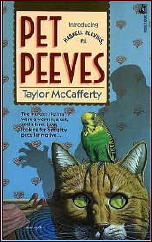
TAYLOR McCAFFERTY – Pet Peeves. Pocket, paperback original, 1990.

   If you’re tired of private eyes in big cities, you might dip into (Barbara) Taylor McCafferty’s Pet Peeves. Haskell Blevins returms to his hometown of Pigeon Fork, Kentucky, rents an office upstairs from his brother Elmo’s drugstore, and hangs out his shingle.

   And waits, in the eternal tradition of PI’s. Eventually the beauteous Cordelia Turley turns up to turn Haskell’s knees to mush. And to hire him to find out who killed her Granny. Sheriff Vergil Minrath has not made much progress over the past seven months, though there are some low-lifes in the underbrush that might serve as suspects.

   Pleasantly whimsical tale.

— Reprinted from The MYSTERY FANcier,
       Vol. 13, No. 2, Spring 1991.


      The Haskell Blevins series —

1. Pet Peeves (1990)
2. Ruffled Feathers (1992)
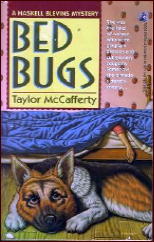
3. Bed Bugs (1993)

TAYLOR McCAFFERTY Haskell Blevins

4. Thin Skins (1994)
5. Hanky Panky (1995)
6. Funny Money (2000)

THE BACKWARD REVIEWER
William F. Deeck


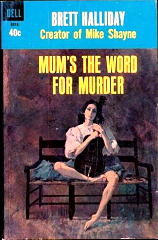
ASA BAKER – Mum’s the Word for Murder. Stokes, hardcover, 1938. De11 #743, paperback, 1953, as by Brett Halliday; several other Dell printings likely, including Dell #5918, 1964.

MIKE NEVINS Reviews

   Asa Baker — the narrator, not the pseudonymous author — writes Westerns when he doesn’t have writer’s block. Thinking of branching out into the mystery field, he accompanies his friend Jerry Burke, co-ordinator of law enforcement in El Paso, Texas, while he investigates several murders that had been advertised beforehand in the newspaper. Three unconnected killings take place, each announced in advance, with the primary suspects all having unimpeachable alibis.

   The plot is a good one. While contending something is a “first” is folly without having read every mystery published, I will say it is the earliest example known to me of this device. The most well-known use of it didn’t appear until 1950.

   That having been said, I cannot otherwise recommend the novel. Baker fancies himself the superior of the El Paso Chief of Detectives, but is just as much a nitwit. Jerry Burke is colorless. The writing is little above hack.

   In addition, the paperback edition also has the flaw, or so I would contend, of having been updated. For example, pay phones cost a dime in the edition I read [from 1964] , whereas they were only a nickel in 1938.

— From The MYSTERY FANcier, Vol. 13, No. 2, Spring 1991.


Editorial Note: Mike Nevins reviewed this same book in one of his columns late last year, while you can find my comments on The Kissed Corpse, the other “Asa Baker” title, posted here on this blog earlier this year.

REVIEWED BY DAN STUMPF:         


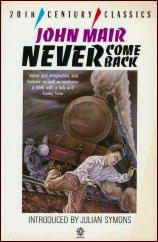
JOHN MAIR – Never Come Back. Victor Gollanz Ltd., UK, hardcover, 1941. Little Brown & Co., US, hardcover, 1941. Oxford University Press, US, softcover, October 1986. Film: Tempean, 1955, as Tiger by the Tail; released in the US as Cross-Up.

JOHN MAIR Never Come Back

   I want to preface this review by saying that I have long suspected that there is no vast, secret conspiracy to weaken our nation, rule the world, or put mind-control drugs in our morning coffee. There may be a litany of irritating little organizations with these ends in sight, but no vast secret one.

   That’s what I suspect, anyway, and there’s a good reason why I know there isn’t any Giant Conspiracy secretly running our lives: If the Army taught me anything at all, it’s that the bigger the organization, the more the entropy — as Edward Snowden, Private Manning and Major Nidal have so clearly/tragically demonstrated. And I recently found my anti-paranoid suspicions pleasantly realized in this old book.

   I first heard about John Mair’s Never Come Back from a passing reference in (where else?) a reference book. Intrigued, I found a copy (and isn’t the internet a wondrous boon to curious readers?) and proceeded to enjoy a thriller like no other.

   Subsequent research has led me to discover that all the best things about it have already been written, but I’ll recap my thoughts here anyway, as this is a book that deserves notice, particularly for fans of John Buchan.

   The central character, Desmond Thane, starts out as a hack-writer for a syndicate, making up human interest articles that are sold to newspapers as filler. He quickly finds himself in Richard Hannay territory though, after leaving the apartment (or flat, if you must) of a murdered woman who turns out to have been involved with one of those Shadowy International Organizations that seem to have been rife in England between the wars. As one might expect, he’s soon in possession of the usual MacGuffin, suspected of the murder, and on the run from the SIO.

   But there are some telling differences here: Thane actually is guilty of the lady’s murder, and he commits another in the course of the narrative. He’s a writer, With a literary approach to intrigue, and also something of a smart-ass. While dodging bullets and brutes, he tends to view his plight with a jaded philosophical detachment:

   Happy the man, he thought, without mental or physical passions, ignoring with equal scorn the bookshop, the brothel and the travel agency. A pity one couldn’t sell oneself to the devil nowadays; the decline of piety had knocked the bottom out of the market, and reduced the wicked to an unwanted proletariat, with nothing to sell but their already conquered souls. Faustus had got twenty-four years power and glory for throwing over law, medicine, logic and philosophy; today every capital was crowded with scholars who were willing to abandon all four and a good many more for a guinea a thousand and an occasional lecture tour. There was over-production of vice as of everything else.

   That’s the attitude we get from Thane as Mair trots him through the usual paces of the genre with style and speed. We get kidnappings by various and sundry bad guys, narrow escapes, cross-country chases, phony cops, seductions, a criminal mastermind with dreams of global conquest… I could go on, but if you’ve read much of this sort of thing, you pretty much know what to expect.

   The difference here is Thane’s attitude and Mair’s canny view of the whole genre — not quite spoof but definitely dubious. The Sinister International Organization turns out to be rather bureaucratic and inefficient, Thane resists torture only because he doesn’t know what the hell the bad guys are after, and when he finds out how valuable it is, his first thought is to sell it back to them and retire in comfort.

   There are about a dozen pages of misplaced whimsy while he fakes amnesia, but things soon get right back on the sardonic track; It seems that the Chairman of the SIO board (and would-be Ruler of the World) has written a book and Thane, like any curious man of letters, feels compelled to read it. Which leads to a scene so unexpected and screamingly funny and perfectly Right that I won’t spoil it for you — check it out.

Biographical Note:   This was the author’s one and only novel. He died in 1942 in a training flight accident as a pilot for the RAF. The book has been reviewed elsewhere on the Internet by author Martin Edwards on his blog. Check it out here.

Reviewed by JONATHAN LEWIS:         


“STEEL.” Episode of The Twilight Zone. CBS. Season 5, Episode 2. October 4, 1963. Lee Marvin, Joe Mantell, Tipp McClure. Director: Don Weis.

TWILIGHT ZONE Steel

   Stories set in a future that have long since passed are often particularly fascinating to read. They do not merely portray imagined futures. They also provide critical insight into how writers understood their own eras within the context of History’s tripartite realms of past, present, and future. Most significantly, many of these stories revolve around man’s complex relationship with technology.

   Consider, for instance, George Orwell’s Nineteen Eighty-Four (1949), Nevil Shute’s On The Beach (published in 1958, but set in 1963), and Arthur C. Clarke’s, 2001: A Space Odyssey (1968). The years in which those novels are set have long since come and gone. When we read these novels, we are reading fiction set simultaneously in the future and in the past. True, they are works of fiction; the books’ authors did not intend them to be prescient renderings of what was yet to come.

   Still, it’s worth reflecting on the fact that humanity did not usher into existence the most compelling aspects of these novelists’ imagined futures. More countries have democratically elected governments than ever before. Humanity avoided a nuclear holocaust. Man hasn’t traveled to Saturn. Scientists have not created an artificial intelligence nearly as advanced as HAL. Well, not yet, anyway.

   Similar to the aforementioned novels, The Twilight Zone episode, “Steel,” based on a Richard Matheson story of the same name (published in the May 1956 issue of The Magazine of Fantasy and Science Fiction), also takes place in a future date that is now past.

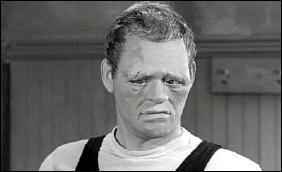
   Originally aired on October 4, 1963, “Steel” is set in a future 1974 in which human boxing is no longer permitted. Android-like robots are the only ones allowed to box; human boxing was criminalized in 1968. Rod Sterling’s narration provides context and instructs the viewer that such a law was passed in an attempt to abolish one facet of human cruelty:

   â€œOnly these automatons have been permitted in the ring since prizefighting was legally abolished in 1968. This is the story of that scheduled six-round bout, more specifically the story of two men shortly to face that remorseless truth: that no law can be passed which will abolish cruelty or desperate need — nor, for that matter, blind animal courage. Location for the facing of said truth: a small, smoke-filled arena just this side of the Twilight Zone.”

TWILIGHT ZONE Steel

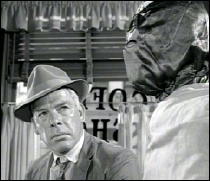
   The episode begins with Steel Kelly (Lee Marvin) and Pole (Joe Mantell) escorting a shrouded figure off a bus and into a small town diner. We soon learn that the mystery man accompanying them isn’t a man at all. Rather, he — it — is a fighting android answering to the name of Battling Maxo (Tipp McClure).

   Steel Kelly and Pole are in need of some prize money. Maxo, a B2 unit and a heavyweight, is set to fight a more advanced B7 unit named Maynard Flash (Chuck Hicks). Problem is, Maxo experiences mechanical failure right before the big fight.

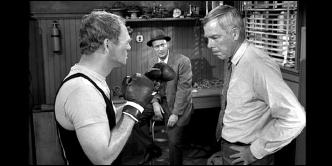
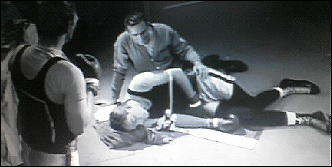
   That’s when Steel Kelly, a former boxer, comes up with what he considers to be an ingenious plan. He’ll pretend that he’s Maxo and will go in the ring against Maynard Flash. Pole urges against this idea. Steel, portrayed with gusto by Lee Marvin, is not about to be swayed. He’s determined to see this through. All too human, Steel is both courageous and foolish. As one might guess, he doesn’t win the fight.

TWILIGHT ZONE Steel

   Sterling’s ending narration emphasizes that the main theme of the episode is man’s relationship with technology:

   â€œPortrait of a losing side, proof positive that you can’t outpunch machinery. Proof also of something else: that no matter what the future brings, man’s capacity to rise to the occasion will remain unaltered. His potential for tenacity and optimism continues, as always, to outfight, outpoint and outlive any and all changes made by his society, for which three cheers and a unanimous decision rendered from the Twilight Zone.”

   Upon hearing these words spoken and seeing Steel collapsed on the floor, I initially felt a sense of disappointment at how the episode ended. Lee Marvin was excellent, the androids appeared both plausibly human and uncannily creepy, and the writing was tight and without sentimentalism. But something was missing.

   That’s when I realized that “Steel” is best appreciated within the context of stories set in the past, but which take place in the future, similar to the novels I alluded to previously.

TWILIGHT ZONE Steel

   In order to appreciate this particular Twilight Zone episode, one has to imagine oneself watching it when it was first aired, some two years after President Kennedy’s moon speech and two months after Martin Luther King Jr.’s “I Have a Dream Speech” in which he declared that, “1963 is not an end but a beginning.” Indeed, “Steel,” when considered within dual contexts of advancing technology and changing legal norms, packs more of a punch than when viewed without reference to contemporaneous political issues.

   The episode’s theme of man’s relationship with technology, however, is a far more universal one. Ever since the Gothic horror of Mary Shelley’s Frankenstein (1818) and Victorian-era science fiction, the relationship between man and machine has been a constant theme in the genre. In this light, “Steel” isn’t a bad episode. It just seems as though it would have been a much better episode to watch and to ponder in 1963 than in 2014.

« Previous PageNext Page »