Reviews


FIRST YOU READ, THEN YOU WRITE
by Francis M. Nevins


   Feeling tired and lazy in these dog days of early autumn, I began asking myself whether I could cobble together a respectable column from the mystery reviews I wrote for my eyes only back in the Sixties and Seventies. To provide a soupcon of unity I decided early on to limit myself to U.S. writers and to novels I wasn’t terribly happy with. Shall we see how the experiment came out?

***

   Baynard Kendrick’s Blind Allies (Morrow, 1954) begins promisingly as a seedy character who claims to be but obviously is not the son of an oil tycoon retains blind detective Captain Duncan Maclain to go to his dad’s mansion at 3:00 A.M. and open a safe whose combination is in Braille.

   May I jump to the first murder? The lights go out in the old dark house, all the suspects run around like buffoons, the lights go on and voila! a body. Back in 1968 I couldn’t find a single kind word for this disaster of a book, which struck me as wretchedly organized and plotted and written, stuffed with implausibilities and contradictions, padded beyond endurance, and resolved by blatant guesswork.

   My reaction would probably be the same were I to re-read it today, but if you’ve tackled this or any other book discussed here more recently than I and think I was too harsh, please say so.

***

   In recent decades dozens of female private eye novelists have flourished, most if not all of them writing about female private eyes. But back when Chandler ruled the genre the only woman in the field was M. V. (Mary Violet) Heberden (1906-1965). She seems to have been heavily influenced by Brett Halliday, and her PI Desmond Shannon is best described as Mike Shayne seen through a woman’s eyes.

   His problem in The Lobster Pick Murder (Doubleday, 1941) is to find out who stuck the pick into the sadistic plastic surgeon’s medulla oblongata. Nothing about this exercise — plot, prose, characterizations, upper-crust Long Island setting, theatrical milie — rises above the drearily competent, and most readers will identify the perp about 200 pages before Shannon. Some of the later Heberdens I’ve read are much better but they’re not on the table this month.
***

FRAZER Find Eileen Hardin

   The writer who was born Milton Lesser (1908-2008) and is best known as Stephen Marlowe, creator of globe-trotting PI Chester Drum, also used other bylines. Roughly 90% of his Find Eileen Hardin — Alive! (Avon #T-343, PBO, 1959), signed as by Andrew Frazer, is the mixture as before.

   Private dick and former football hero Duncan Pride returns to his alma mater when his old girlfriend, now married to his old coach, begs him to help find the coach’s missing teen-age daughter, who’s rumored to have become a call girl. The search brings him up against criminal enterprises like prostitution, abortion (remember this was a dozen years before Roe v. Wade), the enticing of innocent virgins into a life of sin and the fixing of college athletic events, not to mention murder.

   Frazer does give us a few reasonably vivid scenes at a deserted oyster cannery and the old Idlewild air terminal, but the book is too long and full of cliches, much of the motivation would not be out of place in a soap opera, and the sniggering attitude towards sex is a turn-off.

***

   The success of Mary Roberts Rinehart, Agatha Christie and countless others disproves the thesis that sexism forced all or most women mystery writers of the pre-feminist era to adopt male bylines. But it was common practice for women writing the sorts of mysteries generally associated with men, like M.V. Heberden with her PI series, and also like DeLoris Stanton Forbes (1923- ), whose novels about police detectives Knute Severson and Lawrence Benedict appeared under the name Tobias Wells.

   Dead by the Light of the Moon (Doubleday, 1967) is a readable but uncompelling semi-procedural about the murder and de-breasting of an old woman in a Boston apartment building during the great East Coast blackout of 1965. Wells has just finished spreading suspicion evenly among various fellow tenants of the victim when suddenly and arbitrarily the guilty party confesses. Sure, real-life crimes often end this way, but a fiction writer must do better.
***

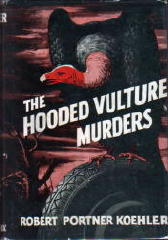
KOEHLER Hooded Vulture Murders

   The novels of Robert Portner Koehler (1905-1988) were published almost without exception by a house at the absolute bottom of the literary food chain, although it does hold the distinction of having been the last U.S. publisher of that great wack of American literature, Harry Stephen Keeler.

   Koehler’s The Hooded Vulture Murders (Phoenix Press, 1947) deals with two hapless California PIs who stumble upon the murder of a blackmailing journalist while driving through southern Mexico on the uncompleted Pan American Highway. Naturally the bumbling native officials welcome with open arms the intrusion of these brilliant Anglo sleuths, although readers may wish the boys had stayed home.

   Koehler paints local color vividly enough but the book is ineptly plotted, woefully written, pathetically characterized, laughably clued, and all in all a pretty lame excuse for a whodunit.

***

   Enough for one month. It took more time and work than I expected to unstiffen the language of these ancient jottings without changing anything substantive. But it’s good to know that I have enough material in the archives for a few more columns if I get to feeling tired and lazy again.

REVIEWED BY WALTER ALBERT:         


THE WRONG BOX. Salamander Film Corp., UK, 1966. Michael Caine, Nanette Newman, Peter Cook, Dudley Moore, Ralph Richardson, John Mills, Peter Sellers, Wilfred Lawson, Tony Hancock. Director-producer: Brian Forbes. Based on the book by Robert Louis Stevenson & Lloyd Osbourne. [Osbourne was Stevenson’s stepson.]

The Wrong Box

   This 1966 version of The Wrong Box is a movie graced by the beetle-like humor of Dudley Moore and a perfect caricature of a fact-spouting pedant, played by Ralph Richardson.

   The film is not as good as the sum of its parts, and is not particularly enhanced by a romantic subplot involving Michael Caine and a forgettable British actress, but the manic attempts of two members of the inimitable “Beyond the Fringe” company, Moore and Peter Cook, to make certain that their uncle, played by Richardson, is the last surviving member of a “tontine” and, thus, inheritor of a fortune of some one hundred thousand pounds, are often very funny.

   Cook is the fast-talking “brains” of the team, constantly maneuvering around the sweet-talking bumbling of overactive Lothario Moore, but Moore gets the best line. After it is pointed out that Cook has altered a death dertificate but inadvertently put on the next day’s date, Moore comments, “here today, gone tomorrow,” a perfectly logical statement in the context of this zany Victorian comedy.

   It is one of the few films I have seen in which the line “the butler did it” is uttered to truly comic effect, and the final scene is a triumph of comic miscalculations that somehow seem inevitable and right.

   A funny take-off on caper-and-chase films, The Wrong Box did not find much of an audience in this country in its original release and is sometimes hampered by a too-obvious and arch adaptation of the Robert Louis Stevenson original story by the America scriptwriters, but the talented cast surmounts most of the weaknesses, and the film is worth watching for.

— From The MYSTERY FANcier, Vol. 8, No. 1, January-February 1982 (slightly revised)


Editorial Comment:   My own review of this film, posted here on this blog almost six years ago (!) agrees with Walter in all but one important aspect.

Reviewed by DAVID L. VINEYARD:         

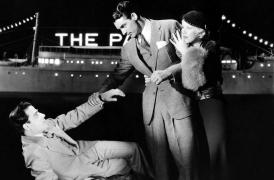
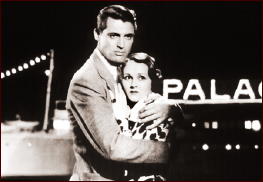
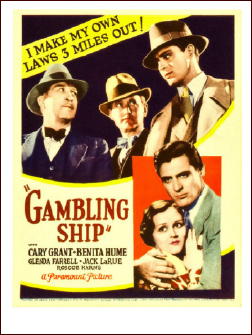
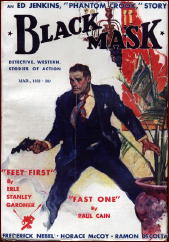
GAMBLING SHIP. Paramount, 1933. Cary Grant, Benita Hume, Jack La Rue, Roscoe Karns, Glenda Farrell, Arthur Vinton, Marc Lawerence. Screenplay: Max Marcin, Seton I. Miller. Adaptation: Claude Binyon. Based on the serial “Fast One” appearing in Black Mask magazine by Paul Cain (Peter Ruric). Directors: Louis Gasnier and Max Marcin.

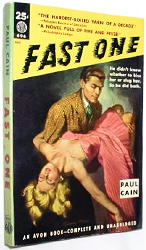
PAUL CAIN The Complete Slayers

   He said: “I’m going to reopen the Joanna D. — Doc Haardt and I are going to run it together — his boat, my bankroll.” Kells said: “Uh huh.” He stared steadily at the electric fan, without movement or change of expression. Rose cleared his throat, went on: “The Joanna used to be the only gambling barge on the Coast, but Fay moved in with the Eaglet, and then Max Hesse promoted a two-hundred-and-fifty-foot yacht and took the play away from both of them.” Rose paused to remove a fleck of cigaret paper from his lower lip. “About three months ago, Fay and Doc got together and chased Hesse. According to the story, one of the players left a box of candy on the Monte Carlo — that’s Hesse’s boat — and along about two in the morning it exploded.”

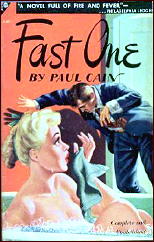
   That passage from the Paul Cain novel is as close as this movie gets to the hardboiled classic it was based on, Fast One, though more than a bit of the basic plot is used — just not to the same effect as in the book.

   How Fast One, a novel that was so terse and stacatto it made Hammett read like a Victorian triple decker, became this romantic dramedy with Cary Grant and Benita Hume is one of those mysteries only a Hollywood producer could explain — or justify — but that’s what happened on the classic Black Mask serial’s way to the big screen as Gambling Ship.

PAUL CAIN Fast One

   Gone are Gerry Kells, the tough as nails gambler and gunman, and Grandquist (Kells looked at the woman. She was blonde — but darkly, warmly. Her mouth was very red without a great deal of rouge, and her eyes were shadowed and deep. She was a tall woman with very interesting curves. Fay said: “This is Miss Granquist.”), a femme fatale so fatal and tough she could give lessons to Hammett’s Diana Brand and Brigid O’Shaunessy as well as Chandler’s Velma, and in their place we have a tough but much smoother Cary Grant as Ace Corbin (replete with gray at the temples and a streak in his wavy dark hair), a New York gambler finding it hard to go straight and Benita Hume as the most lady like (if not entirely wholesome) moll you can imagine (well kept too, her apartment in Los Angeles has a bathroom the size of most bedrooms).

   Gambling Ship opens in New York where the newspaper boys are hawking the extra that gambler Ace Corbin has just been acquitted of a murder charge, a fact that seems to amuse police and public alike:

   Woman: “I saw him at the Bijou once, gee but he was handsome.”

   Second Woman: “Yeah, but he kills people.”

   First woman: “So does rheumatism.”

   Kells has similar problems in the book:

    “I happened to be too close to a couple of front-page kills,” Kells went on. “There was a lot of dumb sleuthing and a lot of dumb talk. It got so, finally, when the New York police couldn’t figure a shooting any other way, I was it.” Granquist was silent, smiling. “They got tired trying to hang them on me after the first three but the whisper went on. It got to be known as the Kells Inside….”

    “And at heart you’re just a big, sympathetic boy who wouldn’t hurt a fly.”

    “Uh, huh.” He nodded his head slowly, emphatically. His face was expressionless.

    “Me — I’m Napoleon.” Granquist took a powder puff out of the bag and rubbed it over her nose.

PAUL CAIN Fast One

   That pretty much sums up this semi-tough film that might be a dress rehearsal for one of Cary Grant’s later iconic roles as gambler Mr. Lucky. Here Ace Corbin is sick of New York and the rackets, and having walked from a frame set up by hood Pete Manning (Jack La Rue), all Corbin wants is to head to the coast and take a vacation.

   Not so easy, as flunky Marc Lawerence points out when one of Ace’s men tosses Ace’s shoulder holster and gun in his bag: “Sometimes even a good man has to blast his way loose.”

   It’s hard to imagine Kells having to be persuaded to “blast his way loose”:

   Then Beery said, “Look out!” and something dull and terrible crashed against the back of Kells’ head, there was dull and terrible blackness. It was filled with thunder and smothering blue, something hot and alive pulsed in Kells’ hand. He fell.

   On the train to the coast Ace meets beautiful society girl Eleanor Kiniston and a romance blossoms, Ace introducing himself as Bruce Grahame. Ace isn’t the only one with a secret. Eleanor is really Eleanor La Vere, girlfriend of Joe Burke (Arthur Vinton), a west coast gambler who runs an off shore casino.

   Burke’s in a bind for money, thanks to his chief competitor hijacking his customers for his own ship, Pete Manning’s Paradise. Once home Eleanor finds out what a bind Burke is in, and being to noble to walk out on him drops Bruce.

   Eleanor: “I couldn’t walk out on Joe when he’s down and out.

   Eleanor’s friend Jennie Sands (Glenda Farrell): “That’s the time to walk out.”

   Meanwhile Burke’s henchman Blooey (Roscoe Karns) is an old friend of Ace, and tries to convince Ace to go in with Burke, a chance to buy into a good deal and take revenge on Manning, but Ace is in love and wants none of it.

   Burke to Ace sarcastically: “Everybody knows what a forgiving nature you have.”

   Blooey: “Yeah, Ace always sends flowers.”

   But Manning won’t leave Ace alone so he agrees to go in with Burke. and starts by hijacking back all the players Manning hijacked in the first place.

   Ace: “Sometimes even a good man has to blast his way out … I’m gonna have that vacation even if I have to kill a few people.”

GAMBLING SHIP

   That does sound like Kells.

   Again, this hews close to the novel:

    “Now I’ll tell you one, Jakie. You’d like to have me on the Joanna because I look like the highest-powered protection at this end of the country. You’d like to carry that eighteen-carat reputation of mine around with you so you could wave it and scare all the bad little boys away.”

   His first night on the ship Eleanor shows up and finds out he’s Corbin, but he still thinks she’s a classy society woman, an illusion that will have to stay in place when Manning fire bombs the ship.

   The ending is well done and exciting, and being pre-Code, neither Ace nor Eleanor have to repent or suffer for the error of their ways. A clinch, a kiss, and Ace is ready to turn that vacation into a honeymoon, assuming he still has marriage on his mind after finding out who she is. This being the pre-Code era, happily ever after didn’t always need a license and a justice of the peace. It’s a very different ending than Fast One.

   Gambling Ship has a bad reputation among fans largely because it is based on Fast One, the legendary hardboiled extravagansa of flying bullets and McGuffey’s reader prose by screen writer Peter Ruric (The Black Cat, The Raven, Grand Central Murder …) writing as Paul Cain.

GAMBLING SHIP

   Granted it would have been nice to see his novel get the pre-Code treatment with Grant as tough-as-nails lethal gambler gunman Kells (though reading the book I always have Alan Ladd in mind), but that aside this isn’t a bad little film and like any decent pre-Code film (or is that indecent?) it’s interesting to note the little touches like the teasing dialogue bordering on double entendre, the suggestion of nudity (Hume outlined fairly clearly in a pebbled glass shower), skimpy lingerie (and not a lot of it), and a cavalier attitude to sex, without moralizing or due punishment, that could only be hinted at in later films.

   To be fair, any movie that has both a journey on a train and a gambling ship can’t be all bad.

   It’s interesting to note as well just how much of the Grant persona and the familiar gestures and slow takes are already established even at this point. It’s not hard to see watching this how Leslie Charteris and Raymond Chandler both could envision the Saint and Philip Marlowe as played by Grant (who was also a pick to play James Bond). He dominates every scene without doing much of anything but being Cary Grant, and for an actor at this early stage in his film career that’s no mean feat.

   Gambling Ship is no masterpiece, but it is a swift moving well done film with crisp direction, a smart script filled with clever quips, a first class cast, and an exciting finale, as well as good camera work by Charles Lang.

GAMBLING SHIP

   If you can manage to forget what it might have been considering its source you will likely enjoy it. And it’s not like Hollywood reserved this treatment for Ruric’s book, or have we forgotten Satan Met a Lady, the second version of The Maltese Falcon?

   That said, once or twice toward the end of the film you get a glimpse of how Grant might have played Kells, and you have to at least think about what might have been, Fast One is a very violent book that reads more like it was written with a tommy gun than a typewriter.

   Kells turned and spoke sharply to Granquist: “Lie down on the seat.” She muttered something unintelligible and lay down on her side across the back seat.

   They turned swiftly down Cherokee and a spurt of flame came out of a parked, close curtained limousine to meet them, lead thudded, bit into the side of the car. Borg stepped on the throttle, they plunged forward, past. Kells looked back at Granquist. She was lying with her eyes tightly closed and her face was very white. He put one arm back toward her and she rose suddenly to her knees, put her hands on his shoulder.

   He smiled. “We’re all right, baby,” he said softly. “They build these cars in Detroit — that’s machine-gun country.”

   Machine gun country is where Ruric’s book would feel at home, if not the film based on it.

GAMBLING SHIP


Note: The novel Fast One has been reviewed by Bill Pronzini some time back on this blog. Check it out here. And both the novel and the author are discussed in depth by Walker Martin in his review of The Complete Slayers, by Paul Cain. It’s worth your reading again, or for the first time, if you haven’t already.

THE BACKWARD REVIEWER
William F. Deeck


HOSANNA BROWN — I Spy, You Die. Victor Gollancz Ltd, UK, hardcover, 1984. G. K. Hall, US, hardcover, 1985. Back-In-Print Books, UK, softcover, 2004.

   The Kavendish Laboratory at Cambridge is developing the Pasar. The Pasar could be used to supply, among other things, free power to the world, or it could be employed to destroy the world. Someone is providing the Chinese, it seems, with piecemeal information about the research.

   Three of the scientists at the laboratory are members of Michaelhouse College, a rather hidebound group who have only recently and reluctantly discovered that females can be scholars. Thus, Her Majesty’s Government, with that delightful government ability to ignore the obvious, concludes that a female investigator is what is needed.

   Adding to what would appear an already chilly reception, the government decides to choose an American. Frank le Roux has achieved some reputation doing investigations for IBM. She is young and beautiful — it goes without saying, doesn’t it? — and she is black, if one-eighth part on her mother’s side qualifies her to describe herself as such. But just to prove her bona fides in this matter, she is a natural blonde.

   At her first evening at Michaelhouse during a Festive dinner, a goblet is passed around the table for all to drink from. Frank is the penultimate imbiber, but something keeps her from tasting. The last drinker, the Master of the college, partakes and dies, poisoned with choral hydrate. If Frank had not put the poison in the goblet, then either she was the target of the poisoner or the poisoner didn’t care if she died along with the Master. Does this bother Frank or even pique her curiosity? Nope.

   The next morning Frank has breakfast with the director of the laboratory, a man now in the running for the mastership of the college. On being shown around his apartment, she spots his four-poster bed. A bed, it becomes clear, means sex to Frank, and she invites the director to have at it.

   He does, and it is, of course, perfect, despite its quickness. “Gruff, half-swallowed professorial grunts of pleasure as Frank herself seemed easily, lightly, to peak. A deep contented moan of ecstasy, like a long-held trumpet note.”

   (Mystery writers, should they wish to make a great deal of money, ought not to write novels but a nonfiction work about how their heroes and heroines manage perfect sex both quickly and under unusual circumstances, And how do “professorial grunts of pleasure” differ from ordinary grunts? But I digress.)

   Frank then proceeds to tell her bedmate, one of the possible suspects of the leaks, all about her top-secret investigation.

   Page 44 had been reached. The world, as far as I could tell, had not been destroyed. Frank, in her own inimitable fashion, must have been successful. Was it really necessary to read on? I decided it would be more enjoyable to abandon the book and read about the adventures of Pooh Bear in a world much more realistic than is contained in I Spy, You Die.

— From The MYSTERY FANcier, Vol. 10, No. 1, Winter 1988.


Bibliographic Notes:   There was one further adventure of Frank le Roux, I am mildly surprised to say — I am inclined to trust Bill’s judgment on all matters criminous — that being Death Upon a Spear (Gollancz, 1986).

   As another point of interest, I am sure that Bill did not know — else he would have mentioned it — that “Hosanna Brown” was the pen name of Robert Malcolm Ward Dixon, who has no further entries in Al Hubin’s Crime Fiction IV.

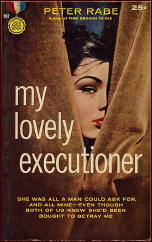
PETER RABE My Lovely Executioner

PETER RABE – My Lovely Executioner. Gold Medal #967, paperback original; 1st printing, February 1960. Five Star, hardcover, 1999. Stark House Press (with Agreement to Kill), trade paperback, 2006.

   It’s my opinion — and so far’s I know, nobody else’s — that Peter Rabe should have a name in the mystery field comparable to some of those writing in the heyday of Black Mask magazine. No, not a top-notcher like Hammett or Chandler, but more along the lines of a Raoul Whitfield, say.

   Like the one at hand, much of Rabe’s work seems to have been devoted to inside glimpses into life in the underworld. Tough, sexy, hard-boiled — all are adjectives that seem to apply. To a certain extent, it occasionally takes some work to read in between the lines Rabe wrote, as if you really had to think like a crook to make the pieces of the puzzle fit together the way they should.

   This one opens with a guy named Gallivan as he’s being busted out of prison. Non-voluntarily, it should be added. He has only three weeks to go before his time is up. Now he’s on the run, aided by the prison-mate who helped spring him, along with a girl named Jessie whom the other guy seems to know.

   Gallivan’s problem is threefold: what’s their motive; how can he escape them; and should he escape them? Add another: can he escape them?

   Not a major story, by any means. There are no big scenes that stand out in your memory afterwards, ones you’d automatically think of when you think of this book. There are a lot of little ones, though, each one individually hardly worth a mention, but each one etched in its way in a small semblance of perfection.

Rating:   B

— Reprinted from The MYSTERY FANcier, Vol. 6, No. 3, May-June 1982 (slightly revised).

Reviewed by
CAPTAIN FRANK CUNNINGHAM:


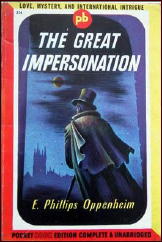
E. PHILLIPS OPPENHEIM Great Impersonation

E. PHILLIPS OPPENHEIM – The Great Impersonation. Hodder & Stoughton, UK, hardcover, 1920. Little Brown, US, hardcover, 1920. Reprinted many times since, including Pocket Book #224, paperback, 1943. Currently in print in various POD editions.

   Sir Everard Dominey, in his twenty-sixth year, leaves England, and after ten years of wandering, turns up in 1913 in German East Africa, where Baron Leopold Von Ragastein, a military commandant, rescues him from death in the bush.

   Dominey and Von Ragastein discover that they knew each other at Oxford, and that the amazing likeness which existed between them in undergraduate days still persists. Then Von Ragastein, who has been ordered to London by the Wilhelmstrasse, determines to make way with the Englishman, assume his identity and enter upon his espionage as Sir Everard Dominey.

   There is a love story of charm and appeal and a mystery that the reader is hardly likely to solve until the last page.

— Reprinted from Black Mask magazine, August 1920.


Bio-Bibliographic Note:   For as much as you might like to know about E. Phillips Oppenheim, check out this website dedicated to him. Quoting:

    “…Oppenheim published over 150 books and countless magazine stories between 1884 and 1946. While most often identified as a mystery writer, Oppenheim’s novels range from spy thrillers to romance. All of them have, however, an undertone of intrigue. Several of his books were published under the pseudonym, Anthony Partridge.”

REVIEWED BY DAN STUMPF:


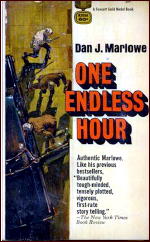
DAN J. MALOWE One Endless Hour

DAN J. MARLOWE – One Endless Hour. Gold Medal R2050, paperback original, 1969. Reprints: Gold Medal T2662, paperback, 1972. Stark House Press (with The Name of the Game Is Death), trade paperback, 2013.

   I like to spend October watching old monster movies and reading spooky books. Things like Burn Witch Burn and Firebug, which I did. But I found nothing all last month quite so chilling as One Endless Hour, by Dan J. Marlowe.

   For awhile therein the 1960s Marlowe bid fair to take up the legacy of Jim Thompson with books like The Name of the Game Is Death and The Vengeance Man, but he chose to settle in the comfortable groove of the continuing (and no doubt more profitable) Earl Drake series, and who can blame him really?

   One Endless Hour is the “bridge” book between the old stuff and the new, and as such it has an attractively pointless momentum I find immensely appealing — that and the over-the-top violence and crude sex of its time.

   The first chapter of Hour is actually the last chapter (slightly re-written) of The Name of the Game Is Death: the bank robber hero finding his partner murdered, killing the woman who betrayed him (“Tell it in Hell, bitch, if you can get anyone to listen,”) and castrating the local lawman behind it all. Then we get a furious car chase and running gun battle that climaxes with our hero (now Earl Drake) getting his hands and face burnt off and ending up in the state prison hospital being systematically tortured — and plotting his escape.

   And that’s just the first chapter.

   There follows a uniquely creepy tale of plastic surgery, bribed guards, jail-break, double-cross, more murders and two bank robberies—one of which goes sour in spectacularly kinky fashion, all told in about a hundred and sixty fast-turning pages. An unforgettably hard-boiled story and perfect for the Halloween season.

   Dan J. Marlowe may have gone on to better selling books, but those of us who cherish the truly subversive in fiction will remember him more fondly for books like this.

THE ARMCHAIR REVIEWER
Allen J. Hubin


ROBERT RICHARDSON The Book of the Dead

ROBERT RICHARDSON – The Book of the Dead. St. Martin’s Press, hardcover, 1989. First published in the UK by Gollancz, hardcover, 1989.

   The third of Robert Richardson’s novels about playwright and occasional sleuth Auguste Maltravers is The Book of the Dead. Here Maltravers is guesting in the countryside when a sixty-ish gentleman, widely respected and married to a habitually unfaithful young wife, is murdered.

   The man had in his safe an unusual treasure — an authentic and unpublished Sherlock Holmes story by Arthur Conan Doyle. This Sherlockian tale — [itself] not to me very impressive — is fully recounted within Richardson’s narrative, and provides Maltravers with some dangerous clues to whodunit.

   Pleasant and devious story: the author had me confidently looking at the wrong person.

— Reprinted from The MYSTERY FANcier,
       Vol. 12, No. 4, Fall 1990.


       The Augustus Maltravers series —

The Latimer Mercy, 1985.
Bellringer Street, 1988.
The Book of the Dead, 1989.
The Dying of the Light, 1990.
Sleeping in the Blood, 1991. US title: Murder in Waiting.
The Lazarus Tree, 1992.

LESLIE FORD The Clue of the Judas Tree

LESLIE FORD — The Clue of the Judas Tree. Dell #61, mapback edition, no date [1944]. First published by Farrar & Rinehart, hardcover, 1933. Also reprinted several times by Popular Library in the 1950s and 60s.

    In several ways it’s hard to believe this book was written almost fifty years ago. The writing is remarkably fresh and relevant, even if the characters and the setting are out of the pages of history, if not history books, per se.

    For example, the Crash of Wall Street in 1929 is still very much on everyone’s mind when it comes to matters financial, and the person who is the immediate suspect when financier Duncan Trent is found murdered is a shell-shock victim of World War I.

    “Psychology” is an important ingredient in this early cross between a gothicky novel overwhelmed with apprehension and a strictly-playing-it-by-the-clues detective story, and so is romance.

    The ending is unusually cluttered, but then perhaps it had to be to explain away all that had happened. Dashiell Hammett, one suspects, would not have had patience with a story like this, nor with the sort of fantasy world it takes place in, but it’s a branch of the detective novel that certainly seemed to blossom about the same time as The Maltese Falcon. This book is not still in print, but it could be — and its descendants, either direct or indirect, certainly are.

Rating:   B minus

— Reprinted from The MYSTERY FANcier, Vol. 6, No. 3, May-June 1982 (slightly revised).


[UPDATE] 11-06-13.   I do not remember reading this book at all. I have only this review to remind me that at one time I did. I see that I did not mention the detective of record, one Lt. Joe Kelly, who also appeared in Murder in Maryland (Farrar, 1932). Ford’s most frequently used series characters, Grace Latham and Colonel John Primrose, did not begin their fictional careers until 1937.

THE BACKWARD REVIEWER
William F. Deeck


LYNN BROCK – The Kink. Harper and Brothers, US, hardcover, 1927. First published in the UK by Collins, hardcover, 1927, as Colonel Gore’s Third Case.

LYNN BROCK The Kink

   Lt.-Col. Wyckham Gore, D.S.O., senior partner of Gore & Talley, Confidential Agents, and his firm have failed to find a missing husband and a missing brother for two clients. One of the missing men turns up In a nursing home, having had, so he says, an accident necessitating the amputation of an arm; he is also missing a significant part of one ear and almost all of his nerve.

   When the Hon. Mrs. Ronayne, whose name had appeared in connection with both mysterious disappearances, calls upon Gore to begin a constant surveillance of her husband, a famous Irish poet who may be involved with the IRA, but does not say why she wants his movements watched, Gore’s interest is piqued.

   He is even more intrigued when her father, Lord Haviland, former Prime Minister, asks him to investigate the theft of what would seem to be some fairly insignificant items from his study, with the peer’s daughter and the poet both suspects.

   As Gore begins his investigation, he meets other members of the family and discovers that they all are more than a bit peculiar, as are some of the servants. Pornographic movies and orgies would seem to be the worst of it, but then someone is brutally murdered.

   Gore is a moderately interesting character, with a dry wit that should have been more in evidence, and a slightly more than adequate investigator. He gets things straightened out, at the risk of his life, in a rather complex but not particularly engrossing case.

— From The MYSTERY FANcier, Vol. 10, No. 1, Winter 1988.


    The Colonel Wyckham Gore series —

The Deductions of Colonel Gore (n.) Collins 1924; Harper, US, 1925.
Colonel Gore’s Second Case (n.) Collins 1925; Harper, US, 1926.
Colonel Gore’s Third Case (n.) Collins 1927; reprinted in the US as The Kink, Harper, 1927.
The Slip-Carriage Mystery (n.) Collins 1928; Harper, US, 1928.
The Mendip Mystery (n.) Collins 1929; reprinted in the US as Murder at the Inn, Harper, 1929.
Q.E.D. (n.) Collins 1930; reprinted in the US as Murder on the Bridge, Harper, 1930.
The Stoat (n.) Collins 1940 [no US edition]

    Under his Lynn Brock pen name, Alister McAllister (1877-1943) also wrote three books about Sgt. Venn, none of which have been published in the US, and two stand-alone mysteries. He also wrote two crime novels as by Anthony Wharton.

« Previous PageNext Page »