Reviews


REVIEWED BY DAN STUMPF:


THE WOMAN EATER. Eros Films, UK, 1958; Columbia Pictures, US, 1959. George Coulouris, Vera Day, Peter Wayn, Joyce Gregg, Joy Webster, Jimmy Vaughn. Director: Charles Saunders.

THE WOMAN EATER

   The Woman Eater is the risible title of a remarkable little film which no doubt inspired (if inspiration had anything to do with it) the better-known Little Shop of Horrors (1960).

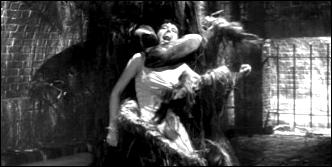
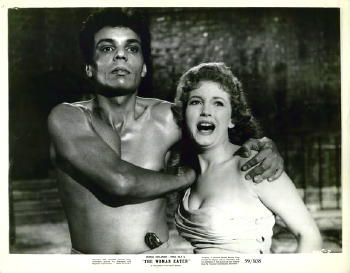
   George Coulouris, best remembered as young Charles’ guardian in Citizen Kane, here plays an intrepid explorer/scientist, and tries hard not to look embarrassed as he journeys deep into the Amazon Jungle where he sees a lot of stock footage and Marpessa Dawn (who would go on to Black Orpheus) being sacrificed to a giant thing that looks like a cross between a hairy Muppet and Mr. Tree — truly one of the most unintentionally amusing monsters of the 50s, and one you should not miss.

   Five years later (a title tells us) he’s back in England with the plant and a cringing native catamite/assistant called Tanga, convinced that the tree secretes a sap that will revive the dead. Of course to get the sap he has to sacrifice young women to the damn thing, so it seems like a zero-sum game to me, but hey, he’s a scientist I’m sure he must think he knows what he’s doing.

   At one point he tests things out by injecting the sap into what looks like a giant chicken heart, which makes one question his priorities, but it doesn’t work and that’s the last we see of the giant chicken heart, which is rather a shame because I thought it was a good part, even if we never learn exactly what it was, where it came from or why. Obviously a film to challenge us with existential questions about the meaning of it all.

   Anyway, the story gets a little strange at this point, as George’s housekeeper says she’s madly in love with him (with George Coulouris???) the young heroine recently employed by George insists there’s something evil in the house (even though they forgot to shoot any scenes of her hearing strange noises or such) and George announces he’s madly in love with the heroine, whom he met the day before. We get the usual climactic conflagration, and all ends, if not well, at least promptly in a film worthy to stand beside classics like Jungle Captive and The Spider Woman Strikes Back.

   As Walt Kelly used to say: it’s enough to make a man think.

THE WOMAN EATER

FIRST YOU READ, THEN YOU WRITE
by Francis M. Nevins
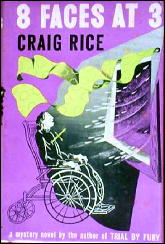

CRAIG RICE 8 Faces at 3

   The latest golden oldie I decided to revisit in my golden years is 8 FACES AT 3 (Simon & Schuster, 1939), which I first read in the summer of 1964, just before I entered law school. Craig Rice (1908-1957), one of the most popular female mystery writers of her generation, entered the genre with this novel, along with alcoholic criminal defense lawyer John J. Malone, drink-sodden talent agent Jake Justus, and ever-inebriated heiress Helene Brand, who would become Mrs. Jake in future outings.

   Amid copious shots of booze the trio probe the stabbing death of vicious old Chicago dowager Alexandria Inglehart, whose murderer also made all the beds in the Inglehart mansion and (dare I say it?) took the time to stop all the clocks in the house at 3:00. The plot is marred by logical holes and legal howlers — sorry, Ms. Rice, but no court would enforce a will provision nullifying an outright bequest if the recipient marries after the testator’s death — and the solution is surprising but only mildly fair and a bit hard to swallow.

   What I found most striking about this novel is the interweaving of some all but noirish sequences with scads of drunken escapades. Rice seems to think that hoisting a few while driving along Chicago streets that have turned to sheets of ice is the height of hilarity, although when held up against the later exploits of Malone and his buddies this one is a model of rationality and sobriety. The critics who have likened Rice’s world to Hollywood’s screwball comedies of the Thirties knew what they were talking about.

***

   How do I know precisely when 8 FACES first came into my ken? Because, rummaging in my file cabinets between sessions with Rice’s madcap protagonists, I discovered an old notebook containing comments on the mysteries I had read back in the Sixties and Seventies. Dozens of these clumsily written paragraphs became the rough sketches for material that wound up in various essays of mine, like the ones on Cleve F. Adams, William Ard and Milton Propper; many others have been seen by no eyes but my own.
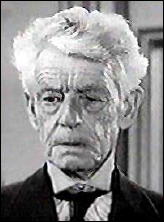
Cyril Delavanti

   Among the subjects of the latter is Clyde B. Clason (1903-1987), who wrote ten well-regarded classic puzzle novels in the 1930s and early Forties before giving up the genre permanently. Protagonist of all ten is Professor Theocritus Lucius Westborough, a little old man whose day job is teaching classical languages and literature but whose true forte is solving bizarre murders.

   Anyone remember an actor named Cyril Delevanti? He was a dried-up old prune who, usually uncredited, played clones of himself in dozens of movies, including Chaplin’s Monsieur Verdoux and Limelight and John Huston’s Night of the Iguana, and a hundred or more episodes of TV series like Gunsmoke, Perry Mason, Have Gun Will Travel, Alfred Hitchcock Presents, Ben Casey and The Twilight Zone.

   For me Delevanti is the living image of just about every little-old-man detective character, including Henry the Waiter in Isaac Asimov’s Black Widowers stories and, of course, Clason’s Professor Westborough. In my mind’s ear I can almost hear Delevanti murmuring “Dear me” as Westborough does times without number.
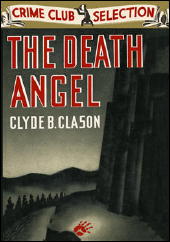
Cyril Delavanti

   Of Clason’s ten novels I’ve only read three, the earliest being THE DEATH ANGEL (1936). On a visit to a friend’s estate in southern Wisconsin while local farmers are staging a violent milk strike, Westborough is deputized by the sheriff after his host first receives a threatening note signed “The Firefly” and then vanishes.

   The professor investigates the series of attempted murders that follow and encounters two clever ways of setting up a perfect alibi and perhaps a bit too much information about archery, mushrooms and the theory of electricity. Clason‘s characters tend to evade, drawl, growl, grunt, explode, supply, venture, persist, ejaculate and flare, but most of his said substitutes aren’t too outrageous and his plot convolutions are spectacular.

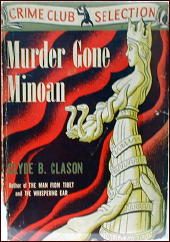
   The later Westborough novels tend to revolve around ancient or exotic settings. MURDER GONE MINOAN (1939) takes place on a private island off the California coast, owned by a Greek-American department-store tycoon with a phobia about the imminence of another Depression and a passion for the millennia-old Cretan civilization. When a priceless Minoan religious image disappears from the tycoon’s Knossos-like palace, Westborough is asked to investigate and encounters a mess of amorous intrigues and two murders apparently committed by a devotee of the ancient Cretan snake goddess.
Cyril Delavanti

   The parts of the story told in transcript and document form are neatly handled, but the mind boggles at the amount of physical action this frail 70-year-old academic takes part in, and the solution he comes up with is hopelessly unfair (except to readers who can tell whether a particular classical quotation comes from the Iliad or the Odyssey). The said substitutes, plus a small army of exclamation points, are piled on with a vengeance.

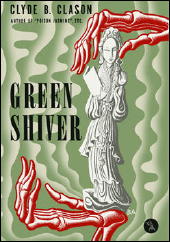
   In GREEN SHIVER (1941), Clason’s tenth and last detective novel, the place and time are southern California in early 1940. As in MURDER GONE MINOAN, the first crime is the theft of an exotic religious image, this time a jade Taoist goddess which vanished from the Oriental palace of an oil widow during a public exhibition of her treasures to benefit Chinese war refugees.

   Westborough, who is suddenly gifted with expert knowledge of ancient China as well as Greece and Rome, is offstage far more than in earlier Clasons but quickly gets involved in a bizarre double murder with occult overtones. The clumsy plot depends on an unplanned perfect alibi, but the Sino-Japanese war background is well evoked and Clason’s knowledge and love of Chinese philosophy and culture enliven every page.

***

   Have I been a little unfair to Clason? According to a slew of experts — Robert Adey, Jon Breen, Bob Briney and Randy Cox, just to name a few from the early letters of the alphabet — by far the finest of his ten novels is THE MAN FROM TIBET (1938), which I’ve never read. If I ever come across a copy, I’ll be sure to write it up in this column.
***

CLASON Murder Gone Minoan

In Clason’s MURDER GONE MINOAN, Westborough satisfies himself that a man claiming to be a fellow classics professor is an impostor by quoting a verse apiece from the Iliad and the Odyssey and not being corrected when he attributes each verse to the wrong epic poem. Somehow this incident brought back memories of other mysteries where the detective character used his specialized knowledge in the same general way.

   Perhaps the best known is found in “The Blue Cross,” the earliest exploit of G.K. Chesterton’s most famous character. At the climax Father Brown explains to the thief Flambeau, who is impersonating a priest, how from their dialogue he knew the other was a fake. “You attacked reason. It’s bad theology.”

   One of my favorite scenes of this sort — largely because it doesn’t require reader familiarity with specialized subjects like Greek poetry or Catholic theology — occurs in Rex Stout’s 1946 novelet “Before I Die.”

   Nero Wolfe is having dinner with a young man who claims to be a third-year law student. “I hope…that you are prepared to face the fact that very few people like lawyers,” Wolfe says. “I don’t. They are inveterate hedgers. They think everything has two sides, which is nonsense. They are insufferable word-stretchers. I had a lawyer draw up a tort for me once, a simple conveyance, and he made it eleven pages. Two would have done it. Have they taught you to draft torts?”

   â€œ…Naturally, sir, that’s in the course,” the young man replies. “I try not to put in more words than necessary.” That, as Wolfe explains at the denouement, was the tipoff. “A tort is an act, not a document, as any law student would know. You can’t draft a tort any more than you can draft a burglary.” “Before I Die” is one of the clumsiest of all the shorter Wolfe exploits but that single moment keeps it green in my memory.

Editorial Notes:   My review of Murder Gone Minoan can be found here. Curt Evans’ review of 8 Faces at 3 can be found here.
Reviewed by DAVID L. VINEYARD:         

DIPLOMATIC COURIER Tyrone Power

DIPLOMATIC COURIER. Fox, 1952. Tyrone Power, Patricia Neal, Stephen McNally, Hildegarde Neff, Karl Malden, James Millican, Stefan Schnabel, with Carleton Young, Dabs Greer, Russ Conway, Lumsden Hare, Charles Bronson, Lee Marvin, Michael Ansara. Narrated by Hugh Marlowe. Screenplay by Casey Robinson & Liam O’Brien, based on the novel Sinister Errand by Peter Cheyney. Directed by Henry Hathaway.

   One of the best spy films of the Fifties, this fast paced thriller directed by Henry Hathaway was shot extensively on location across Europe and races from Paris to Salzberg to the international city of Trieste (“What Lisbon and Istanbul were to the last war Trieste is to this one”), and a finale on the Simplon Orient Express.

   Tyrone Power is Mike Kells, a diplomatic courier tapped for a dangerous assignment almost before he can finish the one he is already on (a voice over by narrator Hugh Marlowe informs us the mission has been triggered by the most important message to be received by the State Department since the 38th Parallel was crossed in Korea — the Semper Project). He’s to board the Arlsberg Express out of Salzberg and meet fellow courier Sam Carew (James Millican) who will give him papers to deliver to Trieste.

   Nothing all that surprising save that they hand him a gun before he boards the plane.

   Normally he’s armed with a briefcase chained to his waist and in no more danger than flirting with attractive flight attendants and trying to fasten his seatbelt while chained to a briefcase.

   On the plane with him he meets attractive widow Joan Ross (Patricia Neal) whose shoulder he promptly falls asleep on. She immediately sets her elegant cap for him, but he keeps disappearing on her.

DIPLOMATIC COURIER Tyrone Power

   Could be a pleasant assignment after all, and it will be nice to see good old Sam again..

   But Sam is being followed and meeting with a mysterious blonde (Hildegarde Neff), and in short order is murdered by a pair of Russian thugs. Mike leaves the train to stay with the body, and Colonel Cagle (Stephen McNally) of military intelligence sets him out as a stalking horse with only military policeman Ernie (Karl Malden) to protect him.

   Now Kells is racing across Europe with spies on his trail, involved with beautiful stateless Janine (Hildegarde Neff), and wondering why Joan Ross keeps showing up.

   It all has to do with the papers Sam was supposed to give him — copies of the Soviet plan to invade and take over Yugoslavia.

DIPLOMATIC COURIER Tyrone Power

   Ernie and Cagle are the only people Mike can trust, and they are using him as a staked goat in a high stakes hunt. Someone murdered his friend, and now they are trying to kill him.

   In Trieste the stakes grow much higher, until the final confrontation with the head of Soviet intelligence in the West (Stefan Schnabel) in a compartment on the Orient Express with Soviet Agents on all sides.

   Henry Hathaway was one of film’s great entertainers, his films including everything from rousing adventures of the Raj like Lives of the Bengal Lancers; film noir like Kiss of Death, Dark Corner, and Call Northside 777; westerns like True Grit, Rawhide, and Garden of Evil; rollicking comedy/adventure like North to Alaska, suspense like 23 Paces to Baker Street and Seven Thieves; and docu-noir like The House on 92nd Street.

DIPLOMATIC COURIER Tyrone Power

   Power did several good films with Hathaway from Johnny Apollo to Brigham Young and the classic noir western Rawhide. You can watch the arc of his career across the Hathaway films alone, and see in this one the mature actor with WW II military experience behind him as well as critical success on stage in Mister Roberts. Here he is self assured, sensibly paranoid, and suitably tough, a fair distance from the male ingenue of Johnny Apollo.

   It’s an assured star performance by an actor at the top of his game.

   This is a fast paced hard nosed spy drama that keeps much of the plot of Peter Cheyney’s novel (first of two featuring Mike Kells, the other is Ladies Won’t Wait) changing the hero from British to American (ironic considering it’s Peter Cheyney famous for using the faux American voice), Cheyney’s ruthless spy boss Peter Quayle to Stephen McNally’s Colonel Cagle, and Cheyney’s cheerful Belgian hit man Ernie Guelvada into Karl Malden’s military policeman Ernie (actually it’s perfect casting either way).

   Cheyney’s penchant for elegant deadly ladies is kept intact. Both Neal and Neff are sexy and suitably dangerous, and it is relatively late in the film before you know which side, besides their own, either is on.

   Both Neal and Neff have strong scenes and handle them well. Neal in particular walks a thin line between comedy and drama and has a great last line.

DIPLOMATIC COURIER Tyrone Power

   Diplomatic Courier has the advantage of a big budget, a first rate supporting cast, a strong script and storyline, beautiful cinematography by Lucien Ballard, taut direction by Hathaway, and attractive leads at the top of their form. It’s not particularly serious, but it is rapidly paced, handsomely shot, and the kind of sure fire entertainment that the big studios did with casual brilliance.

   Look quickly for Dabs Greer, Lee Marvin, Charles Bronson, and Michael Ansara all unbilled in the credits. Greer has no lines and Bronson’s only line is in Russian.

   I think you will be impressed by this one. It’s an exciting slick spy film that is smart and entertaining, and hardly takes a pause for breath from the opening to the finale. You’ll be almost as breathless as Power’s Mike Kells by the time you get to the end. It may not be quite in a class with films like The Third Man, Five Fingers, or North By Northwest, but it is top notch entertainment all the way.

DIPLOMATIC COURIER Tyrone Power

THE BACKWARD REVIEWER
William F. Deeck


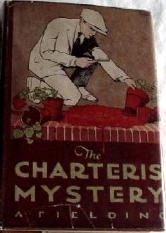
A. FIELDING The Charteris Mystery

A. FIELDING – The Charteris Mystery. Collins, UK, hardcover, 1925. Knopf, US, hardcover, 1925; A. L. Burt, US, hardcover reprint, no date.

   The first third of this novel made me wonder why I hadn’t discovered this author long before now. Some amusing and interesting characters and a complex crime start things off well.

   When a beautiful young lady is found in a quarry with a broken neck, the local M.D, and the authorities are ready to write the death off as misadventure. A few people who knew her well — and, ignoring their knowledge, liked her — have doubts about the death being an accident.

   Despite his being a master of disguise and coming to the case as fully equipped as Dr. Thorndike, Chief Inspector Pointer is an acceptable investigator. Called in unofficially, he discovers that the girl’s demise was a homicide.

   From this point, the book deteriorates into a thriller with too much unlikely melodrama. I’1l try another Fielding novel, even one featuring Pointer, but I’1l have my fingers crossed.

— From The MYSTERY FANcier, Vol. 12, No. 2, Spring 1990.


Editorial Comment: The name behind the “A. Fielding” byline was a subject of several posts on this blog when it first started. The current consensus seems to be that her real identity was one Dorothy Feilding, 1884-? You may use the search box over in the right hand column, or go here for the single post that summarizes the discussion the best.

REVIEWED BY WALTER ALBERT:         


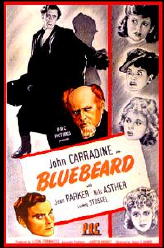
BLUEBEARD John Carradine

BLUEBEARD. PRC, 1944. John Carradine, Jean Parker, Nils Asther, Ludwig Stössel, George Pembroke, Teala Loring, Sonia Sorel. Director: Edgar G. Ulmer.

   John Carradine plays a disturbed puppeteer dubbed “Bluebeard” by the Parisian tabloids in this stylish, low-budget film. In the twenties Ulmer worked as a production designer on films directed by F.W. Murnau and Fritz Lang,and the theatrical-looking studio sets (including what appears to be a cardboard cutout of Notre Dame) are appropriate to this study of a deranged artist.

   The most striking visual effect is a shot of the puppeteer’s eye peering out balefully at the audience in the park- and, coincidentally, at the theater audience. It reminds me of a shot in Lang’s You Only Live Once (1937) in which the blind covering the rear window of a menacing black automobile parts to reveal a pair of eyes, the face covered as if by a mask in an imaginative use of the melodramatic convention of the hooded villain.

   Carradine plays the role of the artist/murderer with great restraint, and his long face and mournful eyes, wedded to his rich but monochromatic voice, give to his performance the haunting — or haunted — look of a fallen angel.

— From The MYSTERY FANcier, Vol. 6, No. 3, May-June 1982.


REVIEWED BY DAN STUMPF:


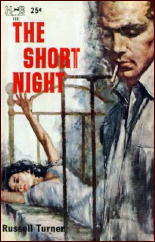
RUSSELL TURNER – The Short Night. Hillman #103, paperback original, 1957.

RUSSELL TURNER The Short Night

   One of the genuine pleasures of grubby old paperbacks is picking up something you never heard of because you like the cover or the set-up on the back, and opening it to discover you are reading a little gem, a happy experience I had with The Short Night, by Russell Turner.

   This is something like a cross between what they call a “tale of Romantic Suspense” and a Gold Medal Original: tough, fast-moving and violent, but when you come right down to it just a story of True Love. Red Dolsan is a middle-aged scout for the Dodgers, recently widowed and just back home after traveling for months who learns in quick succession that he may have fathered a child in a one-night stand with a lonely young woman , and that this child could become the legal heir to a sizable (in 1957) fortune, a turn which would give conniptions to the witchy mother-in-law who caused his wife’s suicide but blames Red for it — frequently and at the top of her voice.

   Red also quickly finds that this ain’t gonna be simple; the lonely young woman has disappeared, and as he starts looking for her he finds himself wading into colorful complications that include threats, small-time crooks, gratuitous violence, a quirky PI, the Feds, and one of the most engaging mysterious ladies I’ve ever come across in crime fiction.

   Turner spins this out neatly, peopling it with bit players who come alive on the page and throwing in suspenseful twists and the occasional slug-fest just to keep it lively. He also evokes a telling picture of the 50s, when a three-room Manhattan apartment with a balcony cost the outrageous sum of $350 a month, a man could be thrown out of Organized Sports for scandalous conduct (like fathering a child out of wedlock) and folks wondered if there was anything to all this talk about cigarettes and cancer. And he paints a picture just as vivid and true of a man who finds himself falling in genuine love — with someone who may be setting him up for blackmail.

   I closed this one with a great deal of satisfaction and ran to the computer to tell everyone about how I had discovered a talented unknown who deserved a bigger, better reputation — only to find that “Russell Turner” was one of the pen names used Leonard S. Zinberg — better known as Ed Lacy!

REVIEWED BY MICHAEL SHONK:


“Ring of Kings, Ring of Thieves” From The Devlin Connection, 27 November 1982. NBC/Jerry Thorpe Production and Mammoth Films in association with Universal Television. Cast: Rock Hudson as Brian Devlin, Jack Scalia as Nick Corsello and Louis Giambalvo as Lt. Earl Borden. Guest Cast: Emory Bass, Stepfanie Kramer. Written by Rudolph Borchert. Directed by Jeff Bleckner. Created by John Wilder. Executive producer: Jerry Thorpe.

   YOUTUBE SPECIAL: As with any YouTube.com link watch it before it disappears.

   Brian Devlin was a successful PI who retired and now is the Director of the Cultural Arts Center in Los Angeles. One day Brian is visited by the son he never knew he had, Nick Corsello. Nick wants Brian’s help starting his own PI agency. Brian finds occasionally helping Nick is a good way for Dad and son to get to know each other.

   The series began October 2, 1982, and aired Saturday at 10-11pm on NBC. Opposite on ABC was FANTASY ISLAND and the last hour of the CBS SATURDAY NIGHT AT THE MOVIES.

   I avoided this series when it was first on because of the cast, especially Scalia, but found this episode an entertaining spoof. While the episode was a typical 80’s TV mystery with believability issues, from the opening scene you get the sense that the show knew it and was having fun as mindless entertainment.

   In “Ring of Kings, Ring of Thieves” Devlin finds himself the center of attention after he buys a gift at a jewelry store, so he hires Nick to check out those following him.

   The opening is missing from the episode so a link to the series opening (from unknown episode) is here.

      RECOMMENDED READING

The Rap Sheet: http://therapsheet.blogspot.com/2010/09/killed-in-ratings-devlin-connection.html

THE BACKWARD REVIEWER
William F. Deeck


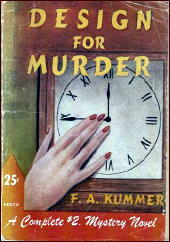
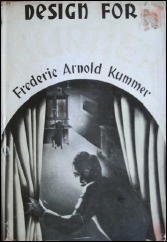
F A KUMMER Design for Murder

  FREDERIC ARNOLD KUMMER – Design for Murder. Lothrop, Lee & Shepard, hardcover, 1936. Arrow Mystery Novel #11, digest-sized paperback, no date [1944].

   Stephen Ransom, a playwright who has written not necessarily a successful but at least a produced play about a detective, is invited to lunch at the home in Washington, D.C., of Mrs. Thomas Kirby, wife of a prominent United States Senator. There Ransom meets Ann Vickers, an interior decorator who is living in the Kirby house while redecorating it. Jokingly he and she discuss a plot for a burglary and the murder of Mrs. Kirby for her jewels.

   That night Ransom returns to the house, for reasons the author does not make persuasive, and notices someone leaving by a window. He investigates, of course, and finds that Mrs. Kirby has indeed been murdered. Vickers, who had overheard some peculiar dialogue and had heard the clock strike twelve when it was still fifteen minutes before the hour, also comes down to investigate.

   It is obvious to Ransom that Vickers couldn’t have done it; she’s too attractive. It is patent to Vickers that Ransom couldn’t have done it; he, after all, has humorous eyes and rust brown hair.

F A KUMMER Design for Murder

   Near the end of the novel Vickers remembers more about what she heard just before Mrs. Kirby’s death. Unfortunately, she won’t mention it over the phone, and thus we are vouchsafed the seemingly obligatory scene of the heroine placing herself in the best, maybe the only, position for the murderer to get at her for foul purposes.

   Create credulity, which is more than the author could do, and you may be able to enjoy this one.

— From The MYSTERY FANcier, Vol. 12, No. 2, Spring 1990.


Note: For some information about the author, fairly prolific in his day, you might wish to check out John Norris’s blog here, where he reviews The Scarecrow Murders, the first of two recorded cases of Judge Henry Tyson. John liked it considerably more than Bill Deeck cared for this one.

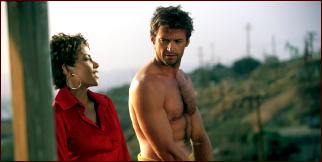
SWORDFISH. Warner Brothers, 2001. John Travolta, Hugh Jackman, Halle Berry, Don Cheadle, Sam Shepard, Vinnie Jones, Camryn Grimes. Directed by Dominic Sena.

SWORDFISH Halle Berry

   As a recently released felon, famed computer hacker Stanley Jobson (Jackman) is recruited by the beautiful and alluring Ginger (Halle Berry) to work for the mysterious (and ruthless) Gabriel Shear (Travolta). Needing money to help regain custody of his young daughter (Camryn Grimes), Stanley accepts, and during the rest of the movie he learns to regret his decision, many times, over and over again.

   This is pretty much one of those movies where you are better off not asking questions and sitting back to enjoy the ride. If, that is, you are not bored with watching someone typing at a keyboard and pretending they are breaking into various money accounts scattered around the world. The less-meaningful (but eye spectacular) action that takes place is largely confined to a mini-prologue that works about as well as anything in the movie (a bank under siege with hostages wired to blow up) and in the last thirty minutes or so, when all of the safety latches are set free.

   Lots of large-scale explosives going off, in other words. Cars careening around busy city streets and smashing into each other, large guns being fired and causing all kinds of havoc, and tons of other vehicles of several makes and models veering out of control and smashing into tall buildings and on several different levels. That still leaves an hour to fill, which of course does not mean there are not plenty of bad guys willing to do all kinds of bad things in those remaining sixty minutes.

   Travolta and Jackman have the good parts, and both do well in them, with Travolta taking (in my opinion) top honors as a truly Machiavellian mastermind, over the top and subtly clever at the same time. Amazing. (Unfortunately, with the need for pyrotechnics to keep the action crowd happy, “over the top” seems to prevail, more often than not, over common sense.)

   Halle Berry appears too aware of herself to be truly sexy, but those commentators who have described her much-maligned topless scene as “gratuitous” should watch the movie again.

   Or if not, at least the ending. (Think subtle.)

— August 2004

REVIEWED BY WALTER ALBERT:         


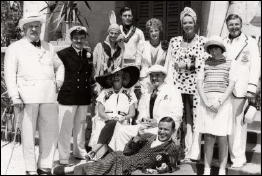
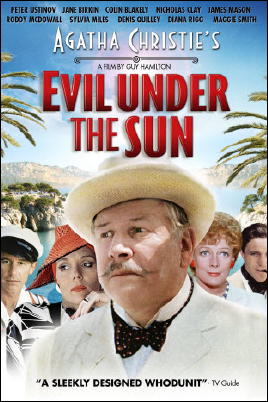
EVIL UNDER THE SUN. Universal, 1982. Peter Ustinov (Hercule Poirot), Colin Blakely, Jane Birkin, Nicholas Clay, Maggie Smith, Roddy McDowall, Sylvia Miles, James Mason, Denis Quilley, Diana Rigg. Based on the novel by Agatha Chrsitie. Director: Guy Hamilton.

EVIL UNDER THE SUN

   In a recent issue of the Times Literary Supplement, Julian Symons complained mightily about the betrayal of the Christie novel on which this is based. Chris Steinbrunner, in the July 1982 EQMM, recognized the tinkering with the novel but thought the result was splendid.

   I haven’t read the novel, but, apart from competent performances by good actors — of whom the most amusing are Peter Ustinov, Maggie Smith, and Diana Rigg (whose archness is, however, beginning to wear thin) — good tunes by Cole Porter attractively orchestrated by John Lanchbery, and handsome location filming on Majorca, there is no reason to pay more than a bargain matinee admission for this film.

   It is too long, the narrative sags intermittently as the camera doodles across the landscape and sets, and there is the curse of a campy performance by Roddy MacDowell as a critic who is probably modeled on the insufferable Rex Reed.

   This might warm you if there’s a blinding snowstorm outside, but this is television fare dressed up as a big screen offering.

— From The MYSTERY FANcier, Vol. 6, No. 3, May-June 1982.


EVIL UNDER THE SUN

« Previous PageNext Page »