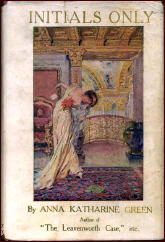
ANNA KATHARINE GREEN – Initials Only. Dodd Mead, hardcover, 1911. Hardcover reprint: A. L. Burt Co.
Mrs. Rohlfs’s latest story [see FOOTNOTE] is distinguished by the small number of people involved and by the consequent narrowing and intensifying of interest upon the criminal and the detective, the latter being our old friend [Caleb] Sweetwater, acting under the aid of our older friend [Ebenezer] Gryce.
Outside of her skill in weaving a plot Mrs. Rohlfs has few of the novelist’s virtues, and her attempt in the first part of this book to narrate events at second-hand through the mouth of a woman who has nothing to do with the plot is extremely awkward. However, this useless device is soon dropped, and the rest of the story proceeds naturally to its ruthless end.
In no other of her stories has she presented a stronger character than [SPOILER DELETED], who is hounded by the relentless Sweetwater, and his character is not extraneous to the plot but essentially involved.
There is a bit of unfairness in the climax which does not come — as it should come in the legitimate detective story — from the direct game of pursuit and evasion.
FOOTNOTE: From Wikipedia: “On November 25, 1884, Green married the actor and stove designer, and later noted furniture maker, Charles Rohlfs, who was seven years her junior.”
Thanks once again to to Mike Tooney, who first uncovered this review and posted it to Yahoo’s Golden Age of Detection group.
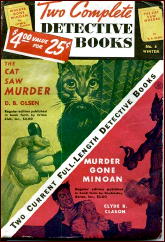
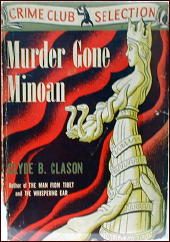
CLYDE B. CLASON – Murder Gone Minoan. Rue Morgue Press, trade paperback, 2003. Original hardcover: Doubleday Crime Club, 1939. Pulp magazine reprint: Two Complete Detective Novels, Winter 1939-1940 (with The Cat Saw Murder, by D. B. Olsen). Hardcover reprint: Sun Dial Press, 1940.
Checking on www.abebooks.com just a few minutes ago, I found only one copy of the Crime Club edition for sale: Near Fine in a Near Fine jacket. Price: a mere $250.00. Further searching revealed a few other copies on other venues, one being a former library copy with no jacket. Price: a much more reasonable $35.00.
But if $14.95 is all you want to spend, this handsome trade paperback will do very nicely. This is but one of many classic mystery reprints coming from Tom & Enid Schantz of Rue Morgue Press, and they should be commended for a job well done, and for jobs yet to be done. (At the moment, the only other Clason title they’re published is The Man from Tibet, but perhaps others are on their way. Only sales will tell, I imagine.)
Only one thing is lacking, before I continue, and that is the original cover art, which as I recall was by Boris Artzybasheff. That gentleman no longer being available (or affordable) a fine piece of work by Rob Pudim was used in his stead. To my eye it’s a bit cluttered, but it Does Catch the Eye.
Clason’s series detective is an eminent Roman historian named Theocritus Lucius Westborough — Westborough for short — who also has earned a well-deserved reputation as a private investigator on the side. If this book is an example — which from my point of view it has to be, at least for the moment, since if I ever read an earlier book in the series, it was long ago and long forgotten — Westborough’s adventures are copiously filled with well-researched lore of ancient times, interspersed with mini-lectures on the same.
I’m jumping the gun here, but it’s Westborough’s knowledge of ancient history that helps crack a killer’s alibi — which is not quite fair to the reader not recently tutored in such matters — such as myself, I have to admit — but it’s a sizable step above nabbing a villain who reveals himself because he’s not aware that buildings do not have thirteenth floors, for example.
Just in passing: There is a deliberate misstatement on my part that is not quite correct in the last sentence of the previous paragraph, but if I were to speak more clearly, I would be revealing more of what Clason had up his sleeve than I should.
This, the seventh of ten cases Westborough is on record as having solved, takes place on an isolated island off the southern California shore, where first a valuable artifact is stolen — and Westborough called in — and then murder, when a missing butler is later found dead.
The owner of the island, a rich Greek businessman named Paphlagloss, is fascinated with the ancient Minoan culture, pre-historic Cretans whose civilization arose and fell even before the ancient Greeks, and his mansion is filled with valuable relics, artwork and jewels. Just the right place for skullduggery to be done, and with only a handful of suspects, one of whom is responsible for doing the dugging, it’s a perfect setting for a mystery.
Clason’s strength is in his characters and their dialogue. To my ears, the lengthy reports of letters and verbatim interviews of suspects are close to perfect. Other parts of the tale are excellent, while others, contrarily, are pure fuddle-muddle.
I like the following quote, for some reason, taken from pages 160-161. Paphlagloss’s daughter is having a private conversation with Westborough:
She shivered and drew the wrap closely to her slim body. “Why do things have to be in such a perfect devil of a mess?”
His mild eyes peered distressfully through his gold-rimmed spectacles. “The question, I should conjecture, has been propounded rather frequently during the four thousand years of recorded history. However, I am unable to recall a single instance where it was answered satisfactorily.”
“You are very wise!” she exclaimed.
He shrugged deprecatorily. “My wisdom is confined to a single fact. I have lived long enough to learn that most of my fellow creatures — and myself, as well — must of necessity be a little foolish.”
“What would you advise me to do?”
“I dare not advise you, my dear. The situation is too delicate. As delicate,” he added thoughtfully, “as the ripples of a Chinese nocturne.”
While it’s great to have this small gem of the Golden Age of Mysteries back again in print, I also have to suggest that it didn’t then, and it doesn’t now, have the staying power of one by a Queen, Christie, or a John Dickson Carr. Even so, and within its limitations, it is a gem in its own right, and no, they don’t write them like this anymore.
— January 2004
[UPDATE] 09-05-13. Checking on abebooks again just now, I found nine copies of the Crime Club edition for sale, ranging in price from $25 (bumped and frayed) to $300 (almost fine in jacket). Rue Morgue Press has a long informative profile of Clyde Clason, the author, and seven books in the Westborough series are now available from them. See below.
CLYDE B(urt) CLASON, 1903-1987.
The Death Angel (n.) Doubleday 1936. RM = Rue Morgue Press.
The Fifth Tumbler (n.) Doubleday 1936.
Blind Drifts (n.) Doubleday 1937. RM
The Purple Parrot (n.) Doubleday 1937. RM
The Man from Tibet (n.) Doubleday 1938.
The Whispering Ear (n.) Doubleday 1938.
Dragon’s Cave (n.) Doubleday 1939. RM
Murder Gone Minoan (n.) Doubleday 1939. RM
Poison Jasmine (n.) Doubleday 1940. RM
Green Shiver (n.) Doubleday 1941. RM
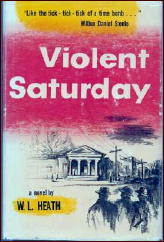
VIOLENT SATURDAY. 20th Century Fox, 1955. Victor Mature, Richard Egan, Stephen McNally, Virginia Leith, Tommy Noonan, Lee Marvin, Margaret Hayes, J. Carrol Naish, Sylvia Sidney, Ernest Borgnine. Based on the novel by William L. Heath. Director: Richard Fleischer.
It took me a long time to catch up with Violent Saturday, which I saw on local TV in the 60s, pretty badly cut up. At the time I thought it a compact little gem of a film, but seeing it again recently at last, I find it’s the kind of film that needs to be badly cut up.
There’s a fine little Heist Movie at the heart of it, and when three exemplary Heavies like Stephen McNally, J. Carroll Naish and Lee Marvin finally square off against Victor Mature, the film snaps, crackles and pops with excitement. Unfortunately, it takes about eighty minutes of Nothing Very Much to get around to it.
I recommend the book, by the way, a nifty little novel by W. L. Heath (Harper, 1955; reprinted by Black Lizard, 1985) that brings life to small-town characters reduced to Soap Opera status in the film.
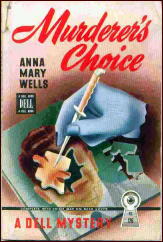
ANNA MARY WELLS – Murderer’s Choice. Alfred A. Knopf, hardcover, 1943. Dell #126, paperback, mapback edition, no date [1946]. Perennial Library, paperback, 1981.
Charles Osgood, famous mystery writer and creator of Silas Smith, bucolic detective, is one of those, it is to be hoped, rare mystery writers who are nasty characters in their own right, and maybe write.
Charles tells his cousin, Felix Osgood, whom he obviously dos not like, that he, Charles, is ging to commit suicide in such a way that the death will seem like murder. Charles also says he will leave clues pointing to Frank.
He adds that be is leaving everything to Frank in his will and has made him the beneficiary of a large insurance policy so that everyone will know who gains by the death. Frank, Charles tells him, will be charged with homicide and executed.
Charles does indeed die, but the death is considered natural. Frank, who has waited nervously for the ax to fall and the evidence to make its appearance, can wait no longer. He hires the Keene Detective agency to look into his cousin’s death, and the agency assigns Grace Pomeroy, a new employee and a former nurse, to the case.
Well written but requires a good deal of suspension of disbelief.
— From The MYSTERY FANcier, Vol. 12, No. 2, Spring 1990.
BIBLIOGRAPHY — [Taken from the Revised Crime Fiction IV, by Allen J. Hubin.]
ANNA MARY WELLS [aka Anna Mary Wells Smits, at one time an associate professor of English at Douglass College], 1906-2003.
A Talent for Murder (n.) Knopf 1942 [Dr. Hillis Owen; Grace Pomeroy]
Murderer’s Choice (n.) Knopf 1943 [Grace Pomeroy]
Sin of Angels (n.) Simon & Schuster 1948 [Dr. Hillis Owen; Grace Pomeroy]
Fear of Death (n.) Wingate 1951
The Night of May Third (n.) Doubleday 1956
Editor’s Note: John F. Norris reviewed this same book over on his blog a couple of years ago. Check it out here.
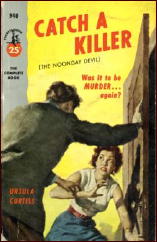
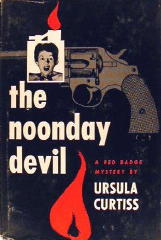
URSULA CURTISS – Catch a Killer. Pocket 940; 1st printing, June 1953. Hardcover edition: Dodd Mead, 1951, as The Noonday Devil.
It’s my guess that every time one of Ursula Curtiss’s books is reviewed today, it begins with the observation that her mother was mystery writer Helen Reilly, and that her sister was mystery writer Mary McMullen. (And equally obviously, I’m no exception.) It must have been in the genes, but during the time when all three were actively writing (Reilly from 1930 to 1962; Curtiss from 1948 to 1985, with a posthumous collection of short stories; and McMullen from 1951 to 1986), do you suppose that anyone ever asked them what was in the water they were drinking?
While Helen Reilly had a series detective who appeared in most of her books, Inspector McKee of Manhattan Homicide, Ursula Curtiss and Mary McMullen, were heavy practitioners of (suburban?) domestic malice and/or romantic suspense, and neither of them (as far as I know) used a repeating character in any of their books.
As far as Curtiss is concerned, this is the only book of hers I’ve read. So far. In any case, what you expect is not always what you get. In Catch a Killer, for example, I was surprised (although not nonplussed) to discover that the leading character is male, and that the story begins in Manhattan. I had the uneasy feeling that I was leaning one way, and the book, with Curtiss in charge, was going another.
In the second half of the book, though, the scene changes, and rather drastically. Under some pretext or another, all of the leading characters seem to find their way to the same small country town in New England, and when they do, everything seems to revert to normal. (By which I mean, closer to what was expected, if not anticipated.) And as a direct consequence, perhaps with the characters’ closer proximity to each other, the action seems to pick up as well.
The atmosphere is dark, introspective and moody throughout. And coincidences simply thrive in such climates, beginning as they do here, in Chapter One. When you walk into an unfamiliar bar for the first time, for example, you never know whom you’ll meet, and that’s where Andrew Sentry finds a man who had been in the same Japanese prison camp as his brother Nick – an encounter occurring only by chance.
Nick, as it happened, died in a fatal attempt to escape, and his death, Andrew for the first time is now told, was no accident. There was an informer – someone Nick knew. Someone who told their guards of Nick’s plans, which were then foiled. This is an unusual (if not unique) means of killing someone, but who was the mysterious man who called himself Sands, and what was his motive?
When Andrew came to break the news of Nick’s death to Sarah, it is revealed, he found her kissing another man, and he has not spoken to her since. And since the case for murder is so flimsy, the police cannot be called in, which limits Andrew’s resources to himself and whoever he feels he can trust, the list of whom changes chapter by chapter.
And so does the reader’s grip on the story, or vice versa, the story’s grip on the reader. Excellent characterizations are mixed helter-skelter with a plot that’s held together with a strong brand of duct tape. Nonetheless, New England summer towns can be filled with as much malice as large population centers such as Manhattan, and the generally capable touch of Ursula Curtiss goes a long way in proving it.
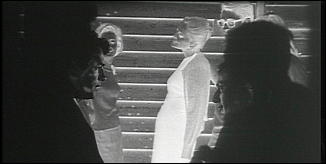
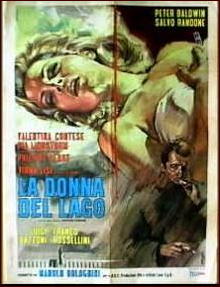
LA DONNA DEL LAGO [or THE LADY OF THE LAKE]. B.R.C. Produzione S.r.l., Italy, 1965. Released in the US as The Possessed. Peter Baldwin, Salvo Randone, Valentina Cortese, Pia Lindström, Piero Anchisi, Virna Lisi. Directors: Luigi Bazzoni & Franco Rossellini.
Not too long ago I saw a movie I’ve been trying to see again for nigh unto thutty year: The Lady of the Lake — NOT to be confused with The Lady in the Lake, Robert Montgomery’s pretentious film of Chandler’s novel. This is an Italian movie from 1965, written and directed by Luigi Bazzoni, whoever-the-hell he is.
I first saw it on TV in the godless hours of the morning between Three and Five, sometime in 1973, badly dubbed, under the unlikely title Love, Hate and Dishonor. I was quite drunk at the time, and I remembered the film as a perversely fascinating mix of Hard-Boiled Mystery and Surreal Story-Telling, tinged with Uneasy Kinkiness — a bleary conviction piqued over the years when I found no mention of the film in any reference book, no repeat viewings of it on TV, or even anyone else who professed to have seen it.
So Love, Hate & Dis remained a personal fetish till I finally saw La Donna Del Lago panned in Phil Hardy’s Encyclopedis of Horror Films and recognized the story and stars. An Ethan-Edwards-like search of film conventions and the Net finally yielded up a watchable copy from a Miami dealer, and I returned at last to this relic of my mis-squandered youth.
And oddly enough, it seemed just as remarkable to this sober nearly-middle-aged man as it did to the drunken tad of whom I am a biological extension. The plot is a simple affair: A disaffected writer breaks up with his girlfriend and decides on a whim to revisit the resort where last Summer he had a pleasant romp with a hotel maid, Tilda (Virna Lisi).
Only it’s Winter now, the Hotel is near-empty, Tilda’s dead, and as the wind howls across the icy lake, our hero wanders through a gaudy ghost town, and he learns that her death was ruled a suicide — in the same coroner’s report that says she died a virgin.
From a fairly standard tale of murder-and-cover-up, Bazzoni crafts a truly mysterious film, full of tricky imagery and shifting narrative. A walk through a snow-capped graveyard suddenly morphs into a flashback that gradually resolves into a dream. Bit-players ooze about with eerie unction, just on the verge of saying too much, and something always seems to be happening, or about to happen, somewhere in the background, just almost out of sight.
It’s easy to see why Hardy included this in his Horror Films book — though it offers no ghosts, monsters, blood or violence — and just as easy to see why he failed to come to terms with its unique style of tale-spinning. There aren’t many things that look just as good on the sober Morning After, but this is one I’ll come back to.
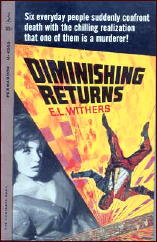
E. L. WITHERS – Diminishing Returns. Holt Rinehart & Winston, hardcover, 1960. Permabook M-4203, paperback, 1961.
Six people are having a nightcap. All are poisoned, but only one dies. Then the other five start dying one by one the next time they get together in ways that are made to appear accidental.
An excellent plot here. Unfortunately, Withers is not able to carry it out without gaping flaws.
The poison used in the first instance is arsenic, which the author thinks acts almost immediately upon ingestion. There is no explanation for the efforts to make the later deaths appear to be accidents when it is obvious — well, fairly obvious — that the poisoning was murder. One “accidental” death is from a broken neck; possible, to be sure, but most unlikely as described. There are other problems that will be left to the keen-eyed reader to spot.
To make up for the somewhat strained logic, Withers provides a most delightful detective — this is his only appearance, alas — named Weatherby, who seems to have no first name.
Weatherby is a retired lawyer, probably a septuagenarian, who likes to sleep until noon and stay up late, who smokes a lot and drinks a great deal, leading to “a slight fuzziness which was always urbane and gentle and good-humored.” He also has no desire “to walk when he could stand still, or to stand still when he could sit, or to sit when he could recline.”
Read this for the “little old man” detective.
— From The MYSTERY FANcier, Vol. 12, No. 2, Spring 1990.
Bibliography: (Taken from the Revised Crime Fiction IV, by Allen J. Hubin.)
E. L. WITHERS. Pseudonym of George William Potter, Jr., 1930-2010.
The House on the Beach. Rinehart 1957
The Salazar Grant. Rinehart 1959
Diminishing Returns. Rinehart 1960
Heir Apparent. Doubleday 1961
The Birthday. Doubleday 1962
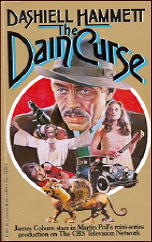
THE DAIN CURSE. CBS – Martin Poll Productions. Based upon the novel by Dashiell Hammett; developed for television by Robert W. Lenski. Producer: Martin Poll. Director: E.W. Swackhamer. Cast: James Coburn as Hamilton Nash, Nancy Addison as Gabrielle Leggett, Bernice Straight as Alice, Jean Simmons as Aaronia, Jason Miller as Owen, Hector Elizondo as Sheriff Feeney and Brent Spiner as Tom Fink.
PART ONE – MAY 22, 1978 – MONDAY AT 9-11 PM (Eastern)
PART TWO – MAY 23, 1978 – TUESDAY AT 9-11 PM
PART THREE – MAY 24, 1978 – WEDNESDAY AT 9-11 PM
THE DAIN CURSE features three stories – a simple diamond robbery that reveals a complex mystery involving drugs, child abuse, blackmail and various murders; a con using a religious cult that ends with death; and a middle aged PI who must overcome his attraction to a young innocent girl and save her from the evil around her.
THE DAIN CURSE originally appeared as four separate Continental Op stories in Black Mask magazine. Hammett would rework the four stories (“Black Lives†November 1928, “The Hollow Temple†December 1928, “Black Honeymoon†January 1929 and “Black Riddle†February 1929) into a three-part novel (Knopf, 1929). While it was a critical and commercial success when first published, time has not been kind to one of Hammett’s weakest work. The book suffers from its clumsy structure, its padded overly complicated story and a weak ending.
The TV adaptation by Robert W. Lenski would win him an Edgar award and an Emmy nomination (losing to HOLOCAUST writer Gerald Green). Surprisingly, there was no writer credit on screen, instead Lenski received a developed for television credit. Perhaps this was because he stayed loyal to the book and its structure. But changes were made, some were wise, others not.
Characters such as Minnie the maid’s boyfriend and many red herrings were wisely dropped. The end of each part was changed. Hammett ended each part with the dramatic closure of that part’s case. Lenski knew each TV episode would need a cliffhanger ending to bring back the viewer for the next night. For example, he followed the book closely, but ended Part One with something that happened in Part Two – The Temple, drugged Gabrielle confessing to murder.
Many of the changes were minor such as changing the Continental Detective Agency to Dickerson National Detective agency and moving the action from the California coast to the East coast and “The City†(New York).
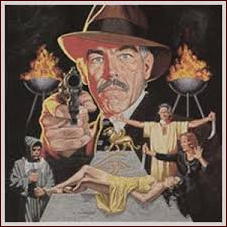
The most notable change was replacing Hammett’s Continental Op with PI Hamilton Nash played by James Coburn. The well-dressed Ham owed more to the crime-fighting image of Dashiell Hammett than to the Continental Op. While Coburn would have been a terrible choice to play the Op, he was perfect as the thin, handsome, more energetic PI Hamilton Nash.
Hammett’s Continental Op appeared in 36 short stories (four would make up Hammett’s first novel RED HARVEST, and four became THE DAIN CURSE). The Op was the visual opposite of TV PI Hamilton Nash. He was a short, overweight (180 lbs), ugly, middle-aged man. He had no life outside of his work. Hammett never even gave him a name. It was this image that made the relationship between the Op and the young victim Gabrielle so important to the tone of the book. It added to the creepiness of the all ready odd mystery as the Op got deeper into Gabrielle’s life, resisting and denying his growing attraction to her and her growing dependence on him, a favorite older Uncle who was fighting inside his desires for the young innocent girl.
Hamilton Nash had a past he hid from others. To keep his noisy boss satisfied (you would think the boss of a detective agency would know the past of his employees) Ham claimed he had an ex-wife who had run off with the milkman because he was never at home. Coburn with his leading man looks and thin athletic body did not seem as wrong for young but adult looking Nancy Addison as the Continental Op did for the virginal Gabrielle.
But Coburn’s Hamilton Nash did share the cynical soul of the Op, as well as the Op’s obsessive personality, his deductive talents, and his fatalistic acceptance of injustice. According to Nash, criminals had invented justice. Nash had no problem leaving a case the client thought solved, even when he knew better.
Nancy Addison had the difficult role of the freaky Gabrielle. Her scenes with Coburn brought to life Hammett’s Gabrielle’s feelings for the older PI who was always there to save her. To her Nash was a protector not a potential lover.
The rest of the cast, especially Jason Miller and Jean Simmons, captured Hammett’s characters well in their performances. Early in the book, Mrs. Alice Leggett was described as being serene and the only sane soul in the Leggett’s household. This played a role in the story. Bernice Straight performance failed to capture that aspect of Alice, but her performance did get her an Emmy nomination for single performance by a supporting actress in a comedy or drama series (she lost to HOLOCAUST Blanche Baker).
E.W. Swackhamer’s direction was worthy of the Emmy nomination he received (he lost to HOLOCAUST director Marvin J. Chomsky). He kept the characters moving to give a sense of energy and tension to the slow paced twisty story. In Part One’s denouement scene, several people filled the lab of the dead man. Nash refused to believe the letter left by the man was a suicide note. Swackhamer had Nash restlessly moving around the room while the rest stay still. As Nash declares the man was murdered, he moves out of the shot (but not out of the room) leaving the camera focused on the reactions of the rest of the people there.
Production values for THE DAIN CURSE were average at best, but never let down the story. Music by Charles Gross reminded us the time was 1928, and added a nice noir sound when needed.
Following the success of the mini-series ROOTS, CBS had high expectations for THE DAIN CURSE. The ratings for the first night were a moderate success with a 37 share. But the ratings for the second and third night fell with each episode receiving a 30 share, OK but not the blockbuster numbers hoped for by CBS.
THE DAIN CURSE aired during the May sweeps, an important ratings period for the networks and its local stations. ABC, CBS, and NBC were going all out to attract viewers. Viewers not hooked by Part One of THE DAIN CURSE had other options, including one in syndication.
THE BASTARD (aka THE KENT FAMILY CHRONICLES) from Operation Prime Time (OPT) scrambled the regularly scheduled programs for that week. OPT was a group of independent TV stations who had united to finance programs from major studios. Produced by MCA/Universal, THE BASTARD was a four-hour mini-series scheduled to air over two nights. It proved a major challenge to THE DAIN CURSE when the two series aired against each other in many markets. Another problem for CBS and the other networks was THE BASTARD aired not only on 25 independent TV stations but also on network stations preempting network programs. THE BASTARD appeared on 14 ABC, 27 CBS and 25 NBC stations.
I would like to read THE DAIN CURSE in its original Black Mask format, but the original four stories reportedly have never been republished. The book was a disappointment. It was padded and told three weak stories instead of one strong one. The TV mini-series was never able to overcome the problems of the novel and added some of its own, most notably the effect casting played on the romantic spine of the story.
Sources:
Broadcasting Magazine – May 15, 1978, May 29, 1978, and June 5, 1978.
Editorial Comment: The first two videos consist only of clips from the show. I do not know if the bottom one is the complete mini-series or not, as I have not watched it to the end. I am suspicious about it, as it is only three hours long.
Also Note: Curt Evans reviewed the novel version of The Dain Curse earlier on this blog. Follow this link.
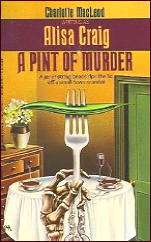
ALISA CRAIG – A Pint of Murder. Doubleday Crime Club, reprint hardcover, 1980. Detective Book Club, reprint hardcover, 3-in-1 edition. Bantam, paperback, 1981; Avon, paperback, 1988 (shown).
Of all the detective murder mysteries that have ever been committed in fiction, a small but sizable number of them have been tackled by a member of the Royal Canadian Mounted Police. Tackled and solved, of course. The Mounties always get their men, as everyone well knows.
Ms. Craig does nicely in adding to the total. The case is that of the food-poisoning death of a crotchety but scrupulously careful old lady in the New Brunswick town of Pitcherville. Inspector Madoc Rhys (a Welshman!) is the Mountie who is called in to investigate.
The story, well, it could be likened to a breath of fresh clear Canadian air, containing only the slightest bit of pollution, and that of the sort produced by the gossipy thoughts and attitudes of small village minds with nothing to rein them in.
This is also a book for those who do not mind a little romance mixing it up with their mystery fiction. By book’s end it quite definitely is clear that the Mounties almost always get their women as well.
Rating: C plus.
— Reprinted from The MYSTERY FANcier,
Vol. 4, No. 4, July-August 1980 (slightly revised).
Bibliographic Notes: This was the first of five books in the Alisa Craig’s Madoc Rhys series. Since I did not mention it at the time, I suspect that I did not know then what I know now: that Alisa Craig was a pen name of Charlotte MacLeod (1922-2005), who under her own name wrote both the Peter Shandy and the Sarah Kelling & Max Bittersohn series — among many other works of mostly humorous mystery fiction.
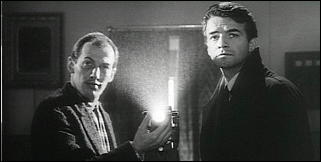
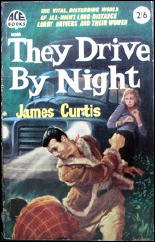
JAMES CURTIS – They Drive by Night. Jonathan Cape, UK, hardcover, 1938. John Lehman, UK, hardcover, 1948. Ace, paperback, date unknown (shown). London Books, UK, 2008. No US edition.
THEY DRIVE BY NIGHT. Warner Brothers-First National (UK), 1938. Emlyn Williams, Shorty Matthews, Ernest Thesiger, Anna Konstam, Allan Jeayes, Anthony Holles. Based on the book by James Curtis, who also wrote the screenplay. Director: Arthur B. Woods.
They Drive by Night is one of those rarities: a uniquely enjoyable book turned into a rather different but equally fine film.
The book details the travails of Shorty Mathews, a petty crook just out of gaol and anxious to return to his larcenous ways. He looks up some old mates, makes a few disparaging comments about a lady-friend currently working the streets and pays a call on said lady, only to find her brutally murdered.
Fearing the Police, Williams turns to his old partners in crime for help, is spurned by them, and takes it on the lam, hitching rides from friendly truck drivers plying the north and southbound roads through the rain-drenched night (hence the title of the piece) and narrowly escaping the pursuing authorities.
He runs into a co-worker of his murdered girlfriend — a hooker named Molly who works truck stops, hence a “Lorry Girl†— and eventually persuades her to help him. As they work to evade the law, thief and whore begin to develop feelings for each other and then . . . well that would be telling.
Curtis spins the tale in lively first-person cockney rhyming slang (as in loaf = head because bread would rhyme with head if you said bread so you say loaf instead. Get it?) dealing out action and suspense in equal measure along with some colorful characterization. One measure of an author is how much care he takes with the bit players, and Curtis meets the mark and then some, filling his tale with sharp cops, hard-edged crooks and working stiffs so real you can smell the sweaty armpits.
He also throws in one of the most real-seeming psychopaths I’ve ever encountered in literature or film: a character suffused with the shabby narcissism one finds in real-life criminals, brilliantly translated into prose. The chapters dealing with his lethal stalk through a seamy city offer a poetic realism and tense energy I’ll remember long after lesser (but better-known) serial slayers have gone their loony way. And if the wrap-up of the books is a bit prosaic, perhaps it’s all the more memorable for its tough-but-tender realism.
The British subsidiary of Warner Brothers filmed this the same year and turned it into a fast-moving, moody little thriller directed by someone named Arthur Woods, who was set to replace Hitchcock when the Master of Suspense moved to Hollywood, but was an early casualty of World War II.
Like Woods’ career, this film came to an untimely end when Warner Brothers decided to use the title and the truck-driving elements for their umpteenth remake of Bordertown two years later and “buried†this little gem for the next few decades.
Be that as it may, this version of They Drive by Night is an enjoyable bit of work. Emlyn Williams plays Shorty with just the right touch of superficial toughness. Released on the morning when another inmate is executed for murder, he casually tosses off a flip comment about the dead man, then turns movingly repentant when he finds he’s talking to the man’s brother — a haunting stretch of cinema.
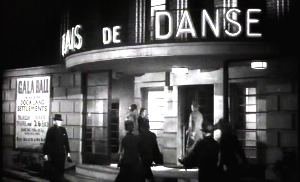
For purposes of censorship, his lady-friend hooker is now a taxi-dancer (called Dance Hall Hostess over there) but she’s just as dead and the ensuing chase is just as lively, played out across a countryside that seems permanently hostile, wet and windswept. Of course Molly the Lorry Girl is now another dime-a-dance girl (played tough-but-not-brassy by Anna Konstam) and in another departure from the book, she helps him return to London to find the real killer.
At which point the film shifts gears, concentrating on Molly’s efforts to find the killer by getting to know the dead woman’s regular customers, a theme that was (coincidentally?) developed into a memorable short story by Cornell Woolrich. One of the “regulars†played with customary gothic relish by Ernest Thesiger, is a learned eccentric, fond of reading and stray kittens, and with his entry, the movie glides smoothly into the realm of the horror film, right up to a moody, memorable finale.
Existing prints of They Drive by Night are not of the best quality, but the film has enough action and intelligence to reward the viewer patient enough to give it the occasional squint. And the book is definitely worth your time.
Note: Another review of this film, the earlier one one written by Walter Albert, was posted here on this blog some four years ago.