Reviews


IT IS PURELY MY OPINION
Reviews by L. J. Roberts


CYNTHIA HARROD-EAGLES – Blood Never Dies. Severn House, hardcover, 2012.
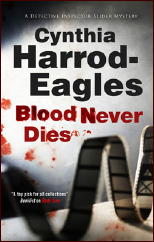
CYNTHIA HARROD-EAGLES Blood Never Dies

Genre:  Police procedural. Leading character:   DI Bill Slider, 15th in series. Setting:  England.

First Sentence: Exsanguination was the word Slider found wandering around his mind.

   When is a suicide not a suicide? When it’s a murder. When the details are just slightly off. When is a murder particularly hard to solve? When you don’t know the identity of the victim. It’s even harder when you find a name but realize it’s false. For DI Bill Slider and his team, the more they dig, the more murders occur, and the more obscure becomes the motive behind it all.

   Cynthia Harrod-Eagles has a wonderfully descriptive style. Her writing, and dialogue, is natural, sprinkled with wry humor, and occasional colloquialisms. She is very British, so occasionally some of her references of phrases might not be understood by Americans. It doesn’t matter; look them up and move on. It is well worth it and you learn something along the way.

   Her writing can make you stop and consider … “Death was so mysterious, Slider thought, not for the first time. The difference between a human being and a dead body was so profound, it always amazed him that made the difference, the vital spark, could disappear so instantaneously and completely.” … “He looked at her. ‘Animals just follow instinct. It’s only humans who perform calculated acts of vileness.’”

   It is particularly appealing that, although Bill Slider is the protagonist, it is truly an ensemble case. Everyone has an important role to play. I also appreciate that Harrod-Eagles shows the harsh and plainly unfair reality of one’s career being limited by either not having the “right” look or manner:

    “But scrawny frog-eyed Hollis, with his despairing hair and feather-duster moustache … made Peter Lorre look like a model from a knitwear catalogue. … He was a damn good policeman, which was all that counted to Slider — though not, of course, with the media-obsessed top bods in the Job, who would never promote Colin Hollis to any position that might get him on camera.”

   Slider is misfit in his own way. He doesn’t judge others but has a dogged determination to find the truth; he believes in fighting for right and justice. What I found missing was the some of the sparkle that makes this, for me, such a must-read series. There wasn’t as much interaction between Slider and his wife, Joanna, his father and Atherton, to which one always looks forward. Even the lovely and malapropism-plagued D.S. Porson: “A case of walking your chickens before they can run…” was little less apparent than in past stories.

   It’s the excellent plotting that makes this such a compelling read. You feel the team’s frustration knowing the clues are leading somewhere, but having no idea where. You become part of the team, looking for the answers, rather than stand outside the story.

   Blood Never Dies is a solid police procedural, with a strong plot and characters you want to visit again and again.

Rating:   Good Plus.
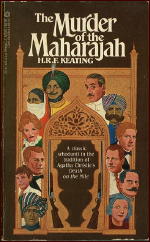
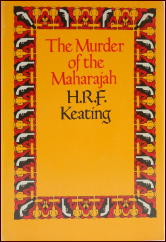
H. R. F. KEATING Murder of a Maharajah

H. R. F. KEATING – The Murder of the Maharajah. Doubleday, hardcover, 1980. Pinnacle, paperback, 1983. First published in the UK: Collins Crime Club, hardcover, 1980.

   If there were an award designed to be given every year to some new mystery in the memory of the late Agatha Christie — there isn’t, and why not? — this is the book that would make Keating this year’s hands-down winner. Not only does it owe a great deal to Mrs. Christie in time, the year 1930, and in exotic locale, India, when that land was still a formidable bulwark of the British Empire, but in atmosphere, characters (some of whom are actually seen reading a Christie novel) and leisurely pace as well.

   The maharajah, never one to be crossed, is also inordinately fond of April Fool’s jokes, but one — a limousine’s plugged exhaust pipe — quickly comes home to roost (backfires?) when a plugged shotgun barrel is discovered to be the immediate cause of His Highness’s demise.

H. R. F. KEATING Murder of a Maharajah

   There are only a limited number of suspects, which should sound familiar, but even so D. S. P. Howard’s investigation into the case makes little initial headway, not even with the most highly enthusiastic help of the palace’s schoolmaster. Not until, that is, in grandly extravagant and artificial fashion — and comes the reminder that very seldom are mysteries written like this any more in today’s penny-pinching economies — an enormous royal banquet is recreated in the smallest detail, staged solely to help a murderer reveal himself.

   Lots of red herrings, you can bet on that, a thwarted romance or two, and a clue I’m willing to wager a bevy of Imperial sandgrouse that you’ll never spot, no matter how earnestly and devoutly you try. And for those who have followed Keating’s long career in writing detective mysteries up to now, there is a last line that is utterly untoppable.

Rating: A minus.

— Reprinted from The MYSTERY FANcier,
       Vol. 4, No. 4, July-August 1980 (slightly revised). This review also appeared earlier in the Hartford Courant.

THE BACKWARD REVIEWER
William F. Deeck


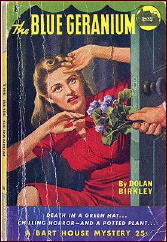
DOLAN BIRKLEY [DOLORES HITCHENS] – The Blue Geranium. Simon & Schuster, hardcover, 1941; Bart House #8, paperback, 1944.

DOLAN BIRKLEY Blue Geranium

   Nina Arkwright is found hacked to death in a cubicle in the pool dressing room of the Hotel Quillan. In the cubicle with the corpse are a green hat, which Nina would never have worn but apparently did, a collection of newspaper clippings, and a geranium and the broken flowerpot that had held it.

   A fire ax was used to do the horrible deed, but it is nowhere to be found and, from all the testimony, could not have been removed from the area without someone having noticed.

   The plot is a good one; its execution not so good. The main character is a female who spends a great deal of time trying to protect the man she loves. Even when it becomes obvious that he could not have committed the second murder, also done with the fire ax, and therefore is innocent of the first murder, she continues to keep information from the police.

   Our heroine devises a way to trap the killer, all by herself. When she manages to do so, she is astonished that the killer is upset by the success of her scheme — which would have been patent had the murder been only mildly astute — and intends to do her bodily harm.

   What she thought the murderer’s reaction might be under these circumstances — commendation, perhaps — is never vouchsafed to the reader.

— From The MYSTERY FANcier, Vol. 12, No. 2, Spring 1990.


Bibliographic Notes:   Dolores Hitchens wrote one other crime novel under this byline, The Unloved (Doubleday, 1965). Under her own name and that of Noel Burke and D. B. Olsen, she was the author of several dozen others. A short entry for her as one of the authors in the Ziff-Davis line of Fingerprint Mysteries can be found on the primary Mystery*File website. (Scroll down.)

REVIEWED BY DAN STUMPF:


THE MAD DOCTOR OF MARKET STREET

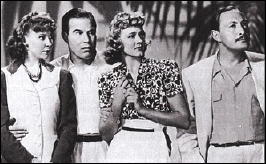
THE MAD DOCTOR OF MARKET STREET. Universal, 1942. Una Merkel, Lionel Atwill, Nat Pendleton, Claire Dodd, Anne Nagel, Hardie Albright, Richard Davies. Director: Joseph H. Lewis.

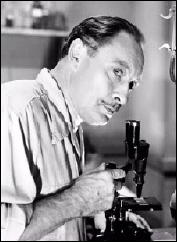
   There`s a certain art to making an enjoyable bad movie, to which The Mad Doctor of Market Street bears witness. Directed by the redoubtable Joseph H. Lewis and written by someone named Al Martin (not exactly a name to conjure with, but he deserves his due) this one offers the eponymous medico-maniac (ably impersonated by Lionel Atwill, the second-greatest mad doctor of his time) against backdrop of a delightful studio-made luxury liner, followed by an equally bogus tropical island.

   Native Devil-Worship, shipwreck, unconvincing leading players (Claire Dodd and Richard Davies, admirably stiff as cardboard cliches) and capable comedy relief provided by Una Merkel and Nat Pendleton.

   The show really revolves around Lionel Atwill as a self-styled genius whose ground-breaking experiments in suspended animation seem to be breaking ground only in cemeteries. After a particularly egregious cock-up, Atwill takes it on the lam and ends up shipwrecked on a tropical island with the rest of the cast, where the natives decide he’s the God of Life and Death, with all the privileges and perquisites pertaining thereunto.

THE MAD DOCTOR OF MARKET STREET

   None of this is to be taken seriously for moment, but everyone involved really seems to act their little hearts out, putting commendable pace and energy into what is, after all, a forgettable time-killer. Director Lewis throws in the odd camera-angle and an occasion bit of mood one doesn’t expect in this sort of thing, and it emerges as quite a worthwhile effort.

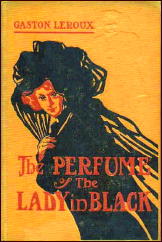
GASTON LEROUX The Perfume of the Lady in Black

GASTON LEROUX – The Perfume of the Lady in Black. Brentano’s, US, hardcover, 1908. Published in the UK in paperback by London Daily Mail, 1909. Translation of Le Parfum de la Dame en Noir, Paris, 1909. Softcover reprints include: Dedalus Ltd, 1998; Wildside Press, 2012. Silent film: Eclair, 1914, as Le Parfum de la Dame en Noir (scw & dir: Emile Chautard). Sound film: Osso, 1931, as Parfum de la Dame en Noir (dir: Marcel L’Herbier). Also: Alcina, 1949, as Le Parfum de la Dame en Noir (scw: Vladimir Pozner; dir: Louis Daquin).

   The present volume is a sequel to that exceptionally clever detective story, The Mystery of the Yellow Room. We presume that it is no disadvantage in a sequel, from the practical point of view, that it shall send the reader back to the pages of its predecessor.

   That is what M. Leroux does in the present instance, though indirectly. Yet it would have been better to insert a frank recommendation right at the beginning that the earlier work be read as a preparation for the treat to come; for without a previous acquaintance with the two men whose deeds fill the pages of both stories, the reader will find it somewhat difficult to enter into the spirit of the latter events.

   The Perfume of the Lady in Black can be described as inferior to The Mystery of the Yellow Room and yet remain a tale of mystery and ‘ratiocination’ very far above the average. Its inferiority consists in this, that the same device which was employed with simple and direct ingenuity in the earlier book, appears here in a somewhat mechanical and cumbersome setting.

   Still, the highest judgment a book of this kind can aspire to is that it cannot be laid down till it is finished. That verdict can be justly pronounced in the present case.

– Unsigned
– “Current Fiction”
THE NATION
– March 18, 1909
http://www.unz.org/Pub/Nation-1909mar18-00281
– [Scroll down to page 282, middle]


Editorial comment: Thanks to Al Hubin’s Crime Fiction IV for the information about the various film versions of this book.

REVIEWED BY WALTER ALBERT:         


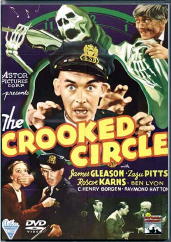
THE CROOKED CIRCLE 1932

THE CROOKED CIRCLE. World Wide, 1932. Ben Lyon, Zasu Pitts, James Gleason, Irene Purcell, Burton Churchill, Frank Reicher, Tom Kennedy. Director: H. Bruce Humberstone. Shown at Cinefest 19, Syracuse NY, March 1999.

   This hit all the right buttons for me, although some people felt it was one of the worst films of the weekend. Lyon, Churchill and Karns are members of the Sphinx Club, a group of amateur criminologists. Their opposite number is The Hooded Circle, a gang of masked villains, who appear to have infiltrated the Sphinx Club and to be poised to eliminate their competition.

   Much of the action takes place in an old house, reputed to be haunted, and it has the requisite sliding panels, chairs that dump occupant down chutes, and a clock that strikes 13 times.

   Almost nobody is what he (or she) appears to be, and you may not care, but I had a good time and I would like to think I wasn’t the only one. Yes, Zasu flutters like an inebriated butterfly, but Gleason’s dry style manages to provide something of a tonic.

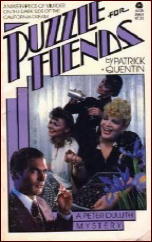
PATRICK QUENTIN – Puzzle for Fiends. Avon, reprint paperback, 1979. Originally published by Simon & Schuster, hardcover, 1946. Other paperback reprints include: Pocket #614, 1949, as Love Is a Deadly Weapon; Ballantine F778, 1970; Penguin, trade paperback, 1986.

PATRICK QUENTIN Puzzle for Fiends

   Since late last year Avon has quietly been reissuing the Quentin “Puzzle” series, although unfortunately they haven’t bothered to publish them in chronological order. This was the first one they did, and as it turns out, it’s one of the later ones in the series.

   But I hope you’ve seen them — the attempts at period photography on the covers came out well, and they’re certainly designed for eye-appeal — and even though the asking price of $2.25 seems a little stiff, if you’ve never read any of them, here’s a part of what the Golden Age of Mysteries was all about.

   As a detective, Peter Duluth was purely an amateur. As a civilian, he was usually a theatrical producer; his wife Iris, a glamorous Hollywood star. In this book, though, she makes only the briefest of appearances, as she’s off on an ex-tended overseas entertainment tour just as Peter arrives home, Navy discharge in hand.

   And for that matter, neither does Peter do any producing, since in true tour de force fashion he wakes up from a mugging attack to find himself without a memory to call his own, casts on both arm and leg, and being taken for someone called Gordy Friend, and by the latter’s own family, no less.

PATRICK QUENTIN Puzzle for Fiends

   Still, there’s nothing like waking up from a nap and finding yourself rich, is there?

   Nevertheless, accident and all, Peter has not been weakened enough mentally to sense that appearances, as always, can be deceiving. He soon learns that he is a central figure in a small fiendish scenario involving both himself and a will about to be contested in unusual fashion by the West Coast branch of the Aurora (Minn.) Clean Living League.

   A number of nicely thought out twists follow before Duluth finds his befogged way out of this mess, with one of them depending greatly on — how does the riddle go? — a “particularly nasty spell of weather.” Well done — Bravo!, in fact — with a couple of scenes decidedly more erotic than anything you could ever find in the complete works of, say, Christie, Carr and Gardner, combined.

Rating:   A.

— Reprinted from The MYSTERY FANcier,
       Vol. 4, No. 4, July-August 1980 (slightly revised).


Bibliographic Note:   Peter Duluth appeared in nine mysteries, the first six of which were in the “Puzzle” series, of which this is the fifth.

REVIEWED BY DAN STUMPF:


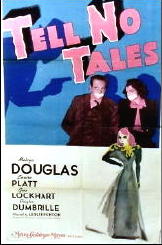
TELL NO TALES 1939

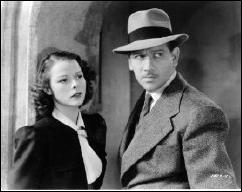
TELL NO TALES. MGM, 1939. Melvyn Douglas, Louise Platt, Gene Lockhart, Douglass Dumbrille, Florence George. Dorector: Leslie Fenton.

   Tell No Tales offers a Good Idea for a Movie, almost buried under MGM production gloss. Melvyn Douglas — who, in his day, starred opposite Greta Garbo and Boris Karloff with equal aplomb — plays a big-city newspaper editor who gets a break on a kidnapping case: a Hundred Dollar bill marked as part of the ransom payment falls into his hands. Using his connections and newsman’s instinct for a story, he follows the bill from hand to hand, back to the kidnappers.

TELL NO TALES 1939

   This is fairly standard stuff for a 30s crime reporter story, but writer Lionel Houser milks a lot of extra interest from it. As Douglas tracks the bill from person to person, we get unsettling glimpses of the lives he’s walking in on: an older man whose pretty young wife bought a gift for another man with it; a black prizefighter who paid his doctor bill before dying or a prestigious singer afraid it will betray a sordid secret.

   Writer Houser and director Leslie Fenton make the most of this Woolrichian bent (the scene at the prizefighter’s wake, held over a seedy nightclub, is particularly unsettling) with flashes of insight that lift this film well out of the ordinary.

TELL NO TALES 1939

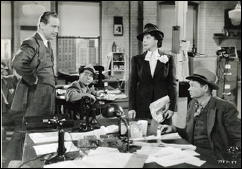
   Unfortunately, there is that MGM Gloss to contend with, and it almost suffocates a very intelligent little B-movie. At Warners, Tell No Tales would have established the lead character cracking a case with a quick montage of sirens, bullets and screaming headlines; Monogram would have opened the film with economic stock-footage and a wise-cracking talk on a pinch-penny Editor’s Office Set.

   But not MGM. No sir. They open Tell No Tales with a big money shot of editor Douglas walking through a busy newsroom packed with extras, taking a few minutes of his (and our) time to give a break to an honest politician, and organizing a surprise party for file paper’s oldest employee, thus establishing him as a man of character and sensitivity (like all big city newspaper editors) and incidentally wasting about ten minutes of a one-hour movie.

   The surprising thing is that once you get past this yawning chasm, Tell No Tales still manages to pack a lot of interest, thanks mainly to fine writing and the considerable charm of leading players Melvyn Douglas and the under-used Louise Platt (who played the pregnant army wife in Stagecoach that same year) seriously abetted by veteran nasties like Douglas Dumbrille and Leroy Mason.

   Look for this one.


Editorial Comment:   This movie has been reviewed once before on this blog, the earlier post contributed by David L. Vineyard. Check out what he had to say here.

WARNING: Part Two of the YouTube video provided is incomplete. (See Comment #1.)

THE BACKWARD REVIEWER
William F. Deeck


ROBERT MARTIN – Just a Corpse at Twilight. Dodd Mead, hardcover, 1955. No paperback edition.

   In this investigation by Jim Bennett, he has been farmed out by his agency’s head to work for an unnamed state checking into industrial accidents and occupational diseases. In Beech Tree to get permission from the widow to perform an autopsy on her husband, who was collecting compensation for silicosis but died of a heart attack, Bennett encounters obstruction from all but the widow.

   The town’s doctor, who is also the county coroner, the funeral director, and the sheriff, a conniving alcoholic, are opposed to the disinterring of the late and at least lamented by the widow. These gentlemen are also all interested in the widow.

   Not one of the world’s quick thinkers, Bennett. He has to be shot at twice before he reluctantly concludes someone doesn’t care for his presence in Beech Tree. Still, he does clear it all up with the aid of Rosemary the cat.

   A character says of a fictional mystery writer’s books: “No cliches, no hard-boiled stuff, no whiskey and blondes and all the rest. He just writes about real people with real problems. Why, even without the murders, his books are interesting.”

   The last sentence may be a bit extreme; otherwise she’s pretty much summed up this novel.

— From The MYSTERY FANcier, Vol. 12, No. 2, Spring 1990.


Editorial Comment: For a long overview of author Robert Martin’s career by Jim Felton, followed by a complete bibliography put together by myself, follow this link now.

IT IS PURELY MY OPINION
Reviews by L. J. Roberts


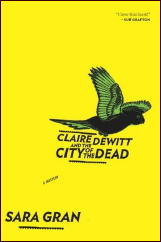
SARA GRAN – Claire DeWitt and the City of the Dead. Houghton Mifflin, hardcover, June 2011. Mariner Books, trade paperback, May 2012.

SARA GRAN Claire DeWitt and the City of the Dead

Genre:  Private eye. Leading character:   Claire DeWitt, 1st in series. Setting:  New Orleans.

First Sentence: “It’s my uncle,” the man said on the phone.

   Claire DeWitt advertises herself as the world’s greatest private investigator. As such, she accepts a case in recent post-Katrina New Orleans. Her client is the nephew of Vic Willing. The case is to find out what happened to him, the city’s wealthy district attorney who disappeared during the flooding after the hurricane.

   Every now and then, an author comes along with a voice and style that it is almost impossible to describe, quantify, or explain. That was my reaction to Ms. Gran’s first book in a series, Claire DeWitt and the City of the Dead.

   At its heart, it’s a classic hard-boiled mystery, complete with drugs, guns, liquor and bad guys. Then intermix with that a detective who was trained by a wealthy New Orleans woman, Constance Darling, and the book Detection, by Jacque Silette.

    “Clues are the most misunderstood part of detection. Novice detectives think it’s about ‘finding’ clues. But detective work is about ‘recognizing’ clues — plus a layer of dreams, intuition. — “Never be afraid to learn from the ether. That’s where knowledge lives before someone hunts it, kills it, and mounts it in a book.” … and the I-Ching, and you have something that is unique and wonderful.

    Claire is anything but your usual female detective. She’s from Brooklyn, she knows death and drugs and liquor. She’s not a comfortable protagonist. We learn details of her past and life throughout the story. What is interesting is that every character Gran creates is vivid and memorable, including those who don’t exist, such as Constance and Silette. It’s a story that doesn’t really have any minor players, only short scenes.

   Gran’s descriptions are powerful. New Orleans is a city unlike any other yet, particularly in this time setting, she does not make any effort to romanticize it. It is ugly, violent, sad, desperate and very real. Remarkably, however, at the end we’re left with a sense of hope, both for the city and the characters. You want to know what becomes of them, even if they break your heart.

   The true sign of a book that stands above the usual, is that it makes you stop and consider: “What will fill the void left by the missing person? … Who will now breathe his air, eat his food marry his wife? Who will fill his seat at the university lecture, the foot ball game, in the old armchair at home?…” Gran has a different perspective than I’ve ever found.

   The story’s plot may not always be the easiest to follow, but it is so worth paying attention to every word and every clue and giving each page a bit of thought. That’s easy to do as it is thoroughly and completely engrossing. There are times it may seem trite or pretentious, but you then find yourself going back and reading sections again because something about them resonates. Only because I needed to sleep at night, did I ever put it down.

   Claire Dewitt and the City of the Dead is a remarkable book. I suspect you will either love it or wonder whether I was indulging in one of Claire’s vices.

Rating:   Excellent.

Bibliographic Note: Book two in this series is Claire DeWitt and the Bohemian Highway (June 2013).

« Previous PageNext Page »