Reviews


REVIEWED BY WALTER ALBERT:         


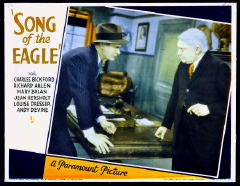
SONG THE EAGLE 1933

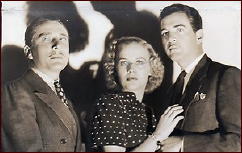
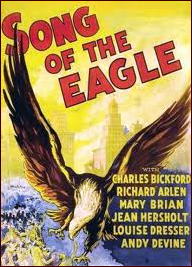
SONG OF THE EAGLE. Paramount, 1933. Richard Arlen, Charles Bickford, Jean Hersholt, Mary Brian, Louise Dresser, Andy Devine, George E. Stone. Director: Ralph Murphy. Shown at Cinefest 19, Syracuse NY, March 1999.

   Hersholt plays a genial brewery owner who attempts a comeback after the lifting of Prohibition, but refuses to go along with the extortion scheme of former employee and now big-time mob boss, Charles Bickford.

   Arlen is the honest son, Dresser the naive, and Devine a brewery employer who stays with Hersholt while certified rat George E. Stones casts his lot with Bickford. The scene in which Bickford gets his comeuppance is highly improbable although enormously satisfying.

   This plays like a Warner Brothers meller that got a bit soft in the head when it was re-routed through Paramount, but it’s still great fun.

SONG OF THE EAGLE 1933

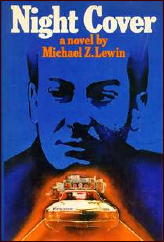
MICHAEL Z. LEWIN – Night Cover. Berkley, reprint paperback, 1980. First published in hardcover by Alfred A. Knopf, 1976. Also: Perennial Library P-721, paperback, 1984; Foul Play Press, softcover, 1995.

   False advertising!

MICHAEL Z. LEWIN Night Cover

   This was supposed to be an Albert Sampson mystery, or at least that’s what is said on the front cover of the paperback edition I just read. As you may have heard, Albert Samson is a private eye, and his reputation is that he is the cheapest in Indianapolis. I read and reported on another of his adventures a while ago, and while it doesn’t seem to me that I recall him giving out green stamps, I do remember enjoying it.

   Samson appears in all of perhaps seven pages of this one.

   In center court instead is Lt. Roy Powder, the cop in charge of the Indianapolis Night Shift for nearly nineteen years. His dominating, gruff personality has grown now until it overshadows most of his cases, two of which involve a school’s missing cashbox, a Maoist hippie, and a runaway girl.

   It’s not surprising that when they meet, which they do, Powder and the outspoken Samson do not get along very well.

   But Powder also uncovers a series of multi-murder crimes and undergoes a change-of-life that surprises even him. In other words, in case you haven’t realized it yet, this is not a private eye story at all. It’s a book with a gritty feel of real small-city police work, enhanced by the deductive instincts of a veteran cop, who has sharpened and tempered them by years of experience on the job.

   It’s a book I’m glad I read, but it sure wasn’t what I expected when I picked it off the shelf.

Rating:   B minus.

— Reprinted from The MYSTERY FANcier,
       Vol. 4, No. 4, July-August 1980 (very slightly revised).


[UPDATE] 07-21-13.   I apologize for not being able to find a cover image for the paperback to show you the blurb I was unhappy about. You’ll have to make do with the cover of the original hardcover edition, which was all I was able to come up with.

TYLER DE SAIX The Man Without a Head

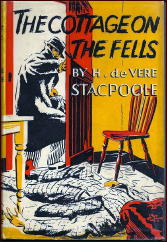
TYLER DE SAIX – The Man Without a Head. Moffat, Yard & Co., 1908. Illustrated. $1.50. Reprinted as The Cottage on the Fells (Werner Laurie, UK, 1908), as by H. De Vere Stacpoole, the author’s real name. Later reprint (shown), Laurie, 1950. Currently available in several Print on Demand editions.

   It is a question whether the mere ingenuity of horror comes within the bounds of art; but whatever one’s personal view, one cannot shirk the admission that such work has a reading public of its own, ready to encourage an increasing output.

   The Man Without a Head will doubtless find many admirers, as it is good of its class. The author has the gift, invaluable to the contriver of a detective story, of plausibly allowing the reader’s suspicion of the truth to precede that of the detective; not with gross obviousness, but with sufficient skill to make the resulting conviction of one’s own astuteness genuinely if briefly satisfactory.

   But the murderer’s device for concealing his crime, while indubitably clever, would insure almost immediate detection of any unfortunately trustful homicide who sought to put it in practice. The story of it moves with interest, however, even under the ballast of aphorisms sprinkled upon the pages with pedagogic heaviness of hand.

– Unsigned
– “Current Fiction”
THE NATION
– September 3, 1908
http://www.unz.org/Pub/Nation-1908sep03-00212
– [Scroll down to page 213, top right]


Editorial Comment:  Thanks to Mike Tooney for continuing to uncover old reviews such as this one, and posting them on Yahoo’s “Golden Age of Detection” group.

REVIEWED BY DAN STUMPF:


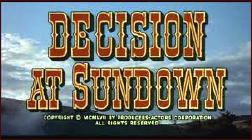
DECISION AT SUNDOWN

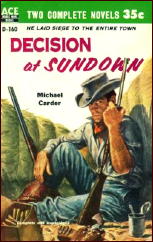
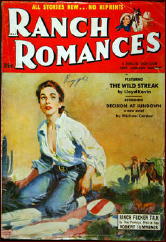
MICHAEL CARDER – Decision at Sundown. Macrae Smith, hardcover, 1955. Ace Double D-160, paperback, no date [1956]. Bound dos-à-dos with Action Along the Humboldt, by Karl Kramer. First serialized in Ranch Romances magazine, January 1955. (Part Three can be found online here.)

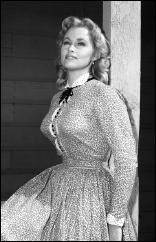
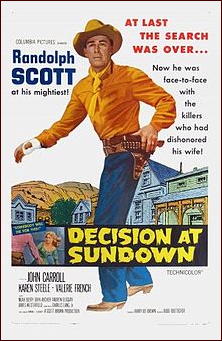
DECISION AT SUNDOWN. Columbia, 1957. Randolph Scott, John Carroll, Karen Steele, Valerie French, Noah Beery Jr., John Archer, Andrew Duggan. Based on the novel by Michael Carder (screen credit given to Vernon L. Fluharty). Director: Budd Boetticher.

   My mention a while back of Jim O’Mara’s Wall of Guns elicited a comment from James Reasoner (a worthy western pen-slinger in his own right) revealing that O’Mara was actually one Vernon Fluharty, who also wrote westerns under the name Michael Carder, among them Decision at Sundown (Macrae Smith, 1955; originally serialized in Ranch Romances, January 1955) which two years later at Columbia studios was turned into one of Budd Boetticher’s most complex and least satisfying westerns.

DECISION AT SUNDOWN

   The book Decision at Sundown bears some interesting similarities to Wall of Guns; in both a bitter loner rides into town seeking revenge, and in both he runs into a range fraught with intrigue: crooked locals grabbing for power, ranchers nursing long-simmering grudges, neighborhood bad guys, loyal friends and a woman who should hate him but finds herself strangely attracted to the handsome stranger (yawn).

   The difference is that Wall of Guns was enlivened by some deeper-than-usual supporting players whose actions — whether short-sighted, passionate or surprisingly thoughtful — sent the book places where lesser tales don’t go.

   In Decision at Sundown however, the ensemble remains depressingly stale: Tate Kimbrough, the town tyrant, is just a double-dyed rat; Lucy, his intended bride comes off like Daisy Mae on the printed page, too purely wholesome and impulsive to believe; Swede and Spanish, the hired guns are nothing but thug-uglies, and — and so it goes: the blowsy ex-mistress, the gruff doctor, grizzled rancher, doughty pardner … they all remain firmly in the cookie-cutter.

DECISION AT SUNDOWN

   There’s a trace of depth as the plot develops and our hero suddenly finds his revenge turned laughable, but it’s quickly drowned in the shallow characters charged with putting it across.

   When the novel reached Hollywood two years later, director Budd Boetticher and writer Charles Lang (story credit goes to Vernon Fluharty) picked up on that particle of originality and ran with it, adding some depth to the characters along the way and coming up with a B-western that if not completely satisfying, is at least original enough to remember.

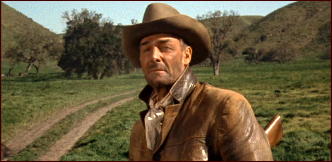
   The hero here is Randolph Scott, and when he rides into town it’s with the easy assurance of two decades of westerns behind him, abetted here by Boetticher’s graceful camerawork and feel for action. Unfortunately, he and the viewer get quickly mired in the story’s rather static complications, and the drama plays out in a few rather cramped and confining sets.

   When one thinks of Budd Boetticher’s films, it’s with appreciation of his feel for characters framed against an open, rugged landscape, dealing warily with their issues and each other as they traverse hostile terrain that reflects some inner conflict. (Or as Andrew Sarris put it, part allegorical odysseys and part floating poker games.) But in this movie, we’re just stuck in a stable.

DECISION AT SUNDOWN

   Stylist that he was, Boetticher managed a few fine moments, notably a couple of deliberately theatrical showdowns in the middle of Main Street, first with Andrew Duggan metaphorically stripping himself down for the performance, and later with John Carroll trying to hide his fears and live up to the Bad Guy’s Code of Conduct, murky as that may be.

   In fact, Boetticher’s attention to this stock character almost brings the film to life. We first see Tate Kimbrough in standard attire for dress heavies in shoot-em-ups: fancy vest, dark coat, and the snide moustache worn by thousands of B-western baddies before him.

DECISION AT SUNDOWN

   Then he starts to show some depth; he’s thoughtful and loving to his trampy ex-girlfriend, frank about himself and his past with his bride-to-be, and toward the end, when he has to go out and face Randolph Scott alone (a pre-doomed enterprise in films of this sort) there’s a rather touching moment when he confesses his fears to his ex-gal (a fine performance from Valerie French, who specialized in this sort of thing) but goes out there anyway.

   I said this was a complex film and I meant it. I also said it was unsatisfying and I meant that too. In Westerns, action is traditionally cathartic, but in this one it simply becomes irrelevant, leading to an ending that Boetticher seems unprepared to handle.

   There’s a lot of stage business between the dramatic climax and the actual ending of the film, and it dilutes the impact of what could have been a uniquely powerful Western. And that’s kind of a shame.

DECISION AT SUNDOWN


Note: To read Mike Grost’s extensive comments on this same film, check out his website here.

REVIEWED BY MICHAEL SHONK:


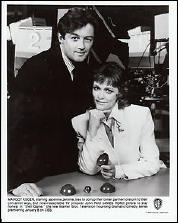
SHELL GAME. CBS, 1987; Warner Brothers Television. Created by Carla Jean Wagner. Cast: Margot Kidder as Dinah aka Jennie Jerome, James Read as Reilly aka John Reid, Marg Helgenberger as Natalie Thayer, Chip Zien as Bert Luna, Rod McCary as Bill Bauer, and (added after pilot) Fred McCarren as Vince Vanneman. Theme by Michel Colombier.

SHELL GAME Margot Kidder

Pilot: 60 minutes. Executive Producer: Michael Rappaport. Produced by Lou Antonio. Coordinating Producer was John Ziffren.

Weekly Series: 60 minutes. A Lou-Step Production & Hey Keed Production in association with Warner Brothers Television. Executive Producers: Nick Thiel and Paul Picard. Supervising Producer: Alex Beaton. Produced by John Wirth

   A link to the opening credits can be found here.

   There were two con artists, husband Reilly and wife Dinah. Reilly decided to go straight but Dinah refused. He left her and they were divorced.

   The show opens with Dinah on the run from a mark and his minions who want her dead. The chase takes her to Santa Ana California where she discovers her ex-husband had settled down and gone straight. Reilly was now John Reid (The Lone Ranger), producer of “Solutions,” a TV consumer action show for KJME-TV. Dinah, now Jennie Jerome (Winston Churchill’s mom), ditches the bad guys and becomes the new associate producer of “Solutions” before John can stop it. Of course, no one knows the truth about John aka Reilly, former conman and husband. Jennie wants John to return to their former life together, but he refuses.

SHELL GAME Margot Kidder

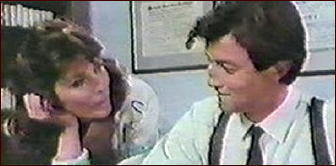
   Margot Kidder (SUPERMAN) as adventure loving Jennie/Dinah and James Read (REMINGTON STEELE) as John/Reilly were wonderful together, and the show, never aiming higher than mindless entertainment, took off whenever the two pulled a con so the TV show “Solutions,” could expose the bad guys.

   Sadly, the series wasn’t satisfied to stop there. There was the supporting cast: stereotypical station manager Vince, the idiot self-centered co-host Bill and the yes-man Bert, all adding annoyingly pointless comedy relief.

   Then there was “Solutions” co-host Natalie who was the rich beautiful daughter of the station’s owner, and John Reid’s current lover. Marg Helgenberger gave Natalie a likable naïve vulnerability that often made us feel sorry for her and her fate as the losing side of the romantic triangle. Worse, the chemistry so strong between Read and Kidder did not exist between Read and Helgenberger.

SHELL GAME Margot Kidder

   Believability is always a problem with shows such as SHELL GAME, especially one as poorly produced as this one. The mysteries, if there were any, were weak. The scripts were filled with action that made no sense. The interior sets were cheap looking. The soundtrack lacked a constant sound to give the series its own audio identity. Nothing in this series worked except when Kidder and Read as Jennie and John were running a con to catch the bad guys.

   But even if SHELL GAME had been HART TO HART with con artists, the series was doomed airing opposite NBC’s top rated THE COSBY SHOW and FAMILY TIES.

         EPISODE INDEX:

“Pilot” (January 8, 1987) Written by Carla Jean Wagner Directed by Lou Antonio. GUEST CAST: William Trayler, Jim Antonio, and Castulo Guerra *** This sixty minute pilot offers some screwball fun as on the run con artist “Jennie” helps her gone straight ex-husband and ex-partner save a potato chip Heiress.

Ratings: SHELL GAME – 9.7 versus ABC’s OUR WORLD – 6.8 and NBC’s COSBY SHOW – 36.6 and FAMILY TIES – 36.4

“Norman’s Parking Ticket” (January 15, 1987) Written by Gerald Sanoff Directed by Harry Harris GUEST CAST: Walter Olkewicz, Jordan Charney and Richard Minchenberg *** A man comes to “Solutions” for help to fight a parking ticket unaware the ticket will tie his car to a murder scene. Meanwhile, Jennie is being nice to Natalie so she can crash a high-stakes poker game to raise money to pay for a wedding anniversary gift to Reilly.

Ratings:: SHELL GAME – 8.9 versus ABC’s OUR WORLD – 6.9 and NBC’s COSBY SHOW – 38.6 and FAMILY TIES – 36.6

“Old Team” (1/22/87) Teleplay by Nick Thiel Story by Kerry Ehrin Directed by Paul Krasny GUEST CAST: Gene Barry, Brynn Thayer and Robert Hanley. *** “Solutions” is following Santa Ana’s police Bunco squad during an average day when offered a chance to join in on a bust. John realizes Jennie’s father is behind the con about to be busted, and that Dad had gotten Jennie to join in the con.

Ratings:: SHELL GAME – 9.3 versus ABC’s OUR WORLD -7.7 and NBC’s COSBY SHOW – 41.3 and FAMILY TIES -39.2

“The Upstairs Gardener” (1/29/87) Written by John Wirth Directed by Chris Leitch GUEST CAST: Michael MacRae, Vincent Schiavelli, Benicio Del Toro and Mary Woronov. *** A thieving husband kills his rich wife and frames her lover, the young gardener. “Solutions” is doing a story on the jail when they meet the young man’s mother who convinces them to prove her son innocent.

Ratings: SHELL GAME – 9.8 versus ABC’s OUR WORLD – 6.8 and NBC’s COSBY SHOW – 36.1 and FAMILY TIES – 36

“Pai Gow” (2/8/87) Teleplay by John Wells Story by Michael Fink Directed by Harry Mastrogeorge. GUEST CAST: James Pax, Clyde Kusatsu and Dustin Nguven *** A man comes to “Solutions” to help him prove he was not driving drunk when he hit and killed a man. The story takes us deep into Santa Ana’s Chinatown run by the evil “Tiger” who uses his gambling den to pass counterfeit money.

Ratings:: SHELL GAME – 8.8 versus ABC’s OUR WORLD – 7.2 and NBC’s COSBY SHOW – 37.6 and FAMILY TIES – 36.4

“Dead Wrong” (2/12/87) Written by John Wirth and John Wells. Directed by Chris Leitch. GUEST CAST: Michael Greene, George Dickerson, and Ora Rubens. *** A beautiful woman claiming to be a man’s wife cons Bert and Bill to do a report about the man committing arson. The police arrest the man, and the real wife decides to sue the station.

Ratings:: SHELL GAME – 8 versus ABC’s OUR WORLD – 6.8 and NBC’s COSBY SHOW – 36.1 and FAMILY TIES – 36.

   For three weeks starting June 3rd, long after it was cancelled, an episode of SHELL GAME was rerun in MAGNUM PI place on Wednesday at 9pm where each week it finished last up against reruns of ABC’s MACGYVER and NBC’S sitcoms FACTS OF LIFE, NIGHT COURT and NOTHING IN COMMON.

   SHELL GAME was a typical fun-dumb romantic comedy mystery with all the substance of cotton candy. While Read and Kidder were on the con the series had a screwball charm, but it wasn’t enough to overcome the many flaws of the series, let alone its suicidal timeslot.

REVIEWED BY WALTER ALBERT:         


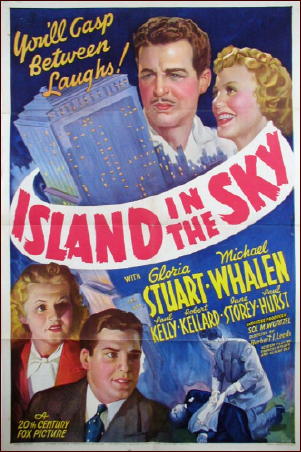
ISLAND IN THE SKY Gloria Stuart

ISLAND IN THE SKY. 20th Century Fox, 1938. Gloria Stuart, Michael Whalen, Paul Kelly, Paul Hurst, June Storey, Leon Ames. Director: Herbert I. Leeds. Shown at Cinefest 19, Syracuse NY, March 1999.

   Beautiful Gloria Stuart is the fiancee of assistant D. A. Michael Whalen and when Whalen refuses to go out on a limb to save a young man on death row, who Stuart is convinced is innocent, she commandeers a reluctant Paul Hurst to help her prove the condemned man’s innocence.

   The climax is staged in an elegant roof-top restaurant and may strain your credibility but not your interest. This is Stuart’s film all the way and she commands the screen with such skill that you wonder why she interrupted her career so abruptly in 1946.

ISLAND IN THE SKY Gloria Stuart

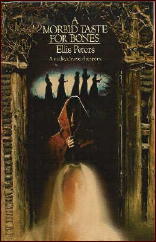
ELLIS PETERS Morbid Taste for Bones

ELLIS PETERS – A Morbid Taste for Bones. Popular Library, reprint paperback, 1980. First Edition: Macmillan, UK, hardcover, 1977. First US Edition: Morrow, hardcover. 1978. Reprinted many times since, in both hardcover and soft.

   Well, yes, I admit it, you’ve caught me. I’ve always claimed not to care for period detective fiction, be it Victorian, 12th century, pre-Elizabethan, or what. But I liked Brother Cadfael as a character in One Corpse Too Many, reviewed here not so very long ago, so much so that when I saw this earlier book was out in paperback, I picked it up and started reading it while I was still in the store, and I ended up not putting it down until well after I got home.

   Some of Cadfael’s earlier, non-ecclesiastical career is revealed in Bones — he was a sailor and a Crusader, very much an adventurer and a man of the world. And yet, with all this life behind him, he has found it easier to adjust to life in the monastic enclave of Shrewsbury Abbey than have some of the younger men.

   In fact, rather than arising from a civil disturbance of the sort that produced the murder mystery of One Corpse Too Many, the crisis of this earlier book focuses inwardly, upon the personalities and the not always totally spiritual ambitions of various of the brothers.

   In particular, it is Prior Robert’s dream of removing the bones of Saint Winifred to England from her burial place in her home country of Wales that initiates the sequence of events that culminates, not unexpectedly, in murder.

   Thwarted romance is also involved. In Cadfael’s objective eye toward such matters, God often needs a little helping hand from man. The culprit is easily spotted, thanks to better-than-average characterization — could this by why some people object so loudly to characterization in detective stories?

   Are mysteries and good writing incompatible? I refuse to think so.

   Occasionally the dialogue waxes exceedingly biblical in tone, and some tolerance for it has to be developed. And perhaps it shouldn’t have, but a reference to a steel-tipped arrow surprised me a little.

Rating:  B.

— Reprinted from The MYSTERY FANcier,
       Vol. 4, No. 4, July-August 1980 (somewhat revised).


[UPDATE] 07-03-13. No, it really shouldn’t have. From Wikipedia:

    “The earliest known production of steel is a piece of ironware excavated from an archaeological site in Anatolia (Kaman-Kalehoyuk) and is about 4,000 years old. Other ancient steel comes from East Africa, dating back to 1400 BC. In the 4th century BC steel weapons like the Falcata were produced in the Iberian Peninsula, while Noric steel was used by the Roman military.”

   Oops. I didn’t know that!

REVIEWED BY DAN STUMPF:


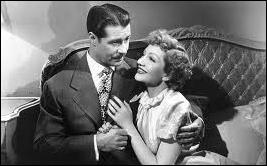
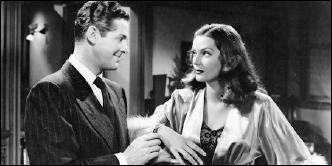
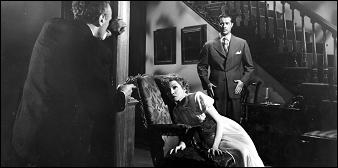
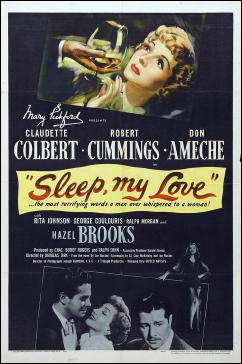
SLEEP, MY LOVE. United Artists, 1948. Claudette Colbert, Robert Cummings, Don Ameche, Rita Johnson, George Coulouris, Raymond Burr, Hazel Brooks. Director: Douglas Sirk.

SLEEP MY LOVE

   The disparity between actions and words in Caught (see my comments here ) was brought home even harder by the movie I saw right after it, Sleep, My Love, adapted from a novel by Leo Rosten, directed by Douglas Sirk, who helmed juicy films like Written on the Wind, Imitation of Life and All That Heaven Allows with a lurid sensitivity all his own.

    Sleep is basically Gaslight in modem dress: faithless-husband Don Ameche (quite nice in a rare bad-guy part) convinces naive-wife Claudette Colbert that she`s going loopy, with the help of a bogus shrink (George Coulouris, the nasty banker from Citizen Kane) so he can have her put away, grab her money, and marry lovely-but-cold Hazel Brooks (whose career apparently went nowhere after this promising start).

   Be that as it may, Don’s byzantine schemes … which are not exactly what they appear to be … get thwarted by healthy young Bob Cummings, one of the few leading men in Hollywood who could romance married women on the screen without losing audience sympathy.

   Okay, so Sleep, My Love goes through the whole Gaslight schtick, with Claudette hounded by nasty George Coulouris, then pampered with false sympathy by rotten Don Ameche, who gently prepares her for a nervous breakdown, while setting up his partner for a nifty double-cross.

SLEEP MY LOVE

   Director Sirk has some fun along the way, adding depth to the picture with carefully-observed scenes of a Chinese wedding, or an interview with a black housekeeper who is much sharper than we might expect. But the real impact of his direction comes with an ending that beautifully melds Style and Substance:

   Sirk has previously established that the Colbert-Ameche living room is curtained from the foyer by a frosted-glass sliding pocket-door. Toward the end, Don arranges to have his partner George waiting in the tiling room to hound Claudette some more. Or at least that`s what George thinks; (WARNING!!) actually Sneaky Ameche is handing his half-doped wife a gun and telling her that her persecutor is just beyond that door.

SLEEP MY LOVE

   Claudette almost shoots, but at the last minute awakens, whereupon her husband grabs the gun and shoots through the door himself, shattering the frosted glass to reveal Coulouris on the other side, who shoots back in revenge. (END OF WARNING.)

   Mere description doesn’t do justice to this scene, where, at the moment narratively when her husband breaks through his web of deception, he also visually breaks the barrier that hides his scheming partner: for once, we get a perfect visual correlative to what the story is telling us. And another reason why I go to the Movies.

SLEEP MY LOVE

REVIEWED BY MICHAEL SHONK:


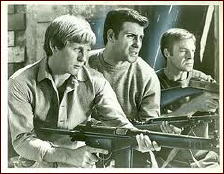
JERICHO. CBS, 1966-67. MGM/Arena Productions. Created by William Link and Richard Levinson in association with Merwin A. Bloch. Cast: Don Francks as Franklin Sheppard, John Leyton as Nicholas Gage, and Marino Mase as Jean-Gaston Andre. Executive Producer: Norman Felton. Supervising Producer: David Victor. Produced by Stanley Niss (pilot episode produced by David Victor). Theme by Jerry Goldsmith.
JERICHO TV series

   JERICHO was set in war-torn Europe during World War II. It told the adventures of three men. American Captain Franklin Sheppard was the leader and an expert on explosives. British Royal Navy Lieutenant Nicholas Gage was a former circus performer and expert in getting in and out of tough situations. Free French Lieutenant Jean-Gaston Andre specialized in weapons, ancient and modern. Together they fought the Nazis behind enemy lines as a group, code named Jericho.

   I watched this series at Warner Archives Instant (free two week trial membership) here.

   Considering the talent behind this series I was very disappointed. The series first reminded me of another CBS series premiering that fall, MISSION: IMPOSSIBLE for its premise and soundtrack. However, JERICHO took on the style of the two other MGM and Norman Felton’s Arena Productions, MAN FROM U.N.C.L.E. and GIRL FROM U.N.C.L.E.

   The theme and opening featured a narrator (no on air credit) introducing the characters over the actor names with clips of each in action. The story then began with the narrator giving the date, location and Jericho’s mission.
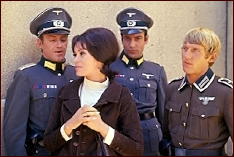
JERICHO TV series

   Today, a major reason to watch this series is who created it. William Link and Richard Levinson would become two of television’s greatest creators of TV series with such series as COLUMBO, ELLERY QUEEN, and MURDER SHE WROTE. But JERICHO was before they joined Universal Studios. Link has discussed how little control they had over their freelance scripts such as their pilot script for MANNIX (in the commentary on MANNIX season one DVD).

   The pilot script for JERICHO would air as episode three “Upbeat and Underground.” From the credits it can be assumed Dean Hargrove (MAN FROM U.N.C.L.E.) rewrote some of the script. Paris 1942, the Nazis plan to force the French National Symphony Orchestra to play Wagner on Bastille Day, so Jericho smuggles the entire orchestra (one hundred people) under Nazis guard in occupied Paris to London. If only Jericho had been available for THE GREAT ESCAPE (John Layton was in the 1963 film but sadly did not play his Jericho hero).

   And who was fellow JERICHO creator Merwin Bloch? Bloch’s greatest success would come later as one of the most influential and successful producers of movie trailers. He would also produced the 70s cult film comedy THE TELEPHONE BOOK. At this time he was just starting out from advertising and had wrote one episode of BLUE LIGHT (which I reviewed here ). According to his IMDb bio, Bloch would supply many of JERICHO’s plots. At least one JERICHO plot was obviously inspired by BLUE LIGHT, in “Panic in the Piazza” Jericho was assigned to blow up a heavily guarded Nazi headquarters buried deep underground.

   JERICHO’s production values for a network show were embarrassing, from inept reusing of a few studio lot exterior sets to the too many times when you wondered if anyone was paying attention or cared.
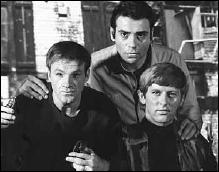
JERICHO TV series

   In the episode “Long Walk Across a Short Street,” action took place at night and in an area where all power was out, yet the streets where bathed in sunlight and the interiors brightly lit. The only way we knew it was dark was when the characters told us. Surprisingly, the director was the talented Richard C. Sarafian (VANISHING POINT, 1971), and the director of photography was the experienced, Emmy award winner and innovator Lester Shorr. Both of these men would have known better, leaving one to wonder how such amateur mistakes could have happened.

   The scripts, because of its YA take on the plots, had problems maintaining the proper balance of believability, humor, action and suspense. For me the most successful was writer Jackson Gillis (MAN FROM U.N.C.L.E.) in “Have Traitor, Will Travel.” A French General and known spy is fed false information. Jericho escorts him to the front hoping to get captured, but encounter problems when the local underground rescues them. The story’s surprising twists had a darkness to them that kept the absurdity from overwhelming the drama.

   The soundtrack was a cross between MAN FROM U.N.C.L.E. and MISSION IMPOSSIBLE. The “Film Score Monthly” review of the record featuring the soundtrack to JERICHO (and THE GHOSTBREAKER), noted that the theme used by JERICHO was scored by Jerry Goldsmith (MAN FROM U.N.C.L.E.) from the second episode, and the pilot music score (and unused theme) was done by Lilo Schifrin.

   Schifrin would find a place for some of the rejected music in his next series, MISSION: IMPOSSIBLE. JERICHO, especially episodes scored by Richard Shores (MAN FROM U.N.C.L.E.), often had scenes with background music familiar to viewers of MISSION IMPOSSIBLE. While one of the more noticeable MAN FROM U.N.C.L.E. influences was the sound used with the graphic break for jump cuts.

   This YouTube clip is from a promo sent to local stations. It is terrible visually and features a different narrator, but illustrates my point about the soundtrack (around 2:05 on the clip):

https://www.youtube.com/watch?v=5r28TEIgI-w

   Perhaps the oddest element of JERICHO was Norman Felton producing CBS’s JERICHO while under exclusive contract to NBC. “Broadcasting” reported the story in issues December 27, 1965 and January 10, 1965. Norman Felton was one of MGM’s most successful producers until NBC signed Felton to an exclusive contract. Felton’s obligations to MGM would end June 30, 1966, but there were exceptions. Felton would continue to produce the show if either of Arena Production’s pilots for CBS went series. JERICHO did. Thus a NBC producer and company (Arena) produced a prime time series for CBS.

   Don Francks’ (HEMLOCK GROVES) performance was the best of the three regulars but lacked a dramatic depth to counter the silliness of the stories leaving him at times bordering on camp such as in “Wall To Wall Kaput” where he posed as a worker wallpapering the office where the top-secret papers were kept. John Leyton had been a British pop star and appeared in films (VON RYAN’S EXPRESS -1965), but by JERICHO his career was in decline. Marino Mase went from starring in films such as Jean-Luc Godard’s LES CARABINERS (1963) to minor roles in films such as GODFATHER 3 (1990).
JERICHO TV series

   Fans of actors will enjoy spotting such people as Barbara Anderson, John Drew Barrymore, Billy Barty, Tom Bosley, John Dehner, James Doohan, Marianna Hill, Walter Koenig, Mark Lenard, Jay North, Michael Rennie, Mark Richman, Gia Scala, Malachi Throne, and Ian Wolfe.

   The series featured one minor recurring character, Jericho’s contact Mallory played in the pilot by Ben Wright and in two episodes by John Orchard.

   The ratings were never good. The hour-long JERICHO aired in color on Thursday night at 7:30-8:30PM opposite of the popular BATMAN and F-TROOP on ABC and DANIEL BOONE on NBC (which usually finished second in the time slot).

   The November 28, 1966 issue of “Broadcasting” reported CBS had cancelled JERICHO, saying the series would remain on until mid-January.

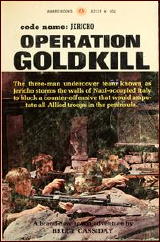
   There was a tie-in original paperback by Bruce Cassiday titled Code Name: Jericho – Operation Gold Kill (Award, 1967).
THE BACKWARD REVIEWER
William F. Deeck


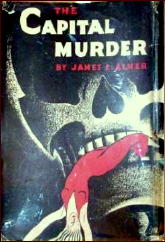
JAMES Z. ALNER – The Capital Murder. Knopf, hardcover, 1932.

JAMES Z. ALNER The Capitl Murder

   Gathered at the Serpentine Club — considering the plot, one wonders whether the author named the club playfully — five men of various talents and one nonentity who chronicles the investigation are discussing crime. They are Trevor Stoke, an epidemiologist; Henry Selden, one of the three commissioners of Washington, D.C., where the novel takes place; Lieut. Runy O’Mara, U.S. Navy; Dr. Basil Ragland, eminent psychiatrist about whom more later; and Lance Starr-Smith, the famous architect.

   An odd event occurs during their discussion, and then Commissioner Selden is told that a woman some of them knew had died shortly before under suspicious circumstances. Stoke discovers how and who, none of it coming as any surprise to the reader, who in addition has been anesthetized by the many unlikelihoods that take place.

   The author was acquainted with various famous fictional detectives of the time. It’s a pity he didn’t learn from their creators how to write better. Oh, there are a couple of good similes — “Empty as a dime-novel detective’s head” and “Open as a Congressman’s mouth” — but that’s about it. Unfortunate also is the 1930’s view of blacks, about whom the “eminent psychiatrist” says:

   The crime was carefully planned. A negro does not do that. When a negro commits murder, as unfortunately does happen, it is either in a drunken frenzy or in an impulsive brawl. A mulatto might plan a homicide, but more likely against one of this own race, if he did it at all.

— From The MYSTERY FANcier, Vol. 13, No. 1, Winter 1991.


Bibliographic Note:   This was the author’s only published work of crime fiction.

« Previous PageNext Page »