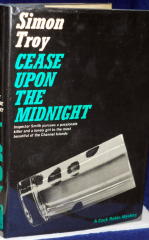
SIMON TROY [THURMAN WARRINER] – Cease Upon the Midnight. Macmillan, US, hardcover, 1965. Previously published in the UK: Gollancz, hardcover, 1964.
The coroner’s jury, sitting on the death of Dr. Bewlay from an overdose of sleeping tablets, leaves open whether it was accidental or intentional. Inspector Smith, too, has not made a decision. Did Bewlay’s fiancee, or his ne’er-do-well actor brother Raymond, or both give him an overdose, and how could it have been done? Certainly Bewlay was not a man likely to kill himself.
Acting on the invitation of Robert Neil, who runs an advanced girls’ school on the island of Grenezy, where both the fiancee and Raymond have gone, though separately, Smith travels to the island, discovers much about the participants, and nearly doesn’t make it back.
While the murderer is known early and may be surmised even earlier, the interest here is in Smith — whose superintendent can’t decide whether he is Machiavellian, naive, or dim — and his investigation, which is first class. The bright but still dumb heroine — “There was no risk,” she contends, “you came just in time” — has a tendency to fall in and out of love with considerable dispatch, and the villain is just a bit too villainous.
These flaws, if flaws they are, weren’t noticed during the reading, only in the reflection afterwards.
— From The MYSTERY FANcier, Vol. 13, No. 1, Winter 1991.
PETER RABE – The Out Is Death. Gold Medal #657, paperback original, 1957. Black Lizard, softcover, 1988.
On a positive note, I recently finished The Out Is Death by Peter Rabe, and am once more impressed by the talent of one of the less-remembered two-bit novelists of the 50s.
Those who sing the praise of Thompson, Goodis et al., should take a look at this tough, sentimental tale of a broken-down safe-cracker and the friend who tries to save him from a sadistic hood coercing him out of retirement.
The action is fast, the plot tight, but it’s Rabe’s feel for the characters, even the minor ones, that lifts this out of the ordinary. Try it.
RICHARD MARR – The Smith Slayer. Big Ben #4, UK, paperback, August 1940. First published: Gardner, UK, 1939, under the pseudonym “Burmar.”
Occasionally I read a book which is utterly preposterous but great fun. The Smith Slayer is such a book. This is a multiple-murder detective novel, which begins with a newspaper advertisement: “God help all whom it may concern: The Smith Slayer commences his campaign.”
Soon people with the surname “Smith” begin to he murdered in the face of the rather incompetent efforts of Scotland Yard to protect them. Still, it’s hard to blame the police force when even a doctor blithely attributes a death to “probably one.of those little known Eastern drugs.”
The book is filled with marvelous assumptions: “Now, if you wanted to hire an assassin where would you go?” “Chicago, I suppose.”
After a series of thriller-like episodes, the book concludes as the Smith Slayer reveals himself and his ridiculous motivation. You won’t believe much of the story, but I’m not sure that you’re supposed to.
— Reprinted from The Poisoned Pen, Vol. 6, No. 2, Winter 1984/85.
Bibliographic Note: Richard Marr has one other entry in Hubin’s Revised Crime Fiction IV, that being Death at Salterton Court (Everybody’s, UK, paperback, 1945).
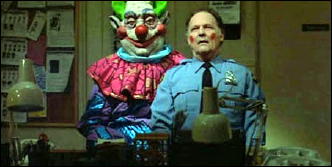
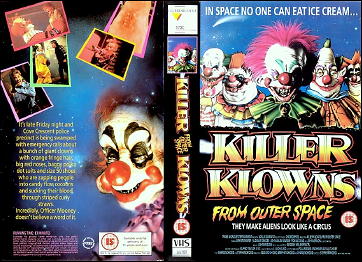
KILLER KLOWNS FROM OUTER SPACE. Sarlui / Diamant, 1988. Grant Cramer, Suzanne Snyder, John Allen Nelson, John Vernon, Michael Siegel, Peter Licassi, Royal Dano. Screenplay: Charles Chiodo, Edward Chiodo (uncredited), Stephen Chiodo. Director: Stephen Chiodo.
Killer Klowns from Outer Space is not a classic — yet. It may well be in a few years, though, since it’s certainly done in the Classic Vein.
A bunch of aliens land in their spaceship and proceed to pillage a small town, taking the locals unaware until a few brave young people get the Authorities on their side and put the blighters to rout. There’s even a nod to the 70s in the person of a redneck Cop who hates College Kids.
The gimmick here is that the aliens look and act like big, ugly clowns; they shoot people with Popcorn Guns, track them down with balloon-sculpture dogs, mummify them in cotton candy and get around in a spaceship that looks like a circus tent. The concept plays much more effectively than I would have thought, thanks to some really imaginative special effects and nice timing.
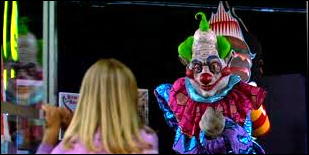
There’s one really suspenseful scene where a clown is trying to lure a cute little girl outside, smiling and crooking a finger at her, and holding an oversize wooden mallet behind his back. Sounds dumber than dogs, I know, but trust me, it works.
— Reprinted from A Shropshire Sleuth #48, January 1991.
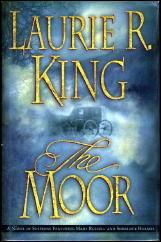
LAURIE R. KING – The Moor. St. Martin’s, hardcover, 1998; Bantam, paperback, 1999.
In her fourth Mary Russell/Sherlock Holmes novel, King brings the couple to the scene of one of Holmes’ most celebrated cases, Baskerville Hall. An American adventurer has bought the Baskerville property but, surprisingly, is on the verge of selling it and moving on.
Russell and Holmes, who are visiting Sabine Baring-Gould, an old friend of Holmes, find the situation at Baskerville Hall somewhat troubling, but their principal concern is to find the killer responsible for two murders and track down the source of reported sightings of a ghostly carriage accompanied by the legendary Hound.
Much of the novel deals with Russell’s growing affection for the Moor, and the portrayal of the region and its inhabitants is the principal strength of the novel. The resolution of the various plot lines is accomplished in a few action-packed pages, which I suspect I will not long remember. The wanderings of Russell about the often desolate but still beautiful Moor really have more drama than the Baskerville goings-on and make me want to revisit Conan Doyle’s novel to see if his descriptions of the Moor are as evocative and powerful as King’s.
I found this to be the most engrossing Russell adventure since The Beekeeper’s Assistant, with the portrayal of the noted author and antiquarian Baring-Gould more telling than the rather bland characterization of Holmes.
DANTE. NBC, Monday 9:30-10pm, October 13, 1960 through April 10, 1961; 26 episodes. Four Star Productions. Created by Blake Edwards. Produced by Michael Meshekoff. Associate Producer: Harold Jack Bloom. Cast: Howard Duff as Willie Dante, Alan Mowbray as Stewart Styles, Tom D’Andrea as Biff. Recurring Cast: James Nolan as Inspector Loper.
The character Willie Dante began as a recurring character on the anthology TV series FOUR STAR PLAYHOUSE (CBS). Dick Powell played the gambler Dante who owned the restaurant Dante’s Inferno with a hidden backroom for illegal gambling. With the help of his friend, ex-safe cracker and bartender Monte (Herb Vigran), and (in some episodes) a former British millionaire with a gambling habit and now waiter Jackson (Alan Mowbray), Dante would help someone and be rewarded with the cops, usually lead by Lt. Waldo (Regis Toomey), closing down the gambling backroom at the end of the episode.
I found Powell’s version disappointing, the writing stale, and the acting not strong enough for me to like any of the bad boy characters. Most if not all can be seen on youtube or available on cheap DVDs. Here is an episode with an unexpected cameo:
https://www.youtube.com/watch?v=HbhKM6Kydhc
Four years after Powell’s last Dante, Four Star and NBC decided to air a weekly series featuring Howard Duff as William Dante. Currently various episodes are available from the collector’s market and youtube. While this is the second episode to air, it appears to be the pilot:
(Part One)
(Part Two)
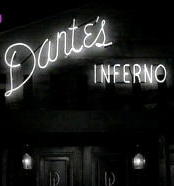
Things were different. Willie Dante moved to San Francisco with hopes of a new start running a new Dante’s Inferno. This time there would be no backroom for gambling. Dante lived in the office that overlooked the inside of the popular nightclub. He had decided to go straight and was dragging two of his best friends with him.
Dante’s sidekicks, former thief and now reluctant bartender Biff, and Dante’s Inferno’s Maitre d’ and ex-conman Stewart Styles helped run the club while Dante was out dealing with that week’s threat to the club or him, and they were there for backup whenever Willie needed help.
Every week Willie would find himself caught in the middle of two or more opposing forces, usually the cops and bad guys. No one believed Willie was going straight, both the good guys and bad guys suspected him to be up to something.
When a fortuneteller tells a woman her husband will be killed by Willie Dante, Dante finds himself caught in the middle of a mess he didn’t create. For the cops it is a simple case, if anything happens to the husband or Dante they will arrest the survivor.
Women played an important role in Willie Dante’s life. It was the un-PC time of 1960 and women usually played one of two basic roles, the rich beautiful woman eager to be seduced by willing but business first Willie or ex-girlfriends turned femme fatale. There was an occasional variation such as a mobster’s girlfriend willing to do anything for Dante except reveal the name of her boyfriend who was after Willie. There was even one episode when a suspected bad girl turned into an undercover cop.
In the episode below, the role of the girlfriend of the week lacked the patience and forgiveness of most, and the female author of a best selling book about a gangster the public believes is Willie Dante gives Willie more problems than any femme fatale ever could.
Created by Blake Edwards, it is no surprise DANTE had a similar look and style of PETER GUNN and MR LUCKY. The dialog was clever and the banter quick and witty. The stories plots were creative and hold up well. In one episode, bank robbers frame Dante by breaking into the Dante’s Inferno safe and switching the stolen money for Dante’s legally gained cash. Plot devices often had a surprise twist such as a blackmailer using homing pigeons.
In the episode below, an enemy from the past wants Dante dead. Before he retires to the Orient he leaves Willie a $50,000 trust to begin the upcoming Monday. But should Willie not be alive on Monday the beneficiary of the trust would be a hitman desperate for money.
https://www.youtube.com/watch?v=vbA0BUffifc
The main writer was Harold Jack Bloom (HEC RAMSEY). He and the other writers succeed where the writers (including Blake Edwards) of Powell’s version failed. The writing was fresh, clever, and the humor rose above the old vaudeville jokes about coffee that burdened the FOUR STAR PLAYHOUSE episodes.
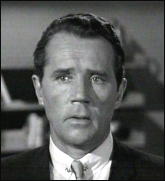
But it was Howard Duff who made Willie Dante the lovable rogue. Duff was perfect as Dante. Much as he did in radio’s ADVENTURES OF SAM SPADE, Duff was believable in all aspects of the character, his humor, the romance, and the hardboiled style.
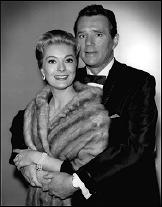
The guest cast featured such talent as Joanna Barnes, Dick Foran, Ruta Lee, Joan Marshall, Charles McGraw, Pat Medina, Edward Platt, Marion Ross, William Schallert, Joan Tabor, Nita Talbot, and (to the left) Lori Nelson.
The series never had a chance as NBC placed it opposite of CBS’s ANDY GRIFFITH SHOW and ABC’s ADVENTURES IN PARADISE. The first episode got a 13.5 rating versus ANDY GRIFFITH 26.6 and ADVENTURES IN PARADISE 21.3. The NBC program before DANTE was BOB HOPE that for that first week had a 31.9 rating. Losing over half the audience of the show before it and finishing last in its time period made it obvious the odds were against DANTE from the beginning.
DANTE with Howard Duff was a superior half hour mystery that remains entertaining today. It is a shame more people didn’t watch it when it first aired and there is not an official DVD available for viewers to discover it today.
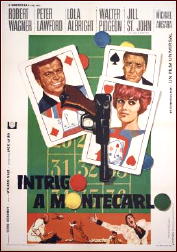
HOW I SPENT MY SUMMER VACATION. Made for TV. Universal/NBC-TV; telecast 07 Jan 1967. Robert Wagner, Jill St. John, Peter Lawford, Lola Albright, Walter Pidgeon, Michael Ansara. Teleplay: Gene R. Kearney; director: William Hale.
How I Spent My Summer Vacation is a splashy, colorful and cheerfully cheesy made-for-TV exercise in adolescent paranoia that landed right on the cusp of my teenage years. As such, it will always keep a place in my heart, if not on any 10 Best list.
Assuming that you weren’t a high school prom queen or captain of the football team, perhaps you can relate to the feeling. I know I could. Which is where Vacation takes its cue and proceeds to run the table with it. Faced with Lawford/Albright’s constant belittling — and flummoxed by the ease with which they do it — Wagner decides on a puerile revenge; he begins gathering evidence of what he thinks are Lawford’s criminal activities.
What follows borders on a teenage dream, as our hero skulks nimbly about, snapping a photo here, jotting down a detail there, keeping one step ahead of his quarry and jotting it all down in a notebook labeled “How I Spent my Summer Vacation.†Even better, as the fantasy proceeds to its climax, writer Gene Kearney (whose talents seem confined to the small screen for his whole career) keeps spinning it further and further out, in true dream-fashion as we get shifting realities, dark plots, mysterious fortress hide-outs and the whole thing related in flashback to a super-villain (Walter Pidgeon) who seems unsettlingly fatherly — the perfect touch for a tale of adolescent angst —leading to a conclusion that… well to say any more would spoil it.
Don’t take this Vacation expecting artistry, but if you have any feeling for that turbulent rebel mood of the 60s you may find this one a lot of fun.
Editorial Comment: This film has been reviewed once before on this blog, the earlier occasion by David L. Vineyard. (Follow the link.)
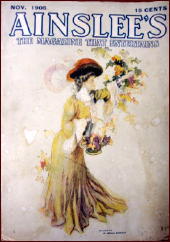
GERALDINE BONNER – The Castlecourt Diamond Case. Funk & Wagnalls, hardcover, 1906. (“Published, December, 1905.â€) First appeared in Ainslee’s Magazine, November 1905. Currently available in several different Print On Demand editions. Online edition: https://archive.org/details/castlecourtdiamond00bonnrich
This is the second version of this review, In the first, employing suitable modesty, I credited myself with the discovery of Geraldine Bonner, an entertaining but (or so I thought) entirely forgotten writer. Having stated that Bonner is unknown, I then belatedly checked my facts … and I found that five years ago Kathi Maio praised another book by Bonner, The Black Eagle Mystery (1916), in Murderess Ink.
Such are the perils of research.
Ms. Maio says that Black Eagle is “a charming mystery” — a phrase that also describes Castlecourt Diamond. The story of the theft of the Marchioness of Castlecourt’s diamonds is told in six “statements.” The first, by the Marchioness’ maid, describes the theft, introduces the main characters, and mentions the two detectives, one official, one private.
The second section is narrated by “Lilly Bingham, known in England as Laura Brice, in the United States as Frances Latimer, to the police of both countries as Laura the Lady.” It’s not much of a surprise that Laura stole the diamonds, though whether she was acting for someone else is not yet clear.
On the whole, however, the mystery is primarily a vehicle for Bonner to produce a comedy of manners, and the interest in the second part is Laura’s successful attempt to plant the diamonds on an unsuspecting American couple, Cassius and Daisy Kennedy. The Kennedys have been courting London society (they already know “a bishop and two lords”) and thus can’t throw out Laura and her henchman when, pretending an invitation, they arrive for dinner.
Two parts of the story are statements by the Kennedys, detailing their schemes to rid themselves of the diamonds and culminating in the theft of the jewels by a seeming sneak-thief. John Burns Gilsey, a private detective engaged by Lord Castlecourt, narrates a section that explains his deductions pointing to the Marchioness as the instigator of the plot, but the book concludes with a statement by the Marchioness showing that Gilsey was only partly correct.
The Castlecourt Diamond Case is indeed charming, and it is made even more so by its brevity — with large type and margins it contains less than 30,000 words, a far cry from many Victorian and Edwardian detective novels, as anyone who has labored through, say, Lawrence Lynch’s novels with their 550 godawful pages will testify.
I can’t claim to be the discoverer of Geraldine Bonner, but I’m happy to join Kathi Maio in recommending her works.
— Reprinted from The Poisoned Pen, Vol. 6, No. 2, Winter 1984/85.
BIBLIOGRAPHY: [Taken from the Revised Crime Fiction IV, by Allen J. Hubin]
GERALDINE BONNER (1870-1930). Born in Staten Island, N.Y.
The Castlecourt Diamond Case (n.) Funk 1906.
The Girl at Central (n.) Appleton 1915 [Molly Morganthau (Babbits)]
The Black Eagle Mystery (n.) Appleton 1916 [Molly Morganthau (Babbits).]
Miss Maitland, Private Secretary (n.) Appleton 1919 [Molly Morganthau (Babbits)]
The Leading Lady (n.) Bobbs 1926.
-Taken at the Flood (n.) Bobbs 1927.
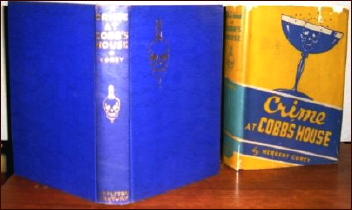
HERBERT COREY – Crime at Cobb’s House. D. Appleton-Century, hardcover, 1934
For reasons best known to himself, the wealthy Charley Cobb hires Thomas Milne, lawyer and private detective. At Cobb’s estate in the horse country of Virginia a double murder takes place, perhaps in retaliation for an earlier unsolved double murder.
Tedium, at least for the reader, prevails here, and then it’s off to Washington, D.C., for additional boredom in a different setting.
A selection in Appleton-Century’s “Tired Business Man’s Library,” Corey’s novel is fitting. Soporific sums it up.
— From The MYSTERY FANcier, Vol. 13, No. 1, Winter 1991.
Editorial Comment: This is the author’s only entry in Al Hubin’s Revised Crime Fiction IV.
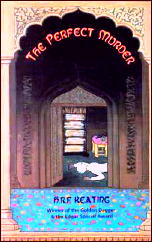
H. R. F. KEATING – The Perfect Murder. Collins, UK, hardcover, 1964. Dutton, US, hardcover, 1965. Film: Merchant Ivory Productions, 1988 (Naseeruddin Shah as Inspector Ghote; Keating makes a cameo appearance about eight minutes into the movie). Softcover reprint: Academy Chicago, US, 1983.
This is the first in H. R. F. Keating’s series featuring Inspector Ghote of the Bombay Police Force. The Perfect Murder received the Mystery Writers of America’s Special Edgar Award and the Crime Writer’s Association’s Golden Dagger.
How interesting that The Perfect Murder refers to an attack on Mr. Perfect. But, will he survive, or succumb to his injuries? Inspector Ghote not only must try to solve this crime with little help from Lala Verde (Perfect’s employer — who talks annoyingly in rhymes) but must also try to solve a theft.
The mysterious disappearance of one rupee from the desk of a Very Important Person, the Minister of Police Affairs and the Arts, is equally crucial where Ghote’s boss is concerned. Struggling amidst bureaucratic red tape and incompetence, and a wife who is less than understanding about his working overtime, Ghote nevertheless forges ahead with both investigations.
A definitely different and amusing murder mystery.
— Reprinted from The Poisoned Pen, Vol. 6, No. 2, Winter 1984/85.