Reviews


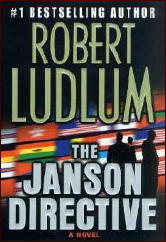
ROBERT LUDLUM – The Janson Directive. St. Martin’s, hardcover, October 2002; paperback, October 2003.

ROBERT LUDLUM The Janson Directive

   I don’t know about you, but the few of Robert Ludlum’s books I’ve read have always kept me reading. And with this particular one checking in at 680 pages in paperback, reading and reading and reading. I can’t do that in one night any longer, no matter what, and I don’t think anybody can.

   Plot: An ex-Vietnamese War prisoner named Alex Janson, now a super-whiz corporate security consultant, is hired to free a wealthy philanthropist Peter Novak from a group of terrorists. Novak’s billions of dollars have been used many times over to promote democracy and peace around the world, and Janson is the only one who can save him.

   Which, after several nerve-shattering incidents, including a free-fall parachute drop from four miles up, he does. This is on page 140. With 540 pages to go. What next? You should only ask.

   Janson finds that he only a pawn, if you’ll forgive the cliché, in an even greater conspiracy, one designed to simply knock your socks off. Ludlum demonstrates such a worldliness in his characters, and leans so heavily on a world of esoteric knowledge that seemingly comes natural to him, that an everyday, ordinary sort of person such as you and I can only sit back in awe.

   Well, I can vouch for me.

   There are flaws, though. Janson is all but perfect, but his shield of invincibility only goes so far. It just isn’t large enough to include all of the people who give him aid and assistance, to put it mildly. They’re on their own. Given a chance to second guess themselves, they might well opt out of this book, given the opportunity. Nor is Ludlum averse to dragging out the clichés himself, as the occasion arises.

   All in all, at $7.99 list price for the paperback, you certainly get your money’s worth. If in the end you start to reflect on the fact that the tale that’s told is no deeper than your standard super-hero comic book, that’s the only drawback that might trigger some regret, and it will quickly pass.

— October 2003


[UPDATE] 10-13-12.   According to at least one online source, following the success of the Bourne movie, The Janson Directive is also being converted to the big screen. It ought to be a good one.

       The Paul Janson series —

The Janson Directive (2002)
The Janson Command (2011) (with Paul Garrison)
The Janson Dilemma (2014)

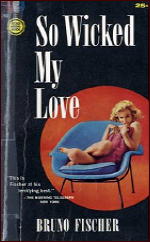
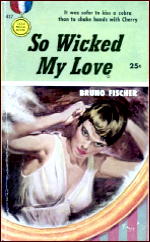
BRUNO FISCHER – So Wicked My Love. Gold Medal #437, paperback original; 1st printing, October 1954. Gold Medal #753; 2nd printing, March 1958. A shorter version appeared in Manhunt, November 1953, under the title “Coney Island Incident.”

BRUNO FISCHER So Wicked My Love

   Sometimes it’s interesting (and often even fun) to put yourself in the shoes of one of the hapless protagonists in one of these early Gold Medal noir dramas of the early 50s. Take Ray Whitehead, for instance.

   He’s a blue collar sort of guy, working as a truck driver for his father in a small Brooklyn-based business. His fiancée has just broken up with him, one of those “my mother always wanted me to marry a doctor” sort of deals, and he has her $1200 engagement ring in his pocket. He’s moping around on Coney Island when spots a redhead he knew in high school, Cherry Drew, a girl with not much of reputation then, but in a bathing suit, she certainly looks fine enough now.

   One thing leads to another, and instead of throwing the ring down a convenient sewer, he’s given her the ring and he’s heading for her apartment with her. There waiting for her, though, is a guy named Shorty. It turns out that Cherry was part of gang of bank robbers, but she’s hijacked the loot with another guy who the rest of gang caught up with and who is now dead, and now they’ve caught up with her.

BRUNO FISCHER So Wicked My Love

   Several minutes later, Shorty is dead – Cherry’s doing – knifed twice in the back. Cherry has $80,000 in stolen cash. Question: what do you do? What can you do that doesn’t keep coming back to haunt you?

   It’s a good beginning, but the book’s far too long for what was first a short story but which is stretched as far as it can go. There are a few twists of the plot that follow, but not even a good pulp writer like Bruno Fischer can keep coming up with as many as he needs. One good one, though, involves Ray’s former fiancée, who changes her mind about him, but who wonders why this other woman has the ring – or what looks exactly like the ring – she realizes she returned to him much too hastily .

   But as sappy as Ray is for Cherry, he’s too honest a guy to be caught up in the latter’s charms all of the way the book, although she tries, believe me she does, and Ray really is as dopey as I said, and then some. In fits and stops. the book wanders around to a sort of happy ending, but only if you don’t stop and wonder about what comes next; how Ray manages to explain his way out of his last final encounter with Cherry.

REVIEWED BY DAN STUMPF:


NIGHTMARE ALLEY

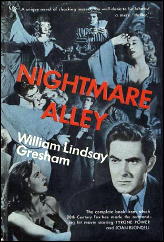
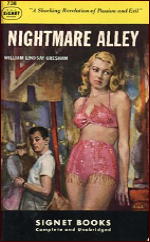
WILLIAM LINDSAY GRESHAM – Nightmare Alley. Rinehart & Co., hardcover, 1946. Triangle Books, hardcover, Photoplay edition, 1948. Signet #738, paperback, 1949. Popular Library, paperback, 1976. Carroll & Graf, paperback, 1986. New York Review of Books, softcover, 2010. Included in Crime Novels: American Noir of the 1930s and 40s, Library of America, hardcover, 1997.

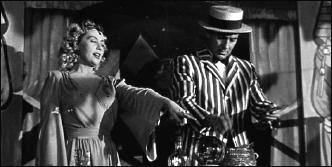
NIGHTMARE ALLEY. 20th Century Fox, 1947. Tyrone Power, Joan Blondell, Coleen Gray, Helen Walker, Taylor Holmes, Mike Mazurki, Ian Keith. Based on the novel by William Lindsay Graham. Director: Edmund Goulding.

   The very words “nightmare alley” with their fusion of dreams and squalor, phantasm and filth, promise a lot when you put them on a book. Or a movie. Nowadays it’s possible to read a book and watch the film made from it in close proximity, and a while back I had a bit of ghoulish fun with the exercise.

NIGHTMARE ALLEY

   Nightmare Alley was William Lindsay Gresham’s first novel, and though there’s a bit of fat in the book, it’s still a powerful and often unsettling tale of Stan Carlisle, a smooth carnival huckster who promotes himself to spiritualist and then religious con-man, rising in society only to find that the seeds of his own undoing were always within him and “what we saw and he didn’t” have grown to hideous (nightmarish?) proportions.

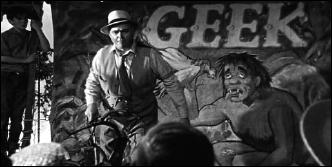
   This was the work that brought the term geek to the public, and Gresham’s description of just what a geek was in those days, and how one was made, is still chilling today. It ain’t for every taste, but fans of Jim Thompson and David Goodis will find it a rare and — in its own way — unforgettable treat.

   (PARENTHETICAL NOTE: William Lindsay Gresham (1909-1962) was, from all accounts, an alcoholic who abused his wife and children and ended up a suicide. His treatment of his wife and kids was bad enough that his spouse took the children and fled to England — where she met, fell in love with, and married C. S. Lewis. Their story can be seen in the film Shadowlands.)

NIGHTMARE ALLEY

   The movie Nightmare Alley that came out in 1947 is something of a surprise from a major studio like Fox, a “class” director like Edmund (Grand Hotel) Goulding, and producer George Jessell (!) but it’s slick, savage, seedy and immensely satisfying.

   Tyrone Power — a smooth leading man with an odd flair for self-destructive roles — puts bitter bite into his performance as Carlisle, ably supported by a spirited cast of capable players, including Joan Blondell, Ian Keith, Mike Mazurki, and chilling Helen Walker as a lethal psychologist; the scene where she destroys Power’s psyche is worthy of Lady MacBeth.

NIGHTMARE ALLEY

   Lee Garmes’ evocative, sleazy-splendid photography helps out too, but best of all is Jules Furthman’s cunning screenplay. Undulating past the censors, he takes the masochism explicit in the book and makes it implicit in the character, and even hints at a darker ending than the one we see on screen.

   Furthman always was a good hand at adapting the works of others (To Have and Have Not, The Big Sleep, etc.) with a slick trick of slicing just enough out of a book to get past the censors, while still preserving the tone of the piece, and his work here is simply splendid.

https://www.youtube.com/watch?v=idlYaKQ1yjw

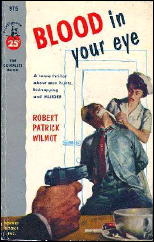
ROBERT PATRICK WILMOT – Blood in Your Eye. J. B. Lippincott, hardcover, 1952. Pocket 975; paperback, October 1953. Cover illustration by James Meese.

   Blood in Your Eye is the first of three cases cracked by New York City private eye Steve Considine, and for the record, here’s a list of all three:

      Blood in Your Eye. Lippincott, 1952; Pocket 975, Oct 1953.
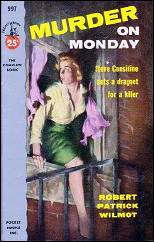
      Murder on Monday. Lippincott, 1953; Pocket 997, March 1954.

ROBERT PATRICK WILMOT

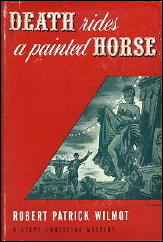
      Death Rides a Painted Horse: Lippincott, 1954; Jonathan Press #80, abridged, no date.

ROBERT PATRICK WILMOT

   You’re much more likely to like this one if you’re a fan of hard-boiled tough guy detective fiction; it really isn’t one that’s going to convert you. The cover of the paperback is (um) an eye-catcher, and the first 100 or so pages are terrific. By that time, though, while the pace hasn’t let up, the air has started to leak out of the tires, and by the time the book is over, you may have cause to wonder from where solution came, far left field?

   To start at the beginning, though, Considine is hired to wet-nurse an actively practicing but generally amiable alcoholic on a plane trip to England, where a doctor is waiting for him. On the night before their departure, Charlie Gillespie, given in the past to hallucinatory and (hence) quite invalid misinterpretations of everyday events, claims to have seen a murder committed, and soon after, goes underground and disappears completely.

   Considine’s job: find him, and thus we have a story. What I think I’ll do is give you two long quotes, both of which caught my attention in no uncertain terms, but in not exactly the same way. First, from pages 36-37, where Considine is alone in a bedroom with a girl who’s involved — and of course there is:
ROBERT PATRICK WILMOT

   Her handbag was on the chair, and she had to turn her back to me, bending to pick up the bag. I moved fast. I wrapped my left hand around her, breast high, and I clapped the palm of my right hand across her mouth, pressing hard. I picked her up bodily and carried her into the bathroom and set her on her feet and shifted my left hand to her mouth while I reached out with my right and turned on the shower taps, full blast. You could hardly hear her yell at all, or me, either, when she sunk her teeth into my hand.

   She bit hard and it hurt like hell and I went crazy mad, for a moment. I got my right hand into her hair and gripped it and spun her around and slapped her across the mouth with the flat of my bloody left hand. Then we were locked in tearing, panting embrace, me trying to hold her hands while she clawed at my face and jerked her knees up into my body, until I got both her arms pinned and pulled her so close that she couldn’t use her hands or knees, and I could feel her breasts swelling firm and big against my chest, and her curved long thighs against my thighs.

   Desire and rage were so completely mingled within me that I twisted her wrist even as I kissed her lips — and I kissed her lips hard. Her head went back and she gave a long, sighing, panting breath, and for an instant her lips met mine wide and warm, and her body seemed to melt in a yielding movement that made it part of my own… Then she butted me solidly on the cheek with her head and twisted loose from my hands.

   It’s quite a first date, even for a kindergarten teacher, which in fact she is, although Considine doesn’t know that yet. He continues:

   And isn’t this all just simply wonderful, I thought, leaning against the door. Gillespie’s out somewhere maybe waxing up a million dollars’ worth of trouble, and you’re supposed to be looking after Gillespie, and what do you do, Considine, what do you do? You don’t take a babe’s word for it that she’s a whore when she says she’s a whore; you’ve got a lousy false pride that’s piqued because you can’t figure out what sort of petty racket she and her pimp and the other guy are mixed up in, and you’re a sorehead who can’t take it when the girl pulls some of the same stuff on you. So you make with the muscles, and now you’ve got her, and what do you really want of her, except the one thing you can’t have unless you take it by force.

   The girl’s name is Carla Paul, and later on — here’s the other quote coming up now — Considine is talking the case over with the cop on the case. From pages 65-66:

    “One more thing,” Christie said to me. He looked about him as though to be sure there was no one else in the room, lowered his voice and squinted at me. “You ever read detective stories, Considine?”

    “Sometimes,” I said, wondering what-the-hell.

    “You know how it is in those stories,” Christie said. “They got a regular formula. The hero is always a bright gum-shoe, with ideas, and he’s always getting fouled up with a lot of stupid, sadistic city cops who do everything they can to prevent him from solving the crime.”

    “I bet you could write yourself,” I said. “How do you know, if you haven’t ever tried?”

    Christie ignored my remark. “So, because of the dumb cops, our Shamus hero has to more or less take the law into his own hands. In order to bring the villain to book, it’s necessary for our hero to break every law in the book, himself.”

    “Tell me more,” I said.

    “Take a case like this,” Christie went on. “The cops might wanna case Carla Paul’s room, just to see what they could see. But they’d need a warrant, because if Carla or the landlady came in while they were shaking down the place, there’d be hell to pay. If it did happen to be a case of mixed identity, I’d hate to be the cop who happened to be caught with a handful of her unmentionables.”

    “Time presses,” I said, “so suppose I just take the story from here. The Shamus in your story isn’t inhibited by legal red tape or bothered by stupid principles against the search. Right?”

    “Oh, so right,” Christie cooed.

    “So he waits until Paul isn’t home,” I said, “and he opens her door with a skeleton key, or maybe a strip of celluloid because that makes it sound harder. He goes into the room and combs it good, and maybe he finds something — a letter or something — that gives him a line on Mr. Blair? Okay so far?”

    “Perfect,” Christie answered, avoiding my eyes. “I doubt if Raymond Chandler himself could do better.”

    “There’s only one thing wrong,” I said, “and that’s the possibility that someone may come in and catch the bold hero in shaking down the apartment. Someone like a big, tough policeman, for instance. Or a two hundred and fifty pound wrestler, who doubles as a janitor.”

    “That ain’t in the script,” Christie said, “but I’ll admit it would be awkward if it happened.”

    “Yes, wouldn’t it? And then our Shamus gets carted off to the nearest police station and placed in a backroom where a lot of uncouth persons ask impertinent questions about him having been in the apartment. And then maybe Shamus gets so indignant that he gives a discourteous answer, and loses some of his teeth.”

    I flipped my cigarette at the cuspidor and grinned at Christie. “I need my teeth, lieutenant. I might be sent out on a job that paid so well I could afford to eat steak.”

    Christie rolled a pencil around on the desk top and looked at me thoughtfully. “Of course,” he said, “the Shamus could always ask to speak to Lieutenant Christie.”

    “No doubt he could,” I said, “and by the time he got to talk to Christie, our hero would have a pocket full of teeth. See you later, Chris.”

    We went out, and as we closed the door, Christie sighed again.

   I don’t know about you, but for me, that was worth the price of admission, right there. I also have to admit that there was a time, about half way through, that I had absolutely no idea where the story was going next, and that’s doesn’t happen, or at least not very often.

    You may take that as a good thing — I do — but what it also means it that it takes a full final chapter that’s ten pages long, after the bad guys have been named and identified, to tie up all of the loose ends, or at least all but one, a huge, massive coincidence that Wilmot dares not even mention, but I will. Possible? Sure, but without it, it all falls apart.

— October 2002


[UPDATE] 10-06-12. I’ve not been able to find any personal information about the author online, but I did come across a reference to one quote that’s interesting. From the cover or jacket flap of a British edition of Death Rides a Paper Horse: “Robert Patrick Wilmot has been compared by Anthony Boucher of the New York Times to the young Dashiell Hammett.” I have not found the quote from the Times itself, but it does suggest that reading the book again may be in order, or even all three of them.
REVIEWED BY WALTER ALBERT:         


WHAT PRICE GLORY 1926

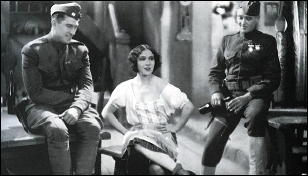
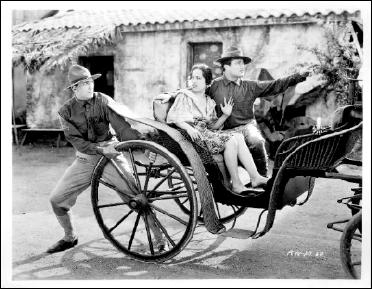
WHAT PRICE GLORY. Fox, 1926. Victor McLaglen, Edmund Lowe, Dolores Del Rio, William V. Mong, Phyllis Haver, Elena Juardo, Leslie Fenton, Barry Norton, Sammy Cohen, Ted McNamara. Director: Raoul Walsh, director. Shown at Cinevent 38, Columbus OH, May 2006.

   This was a year for repeat screenings, but I had never seen this great success of 1926. The film was based on the Lawrence Stalling/Maxwell Anderson stage hit of 1924, but with the antics of co-stars McLaglen (Captain Flagg) and Lowe (Sergeant Quirt) beefed up at the expense of the strong anti-war message of the play.

   Much of the film deals with the combative womanizing of Flagg and Quirt, but the climax features a well-staged battle sequence that does play up the brutality and inhumanity of war, with the obligatory sacrifice of a secondary character whose demise you can spot coming very early in the film. (He’s the young artist who’s the least likely of the recruits but performs gallantly until his heroic death.)

WHAT PRICE GLORY 1926

   There’s a similar sacrificial lamb in the first talking-film sequel (The Cock-Eyed World, 1929), demonstrating once again that Hollywood loves nothing better than a formula that strives to repeat the success of the original. Still, with its engaging cast and Walsh’s vigorous direction, the film has retained much of its impact.

Editorial Comment:   Mike Grost has a long in-depth look at this movie on his website. Check it out here.

REVIEWED BY MICHAEL SHONK


PARIS PRECINCT. Episode: “A Woman Scorned.” Etoile Production for MPTV, syndicated, 1954-1955, 26 half-hour episodes in black and white. Cast: Louis Jourdan and Claude Dauphin. Technical adviser: Inspecteur Jean Couade. Created by Jo Eisinger. Produced by Andre Hakim.

PARIS PRECINCT Louis Jourdan

    Yet another police procedural based on “real” cases, Paris Precinct used the files of the Paris, France police department. Shot on location in Paris, the series was produced for American syndication by Etoile Production, a company owned by Louis Jourdan, Claude Dauphin, producer Andre Hakim and writer Jo Eisinger.

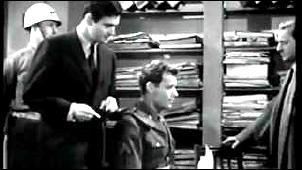
“A Woman Scorned.” Teleplay by Charles K. Peck Jr. Guest Cast: Giselle Preville, Jean Ozenne, Bruce Kay, Nicole Francis, and Phillippe Clay. Directed by Sobey Martin. *** While on a date with an American soldier, a young blond woman dies from poisoned brandy.

    The episode can be found on YouTube in more than one place including here:

https://www.youtube.com/watch?v=NXaCbwmy3ZM

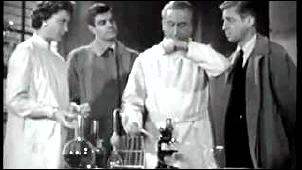
    “A Woman Scorned” was a typical TV mystery of the era. The simple story was told in the linear style procedural fans are accustomed to with one twist that made it worth watching for the rest of us. It begins with the murder then introduced our detectives who began a step-by-step search for the killer.

    Our two detectives are different enough to make a good team. Louis Jourdan plays the serious Inspecteur Beaumont, lead detective and show’s narrator. Claude Dauphin is charming as the lighthearted Inspecteur Bolbec.

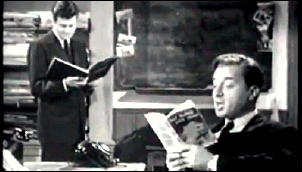
    In their first scene we see the two detectives differences through their reading material. Jourdan’s Beaumont is reading a police file, while Dauphin’s Bolbec is enjoying a cheap noir paperback The Blonde Died Young. Bolbec jokingly envies the fictional detective who has made love to three beautiful blondes and one redhead in the first hundred pages.

PARIS PRECINCT Louis Jourdan

    “A Woman Scorned” suffers from some overacting from the supporting cast, one of the common flaws of early TV caused by talentless newcomers or actors who were inexperienced in the subtleties of acting on television versus stage or film.

    The episode featured more sets and characters than the usual 50s TV syndication low budget series, partly to give our detectives another excuse to drive through the Paris streets as they moved from one character’s location to another.

    There is a surprising absence of fights and chases in “A Woman Scorned,” but that may not have been typical for the series. In Billboard (April 16, 1955), Leon Morse reviewed the Paris Precinct episode “The Convict” and commented favorably on the action scenes such as the bar-fight and a chase across the rooftops of Paris. Morse believed the show should appeal to melodrama fans looking for something off beat.

    Writer Charles K. Peck Jr. career would include film (Seminole, 1953), TV (Caribe, 1975) and Broadway (La Strada, 1969). His script for “A Woman Scorned” lacked the action one expects from 50s crime TV, but it had its moments, most notably the twist involving the murder weapon.

    Director Sobey Martin stuck with the style of the time, begin with master shot, cut to close ups, and toss in an occasional odd angle such as from overhead. Martin would work for many TV series including Boston Blackie, but he is best known for his work with Irwin Allen and series such as Lost in Space and Time Tunnel.

PARIS PRECINCT Louis Jourdan

    As with most of the early TV syndicated series, specific dates for the series can be difficult to determine. The first mention of the series I could find was in Broadcasting for November 23, 1953 (followed by Billboard, November 28, 1953). Plans were for 117 half hour TV-film episodes to be done in color and distributed by MPTV. Filming had to start May 1, 1954 due to Louis Jourdan’s commitment to a Broadway play (most likely, The Immoralist). Paris Precinct was expected to air September 1954.

    In Billboard, May 29, 1954, the series was being offered for sale. Twenty-six episodes were available. Also offered were thirty-nine half hour episodes that would be available in color by September 1, 1954. The additional thirteen episodes most likely were never filmed.

    As for Paris Precinct being shot in color but airing in black and white, Billboard (October 23,1954) ran an item about MPTV desire to shoot its TV-Film series in color (tint), but producers had discovered the black and white prints were fuzzy on the air.

    “The first twenty six segments of Duffy’s Tavern were tinted, and the last thirteen were monochrome,” noted the article, “as are MPTV’s subsequent shows which were originally planned for tint.”

    September 25, 1954 Billboard mentions MPTV had yet to sell Paris Precinct (and Sherlock Holmes) to any TV station or sponsor. In October, UM&M took over the sales of Paris Precinct (Billboard, October 23, 1954).

    In December 1954, Max Factor agreed to sponsor the series in four major markets, New York, Detroit, Chicago, and Los Angeles (Billboard, December 25,1954).

    Shulton (Old Spice) agreed to sponsor Paris Precinct in a nation-wide campaign aimed at thirty-five markets in March 1955. In what would be Old Spice’s first TV commercials, Louis Jourdan starred in thirteen commercials to be used with the series. The commercials, filmed by Transfilm, Inc in New York, were sixty seconds or twenty seconds each and filmed live with a jingle. (Billboard, March 5, 19, and 28, 1955).

    The production details listed in Billboard (May 28, 1955) gave the initial release date for Paris Precinct as December 1954, and twenty-six episodes were available for syndication.

    “A Woman Scorned” is a mildly entertaining half hour mystery that will appeal to those who enjoy an old-fashioned police procedural or those who enjoy seeing 1954 Paris. Hopefully, more episodes will someday surface.

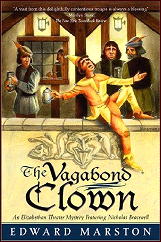
EDWARD MARSTON – The Vagabond Clown. St. Martin’s, hardcover, August 2003.

EDWARD MARSTON The Vagabond Clown

   Marston is a wonderfully prolific writer. Besides two separate series written as by Keith Miles, which as it happens is his real name, he has three additional series under this particular pseudonym, all historical mysteries: (1) with Christopher Redmayne, an architect, and Jonathan Bale, a constable in 1600s London, England; (2) the Domesday series, with Ralph Delchard, soldier and Gervase Bret, lawyer in medieval England; and (3), of which this is the latest, a series featuring Nicholas Bracewell, book holder for Westfield’s Men, an accomplished acting company in Elizabethan times.

   A book holder includes the jobs of both stage manager and road manager, and Nicholas has his work cut out for him in The Vagabond Clown, what with one clown incapacitated with a broken leg, and the second, recruited from a debtor’s cell, subject to serious bouts of wine, women and japery.

   Murder and other calamities also follow the trail of the travelers as they make their way from London to Dover, making adjustments to their plays as they go. The jealousies and acrimony between the two clowns make for fine amusement, and it is hard to imagine how the life of troupers like these on the road could be better described.

   The solution to the mystery is more than a little weak, alas, with motivations hidden until the very end, far too late to be of any help to the reader at home, though the culprits themselves are painfully obvious. An uneven entry in the series, therefore, but one that’s definitely worth reading.

PostScript: For the sake of completeness, the detective novels written under the Keith Miles byline are (1) the Alan Saxon mysteries, in which the current day golfer goes from country to country solving crimes and (2) a rather new series following the adventures of Merlin Richards, a young Welsh architect and a Frank Lloyd Wright protégé, taking place in Phoenix and Chicago in the 1920s and 30s.

   This is embarrassing. Marston/Miles can write faster than I can read.

— October 2003


[UPDATE] 10-03-12. Here it is, nine years later. The Vagabond Clown was the 13th in the Nicholas Bracewell series; there are now 16. Other current totals:

Eleven books in the Domesday series.
Six books in the Christopher Redmayne series.
Ten books in the Inspector Robert Colbeck series (begin in 2004).
Five books in the Captain Rawson series (begun in 2008).
Two books in the Inspector Harvey Marmion and Sergeant Joe Keedy series (begun in 2011).

       As by Keith Miles:

Six books in the Alan Saxon series.
Two books in the Merlin Richards series.

       As by Martin Inigo (not mentioned above):

Two books in the Dan Hawker series

   In the past nine years, if my count is correct, Marston/Miles has written 23 books.

REVIEWED BY DAN STUMPF:


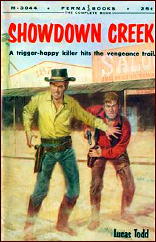
LUCAS TODD – Showdown Creek. Macmillan, hardcover, 1955. Toronto Star Weekly Novel, newspaper supplement, Saturday 19 November 1955. Permabook M-3044, paperback, 1956

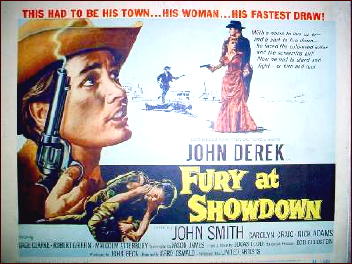
FURY AT SHOWDOWN. United Artists, 1957. John Derek, John Smith, Carolyn Craig, Nick Adams, Gage Clarke, Robert Griffin. Screenplay: Jason James, based on the novel Showdown Creek, by Lucas Todd. Director: Gerd Oswald.

FURY AT SHOWDOWN

   Showdown Creek is the kind of spare, gritty tale that Westerns should aspire to. Researching this, I can find no other book attributed to Lucas Todd, the author, nor any bio/bibliographic background on him, but perhaps that’s as it should be for a book that celebrates the outcast as this once does.

   As the story opens, Brock Mitchell is trying to ramrod a one-horse ranch for his broken-legged Uncle Ben and live down a reputation as a smart-ass hellion. Uncle Ben has arranged financing to get him through lean times, but the deal’s hit a snag, and nobody seems to know what the delay is —- until Mitchell learns that Chad Deasey, an ex-con with a grudge against him, has hit town and put up a respectable front, tied in with the most prominent local lawyer (soon to turn up dead) and persuaded the town banker to put the brakes on Uncle Ben’s deal, apparently just to ruin him and repay Mitchell for killing Deasey’s brother in a fair fight back in Brock’s gun-toting days.

   It’s pretty standard stuff for a Western: crooked banker, shady lawyer, upright hero handy with a gun, honest ranchers and even a purty blue-eyed widder woman trying to understand it all. Author Todd seems to know something about moving cattle around (not all western writers do) and he puts it across as he ladles out the more standard ingredients into his prairie stew, giving Peters a hot-headed sidekick and adding something about the railroad coming through.

FURY AT SHOWDOWN

   But he also tinges all this with an almost intangible feel for the dilemma of a flawed man painfully misunderstood. Every fight, shoot-out and unsolved crime echoes not only in physical violence but also in the looks Brock gets from the good citizens of Showdown Creek: the rumors, conversations broken off when he enters a room, and his increasing isolation from a community he needs.

   It’s intriguing stuff, and if it never quite rises to the level of Camus, the sense of alienation is still strong enough to lift this above the run-of-the-range shoot-’em-down and linger in the memory.

   Showdown Creek was filmed, appropriately enough, by Gerd Oswald, himself something of a Hollywood pariah, who was given only five days and a cast of unknowns and no-talents to do the job —- the only two players you ever heard of in this movie are John Derek and Nick Adams, so you see what I mean about the acting.

FURY AT SHOWDOWN

   The marvel is that Fury at Showdown emerges as a tight, deeply-felt tale of guns, cattle and youthful angst.

   Given the low budget and tight schedule, Fury at Showdown is necessarily a town-bound western, rarely leaving the claustrophobic confines of office, saloon and jail for the free range that now seems more like a false promise than the reality of the West.

   Somehow, though, that only helps convey the sense of constriction felt by the hero (or supposedly felt; this is John Derek acting, remember) as he struggles to reach some wide open plain of the soul, free of the town’s censure.

   That sounds like tall boots for a B Western to fill, but writer Jason James tweaks the story significantly — in his version, Chad Deasey has always been a respectable citizen and it’s Brock Mitchell who’s the ex-con, just released from jail for killing Deasey’s brother — and director Gerd Oswald puts it across with well-judged camera work and a sense of pace that never falters.

   Fury at Showdown never got much attention, and it’s far from ideal, but definitely worth your time.

FURY AT SHOWDOWN

REVIEWED BY BARRY GARDNER:


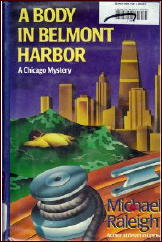
MICHAEL RALEIGH – A Body in Belmont Harbor. Paul Whelan #2. St. Martin’s, hardcover, 1993. iUniverse, paperback, May 2000.

MICHAEL RALEIGH Body in Belmont Harbor

   When I found this in the library last week I vaguely remembered reading the first in the series, Death in Uptown, but couldn’t remember anything about it. Not particularly promising, but it was a lean library day, so I checked it out anyway. Good move.

   PI Paul Whelan is a Chicago native who works the dangerous Uptown neighborhoods. As your basic hardboiled PIs tend to be, he’s somewhat at loose ends when a lady asks him to follow a man she suspects of murdering her husband two years ago. The police ruled it a suicide, but she doesn’t believe that; particularly since a small-time hood called her and said he had evidence against the man, then turned up in Belmont Harbor, murdered.

   Whelan doesn’t see much there, but the money’s good, and he takes the case. This quickly brings him in contact with Al Bauman, a legendary and irascible Chicago cop whom he helped and with whom he clashed in the first book. Bauman is investigating the hood’s murder, and Whelan’s involvement isn’t wanted. We know how that goes, though.

   This is one of the better PI books I’ve read lately. The story is told in a straightforward third-person narrative, from Whelan’s point of view other than the prologue. Whelan is a sympathetic and believable character, more reminiscent of Marlowe than Spenser though without the wisecracks. He manages to be both tpugh and vulnerable, and credibly so.

   The cop, Bauman, is also very well portrayed, seems one of the more realistic ones I’ve come across. There is a wealth of Chicago color, particularly in the area of restaurants and taverns, and although I don’t know from Chicago, it seemed real to me. The plot mechanism was the weakest part of the story, but wasn’t so bad as to cause outrage. All in all, I liked it considerably.

— Reprinted from Ah, Sweet Mysteries #9, September 1993.


       The Paul Whelan series —

Death in Uptown. St. Martin’s 1991
A Body in Belmont Harbor. St. Martin’s 1993
The Maxwell Street Blues. St. Martin’s 1994
Killer on Argyle Street. St. Martin’s 1995
The Riverview Murders. St. Martin’s 1997

Editorial Comments:   For more information about the author, he has a webpage here. I have three of the five Paul Whelan novels, but I’ve never read one. Barry’s review of this one tells me that I may have made a mistake about that.

SWING HOSTESS Martha Tilton

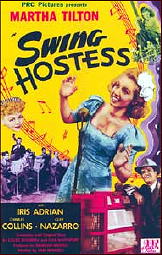
  SWING HOSTESS. PRC, 1944. Martha Tilton, Iris Adrian, Charles Collins, Cliff Nazarro, Harry Holman, Betty Brodel, Philip Van Zandt, Earle Bruce. Music and lyrics by Jay Livingston, Ray Evans and Lewis Bellin. Director: Sam Newfield.

    There are maybe three reasons to watch this low-budget wartime musical, and the first, by a wide margin, is Martha Tilton, perhaps best known as a longtime singer for the Benny Goodman band. In Swing Hostess she plays an aspiring singer named Judy Alvin who can’t seem to catch a break in show business, what with a series of never-ending mixups between who sang what song on which recording disk, missed phone calls and messages, and a competitor (Betty Brodel, sister of Joan Leslie) who can’t sing but whom fortune seems to smile upon a lot more often.

    Miss Tilton made only a handful of movies, and was one of the stars in even fewer, but she has a pleasant and relaxed onscreen presence that should have opened the door for making many more. She sings six songs in Swing Hostess, all charmingly and in good cheer. Back in the 1940s you’d have gotten your money’s worth from this film from the music alone. (If you’re of a certain age, today as well, for that matter.)

SWING HOSTESS Martha Tilton

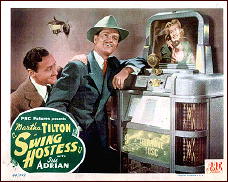
    Another interesting aspect of Swing Hostess is that a sizable portion of it takes place at Judy Alvin’s day job, as she waits for bandleader Benny Jackson (Charles Collins) to notice her. Instead of self-contained juke boxes, back in 1944 they apparently consisted of units with phone lines to a central location where the operators would locate the 78 on a rack and play it back to the person on the other end whose nickel or dime it was. I’ve not been able to find anything online about this kind of operation, if it really existed, so if anyone knows more, tell me about it.

    The plot is really rather dopey and not worth saying anything more about, but some of the supporting cast is worth a mention. I’ve probably heard comedian Cliff Nazarro’s double talk ability before, but if so, I’d forgotten about it. All I can say is amazing. Earle Bruce, whose nice guy character seemed to be on a direct path to Judy’s heart, is dumped in the middle of the movie and sent off to the army instead. This gives bandleader Benny Jackson a clear shot, which he takes full advantage of, but since this was the only movie that Bruce ever made, even at this late date I’m going to cry foul.

« Previous PageNext Page »