Reviews


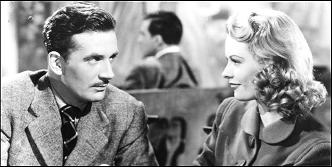
THE SAINT'S VACATION

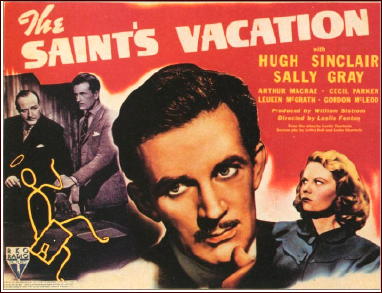
THE SAINT’S VACATION. RKO Radio Pictures, US/UK, 1941. Hugh Sinclair, Sally Gray, Arthur Macrae, Cecil Parker, Leueen Macgrath, John Warwick. Based on the novel Getaway (1932), by Leslie Charteris (also a co-screenwriter). Director: Leslie Fenton.

   Whenever a series character such as Simon Templar, known more familiarly as The Saint, decides to go on a vacation trip, say to Europe, you can bet your last bottom dollar that as soon as he and his companions check into their hotel, their paths will cross those of some evil ones.

THE SAINT'S VACATION

   Nazis, in this case, or so one suspects, as I do not believe they were ever identified as such – as well as an adventure involving several deaths and a mysterious music box that is the key to something – that something never revealed, of course, until way at the end of the movie, which by that time, we may not care any more.

   Luckily the movie is just over 60 minutes long, as very little of what happens makes any logical sense, but as they say in France, it’s fun while it lasts. The was the first of two chances that British actor Hugh Sinclair had to impersonate The Saint, and if you’d like to know my impression, I think he was far too stiff and formal to be what I think of as the dashing and debonair hero I remember from the books.

   Patricia Holm, Simon’s close companion who was in the book Getaway, does not show up in this filmed version. She’s replaced instead by a reporter named Mary Langdon who is played by husky-voiced Sally Gray, of whose vivacious performance I heartily approved – feminine but just brash enough to be a fitting replacement for Miss Holm, although in the movies it is a strictly separate bedrooms kind of arrangement. In the books you’re never quite sure, but somehow you just know.
   

THE SAINT'S VACATION

IT IS PURELY MY OPINION
Reviews by L. J. Roberts


BARBARA CLEVERLY – Not My Blood. Soho Crime, hardcover, August 2012.

Genre:   Historical / Police procedural. Leading character:   Joe Sandilands, 10th in series. Setting:   England; 1933.

BARBARA CLEVERLY Not My Blood

First Sentence:   Carrying more than a hint of snow, a southwesterly wind gusted up from the Channel, spattering the school’s plate glass windows with sleety drops.

   A phone call from a young boy named Jackie Drummond has Joe Sandilands traveling to a boarding school in Sussex where a teacher has been murdered. The case raises a number of questions for Joe. His suspicions aroused, can the boy actually be his illegitimate son? Why is Dorcus Joliffe, the daughter of close friends, who had recently been avoiding Joe, suddenly insistent on helping him with this case?

   However, the main question is what has happened to a surprising number of missing boys, each from a wealthy family. With Dorcus to aid him, Sandilands is headed to school, looking for answers.

   Barbara Cleverly really knows how to captivate her readers from the very first page. Her excellent descriptions of period, place and weather create the atmosphere and bring us straight into the story. It is fascinating to see this period of history between the wars when women are becoming police officers and education reform in public schools is beginning.

   The characters are charismatic and real: Joe, his sister Lydia, Jackie, ever-clever aide de camp Alfred, and Dorcus who is now grown and has a degree in psychology. These are people you come to know by Cleverly providing enough history that new readers don’t feel lost and with whom fans of the series have become friends.

   I am not normally a fan of relationships between two principle characters, but Ms. Cleverly makes it work and faithful readers will see things progress as they may have hoped it would so do.

   Dialogue makes such a difference and here, it is excellent and reflective of the period and class. Ms. Cleverly’s writing is wonderfully literate and she expects the reader to be the same. At the same time, she isn’t trying to embarrass or be over the head of the reader. The meaning is always clear from the context: “If anyone’s been setting himself up as some sort of a psychopompos, a guide to the souls to the Land of the Dead — a Hermes, or even a playful Peter Pan — we’ll have him.”

   The intrigue and subterfuge is masterfully created, yet clever plotting and occasional humor keep things from becoming overly grim. This is a time when science is evolving. The motive is horrific but not inconceivable, and that makes it the more terrible still.

   Not My Blood is an excellent traditional police procedural driven by intelligent dialogue and charismatic characters and where the case is solved by following the clues and having a good working relationship with the other branches involved. It also has a wonderful, lovely ending. This is a very good series which should be read in order.

Rating: Very Good Plus.

Editorial Comment:   LJ’s review of Strange Images of Death, the 8th in the Sandilands series, may be found here on this blog. Following the review is a list of the first eight in the series. Missing is The Blood Royal (2011), number nine.

ELSEWHERE ON THE WEB, by Mike Tooney:
CLAYTON RAWSON’s Don Diavolo.


CLAYTON RAWSON Don Diavolo

CLAYTON RAWSON, writing as Stuart Towne – Death from Nowhere: Don Diavolo Mysteries. Mysterious Press, ebook, two novellas, May 2012.

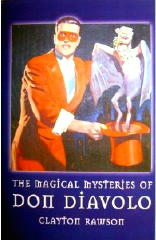
— The Magical Mysteries of Don Diavolo. Battered Silicon Dispatch Box, hardcover, March 2005.

    “Overall, I really enjoyed Death from Nowhere. The stories are creative and imaginative, and although there are flaws, the book still manages to be quite enjoyable.”

— Patrick, Review of Death from Nowhere, “At the Scene of the Crime.”

http://at-scene-of-crime.blogspot.com/2012/09/the-scarlet-wizard.html

      See also:

CLAYTON RAWSON Don Diavolo

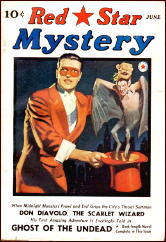
    “Nicolas Alexander Houdin, alias Don Diavolo, is a crime fighting stage magician detective who routinely faces seemingly supernatural horror and mystery in all four of these circa 1940 stories. Despite his Latin-esque name, the 30-something vaudeville conjurer is blond and wiry with a lithe and powerful physique, the endurance of 6 men, and capable of lightning fast thought and action. He often wears a scarlet suit of impeccably cut clothing, and may sometimes adopt the clothing over far and near Eastern illusionists in his stage and public acts.

    “Don Diavolo finds himself routinely dragged into adventures in crime-fighting, often at the instigation of his suspicious nemesis, Inspector Church of NYC’s Homicide Division. Rather than using hand waving and spooky mysticism to fix things right and routinely clear his sullied name, Don Diavolo solves these baffling mysteries using modern techniques of science and psychology, along with a healthy dose of vaudeville drama and stage hocus pocus.”

— Review of The Magical Mysteries of Don Diavolo, “Age of Menace.”

http://docmystery.wordpress.com/2008/05/29/book-39-pulp-the-magical-mysteries-of-don-diavolo-by-clayton-rawson-reprint-2004/

CLAYTON RAWSON Don Diavolo

    “Rawson wrote four novellas in 1940 about magician-sleuth Don Diavolo. They have recently been collected in book form as The Magical Mysteries of Don Diavolo. The first three Don Diavolo stories are Rawson’s richest impossible crime tales… The Don Diavolo stories often feature dying messages, a kind of mystery puzzle that rarely appears in impossible crime tales. Rawson is throwing every possible mystery idea into these tales.”

— Mike Grost

http://mikegrost.com/laterimp.htm#Rawson

    “Don Diavolo is the fabulous Scarlet Wizard, a magician detective created by author and illustrator Clayton Rawson (1906-1971) writing under the pen-name Stuart Towne. Himself a magician as well as writer, Rawson is mainly remembered today for his magician detective, the Great Merlini, but not to be ignored are the four short novels he wrote about Don Diavolo.”

— “The Battered Silicon Dispatch Box.”

http://www.batteredbox.com/LostTreasures/07-DonDiavolo.htm


CLAYTON RAWSON Don Diavolo

From The Saturday Review, 27 May 1939, “The Criminal Record”:

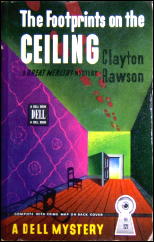
    “Title and Author: THE FOOTPRINTS ON THE CEILING – Clayton Rawson (Putnam: $2.00)

    “Crime, Place, Sleuth: Poisoned corpse of agoraphobic heiress found in East River island mansion beneath sole-marked ceiling. Merlini unmagicks three incredible killings.

    “Summing Up: Encyclopedically fascinating, with amazing bits about sunken treasure, catalepsy, ‘the bends,’ assorted poisons — also gun-play and sky-high suspense.

    “Verdict: Immense!”

http://www.unz.org/Pub/SaturdayRev-1939may27-00020

CLAYTON RAWSON Don Diavolo

From The Saturday Review, 16 July 1938, “The Criminal Record”:

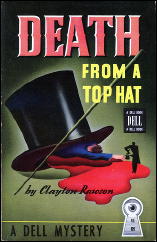
    “Title and Author: DEATH FROM A TOP HAT – Clayton Rawson (Putnam: $2.00)

    “Crime, Place, Sleuth: Occultist found slain in pentagon: death deals card-trickster Black Lady. Merlini, ex-magician, helps cops fathom riddle.

    “Summing Up: Amazingly good dope on magicians and their art, keen foolery, extra-tricky plot, and conclusion that lifts the roof.

    “Verdict: Dazzling.”

http://www.unz.org/Pub/SaturdayRev-1938jul16-00020a02

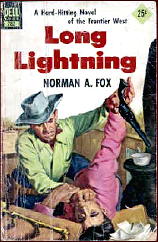
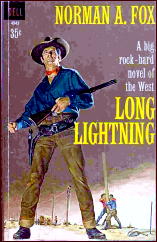
NORMAN A. FOX – Long Lightning. Dodd Mead, hardcover, 1953. Dell 783, paperback, 1954; several later printings. First published as the short novel “Wire to Warlock,” Zane Grey’s Western Magazine, December 1952.

NORMAN A. FOX Long Lightning

   For those of you always on the lookout for hard-boiled fiction to read, and you have no a priori objections to reading a western, here’s one you might want to hunt down. There are some solid “tough guy” aspects to this 50-year-old novel that may be worth your attention, largely due to the highly individualistic nature of its main protagonist, Holt Brandon, construction chief for the Mountain Telegraph Company. In this book, not only must he get the job done on time, but he has to fight for his life all the while he’s doing so.

   There are two obstacles, the first being Mountain’s main competitor, Consolidated, and they do not hesitate in hiring local gunmen to make sure Holt’s crew do not make their deadline. Second, and not insignificantly, is Colonel Templeton, the owner of the Montana land they must cross, an elderly gentleman from the South who imagines that the War Between the States is still going on, and still fighting imaginary battles in his mind.

NORMAN A. FOX Long Lightning

   Holt Brandon plays his cards strictly by the book, and his loyalty to his boss, Sam Whitcomb is never in question. The world of financial matters is beyond him, but what he’s fully aware of is this: If they do not get the wires strung to Warlock from Salish on time, all is lost for Mountain Telegraph.

   Here’s a quote that demonstrates that Fox knew exactly what he was writing about, from page 113:

   String wire, and you lose yourself in the endless race, not knowing one day from another but realizing that each day is a leaf fallen from the calendar, each days brings the deadline nearer; and always the poles set between the suns seem not enough. The ground is stubborn and repels the pick and the shovel, a batch of insulators proves inferior and has to be returned to Salish, and three of your crew slip away to see the lights of town and buck the tiger and fill a painted woman’s shoe with silver.

NORMAN A. FOX Long Lightning

   Poles are late in arriving, and the crew sent to fetch them reports a brush with hidden marksmen who keep them busy with guns when they should have been using axes. The wire stringers stand idle that day. The long lightning is flung from camp to town, shouting always for more supplies, more men, and you hammer the key constantly and wish that Sam Whitcomb were up and about and doing the job at the other end.

   To add some variety to the plot, Holt is not shy around women, but he is caught by surprise when he finds himself the focus of attention of two of them: Gail, the daughter of his boss, and Ellen Templeton, the colonel’s daughter. It is clear which of them he will end up with, if either is to be the case, but that he will lose both of them is a definite possibility, and what Fox does is make sure the reader does not lose sight of that.

   So — here’s a western that’s a trifle clumsy when it comes to affairs of the heart, perhaps, but not– ever — when it comes to matters of loyalty and pride, and other qualities that men have, or they’re supposed to.

— Reprinted from Durn Tootin’ #5,
   July 2004 (slightly revised).


NORMAN A. FOX Long Lightning

[UPDATE] 09-07-12.   I’ve made no attempt to obtain an exact count of the western novels written by Norman Fox (1910-1960), but if he’d been able to live longer, I’m sure he’d have written a lot more than the roughly 30 or so I’ve quickly come up with.

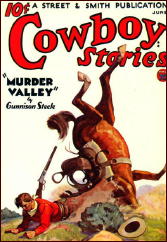
   He was a pulpster as well, with nearly a full page of entries already listed for him in the online FictionMags index, a list still under construction. The first of these, by the way, is “The Strange Quest” (Cowboy Stories, June 1934).

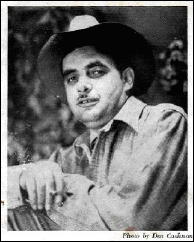
   The photo of him comes from the back cover of one the hardcovers I own by him. What’s unusual about it is that it was taken by fellow western and adventure writer, Dan Cushman. I’d love to know more about when, where and why.

REVIEWED BY DAN STUMPF:


FINGERPRINTS DON'T LIE

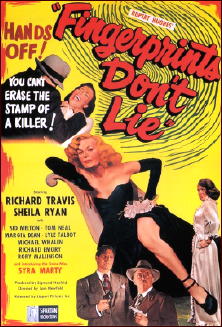
FINGERPRINTS DON’T LIE. Spartan Productions / Lippert Pictures, 1951. Richard Travis, Sheila Ryan, Sid Melton, Tom Neal, Margia Dean, Lyle Talbot, Michael Whalen, Karl Davis. Director: Sam Newfield.

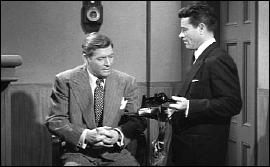
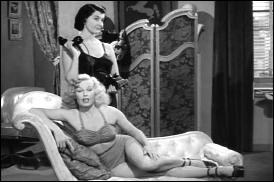
   Early this year an old childhood buddy of mine gifted me with a box of perfectly-chosen DVDs: no classics, just a lot of stuff I kinda wanted to see but didn’t want to spend much money on. So far, the gem of the set has been Fingerprints Don’t Lie (Spartan Productions, 1951) an enjoyably bad film that passes too quickly for its deficiencies to grow irksome.

   Yeah, this is listed as “A Spartan Production,” and Spartan it is, but “Cheapo” might have caught the spirit better, as it was produced by Sigmund Neufeld and directed by Sam Newfield, the driving talents (for want of a better word) behind PRC, which has been widely celebrated as the most penurious studio in Hollywood. Fingerprints carries nobly on in the PRC tradition, with tacky sets, perfunctory acting, and a screenplay that seems more interested in killing time than actually getting anyplace.

FINGERPRINTS DON'T LIE

   What makes it fun to watch, though (for me anyway) is the amusingly slip-shod nature of the thing. Instead of background music we get an organ soloist, just like in the old-time soaps, bridging scenes and setting moods with a turgid melancholia that broke me up every time.

   Then, late in the film, we get one of those cinematic conventions that normally go unnoticed: two characters talk about checking out a suspect’s apartment on the sixth floor of the Metropolitan Hotel, and we cut to an exterior shot of the Metropolitan, the camera sweeps up to the sixth floor, and we cut to the two characters walking into the apartment.

   It’s the kind of movie-shorthand you’ve probably seen dozens of times and never noticed. Only in this case they couldn’t afford to send a cameraman out for an exterior shot, so they simply panned up a photograph of the hotel —- which might have worked except that no one noticed the photo was printed backwards and we see the words LETOH NATILOPORTEM in mirror-image!

FINGERPRINTS DON'T LIE

   Still later, the gaffes come fast and funny as the Police close in on the Crime Boss and his Moll in a rather economical–looking suite. When they tell the baddie he’s going Downtown, the obliging Moll opens her purse, ostensibly for lipstick, but holds it up what seems like an eternity as he sees the gun inside and they exchange significant glances. At some length.

   Much later (it seems) he reaches inside the purse and fumbles around for several seconds before finally pulling the gun out — upside down! Whereupon he spends several more seconds getting it pointed at the cops, who promptly register surprise. Now that’s acting!

   Following a bit of stand-off, the Crime Boss eventually shoots a cop, who bends sharply forward, as if hit in the stomach, then apparently remembers some long-ago instruction from the director, straightens up and grabs his supposedly-wounded shoulder. Bullets fly (or rather, bullet-type noises fill the soundtrack) till our bad guy (WARNING!) “falls” out a window.

   Actually, we see him slide out the window-set, lie down on a not-quite-hidden platform and roll out of view. Which at least gets him mercifully out of this turkey.

FINGERPRINTS DON'T LIE

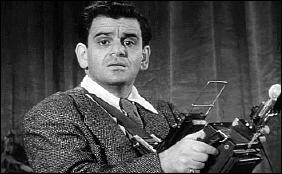
   I should perhaps add that the unfortunate actors in this thing at least carry on manfully, ignoring the paucity of their surroundings and the deficiencies in the script. In one scene, the prosecutor is played by Tom Neal, who would soon be facing a prosecutor himself. An actor named Sid Melton gamely struggles to apply comic relief as a newspaper photographer who can’t work a camera, and Karl “Killer” Davis makes a rather effective Hood. Altogether a game bunch, and it’s just a pity they had so little to work with.

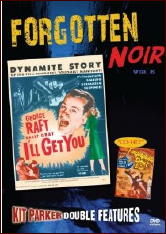
Editorial Comments:   This film, if you would like to obtain a copy, is easily available on DVD, as part of a two-for-one “Forgotten Noir” pair of offerings. See the image above. I’ll Get You, with George Raft and Sally Gray, is the main feature, with Fingerprints getting only second billing (in very small print).

   Also worth noting, as Dan has already pointed out in a comment following Michael Shonk’s recent review of Philo Vance, Detective, this is one of the movies that was re-titled (as Fingerprints) and edited down to less than thirty minutes in a syndicated package of films sold to TV stations in the early 1950s.

FINGERPRINTS DON'T LIE

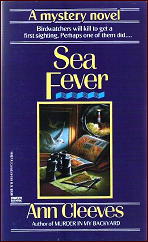
ANN CLEEVES – Sea Fever. Fawcett Gold Medal, paperback original, 1st printing, October 1991. Macmillan, UK, hardcover, 1993.

ANN CLEAVES Palmer-Jones

   This is the fifth mystery novel in which inveterate birdwatcher George Palmer-Jones has become involved with a case of murder. It shouldn’t be too surprising: even though he’s now actually a retired civil servant, he and his wife Molly have become partners in an “enquiry agency” as a means to keeping themselves busy in their declining years.

   George hates the term “private detective,” but there is no escaping it: whether “enquiry agent” or PI, that’s the kind of work they do. (*) George has birds on his mind most of the time, though, and if it weren’t for Molly to push him, I think his investigative business would be nothing at all, in no time flat.

   In Sea Fever they’re hired to trace a wayward son who refuses to come home, or to acknowledge the existence of his worried parents in any way. That he’s also an ardent birdwatcher makes the Palmer-Joneses the ideal couple to track him down. They catch up to him momentarily on a sea cruise/birdwatching expedition, but they lose him again almost as quickly at the hands of a killer.

   Murder at sea means a limited number of suspects, and this is classical detection at very nearly its highest level and its most overwrought, boosted by little annoying hints of what is yet to come and a (female) police inspector who finds her own life close to exploding out of control.

   Don’t get me wrong, though. While this may not be the equivalent of John Dickson Carr in plot complexity, it is a pleasant voyage through waters charted several times or more. Every time I take the trip, I enjoy it just about as much as the time before, and that’s the kind of book this is.

(*)   I’ve just checked John Conquest’s Trouble Is Their Business (Garland, 1990), a superb compendium of just about every other fictional PI you could name, and as it happens, he misses these two. They’re borderline, I’d say, but by Conquest’s own definition, they’re PI’s, and they should be in there.

— Reprinted from Mystery*File 36,
     (slightly revised).


[UPDATE]. 09-05-12. And for what it’s worth, the Palmer-Joneses are not included on Kevin Burton Smith’s Thrilling Detective website either. Kevin doesn’t miss many, but this is one pair of PI’s I think he he has. A lengthy profile of the author by Martin Edwards can be found here, along with a long list of all her mysteries. (She’s done more than just this one series.)

       The George & Molly Palmer-Jones series —

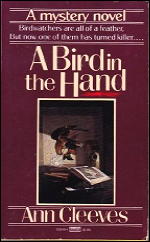
A Bird in the Hand. 1986.

ANN CLEAVES Palmer-Jones

Come Death and High Water. 1987.
Murder in Paradise. 1988.
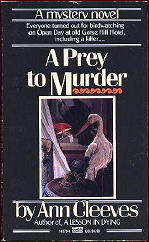
A Prey to Murder. 1989.

ANN CLEAVES Palmer-Jones

Sea Fever. 1991.
Another Man’s Poison, 1992.
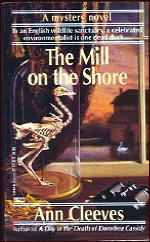
The Mill on the Shore. 1994.

ANN CLEAVES Palmer-Jones

High Island Blues. 1996.

REVIEWED BY MICHAEL SHONK


PHILO VANCE, DETECTIVE. Official Films, 18 minutes. (Originally Philo Vance’s Secret Mission, PRC, 1947; 58 minutes). Cast: Alan Curtis, Sheila Ryan, Tala Birell, Frank Jenkins, James Bell, and Frank Fenton.
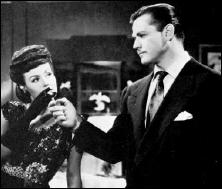
PHILO VANCE'S SECRET MISSION

   Philo Vance, Detective did not include any onscreen credits except for the actors listed above. (The actor listed as Frank Jenks in all the databases is credited on screen as Frank Jenkins.) According to the TCM (Turner Classic Movies) database and imdb.com, the original film was written by Lawrence Edmund Taylor and directed by Reginald LeBorg. S. S. Van Dine received no screen credit.

   In 1947 PRC (Producers Releasing Corporation) made three Philo Vance theatrical films: Philo Vance’s Secret Mission, Philo Vance’s Gamble, and Philo Vance Returns. Both Secret Mission and Gamble featured Alan Curtis as Philo with his assistant Ernie Clark played by Frank Jenkins. In Returns Philo was played by William Wright (without Jenkins).

   The PRC version of Philo Vance resembled the generic detective hero of the average 1940s Poverty Row studio film series more than S. S. Van Dine’s creation.

   By the 1950s television had become the gluttonous beast with an insatiable appetite for content that it remains today. When the networks were unable to fill the needs of the TV stations, the stations turned to syndicated producers such as Ziv, CBS TV-Films and Official Films. Distributors such as MPTV (Motion Pictured for Television) acquired the rights to B-movies, cartoons and short films such as Philo Vance’s Secret Mission and sold them to the hungry hungry hippos aka the local TV stations.
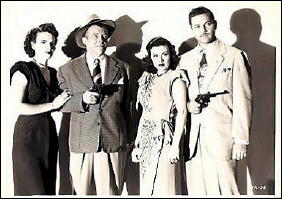
PHILO VANCE'S SECRET MISSION

   One of the major problems facing MPTV and others was local stations taking a dull ax and editing programs to suit the local station needs. This could be the cause for a 58-minute theatrical film to exist in a renamed TV version suitable for a half hour time slot. More likely, Official Films, one of the top syndication companies at the time, did the editing and sold it in a package of half-hour mysteries.

   Fortunately, the TCM database has a complete synopsis full of spoilers and credits for the 58-minute film short.

   Jamison (Paul Maxey), co-publisher of pulp magazines, has invited writer Philo Vance to his office to discuss the possibility of Vance writing a mystery based on Jamison’s former partner’s murder seven years ago. With his assistant Ernie Clark and a woman who is not introduced, says nothing and no one says anything to her during the long scene (she is Vance’s secretary Mona), Vance meets the suspects.

   Mona (Sheila Ryan) will be in nearly every scene of Philo Vance, Detective, while most of the rest in this scene will end up victims of the missing forty minutes and not be seen again.

   Jamison’s other partner is upset over the idea of leaving pulps to publish “books.” The company’s two main writers also hate the idea of mystery books (there are too many of them now). When Jamison announces he had solved the murder of the dead partner, office secretary and victim’s wife (Tala Birell) faints. Jamison invites Vance to his house that night to discuss the case.

   Vance and Mona arrive to meet Jamison. They hear gunshots and a cry for help. The two break into Jamison’s home to find blood on the floor but no body (just like the earlier murder). They call and wait for the sheriff.
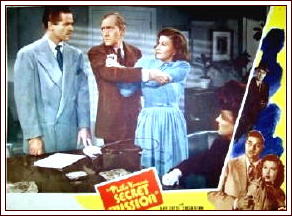
PHILO VANCE'S SECRET MISSION

   â€œI think I am going to faint,” says Mona, half seriously.

   â€œWhy don’t you wait until the police come and I’ll catch you in my arms,” suggests Philo, who is busy on the phone.

   Vance and Mona leave but a motorcycle cop chases them down. The murdered man’s body is in Vance’s car trunk. Next we see a cop using the police radio informing all police cars to look out for an armed and dangerous killer, and the cop is nice enough to add Philo “and girl companion” have been released.

   Now the editing becomes noticeable. We miss all the scenes with the suspects, clues to motive, where the murder weapon came from, and information about the first murder. One entire character, Joe the cover photographer, ends up on the editing floor.

   Instead we jump to Vance and Mona driving to the first victim widow’s home. They are followed and shot at. Vance fights with the bad guy who runs away unseen in the dark. Vance rushes to the widow afraid she would be next. Instead he finds her packing for a cruise where she plans to marry her finance.

   More scenes vanish including (according to the TCM synopsis) the denouncement scene where Vance names his girl friend Mona as the killer (that I would need to see to believe).

   But it was all a ruse to trap the killer. At the cruise ship the killer is revealed, Vance suggests he and Mona take a cruise together, but then he heads for the exit when she suggests they get married at sea. She stops him with a long kiss.

   It would be unfair to judge the cast and production with forty minutes missing from the 58-minute film, but the story holds up considering. There are times the viewer is confused by what is going on such as why does Vance think the widow is in danger. But while the editor of this television version has removed the mystery, the story barely survives to find a home in the crime genre with the relationship between Vance and girl friend Mona providing most of the entertainment.

Sources: TCM.com database, IMDb.com, Billboard. If you wish to avoid spoilers you can read Steve’s review of the original film here. I need to find a copy of the original, if only to see Sheila Ryan posing for a pulp cover.
CHARTER PILOT Lynn Bari

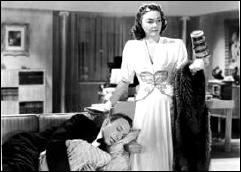
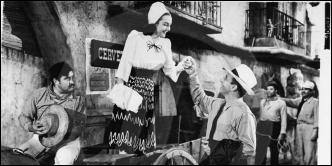
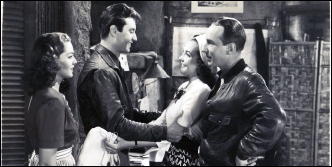
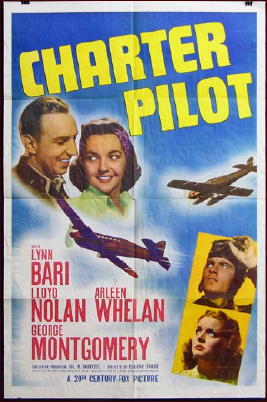
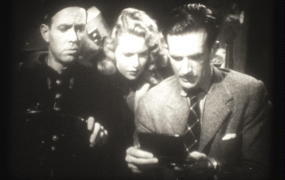
CHARTER PILOT. 20th Century Fox, 1940. Lloyd Nolan, Lynn Bari, Arleen Whelan, George Montgomery, Hobart Cavanaugh, Henry Victor, Etta McDaniel. Director: Eugene Forde.

   In spite of the fact that a couple of my favorite B-movie stars are in this one, I found myself disappointed for most of the movie’s running time.

   The opening scene showed some promise. Lynn Bari is the scriptwriter for a radio show based on the fictional exploits of air ace King Morgan, played by Lloyd Nolan. In reality, and far from fiction, Morgan is indeed a pilot, but for a commercial airline whose more prosaic tasks include bringing a load of soft-shelled crabs up from Galveston to LA.

CHARTER PILOT Lynn Bari

   OK. So far, so good, but it turns out that there are romantic complications between the two, and for maybe next 50 minutes or so the movie turns into a comedy of most mundane proportions. He proposes, she refuses until he gives up flying, he gives up flying and goes to work behind a desk, which doesn’t work, in great detail which I shan’t bore you with, but if you were expecting a comedy, you might find this portion of the film amusing, if not out and out funny.

CHARTER PILOT Lynn Bari

   It also turns out, though, eventually, that there is a bad guy in the background, and the next to final scene, with King Morgan and aforesaid bad guy kicking, wrestling and fist-fighting in the cramped space of a cockpit of a small airplane over the jungles of Honduras, with Lynn Bari screaming behind the controls while live on the air – well, at last the film was worth the money I paid to see it. On a homemade DVD, of course, as almost goes without saying.

   Lynn Bari, of course, is as beautiful as ever, and Lloyd Nolan, while far from beautiful, is, as usual, one of the finer actors ever to be a B-movie star. Watching him rehearse his prepared proposal speech, while working out a whole gamut of ways to present his lines, is like attending a master class in acting, and he does it with ease.

CHARTER PILOT Lynn Bari

THE ARMCHAIR REVIEWER
Allen J. Hubin


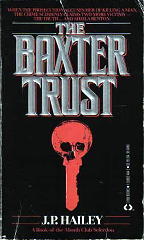
J. P. HAILEY – The Baxter Trust. Donald I. Fine, hardcover, 1988; Lynx, paperback, 1989.

PARNELL HALL Hailey

   J. P. Hailey, “a pseudonym for a bestselling author of crime novels featuring a well-known detective,” introduces Steve Winslow in The Baxter Trust. Winslow is an intriguing chap, and his excellent debut has given me a thirst for more.

   He’s a failed actor who went to law school, passed the bar, joined a conservative law firm, and was immediately fired for his unconservative tactics. Now he advertises his freelance legal services (takers in one year = 0) while driving a cab for a living.

   Until Sheila Benton calls. She’s been charged with murder and picked Winslow (trial experience = 0) out of the yellow pages. Trouble is the D.A. has an ironclad case. And Sheila lies to everyone (including Steve).

   And Sheila has no way to pay Steve: the twenty million dollar trust she’s scheduled to inherit in eleven years won’t allow payments to defend her, and if her various peccadilloes were to become known (as they are almost certain to), she’ll be disinherited anyway.

   Lovely case for Winslow to get his law practice started on. A fresh and polished narrative.

— Reprinted from The MYSTERY FANcier,
       Vol. 11, No. 1, Winter 1989.


Editorial Comments:   My review of The Anonymous Client, the second in the series, can be found here. (I agree wholeheartedly with Al’s assessment.) Included with that review is a complete list of the books in the series, along with the ID of the author’s real name, Parnell Hall, apparently unknown at the time of Al’s comments.

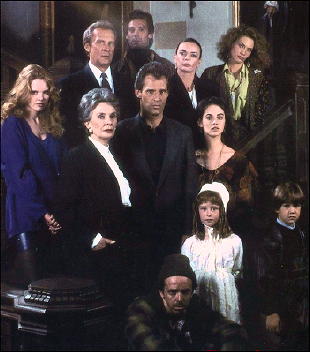
DARK SHADOWS 1991 Revival

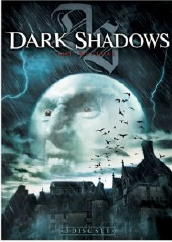
DARK SHADOWS. NBC; January 13-14 1991. Premiere of TV series: 4-hour mini-series. Ben Cross, Joanna Going, Joseph Gordon-Levitt, Jim Fyfe, Barbara Steele, Ron Thinnes, Barbara Blackburn, Jean Simmons. Director: Dan Curtis.

   Part Two of the continuing saga of Barnabas Collins, the 200-year-old vampire whose release from a coffin chains means dire things for the village of Collinsport, Maine. I only occasionally watched the previous TV serial, not making much heads or tails of it when it was on originally. Picking the story up in the middle tends to do that to you.

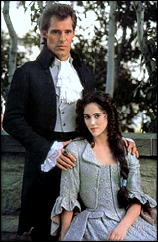
   Coincidentally, if you remember reading my review of Barbara Hambly’s SF-Fantasy novel, Those Who Hunt the Night, which was posted here on this blog a short while ago, you will recall that the basic premise is the same: that vampirism is a blood disorder that might be curable. Ben Cross plays Barnabas to the hilt, agonized and tortured (and possibly sensuous, but I have seen anything romantic about vampires), while former Italian horror movie starlet Barbara Steele is Dr. Julia Hoffman, the physician who thinks she can cure him. (It looks as though she speaks through clenched teeth.)

DARK SHADOWS 1991 Revival

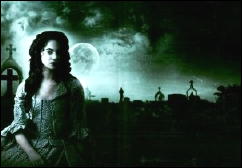
   The other major plot thread (there are a few other minor ones, mostly of sexual affairs and liaisons yet to come) is the budding romance between Barnabas and the new governess to the mansion, Victoria Winters, played by Joanna Going, who is beautiful, innocent and charming.

   There is a lot of blood — “Where did it all go? If she lost all that blood, where did it go?” — there is at least one stake to the heart, lots of moody atmosphere — caused by lots of fog — and spooky music. Or in other words, the works.

DARK SHADOWS 1991 Revival

   If released as a theatrical movie, this new series would probably be given a PG rating, but it’s not impossible it would be given a PG-13. This may be why, when the series itself started [the following week], it was switched at the last moment to ten o’clock instead of nine. Which is why I missed it, and so (missing an episode) why I probably won’t be watching it on a continuing basis.

   (Network shows are losing viewers left and right, and it’s really no wonder, when you consider that with all the stunting around, no one knows when anything is on for sure.)

   A brief word on the behalf of Jim Fyfe, who plays the semi-demented handyman Willie Loomis. You have never seen a more perfect example of small-town inbreeding, straight from an H. P. Lovecraft novel, perhaps.

   By the way, in case you’re interested, the mini-series is not complete in itself. If the people in charge have their way, the series may never end. I enjoyed it for the two nights it was on, and I may sample the series now and then, but for now, it simply left me — shall I say it? — hanging.

— Reprinted from Mystery*File 28,
       February 1991 (slightly revised).


DARK SHADOWS 1991 Revival

[UPDATE] 08-25-12. I have been trying to match up the comments I wrote at the time with the episode list found on IMDB. I think what NBC did was to show the two-hour pilot on January 13th, then combined episodes #2 and 3 and aired them on January 14th.

   The series itself began on January 18th. Interest in the series seems to have faded quickly. There were only 12 episodes in all, including the three that were shown as part of this introductory mini-series. The final one was shown on March 22, 1991.

« Previous PageNext Page »