Reviews


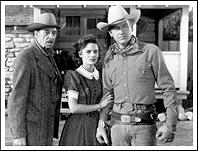
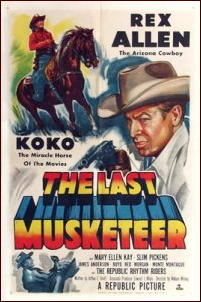
THE LAST MUSKETEER. Republic, 1952. Rex Allen, Koko (the Miracle Horse), Mary Ellen Kay, Slim Pickens, James Anderson, Michael Hall, The Republic Rhythm Riders. Director: William Witney.

   Someone more knowledgeable than I about B-western movies will have to explain (in the comments, if you would, if you can) why titles of B-western movies have so little to do with the movies as they were filmed, and this one (I shouldn’t have to tell you) is about as puzzling as they come.

THE LAST MUSKETEER Rex Allen

   The son of Taskerville’s founder (with a statue of him in the town’s square, a touch I don’t remember seeing before in any western, B or not) is the villain of the piece. His reservoir is the only water in the valley, and his prices are so steep that the cattle of all of the other ranchers is curling up and dying.

   A fact that Rex Allen, cattle buyer, soon discovers as he rides into town. He also discovers the local divining wizard, Slim Pickens, being beaten up by Tasker’s men. Coming to Slim’s assistance, Rex then finds himself on the outs with Tasker’s men throughout the rest of the movie, and Tasker himself.

   Tasker is no ordinary villain, though. He has plans. A dam across the end of the valley, once the other ranchers have moved on, will generate electric power for the vicinity, then the whole state, then a big chuck of the entire West. No small planner, he.

   You may have noticed the presence of the Republic Rhythm Riders in this movie, and if you were to infer from that that this is a singing cowboy movie, you’d be right. A good portion of this film is taken up with songs and music (including the most horrible braying, there is no other word for it, by Slim). Rex is a pretty good yodeler, though; in fact, he’s better than OK, though I’m not sure I would have agreed when I was 10 years old, which is the age level this movie was aimed for.

   What I really wonder what I at that age would wondered about the ending of the movie, one in which the villain is defeated by a not-so-small case of breaking, entering and worse. By which I mean totally illegally. Foul means, unsportsmanlike conduct, and below the belt. All in a good cause, but still.

THE LAST MUSKETEER Rex Allen

REVIEWED BY BARRY GARDNER:


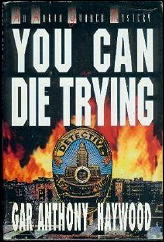
GAR ANTHONY HAYWOOD – You Can Die Trying. Aaron Gunner #3. St. Martin’s, hardcover, 1993. Penguin, paperback, 1994.

GAR ANTHONY HAYWOOD Aaron Gunner

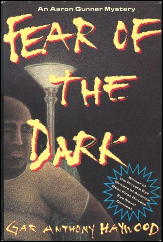
   Haywood first wrote about black PI Aaron Gunner in the 1988 Fear of the Dark. For some reason, even before the President put his two cents in, Walter Mosley had gotten more attention as a black crime writer. Recently, Barbara Neely has been in the spotlight. I think Haywood writes about blacks better than either, and is a better writer overall.

   Gunner, for that best of reasons, poverty, takes a case that can bring him nothing but grief: proving that a bigoted cop was innocent of killing a 14 year old black youth in an attempted robbery. The cop had been fired for his actions, and eight months later ate his gun.

   A man comes to Gunner who said he witnessed the shooting, and that the kid fired at the cop first; and that he failed to come forward because he received anonymous threats on his family. No one wants to change history; not the black community, and not the police, who are re-building an image after the riots. Only Gunner. And he’s not really sure that he does. He knew the cop, too.

   Gunner is to me a believable person, but that doesn’t really mean anything. Any WASP male who claims to understand blacks is a fool, and in that regard at least, I’m not.

   Haywood is a thoroughly competent writer, and knows his way around the black middle-class as well street life. One of the book’s strongest points is that it clearly lays out why bigoted, brutal cops exist, and why, except in isolated instances, the black community can never like or trust people with badges.

   It is not a hopeful book, except in that it portrays a few decent people on both sides of the equation. It is a thoughtful book, though, and I think a good one.

— Reprinted from Ah, Sweet Mysteries #8, July 1993.


       The Aaron Gunner series —

1. Fear of the Dark (1988)

GAR ANTHONY HAYWOOD Aaron Gunner

2. Not Long for This World (1990)
3. You Can Die Trying (1993)
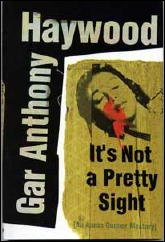
4. It’s Not a Pretty Sight (1996)

GAR ANTHONY HAYWOOD Aaron Gunner

5. When Last Seen Alive (1997)
6. All The Lucky Ones Are Dead (2000)

IT IS PURELY MY OPINION
Reviews by L. J. Roberts


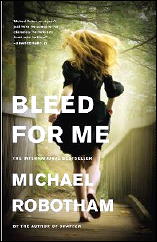
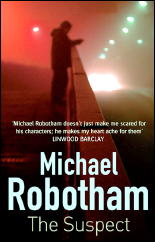
MICHAEL ROBOTHAM – Bleed for Me. Sphere, UK, hardcover, 2010. Mulholland Books, US, hc, February 2012.

Genre:   Unlicensed Investigator: Psychiatrist. Leading character:  Joe O’Laughlin (4th in series). Setting:   England.

First Sentence:   I should start by telling you my name, although it’s not really important.

MICHAEL ROBOTHAM

    Psychiatrist Joe O’Laughlin is trying to deal with having Parkinson’s disease, being separated from his wife and only seeing his daughter part time. When his daughter’s best friend is accused of murdering her father, a former police detective, Joe can’t ignore his daughter’s plea to help.

    I’ll admit I’m always excited when a new Robotham book comes out and, once again, he delivers. From the very powerful and disturbing prologue to the nail-biting ending, I was completely absorbed.

    One thing I really appreciate is that, although this is the fourth book in the series, he doesn’t assume you’ve read any of the previous books. Without burdening the plot or slowing down the story, within a very short period the author does an excellent job of providing a comprehensive back story on the characters. You never feel as though you’ve missed something.

   The portrayal of a couple who are amicably yet needfully separated is effective without being maudlin. I don’t know how accurate the psychiatry aspects are; it does seem Joe is, at time, a bit too insightful for belief, but it works and provides some interesting observations.

    Having recently served on a criminal-case jury; albeit not a murder, I found his comments on juries fascinating as well as the demonstration that, with motivation, anyone can be pushed to violence.

    It’s the balance of introspection and suspense that brings me back to Robotham every time. The plot is complex, twisty and fast-paced. I liked that all the clues were there to identify the killer, yet I didn’t, and that justice prevailed.

    If you’ve not yet discovered him, Robotham is an author I definitely recommend trying.

Rating:   Good Plus.

       The Joseph O’Loughlin series —

1. The Suspect (2004)

MICHAEL ROBOTHAM

2. Lost (2005) aka The Drowning Man (US)
3. Shatter (2008)
4. Bleed for Me (2010)

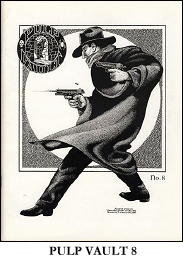
PULP VAULT 14:
The Greatest Single Issue Ever of a Pulp Fanzine
by Walker Martin
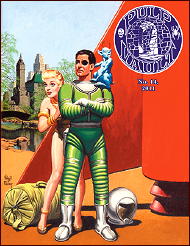

PULP FANZINES Pulp Vault

   Recently while discussing PulpFest 2011 I made the claim that Pulp Vault 14 was the best ever issue of a pulp fanzine. I was immediately questioned by a reader concerning this statement. First, what qualifies me to make such a claim? I’ve been collecting pulps since the 1950’s and I’ve read most of the pulp fanzines published along the way. (By the way, I’m not talking about the SF fanzines which is a different subject.)

   The first quality pulp fanzine that I read was Lynn Hickman’s Pulp Era in the late 1960’s and early 1970’s. During the same period I was reading Fred Cook’s Bronze Shadows which published Robert Jones survey of the weird menace pulps in several issues.

   I was so impressed by this long article that I literally nagged Bob Jones into writing the book, The Shudder Pulps, and we became good friends especially through our correspondence which lasted 20 years until Bob’s early death.
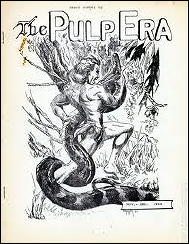
PULP FANZINES Pulp Vault

    Robert Weinberg published Pulp which I recall as lasting 6 issues.

   Then I became a subscriber to Xenophile which was an excellent ad zine full of for sale and want ads. The editor was Nils Hardin who also started publishing articles about the pulps. The magazine lasted over 40 issues in the 1970’s. Echoes lasted over 100 issues and was edited by Tom and Ginger Johnson.

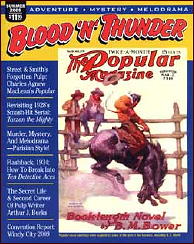
   John Gunnison published The Pulp Collector and Doug Ellis started Pulp Vault. Another quality pulp fanzine was Purple Prose edited by Mike Chomko. At present we have Blood n Thunder, edited by Ed Hulse, another excellent magazine which has just reached the 30th issue.

   Other magazines were published but the above titles remain in my memory as the best. If I have left out your favorite pulp fanzine please let me know in the comments.
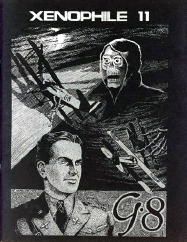
PULP FANZINES Pulp Vault

   All the above editors have one thing in common, they all were awarded the Lamont Award, or in Mike Chomko’s case, the Munsey Award. If we tried to pick the best single issue from all the above titles, we would find no consensus among all the issues.

   Until Pulp Vault 14, that is. Fifteen years ago when Doug Ellis published Pulp Vault 12/13, I began pestering him about the next issue. It had taken him three years to publish issue 12/13 and I was worried that issue 14 might also take three years.

   Each year at Pulpcon, I asked him the same question, “When will Pulp Vault 14 be published?” His response was always “Soon, Walker”. Well it took 15 years but the wait was worth it.

   What makes this issue the best ever? First of all it is larger than any single issue that I recall: 264 pages in the large 8 by 10 inch format. It has at least 10 major articles including an unpublished Virgil Finlay cover. Actually one article makes this issue a must buy: a 44 page piece by Mike Ashley titled, “Blue Book — The Slick in Pulp Clothing.” This magazine is one of the great pulp titles and lasted over 50 years, 1905-1956. (It was later revived by another publisher as a men’s adventure magazine, 1960-1975.) Mike Ashley covers the magazine’s history in five long chapters.
PULP FANZINES Pulp Vault

   This tremendous survey belongs right up there with the great pulp surveys, such as Ed Hulse’s two-part coverage of Popular Magazine and his slightly shorter two-part article on Short Stories. Both articles appear in Blood n Thunder as well as excellent issues devoted to Adventure and Dime Detective.

   Sam Moskowitz’s history of the Munsey publications is another fascinating survey but though it mainly covers All Story and Argosy, it really is about several magazines and not a survey of one title like Mike Ashley’s.

   I also don’t want to forget the extensive coverage of Western Story Magazine in Jon Tuska’s The Max Brand Companion and in Eggenhofer: The Pulp Years. Another great pulp magazine, Adventure, is covered in a long article by Richard Bleiler in The Adventure Index. Astounding also had a book covering its history.
PULP FANZINES Pulp Vault

   So Mike Ashley’s long piece on Blue Book belongs with the great pulp surveys. But that is just a part of Pulp Vault 14. We also have a long essay on Thrill Book by Will Murray; a discussion of the Clues Detective character Cyrus North (with a unpublished long novelet!); an article by Hugh Cave with a reprint of one of his very best long stories.

   And there’s more: an article on Singapore Sammy by Rick Lai; a memoir by Robert Barbour Johnson on the Weird Tales days; an article by J. Edward Leithead on writing for the pulps, especially the early western titles; Otto Binder on his trip to NYC and many photos of the NYC World SF Convention in 1939; artist and publisher Tom Roberts on painting Doc Savage; and David Saunders on his father Norman Saunders.

   That’s like ten major, long articles! And there is more such as Bob Weinberg on Strange Stories; Link Hullar on artist Frank Hamilton; and a long adventure novelette from Popular Magazine. So this is why I call Pulp Vault 14 the greatest single issue ever published of any pulp fanzine. Copies may be obtained from Black Dog Books or Amazon.com.

   On page 2 of the issue editor Doug Ellis says, “Walker, please don’t ask us about issue number 15!” Needless to say the first thing out of my mouth when I saw Doug at PulpFest in July 2011 was, “Hey Doug, when will the next issue of Pulp Vault be out?”
REVIEWED BY WALTER ALBERT:         


JUST OFF BROADWAY Lloyd Nolan

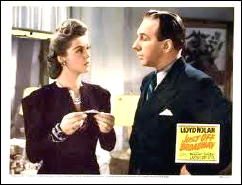
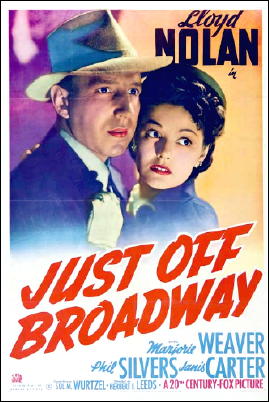
JUST OFF BROADWAY. 20th Century Fox, 1942. Lloyd Nolan, Marjorie Weaver, Phil Silvers, Janis Carter, Richard Derr. Screenplay by Arnaud d’Usseau, based on the character created by Brett Halliday and an idea by Jo Eisinger; photography by Lucien Andriot. Director: Herbert J. Leeds. Shown at Cinevent 40, Columbus OH, May 2008.

   This sixth, and penultimate Shayne film starring Nolan as the brash private eye, finds the series showing signs of running out of steam. Nolan is as engaging as ever, but the script, which has Shayne serving as a juror and attempting to prove that the wrong person is being tried while he’s sequestered with the jury, requires some stretch of the imagination to find credible.

   I will give the scriptwriter a point for originality (Shayne wraps up the case from the jury box with nary a peep from the judge or lawyers), but nothing for believability. Jim Goodrich, who watched this film with me, added that Phil Silvers, “as always,” brightens up the proceedings.

JUST OFF BROADWAY Lloyd Nolan

REVIEWED BY MICHAEL SHONK:


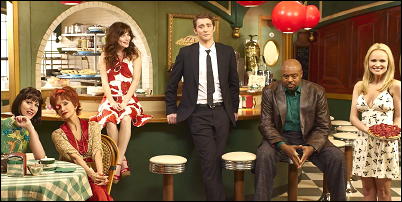
PUSHING DAISIES. ABC-TV/Warner Brothers. October 3, 2007 through June 13, 2009. 22 episodes @60 minutes. Created and Showrunner : Bryan Fuller. Cast: Lee Pace (Ned), Anna Friel (Chuck), Chi McBride (Emerson Cod), Jim Dale (Narrator), Kristin Chenoweth (Olive Snook), Ellen Greene (Vivian), Swoosie Kurtz (Lily)

PUSHING DAISIES

   One of the most redeeming qualities of television is no matter how mundane mainstream television gets, there are always the unusual and delightful series on the air we will remember forever. Sadly, most of these series last only long enough to find a small enthusiastic following.

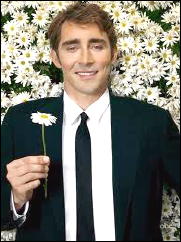
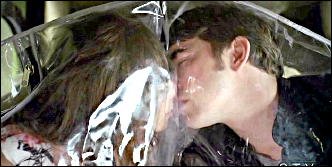
   One such series was Pushing Daisies, a screwball comedy mystery fantasy featuring a pie maker who can raise the dead with a touch and uses that talent to help a PI solve murder mysteries.

   Ned’s secret magical finger was not without rules. The first touch woke the dead, but a second touch killed them forever. And if Ned did not touch them a second time within one minute the formerly dead would stay alive and someone near by would die.

   Enter cynical PI Emerson Cod, who saw a way to profit off Ned’s special talent. Ned would revive murder victims, ask them who killed them, solve the murder, and they would collect the reward. But it was never that easy and sixty seconds were never long enough. In the episode “Bitches,” the victim told them he was killed by his wife, but then they learned he had four wives.

PUSHING DAISIES

   The mystery shared the story with the personal comedy drama of the strong well-developed characters, all with their own secrets and story lines. Because the series is told in fairy tale serial form, it is wise to watch the episodes in order.

   When Ned and Emerson decided to solve the murder of Ned’s childhood crush, Chuck, Ned decided to let her live at the cost of an evil funeral director’s life. Chuck and Ned fall in love but can never touch, the tragedy of two lovers who can never touch lightened by the funny ways Ned and Chuck find to express their love.

   Jim Dale’s narration and Jim Dooley’s music were perfect in setting the mood in this fantasy world of bright colors and odd locales. The camera with its angles and symmetrically frames shots also added to the series special look.

PUSHING DAISIES

   Each story began with an absurd death such as an exploding scratch ‘n’ sniff book. After talking to the victim and getting little to go on, they would meet the suspects, find clues and twists until the killer was revealed. Meanwhile, a story arc featuring the relationships and secrets of the characters formed the subplot of each episode.

   Mystery fans found much to enjoy in the series, especially episodes such as “The Norwegians,” featuring the brilliant Norwegian forensic team and their crime solving bus, “Mother.”

   The oddness of characters, stories, look, sound, and fast paced lyrical dialog drew us happily into Pushing Daisies’ whimsical world of mystery, romance, and pie.

   The television series ended with closure for the characters, but there were still some loose ends involving Chuck and Ned’s fathers. After the series was canceled, Bryan Fuller promised Pushing Daisies would continue as a comic book much as Buffy the Vampire Slayer and others had.

   The comic book written by Bryan Fuller and drawn by Jonathan Wayshak continues in search of a publisher. In April 2011, Fuller posted at various websites the first two pages of the comic book. Here is a link to one site where you can read the two page sample of what is called “Season Three.”

   The complete TV series is available on DVD or for download. You can watch the first season of nine episodes for free here.

      PUSHING DAISIES

A 1001 MIDNIGHTS Review
by Bill Pronzini


DAVID ALEXANDER – Hangman’s Dozen. Roy, hardcover, 1961.

    David Alexander is an underrated writer, in part at least because he had an idiosyncratic, sometimes self-consciously poetic and mannered style that some readers find offputting. But his work has undeniable power, and his novels featuring sporting newspaperman Bart Hardin are superior portraits of New York’s Broadway and Times Square in the 1950s. His plots, too, are unusual and compelling, as are his offbeat, colorful characters.

    Alexander was an even better short-story writer than novelist — certainly his prose was leaner and less eccentric in his short fiction — and the thirteen stories in Hangman’s Dozen are his best.

    “The Man Who Went to Taltavul’s” (which won a prize in one of Ellery Queen’s annual contests) and “Something in the Air” are excellent historical tales with startling twists at the end. “The Other Ones” is a chilling fantasy about some of the murderous inhabitants of hell. “Run from the Snakes” concerns a wet-brain, an alcoholic so far gone that he no longer even knows who he is.

    “Face of Evil” is a procedural about a cop named Romano, who appears in many of Alexander’s novels. “Love Will Find a Way” deals with three mountain climbers trapped by an avalanche and by their own passions in Switzerland, and the extraordinary crime perpetrated by two of them. The best of the hangman’s dozen is “Uncle Tom,” a devastating indictment of bigotry and racial injustice in the South — a story Alexander was unable to sell to any magazine in the Forties and Fifties.

    This is a heterogeneous collection, illustrating the range and depth of the author’s talent.

         ———
   Reprinted with permission from 1001 Midnights, edited by Bill Pronzini & Marcia Muller and published by The Battered Silicon Dispatch Box, 2007.   Copyright © 1986, 2007 by the Pronzini-Muller Family Trust.

NOTE:   Coming soon to a blog near you (this one), reviews by Marcia Muller and Bill Pronzini of The Madhouse in Washington Square and Paint the Town Black, both also by David Alexander.

REVIEWED BY DAN STUMPF:         


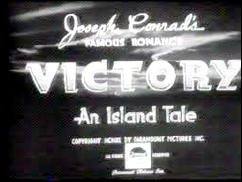
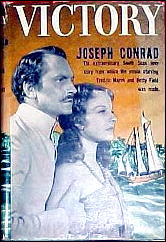
VICTORY. Paramount, 1940. Fredric March, Betty Field, Cedric Hardwicke, Jerome Cowan, Sig Ruman, Margaret Wycherly, Fritz Feld. Screenplay: John L. Balderston , based on the novel by Joseph Conrad. Director: John Cromwell.

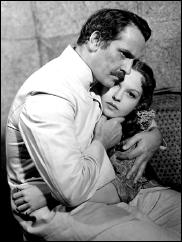
VICTORY Fredric March

   I’ve been trying to see Victory since I read about it in 1968. For some reason, however, Paramount retired the film and in the intervening umpty-ump years I’ve never once seen it listed on television or in a movie catalogue. All things come, however, to he who has Internet, and last month I finally found a copy—a bit soft, and bleached out in a couple spots, but watchable.

   Victory is probably Conrad’s most-filmed novel, starting with a silent in 1919, (lushly directed by Maurice Tourneur, but somewhat over-balanced by Lon Chaney Sr as knife-wielding Ricardo) and ending, for now, with a 1995 film starring Willem Dafoe, featuring Rufus Sewell as Ricardo and Sam Neill as plain Mr. Jones — as nasty a pair of heavies as you could want — plus Irene Jacob as a poignant heroine.

VICTORY Fredric March

   The 1940 film was adapted by John L. Balderston, whose credits range from Bride of Frankenstein to Prisoner of Zenda, who brought to the project sense enough to leave Conrad’s novel mostly intact. Direction came from John Cromwell, never a cinematic pioneer, but always able to do a thing up nicely — check out movies like Algiers, Dead Reckoning and The Enchanted Cottage to see what I mean.

   Cromwell fills Victory with steamy jungles, sweltering hotels and blistering thunderstorms, but his main focus is on the actors, with Fredric March his usual fine self, and Betty Field a remarkably lovely heroine.

   Field never achieved stardom, but she had major roles in important-looking pictures like Of Mice and Men, The Great Gatsby and King’s Row, and did very well by them—pperhaps she was too good an actress to be a star, but she trouped on to the end, finally trading insults with Clint Eastwood in Coogan’s Bluff. (1968.)

VICTORY Fredric March

   The acting triumph in Victory, though, goes to Sir Cedric Hardwicke and Jerome Cowan as plain Mr. Jones and Martin Ricardo; I honestly never knew these two could act like this. Hardwicke, usually the stuffy patriarch, plays Jones like a cross between Oscar Wilde and Lee Van Cleef, his every gesture languid and deadly, casually referring to past murder and dismissing it with a bored, “Ah well, it’s a long story. Another time perhaps.”

   Even more surprising is Jerome Cowan, normally a rather uninspiring player, who comes on unshaven and cat-like, sporting a fine cockney accent and darting about the scenery as he pursues Betty Field with stylish lust. Given a chance to stretch a bit, Cowan and Hardwicke indulge themselves wonderfully, and together they make this a film to treasure and watch again.

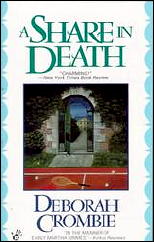
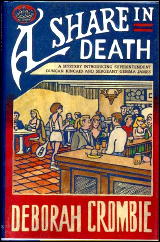
DEBORAH CROMBIE – A Share in Death. Charles Scribner’s Sons, 1993. Berkley, paperback, May 1994. Avon, pb, August 2003.

DEBORAH CROMBIE

   A Share in Death is the first of what is now fourteen books in author Deborah Crombie’s Duncan Kincaid & Gemma James series, both of Scotland Yard. Kincaid is a rising star in the ranks and a Detective Superintendent at the time this one takes place. We do not see much of Gemma. She’s a Sergeant newly assigned to Kincaid, and (we are told) they work as quite a team together.

   But thanks to a cousin and his wife who couldn’t get away, Kincaid is off to Yorkshire at the beginning of the book, for a bit of pampering at a luxury timeshare he couldn’t begin to afford on his own, while Gemma is left to take care of loose ends back in London. And quite naturally murder soon occurs, then another, and Kincaid’s attempt at anonymity is foiled almost at once.

   While of course anyone from the outside might have been the killer, the odds are highly against it. This is the present version of one of those old isolated manor house mysteries of the 30s and 40s, where the killer is one of the suspects, but which one?

DEBORAH CROMBIE

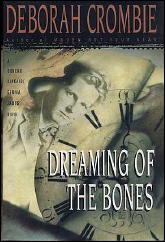
   The Texas-born Crombie’s forte is description, characterization and dialogue, three big pluses that not every detective story writers has a full supply of, and which has made her books quite popular, following as they do the lives of the two lead characters throughout the series, as well as the cases they work on together. (A Share in Death was nominated for the Agatha and Macavity awards for Best First Novel of 1993, and the fifth in the series, Dreaming of the Bones, was nominated for a Best Novel Edgar by the MWA for Best Novel in 1997.)

   I may not visit the right websites, however, as I haven’t read a lot about her, not as much as I think I should have, considering that she writes old-fashioned detective stories combined with the “cozy” aspects that present day fans seem to demand.

   Description, characterization and dialogue: all three present and accounted for. The plotting I had some problems with. Not major ones, but when a suspect and possible witness starts to tell the investigating officer something, and they’re interrupted before they can say their piece, don’t your armchair detecting organs make you sit up and take notice? Mine do, and they did.

DEBORAH CROMBIE

   And it’s always a problem when the concluding chapter is the weakest of the book. The clues are all there – I checked to make sure – but it’s only under the barest of possibilities that Kincaid could have made the jump in logic that he did and come up with the identity of the killer, accurately, when he did. Maybe, I grant you, but only maybe.

   The next would-be victim’s behavior is even more inexplicable, especially after a previous attempt on his/her life. Hie off by yourself to an isolated spot in the local countryside? Not me, not if it were I, not one chance in a thousand, and that’s the understatement of the year.

   I tell you this not to dissuade you from reading the book, far from it. There is far too much good to it for that to be my intention. It does suggest that writing a puzzle to be solved in a mystery novel is much harder than anyone who has never tried it may think. For a first novel and these exceptions, A Share in Death is awfully good.

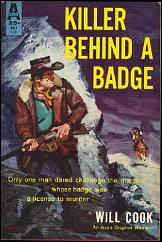
WILL COOK – Killer Behind a Badge. Avon T-867; paperback original, 1960. John Curley, large print hardcover, 1994.

WILL COOK Killer Behind a Badge

   A western novel, and in only 128 pages, it packs a nifty punch. Will Cook, who also wrote as Wade Everett, James Keene, and Frank Peace, had the knack of summing up a person’s life history in just a few descriptive sentences.

   Take, for example, the first paragraph of the book:

   As was his habit each evening at seven, Bob Shannon left his hotel, crossed the street and walked a few doors down to Big Bessie’s Place, where he had his supper of chili beans and a double rye whiskey. This was the beginning of Shannon’s day, and it would not end until four in the morning; his office was a piano stool and a battered upright that had once graced a St. Louis bank president’s home.

   The power in town belongs to Jefford Lane. From page 7:

The old man was fifty, blocky in the face and shoulders; there was about him the humorless stamp of hard work, and the first time you looked at him you knew that he had never heard a joke funny enough to laugh at.

   The local law is in the hands of Manning Cordell. From page 8:

   Shannon looked past them as the doors swung open and Manning Cordell came in. He was a man of medium height, not very heavy, and he wore a dark suit and flat-heeled boots. Before his appointment as U.S. Marshal, he had been a clerk in the courthouse, and many people in Cedar Springs were surprised that the government had made a law officer of him. Yet somehow he fit the job, for he was a quiet, dedicated man in his middle thirties, always serious and very thorough in the things he did. Not many people could recall a mistake Cordell had made.

   I could go on, but these are three of the main characters, all important, if not essential, to the plot. Cordell is tough on lawbreakers, and Shannon is the only one who knows exactly how tough the Marshall is: judge, jury, and executioner, all wrapped up in one tidy package. As he explains to the faro dealer Elfrieda on page 33:

    “I guess you could call it a solution. Some people might think it a good thing if a mad dog bit every bad person, but who gets rid of the dog?”

    Here’s where the title of the book comes in. From this point on, it’s a game of wits to determine who will prevail, Shannon or Cordell, and all bets are off in terms of which way this terse and concise hardboiled little novel will go.

   It gets a little choppy here and there — two cattle rustlers siding with Shannon are deposited in jail and never heard from again — but there’s a lot of tough action to go with some insightful perspective into the minds of the players.

   And the ending is doubly satisfying, quite ironic in terms of a man who, having succeeded once, follows it up by making what’s clearly a terribly wrong choice. Very nicely done, and it’s quite unexpected. If you’re a western fan, be on the lookout for this one.

— Reprinted from Durn Tootin’ #3,
   October 2003 (with revisions).


[UPDATE] 07-30-11.   I have a feeling that the ending of this review was deliberately vague, so as not to any reveal significant plot points that I shouldn’t. Of course here it is, over eight years later, and I don’t remember the ending at all.

   No matter. I trust my judgment. I recommended the novel then, and I still do now.

« Previous PageNext Page »