Reviews


Curse, Smersh!
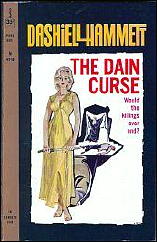
Dashiell Hammett’s The Dain Curse
A Review by Curt J. Evans


DASHIELL HAMMETT – The Dain Curse. Alfred A. Knopf, hardcover, 1929. Reprinted many times since.  TV movie: 1978 (with James Coburn as “Hamilton Nash”).
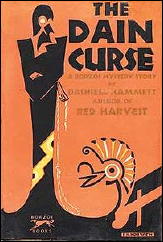
DASHIELL HAMMETT Dain Curse

   Not all Hammetts were created equal. Case in point: Hammett’s second novel, his famous family slaughter saga, The Dain Curse. Less viscerally organic than his first crime tale, Red Harvest (1929), it is also, in my opinion, vastly inferior both to his immediately following works, The Maltese Falcon (1930) and The Glass Key (1931), and even to his last novel, the slick (if rather facile) The Thin Man (1934).

   I am hardly the first person to note flaws in The Dain Curse. A quarter-century ago, in his entry on the novel in 1001 Midnights, Bill Pronzini observed that The Dain Curse was “overlong and decidedly melodramatic.” Indeed it is!

   Where in Red Harvest the gang violence culminating in massacre that Hammett chronicles seems to rise naturally out of the darkest strains of indigenous Americana, in The Dain Curse the bloodletting is tied to an impossible plot that resembles the more absurd Golden Age British detective fiction that Hammett purportedly despised.

   If you were to ask me which 1929 detective novel is the more ridiculous when looked at objectively, The Dain Curse or S. S. Van Dine’s The Bishop Murder Case (though Van Dine was not British, he clearly was heavily influenced by the sort of classical detective story we associate most with British writers), I would be hard pressed to name the latter title, even though it involves an unbelievably baroque plot involving multiple slayings carried out on the basis of nursery rhymes.
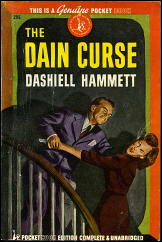
HAMMETT Dain Curse

   At one late point in the The Dain Curse, Hammett’s detective, the Continental Op, stops to list for a friend the myriad acts of bloody mayhem that have occurred around him of late. I have to say I found this list hilarious:

    “Are you sure,” Fitzstephan asked, “that you’re right in thinking there must be a connection?”

    “Yeah. Gabrielle’s father, step-mother, physician, and husband have been slaughtered in less than a handful of weeks — all the people closest to her. That’s enough to tie it all together for me. If you want more links, I can point them out to you. Upton and Ruppert were the apparent instigators of the first trouble, and got killed. Haldorn of the second, and got killed. Whidden of the third, and got killed. Mrs. Leggett killed her husband; Cotton apparently killed his wife; and Haldorn would have killed his if I hadn’t blocked him. Gabrielle, as a child, was made to kill her mother; Gabrielle’s maid was made to kill Riese, and nearly me. Leggett left behind him a statement explaining — not altogether satisfactorily — everything, and was killed. So did and was Mrs. Cotton. Call any of these pairs coincidences. Call any couple of pairs coincidences. You’ll still have enough left to point at somebody who’s got a system he likes, and sticks to it.”

HAMMETT Dain Curse

   This passage makes Philo Vance’s “psychological” lectures at the end of The Greene Murder Case (1928) and The Bishop Murder Case seems overwhelmingly convincing by comparison. Unfortunately, it is reflective of the many pages in the novel given over to the Op’s inevitably tedious explanations of an extremely convoluted but ultimately not very rewarding mystery plot.

   To be fair to Hammett, with The Dain Curse (as with Red Harvest) he was faced with the task of stitching together a novel from short stories. To make The Dain Curse stick together in one piece he was forced to use as glue the criminal mastermind gambit.

   This device usually is not convincing in Edgar Wallace novels either, but then Edgar Wallace is not universally acclaimed today for having heroically and almost single-handedly (with some help from Raymond Chandler) introduced realism to the Golden Age mystery story.
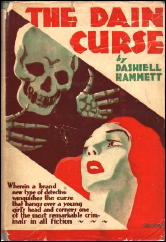
HAMMETT Dain Curse

   This is not to say that there are not interesting points to The Dain Curse. There are times when one pleasingly can hear the wisecracking voice of Philip Marlowe and that smart ass legion of private eyes who jauntily followed Hammett’s Continental Op and Sam Spade down those mean streets:

   While I waited [explains the Op when he is at the home of the well-off Leggetts], I looked around the room, deciding that the dull orange rug under my feet was probably both genuinely oriental and genuinely ancient, that the walnut furniture hadn’t been ground out by machinery, and that the Japanese pictures on the wall hadn’t been selected by a prude.

   â€œFor God’s sake let’s get her out of here — out of this house — now, while there’s time!”

   I said she’d look swell running through the streets barefooted and with nothing on but a bloodstained nightie.

   And then there is simply the thrill in The Dain Curse of Hammett’s sharp and direct depictions of drug dependency and pure, elemental brute violence (which in 1929 must have been really thrilling — or appalling, depending on the reader):

   â€œWhere’s Gaby?” he gasped.

   â€œGod damn you,” I said and hit him in the face with the gun.

HAMMETT Dain Curse

   Although I think that, in contravention of academics who have given much serious study to it, Hammett’s treatment in The Dain Curse of a religious cult is more pulp fiction than deep thinkin’, nevertheless I was greatly amused by this sardonic observation from the Op:

   They brought their cult to California because everybody does, and picked San Francisco because it held less competition than Los Angeles.

   Too bad Hammett (and the Op) missed the Swinging Sixties!

   Overall, however, I would say that The Dain Curse is neither a great crime novel nor even a very good one, really — though it undeniably has importance both in the study of Hammett’s development as a writer and in the development of American detective fiction.

   But when it comes to melodramatically and improbably cursed genteel families and wildly overcomplicated murder plots, give me S. S. Van Dine any day of the week. Indubitably, his Philo Vance is the go-to guy when one is faced with that sort of the case.

REVIEWED BY GEOFF BRADLEY:         


DANIEL STASHOWER – The Adventure of the Ectoplasmic Man. William Morrow, hardcover, 1985. Penguin, paperback, 1986. Titan Books, trade paperback, 2009.

DANIEL STASHOWER Ectoplasmic Man

   I’m a sucker for Sherlock Holmes stories written by hands other than Conan Doyle not because I think they’re good, but because I’m always hoping they will be. I had read some good things about this book so with fingers crossed I decided to try it.

   Watson, on the death of Houdini, sends Houdini’s widow a manuscript detailing the adventure where Holmes untangled, in 1910, a plot to discredit Houdini, who was performing in London, and blame him for murder and crimes against the state.

   The book could be described, I suppose, as a romp rather than an accurate pastiche. Holmes is larger that life, naturally, but his techniques seem a little far-fetched and it was surprising that he knew how to fly a plane. Still it was a light and fast read, and I have to say I quite enjoyed it, without, for a moment, taking it seriously.

Bibliographic Notes:   (1) Ectoplasmic Man was nominated for an Edgar (Best First Novel) by the MWA in 1986.

   (2) Several years after this book appeared, Daniel Stashower wrote a series of three novels in which Harry Houdini himself was the primary detective:

      The Harry Houdini series —

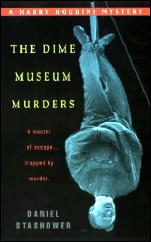
1. The Dime Museum Murders (1999)

DANIEL STASHOWER

2. The Floating Lady Murder (2000)
3. The Houdini Specter (2002)

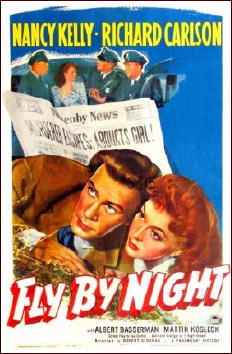
FLY-BY-NIGHT. Paramount Pictures, 1942. Richard Carlson, Nancy Kelly, Albert Bassermann, Miles Mander, Edward Gargan, Adrian Morris, Martin Kosleck, Walter Kingsford, Cy Kendall, Nestor Paiva, Marion Martin, Oscar O’Shea, Mary Gordon, Clem Bevans. Based on a story co-written by Sidney Sheldon. Director: Robert Siodmak.

FLY BY NIGHT Nancy Kelly

   It was a cold and stormy night. The lightning crashes, the thunder rolls, and the rain is coming down in torrents. The gates of the Riverford Sanitarium are locked up tight. Nonetheless one of the inmates, locked up behind steel bars, kills a guard and makes his way over the wall.

   Eluding the guards on his trail, he finds his way into Dr. Burton’s car — temporarily out of gas and marooned — and at gunpoint forces the young physician to aid and abet his getaway. He’s no maniac, he tells the doctor. He works for a famous chemist who’s invented a substance called G-32 that a gang of spies are determined to get their hands on.

   Leaving the hotel room where they’ve holed up at for a short moment, Burton (an equally young and very earnest Richard Carlson) returns to find the man dead, murdered by one of his own scalpels. Do the police believe a word of this? Not for a minute.

   Now on the run himself, Burton commandeers the aid of a young and beautiful brunette (redhead?) staying in a room below, a sketch artist named Pat Lindsey (Nancy Kelly, to those of us who’ve read the credits). And they’re off and running, in one of the most amusing screwball mysteries I’ve had the occasion to watch in a long long while.

FLY BY NIGHT Nancy Kelly

   Not laugh-out-loud funny, but amusing in the sense of a smile to yourself when another “I can’t quite believe this” scene comes along. Besides their finding a secure hideaway with a rustic justice of the peace and his family, who have their own ideas as to why they’re on the run, there’s some absolutely top notch stunt work involved, as the pair jump from the lady’s automobile they’re driving, up onto a car carrier filled with new cars, hopping into one of them, then releasing it backwards onto the highway, all while going full speed away from both the police and the gang that’s not far them.

   Whew! This movie was not at all what I expected from the opening scene, which I described in a lot more detail than I will the couples’ further quarreling adventures, which I will leave to you find and discover on your own, and delightfully so, if you do.

   Of the cast, most of them were only names to me. Richard Carlson, of course, and Nancy Kelly (sister of Jack Kelly) who later on won a Tony and was nominated for an Oscar, but the others, while they were all terrific in their parts, they don’t win awards for movies like this one. (But maybe they should.)

FLY BY NIGHT Nancy Kelly

REVIEWED BY BARRY GARDNER:


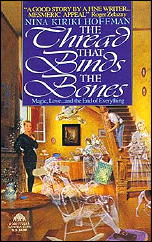
NINA KIRKI HOFFMAN The Thread That Binds the Bones

NINA KIRIKI HOFFMAN – The Thread That Binds the Bones. Avon, paperback original, 1993.

   I don’t find much fantasy that I like anymore, whether it’s a function of my own jaded sense of wonder or they’re just not writing ’em like they used to. I enjoyed this one.

   It’s the story of a strangely talented young man who blunders into an even more strangely talented family living in the Oregon boondocks, and what happens between them. Reminds me a bit of Suzette Haden Elgin’s Ozark novels, though it isn’t as good. The plot has holes in it, but the writing’s good, and the characters are engaging.

— Reprinted from Ah, Sweet Mysteries #7, May 1993.


Editorial Comment:   I haven’t finished looking through all of Barry’s old reviews, but this is the first I’ve come across that’s either a fantasy or science fiction novel. By my usual standards it’s too short to post, but I thought in this case I’d make an exception.

REVIEWED BY WALTER ALBERT:         


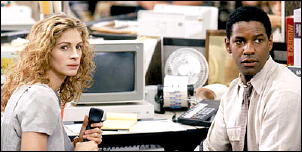
JOHN GRISHAM – The Pelican Brief. Bantam, paperback, 1993; Doubleday, hardcover, 1992.   Film: 1993, with Julia Roberts & Denzel Washington.

THE PELICAN BRIEF

   A friend showed up on my doorstep and pressed this into my hands, saying only that this was a page-turning read.

   Well, it was, if you count skipping about 3/4 of the book as you race forward to the denouement as page-“turning.” I can’t believe that Grisham is as popular as he seems to be currently. The book is long, turgid and sloppily written. Don’t they have literate copy-editors anymore at any of the publishing houses?

   I didn’t stop to document any of the linguistic atrocities, but several of them brought me up short. Spare me any more Grisham. Life is too short and time too precious to waste on this pre-digested pablum.

— Reprinted from Walter’s Place #95, May 1993.

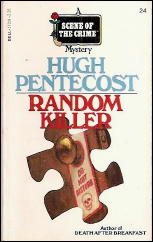
HUGH PENTECOST Random Killer

HUGH PENTECOST – Random Killer. Dodd Mead, hardcover, 1979. Hardcover reprint: Detective Book Club, 3-in-1 edition, October 1979. Paperback: Dell, Scene of the Crime Mystery #24, 1981.

   Although fictional, the Hotel Beaumont, located in New York City, is the model that all the world’s other fine luxury hotels must pattern themselves after. It is indeed a small city within itself, and Pierre Chambrun’s staff keeps everything working like clockwork.

   Until, that is, the week a crazed killer’s series of strangulation murders has the patrons packing up and leaving for elsewhere in panic. A pattern does at last emerge, one that connects the several deaths to that of a ski instructor in Colorado two years earlier.

   In spite of the enormity of the coincidence required to bring all the right people together at the same time in the same hotel — Chambrun’s — Pentecost’s flair for adapting headline-making drama keeps the story alive and continually in motion.

Rating: B minus.

— Reprinted from The MYSTERY FANcier, Vol. 3, No. 6, Nov/Dec 1979 (slightly revised). This review also appeared earlier in the Hartford Courant.

IT IS PURELY MY OPINION
Reviews by L. J. Roberts


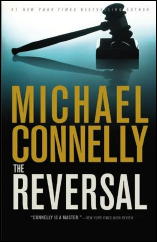
MICHAEL CONNELLY – The Reversal. Little Brown, hardcover, October 2010. Premium-sized paperback: Vision, August 2011.

Genre:  Legal Mystery/Police Procedural. Leading characters:  Mickey Haller (3rd in series) & Harry Bosch (16th). Setting:   Southern California.

First Sentence:   The last time I’d eaten at the Water Grill I sat across the table from a client who had coldly and calculatedly murdered his wife and her lover, shooting both of them in the face.

MICHAEL CONNELLY The Reversal

   Jason Jessup has spent the last 24 years in prison, convicted of kidnapping and murdering a 12-year-old girl. New DNA evidence has won him a new trial, but the LA DA’s office can not use one of their own to prosecute the case.

   Instead, they hire defense attorney Mickey Haller to switch sides. Mickey agrees to prosecute the case as long as he runs the case with his ex-wife Maggie McPherson as 2nd chair and LAPD Det. Harry Bosch as
investigator.

   You can never go wrong with a book written by Connelly, and this is one of his better books. From the very beginning, you are involved and want to keep reading to the last page. It really is a legal thriller.

   The story is much more plot-driven than character-driven. Certainly there are details of each character’s personal life — it wouldn’t be realistic without them — but the story focuses on the case. While that did mean there was less character development than I’d have liked, it made sense with the trajectory of the story. To do otherwise, may have bogged things down.

   The drama is split between the investigation and the courtroom. And drama there is. Connelly creates an excellent sense of tension without ever going over the top. When there is threat, it feels real. When there is emotion; that too is realistic.

   The courtroom scenes were ones I found fascinating. From pre-trial, to dealing with the political and media pressures, jury selection, and legal maneuvers, having just served on a criminal-trial jury, it all seemed very real to me. The ending was not as satisfying as I might have wished, but it was more realistic than a more classic ending.

   One element I did find disconcerting was the alternating voices. I do wish it had all been done in third person, but I understood why it was not. However, it was a bit confusing at times.

   I’ve always said there is nothing wrong with a “Good” book. This was more than “Good” but still falls in that range. It is a four-hour, straight-through, airplane read, and that is not meant to be a disparaging term. It does mean it’s a book in which one becomes so engrossed, you can tune out everything else around you, go for the ride, and finally breathe at the end, looking around you to remember where you really are.

   In other words; I really enjoyed reading it!

Rating:   Good Plus.

A REVIEW BY RAY O’LEARY:
   

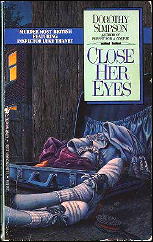
DOROTHY SIMPSON – Close Her Eyes. Bantam, paperback, 1985. Hardcover edition: Scribner’s, US, 1984. First published in the UK: Michael Joseph, hc, 1984.

DOROTHY SIMPSON Close Her Eyes

   Detective Inspector Luke Thanet is called in on his day off when a 15 year old girl is reported missing; Charity Pritchard and her girlfriend were supposed to be at a Youth Hostel while her parents were away, but it seems the girlfriend took ill and Charity… well, she left the girlfriend’s house just minutes before Thanet and Sgt. Lineham showed up looking for her, but an hour later she’s found dead on the shortcut to her house — and evidence turns up that she’s not the Little Innocent everyone took her for.

   I sampled Simpson’s Thanet novels years ago, but got so ticked off by Puppet for a Corpse [see below] that I didn’t return to her until just recently. I found this one a pretty decent effort, though the killer was pretty evident from the get-go and I wondered what took Thanet so long to get around to him.

   (Why Puppet?   WARNING: SOLUTION REVEALED!   See Comment #1.)

THE BACKWARD REVIEWER
William F. Deeck


SHELLEY SMITH – He Died of Murder! Harper & Brothers, hardcover, 1948. First published in the UK: Collins, hardcover, 1947.

   When the Master of The Seekers, a religious sect devoted to celibacy, truth-telling, and a vegetarian diet, is murdered, it appears to be something of a miracle, in the nonreligious sense, to be sure. The Master was shot almost point blank in the middle of a plowed field with several of his sect more or less observing. Yet no one was near him and there were no footprints other than his in the field.

   Staying at the Sanctuary, the home of The Seekers, Detective Inspector Chaos of Scotland Yard investigates these now ostensibly unworldly people and their definitely worldly neighbors. A man of insights and practical knowledge, Chaos, belying his name, finds an unspiritual motive and calmly tracks down the murderer.

   Generally I find novels of alleged psychological suspense tedious or unpersuasive. I have heretofore avoided Smith’s works for that reason. But this is also a detective novel, with Chaos a delightful character. Even the child whom he befriends and who intends to marry him is acceptable, most unusual in a genre where children are little horrors whether the author intended it or not.

— From The MYSTERY FANcier, Vol. 12, No. 3, Summer 1990.


Bibliographic Notes:   Shelley Smith was the pseudonym of Nancy Bodington, 1912-1998, author under this pen name of 15 crime and detective novels between 1942 and 1978. There was one earlier case adventure for Inspector Jacob Chaos, that being Background for Murder (Swan, 1942; no US edition).

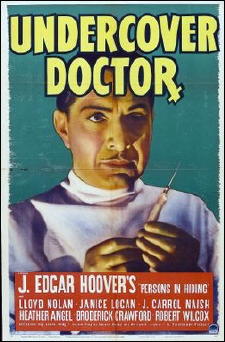
UNDERCOVER DOCTOR. Paramount Pictures, 1939. Lloyd Nolan, Janice Logan, J. Carrol Naish, Heather Angel, Broderick Crawford, John Eldredge, Raymond Hatton, Paul Fix, Richard Denning. One of four short films made in 1939-40 based on the book Persons in Hiding), by J. Edgar Hoover. Director: Louis King.

UNDERCOVER DOCTOR Lloyd Nolan

   Lloyd Nolan gets top billing, although at least fifteen minutes have gone by before he shows up on the screen. (It pays to have a good agent.)

   It’s J. Carroll Naish as the titular doctor instead who gets most of the screen time, he along with semi-brutish Broderick Crawford, whom I’ve never seen so young, as Public Enemy #1, Eddie Krator, a role he was (as they say) born to play.

   You might get the idea from the title that Dr. Bartley Morgan (Naish) is working undercover for the FBI, for whom Nolan is of their top agents, but if so, you would be wrong. The title of this film really ought to be Underworld Doctor, since Morgan, in a moment of weakness (and the love of money) works for Krator and not against him.

UNDERCOVER DOCTOR Lloyd Nolan

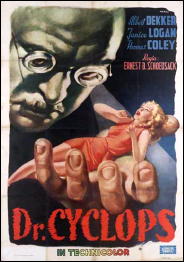
   He’s a high society kind of guy, or so are his aspirations. Loving him in vain is his nurse and devoted assistant (and keeper, if truth be known), played by Janice Logan, whom you may also have seen in Dr. Cyclops (1940) as Dr. Mary Robinson. If you missed that one, you probably missed her career, as she was in only six feature films in all. At times and at the right angles, she reminded me of a slightly prettier Veda Ann Borg.

   In any case, if Dr. Morgan is content to ignore the woman who works for him, aiming for a society marriage instead, it is cool Lloyd Nolan who was never loath to pass up a chance like this. Dumping Krator when his usefulness is up, Morgan suddenly finds himself short of funds and has to do one more job for his former mentor. Which is when the bottom falls out of his life, which I hope does not reveal anything I should not. (I do not believe so.)

   The movie’s a solid piece of work all the way through, even though you will see all of the twists coming a mile away. You will also see lots of lots of familiar faces. I’ve listed some of them that I could put a name to, but there are many others that I couldn’t, and so I didn’t.

UNDERCOVER DOCTOR Lloyd Nolan

« Previous PageNext Page »