Reviews


THE BACKWARD REVIEWER
William F. Deeck


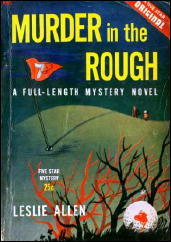
LESLIE ALLEN Murder in the Rough

LESLIE ALLEN [HORACE BROWN] – Murder in the Rough. Five Star Mystery #45, paperback original, digest-sized, 1946.

   In Napoleon B. (which may stand for “Buttercup,” but probably doesn’t) Smith’s only case, he apparently kills a slightly dotty old lady during a golf game when one of his drives, as is the fate of most of them, hooks into what is known as Hell’s Half Acre. Only sometime later does Smith conclude that he was not really responsible and that a murderer was on the course that day.

   A sort of active and crass Nero Wolfe, Smith is a former policeman who uses his weight and bad manners as aids in his investigations. However, he also employs brains, which are not puny, and a literary background that is unexpected. Leslie Allen, Smith’s Watson [or Archie], reluctantly takes care of the dogsbody work.

   It is to be hoped that Leslie Allen the character and alleged writer is a better stylist than Leslie Allen the author. Still, the creation of Smith is something of an accomplishment.

— From The MYSTERY FANcier, Vol. 12, No. 3, Summer 1990.


Bibliographic Data:   Under his own name Horace Brown was the author of two other crime novels included in the Revised Crime Fiction IV, by Allen J. Hubin:

BROWN, HORACE.   1908-??

       Whispering City. Streamline, 1947.
       The Penthouse Killings. Newsstand Library #17A, 1950; reprinted as The Corpse Was a Blonde, Boardman, UK, 1950.

   Whispering City was a novelization of the Canadian film of the same name starring Paul Lukas, Mary Anderson and Helmut Dantine. It was released in the US as Crime City (1947).

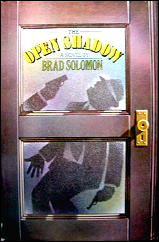
BRAD SOLOMON – The Open Shadow. Summit Books, hardcover, 1978. Avon, paperback, 1980.

BRAD SOLOMON

   The private eye team of Thieringer and McGuane is as quietly competent as they come, most of the time. The only difference is that while Thieringer’s name is Fritz, McGuane’s is Maggie. They’re also both as tough as they come, so how’s anyone going to convince her that detective work is no job for a lady, if no one has by now?

   Besides having to convince a reluctant client to hire them to protect himself from a kid with threats and a gun, Thieringer finds himself nursing along a youthful new assistant who may or may not work out. It’s a rough business.

   As a specimen of the hard-boiled school, this is closer to Hammett than Chandler, the added plus being some refreshing humor that stays just this side of parody. Promising.

— Reprinted from The MYSTERY FANcier, Vol. 3, No. 6, Nov/Dec 1979 (very slightly revised). This review also appeared earlier in the Hartford Courant.


Bibliographic Comments:   In spite of the promise I saw in the Thieringer and McGuane team-up, there never was a followup case for the PI twosome. Brad Solomon, in fact, wrote only three detective or crime fiction novels in the late 1970s, then seemingly disappeared from our field for good. From the Revised Crime Fiction IV, by Allen J. Hubin:

SOLOMON, (Neal) BRAD(ley).

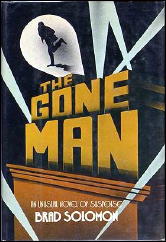
    The Gone Man (n.) Random 1977.

BRAD SOLOMON

    The Open Shadow (n.) Summit 1978.
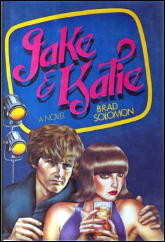
    Jake & Katie (n.) Dial 1979.

BRAD SOLOMON

   The hero of record in The Gone Man was Charlie Quinlan, an actor who turns to PI work to make a living. Bill Crider reviewed the book here on his blog, where there’s also a link to Ed Gorman’s blog, where Dick Lochte posted a list of his “Top 20 PI Novels,” which includes The Open Shadow. The company’s not bad there, either, what with Chandler, Hammett, Macdonald, Parker, Ellin and Estleman among the competition.

   Bill also reviewed Shadow on his blog. Look for it here.

   As for Jake & Katie, I don’t believe it did very well. There are only 10 copies offered for sale on ABE, for example, compared to 80 of The Gone Man and 60 of The Open Shadow. It’s described as a novel on the cover, but one seller calls it a “Hollywood mystery.” Yet another goes into considerable detail:

    “Jake isn’t making it in Tinseltown. He meets Katie in a bar, and his life changes dramatically. Katie is young, beautiful, charismatic. when she moves in with Jake, she takes possession of his life . transforms it, getting him the roles he’s been looking for. Jake begins to feel that he’d be nothing without Katie, and it terrifies him. Soon he realizes that he really knows very little about the woman he’s living with. Why does she have such extreme mood swings? Why does she tell conflicting stories about her past? What does she want from him and how far is she prepared to go to get it?”

   There is the briefest amount of biographical data on Brad Solomon in Contemporary Authors, and nothing to suggest why these three books were all there were.

REVIEWED BY BARRY GARDNER:


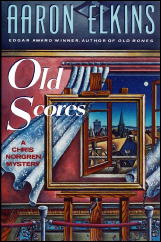
AARON ELKINS – Old Scores. Chris Norgren #3. Scribner’s, hardcover, 1993. Fawcett Gold Medal, paperback, 1994.

AARON ELKINS

   One thing about Elkins, he picks widely varying specialties for his series characters. Though he’s best known for his “bone doctor” series about Gideon Oliver, the Norgren books seem to be picking up speed. Chris Norgren is curator at the Seattle Art Museum, and who’d have thought the world of acquisitions would be so hazardous?

   A famous French collector wants to give the museum a Rembrandt — great, hein? Well, maybe. There are a couple of catches: the painting has no provenance, and no scientific tests will be allowed.

   Chris’s director wants him to go to France and make an accept/reject decision. Chris wants to reject it out of hand, but goes anyway, at the cost of some discombobulation to his already shaky love life.

   Things are even weirder than expected in France, the situation turns nasty, and murder is done. Well, hell, what did you expect?

   I don’t believe for a minute that any museum would even consider accepting a master painting without provenance and/or testing, but what do I know about museums? Aside from that, this is the kind of entertaining tale I’ve come to expect from Elkins.

   I like Norgren as a character, and find the artistic background interesting and edifying. Elkins tells a good story, and creates a good set of supporting characters. His stories fall somewhere between cozy and hard-edged, and while I don’t think anyone would call them memorable, they provide an entertaining read.

— Reprinted from Ah, Sweet Mysteries #7, May 1993.


AARON ELKINS

Editorial Comments:   In spite of Barry’s feeling that Elkins’ Chris Norgren series was catching on, this was the third and last of his recorded adventures.

       The Chris Norgren series —

1. A Deceptive Clarity (1987)
2. A Glancing Light (1991)
3. Old Scores (1993)

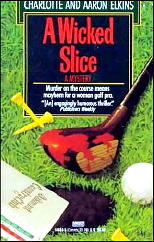
   As of this month’s publication of The Worst Thing, there are seventeen Gideon Oliver books. Aaron Elkins’ wife Charlotte has been his co-author with five books in their Lee Ofsted series. The latter is a lady professional golfer; her first appearance was in A Wicked Slice (1989).

IT IS PURELY MY OPINION
Reviews by L. J. Roberts


WILLIAM KENT KRUEGER – Vermilion Drift. Atria, hardcover, September 2010; trade paperback, June 2011.

Genre:   Private eye. Leading character:  Cork O’Connor; 10th in series. Setting:   Minnesota.
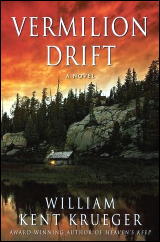
WILLIAM KENT KRUEGER Cork O'Connor

First Sentence:   Some nights, Corcoran O’Connor dreams his father’s death.

   Max Cavanagh owns several mines, one of which is being studied by the Department of Energy as a possible site to store nuclear waste. In addition to protests causing Cavanagh worry, his sister, Lauren, has gone missing.

   Cork, hired to find her, does so but she is not alone. He locates her body in, what had been a closed off section of the mine, among five skeletons. The five skeletons are those of women known as “The Vanishings” who had disappeared decades ago, and two of the bodies contain bullets fired from the gun of Cork’s late father.

   I was recently involved in a discussion of prologues and how many of us are either annoyed by them or ignore them completely. It takes a writer as skilled as Krueger to write a prologue which contains an important thread which runs through the story. The one in Vermilion Drift is not a prologue to ignore.

   Krueger has become one of my favorite authors. His skill with description take what could be a fairly ordinary scene, but instead comes alive with clear, visual images. We are able to go where the author takes us and be a part of that which is described to us.

   Even from those scenes where we might prefer to look away, we can’t. That doesn’t mean he is graphically violent; he’s not. It is more that we feel the emotion of the scene and, thereby, understand it.

   Because I read first for character is another reason why Krueger’s writing appeals to me. He creates dimensional, interesting, relatable characters. I’ll admit I wasn’t particularly happy with the events of the previous book, Heaven’s Keep, but the transition to this book has been very effectively and tastefully handled and I now understand the purpose of those events.

   Cork’s heritage is half Irish, responsible for his impatience and occasional anger, and half Ojibwa, which connects him to the people on the reservation, Indian history, and my favorite character Henry Meloux. It also provides the link to the mystical element in each book.

   Before you walk away saying “I don’t like woo-woo,” wait. Mysticism and the spirit world are part of the Indian culture. They are also part — along with several other themes including that of what do we really know of our parents and the definition of evil — of what takes this book, and this series, beyond the normal and elevates it into something that makes you stop, think and consider.

   Krueger is a very fine author who knows how to create characters, write dialogue, set a scene and, most of all, develop a plot. The story continually builds upon itself. It’s a twisty road filled complete with suspense, emotion and startling revelations.

   I despise the cliché of “If you’ve not read this author yet, read him now,” yet that is the way I feel. Even if you don’t, be assured I shall be reading his next book as soon as it comes out.

Rating:   Excellent.

      The Cork O’Connor series

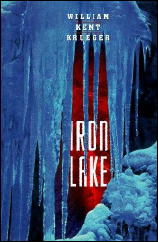
1. Iron Lake (1998)

WILLIAM KENT KRUEGER Cork O'Connor

2. Boundary Waters (1999)
3. Purgatory Ridge (2001)
4. Blood Hollow (2004)     Anthony award, Best novel, 2005.
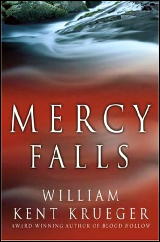
5. Mercy Falls (2005)     Anthony award, Best novel, 2006.

WILLIAM KENT KRUEGER Cork O'Connor

6. Copper River (2006)
7. Thunder Bay (2007)     Anthony nominee, Best novel, 2008.
8. Red Knife (2008)     Barry & Anthony nominee, Best novel, 2009.
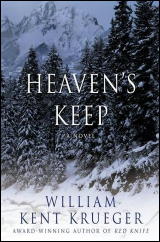
9. Heaven’s Keep (2009)

WILLIAM KENT KRUEGER Cork O'Connor

10. Vermilion Drift (2010)
11. Northwest Angle (2011)
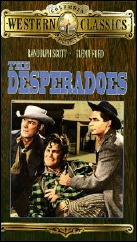
THE DESPERADOES Randolph Scott

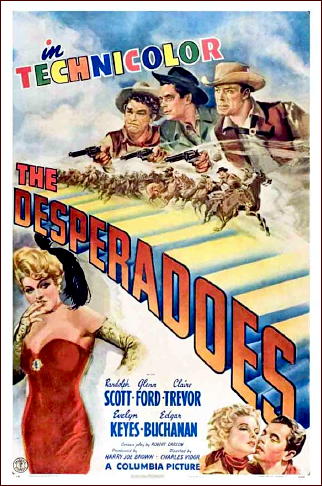
THE DESPERADOES. Columbia Pictures, 1943. Randolph Scott, Claire Trevor, Glenn Ford, Evelyn Keyes, Edgar Buchanan, Guinn “Big Boy” Williams, Raymond Walburn, Porter Hall. Based on an original story by Max Brand. Director: Charles Vidor.

   Randolph Scott and Claire Trevor were the bigger names at the time, and they’re listed first in the credits, but neither of the two contributes nearly as much to this western extravaganza as do stars number three and four, Glenn Ford and Evelyn Keyes.

THE DESPERADOES Randolph Scott

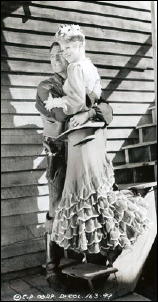
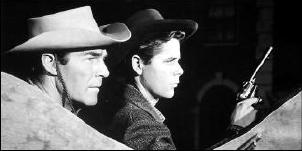
   Glenn Ford, who plays Cheyenne Rogers in the film, was being groomed as a star at the time. The same path was envisioned for Evelyn Keyes, who was married then to director Charles Vidor, but as pretty and talented as she was, most of her films were of the B-variety. On the other hand, Glenn Ford, who was a very young 27 in 1943 – and looks it – did go on to many bigger and better things.

   Cheyenne is a gunfighter hired by Evelyn Keyes’ Uncle Willie (Edgar Buchanan) to rob the local bank – unknown to her, of course – while Randolph Scott is the local sheriff who has a fatherly interest in Keyes. Maybe more, but he steps aside without a fuss if he did when Cheyenne comes along – the latter is a friend of his, as it turns out, even though they are on opposite sides of the law.

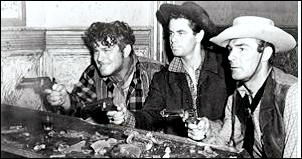
   As for Claire Trevor, she’s the owner of the local gambling palace – and a very sumptuous one, as far as the usual standards of small western towns are concerned. They may be more going on in the back rooms than could be let on in a movie made in 1943. She’s also in on the plot to rob the bank, but if her part hadn’t been written into the screenplay, nobody would have noticed.

THE DESPERADOES Randolph Scott

   There is a lot of action in The Desperadoes, including one of the wildest wild horse stampedes I have ever seen in a movie, clear through Red Valley [Utah]. Of course some fool decides he has to run across the street from one sidewalk to the another just before the horses run through, but I guess every town has fools like that. (He makes it.)

   Personally, I’d have liked to have seen more of Randolph Scott than Glenn Ford, who seems too young (see above) to be a wanted man with a reputation, even if wrongly accused, and awfully unsure of himself as an actor. Evelyn Keyes, though, is very pretty in either a calico dress or a western shirt and blue jeans. Even so, I’m afraid I’d have to agree that she doesn’t have the onscreen catch-your-eyes-and-hold-them type of personality she needed, as much as I’d like to say otherwise.

THE DESPERADOES Randolph Scott

   I mentioned a lot of action, but I haven’t mentioned (so far) the beautiful outdoor scenery, as befits a western film shot in color. (In fact, The Desperadoes was the first movie by Columbia to be released in color, a more than incidental fact that’s worthy of note.)

   Incongruously, though, there is more comedy in this film than seems appropriate; that is to say, the presence of Edgar Buchanan and Big Boy Williams, not to mention the saloon fight that all but destroys the place. It is also difficult to reconcile Edgar Buchanan’s crooked and outwardly befuddled Uncle Willy with the innocence of Evelyn Keyes’ character; they simply don’t mesh.

THE DESPERADOES Randolph Scott

REVIEWED BY WALTER ALBERT:         


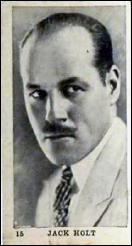
OUTLAWS OF THE ORIENT. Columbia, 1937. Jack Holt, Mae Clarke, Harold Huber, Ray Walker, James Bush, Joseph Crehan, Harry Worth, Bernice (Beatrice) Roberts). Director: Ernest B. Schoedsack. Shown at Cinecon 44, Hollywood CA, Aug-Sept 2008.

JACK HOLT

   The program annotator was surprised to find Schoedsack directing this post-Kong quickie (only 61 minutes long). However, whatever its length and place in the hierarchy of Columbia’s releases in 1937, it proved to be an entertaining action film with engineer Holt, reluctantly returning to China to oversee drilling operations for oil, dealing with his problem-ridden brother (ostensibly in charge of the project) and attacks by a desert Warlord (Harold Huber), in the pay of a rival company.

   When I was a wee lad, nobody was better than Jack Holt at projecting iron-jawed determination and bringing off what appears to be an impossible job. The movie zings along, anchored by his solid performance, a screening well-worth staying up for past my usual bedtime.

   The notes claim that the film never made it to television syndication, so this was thought to be its first screening in some 71 years. Lucky Cinecon attendees.

REVIEWED BY DAN STUMPF:         


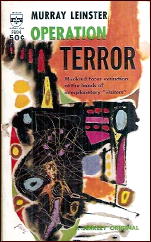
MURRAY LEINSTER – Operation Terror. Berkley F694, paperback original, 1962. Cover art: Richard Powers.

MURRAY LEINSTER Operation Terror

   Next up, Operation Terror by that veteran boshmeister Murray Leinster. It’s easy to dismiss Leinster as a competent hack from the 60s, but there were all too few who could hack words so proficiently.

   Operation starts off as Earth (or more precisely, Boulder Lake) is invaded by beings from another world, complete with flying saucer and paralyzer-beam, monitored helplessly by one of those competent, thoughtful, quick-thinking scientific type that we readers of sci-fi all imagined ourselves to be.

   But as our hero sets about rescuing a distressed damsel and escaping the aliens, the invasion starts to seem more and more hokey, a development that steps up the suspense as he tries to counteract the alien rays, get to safety, warn the authorities, protect the girl and save the planet, all in the space of about a hundred-sixty tightly-packed pages.

   These days when Sci-Fi has been replaced by multi-volumed tomes of “speculative fiction” we can but look back and admire the terse economy of writing like this.

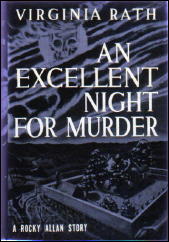
VIRGINIA RATH – An Excellent Night for a Murder. Doubleday, Doran & Co. / Crime Club, hardcover, 1937.

   All things being equal, I’m willing to bet that if I weren’t here to tell you otherwise, you’d have identified Rocky Allan as one of those rough-and-tumble cowboy stars who starred in a long list of those well-remembered B-western moving pictures of a generation or so back.

VIRGINIA RATH An Excellent Night for a Murder

   And while he’s actually the detective hero in a series of mystery novels written by author Virginia Rath, to tell the truth, you’d still not be so very far from being wrong.

   In this book he’s the sheriff of a small country town called Brookdale, which I gather is somewhere in California. Even though this is his fifth recorded adventure, I seem also to have gotten the impression that he’s not been the sheriff there for very long. I don’t know why I’m not sure of these things, but it’s obvious that some research into his earlier cases seems warranted. I’ll have to report in with more information on this later.

   As the story opens, a stranger to Brookdale is taken in by the Graydons, the biggest name in that part of the country, but he’s quickly thrown out, and on one of the rainiest nights of the year. He makes his way into town on foot, and he wakes up dead the next morning in his hotel bedroom. He was a blackmailer, as you might have guessed by now, and a very cooperative one at that, leaving so many victims behind like this to serve as murder suspects.

   The murder investigation is a fairly predictable one, but Rath does a surprisingly fine job in utilizing the folksy, small-town way of living both as background and as a general atmosphere. Surprisingly, for when was the last time you heard the name Virginia Rath mentioned in conversation, even with a fellow aficionado?

   Facts are realistically uncovered in haphazard fashion, too often in the wrong order, and there’s a good twist or two hidden in the end, somewhere midst the clutter caused by having a few too many characters on hand.

   Don’t get the idea that Rath writes only of a hick sheriff in a one-horse town, however. Rocky Allan is still a young guy, and he’s sharper than that. And while his meeting with Pearl in a San Francisco hotel room is downplayed, it’s quite definitely a highlight of the book.

— Reprinted from The MYSTERY FANcier, Vol. 3, No. 6, Nov/Dec 1979 (slightly revised).


      Bio-Bibliographic Data:

   A biographic profile of Virgina Rath can be found on the Ziff-Davis “Fingerprint Mystery” page of the primary Mystery*File website (follow the link and scroll down).

   From the Revised Crime Fiction IV, by Allen J. Hubin:

RATH, VIRGINIA (Anne McVay), 1905-1950. Pseudonym: Theo Durrant.

* Death at Dayton’s Folly (n.) Doubleday 1935 [Sheriff Rocky Allan; California]
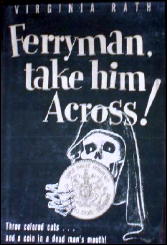
* Ferryman, Carry Him Across! (n.) Doubleday 1936 [Sheriff Rocky Allan; California; Academia]

VIRGINIA RATH

* Murder on the Day of Judgment (n.) Doubleday 1936 [Sheriff Rocky Allan; California]
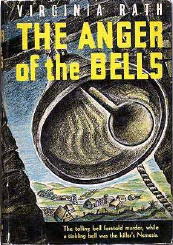
* The Anger of the Bells (n.) Doubleday 1937 [Sheriff Rocky Allan; California]

VIRGINIA RATH The Anger of the Bells

* An Excellent Night for Murder (n.) Doubleday 1937 [Sheriff Rocky Allan; California]
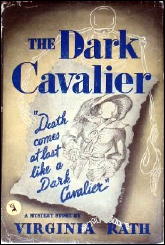
* The Dark Cavalier (n.) Doubleday 1938 [Michael Dundas; San Francisco, CA]

VIRGINIA RATH

* Murder with a Theme Song (n.) Doubleday 1939 [Sheriff Rocky Allan; Michael Dundas; California]
* Death of a Lucky Lady (n.) Doubleday 1940 [Michael Dundas; San Francisco, CA]
* Death Breaks the Ring (n.) Doubleday 1941 [Michael Dundas; California]
* Epitaph for Lydia (n.) Doubleday 1942 [Michael Dundas; San Francisco, CA]
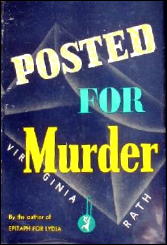
* Posted for Murder (n.) Doubleday 1942 [Michael Dundas; San Francisco, CA]

VIRGINIA RATH

* A Dirge for Her (n.) Ziff-Davis 1947 [Michael Dundas; San Francisco, CA]
* A Shroud for Rowena (n.) Ziff-Davis 1947 [Michael Dundas; San Francisco, CA]

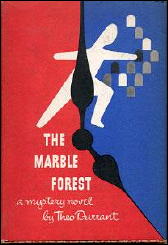
DURRANT, THEO. Pseudonym of William A. P. White, Terry Adler, Eunice Mays Boyd, Florence Ostern Faulkner, Allen Hymson, Cary Lucas, Dana Lyon, Lenore Glen Offord, Virginia Rath, Richard Shattuck, Darwin L. Teilhet & William Worley.

      * The Marble Forest (n.) Knopf 1951 [California]

VIRGINIA RATH

      * The Big Fear (n.) Popular Library 1953. See: The Marble Forest (Knopf 1951)

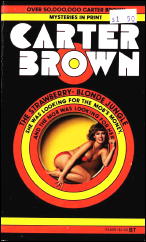
CARTER BROWN – The Strawberry-Blonde Jungle. Belmont Tower, paperback original, 1979.

CARTER BROWN Strawberry-Blonde Jungle

   Carter Brown’s back, and he’s got Danny Boyd with him. Brown was a mainstay at Signet for years — sales of over 50,000,000, so says the cover, and not a bad track record at all — before being dropped several years ago.

   His kind of story being hard to sink, he’s resurfaced in recent months at Belmont Tower, but with some of the sleazier aspects of his later days at Signet still very much in evidence — if not more.

   As for Danny Boyd, he’s moved from Manhattan to Santo Bahia, California, but he’s still a private eye. In his own words, he’s about the ripest bastard he knows, with a penchant for a leer and saying his mind.

   This latest case involves a widow’s hunt for some leftover syndicate money, and a reasonable number of complications develop, but it’s your meat only depending on how deeply your craving for bosomy babes and bawdy broads runs in your daily dose of detective fiction.

   This is a family magazine, as I’ve remarked before, so I don’t believe I’d better explain the title.

— Reprinted from The MYSTERY FANcier, Vol. 3, No. 6, Nov/Dec 1979 (very slightly revised).


Bibliographic Note:   The final Carter Brown novel from Signet may have been The Dream Merchant, which came out in June 1976. When Belmont Tower picked up the franchise in 1979, they published six or so that year, with Donovan’s Delight and The Spanking Girls appearing first, followed by The Strawberry-Blonde Jungle.

THE BACKWARD REVIEWER
William F. Deeck


N. A. TEMPLE-ELLIS – The Man Who Was There. E. P. Dutton, US, hardcover, 1930. First published in the UK: Metheun, hardcover, 1930.

   In order to hasten his recovery from influenza, Montrose Arbuthnot, criminologist, has taken his faithful but not too bright companion, Sir Edmund King, to the Isle of Wight. One day as they are preparing to golf, the housekeeper from a nearby bungalow informs them that her master had been shot and killed.

   They find the corpse, an empty safe, a young man on the veranda reading Palgrave’s Golden Treasury, and Arbuthnot’s card on the floor of the dining room. The corpse’s missing pince-nez is of concern to Arbuthnot, but even more puzzling to him is the hat that cannot be found when the alleged murderer drives off a cliff. “Murderers always wear hats,” Arbuthnot contends.

   Amusing and action-filled, with a complex crime and somewhat fair play. Arbuthnot and King are interesting characters, though one does wonder how they manage to tolerate each other’s faults, if indeed Arbuthnot can be said to have faults.

— From The MYSTERY FANcier, Vol. 11, No. 4, Fall 1989.


    Bibliographic data:     [Taken from the Revised Crime Fiction IV, by Allen J. Hubin.]

TEMPLE-ELLIS, N. A. Pseudonym of N. A. Holdaway, 1894-?

* The Inconsistent Villains (n.) Methuen 1929; Dutton, 1929. [Montrose Arbuthnot]
* The Cauldron Bubbles (n.) Methuen 1930
* The Man Who Was There (n.) Methuen 1930; Dutton, 1930. [Montrose Arbuthnot]
* Quest (n.) Methuen 1931 [Montrose Arbuthnot]
* Six Lines (n.) Hodder 1932
* The Case in Hand (n.) Hodder 1933
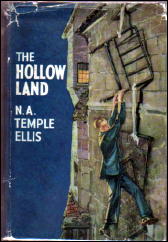
* The Hollow Land (n.) Hodder 1934

TEMPLE ELLIS The Hollow Land

* Three Went In (n.) Hodder 1934 [Insp. Wren]
* Dead in No Time (n.) Hodder 1935 [Montrose Arbuthnot; Insp. Wren] US title: Murder in the Ruins, Dial, 1936
* Death of a Decent Fellow (n.) Hodder 1941 [Insp. Wren]

Note:   Temple-Ellis’s first book, The Inconsistent Villains, was the winner of the publisher’s Detective Story Competition of the year, beating Josephine Tey’s classic The Man in the Queue.

« Previous PageNext Page »