Reviews


REVIEWED BY GEOFF BRADLEY:         


STIEG LARRSON Lisbeth Solander

STIEG LARRSON – The Girl With The Dragon Tattoo (2008), The Girl Who Played With Fire (2009), The Girl Who Kicked the Hornet’s Nest (2009).

   I have read and heard much about this, the first of the much lauded Swedish trilogy. I had determined to resist, though, mainly because I couldn’t face embarking on a 1845 page marathon. But one day we were in a charity shop and there was the first of them and so I bought it.

   I have to say though, that it took me a while to get into the book. If I used a fifty-page rule — and knew nothing about the book — I would probably have given it up. Indeed it was some 200 pages before I was picking the book up eagerly and wanting to know what was going to happen next.

STEIG LARSON Lisbeth Solander

   The story involves an investigating journalist, Mikael Blomkvist, who has been found guilty of libel and is hired, on the promise of information that will clears him, to investigate the disappearance in 1966 of a 16 year old girl from a small town in northern Sweden.

   To help him in his task he hires the girl of the title, Lisbeth Salander, a young — probably autistic — girl who is a computer wiz, and together they attempt to unravel the mystery.

   The story comes to climax with about 70 pages to go and in some ways, though these final pages round the story off nicely, the rest is a little anticlimactic.

   So my verdict is that this is a good, not great, book (where have I heard that before) but good enough for me to move straight on to the second.

STEIG LARSON Lisbeth Solander

   The second and third books are really just one continuous story starting a year or so after the conclusion of the fIrst book. Salander has withdrawn trom contact with Blomkvist who is supervising an expose on the sex trade to be published in his journal, Millenium.

   When the writer of the piece and his girlfriend are murdered Salander is the prime suspect and goes into hiding. Blomkvist begins investigating to clear her name, but Salander investigates with deeper motives stretching back into her history.

   I have to confess I got very involved with this story and towards the end of the third book I was eager to continue reading at every possible moment. There are, I think, one or two plot devices which are rather far-fetched, but overall the books (especially books 2 and 3) are a delight, and I’m glad I read them.
RALPH DENNIS – Deadman’s Game. Berkley Z3003, paperback original; 1st printing, January 1976.

   Dennis was previously the author of Popular Library’s “Hardman” series, now apparently defunct. Although not so indicated, this could be the start of a new series. (Can the cover numbering system no longer be a selling point?)

   Kane is a cashiered government assassin in Deadman’s Game, with an impaired memory and a new identity, but with the same killer-for-hire instinct, and now working privately. There are those who think him a danger, and so his business puts him in the middle, both hunter and hunted.

   In this first adventure he avenges a brother’s death. He’s more on the side of the right than the law would say, but the amount of blood involved is disturbing.

   The first chapter or so I found overwritten, but Dennis writes free-flowing dialogue and action from that point on. Funny thing is, I don’t like what Kane does, but I do like him in his underlying innocence. No kidding.

Rating:   B minus.

— From Mystery*File #9, Vol. 2, No. 2, Spring 1976 (slightly revised).


[UPDATE] 02-13-11.   I don’t know if you know what an apa (amateur press association) is, or if you’d heard of DAPA-Em, the mystery apa that started up in 1974 or ’75, but I was a member, on and off, over the past 35 years.

   The final mailing, #216, arrived at my door this past week, a sad day indeed. For more on this, if you’d care to, including more details about how the apa worked, you could do no worse than to check out George Kelley’s post on the event over on his blog.

   Going through a stack of past mailings in my upstairs closet yesterday afternoon, I came across an envelope of zines that comprised mailing #11, which included a copy of Mystery*File #9, which I don’t believe I’ve seen in over 30 years, and this is one of the reviews that was in it.

   I hope you don’t mind the small amount of editing I did on the review. I didn’t change any of the ideas. Just a trifle bit of tinkering with the wording, nothing more.

   As for the book itself, if it was meant to be the first of a series, the series didn’t happen, for whatever reason. Poor sales, is my guess. There are only two copies offered for sale anywhere on the Internet, both on Amazon, and both for $16.65.

   And this means no cover image, unless you or someone else can supply one. I still have my copy, but alas, I don’t have access to it. (But I do know where it is.)

[UPDATE #2]   Later the same day.   Other members of DAPA-Em, along with one long-time former member (*), who have blogged about the last mailing are (listed alphabetically):

Bill Crider: http://billcrider.blogspot.com/2011/02/dapa-em-r-i-p.html

(*) Evan Lewis: http://davycrockettsalmanack.blogspot.com/2011/02/last-dapa-em.html

Bob Napier: http://capnbob.blogspot.com/2011/02/final-dapa-em.html

Richard Robinson: https://brokenbullhorn.wordpress.com/2011/02/10/an-ending-of-something-great/

   If I’ve missed others, let me know!

STREET CORNER Peggy Cummins

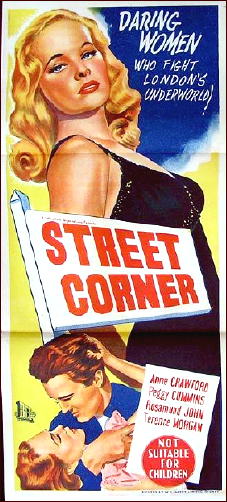
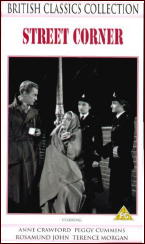
STREET CORNER. J. Arthur Rank, 1953. Released in the US as Both Sides of the Law, Universal Pictures, 1954. Peggy Cummins, Terence Morgan, Anne Crawford, Rosamund John, Barbara Murray, Sarah Lawson, Ronald Howard. Screenplay by Muriel Box & Sydney Box. Director: Muriel Box.

   I don’t know how common it was for a British film in the early 1950s to have a female director, but I have a feeling there weren’t many of them. Looking at Muriel Box’s list of directing credits, and there were 15 of them, the only one that catches my eye is Rattle of a Simple Man (1964), and that the last one she did.
STREET CORNER Peggy Cummins

   Street Corner was the second, and I don’t know what the title means, but I purchased this on DVD as being a noir film, and to tell you the truth, I’m not so sure about that either. What Street Corner is, when it really comes down to it, is a rather nitty-gritty portrayal of London’s women police as they go about their everyday duties, told in stark black-and-white documentary style.

   Let’s get back to the word “noir,” though. Life in Britain after the war was often a struggle, and this movie, shot every so often on outdoor locations, reflects that struggle a lot more than you’d able to learn about it from only reading books about it.

   Cramped quarters, when you could find quarters, vacant lots, life on the make (and on the take) and even life without much hope, that was England in 1953, even without a scriptwriter concocting up a story to go with it.

STREET CORNER Peggy Cummins

   The women who are policemen in Street Corner are largely anonymous. In these early days of the very concept of female officers, in this film they are treated as though they were the women’s auxiliary.

   I couldn’t match any of their names (fictitious) to the actresses (real) who played them, perhaps by design. The stories – three of them, otherwise unconnected – are what’s designed to catch the viewer’s interest:

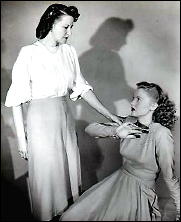
   (1) A young married woman (Peggy Cummins) with a small child and her husband on the road is tempted into world of far more glamour by a young hoodlum looking for a score. (2) A young girl goes AWOL from the Army to come to the assistance of her ill new husband. (3) A three-year-old girl is left alone to fend for herself in a dingy apartment by her uncaring father and stepmother.

   Peggy Cummins, last seen and written about by me for her role in Escape (reviewed here ), continues to impress me as an actress. Her career didn’t go all that far, however. It was essentially over in 1961 when she was only 36.

STREET CORNER Peggy Cummins

THE BACKWARD REVIEWER
William F. Deeck


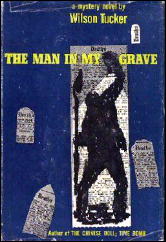
WILSON TUCKER – The Man In My Grave. Rinehart & Co., hardcover, 1956. Hardcover reprint: Detective Book Club, 3-in-1 edition, February 1956. No paperback edition.

WILSON TUCKER The Man in My Grave

   It is to Rocky Knoll, Illinois, that Benjamin Gordon (Beejee) Brooks comes to check out the grave in which he is supposedly buried. The grave and the headstone are indeed extant, but he somehow feels he isn’t in the plot. After all, he argues, here he is above ground some twenty-five years after the alleged interment.

   The discovery of his premature burial was brought about by someone pointing out the epitaph in a printed collection of the wisest and wittiest. Besides the epitaph’s being inaccurate, Brooks claims it doesn’t scan, by which I think he means doesn’t rhyme.

   Still, it seems that Brooks has other graves — actually, the lack of them — in mind. For Brooks is a field representative of the Association of American Memorial Parks, and he and his organization believe that burking is rife in the area. As defined by Brooks, burking, named after the infamous William Burke, is the providing of cadavers to medical schools under suspicious circumstances, although murder does not necessarily play a role.

   An interesting detective in an unusual line and a somewhat frenetic investigation put this in the enjoyable entertainment class.

— From The MYSTERY FANcier, Vol. 11, No. 4, Fall 1989 (slightly revised).


Bio-Bibliographic Notes:   While Tucker was the author of 14 novels in Al Hubin’s Crime Fiction IV, three are primarily science fiction novels, a field in which his reputation more fully lies. He became a SF fan in 1932 and won a Hugo for best Fan Writer in 1970. As a writer of science fiction, his novel The Year of the Quiet Sun was nominated for a Nebula, also in 1970.

   For more on Wilson “Bob” Tucker, his Wikipedia page is a good place to start.

REVIEWED BY WALTER ALBERT:         


  ●   A PHILISTINE IN BOHEMIA.   Vitagraph, 1920. Nellie Spaulding, Edna Murphy, George de Winter, Rod La Roque. Based on a story by O. Henry. Director: Edward Griffith. Both this film and the one following were shown at Cinefest 28, Syracuse NY, March 2008.

EDNA MURPHY

   A charming short film in which Kate, whose mother runs a boarding house, is taken with Mr. Brunelli, a roomer who has the airs of an aristocrat. One day he invites her to dinner at the Restaurant Tonio where everybody seems to know him and confirms Kate’s suspicion that he must be a count.

   To her surprise, he reveals himself to be Tonio, the restaurant owner and chef, a spaghetti “prince” but not a true aristocrat, a species of disreputable roomer with whom the Irish boarding-house owners have had most unpleasant experiences.

   Relieved, Kate allows Tonio to kiss her, delighted that she has found a plebeian suitor that her mother will accept.

   Edward/Edward H./E. H. Griffith had an extensive list of directorial credits for silent films, and was also the director of the first version of Holiday (1930), which a good friend has told me he finds superior to the Cukor remake with Katherine Hepburn and Cary Grant.

  ●   THE VIOLIN OF M’SIEUR.   Vitagraph, 1914. Etienne Girardot, Clara Kimball Young, James Young, Napoleon the Dog. Director: James Young.

   When violin teacher Pere (Etienne Girardot) is separated from his beloved daughter Yvonne (Clara Kimball Young) by the FrancoPrussian war, he wanders for years until a chance encounter leads him to his daughter, now grown, married and the mother of a child, and a happy and prosperous future.

   I know you’ll want to know this: the dog saves the day. I’m glad he got a credit.

A REVIEW BY RAY O’LEARY:
   

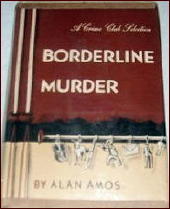
ALAN AMOS – Borderline Murder. Doubleday Crime Club, hardcover, 1947. Hardcover reprint: Detective Book Club, 3-in-1 edition, March 1948.

ALAN AMOS Borderline Murder

   Not too long ago I was surprised to still able to pick this up for 53 cents at the Salvation Army store on Myrtle Avenue near Jamaica. The dust-jacket symbol is the Dagger — for Chase and Adventure.

   Larry Winter, embittered by a two-year stretch for a robbery he didn’t do, gets off the Bus in Laredo, Texas on Christmas Eve.

   A private eye buddy of his has been keeping track of the man whose perjured testimony sent Winter up, and it seems the suspect, one Brantz Hallem, aka Burke Hall, is in Mexico about to smuggle some stolen jewelry stateside.

   Almost immediately, things get complicated. Winter is forced to share a room with a talkative fellow-passenger from the Bus, and the two of them get glad-handed by one Larry Higby & Wife, who are organizing a party of Motel Guests to spend Christmas across the Border.

   Then Winter hears from his PI buddy that Higby has been traveling in Mexico with Hallem/Hall and will probably be doing the smuggling.

   Oh yes; also on the trip are two elderly spinsters, an over-the-hill Opera Star, a female ventriloquist with a life-sized male dummy, an elderly doctor waiting on a burro (I’m not making this up.) and a fellow who claims to be writing a history of Texas.

   Sometime during the course of the evening, Winter gets knocked unconscious and the elderly Doctor turns unexpectedly dead. With his prison record, that makes Winter a pretty good suspect, and he realizes he now must find the real killer or face dire consequences.

   Got kind of long-winded in my rundown. This one turned out to be a pretty good read, not great by any means, nor even very memorable, but a solid piece of entertainment.

   My one quibble was with the character of Winter’s PI buddy, who, we are supposed to believe, has been tracking Hallem/Hall for two years and living on God-knows-what, then just sends Winter a letter and bows out, with no desire to be in on the kill or anything. Seems more convenient than realistic, if you ask me.

Bibliographic Bits:   Alan Amos was the pseudonym of Kathleen Moore Knight, ca. 1890-1984, a prolific mystery and detective story writer from the mid-1930s on through the 1950s, mostly for the Doubleday Crime Club — and all but forgotten today.

   She wrote four thrillers as Amos, and under her own name, more than 30 more novels, many of them cases solved by Elisha Macomber, a Penberthy Island selectman up around Martha’s Vineyard way.

   One of these books, The Trouble at Turkey Hill, was reviewed earlier by me (Steve) here on this blog. Included is a list of all sixteen of Elisha’s appearances.

REVIEWED BY STAN BURNS:


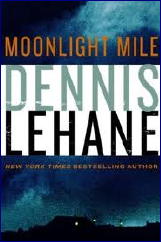
DENNIS LEHANE – Moonlight Mile. William Morrow, hardcover, November 2010.

    It is twelve years after the end of Gone Baby Gone (1998).   [PLOT WARNING:  There is no way this current book can be reviewed without revealing the ending of the previous one. This review is no different.]

DENNIS LEHANE Midnight Mile

    After a year of separation, Patrick Kenzie and Angie Gennaro are not only got back together again, they married and now have a young daughter. But the economy has been brutal to Patrick’s PI business — he has no work and worries how he will pay the medical insurance bill that is due at the end of the month.

    Into this setting comes the case that broke them apart — Amanda McCready is now sixteen, and has run away from home. Before, when Patrick returned her to her addicted mother when she was four, he did the right thing legally — but did not help her.

    Instead he took her away from the only loving parents she had ever known (even if they had kidnapped her), and got them imprisoned for trying to do the right thing and protect Amanda from her drugged mother. Now Amanda is on the run again — and her druggie mother and her drug dealer father in law want to find her — but not, Patrick suspects, for the reasons they are saying.

    Is this a chance for a Patrick to make amends for making the wrong decision even if it was the right one legally — and help and protect Amanda from her parents, and others who are pursuing her?

    A weak entry in the series; it reads more like an attempt by Lehane to end it right this time. A fast enough read but without the biting ending of the previous novel.

  Rating:   B minus.

IT IS PURELY MY OPINION
Reviews by L. J. Roberts


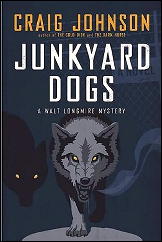
CRAIG JOHNSON – Junkyard Dogs. Viking, hardcover, May 2010. Trade paperback: Penguin, May 2011.

Genre:   Police procedural. Leading character:   Walt Longmire; 6th in series. Setting:   Wyoming.

CRAIG JOHNSON

First Sentence:   I tried to get a straight answer from his grandson and granddaughter-in-law as to why their grandfather had been tied with a hundred feet of nylon rope to the rear bumper of the 1968 Oldsmobile
Tornado.

    It begins with a severed thumb found within a Styrofoam cooler at the junkyard. Sheriff Walt Longmire decides this might be a way to re-spark the drive in his bullet-shy deputy, Santiago Saizarbitoria. Little did Walt
know that thumb would lead to murders, drugs, kidnapping and family secrets.

    Craig Johnson is a story teller in the classic and best sense of the word. You are captivated with the first sentence and taken along with Walt through the story to the end.

    The characters are alive, real and balance each other beautifully. Walt is the personification of the good man who is intelligent, believes in his job, compassionate in his handling of people and dedicated to justice even when it takes a little bending of the law.

   Deputy Victoria Moretti is the street-wise, profane, East Coast transplant who provides edge to Walt’s calm. Of greater significance is that all the characters, whether recurring or episodic, are fully realized. Johnson’s voice is one to which you cannot help but listen. His dialogue, whether it be Walt’s internal dialogue or that between characters, is audible.

CRAIG JOHNSON

   His humor often causes me to laugh aloud…”It was a two-gallon Styrofoam cooler — one of the cheap ones that you can pick up at any service station in the summer season and then listen to it squeak to the point of homicidal dementia.”

   Sense of place and description can add so much to a story. Here we are in the middle of an exceptionally cold winter in Wyoming and no matter when and where you may be reading the book, you feel that cold.

    This particular book doesn’t convey as much of the openness of the area as some of the previous books, but it does make you aware of how small is the town and the relationships and history of the residents.

    The story builds beautifully, starting out fairly light and the tension building as the story progresses. I was never able to anticipate where the story was going yet the twists never seemed contrived. The element of the metaphysical is there but not overdone.

    As much as I enjoyed the book, and I did, I don’t feel the story is up to the same standard as the previous books. It lacked growth, depth, tension, and focus, both of story and of characters. I do recommend Junkyard Dogs, but really recommend reading the series from the beginning.

Rating:   Good Plus.

The Walt Longmire mystery series —

1. The Cold Dish (2004)

CRAIG JOHNSON

2. Death Without Company (2006)
3. Kindness Goes Unpunished (2007)
4. Another Man’s Moccasins (2008)

CRAIG JOHNSON

5. The Dark Horse (2009)
6. Junkyard Dogs (2010)
7. Hell Is Empty (2011)

CRAIG JOHNSON

REVIEWED BY BARRY GARDNER:


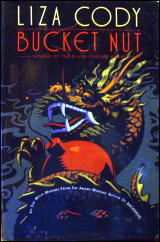
LIZA CODY – Bucket Nut. Eva Wylie #1. Doubleday, hardcover, 1993. UK edition: Chatto & Windus, hardcover, 1992. Mysterious Press, US, paperback, 1995.

LIZA CODY

   I haven’t been a big fan of Cody’s Anna Lee stories. Haven’t really hated them, you understand, just haven’t like them well enough to seek them out. For better or worse, Eva Wylie is a different breed of cat entirely.

   Eva is a big, not very pretty, not exceptionally bright young lady who is a security guard for a wrecking yard, and a lady wrestler (the villain), and an errand runner for a shady Chinaman. She has an attitude, a drunken whore for a mother, and a sister from whom she was separated in childhood and with whom she yearns to be reunited.

   She’s a bit of a thief, too. She’s a brick or two shy of a load, and it’s probably because she threw them at someone. Her best friends, maybe her only, are two guard dogs, but she wants none of your effing pity, thank you. Innocently enough (according to her own lights, anyway), she gets herself involved in a gang war, and ends up with what seems to be half of London looking for her.

   This is different. If you’re tired of the same old thing in crime fiction, this isn’t it. It’s a portrait of a young woman who hasn’t been given a whole lot of a breaks by either nature or nurture, and is coping the best way she can. Cody tells her story in a matter-of-fact first person, and the language is the lower-class language of London.

   It’s a rough story, told in rough words, about rough people. The picture painted of the world of professional wrestling is fascinating, if not particularly edifying.

   Cody seems to strives for neither humor nor tragedy, though you may find elements of either or both, depending on your own psyche. While first-person a narration has its limitations, it is perfect for the kind of portrait that she paints here.

   This is as good a job of making an unlovely, unlikable character seem human enough to be worthy of sympathy as I’ve seen lately, and it’s excellent storytelling. Eva sticks in your mind.

— Reprinted from Ah, Sweet Mysteries #9, September 1993.


Note:   Bucket Nut was awarded the British CWA Silver Dagger in 1993. Cody’s other series character, PI Anna Lee, makes a cameo appearance in this first outing for Eva.

       The Eva Wylie series —

1. Bucket Nut (1992)
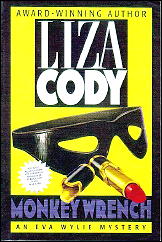
2. Monkey Wrench (1994)

LIZA CODY

3. Musclebound (1997)

Reviewed by DAVID L. VINEYARD:         


THIS GIRL FOR HIRE. Made-for-TV movie, CBS, 01 November 1983. Bess Armstrong, Celeste Holm, Cliff De Young, Hermione Baddeley, Scott Brady, Howard Duff, Jose Ferrer, Beverly Garland, Roddy McDowall, Percy Rodrigues, Ray Walston, Elisha Cook Jr. Directed by Jerry Jameson

   This 1983 made for television movie aired on CBS as a pilot for a proposed series about B.T. Brady (Bess Armstrong), a somewhat less than perfect female private eye with a penchant for trench coats and fedoras, an exotic mother, Zandra (Celeste Holm) who is a former B movie actress living in the past (the 40’s to be exact), and a policeman boy friend (Cliff de Young).

THIS GIRL FOR HIRE Bess Armstrong

   The plot involves a group of mystery writers, one of which — an arrogant and obnoxious fellow (Jose Ferrer) has been murdered. The writers are Hermione Baddeley (Agatha Christie more or less), Scott Brady (Spillane down to the pork pie), Howard Duff, Beverly Garland (who writes under a man’s name), and Roddy McDowall (who writes a Saint like character but is not Charteris).

   In solving the case B.T. is aided by her mother’s old Hollywood contacts and haunted by a mysterious fellow (Ray Walston) of suspicious motives.

   If any of this sounds a little familiar it may be because save for the actual plot, the characters, setting, and the name are all taken from This Girl For Hire by G. G. Fickling — the first Honey West novel, by a husband-and-wife writing team.

   This is not an adaptation of that book — at least not officially. In fact among the army of writers on the teleplay, the characters are attributed to Clifford and Jean Hoelscher. Neither has any other writing credits; other than this film Clifford’s name appears only as an editor and sound designer on a handful of movie and TV productions.

   Is it just a coincidence that this This Girl For Hire was apparently created by a husband and wife team too (Jean could be a man, but I’m guessing not) who have no other screen writing credits whatsoever?

   I don’t know about you, but something stinks.

   It’s not the movie, thankfully It’s nothing special, but a pleasant way to kill two hours, with Armstrong a feisty likable unlikely private eye, Celeste Holm underutilized, and Brady pretty much doing a dead on imitation of Mickey Spillane. Nice to see the old faces, and the plot isn’t terrible. Nothing great, but not terrible.

   Did I mention B. T. Brady’s dad was a murdered detective — just like Honey West’s father?

   If I recall this right I think she even lives in Bellflower, the Los Angles suburb Honey is from.

   A much bigger mystery than any solved in this mediocre film is how they used the title of the first Honey West book with a plot so similar to it. You can’t copyright titles, but neither can you write a Civil War novel called Gone With the Wind and get away with it.

   Who were the Hoelschers? Why is this their only credit? And how come no one noticed or mentioned this was so close to the original Honey West — not the later Honey, or the Anne Francis Honey, but the one in the first couple of books — who, like B.T. Brady is a bit of a klutz and a bit out of her element as a private eye.

   To paraphrase Red Skelton about a joke that didn’t get a laugh — I just state the problems, I don’t explain them.

   Anyone have a solution?

   Is this a lost Honey West movie in all but name? A case of out and out plagiarism that they got away with? A huge unlikely coincidence? Corporate intrigue? Cosmic Karma?

   Poltergeist?

   I place the mystery in your hands, oh mighty bloggers on this site.

   What the heck is going on here?

« Previous PageNext Page »