Reviews


REVIEWED BY DAN STUMPF:         


LAURENCE JANIFER – The Final Fear. Belmont B50-764, paperback original, 1967.

   I read Laurence Janifer’s The Final Fear back in high school, and for some reason it stayed on my shelf all this time, so the other day I decided to take it out and have a re-read after 40+ years. Robert Bloch had some kind words to say about it, so I figured it might be worth another look.
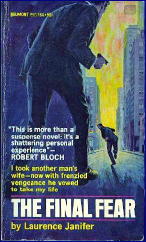
LAURENCE JANIFER The Final Fear

   Well, it’s interesting. Not entirely successful, and I don’t know if I’d recommend it very highly, but it has its moments. The whole thing has kind of a rushed feel to it, starting out with the plot, if you want to cal it that, already underway: the Hero running for his life as the Villain shoots at him on a New York street, with the Heroine and Good Friend yet to make an appearance.

   This is basically a four-character drama, as if Janifer (a busy sci-fi hack in those days) wanted to rush through it without too much bother. It quickly develops that the Hero is Jack Roe, a high school English teacher who had an affair with the Heroine, Madeline, whose husband Edward learned he had only six months to live and decided to kill the man who wrecked his happy home.

   The Good Friend, a police detective, comes in just a bit later, primarily to move the plot along. And that’s pretty much it. Edward shows up and shoots at Jack, who runs away and talks to Madeline for a bit, then Edward shows up, shoots at Jack, who runs away and talks to the cop for a bit, then Edward shows up.

   Somewhere along the way, this acquires an almost poetic simplicity, like a ballad oft-repeated, or a Woolrich tale set in some hostile universe where the price of love is death.

   But it never gets to the level of good writing in any conventional sense. Janifer moves his tale across New York City in the late 60s, when the rotting arcades and crumbling theaters held a sleazy splendor all their own, none of which he evokes here. Instead, he simply runs from one scene to the next: Washington Square, Greenwich Village, the subway, Central Park…

   We go through all this and more, but never with the sense of having been there. His police detective, on the other hand, is pure Woolrich: a patient, thoughtful man with nothing but time on his hands and apparently working a 24-hour shift because he can turn up any time the plot calls for him.

   The Final Fear didn’t give me time to get bored, but somehow it never really grabbed me either.

Editorial Comment:   It’s possible that it’s large enough for you to read it from the cover image provided, but in case it’s not, here’s the blurb from Robert Bloch which I’m sure Belmont has happy to use: “This is more than a suspense novel; it’s a shattering personal experience.”
IT IS PURELY MY OPINION
Reviews by L. J. Roberts


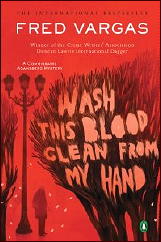
FRED VARGAS – Wash This Blood Clean from My Hand. Knopf-Canada, hardcover, 2007. Penguin, US, trade paperback, 2007. First published as Sous les vents de Neptune, Paris : Viviane Hamy, 2004; translated by Sian Reynolds.

Genre:   Police procedural. Leading character: Commisioner Adamsberg; 5th in series (4th translated into English). Setting:   Canada.

FRED VARGAS

First Sentence:   Leaning his shoulder against the dark basement wall, Jean-Baptiste Adamsberg stood contemplating the enormous central heating boiler which had suddenly stopped working, two days before.

   Comm. Jean-Baptiste Adamsberg and seven of his officers are getting ready for forensics training in Quebec, Canada. A few days before they are to leave, Adamsberg sees a news story about a murder where the victim received three stab wounds to the stomach and the accused has no memory of committing the crime.

   A number of similar crimes, including one where Adamberg’s brother was accused, occurred 16 years ago. Adamsberg is certain the true killer is back, except that he attended the man’s funeral. Now in Canada, another murder occurs, but this time it appears Adamsberg is the killer.

   The most important elements of a book, for me, are the characters. Vargas creates wonderful characters, although she does not provide as much background with each book as a reader coming into the middle of the series should have.

   However, once you do start to know the players, they become real and characters about whom you want to know more. What is appealing about Adamsberg is that is he a very unconventional policeman, yet he gets results and has the loyalty of his colleagues and friends.

   Vargas’s voice is wonderfully effective. Originally written in French, I appreciate that the translation still has a Gallic undertone to the text. Her descriptions are vivid and her phrasing lush. She has an excellent ear for dialogue, and a delightful sense of humor.

   The plot of Wash This Blood is so well done. Yes, there are coincidences — it is rare to find a book without them — but it is also very clever with excellent twists and a soupçon of poignancy that adds dimension to Adamsberg’s character.

   It is also the first time I recall that we see Adamsberg really lose his temper, which humanizes him even more. I’ve one criticism in that it feels as though there is a book missing from the series. Knowing how Have Mercy ended, this did cause a bit of confusion in terms of series plot continuity.

   This was an excellent read. I highly recommend both it and the series which must be read in order — frustrating as the English versions have not been published in series order.

Rating:   Excellent.

       The Chief Inspector Adamsberg series —

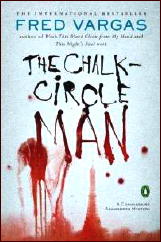
1.   The Chalk Circle Man (2009). First published in France as L’Homme aux cercles bleus (1991).

FRED VARGAS

2.   Seeking Whom He May Devour (2004). First published in France as L’Homme à l’envers (1999).

[*]   The Four Rivers. Date? [Graphic novel]. Published in France as Les quatre fleuves (2000).

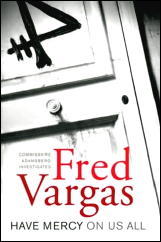
3.   Have Mercy on Us All (2003). First published in France as Pars vite et reviens tard (2001).

FRED VARGAS

[*]   Coule la Seine (2002). [Collection of graphic stories.] Not yet published in English.

4. Wash This Blood Clean from My Hand (2007). First published in France as Sous les vents de Neptune (2004).

5.   This Night’s Foul Work (2008). First published in France as Dans les bois éternels (2006).

6.  An Uncertain Place (2011). First published in France as Un lieu incertain (2008).

Editorial Comment:   Please consider this bibliography a work in progress. Dates for the French editions are based on information obtained from Wikipedia-France. Dates for the English editions are (I think) a mixture of US and Canadian first printings.

   In any case, L.J. is correct in suggesting that readers of the series in the US have been treated badly by Ms. Vargas’s publishers. One can assume, however, that perhaps they started with what they believed to be a stronger title in the series, uncertain of the reception her books might receive.

   Whether one must read the graphic novel or collection listed above (without number) in order not to miss any of the overall series continuity is at present unknown, but it would explain L.J.’s comment regarding “a book [she felt was] missing from the series.”

REVIEWED BY FRANCIS M. NEVINS, JR.         


ERLE STANLEY GARDNER —

       The Case of the Amorous Aunt. Morrow, hardcover, 1963. Reprint paperback: 1st Pocket printing, June 1965. (All four titles have been reprinted many times.)

ERLE STANLEY GARDNER Perry Mason 1960s

   A young woman and her opportunistic boy friend ask Perry Mason to help get the woman’s aunt out of the clutches of a handsome stranger who may be a professional killer of women.

   But it’s the Bluebeard who turns up dead, in a bordertown motel unit next door to the aunt, so that Mason winds up having to try a murder case in a country where he’s an alien and with a client whose story simply doesn’t square with the facts.

   The long meaty courtroom scenes are distinguished by Mason’s demolition job on a tricky district attorney and a shifty prosecution witness, with help from a young local lawyer who might have become the Mason of the next generation if Gardner had written a new series around him.

But, like so many other Mason novels of the Sixties, this one is pockmarked with dozens of inconsistencies, incredibilities and careless oversights in plotting, although there is one neatly planted clue amid the debris.

ERLE STANLEY GARDNER Perry Mason 1960s

       The Case of the Daring Divorcee. Morrow, hardcover, 1964. Reprint paperback: 1st Pocket printing, 1965.

   The pace is as vigorous as usual in this adventure and the plot elements as exciting, including a mysterious woman who flees Mason’s office leaving behind a handbag containing a twice-fired gun.

   Add a will contest, a gun-switching ploy, some elaborate schemes to discredit eyewitnesses, and a full measure of familial and financial flimflams, and the basis exists for a spectacular display of Masonry.

   Unfortunately it never comes. Even the courtroom sequences this time around the track are wretchedly constructed, with dear old Hamilton Burger introducing totally irrelevant evidence just so that certain story elements can be furthered, and with a rabbit-out-of-chapeau Mason solution that rests on hopelessly silly reasoning and explains nothing.

   Fiasco.

ERLE STANLEY GARDNER Perry Mason 1960s

       The Case of the Phantom Fortune. Morrow, hardcover, 1964. Reprint paperback: 1st Pocket printing, November 1965.

   This time the opening scenes are rather sluggish, and so inconsistent with later developments that they seem to be part of a different book.

   The fireworks start to go off when Mason plays fast and loose with the penal law in trying to protect his client’s wife from a blackmailer, but soon finds his client charged with the extortionist’s murder, and himself suspected of attempting to hang a felony rap on an innocent man.

   Although the pace and intellectual excitement never let up once the story proper gets under way, and the solution packs a beautiful wallop, the usual quota of holes in the plot remain unplugged, and — a fault rare in Gardner — too many characters speak in impossibly textbookish sentences.

ERLE STANLEY GARDNER Perry Mason 1960s

       The Case of the Horrified Heirs. Morrow, hardcover, 1964. Reprint paperback: 1st Pocket printing, February 1966.

   The best part of this one comes early, in a brilliant courtroom sequence where Mason proves that his client, the former secretary of another attorney, was framed on a narcotics charge.

   Trying to learn who framed the girl and why, Mason discovers a connection with a scheme to forge two contradictory wills, which as usual leads to a murder trial, although this one winds up with a twist unique in the Mason canon.

   Wonderful ingredients, wretched construction, unfair solution — in short, standard late-model Gardner with all the strengths and all the flaws.

— From The MYSTERY FANcier, Vol. 1, No. 3, May 1977.

GREGORY MCDONALD – Fletch. Bobbs-Merrill; hardcover, 1974. Avon, paperback, 1976; reprinted several times. Vintage, pb, 2002. Film: Universal Pictures, 1985. Starring Chevy Chase as Fletch; screenplay: Andrew Bergman.

FLETCH Gregory Mcdonald

   Fletch is a reporter working on a drug story. His role as a beach bum, a drifter with no connections, arouses no suspicions along an insidious stretch of Californla beach, and in fact he is convincing enough to be given an unexpected job interview. An aviation executive with cancer has in mind an acceptable alternative to a long, slow death. He hires Fletch to kill him.

   Maintaining his watch on the beach for the source of the drugs, Fletch also becomes a skeptical undercover investigator. Details fall into place a little too quickly toward the end, but that in no way detracts from a good amount of nimble-tongued inquiry and observation, and the crackling dialogue that zips by as the plot unthickens.

   Fletch’s casually derisive approach to life goes far in preparing for, the final wrap-up, one coming alarmingly close to copping out, but it’s also one that provides a nice amount of chuckling satisfaction as well. A tale told with artistic gusto.

— From The MYSTERY FANcier, Vol. 1, No. 3, May 1977.


[UPDATE] 10-30-10.   By the time I wrote this review, I assume that I knew that the novel had become the first of a series. There were eleven in all, most of them paperback originals, even though this first one came out in hardcover. I’ve seen only parts of the movie. A little Chevy Case goes a long way for me, but I have a hunch that if Fletch the character is remembered at all today, it’s with Chevy Chase’s face.

   I didn’t include my letter grade with the review itself, but if you’re curious, I gave it an “A.” Thus I was pleased to see that not only did David Vineyard include Fletch in his second grouping of humorous mysteries, but Jeff Meyerson also included it in his list of 100 overall “best” mysteries. It always feels good when people agree with you.

REVIEWED BY GEOFF BRADLEY:         


FIVE DAYS. BBC-TV (UK), March 1 through 5, 2010. Shaun Dooley, Steve Evets, Shivani Ghai, Bernard Hill, Suranne Jones, Matthew McNulty, Aaron Neil, Anne Reid, David Morrissey. Teleplay: Gwyneth Hughes. Director: Toby Haynes.

FIVE DAYS BBC 2010

   It’s become quite fashionable over here to run a drama over five successive nights. We have had several in recent years and this is the second to be called Five Days (though this one doesn’t use the characters from the first, first seen in 2007).

   In these we see five key days (but not successive days) of the investigation. The story starts with a train hitting a body falling from a bridge. On the train is PC Laurie Franklin (played by Suranne Jones), taking her mother to a hospital consultation about her dementia.

   Meanwhile a young baby is found abandoned in the hospital toilet and it is suspected for a while that the baby is connected to the body.

   I found the first episode rather underwhelming and, though it picked up over the remaining episodes, it was overall rather unsatisfactory. Firstly there were just too many issues covered. I’ve already mentioned dementia, terrorism and multi-cultural relationships but there were many more.

   Another problem was that everyone had to have a deeper part in the story even though this lead to some unbelievable coincidences. A lot a work had gone into this production and it was a good cast; it’s a pity that script wasn’t much tighter.

REVIEWED BY TINA KARELSON:         


VICTOR CANNING – The Python Project. The Companion Book Club, UK, hardcover reprint, 1968. Originally published by William Heinemann, UK, hardcover, 1967. Also: William Morrow, US, hardcover, 1968. Paperback reprints include: Pan, UK, 1969; Charter, US, date?

VICTOR CANNING The Python Project

   I picked up this British book club edition at a library book sale last year because it looked like good, mindless, vintage fun. And it is — though too witty and well crafted to be called mindless.

   London P.I. Rex Carver is the first-person narrator. He’s vaguely connected to British intelligence, but not at all happy about their attempts to insinuate themselves into his life, which they do while he’s working on his latest assignment: finding a python bracelet for a rich, seductive, young widow.

   His client claims her brother stole the bracelet and some money. Of course the situation is more complicated than it first appears, as evidenced by Rex being frequently bashed over the head and required to travel to places like Tripoli.

   Life is tough in swinging ’60s London, especially when your partner/secretary is on vacation.

   More on Canning and his books can be found at: http://myweb.tiscali.co.uk/wordscape/canning/

Editorial Comment:   You also need go no farther than this blog for coverage of many of Canning’s books, most recently David Vineyard’s review/essay of two of his novels, which you can find here.

REVIEWED BY BARRY GARDNER:


NOREEN AYRES – The World the Color of Salt. “Smokey” Brandon #1. Avon, paperback reprint, 1993. First published by William Morrow, hardcover, 1992.

NOREEN AYRES Smokey Brandon

   I bought this as much for the cover as anything — a blue and green composition that blends a mermaid-like naked body into a coastline. Strikingly attractive, and different. The title is from a poem by Richard Hugo, who wrote a mystery before his death.

   Smokey Brandon is a forensic Specialist for the Orange County Sheriff/Coroner’s office. She’s been a stripper, and she’s been a cop, and she’s about half tough. Her troubles start when a 20 year old kid she knew casually is killed in the robbery of a stop and go store. Though she’s developed a protective shield to go with her job, this one gets to her.

   She’s sort of in love with a married co-worker, and her best friend takes up with a guy with a record who was briefly a suspect in the killing. Things go from bad to worse on all fronts, and she finds herself hunting her friend while she continues to search for answers to the killing.

   Ayres is an award-winning poet, and this is her first mystery novel. It’s a good one, and I don’t know how I missed it in 1992. Ayres gives Brandon a glib, hard voice entirely in keeping with her character, and she is one of the best realized new characters, male of female, that I’ve come across in a while in hardboiled fiction.

   And this is hardboiled, make no mistake about that. The story is told in first person, and very effectively. Ayres has an eye for the California landscape and its denizens, and if the details of the forensic trade aren’t accurate, they’re done well enough to fool me.

   The only fault I found was an occasional jerkiness as the story shifted from reflection to action, and that wasn’t often. Ayres is good.

— Reprinted from Ah, Sweet Mysteries #10, November 1993.


The Smokey Brandon series —

      A World the Color of Salt. Morrow, 1992.
      Carcass Trade. Morrow, 1994.

NOREEN AYRES Smokey Brandon

      The Juan Doe Murders. Five Star, 2000.

Editorial Comments:   Once again I’m pleased to say that here online I can show you the cover that Barry was referring to, one he wasn’t able to in his printed zine. I think it lives up to his description of it, don’t you?

   As for the book itself, based on Barry’s review, it’s a shame that there’s been only three books in the series, the third of which was news to me. For whatever reason, the series didn’t catch on. Or perhaps Noreen Ayres herself had other options available to her.

   From her website: “Noreen Ayres has published novels, short stories, and poetry, and has had three teleplays produced, winning several awards for writing. Her varied career includes positions as a technical writer/editor and publications manager for major engineering, petroleum, and aerospace companies. Holding a Masters degree in English and post-grad certifications in business, she has taught composition, creative writing, business, and science.”

MIDNIGHT MYSTERY. 1930. Betty Compson, Lowell Sherman, Raymond Hatton, Hugh Trevor, June Clyde. Director: George B. Seitz.

BETTY COMPSON

   It was a dark and stormy night … on a rock-bound island off the coast of Cuba. [FOOTNOTE] A mansion, full of guests, laughter and merriment, and suddenly … a shot rings out.

   A rush to the wall at the edge of the cliff … and a body is seen being washed out to sea. A confession … despair … hatred … and (would you believe?) murder.

   The fiancee of the accused man, with whom she has been quarreling, is also a writer of mystery novels (“dime novels,” he sneers), and in this movie she proves her worth as a detective. While we (the viewer) know who the killer is, it is nice, on occasion, one such as this, to be able to follow the deductions along with the sleuth of the story.

   And a stagey sort of story it is (not surprisingly, being adapted directly from a play, one called Hawk Island), with the acting ranging from barely adequate to abysmal. By today’s standards, I hasten to add.

   The only player I recognized was Raymond Hatton, but after seeing him as a cowboy sidekick in countless other movies of a type other than this, I’m not sure I would have recognized him, what with suit jacket, vest and tie, if his name hadn’t appeared early on in the credits.

[FOOTNOTE]   There is some confusion about this, as this week’s TV Guide says it was off the coast of Maine, which seems more likely, but I checked the beginning of the movie again, and no, it says Cuba, right there in the opening scene.

— Reprinted from Mystery*File #35, November 1993, very slightly revised.


[UPDATE] 10-26-10.   I should still have the video tape I made of this movie, and I certainly hope so, since I’ve not been able to find one on DVD. Presumably I taped it from either TCM or American Movie Classics, so there is no doubt that it does still exist somewhere.

    Betty Compson, pictured above, made a lot of silent films, and I mean a lot, but she survived the switch to talkies and was still making movies through the late 1940s, albeit of the “B” variety, a la Hard Boiled Mahoney (1947), which I watched a month or so ago during an all-day Bowery Boys marathon.

A REVIEW BY CURT J. EVANS:         


WINIFRED PECK – The Warrielaw Jewel. Faber & Faber, UK, hardcover, 1933. E. P. Dutton, US, hardcover, 1933.

   In 1933, Catholic priest and writer Ronald Arbuthnott Knox, one of the talented Knox siblings, children of Edmund Arbuthnott Knox, former Anglican Bishop of Manchester, published Body in the Silo, a detective novel.

WINIFRED PECK The Warrielaw Jewel

   This is not really news. Father Knox, best known in the mystery genre today for having formulated an influential set of “rules” for the writing of detective fiction, had before 1933 already published three well-received detective novels and been admitted as an original member of the Detection Club in 1930.

   There was a five year lag between The Footsteps at the Lock (1928) and The Body in the Silo (1933), but, still, the appearance of the latter could not exactly be called a surprise.

   But another Knox sibling also published a detective novel in 1933: one of Ronald Knox’s sisters, (Lady) Winifred (Knox) Peck. Entitled The Warrielaw Jewel, this mystery tale by Peck, a once successful though today mostly forgotten mainstream novelist, received quite favorable reviews and holds up well today.

   Three years ago, the excellent Persephone Books reprinted Peck’s House-Bound, a mainstream novel with a World War Two period setting, with an introduction by her (and Ronald Knox’s) famous niece, the late novelist Penelope Fitzgerald. The Warrielaw Jewel deserves reprinting as well.

   Jewel is notable as an early example of a Golden Age mystery that, in its shifting of emphasis from pure puzzle to the study of character and setting, helped mark the gradual shift from detective story to crime novel which Julian Symons famously celebrated in his history of the mystery genre, Bloody Murder .

   A tale of Victorian/Edwardian familial dysfunction, Jewel rather resembles Margery Allingham’s Police at the Funeral (1931) and More Work for the Undertaker (1948), as well as S.S. Van Dine’s The Greene Murder Case (1928).

   While the puzzle certainly is not as intricate as Van Dine’s in the latter novel, the writing is excellent, in my view on a level with that of Allingham and her Crime Queen contemporaries Dorothy L. Sayers and Ngaio Marsh. (There also is some similarity to American Mary Roberts Rinehart’s mystery novel The Album, published the same year, though thankfully The Warrielaw Jewel is without all Rinehart’s Had-I-But-Known digressions.)

   As one pleased reviewer noted of Peck’s mystery novel, “the writing, atmosphere, and characterization” made the story “something quite distinct.”

   The Warrielaw Jewel actually is set in the Edwardian era, 1909 specifically ( “that period, so far away from modern youth, when King Edward VII lived, and skirts were long and motors few, and the term Victorian was not yet a reproach”).

   The narrator, Betty Morrison, wife of the lawyer for the eccentric, decaying gentry family of Warrielaws, tells the tale from the vantage point of the early 1930s, looking back over those shocking events in the vicinity of Edinburgh, Scotland, including the death of elderly family head Jessica Warrielaw and the trial of her favored nephew for murder.

   Involved in the affair is a family heirloom, a so-called fairy-jewel, said to have been given to the Warrielaw family centuries ago by a glittering enchanted lady carried off and married by a dark and brooding laird ancestor. A curse is said to have been laid upon the jewel. Certainly dreadful happenings, whatever the cause, overtake the family in the present day.

   There is investigation and detection, performed by an retired policeman friend of Betty Morrison’s husband; yet it is Betty herself who provides the final, crucial piece of evidence. The mystery itself is engrossing, though the best elements of the tale are found in the characters — particularly the various odd Warrielaws and their remaining retainers –and the Edwardian Scottish atmosphere.

   I hope that one day Winifred Peck’s The Warrielaw Jewel is republished and honored as a member of the company of better-written, literate mysteries of the period, for it certainly deserves to be so designated.

   When one reviewer declared The Warrielaw Jewel “in a class by itself” and added that “it looks as if [Mrs. Peck] were going to bear [Father Knox] at his own special game,” he was not, in my view, exaggerating.

Bio-Bibliographic Data:   Winifred Peck, 1882-1962, was born and educated in Oxford and lived in Edinburgh, according to the Revised Crime Fiction IV, by Allen J. Hubin. His bibliography includes only one other mystery novel that she wrote, the provocatively titled Arrest the Bishop? (Faber, 1949).

   While copies of the latter may be found offered for sale online (although with asking prices of $50 and up), none of The Warrielaw Jewel were seen, even with a US edition.

THE ARMCHAIR REVIEWER
Allen J. Hubin


DICK CLUSTER – Return to Sender. E. P. Dutton, hardcover, 1988. Reprint paperback: Penguin, 1990.

DICK CLUSTER Return to Sender

   Dick Cluster, a Bostonian newcomer to our field, offers Return to Sender. Alex Glauberman, 40, repairs foreign cars in Boston. He’s divorced with one child who lives with her remarried mother.

   Alex’s current bedmate is a professor, on sabbatical in London. He’s going through chemotherapy for recently diagnosed cancer, and his life and thinking and physical condition are much influenced by this.

   One day, while he is waiting in line at a post office, an elderly man asks him to mail a package to his daughter in Berlin. Alex does so. Later, after Alex sees him being escorted away by a pair of strongarm types, the man returns to ask Alex, for $2500, to go to Germany and retrieve the package.

   Alex had thought to visit London anyway, and agrees. But this proves a most deadly assignment. Sender, with its fresh and intriguing plot and central character, is well worth your attention.

— From The MYSTERY FANcier, Vol. 11, No. 2, Spring 1989.


Bibliographic Data:    [Taken from the Revised Crime Fiction IV, by Allen J. Hubin]

CLUSTER, DICK.   1947- .     Alex Glauberman in all:

DICK CLUSTER Return to Sender

        Return to Sender. Dutton, 1988.
        Repulse Monkey. Dutton, 1989.
        Obligations of the Bone. St. Martin’s, 1992.

Editorial Comment:   I thought the contrast between the two covers is very interesting. As usual for mystery novels of this era, the one on the hardcover is about as stark and minimal as you can get. The cover of the paperback is far more colorful, although perhaps hard to make out what’s really pictured, unless you can look at it closely, but at least (to me) it has something to it that also says Pick Me Up At Least and Look Inside.

   There’s no need to think I’m disparaging Dutton, who published the hardcover. Artists cost money, and I suspect 90% of the sales of this mystery, by a first-time writer, went to libraries sight unseen, and another 9% went to the author’s friends. (A small laugh, hopefully at no one’s expense.)

   By the way, you can’t make it out, but the quote on the paperback is by Tony Hillerman: “Gripping… raises the Mystery into the realm of Literature.”

« Previous PageNext Page »