Reviews


THE BACKWARD REVIEWER
William F. Deeck


HENRY KANE Corpse for Christmas

HENRY KANE – A Corpse for Christmas. J. B. Lippincott, hardcover, 1951. Hardcover reprint: Unicorn Mystery Book Club, November 1951. Paperback reprints: Dell 735, 1953; Zenith ZB-19, 1959, as The Deadly Doll; Signet D2877, 1966, as Homicide at Yuletide; Lancer 75261, 1970s? Previously a two-part serial in Esquire, December 1949 & January 1951.

    As all of you — or at least the three people who read these reviews out of a misguided urge to get your money’s worth from this magazine — know, I strive for balance here. That is to say, I endeavor to work in at least one tough P.I. novel every other column.

HENRY KANE Corpse for Christmas

    This one almost didn’t make it, since fantasy is what the author starts with. I mean, of the six females encountered by the detective, four of them are hot for his body immediately. His client would be, but she is aware he lusts after her so she needn’t bother. Only a landlady shows no desire, perhaps because she’s unprepossessing and it would embarrass the detective.

    Acting in behalf of his client, another private eye in jail on several traffic charges, Peter Chambers discovers a man, with wine-red hair and beard of the same color, shot to death. Holding the murder weapon is a young lady, who of course didn’t do it.

HENRY KANE Corpse for Christmas

    A gangster looking for some jewels possessed by the dead man is the client of Chambers’s client, and there are various former wives of the dead man whose income he was going to cut off but who didn’t mind that, or so they say.

    Chambers investigates on Christmas Eve and Christmas and identifies the murderer, who was fairly obvious at least to this reader.

    What kept me reading was Kane’s obvious love of the language and Chambers’s sense of humor. Kane has a delightful style, although I still haven’t figured out what a “saltatory mattress” might be. Maybe he’ll explain it in his other books, which I’ll be looking for.

— From The MYSTERY FANcier, Vol. 11, No. 2, Spring 1989.


REVIEWED BY DAN STUMPF:         


FOG ISLAND George Zucco

FOG ISLAND. PRC, 1945. George Zucco, Lionel Atwill, Jerome Cowan, Sharon Douglas, Veda Ann Borg, John Whitney, Jacqueline DeWit, Ian Keith. Screenplay by Pierre Gendron, based on the play Angel Island, by Bernadine Angus. Director: Terry O. Morse.

   Fog Island cost about a buck-ninety-five to chum out and looks it, but here is a film to sink your teeth into; a stylish, creaky Old-Dark-House thriller directed at penurious pace by someone named Terry Morse and offering a hand-picked cast of cinematic low-lifes including George Zucco, Lionel Atwill, Ian Keith, Veda Ann Borg and Jerome Cowan (best remembered as the short-lived half of the Spade-Archer partnership in The Maltese Falcon) at his slimiest.

   Before going on to rave about this thing I should add perhaps that by nomic standards, Fog Island don’t amount to much. The script makes very little sense at all, the sets — when there are any seem about to topple any moment, and the whole affair is served up with a rushed look that seems cheap-jack even by PRC’s bottom-of-the-trash-can standards.

   Watching it is like seeing a derelict car chug its clanking way down a superhighway – you can’t believe it’s actually moving right there in front of you, much less understand what keeps it going.

FOG ISLAND George Zucco

   For the record, Fog Island concerns itself with the efforts of recently paroled embezzler Zucco to revenge himself on his unindicted co-conspirators, and their efforts to prise out of him the money they’re sure he squirreled away.

   As the plot unspools, hints are dropped here and there that Zucco and/or some of his cronies may or may not be guilty — but these are mostly left unresolved in the haste to get this thing in the can.

   What’s left is brilliantly atmospheric and astonishingly grim as Zucco, Atwill et. al. struggle, grasp and claw at each other to see who will emerge Wealthy… or Alive, anyway. Oh. there’s a romantic sub-plot stuck in there somewhere, but Director Morse and writer Pierre Gendron (who worked on Ulmer’s masterful Bluebeard) clearly save most of their interest for the Baddies — who are all played by much more interesting actors anyway.

FOG ISLAND George Zucco

   The big Confrontation scene where Zucco and Atwill pull out all the dramatic stops and hammer away at each other (accent on Ham) with histrionic abandon has — no kidding — Real Chemistry — made all the more compelling by being shot practically in the dark to hide the cheap-o sets.

   With nothing to distract us, the eyes are drawn irresistibly to the spectacle of two full-blooded (to put it mildly) performers face-to-face and toe-to-toe in the thespic equivalent of a knockdown drag-out prize fight.

   After this emotional high point, Fog Island drags, lurches and stumbles a bit to a conclusion that, as I say, is surprisingly grim and well-realized for a B-Horror/Mystery Movie. The glimpse of impressive artistry someone heaped on this obscure thing while no one was looking makes me despair of facile, expensive things like The Firm and Line of Fire.

   Which is not to say that Fog Island is as entertaining as either of them; it isn’t. The only thing it has going for it is the gratuitous energy and enthusiasm of its creators. Which is enough for me.

— From The Shropshire Sleuth #61, September 1993.


FOG ISLAND George Zucco

REVIEWED BY WALTER ALBERT:         


THE SORROWS OF SATAN 1926

THE SORROWS OF SATAN. A Famous Players-Lasky Corporation production, distributed by Paramount, 1926. Adolphe Menjou, Ricardo Cortez, Lya De Putti, Carol Dempster, Ivan Lebedeff, Marcia Harris.

Screenplay by Forrest Halsey, based on the novel by Marie Corelli (1895). Directors of photography, Harry Fischbeck & Arthur De Titta; art director, Charles Kirk. Director: D. W. Griffith. Shown at Cinevent 42, Columbus OH, May 2010.

   In this modern morality play, urbane Prince Lucio de Rimanez (Menjou) promises Geoffrey Tempest (Cortez), a struggling writer, great riches if he will surrender his soul. Tempest abandons his pregnant fiancee Mavis Claire (Dempster) and falls under the spell of the debauched Princess Olga Godovsky (Lya De Putti), whom he subsequently marries.

   The Prince is, course, the Devil, and Tempest is the Faust who sells his soul not for youth or knowledge, but for worldly success. Menjou is impressive, both charming and sinister, and Dempster is touching as the abandoned Marguerite.

THE SORROWS OF SATAN 1926

   Lya de Putti, a Beardsley-like siren in a performance that seems molded on one of DeMille’s seductive vamps, captures the coldness of the often deceived searcher of forbidden pleasures and the almost desperate yearning for a pleasure that will prove more than fleeting.

   The weak link in the casting is Cortez, who seems too much the self-absorbed matinee idol to convincingly portray the adoration for the guileless Dempster and the lustful pursuit and conquest of the worldly De Putti.

   The film is greatly enhanced by the artful cinematography that is particularly effective in portraying the opulence of the world to which the Prince introduces Tempest. It may not have the power of Griffith’s use of the traditional materials of Victorian melodrama that he demonstrates in Way Down East, but it renews the time-worn themes of the Faustian tale with sensitivity and pictorial beauty.

THE SORROWS OF SATAN 1926

IT IS PURELY MY OPINION
Reviews by L. J. Roberts


IMOGEN ROBERTSON – Instruments of Darkness. Headline, UK, hardcover, May 2009. Pamela Dorman Books, US, hardcover, February 2011.

Genre:   Historical mystery. Leading characters: Gabriel Crowther/Harriet Westerman; 1st in series. Setting:   England, 1780.

IMOGEN ROBERTSON

First Sentence:   Gabriel Crowther opened his eyes.

    Harriet Westerman, wife of a navy commander, has given up sailing with her husband to raise their family and provide a home for her sister at Caverly Park in West Sussex. When she finds the body of a man whose throat has been slit, she summons help from anatomist Gabriel Crowther.

   The victim has a ring bearing the crest of neighboring Thornleigh Hall. Was the man Alexander Thornleigh, the missing heir to the Earl of Sussex?

   Meanwhile in London, music shop owner Alexander Adams is murdered. Before dying, he tells his daughter to find a box hidden under the counter. Was Alexander the missing heir and how can his children be removed from the city in spite of a killer and the anti-Catholic Gordon Riots?

   Wonderful characters make this book a treat to read. Jane Austin fans will quickly associate Harriet Westerman with Mrs. Croft, the captain’s wife from Persuasion.

   She has traveled, seen war, is outspoken and not to be put off. Her younger sister, Rachel Trench, is “Jane Eyre,” in her attraction to the war-wounded Hugh Thornleigh, younger brother of the missing Alexander and the Mr. Rochester of our story.

   Gabriel Crowther is a scientist, and something of a recluse until being pulled into the investigation by Harriet and his own curious mind. There are a lot of characters, including some real historical figures. It was occasionally difficult to keep track of who was who.

IMOGEN ROBERTSON

   However, they each played their part and added to the overall Gothic feel of the story. Ms. Robertson convincingly transported me to Georgian England in sight, sound, dialogue appropriate to the period and historical fact. I had not known of the Gordon Riots until now.

   She also includes a perspective of the American Revolution from the viewpoint of a British soldier. There is a lovely, Gothic feel to this book, but it was not perfect. Happily, in spite of identifying the villains fairly soon, the motive remained a secret until the end.

   Although the story did feel overlong, I was completely involved and never found myself skipping through it. The book was engrossing and suspenseful, with interesting historical information. The different threads of the plot were brought together well in a slightly overly dramatic fashion.

   The most important thing is whether I would read another book by this author. The answer is a definite “yes,” and the second (Anatomy of Murder ) is already on order.

Rating:   Good Plus.

NOTE: Visit the author’s blog at http://imogenrobertson.wordpress.com/

REVIEWED BY TINA KARELSON:         


ANTHONY BOURDAIN

ANTHONY BOURDAIN – Bone in the Throat. Bloomsbury, reprint softcover, September 2000; hardcover edition: Villard, June 1995.

   Before he gained fame and fortune as a food writer/celebrity chef, Anthony Bourdain was an obscure, but damn fine, crime fiction writer.

   Tommy Pagano, a sous-chef at the Dreadnaught, accidentally gets mixed up in a murder committed by his misfit gangster uncle, Sally “Wig,” and his creepy sidekick “Skinny,” who kills in the nude to avoid getting evidence on his clothes.

   The feds are convinced Tommy’s dirty — and he doesn’t know that the restaurant where he works is an elaborate federal sting operation. Can this end well for anyone?

   Bone in the Throat is wickedly humorous, which only serves to intensify the noir tension. The few scenes set in a heroin house are truly terrifying. Dark, funny, fine and recommended.

ANTHONY BORDAIN – Crime Fiction:

      Bone in the Throat. Villard, 1995.
      Gone Bamboo. Villard, 1997.

ANTHONY BOURDAIN

      The Bobby Gold Stories. Bloomsbury, 2003.

THE ARMCHAIR REVIEWER
Allen J. Hubin


WILLIAM BEECHCROFT – Secret Kills. Dodd Mead, hardcover, 1988. No paperback edition.

   William Beechcroft’s fifth suspense novel is Secret Kills, featuring Dan Forrest, reporter for New York tabloid NewsLeak, a publication which is certainly no better than it has to be. Forrest, whom we’ve met before (in Chain of Vengeance), is here interested in the death of actress Marguerite Falconer.

   The official police verdict, seemingly dictated from on high, is death by autoerotic asphyxia. This is not consistent with what Forrest learns of Falconer’s character, and the trail leads to Washington, to Edwin Stanfield at the Department of State, whose daughter has just been badly damaged in a subway bombing.

   Dan, in unlikely harness with NewsLeak’s rotund society reporter, Corky Brion, starts poking about in a pile of corruption which surely includes one more death, likely his. A pleasant diversion.

— From The MYSTERY FANcier, Vol. 11, No. 2, Spring 1989.


BEECHCROFT, WILLIAM. Pseudonym of William F. Hallstead, 1924- . [Taken from the Revised Crime Fiction IV, by Allen J. Hubin.]

    Position of Ultimate Trust. Dodd, 1981.
    Image of Evil. Dodd, 1985.

WILLIAM BEECHCROFT

    Chain of Vengeance. Dodd, 1986. [Dan Forrest]
    The Rebuilt Man. Dodd, 1987.

WILLIAM BEECHCROFT

    Secret Kills. Dodd, 1988. [Dan Forrest]
    Pursuit of Fear. Carroll & Graf, 1990.

REVIEWED BY DAN STUMPF:         


THE CAT’S PAW. Paramount, 1934. Harold Lloyd, Una Merkel , George Barbier, Nat Pendleton, Grace Bradley, Alan Dinehart. Screenplay: Sam Taylor, based on a story by Clarence Budington Kelland (serialized in the Saturday Evening Post, August 26-September 30, 1933). Director: Sam Taylor.

HAROLD LLOYD Cat's Paw

   We like to think of the Past as a simpler, better time. Just how un-simpler and un-better that Time actually was is evinced with unsettling clarity in The Cat’s Paw, which is also Capraesque (not surprising, since it was written by Clarence Buddington Kelland, who authored Mr. Deeds Goes to Town) but in a more distinctly early-30’s style.

   Harold Lloyd stars as a super-naive Missionary vacationing from China, who returns to his American home town in search of a wife. He quickly gets involved with corrupt local politics, local hoods (Grant Mitchell, Nat Pendleton and Warren Hymer: as bluff an ensemble of plug-uglies as graced any Gangster Film.) and the local wise-cracking soft-hearted Jean Arthur type, played here by the lovely Una Merkel.

   In less time than it takes to tell, he becomes a local hero, gets elected Mayor, is framed, disgraced, and about to be indicted.

HAROLD LLOYD Cat's Paw

   At which point I expected him to save the day with an impassioned filibuster or some such, and was mildly amazed to watch meek little Harold pull the Fat out of the Fire with some surprisingly grim (not to say Fascist) tactics better suited to Mussolini than Mr. Deeds.

   This is an unusual — eschewing the star’s trademark inventive slapstick for a more thoughtful — and less funny approach. And while it’s not entirely successful, it’s fascinating to watch and wonder what else Lloyd might have done had he opted for Social Commentary instead of settling for being the Talkies’ best Physical Comedian.

   I doubt that he could ever have come up with anything to match the Marx Brothers’ Duck Soup (1933, also Paramount) but it’s interesting to see him try.

REVIEWED BY WALTER ALBERT:         


FRANK TALLIS –

FRANK TALLIS

    ● Fatal Lies. Random House, US, softcover, February, 2009. Century, UK, hardcover, January 2008; Arrow, UK, pbbk, August 2008.
    ● Vienna Secrets. Random House, US, softcover, February, 2010. Century, UK, hardcover, April 2009, as Darkness Rising.

   The third and fourth installments in the Max Liebermann series which take place in early 20th-century Vienna maintain the high standards set by the first two.

   In Fatal Lies, Dr. Liebermann and his homicide colleague, Detective Inspector Oskar Reinhardt, investigate what first appears to be an accidental death in a laboratory at St. Florian’s, an elite military academy.

   Max is somewhat distracted by a flirtation with a visiting Hungarian violinist but both the amorous relationship and the investigation of the suspicious death of the young student soon begin to expose unsuspected dark undercurrents.

FRANK TALLIS

   Vienna Secrets returns to the kind of bizarre crimes that characterized the first two Vienna novels. A series of murders in which the victims’ heads are violently torn from their bodies exposes, once again, the festering political and social climate that pits right-wing zealots, fueled, by anti-Semitism. against the more liberal artistic and intellectual community, with Max, largely indifferent to his Jewish heritage, finding himself shaken by events that put his indifference to the test.

   I might add that all the Liebermann “papers” (as they are referred to on the title pages of the four books) should be approached with caution by readers with a weakness for culinary pleasures. The characters eat frequently, and well, and the descriptions, particularly of the famous Viennese pastries, are mouth-watering. Murder is only one of the arts celebrated in the pages of this sumptuous series.

Previously reviewed by Walter:

    1.   A Death in Vienna
    2.   Vienna Blood

Reviewed by DAVID L. VINEYARD:         


HOLD THAT GHOST. Universal Pictures, 1941. Bud Abbott & Lou Costello, Joan Davis, Richard Carlson, Misha Auer, Evelyn Ankers, Russell Hicks, Marc Lawrence, William Davidson, Shemp Howard, Thurston Hall, Nestor Paiva, Don Terry, Ted Lewis and his Orchestra, the Andrews Sisters. Director: Arthur Lubin.

    “Is everybody happy?”

— Ted Lewis

ABBOTT & COSTELLO Hold That Ghost

   Well, Universal certainly was. Abbott and Costello were a major success, and their films seemed to flow out of the studio, one hit after another. Hold That Ghost is one of their best, with some of their best routines and snappiest lines.

   On top of that it has one of the best casts of their film career with Joan Davis equally as funny as the boys as a professional radio screamer, Richard Carlson an eccentric doctor, veteran Universal horror star Evelyn Ankers as the romantic interest, and Marc Lawrence as a gangster playing the boys along.

    Costello (after Joan Davis has run into him): You blind or somethin’?

   Joan Davis: What’s a matter, I hit ya didn’t I?

   Hood Moose Matson (William Davidson) leaves all his money and property to whomever is with him when he dies, which turns out to be the boys, a pair of gas station attendants who end up in a high speed car chase with him ( “We were very close to him at the time of his surmise.”). The property turns out to be an old roadhouse — replete with a ghost and the loot from one of Matson’s holdups.

   When the boys, Ankers, Davis, Carlson, and Lawrence get stranded in a storm in the roadhouse they don’t know there is a killer and a fortune in the house.

   When Lawrence goes missing, they go looking and discover the roadhouse used to be a speakeasy. In many ways this is a preview of their best film Abbott and Costello Meet Frankenstein ( Carlson: “He’s been strangled?” — Lou: “Is that serious?”) with the comic possibilities of being scared given full reign ( “I’d be awfully silly if I was scared wouldn’t I?” — “Yes you would.” — “Boy am I silly.”).

ABBOTT & COSTELLO Hold That Ghost

   In 1941 when this was made, Abbott and Costello were at the top of their game, and this one could spare the time and effort to cast Misha Auer and Shemp Howard in little more than walk-ons. This one is a class act from the animated titles to the musical numbers that include Lewis’s famous “Me and My Shadow.”

   Davis, one of the few female physical comics equal to the manic Lou, is a delight, fast with a quip (when the soup tastes funny: “Just like Mother used to make — It stinks.”) and lethal with her elbows and angles in a comedic dance number with Lou that soon descends into mayhem, thanks to a bucket filled with rain water.

   One of the best routines involves a hidden gambling salon that folds back into the walls whenever Lou hangs up his coat and goes back whenever he takes it off the hook ( “Don’t get yourself in a frenzy.” — “I ain’t makin’ frenzies with nobody in here.”).

   The old dark house was an ideal set up for the boys and they make the most of it, hitting every cliche with as much zest as if it had never been done before, from Davis tap dance routine on the stairs with a ghost to Lou and the moving candle (“Do you feel a draft?” — “No.” — “If these candles move, you will”).

   Lou: Suppose the ghost comes back?

ABBOTT & COSTELLO Hold That Ghost

   Bud: Why the ghost is only a rumor.

   Lou: I don’t care if he’s the landlord.

    “Is everybody happy?” You likely will be too with this bright comedy that never takes time for a breath:

    Ankers: What happened to Camille (Davis)?

   Lou: We had a run away marriage. She wanted to get married, and I ran away.”

   It may not always be art, but there is no doubt it’s funny, and at this point in their careers it seemed the quips and invention would never end. Of course it did, but with the exception of a few bad films at the end and some comparative duds they had a remarkable run for their, and our, money.

   This is a reminder just how fresh they made some of the old routines feel at the time. This one, Who Done It?, and Abbott and Costello Meet the Killer are all good mixes of mystery and comedy with the boys aided and abetted by some of their best casts, including Boris Karloff in the latter, and in the former, William Bendix (outstanding as a cop even dumber than Lou), Don Porter, Patric Knowles, Thomas Gomez, Mary Wickes, and William Gargan.

ABBOTT & COSTELLO Hold That Ghost

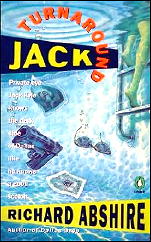
RICHARD ABSHIRE – Turnaround Jack. Morrow, hardcover, 1990. Penguin, paperback, 1992.

   According to the short biography inside the front cover, Abshire was a policeman for 12 years before becoming a real-life PI for two. And not so coincidentally, this is exactly why the activity in this mystery, the second recorded case of fictional PI Jack Kyle, is authentic enough to be — dare I say it? — boring.

RICHARD ABSHIRE Jack Kyle

   Which is by no means meant to be derogatory. In fact, quite the opposite. Most real-life PI work consists of endless hours doing nothing but watching, checking down leads, looking up information, and sitting and driving and sitting again.

   That’s just what the case is here, and it’s well into the second half of the book before anything at all out of the ordinary begins to happen.

   Kyle is hired to take some pictures of a rich man’s wife, and on page 127 he has turned in his report, along with some well-received video tapes. The client is very pleased.

   Case closed? No, sir. Seven pages later Kyle is worked over by a couple of professionals. A body is found, then two, and a customs agent suddenly seems to have disappeared.

   This is a hard-boiled detective story, and in spite of the slow beginning, the second half of the book is well worth waiting for. And so that you don’t get me wrong, let me hasten to add that even in the first half Abshire is nearly as witty in descriptive passages as Robert B. Parker, say, and it doesn’t drag. It speeds by almost as fast as a hot rod on roller skates. (This is NOT an example of the author’s wit.)

   Sometime in his past, Kyle earned his nickname — the book’s title — from his tendency to become involved in cases amply endowed with the inscrutable art of the double-cross, in its several and sundry forms.

   So it is with the story in this book. There are a couple of small glitches in the plot, but none, I dare say, that are even closely essential to the story line. They’re just enough to make you wonder why editors don’t bother to edit any more.

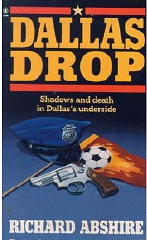
   The first Jack Kyle mystery was Dallas Drop (1989). Did a third one ever appear? If so, I’ve missed it, and from the evidence shown here, I certainly hope I haven’t.

— September 1993.


RICHARD ABSHIRE Jack Kyle

[UPDATE] 09-29-10.   There was a third one, as I suspected at the time, The Dallas Deception (1992), but that was it. No other cases for Jack Kyle besides these three, which may be a case of Too Bad, given my comments above.

   In the 1980s Richard Abshire was the co-author of two mystery novels with a series character called Charlie Gants, who according to one website, is an ex-homicide detective who as a PI of sorts investigates cases with a super-natural twist. In 1991 he and William R. Clair collaborated again under the name of Terry Marlow, producing one police novel, a thriller titled Target Blue.

   As Cliff Garnett, a house name, in 2000 Abshire wrote at least one of the “Talon Force” men’s adventure books, but he doesn’t appear to have written anything since.

« Previous PageNext Page »