Reviews


IT IS PURELY MY OPINION
Reviews by L. J. Roberts


NANCY PICKARD – The Scent of Rain and Lightning. Ballantine, hardcover, May 2010. Trade paperback: February 2011.
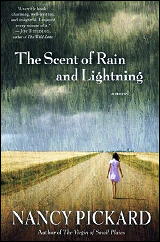
NANCY PICJARD Scent of Rain and Lightning

Genre:   Mystery. Leading character: Jody Linder; standalone. Setting:   Kansas.

First Sentence:   Until she was twenty-six, Jody Linder felt suspicious of happiness.

    In 1986, ranch hand Billy Crosby was known for being resentful, a drunk, and an abuser. Fired from working on the Linder family ranch, he was accused of killing a cow and tearing down fences, but the charges didn’t stick.

   Fearing retribution, 3-year-old Jody Lindner was taken from her parent’s home in town to spend the night at her grandparent’s ranch farmhouse. The next morning, her father was found murdered and her mother missing, with only her blood-stained dress found in Billy’s truck.

   Now, after serving 23 years on circumstantial evidence, Billy’s sentence has been commuted and he is returning to town. Jody learns that not everyone, including his son, thought Billy was guilty. The past isn’t always past.

   Ms. Pickard has a great voice. She draws you in from the first sentence and captivates you to the very last sentence. She brilliantly conveys the aftermath of murder and its impact on the lives of both the families of the victim and the accused.

   Yet even in tragedy, there is humor. When Jody’s grandmother realizes Jody is afraid of God because of the prayer “…if I should die before I wake…” and mentally tells God, “…You ought to be ashamed of yourself.” She heard a deep voice in her mind retort: “I never told anybody to say that stupid prayer.”

   Pickard’s skills with dialogue and story balance are only two aspects of her talent. Other areas in which she shines are character and sense of place. Her characters are alive, nuanced and real in that they are not all or always likable. The family is tight-knit but not perfect; the townspeople are representative of any small town.

   I felt connected to the principal characters and appreciated seeing them grow and change over time. The depiction of ranch life, the small towns around them, the impact of weather on the life and livelihood of both is so well done.

   This is a beautifully written book and a very good mystery with excellent twists and escalating tension. While it didn’t have quite the “wow” factor of The Virgin of Small Plains, it is powerful, effective and affecting. I highly recommend reading it.

Rating:   Very Good Plus.
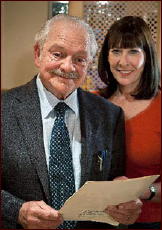
REVIEWED BY GEOFF BRADLEY:         


A TOUCH OF FROST: “If Dogs Run Free.”   ITV1 [UK], 04-05 April 2010. David Jason (Insp. Jack Frost), Bruce Alexander (Supt Mullett), John Lyons (D.S. Toolan), Arthur White, Niamh Cusack, Phyllis Logan (Christine Moorhead). Screenplay: Michael Russell, based on characters created by R.D. Wingfield. Director: Paul Harrison.

A TOUCH OF FROST If Dogs Run Free

   After 17 years this venerable programme has come to an end, ostensibly because David Jason took the perhaps rather belated decision that he was too old credibly to play a serving police officer.

   This final two-parter (two two-hour episodes, less adverts), “If Dogs Run Free”, starts with an illegal dog-fight that the police are staking out thanks to a tip-off. Frost is involved because there is a major criminal involved in the drug trade who is living in Denton and is known to like dog-fights.

   By chance he is late and when the police move in he has not arrived. However his consequential desire to punish the informant leads to major consequences. Meanwhile someone seem to be repeating some criminal acts of 20 years before, including violent death, that Frost was involved in.

   This was a highly enjoyable episode in this long-running season and I enjoyed watching it, although Frost’s burgeoning romance with the RSPCA lady, Christine Moorhead, was not as riveting for me as the investigations.

   Amid much publicity, the production company filmed two endings and, after the showing, screened the alternative (and similar, except in personnel) ending on the internet.

   Sad to say both endings were rather low key and it seems a little odd that the producers should choose to go out that way, though I suspect that, rather crassly, they thought that by airing the two possible endings approach they may get more viewers.

REVIEWED BY WALTER ALBERT:         


IT STARTED WITH EVE Deanna Durbin

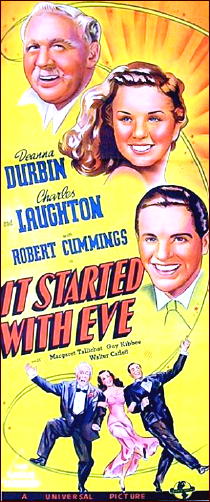
IT STARTED WITH EVE. Universal, 1941. Deanna Durbin, Charles Laughton, Robert Cummings, Guy Kibbee, Margaret Tallichet, Catharine Doucet, Walter Catlett, Charles Coleman, Mary Gordon, Sig Arno, Mantan Moreland. Screenplay by Norman Krasna and Leo Townsend; cinematography by Rudolph Mate; music director, Charles Previn. Director: Henry Koster. Shown at Cinevent 42, Columbus OH, May 2010.

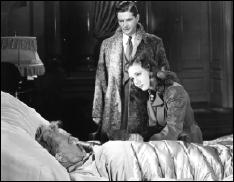
   Tycoon Jonathan Reynolds (Charles Laughton) is expected to die momentarily, but when his playboy son Johnny (Robert Cummings) arrives at his bedside, Reynolds asks for his son’s fiancee Gloria Pennington (Margaret Tallichet), whom he’s never met.

   The distraught son, unable to locate her at her hotel, persuades hatcheck girl Anne Terry (Durbin) to substitute for Gloria in what he believes to be his father’s final moments. Of course, the father recovers and is delighted with his son’s choice. And the plot is off and heating up rapidly.

   Durbin is, as always, a perky delight, Laughton is wonderful as the irascible father, and Cummings is bearable. (I’ve never forgiven him for being the major casting flaw in King’s Row.)

   But it’s Walter Catlett, as Reynolds’ frantic doctor, who walks off with the comedy honors. Durbin sings prettily and she and Laughton dance a mean conga in this very entertaining comedy.

IT STARTED WITH EVE Deanna Durbin

A REVIEW BY CURT J. EVANS:         


ANTHONY WYNNE – Emergency Exit. Hutchinson, UK, hardcover, 1941. Julian Messner, US, hardcover, 1944.

   The popularity in the United States of Anthony Wynne seems to have waned with the onset of World War Two. Wynne’s longtime American publisher, Lippincott, seems to have dropped the author after it published his Doornails Never Die (1939). Of Wynne’s next three books, published between 1940 and 1942, I’m aware of only one that appeared in the United States: Emergency Exit (1941), which was belatedly published in the U. S. in 1944 by Julian Messner.

   I’m happy Messner published Exit, because it’s a fine example of a locked room mystery — in this case murder in a private, sealed bomb shelter, surrounded by snow. How’s that for a miracle problem?

   As is very often the case in Wynne’s mystery novels, the murder his Great Detective Dr. Hailey is called on to investigate is that of a millionaire financier; and the murder has taken place at the man’s opulent country estate. Some good descriptive writing sets the stage, but we soon get down to the problem, which is initially laid out at an inquest.

   Naturally the murder victim proves to have been rather an unlovable fellow, and we are presented with half-a-dozen suspects who might well have done the old man in — but how?!

   Exit is not as good a detective novel, in my opinion, as Murder of a Lady, reviewed here. The setting and characters are less original and the likely identity of the key culprit should not tax readers overmuch.

   Also, movement flags a bit in the central portion of the novel (which consists too much of Hailey wondering about the country house and its grounds).

   Still, Emergency Exit should leave admirers of Golden Age mystery pleased. The why? question turns out to be quite interesting and the locked room problem (how?) cleverly turned out indeed (though a map would have been nice).

   As far as the characters go, the most interesting aspect of the novel is the relationship between the financier’s daughter and the man she loves, a heroic fighter pilot who received a blow on the head and is suspected of the murder by the police, as he may not be “quite right” anymore. Readers may find the daughter rather unbearably priggish, but the fighter pilot is an interesting character.

   Wynne also allows himself some interesting asides on the war and England’s resolve to fight it. And the title proves itself quite an apt one. A good tale.

REVIEWED BY DAN STUMPF:         


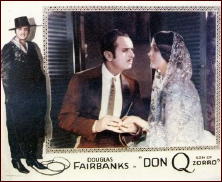
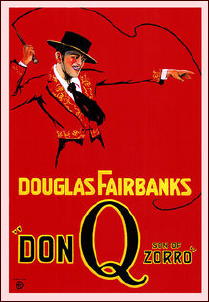
DON Q, SON OF ZORRO. United Artists, 1925. Douglas Fairbanks, Mary Astor, Jack McDonald, Donald Crisp, Stella De Lanti, Warner Oland, Jean Hersholt. Based on the novel Don Q’s Love Story by Kate Prichard & Hesketh Prichard. Director: Donald Crisp.

DON Q SON OF ZORRO

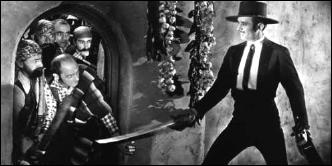
   Three Bucks at a local Grocery Store sufficed to deliver unto me a genuine Rarity, Don Q, Son of Zorro. The most enjoyable of Douglas Fairbanks Sr.’s Swashbucklers I’ve seen to date.

   I’ve carped before about the dreadful lack of Pace in Doug’s Costume Pictures, a defect that causes the films to drag even in the midst of some of the most flamboyant and fun-to-watch capering ever committed to the Screen. Don Q, however, harks back to the early knockabout comedies that made Fairbanks’ reputation (along with those of Chaplin, Keaton, et. al.) and spends most of its time indulging Doug in that insouciant showing-off he did so well.

   Hard to believe this fast-paced souffle was directed by none other than Donald Crisp, Hollywood’s resident Patriarch/Wet Blanket in films from How Green Was My Valley to Dr. Jekyll and Mr. Hyde.

DON Q SON OF ZORRO

   Crisp elicits neat performances from Warner (Charlie Chan) Oland as a German Prince, Jean (Dr. Christian) Hersholt as a fawning toady, and does a surprisingly neat turn himself in the Young-Basil-Rathbone style as a lecherous cad.

   As for Fairbanks, Crisp manages to indulge him without over-indulging him, and never lets the pace flag for a moment.

   No mean feats, those.

Editorial Comment: This film is, of course, a sequel to The Mark of Zorro (1920), also, as everyone knows, with Douglas Fairbanks, Sr. Out of curiosity, I investigated. The book by the Prichards (a mother and son collaboration) has no connection with Zorro whatsoever.

DON Q SON OF ZORRO

REVIEWED BY BARRY GARDNER:


TAFFY CANNON – A Pocket Full of Karma. Nan Robinson #1. Carroll & Graf, hardcover, 1993. Reprint paperback: Fawcett Crest, 1995. This is Cannon’s first mystery, though she has had one novel published previously.

TAFFY CANNON

   Nan Robinson is an investigator with the State Bar of California, single and in her late thirties. She is surprised when a letter arrives at the office for her ex-secretary, Debra, who hadn’t worked there in three years.

   More puzzling still, it was from her mother. Nan and her secretary were from the same town, and though they had never been close friends, Nan feels guilty for not having kept better track of her.

   She decides to deliver the letter in person, but finds an empty house, with signs that the woman had vanished rather abruptly. Her curiosity aroused, she begins to try to track her down, and discovers that she has been working for a firm specializing in hypnotic regression to past incarnations.

   Just to complicate things, Nan finds herself attracted strangely to one of the owners of the firm. But what’s happened to Debra, and where is she?

   We know where Debra is, or at least what happened to her, because the book opens with a couple of pages from the mind of the killer. There are several other such interludes, though the rest of the story is told third-person from Nan’s viewpoint.

   This is a competently told first mystery, with only a few unlikely aspects to the plot. Nan is a likable enough character, though in all honesty not someone who really grabbed my attention or enlisted my sympathies.

   One saving grace is that she doesn’t fall in love with a cop. All told, this is a decent if not exceptional book, making it better than many.

— Reprinted from Ah, Sweet Mysteries #10, November 1993.


      The Nan Robinson series —

    A Pocketful of Karma. Carroll & Graf, hc, 1993.
    Tangled Roots. Carroll & Graf, hc, 1995.

TAFFY CANNON

    Class Reunions Are Murder. Gold Medal, pb, 1996.

A TV Review by MIKE TOONEY:


ALFRED HITCHCOCK Magazine - June 1961

“A Home Away from Home.” An episode of The Alfred Hitchcock Hour (Season 2, Episode 1). First air date: 27 September 1963. Ray Milland, Claire Griswold, Mary La Roche, Virginia Gregg, Ben Wright, Connie Gilchrist, Brendan Dillan. Writer: Robert Bloch, based on his short story in Alfred Hitchcock’s Mystery Magazine, June 1961. Director: Herschel Daugherty.

   Young and pretty Natalie Rivers (Claire Griswold) is on her way to visit relatives when she decides to drop in on her uncle, Dr. Howard Fennick (Ray Milland), whom she has never actually met. Fennick runs a private sanitarium, where he practices “permissive therapy,” allowing the inmates more latitude than is usual in such institutions.

   Natalie isn’t really surprised by the behavior of the patients — that they would be rather egocentric is to be expected. Her apprehension level rises, however, when she encounters a man locked away upstairs who keeps claiming that he is the doctor’s assistant and that Natalie’s uncle is no doctor.

   Imagine Natalie’s level of apprehension when she discovers that dead body in the dumbwaiter ….

   Ray Milland (1905-86) was a versatile Welsh actor, a leading man when he was younger but a fine villain in his latter days. He was murdered in Payment Deferred (1932) but came back as Bulldog Drummond (Bulldog Drummond Escapes) in 1937.

   He also appeared in Ministry of Fear (1944), The Big Clock (1948), Alias Nick Beal (1949), Dial M for Murder (1954), The Safecracker (1958), Markham (a TV series, 1959-60, as a lawyer/detective), tangled a couple of times with Lieutenant Columbo (1971-72), featured prominently in “Too Many Suspects” (1975, the prequel to the Ellery Queen TV series), and even menaced the Hardy Boys and Nancy Drew (1978).

   Robert Bloch (1917-94) specialized in horror, but he could do suspense as well. After Psycho (1960), he got into TV with five episodes of Lock Up, ten installments of Thriller, ten with Alfred Hitchcock Presents and seven more with The Alfred Hitchcock Hour, as well as three episodes of Star Trek (including “Wolf in the Fold,” in which 23rd-century spacemen encounter Jack the Ripper).

    “A Home Away from Home” can be viewed on Hulu here.

THE BACKWARD REVIEWER
William F. Deeck


D. B. OLSEN Rachel & Jennifer Murdock

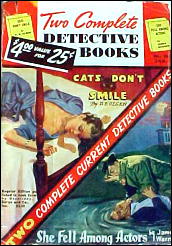
D. B. OLSEN [aka DOLORES HITCHENS] – Cats Don’t Smile. Doubleday Doran/Crime Club, hardcover, 1945. Later published in Two Complete Detective Books #36, pulp magazine, January 1946 (with She Fell Among Actors, by James Warren).

    Rachel and Jennifer Murdock, whose exploits — if Jennifer can be said to engage in exploits — Olsen has chronicled before and after this novel, go to Sacramento, Calif., to house-sit for Cousin Julia, who for reasons she doesn’t explain must leave the house and does not want her roomers unsupervised.

    Miss Rachel embroils herself in the roomers’ affairs and those of the next-door neighbors. Before she can meddle much, one of the roomers is murdered.

    For those who enjoy Little-Old-Lady detectives, this should be a pleasing mystery, particularly if active LOL’s are preferred. For my part, I have always thought Jane Marple was the perfect type. Not for her the burglary at dead of night or skulking in gardens eluding who knows what.

    Both interesting and unusual is the motive for murder. However, I had difficulty in accepting the solution, for reasons which I won’t go into since it would reveal the murderer’s identity.

    Warning: Cat lovers may be upset by one of the incidents in the novel.

— From The MYSTERY FANcier, Vol. 11, No. 2, Spring 1989.


       The Rachel & Jennifer Murdock series —

    The Cat Saw Murder. 1939. [Doubleday Crime Club for all but one.]

D. B. OLSEN Rachel & Jennifer Murdock

    The Alarm of the Black Cat, 1942.

D. B. OLSEN Rachel & Jennifer Murdock

    Cat’s Claw. 1943.
    Catspaw for Murder. 1943.
    The Cat Wears a Noose. 1944.
    Cats Don’t Smile. 1945.
    Cats Don’t Need Coffins, 1946.
    Cats Have Tall Shadows. Ziff-Davis, 1948

D. B. OLSEN Rachel & Jennifer Murdock

    The Cat Wears a Mask. 1949.
    Death Wears Cat’s Eyes. 1950.
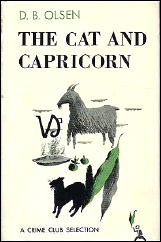
    The Cat and Capricorn. 1951.

D. B. OLSEN Rachel & Jennifer Murdock

    The Cat Walk, 1953.
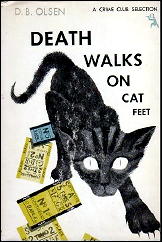
    Death Walks on Cat Feet. 1956.

D. B. OLSEN Rachel & Jennifer Murdock

THE ARMCHAIR REVIEWER
Allen J. Hubin


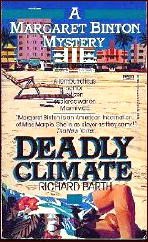
RICHARD BARTH – Deadly Climate. St. Martin’s, hardcover, 1988. Reprint paperback: Fawcett Crest, 1989.

RICHARD BARTH Margaret Binton

   The fifth caper for septuagenarian New Yorker Margaret Binton is Deadly Climate, by Richard Barth. Here Margaret wins a $40,000 RV in a raffle, and she and three friends of comparable vintage head for Miami, where they plan to vacation a bit and sell the vehicle.

   On arrival they are rousted from street parking by one of Police Capt. Diamond’s minions. Complaints fall on deaf Diamond ears; he’s more concerned with the cocaine importation industry, flourishing of late. So Margaret and friends turn to good works, giving rides to housebound retirees.

   Curiously, the management of Forstman’s Rest Home won’t let its inhabitants out for a ride. Strangely, those inhabitants seem more prisoners than anything else. But of course none of this could put Margaret and cohorts in deadly danger, none of this could have anything to do with cocaine… Of course not.

   Very enjoyable fun and games.

— From The MYSTERY FANcier, Vol. 11, No. 2, Spring 1989.


       The Margaret Binton series:

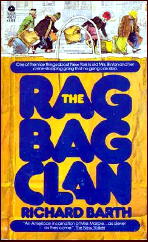
   The Rag Bag Clan (n.) Dial 1978.

RICHARD BARTH Margaret Binton

   A Ragged Plot (n.) Dial 1981.
   One Dollar Death (n.) Dial 1982.

RICHARD BARTH Margaret Binton

   The Condo Kill (n.) Scribner 1985.
   Deadly Climate (n.) St. Martin’s 1988.
   Blood Doesn’t Tell (n.) St. Martin’s 1989.

RICHARD BARTH Margaret Binton

   Deathics (n.) St. Martin’s 1993.

IT IS PURELY MY OPINION
Reviews by L. J. Roberts


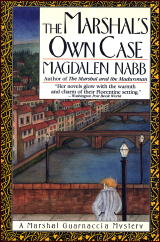
MAGDALEN NABB – The Marshal’s Own Case. Scribner’s, hardcover, July 1990. Penguin, paperback, August 1991. Trade paperback: Soho Crime, September 2008.

Genre:   Police procedural. Leading character:   Marshal Guarnaccia; 7th in series. Setting:   Florence, Italy.

MAGDALEN NABB The Marshal's Own Case

First Sentence:   The week that school opens for the autumn term is as bad a Christmas.

   An older woman asks the Marshal to look for her 45-year-old son, missing for two weeks and his own son is having problems in school.

   When pieces of the son, “Lulu,” turn up in plastic garbage bags, Guarnaccia is assigned to lead the murder investigation. With the assistance of his Captain’s man, Ferrini, the Marshal is introduced to Florence’s transsexual community to find a killer and save an innocent man’s life.

   In many ways, this is a book about those on the outside: children teased at school; immigrants whose lives were intolerable in their native lands yet find themselves abused in a place they took refuge; those emotionally abused and those whose sexual preferences do not conform.

   Marshal Salvatore Guarnaccia doesn’t feel he fits in; he is big, clumsy, and allergic to the sun, has always been told he is a dreamer and never feels as smart or clever as those around him. He loves his family yet is uncomfortable showing or expressing his emotions. Even Guarnaccia’s Captain views him as “…none too bright and far from articulate but there was no getting away from the fact that he didn’t miss much and that the quieter he got, the nearer he was to whatever he was after.”

   It’s nice to have a protagonist who is not handsome and macho, but who has insecurities as we all do. While some may choose not to read this book because of the subject matter, that would be a shame. Ms. Nabb introduces us to a cross-section of the transgender community in a sensitive and non-sensational, non-judgmental manner establishing back stories for each of the characters, individualizing them.

   Nabb, once again, takes us to a new area of Florence. Beyond providing a sense of physical place, for part of the book, she takes the weather and makes it an element that is almost another character.

   The plot is engrossing, emotional, tragic and poignant. I applaud Nabb for not employing a cliched ending. Each book in this series has, so far, been better than the last. This is no exception. The impact has stayed with me far beyond the final page.

Rating:   Excellent.

« Previous PageNext Page »