Reviews


IT IS PURELY MY OPINION
Reviews by L. J. Roberts


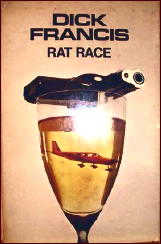
DICK FRANCIS – Rat Race. Harper & Row, US, hardcover, 1971. Michael Joseph, UK, hardcover, 1970. Reprinted many times.

Genre:   Amateur sleuth. Leading character:   Matt Shore, stand-alone. (Francis’s 10th novel.) Setting:   England.

DICK FRANCIS Rat Race

First Sentence:   I picked four of them up at Whit Waltham in the new Cherokee Six 300 that never got a chance to grow old.

   Matt Shore’s life and career as a pilot have been on a downward spiral. His latest job is with a flying taxi service for racecourses and his first flight ends with the plane exploding after he lands from sensing a problem with the aircraft.

   Although all the passengers are safe, it’s another black mark on Matt’s career and he wants to know why.

   Although I’ve not read this particular book since January 1977, it reminds me why I became such of fan of Dick Francis’s writing. The protagonist, Matt Shore, is so appealing and one of a style I appreciate — the “common” man caught up in an uncommon situation.

   He is not perfect. He is intelligent without being egotistical, attractive without being overbearing, and heroic without being macho. And he gets the girl, but you know there will be painful incidences along the way.

   In spite of the opening portent, the story captivates you from the very first page and never lets you go. The pacing between suspense and respite is every effective. The writing is masterful — not a term I use lightly — and imminently readable.

   I was surprised how much of the plot I remembered after all these years, and that’s a real tribute to the author. Whether Dick or Mary Francis was the primary author of this, and the other books by Dick Francis, I frankly don’t care.

   All I know is that it was a great read when I read it the first time, and it is a great read now.

Rating:   Very Good Plus.

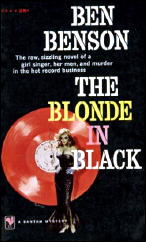
BEN BENSON – The Blonde in Black.   Bantam #1974, paperback reprint; 1st printing, July 1959. Hardcover: M. S. Mill; first edition, February 1958.
BEN BENSON Mystery Writer

   When the subject of police procedurals comes up, and which authors were among the first, Lawrence Treat and his novel V for Victim (1945) is often cited as the first of those in the modern era.

   There were, of course, any number of candidates in the 1930s and even before. The idea of police solving crimes is a natural, after all; private eyes and purely amateur sleuths can’t have all the fun.

   Ben Benson, whose books in softcover I’ve owned for many years (there were 19 of them and this is, alas, only the second one I’ve read) has somehow become neglected as one of the early authors in the field.

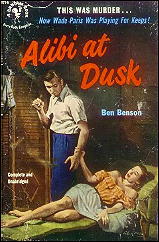
   His first book, Alibi at Dusk, came along in 1951, for example, and there were not many other authors who might fit into the category between Treat’s books and his. As a minor quibble, if you were to look closely at The Blonde in Black, you might say that it does not really fit the category — if the category consists of a police department at work upon several unrelated crimes at the same time.

   But if a police procedural can also consist of several members of a police department working as a team, following professional guidelines and conducting a case coolly and intelligently, then The Blonde in Black does indeed qualify, and presumably so do all of Benson’s other books.
BEN BENSON Mystery Writer

   The blonde in question is Junie Jacques, whose image as a sexy singer has been built as a gigantic case of fraud by her record company. She’s in reality a home town girl from Massachusetts who needed the money and agreed mostly against her will to go along with the image the public knows her by.

   And when she tells her record company executive that she’s quitting to get married, to the nephew of the governor, he’s fit to be tied. He’s also very quickly dead, with the D.A.’s office ready to arrest Junie for his death, which she claims to have been only a shooting accident.

   Captain Wade Paris of the Massachusetts State Police is not so sure of Junie’s guilt, and he continues his investigation anyway, regardless of what the ambitious fellow from the D.A.’s office might think.

   In one sense, this is an impossible crime, since Junie’s warning shot against what she thought was an intruder was in the air and toward the figure coming toward her, and as it turns out, the man was shot in the back. But the shot came from her gun, and only one shot was fired.

   A fact which may sound insurmountable, but it’s easily enough solved. (It didn’t take me much time to figure it out, in other words.) Most of the book is taken up, in documentary fashion, with the ins and outs of the music business as it was in the 50s, in what it took to create an image the public would go for; payola to grease the palms of important disk jockey’s; the expectation that girl singers would do whatever it took to get ahead; and so on.
BEN BENSON Mystery Writer

   Benson’s a bit stodgy in the details here, nor does he see a lot to rock-and-roll singing beside the well-planned gyrations on stage, but his policemen, while largely faceless, do know their business. And on the other hand, while the case is a slight one, the other characters involved are real enough to have convinced me.

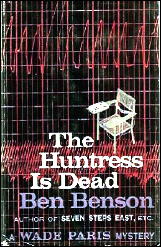
   Ben Benson died young, in 1959, at the age of only 44, and I don’t know any details. His 19 books were written in a span of less than ten years, the last, The Huntress Is Dead (1960), being published after his death, and was never published in softcover.

   Wade Paris was in ten of his novels; a Massachusetts state trooper named Ralph Lindsey was in another seven. There do not appear to have been any crossovers, but I’d love to be corrected about this. The other two books Ben Benson wrote consisted of one standalone novel and a collection of two novelettes. (Thanks to Roger Ljung, whose comment made an essential correction to this statement.)

[UPDATE] Later the same day.   I have discovered one source online that says this about Benson:

    “[He] was born in Boston and seriously wounded during Army service in WW2. He began writing as therapy…” A complete list of Benson’s novels can also be found on this site.

[UPDATE #2] 07-01-10.   I recently received the following email from Victor Berch, with a cc sent to Al Hubin. The updated information about Benson will appear in the next installment of the online Addenda to the Revised Crime Fiction IV.

Hi Steve:

I became interested in your review of Ben[jamin] Benson’s books and since he was a Boston boy, I decided to check on his vital statistics. I know Contemporary Authors and other sources assign a 1915 birth date to him. However, according to the Massachusetts Vital Records, 1911-1915, there was no Benjamin Benson born in 1915.

What little data that is presented in Contemporary Authors reveals that Benson had enlisted in the US Army in 1943. So, I decided to check out any statistics that might appear in his Army record. Sure enough, his record was available.

It stated that he had enlisted in Boston on Sept. 24, 1943 as a private for the duration of the war (his Army serial number was 31422170, should anyone care to explore his record further). His year of birth was given as 1913, had two years of college education and his civilian occupation was given as a salesman.

Armed with that 1913 birth date, I went back to the Massachusetts Vital Records, 1911-1915. And his record was available. The data revealed that Benjamin Benson II had been born in Boston June 14, 1913, the son of Hyman D., a printer, and Rivka [Rebecca] (Charmonsky) Benson, both immigrants from Russia.

Whatever the family name originally was would have to be obtained from his father’s naturalization papers. His family had only immigrated to the US in 1912.

Best,

Victor
Reviewed by DAVID L. VINEYARD:         


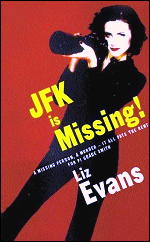
LIZ EVANS – JFK Is Missing! Orion Books, UK, 1998. Distributed in the US by Trafalgar Square, circa 2002.

LIZ EVANS Grace Smith

   Grace Smith isn’t exactly the most promising private eye you will ever meet. To begin with she works the mean streets of Seatoun, a unprepossessing town on England’s South Coast, and she isn’t the greatest at her job. But as her friend Annie tells her:

    “You’d be crap at anything else. You may as well stick to being crap at what you know.”

   And she even has a client, Henry Summerstone, and all he wants is for her to find someone — save he doesn’t know her name — and he can’t tell Grace what she looks like because he’s blind. But aside from that it’s a perfect case for Grace, a girl named K something that Henry met on the beach during his daily walk with his seeing eye dog:

    “She was wearing one of those recording things.” He looped one finger from the right ear to the left.

    “A personal stereo player?” I suggested.

    “I believe that’s what it’s called … she was listening to Little Dorrit.”

    “I’m afraid I don’t know them. I tend to go in for middle-of-the-road stuff myself: you know, Alison Moyer, Enya. And a bit of country and western.”

    “I was referring to the book. By Charles Dickens.”

    “Oh, that Little Dorritt. Sure. Right. Fine.”

    Henry explained that he was a great fan of Dickens. “A writer who embraces all the elements of emotion, don’t you find Grace?”

    “Absolutely.” I’d seen Oliver three times on video.

   Anyway, Henry loaned K a recording of David Copperfield and now she hasn’t shown up for a while, and since she seemed a nice young woman he’s worried. Grace agrees to take the case expecting to find very little.

LIZ EVANS Grace Smith

   What she finds is a young woman named Kristen — Julie-Frances Kreble aka Kristin Keats, who has gone missing. There’s also a teenage girl called Bone who just wants to be loved; a skateboarder called Figgy; a pair of pot bellied Vietnamese pigs that have outlived their cute stage; Bertram who used to be married to Kristen; and Bone’s family: brother Patrick who hates boarding school, father Stephen who is something of a player and up and coming rather nicely in the world in their nice upper middle class home, and mother, Amelia, a social climbing self involved air head.

   And something else — Stephen, Daddy, and Kristen were friends. Close friends.

   And what she begins to suspect — even though there is no body — is that Kristen is dead. Murdered. Stephen Bridgerman, her primary suspect, is on to her:

    “Oh, there you are Miss Smith — or are you someone else today?”

    “Should I be?”

    “I’ve no idea. You seem to be a versatile girl: tax official, cleaner, waitress. Is there any limit to your talents?”

    “If there is, I’ve never found it. Mind you there are those who reckon there’s no beginning to them.”

   A trip to Jersey to visit Kristen’s parents and a missing workman add to the mystery as well as who ran over the skateboarding Figgy, son of one of Amelia’s chums, and a government cover up involving her not so innocent blind client who knows more about the missing Kristen than he’s been saying.

   Which leads to Grace chained up in a wine cellar with a nasty blow to the head and a very full bladder waiting for a very confused but totally ruthless killer to decide what to do with her.

LIZ EVANS Grace Smith

    How come fictional murders aren’t like this, I wondered? Where are all those meticulously planned, cleverly plotted deaths like in Agatha Christie and P.D. James novels? These two would be more at home in a Quentin Tarantino movie.

   Before it’s over Grace will end up in the boot of her own car, sloshed with gasoline and with a belly full of vodka being driven to a convenient place for another little murder — her own.

   Grace may get it all wrong but she also solves a murder and brings down a murderer — even if she nearly gets killed along the way — and ends up answering to the RSPCA for a pair of Vietnamese pot bellied pigs …

   JFK is Missing! is exactly what it sets out to be, a solid funny private eye novel with an attractive, if less than brilliant, heroine, a set of quirky characters, a well realized setting, and the kinds of crimes that you see on the nightly news.

   It’s a sprightly series, other entries including Who Killed Marilyn Monroe? and Don’t Mess With Mrs. In-Between. The lines are snappy, the pace fast, the cliff hangers nerve wracking and dripping with irony, and you could easily find Grace Smith one of your favorite sleuths of the modern era. With this single book she has moved well up on my list.

       The Grace Smith series —

1. Who Killed Marilyn Monroe? (1997)
2. JFK Is Missing! (1998)
3. Don’t Mess with Mrs In-Between (2000)
4. Barking! (2001)
5. Sick as a Parrot (2004)

LIZ EVANS Grace Smith

6. Cue the Easter Bunny (2005)

   As Patricia Grey, Liz Evans has also written a series of four books with Detective Chief Inspector Jack Stamford and Sergeant Sarah McNeill taking place during World War II —

1. Junction Cut (1994)
2. Balaclava Row (1994)
3. Good Hope Station (1997)
4. Cutter’s Wharf (1998)

THE BACKWARD REVIEWER
William F. Deeck


BURTON E. STEVENSON – The House Next Door. Dodd Mead, US, hardcover, 1932. Hutchinson, UK, hardcover, 1932.

   Reviewers, certainly those like me who assay the gold of the past, ought to get hazardous-duty compensation for the dross. Reading this novel could have produced brain rot if the author’s leaden prose had not set up the defense mechanism of allowing me to immediately forget what had just been read.

   Something like eight years passed between Stevenson’s previous mystery effort and this one. I can assure you that he was not perfecting The House Next Door all that time.

   According to the publisher: “In order to aid the reader in choosing a mystery of whose merit he may be certain in advance, the ‘hard-faced editors’ are placing a red badge on those detective stories which they are willing to recommend unreservedly to the most discriminating reader.”

   The red badge on this one is indubitably a fraud, for God knows I am not all that discriminating.

   The only thing that can be said in favor of this novel is the apparent absence of typographical errors. Otherwise, the plot is silly, the characters totally unbelievable, and the characters’ acts and conversation tedious.

   Turning the pages was an ordeal, but I continued to read in the hope that there might be something — anything, even one felicitous phrase — to justify publication. That hope was dashed when page 313 was reached.

   The narrator, a lawyer, judges everyone by physiognomy, even including the first corpse, whose “high, narrow forehead bespoke intelligence, but also a limited and narrow character. There were little peevish lines about the eyes It was a selfish and egotistical face, utterly without attraction.”

   One of the detectives — Godfrey, of the Record, as he is described — says: “‘Of course I suspected [Blank] from the first. For one thing, I didn’t like the way his eyes were spaced.”’

   Anyone unprepossessing or suffering from some slight physical impairment had better not be around these chaps when a crime is committed.

   As for what there is of a plot, Professor Verity wants to change his will, but somebody breaks his neck before he can accomplish that aim. The neighbors are a heathen Hindu and an oily Italian. Look no farther for suspects.

   Oh, there’s another chap that might have done it, but the Professor’s daughter is in love with him and he’s Anglo-Saxon and not obviously disfigured, so he has to be innocent.

– From The MYSTERY FANcier, Vol. 10, No. 2, Spring 1988.


Bio-Bibliographic Notes:   According to Crime Fiction IV, by Allen J. Hubin, Burton E. Stevenson, 1872-1962, wrote thirteen mysteries, one marginally criminous, between 1903 and 1939. The book Bill referred to as preceding this one was The Storm-Center (1924). Jim Godfrey, the sleuth of record in The House Next Door, was in five others, including Stevenson’s first one, The Holladay Case (1903).

   Mike Grost takes a critical look at The Mystery of the Boule Cabinet (1911), one of Stevenson’s earlier books, on his Classic Mystery and Detection website, comparing his work in some ways to that of Mary Roberts Rinehart.

   Many of Stevenson’s books, including the latter, are available online. A complete listing can be found here.

   When he wasn’t writing mystery fiction, Burton Stevenson was quite well-known in other fields, at least locally, in his home town in Ohio. Quoting from this online site:

    “Born in Chillicothe in 1872, Burton Stevenson’s life was devoted to the written word as a prolific author and anthologist, and as a librarian. Following stints as a journalist while a student at Princeton University and then at newspapers in Chillicothe, Stevenson became the librarian of the city’s public library in 1899. He held the post for 58 years.

    “Stevenson then went to Paris as the European director of the Library War Service. After the Armistice in 1918, he established the American Library in Paris and directed it until 1920 and again from 1925-1930. In addition to accomplishments as a librarian, he wrote or compiled more than 50 books….”

REVIEWED BY WALTER ALBERT:         


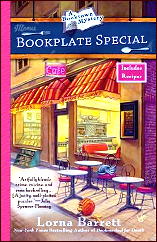
LORNA BARRETT – Bookplate Special. Berkley, paperback original; 1st printing, November 2009.

LORNA BARRETT

   Tricia Miles, proprietor of the mystery bookstore Haven’t Got a Clue in Stoneham, New Hampshire, is probably the least appealing protagonist of any recent mystery series I’ve been sampling.

   She’s confrontational, irascible, and downright unpleasant, particularly in her dealings with local police and her current boyfriend, Russ, publisher of the local weekly newspaper. The series also includes recipes, which I are generally a turnoff for me, but the bookstore setting brought me back, after I’d read and reported on the second in the series (Bookmarked for Death, reviewed here ) for this follow-up novel.

   Shortly after Tricia tells a lingering house-guest to pack up and move out, the woman is murdered, and Tricia, not one to let the local authorities handle the investigation, is almost immediately very much. involved, withholding vital evidence and, in general, acting without regard for her own safety or for a reasonable outcome for a very thorny investigation.

   The author thanks friends who “pointed out the places” where she tripped up. Frankly, I think she needs a new group of friends who would point out to her that amateur sleuthing doesn’t mean you shouldn’t observe a modicum of common sense.

   However, in spite of her unattractive side, she’s still able to come out of the labyrinth of missteps and bad decisions with two potential boyfriends and only minor collateral damage.

   So what you have is a potentially attractive series, with a strong protagonist who may turn off some readers but please anti-establishment, feminist readers who will be urging Tricia on from the sideline.

       The Booktown Mystery series —

1. Murder Is Binding (2008)

LORNA BARRETT

2. Bookmarked For Death (2009)
3. Bookplate Special (2009)
4. Chapter and Hearse (2010)

   Coming in 2011 is A Crafty Killing, the author’s first “Victoria Square Mystery.” Lorna Barrett, the pen name of Lorraine Bartlett, has also written two suspense thrillers as by L. L. Bartlett.

A TV Review by MIKE TOONEY:


“Diagnosis: Danger.” An episode of The Alfred Hitchcock Hour (Season 1, Episode 22). First air date: 1 March 1963. Michael Parks, Charles McGraw, Berkeley Harris, Rupert Crosse, Allen Joseph, Douglas Henderson. Writer: Roland Kibbee. Director: Sydney Pollack.

MICHAEL PARKS

   A car returning from Mexico heading toward Los Angeles suddenly lurches and a man falls out of the back, unnoticed by the driver. Between the time he becomes airborne and the moment he hits the road’s shoulder, he dies — not from the impact but from the deadly and highly contagious disease of anthrax.

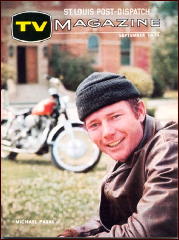
   Dr. Daniel Dana (Michael Parks) works for the County Department of Public Health as an epidemiologist; his boss, Dr. Simon Oliver (Charles McGraw), is a study in paradox — he can’t stand the sight of blood, flinches when someone is in pain, gobbles antacid pills, and prefers to call himself a politician. Nevertheless, these two will have to oversee the search for an unknown number of people who have come into contact with the dead man on the roadside.

   Before the day is over, Dr. Dana will be striving to save the life of a man with a rifle who, in return, will be trying to kill him ….

   Michael Parks (b. 1940), with his brooding attitude and mumbling delivery, was supposed to be the second coming of James Dean. In “Diagnosis: Danger” he has to deal with what has since become known as “technobabble”; half the time he’s incomprehensible — but when he isn’t, he’s quite good.

   He made many appearances in individual episodes of ’60s and ’70s TV series, everything from Ben Casey to Perry Mason. In films he was Adam in The Bible (1966) and Bradley Ford in The Story of Pretty Boy Floyd (1974, TVM), made one Ellery Queen (1976), Murder at the World Series (1977, TVM), Dial M for Murder (1981, TVM), Prime Suspect (1989), The China Lake Murders (1990, TVM), five appearances on Twin Peaks (1990-91), Kill Bill, Volumes 1 and 2 (2003/4), and even had his own series, Then Came Bronson (27 episodes, 1969-70).

   Douglas Henderson (1919-78), the nosy reporter, was one of those ubiquitous screen faces whose name you never knew, bit-part performers who superbly served as cinematic wallpaper. Criminous credits: Cage of Evil (1960), The Manchurian Candidate (1962), Johnny Cool (1963), Seven Days in May (1964), three episodes of The Outer Limits (1963-64), six appearances on Perry Mason, Pendulum (1969), 10 segments of The Wild Wild West (1966-69), Zigzag (1970), four episodes of Mannix, six installments of The F.B.I., and three installments of Mission: Impossible.

    “Diagnosis: Danger” can be viewed on Hulu here.

Editorial Comment:   According to one source on the Internet, “Diagnosis: Danger” was intended as the pilot for a weekly series starring Michael Parks, but the project failed to find a sponsor.

A REVIEW BY CURT J. EVANS:         


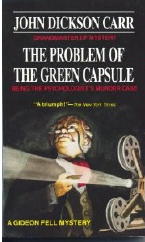
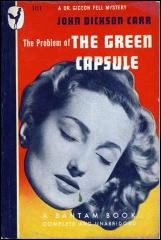
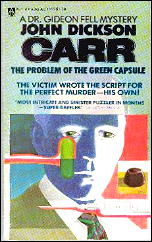
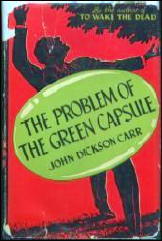
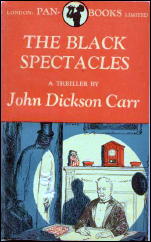
JOHN DICKSON CARR – The Problem of the Green Capsule. Harper & Brothers, US, hardcover, 1939. Published in the UK as The Black Spectacles, Hamish Hamilton, hardcover, 1939. Reprinted many times, in both hardcover and paperback, including: Books, Inc., hc, 1944; Pan, UK, pb, 1947; Bantam #101, pb, 1947; Berkley, pb, 1970; Award, pb, 1976; IPL, pb, 1986.

JOHN DICKSON CARR The Problem of the Green Capsule

   A series of poisonings of village children by means of doctored chocolates brings in a Scotland Yard detective, Andrew Elliot. While he’s there, it is learned that another murder has taken place: that of Marcus Chesney, a local millionaire whose niece, Marjorie, has been suspected of the earlier poisonings.

   Chesney has died from poisoning! And he was being filmed at the time he was poisoned! Chesney was doing a demonstration of how the doctored chocolates had been substituted for the innocent chocolates in the village shop, testing the perceptions of an audience of three people: Marjorie; Marjorie’s fiance, George Harding; and a neighboring friend, Professor Ingram.

   Chesney’s brother, Doctor Joe Chesney, had had to absent himself from the performance, while Marcus’ employee, Wilbur Emmet, was a participant in the performance, as the mysterious, muffled Mr. Nemo.

JOHN DICKSON CARR The Problem of the Green Capsule

   It is “Mr. Nemo” who forced a presumably poisoned capsule down Marcus Chesney’s throat. But Wilbur is found concussed in the yard after the performance. Was Wilbur really Mr. Nemo, or was someone else masquerading as him?

   All three members of the audience seemingly have perfect alibis — they were watching the performance. Dr. Joe was attending a patient. So we have an impossible crime once again, though more in the nature of an alibi problem: how was someone able to get in position to poison Marcus?

   I find this on re-reading still to be a very good detective novel, with an interesting problem, lucidly elucidated at the end. Some may find it short on action, but that’s okay with someone like me, who finds some Carr’s too active.

JOHN DICKSON CARR The Problem of the Green Capsule

   Interestingly, the Carr stand-in hero here is a young police inspector. On the whole, this works well. Dr. Fell does not appear until halfway through the book, and a very good police investigation is conducted until then. Then Inspector Elliott meets Dr. Fell, shouts that he loves Marjorie and confesses that he has concealed that he knew before taking the case that Marjorie tried to buy poison.

   Fell (who it turns out is suppressing evidence about Marjorie as well) compliments Elliott on his chivalry. This put me off a bit. It seemed Carr’s romanticism getting the better of good sense. Any policeman behaving that way should have been drummed out of the force.

   And that Elliot could have been “in love” with Marjorie to that extent after seeing her once in Pompeii (Pompeii is for lovers?) seemed absurd to me. But I think I’m the first person ever to complain about this, so I guess it isn’t an issue with most people.

JOHN DICKSON CARR The Problem of the Green Capsule

   The characters are solid enough, classic Carr stock. We have the disputatious academic (Professor Ingram); the bluff, hearty fellow who roars a lot (Doctor Joe); the goody two shoes, obsequious male (George Harding — though did Carr really need to give us as black marks that he has “Southern European” looks and went to a “minor” public school, oh dear!); and the beautiful girl who is either an angel or a devil.

   The police are nicely characterized (Major Crow only sounds like Carr once, when he informs Elliott of Marjorie: “For all her sweetly innocent looks, I hear she sometimes uses language that would startle a sergeant-major”).

   There’s a lot of roaring from the male characters that goes on in this book (Dr. Fell even makes a roaring whisper, I don’t know how). I could do without the roaring myself, and I know this got on Barzun’s nerves.

JOHN DICKSON CARR The Problem of the Green Capsule

   After reading Doug Greene’s excellent biography of Carr with all the information about his drinking, I can’t help wondering if the drinking bouts kind of influenced Carr’s writing in this regard. After all, drunken people do often roar and shout. Or maybe Carr was just naturally excitable.

   We know he was strongly attracted to the more romantic past. It’s interesting that he was such good friends with the phlegmatic John Street. Of course, both Carr and Street had a fascination with and great talent for murder mechanics.

   Carr often coupled this talent for murder with a Christie-level skill at misdirection, which makes him a truly major figure of the period even if one does like all his stylistic quirks. Barzun and Taylor are far too harshly critical of Carr (and it should be noted they never read many of his best books).

   Nitpicking aside, this seems to me one of Carr’s strongest books. Not flashy, but a fascinating problem. One part of the explanation has a beautiful simplicity, but chances are the reader will miss it until it is revealed!


Editorial Comment:   Curt has recently been re-reading a number of books by John Dickson Carr. This is the fourth in a series of reviews he wrote as a result. The Corpse in the Waxworks was the third, and you can read it here.

IT IS PURELY MY OPINION
Reviews by L. J. Roberts


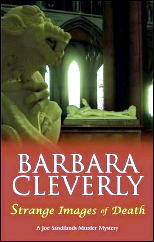
BARBARA CLEVERLY – Strange Images of Death. Constable, UK, hardcover, March 2010. Soho Constable, US, hardcover, April 2010.

Genre:   Police procedural. Leading character:   Commander Joe Sandilands, 8th in series. Setting:   France; 1926.

First Sentence:   He studied her sleeping face for the last time.

BARBARA CLEVERLY Joe Sandilands

   Scotland Yard Commander Joe Sandilands is taking Dorcas, his friend’s 14-year-old daughter, to meet her artist father at an old castle in Provence. On the way, she asks Joe to find the mother who abandoned her when she was 2 years old.

   Upon arrival, there is a second mystery to solve. It begins with the destruction of a tomb figure, escalates to the death of a rabbit and culminates in the murder of a beautiful woman. Forced to work with French Commissaire Francis Jacquemin, known for arresting first, then forcing confessions, Joe must ensure he catches the proper killer and prevents any more deaths.

   Characters. It is they who bring a story to life and Cleverly’s characters do not disappoint. They are fully developed with their backgrounds established and their personalities distinct. We not only learn about Joe, for those who’ve not read previous books in the series, but are told of his appearance in an unforced manner.

   A predominant young character can be awkward, but not here. Dorcas, his 14 year old “niece” is someone who holds her own. She is someone I want to see remain part of the series, if not in every book but certainly in the future. There was a character I felt wasn’t as strong an element as I thought might be, but I was okay with that.

   Cleverly is a very visual writer, whether in panorama or in detail. You have a real sense of their surroundings at all times. I appreciate dialogue that has a natural ear and flow with a touch of humor, and she satisfies on all aspects.

   This book’s opening hook is very strong; suspenseful, dramatic and ultimately brutal without the reader having to witness the act. It is also, we soon learn, the first of many excellent twists within the plot, this first so subtle you don’t realize it until later.

   Cleverly skillfully interweaves interesting historical information into the story as well as providing an adept explanation of French and English police ranks and an amazing assessment of Van Gogh’s self portrait.

   These are only a few examples of the deftness with which Ms. Cleverly writes, with none of these causing a break in the flow of the story. Add to that an emotional secondary mystery, and just the right touch of suspense and you have a well thought out and well executed traditional mystery.

   Each year I plan for the release of the newest Sandilands book and order it as soon as it is available. If you’ve not read them, do start at the beginning of the series and set aside uninterrupted time to enjoy each one. I know why they rank so high on my “must read” list; they are excellent.

Rating: Excellent.

      The Detective Joe Sandilands series —

1. The Last Kashmiri Rose (2001)

BARBARA CLEVERLY Joe Sandilands

2. Ragtime In Simla (2002)
3. The Damascened Blade (2003)
4. The Palace Tiger (2004)

BARBARA CLEVERLY Joe Sandilands

5. The Bee’s Kiss (2005)
6. Tug of War (2006)
7. Folly Du Jour (2007)

BARBARA CLEVERLY Joe Sandilands

8. Strange Images of Death (2010)

   Barbara Cleverly has also written three books about aspiring archaeologist Leatitia Talbot, a series that also takes place in the late 1920s and various exotic places around the world.

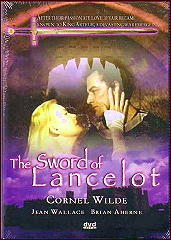
THE SWORD OF LANCELOT Cornel Wilde

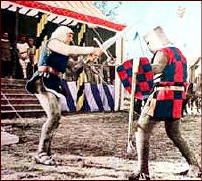
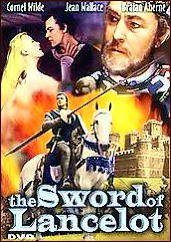
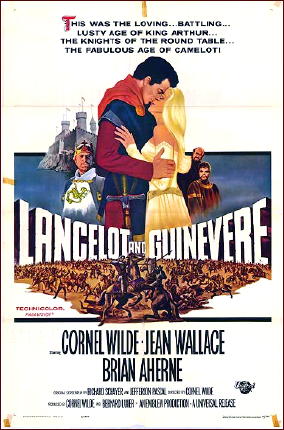
THE SWORD OF LANCELOT. Universal Pictures, 1963. Released originally in the UK as Lancelot and Guinevere. Cornel Wilde (Lancelot), Jean Wallace (Guinevere), Brian Aherne (King Arthur), George Baker, Archie Duncan, Michael Meacham, Mark Dignam (Merlin). Director & co-screenwriter: Cornel Wilde.

   Everyone reading this knows the story, or you should, so I won’t take the time or space to go into details. But the details do change every time the story is filmed — and how many times has it been? — which is why every time it’s filmed, it’s worth seeing again.

   There must be something in the story, the ill-fated love triangle between Arthur, Guinevere and Lancelot, that keeps it fresh and entertaining, no matter how times you see it.

   I do have a couple of comments, though, and as I keep typing, the couple may turn into a few. The first, though, are the ages of the performers. Brian Aherne was 61 and close to the end of his acting career. Cornel Wilde was 48, and Jean Wallace, to whom he was married at the time, was 40.

THE SWORD OF LANCELOT Cornel Wilde

   They were not youngsters, but even if you were to think them too old — by say 20 years — with their general enthusiasm and zeal for their roles, they can make you believe that they are younger, or very nearly so.

   By all appearances, Cornell Wilde was working with a relatively low budget. This is not a lavish, MGM-style motion picture. But I think the non-majestic if not homely surroundings for the interior of Camelot are more likely to have been the case at the time, if Camelot every really existed, than the splendiforous, wonderfully marvelous settings you may see in other movie versions of the tale, if not most of them.

THE SWORD OF LANCELOT Cornel Wilde

   The movie is in color, which is definitely a plus. And the battles on horseback and on foot, with lances, spears, axes, maces and any other fierce-looking weapons the combatants could get their hands on are equally authentic looking.

   Not to mention gruesome. One gets the feeling at times that this is the way battles really looked, with swords sticking out of endless bodies on the ground, with the constant danger of being trampled underfoot, if they were not already dead.

   Merlin plays a relatively small role, I am disappointed to say, but Arthur seems really delighted to have Guinevere brought to him by Lancelot, and I felt badly for him when things do not work out the way he anticipates. Even worse, his final fate is dealt with off-screen and well after the fact, and I was disappointed in that as well. He deserved better.

THE SWORD OF LANCELOT Cornel Wilde

IT’S ABOUT CRIME
by Marvin Lachman

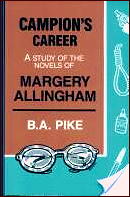
B. A. PIKE – Campion’s Career: A Study of the Novels of Margery Allingham. Popular Press, hardcover/trade paperback, 1987.

— Reprinted from The MYSTERY FANcier,
       Vol. 10, No. 2, Spring 1988.

BARRY PIKE Campion's Career

   While primarily of interest to a limited audience, B(arry) A. Pike’s Campion’s Career is a loving evocation of the creation of one of the great writers of the detective story’s golden age.

   Pike conveys the wit and wisdom of Allingham and the complex character she invented, deftly showing Camplon’s evolution from a silly ass to a wise and avuncular detective.

   I recommend it without reservation to all who have read Allingham. I suspect that those who haven’t will get more by reading the original first, then reading Pike on Allingham.

Editorial Comments:   It is may not be complete, but Google does have the book online, most if not all. You can check it out here.

   This is the fourth in a series of reviews in which Marv covered reference works published in 1987, books about the field of mystery and crime fiction. Preceding this one was An Introduction to the Detective Story, by LeRoy Lad Panek. You can find it here.

       Previously on this blog:

Call for Campion Complete, by Mike Nevins (the Campion short stories)
Tether’s End (reviewed by Tina Karelson)
Death of a Ghost (a 1001 Midnights review by Thomas Baird)
Mr Campion and Others (reviewed by Mike Tooney)
Dancers in Mourning (reviewed by Steve Lewis)

« Previous PageNext Page »