Reviews


REVIEWED BY WALTER ALBERT:         


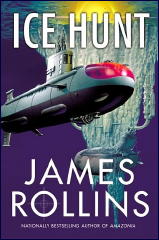
JAMES ROLLINS – Ice Hunt. William Morrow, hardcover, July 2003. Reprint paperback: Avon, June 2004.

JAMES ROLLINS Ice Hunt

   Another of Rollins’ high-tech adventure thrillers, this time pitting Russian and American scientists and para-military teams against one another at the site of an abandoned polar cap laboratory where the results of horrific experiments, buried but not quite dead, have waited 70 years for the chance to feed again.

   The fate of mankind rests on the outcome of the bloody struggle and I’m sure that you won’t think that I’m giving away anything if I tell you that mankind survives. After all, Rollins doesn’t want to wipe out everything that could keep his Tom Swiftian imagination from achieving more fictional successes.

    Publisher’s Weekly is quoted as saying that “Rollins’s characters [are] fully drawn” in this “first-class roller-coaster.” Well, maybe fully but not deeply felt or imagined. As usual, the most compelling characterization is that of an animal (this time, a wolf), not surprising if you keep in mind that Rollins has a veterinary practice in Sacramento, California.

   In case it wasn’t apparent from my lack-luster review, I ended my flirtation with Rollins’ work with this book.

A WESTERN MOVIE REVIEW
by David L. Vineyard.


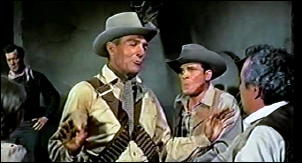
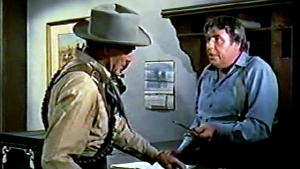
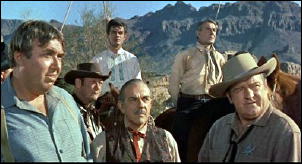
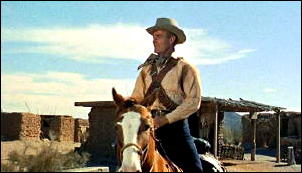
BUCHANAN RIDES ALONE. Columbia Pictures, 1958. Randolph Scott, Craig Stevens, Barry Kelley, Tol Avery, Peter Whitney. Based on the novel The Name’s Buchanan by Jonas Ward. Directed by Budd Boetticher.

BUCHANAN RIDES ALONE

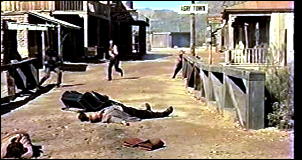
    Synopsis: Riding home through the border town of Agry, Tom Buchanan gets caught up in a feud between the lawless Agry brothers and a family of Mexicans.

   Buchanan Rides Alone is a key film in the group of films Budd Boettticher did with Randolph Scott in the late 1950’s and is something of a comment on society as a whole. There’s nothing new about the newcomer riding into town and ending up cleaning the place up, but Buchanan goes about it in a singularly tough minded manner.

   The characters played by Scott in these films are good men who have been driven by circumstance to become hard, and while they carefully guard a nugget of their humanity beneath that tough exterior they can be ruthlessly violent and even brutal when it’s warranted.

BUCHANAN RIDES ALONE

   Because Buchanan Rides Alone is the first of a series of books and the character a sort of drifter, there is less backstory than usual in a Boetticher film. Buchanan would seem to be just another drifting cowboy looking for work — until someone pushes him the wrong way.

   At that point it becomes clear just how far the Scott hero will go to restore what he considers his personal honor. In some ways his Buchanan has some relationship to John D. MacDonald’s later Travis McGee character, particularly in The Green Ripper. Once he has unleashed the man beneath the surface someone is going to pay in blood before he resumes his easy going facade.

   That’s true of most western (and other) heroes but Scott and Boetticher together so refined and perfected the Scott persona in their movies together that they develop a sort of cinematic shorthand, a gesture, a look, a single word, that says more than pages of expository dialogue and background in other films.

BUCHANAN RIDES ALONE

   In some ways Scott’s take on the iconic western loner is the dominant one in the western imagination, however important the Gary Cooper, John Wayne, or even Clint Eastwood model. Likely the truest moment in Mel Brooks’ Blazing Saddles is when the townfolk remove their hats reverently at the mere mention of Randolph Scott’s name.

   Barry Kelly is the corrupt town boss and Craig Stevens (just before Peter Gunn) a smooth gunfighter. There is nothing unusual in the plot, but the writing and direction are as superior as would be expected in a Boetticher film, and while the plot may be tried and true, the approach to character makes this one notable.

   The surprising thing about the Boetticher films is that while they are set against the wide open spaces of the west, they are closely focused character studies of men under stress, particularly the Scott hero, who reveals depths of feeling and humanity with little more than a pained look or by holding himself a little apart from everyone else in the film.

BUCHANAN RIDES ALONE

   I imagined the Buchanan of Jonas Ward’s series of books as someone along the line as Gary Cooper, but Scott at this time was at the height of his appeal, and his take on Buchanan combined a gentle charm that could turn to steel with a glint of his narrow eyes.

   And it isn’t as if there weren’t close bonds between Scott and Cooper. Scott got his start in Hollywood as Coooper’s dialogue coach for The Virginian and replaced Cooper in the popular Zane Gray series of films. By the time he made the series of films with Boetticher his version of the western hero was almost as iconic as Cooper’s, though it has only been in recent years he’s gotten real credit as an actor in them.

   At first glance Buchanan Rides Alone only seems to be a superior product of the heyday of the adult western, but there is more to the Scott character and to Boetticher’s direction than there may seem to be on the surface.

BUCHANAN RIDES ALONE

   In the confines of a fairly common western story Boetticher is commenting on both contemporary American society, and also saying something about the idealized American character. Scott’s hero in these films is the man who does the right thing even when it’s messy and society might prefer that he look the other way. Once he is unleashed he will have a reckoning, whatever the price.

[EDITORIAL COMMENT.]   A complete list of the “Buchanan” books by Jonas Ward can be found following my review of Buchanan’s Black Sheep, a much later entry in the series. David originally left this movie review as a comment following that earlier post. I’ve revised it slightly for its appearance here.

A REVIEW BY BILL CRIDER:

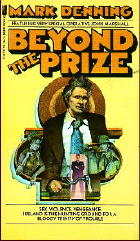
MARK DENNING – Beyond the Prize. Jove V4473, paperback original; 1st printing, 1978.

MARK DENNING Beyond the Prize

   This is the third book of a series featuring John Marshall, the one-armed secret agent (not to be confused with Dan Fortune, the one-armed private eye).

   This time Marshall is after an AWOL colleague in Ireland, where he tangles with the IRA, the KGB, and just about everyone else.

   There’s plenty of action, plus a plot twist or two that you don’t really expect in such an action-oriented story, and Marshall has an enjoyable toughness. There aren’t too many books of just this kind being written today, and if you liked James Bond, give it a try.

– From The MYSTERY FANcier, Vol. 3, No. 3, May-June 1979.


   Bibliographic data:     [Taken from Crime Fiction IV, by Allen J. Hubin.]

DENNING, MARK. Pseudonym of John Stevenson, ?-1994.     JM = John Marshall.
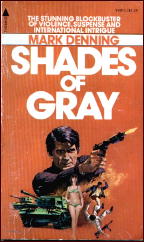
      Shades of Gray. Pyramid, pbo, 1976.    JM

MARK DENNING

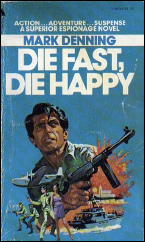
      Die Fast, Die Happy. Pyramid, pbo, 1976.    JM

MARK DENNING

      Beyond the Prize. Jove, pbo, 1978.    JM
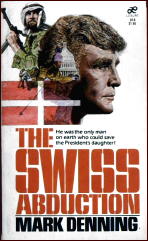
      The Swiss Abduction. Leisure, pbo, 1981.    JM

MARK DENNING

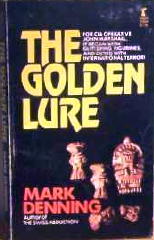
      The Golden Lure. Tower, pbo, 1981.    JM

MARK DENNING

      Din of Inequity. St. Martin’s, hc, 1984.
      Ransom. Pocket Books, pbo, 1990.

KATHLEEN WADE – Crime at Gargoyles. Hutchinson, UK, hardcover. No date stated [1947].

   The current, updated entry for Kathleen Wade in the Revised Crime Fiction IV, by Allen J. Hubin, looks like this:

   WADE, KATHLEEN (Nesta Knight). 1903 -1986. SC: Detective Inspector (Hamilton) Drake, in at least those marked HD.

      Death at Aranshore (Gifford, 1942, hc)
      Death on ?Calamity” (Gifford, 1945, hc) [England; Ship]
      Crime at Gargoyles (Hutchinson, 1947, hc) [England] HD
      A Cloak for Malice (Hutchinson, 1949, hc) [England]
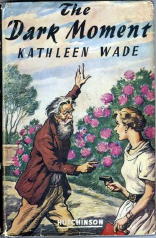
      The Dark Moment (Hutchinson, 1951, hc) [England] HD

KATHLEEN WADE

      Act of Violence (Hutchinson, 1954, hc)

   Note that some of this information appears only in the online Addenda, which adds some facts uncovered by British mystery bookseller and researcher Jamie Sturgeon. He also notes that “she lived with the [noted] sculptor and writer Eric Benfield (if you do a Google search you will find a little bit about both of them).”

   The link will lead you to one such page; more than likely there are several others. It was also Jamie who discovered that Inspector Drake appeared in at least two of the books, Crime at Gargoyles being one of them.

   Drake doesn’t enter in until well after halfway through, however. Until then the story focuses solely on John Shirley, home from the Far East as a war correspondent on sick leave — a “recent breakdown.”

   Which helps explain, perhaps, why he does what he does when he moves a body he finds in his guest lodgings at Max Tarn’s manor house, a former monastery called Gargoyles. He was shattered at first by meeting his ex-fiancee at the dinner party the night before, but matters are made worse when the dead man turns out to be the fellow she chose as a husband instead, Tarn?s stepson.

   Strangely enough, when he dumps the body in a small nearby stream — although he realizes how neat a frame it is — he’s thinking as much of the old man who’s been taking care of the guest lodge, a fellow named Beal, who also had good reason to hate the dead man. But good intentions often lead to bad consequences, and of course that is what they do here.

   It isn’t until another victim is found, one presumed to be suicide, but Shirley thinks not, that he decides to call on his good friend Inspector Drake, eventually confessing all. By that time, the case has evolved into as much a thriller novel as a detective story.

   One possible definition of a thriller novel: one that you pick up at midnight to read and at 2:30 you discover you haven?t put it down yet.

   Of course when you do finish it, perhaps not the same evening, you may often look back and see how inconsequential it all was, as is the case here, but not while you are reading it, not at all.

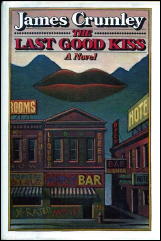
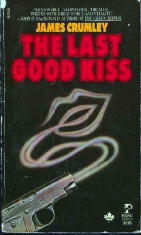
JAMES CRUMLEY – The Last Good Kiss. Random House, hardcover, 1978. Reprint paperback: Pocket, 1981. Vintage Books, trade ppbk, 1988.

JAMES CRUMLEY

   Most private eyes work out of huge metropolitan cities like New York, Los Angeles and San Francisco. Through the years a handful of others have based their somewhat seedier operations in midwestern population centers such as Chicago, Cleveland and Indianapolis.

   On television this season there is an example of how a Las Vegas detective goes about his business, but you’d have to admit that the glamor and glitter of that particular show is far from typical of mainstream America, and so it remains far more reminiscent of that old stand-by of the pulp magazines, the Hollywood private eye story.

   C. W. Sughrue’s home is Montana, however, and his outlook on life and happiness, or the pursuit thereof, is correspondingly closer to a segment of American demographics long ignored by other authors, obsessed with the bizarre vagaries of life in southern California, for example.

   Rocky Mountain jade. Sughrue is often dirty and unshaven, and a good deal of the time he’s drunk, or close to it, but never obnoxiously so. He’s as much a combination of hippie and redneck as either variety of humanity could ever recognize as possible. He mixes affably with both, and yet he has the same moral obligation to himself that all the great private detectives of literature have had to have hidden inside.

JAMES CRUMLEY

   The story, as it strips his character carefully away in layers, is so intensely revealing that for him to become yet another series creation would be close to pointless.

   As muddled — or even more so — as any in real life, the story begins with a hunt for a famous bar-hopping poet and novelist who takes him on a binge through several states before he’s found, but before he can return home Sughrue is sidetracked into chasing down a runaway girl, lost and not found in the pornographic environs of San Francisco ten years earlier.

   Lives are muddled as well, and revelations are painfully hard to come by. The tale that Crumley has to tell builds slowly and easily into a climax that explodes with all the emotional thrill of a gut-satisfying revenge about to be released.

   Crumley is not the new Hammett. He’s closer to Chandler, if names must be dropped, but in several ways he’s the equal of both, their peer. In fact, he’s that rarity, an authentic rough-hewn original, and they don’t happen along very often.

— Reprinted from The MYSTERY FANcier, Vol. 3, No. 3, May-June 1979 (very slightly revised). This review also appeared earlier in the Hartford Courant.


[UPDATE] 04-14-09.   Some comments from me, thirty years later. I have not re-read the book at any time between then and now.

(1) Here’s the first line of the book, still one of the more memorable ones of hard-boiled crime fiction, in my opinion:

    “When I finally caught up with Abraham Trahearne, he was drinking beer with an alcoholic bulldog named Fireball Roberts in a ramshackle joint just outside of Sonoma, California, drinking the heart right out of a fine spring afternoon.”

(2) I do not know what TV show I was referring to in the second paragraph. I could look it up, but if you know without resorting to a reference book, leave a comment. I have no prizes to offer to the first one to come up with the correct answer, I’m sorry to say.

(3) It is difficult, sometimes, for a reviewer to say exactly why he or she likes a book. It is far more easy to say why you don’t. Reading this review for the first time in the same 30 years, I’m disappointed (but not surprised) that I wasn’t more clear as to what I read that produced this rave review. (In the MYSTERY FANcier version, but not the one in the Courant, you might like to know that I included a rating: A Plus.)

(4) Somewhere in the middle I suggested that it would be difficult for Crumley to continue using C. W. Sughrue as a series character. As we know now, there were other books, but as I recall none of them knocked my socks off as much as this one. I’ll add a complete list below. (It did take 15 years for Crumley to write about Sughrue again.)

(5) At the end of the review, I compared Crumley to both Hammett and Chandler, saying he was their equal. In the long run, while the author and his books are both cult favorites, I don’t think his career was anywhere near as successful (or known today) as I thought it might. Am I wrong about this?

C. W. SUGHRUE.   [James Crumley]

       * The Last Good Kiss. Random House, 1978.
       * The Mexican Tree Duck. Mysterious Press, 1993.

JAMES CRUMLEY

       * Border Snakes. Mysterious Press, 1996. Note: Crumley’s other PI character, Milo Milodragovitch, also appears in this book.
       * The Right Madness. Viking, 2005.

THE GOLDEN AGE OF BRITISH MYSTERY FICTION, PART IV
Reviews by Allen J. Hubin.


   Hal Pink’s obscurity in this country is total. None of his thirteen books from 1932 to 1941 was published here, and I think Pink escapes notice in every commentary on the genre known to man or beast.

   So at least I wasn’t over-expectant in approaching The Strelson Castle Mystery (Hutchinson, 1939), but it turned out to be a cheerful, fast and gratifying read. No detective story, this; it’s a thriller, with bad guys and good guys clearly identified at the outset.

   The good guys are a trio of bachelors, vacationing in Europe’s vest-pocket kingdom of Zovania. The bad guys are trying to grab control of a mysterious fortune, apparently hidden somewhere in Zovania’s titular castle, which has just been inherited by beautiful British opera star Coralie Mayne.

   The fun begins at the Zovanian border, and then it’s pell mell action all the way, in two batches – since the chief villain, vanquished once, brews another rotten scheme and surfaces again in his sewer.

***

   Burford Delannoy wrote a number of volumes of crime fiction around the turn of the century, some of which are collections of detective short stories and vanishingly scarce. Denzil’s Device (Everett, 1904) is one of his novels and, for all its antiquity and stylistic peculiarity, it surprised me with its effectiveness, especially in the portrayal of odious villainy.

   The peculiarity lies in a pronounced tendency toward subjectless sentences (the subject of the previous sentence applies but is left unstated); this is compensated for by a wryly humorous turn of phrase. And while the basic outcome is fairly well assured from the outset, some uncertainty and suspense about details develops.

   Denzil is wealthy and evil. He lusts after the daughter of a judge, but she rejects him for an actor. Denzil’s device is a scheme to acquire the girl (willingly or not) and revenge himself upon the actor. For his purposes he makes use of a murderous lowlife and an embittered mimic; for his downfall the careful attentions of Detective Doyle and colleagues must be praised.

***

   My only reading of the works of Annie Haynes involves The Blue Diamond (Lane, 1925), which I found effective — surprisingly effective, even, in creating complexity and mystification and in arousing my interest.

   We meet the wealthy and titled Hargreaves, whose estate lies near Lockford in Devonshire, and who own the titular gem. A beautiful young woman, afraid and bereft of her memory, is found one night on the estate. The Hargreaves allow the woman to make the manor her home until her memory returns, or until her family can be traced.

   She soon wins the hearts of most of the household, especially that of Sir Arthur, the impressionable male head of the line who is just reaching his majority. No trace of the woman’s earlier existence can be found; her memory does not return. She stays on, and Sir Arthur’s swoon deepens.

   Not everyone, however, finds her credible, and the disappearance without trace (apparently through locked doors) of a nurse brought in to aid her recovery casts a pall on the manor. And brings in the police…

***

   NOTE: Go here for the previous installment of this column.

[EDITORIAL UPDATE] 04-13-09. There are few authors so obscure that no one recognizes their name. In spite of the fact that not a single one of Hal Pink’s fourteen mysteries is offered for sale online right now — I just looked — Bill Pronzini had this to say when this set of reviews first appeared:

    “One minor point in re Hal Pink: It’s true that none of Pink’s novels was published here in book form, but he was published in the U.S. A handful of his short stories appeared in such magazines as Mystery (The Illustrated Detective Magazine) and Street & Smith Detective Story in the early 30s. Pretty good stories, too.”

    Steve again: There’s nothing like a comment like that to prompt a checklist. I’ve come up with three stories from US magazines, but if someone more knowledgeable than I knew more about the British pulps than I do, I would expect the list to be a whole lot longer.

         The Blond Raffles, Mystery, February 1934.
         Bat Island, Mystery, March 1934.
         The Fires of Moloch, Detective Story Magazine, September 1939.

   Some time later, I heard from Christine Craghill, a relative of Mr. Pink’s whom I corresponded with for a while. I’ve lost contact with her, so I haven’t asked, but I hope she doesn’t mind my reprinting some of the information she found out about him. I’ve left out a good deal, but this is the essential data:

    “Hal’s real name was Harry Leigh Pink (Leigh being his middle name, given in respect of his step grandfather Edmund Leigh) and he was born in 1906 on the Wirral Peninsular in Cheshire, England. He was the son of my grandfather’s brother Frederick Pink and his wife Ethel. So I was right with my first hunch about him, he was my father’s cousin and therefore my second cousin. […] He died in Bakersfield [California] in 1973.”

   In her first email to me, Christine thought that Hal Pink’s name was really Percy Pink, which is the information that’s given in Part 31 of the online Addenda to the Revised Crime Fiction IV, by Allen J. Hubin. This she corrected in a later email, having discovered that Hal and Percy were actually brothers.

   One last note: Hal Pink’s The Test Match Mystery (1941) is mentioned very briefly by Marv Lachman in an article he wrote called “A Yank Looks at Cricket and the Mystery Story.” Worth a look, I think, if you haven’t seen it before.
HAL GLATZER – The Last Full Measure.

Perseverance Press; trade paperback original; April 2006.

HAL GLATZER The Last Full Measure

   Number three in the continuing mystery-solving adventures of itinerant 1940s swing band musician Katy Green turns out to be measurably better than number two, A Fugue in Hell’s Kitchen (2004), in my opinion, but still not nearly as fine as number one, Too Dead to Swing (2002), which is still the best of the three so far.

   The primary setting for Katy’s latest adventure is an ocean liner that is headed for Hawaii in December, 1941.

    “Ah, ha!” you say. Yes, and you’d be right.

   It is indeed one of those novels in which the reader knows exactly what is in store, but for the passengers and crew, all they’re aware of are rumbling war clouds somewhere off in the distance (but getting closer and closer as time goes on). Katy is part of an all-girl group hired to entertain the passengers, and while you might think impending events would be trouble enough, it is not so.

   There is a murder on board, but as it is also one with no real suspects. Once the ship arrives in Hawai’i, there is (strangely) nothing to forestall a side journey by a subgroup of the all-girl orchestra and various other passengers to locate a treasure buried by native Hawai’ians during a failed insurrection against the haoles in control of the islands many years before.

HAL GLATZER

   Of course this recitation of historical events requires a couple of short lectures, but while while they’re necessary, they also slow the action to a temporary crawl.

   Soon enough, however, it is back to the still unsolved murder, committed by one of the dumbest villains in print, magnified by two events having probabilities of say, one in a million each. (Since the events are not likely to be independent, the overall combined probability of the two events both happening is NOT found by multiplying the two individual probabilities together, so perhaps it’s not as bad as it sounds.)

   Other than that, the travelogue and on the on-board camaraderie are nicely done and may be in themselves worth the price of admission. The author certainly knows his music, and it shows.

— March 2006


   Note: A shorter version of this review appeared in Historical Novels Review.

[UPDATE] 04-06-09.   This was, alas, the last of Katy Green’s adventures in print, so far. Author Hal Glatzer is also a playwright as well as a writer and (not surprisingly) a musician. You can visit his website here.

THE GOLDEN AGE OF BRITISH MYSTERY FICTION, PART III
Reviews by Allen J. Hubin.


   My first sampling of British author John Laurence, The Fanshawe Court Mystery (Hodder & Stoughton, 1925), quite encourages me. This is a well-paced tale, nicely complex in plotting and properly mystifying.

   Sometime detective story writer John Martin is riding his motorcycle along a rural lane one rain-filled night, headed for home, when flagged down by the beautiful girl he’s worshiped from afar but not yet met. The girl has come through a forest path and urgently asks a ride to the station so she can catch the train to London.

   He helps her, and later learns that a reclusive local resident has been found murdered along that path. Why was he killed, and what roles do the girl and her dragon-aunt play? Supt. Barlow seems not to be making much headway, so Martin and a crime reporter do their own digging, as much to save the girl as anything else. Gradually threads of conspiracy, fraud, murder and revenge emerge.

***

JOHN GLOAG Ripe for Development

   Ripe for Development (Cassell, 1936) is one of several novels by John Gloag about Lionel Buckby, and it’s a rather peculiar affair. Buckby has private money and only one passion: old furniture. He’s not very fond of the U.S…

    “There was no sherry in America; nobody had a palate for wine; nobody really understood comfort – they gave you plumbing, central heating, air-conditioning, non-stop noise and high speed and called the whole thing luxury and progress. It was good to be back in real civilization.”

   …and he’s one of the least perceptive protagonists in the genre. He gets mixed up with a crooked New York art importer and a pair of Chicago gangsters and never catches the drift. The results are nearly fatal – but New York’s Insp. Slamble, allied with the Yard at the end, comes to the rescue. The scheme has something to do with furniture bearing Buckby’s authentication being shipped across the Atlantic. Amusing in spots but not impressive.

***

   Another British author of total obscurity is Josephine Plain, who perpetuated three mysteries featuring Colin Anstruther in the 1930s. One of these is The Secret of the Snows (Butterworth, 1935), set in a Swiss mountain village.

   Detestable chemist Alfred Gitterson married a young and beautiful and fearsomely superficial wife and in due course got himself strangled on a mountainside. Or so it appears at first glance. At second glance circumstances change drastically and it seems physically impossible for only one person to have done the deed.

   Anstruther is providentially vacationing on the spot. He wants no part of the matter, but his old friend, Swiss detective M. Maraud, draws him in – and in any case Colin had suspected one of the principals of murder in an earlier case.

   Various characters are slowly revealed for what they are as Colin and Maraud struggle against an impossibility which gets worse the more they dig. Pleasant and well-written as this is, it neither plays fair nor convinces nor satisfies in resolving the puzzle.

***

   NOTE: Go here for the previous installment of this column.

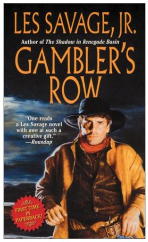
LES SAVAGE, JR. – Gambler’s Row.

Leisure, paperback reprint; 1st printing, February 2003. Hardcover edition: Five Star, February 2002.

LES SAVAGE JR Gambler's Row

   Yes, this is a western, and if you’re a mystery fan only, you can go right on to the next review, if you prefer. But over the past few years Five Star has been doing western fans a great big favor in publishing collections of vintage pulp stories like this one, and thanks to Leisure Books as well, many of them are now available in cheaper editions.

   There are three short novels in this one, all previously appearing in the badly flaking pages of Lariat Magazine, circa 1945-48. But where’s the crime connection, you ask? I’m glad you did, since I was coming to that. In “Gambler’s Row,” the title story, a wandering cowpoke named Drifter (well, yes) is hired by the female owner of the Silver Slipper to locate the sole witness to a murder.

   In “Brush Buster” the only crime is cattle rustling, but it does take some detective work on the part of small-scale rancher Nolan Moore to track them down (and win the hand of lush, full-bodied Ivory Lamar). And in “Valley of Secret Guns” one-armed bronc-buster Bob Tulare is suspected by a gang of rustlers and killers of being a private detective, working undercover to bring them to justice. There is, of course, a woman involved as well.

LES SAVAGE JR Gambler's Row

   As you can probably tell, Al Hubin isn’t likely to include this book in the latest edition of his Bibliography of Crime Fiction, nor would I if I were he, to tell you the truth, but like most westerns, it’s not all that far afield. The stories are melodramatic, especially the first one; humorous, especially the last one; romantic, all three of them; and, most importantly, authentic, again all three of them.

   If you read carefully enough, you can learn how to track someone on horseback without being spotted; how to retrieve cattle used to running wild in the mesquite and thick brush along the Mexican border; and how to break killer horses at five dollars a bust.

   There are cowboy terms in this book that I’ve never heard of, and I don’t think Savage made them up. From page 160: “Center-fire rig popping and snapping beneath him, Tulare unhitched his dally … he didn’t have to get too close with forty-five feet of maguey in his hand.”

   Savage also writes great fight scenes, a few that go on for pages. Not great literature, by any means, but for the market for which they were written, these stories are top of the line.

— March 2003

REVIEWED BY WALTER ALBERT:         


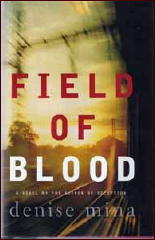
DENISE MINA – Field of Blood. Little, Brown; hardcover, July 2005; Bantam, pb, April 2006.

DENISE MINA

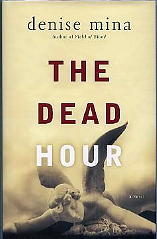
       — The Dead Hour. Little, Brown; hardcover, July 2006; Back Bay Books, trade pb, February 2008.

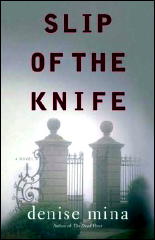
       — Slip of the Knife. Little, Brown; hardcover, Februray 2008. First published as The Last Breath (UK, Bantam Press, 2008).

    I thought that Denise Mina’s Garnethill (Carroll & Graf, 1999) marked the debut of a outstanding crime writer. I was less taken with her stand-alone novel Deception (Little, Brown, 2004). But her new series with neophyte reporter Paddy Meehan has, for me, validated the promise of her early work.

DENISE MINA

    Paddy, a bright young woman obsessed with a negative self-image, establishes a tentative hold on the bottom rung of the journalistic ladder in a small Scottish newspaper in Field of Blood, her first appearance, while in The Dead Hour she has risen to full-time employment on the night shift, hoping to get the story that will gain her the respect of her colleagues, and make her career.

    She lucks into it but with bent cops trying to effect a coverup and both Paddy’s life and career on the line, she follows leads that could prove her suspicions or kill her.

DENISE MINA

    In Slip of the Knife she’s achieved her journalistic ambition with a position as a newspaper columnist that brings her recognition if not the complete personal satisfaction that is the more elusive goal. When she learns that a close friend and sometime lover has been murdered and that she has inherited his scrubby estate, she finds she has also inherited his troubled history and deadly secrets that now threaten her.

    This still developing series has the drive of the early Rankin Rebus outings, with a potentially self-destructive protagonist who rivals Rebus in her ability to court disaster without falling prey to it. She may not ask for the reader’s attention, but the power of her narrative voice demands it.

« Previous PageNext Page »