Reviews


A 1001 MIDNIGHTS Review
by Bill Pronzini:


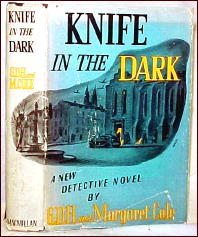
G. D. H. & MARGARET COLE – Knife in the Dark.

Collins Crime Club, UK, hardcover; Dec 1941. The Macmillan Co., US, hardcover, 1942 (shown below).
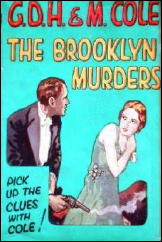
GDH & M COLE Brooklyn Murders

   G. D. H. and Margaret Cole were extremely prolific writers between the two world wars: individually and collaboratively, they published well over two hundred books of fiction, nonfiction, and verse.

   G. D. H. was a prominent social and economic historian; his five-volume A History of Social Thought is considered a landmark work. Dame Margaret is best known for her biographies of Beatrice Webb and of her husband (The Life of G.D.H. Cole, 1971).

   The Coles co-authored more than thirty “Golden Age” detective novels, beginning with The Brooklyn Murders in 1923, and six volumes of criminous short stories. Knife in the Dark is their next to last novel, and the only one to feature Mrs. Warrender as its protagonist.

   “A naturally trim and tidy old lady,” Mrs. Warrender is the mother of private detective James Warrender (who affectionately calls her, among other things, “an incurably meddling old woman”). She is also solidly in the tradition of such “little old lady” sleuths as Miss Jane Marple and Hildegarde Withers, although less colorful than either of those two indefatigable crook-catchers.

   Knife in the Dark takes place at a mythical ancient English university, Stamford, during the dark days of World War II. Kitty Lake — wife of Gordon Lake, a teacher of Inorganic Chemistry whose mother is a cousin of Mrs. Warrender’s — is stabbed to death during an undergraduate dance which she herself arranged.
GDH & M COLE Knife in the Dark

   Any number of people had a motive to do away with the mercurial Kitty, who had both a mean streak and a passion for other men; the suspects include her husband, an R.A.F. officer, a young anthropologist, a strange Polish refugee named Madame Zyboski (who may or may not be a Nazi spy), and a dean’s wife whom James Warrender describes as “an awful old party with a face like a diseased horse and a mind like a sewer.”

   Like all of the Coles’ mysteries, this is very leisurely paced; Kitty Lake’s murder, the only one in the book, does not take place until page 104, and there is almost no action before or after. Coincidence plays almost as much of a role in the solution as does detection by Mrs. Warrender (who happens to be staying with the Lakes at the time of the murder); and the identity of the culprit comes as no particular surprise.

   For all of that, however, Knife in the Dark is not a bad novel. The characters are mostly interesting, the university setting is well-realized, and the narrative is spiced with some nice touches of dry wit. Undemanding fans of the Golden Age mystery should find it diverting.

   Mrs. Warrender’s talents are also showcased in four novelettes collected as Mrs. Warrender’s Profession (1939). The best of the four is “The Toys of Death,” in which Mrs. W. solves a baffling murder on the south coast of England.
GDH & M COLE

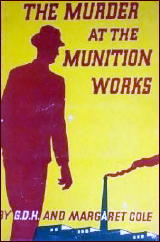
The Coles also created three other series detectives, none of whom is as interesting an individual as Mrs. Warrender. The most notable of the trio is Superintendent Henry Wilson of Scotland Yard, for he is featured in sixteen novels, among them The Berkshire Mystery (1930), End of an Ancient Mariner (1933), and Murder at the Munition Works (1940); and in the collection of short stories, Superintendent Wilson’s Holiday (1928).

         ———
   Reprinted with permission from 1001 Midnights, edited by Bill Pronzini & Marcia Muller and published by The Battered Silicon Dispatch Box, 2007.   Copyright © 1986, 2007 by the Pronzini-Muller Family Trust.
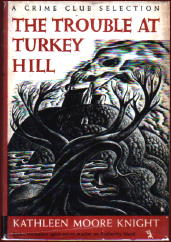
KATHLEEN MOORE KNIGHT – The Trouble at Turkey Hill.

Doubleday Crime Club, hardcover, 1946. Hardcover reprint: Detective Book Club [3-in-1 edition], June 1946.

KATHLEEN MOORE KNIGHT Turkey Hill

   My wife Judy and I moved to Connecticut in 1969. I’m a transplant from Michigan and not a native New Englander at all. I don’t know if there really is a Penberthy Island, where many of Kathleen Moore Knight’s books take place, and if there isn’t, while I can’t tell you which one she may have used as a model, Martha’s Vineyard certainly suggests itself.

   No matter. There has to be plenty of communities all along the Cape Cod coast that are just like it, and all of them are ideal places to live, too, if you don’t mind tourists. I count a total of sixteen Elisha Macomber murder mysteries, he being her most commonly used series character. On a per capita basis, I think you’d have to admit, Penberthy would have to be a terribly dangerous place to hang your hat.

   What Elisha Macomber does is operate the village fish market, but besides that, he’s also the chairman of the local Board of Selectmen. So in addition to being considered an autocratic father figure by the entire island, he’s also the investigative officer whenever another murder occurs.

   In this case he’s in charge of tracking down the killer of the wife of a recently returned war veteran.

   Telling the story is Miss Marcella Tracy, librarian and former school teacher. A lot of strange things happen to confuse matters, and even though everyone already has a sharp eye out into everyone else’s affairs, I got the feeling that calling all the suspects together into one big room to be confronted with all the evidence all at once might not have been such a bad idea. It’s that kind of story.

   I’m too embarrassed to say that I mucked the solution up something fierce, so I won’t.

— Reprinted from The MYSTERY FANcier, Vol. 3, No. 4, July-Aug 1979 (revised).


[UPDATE] 02-28-09.   One of the corrections I made in the review was the number of Elisha Macomber books there were. The number above is now the right one. Kathleen Moore Knight also wrote four books between 1940 and 1944 with Margot Blair as the leading character. According to the Golden Age of Detection Wiki, Blair was a partner in a public relations firm called Norman and Blair.

   I don’t think I’ve read any of the latter’s adventures, but I have read (and as I recall, enjoyed) three or four of Elisha Macombers, which appeared over a long period of time, from 1935 to 1959. That’s a long run for a fellow who’s probably next to unknown to most mystery readers today. It is a shame.

   From the Revised Crime Fiction IV, by Allen J. Hubin, here’s a list of all sixteen. Note that a couple of pre-war cases took place in Panama. Macomber then disappeared for six years while the war was going on. I wonder what that was all about.

MACOMBER, ELISHA    [Kathleen Moore Knight]

      Death Blew Out the Match (n.) Doubleday 1935 [Massachusetts]
      The Clue of the Poor Man’s Shilling (n.) Doubleday 1936 [Massachusetts]
      The Wheel That Turned (n.) Doubleday 1936 [Massachusetts]
      Seven Were Veiled (n.) Doubleday 1937 [Massachusetts]
      Acts of Black Night (n.) Doubleday 1938 [Massachusetts]
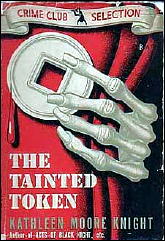
      The Tainted Token (n.) Doubleday 1938 [Panama]

KATHLEEN MOORE KNIGHT

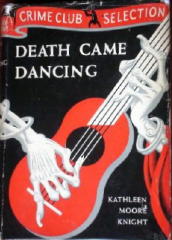
      Death Came Dancing (n.) Doubleday 1940 [Panama]

KATHLEEN MOORE KNIGHT

      The Trouble at Turkey Hill (n.) Doubleday 1946 [Martha’s Vineyard]
      Footbridge to Death (n.) Doubleday 1947 [Martha’s Vineyard]
      Bait for Murder (n.) Doubleday 1948 [Martha’s Vineyard]
      The Bass Derby Murder (n.) Doubleday 1949 [Martha�s Vineyard]
      Death Goes to a Reunion (n.) Doubleday 1952 [Massachusetts]
      Valse Macabre (n.) Doubleday 1952 [Martha’s Vineyard]
      Akin to Murder (n.) Doubleday 1953 [Massachusetts]
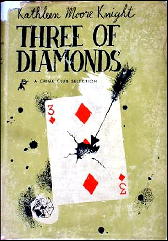
      Three of Diamonds (n.) Doubleday 1953 [Martha’s Vineyard]

KATHLEEN MOORE KNIGHT

      Beauty Is a Beast (n.) Doubleday 1959 [Martha’s Vineyard]

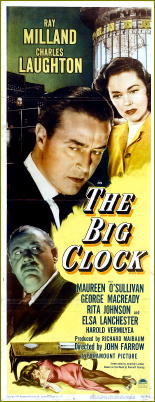
THE BIG CLOCK Ray MillandTHE BIG CLOCK. Paramount, 1948. Ray Milland, Charles Laughton, Maureen O’Sullivan, George Macready, Rita Johnson, Elsa Lanchester, Harry Morgan, with uncredited appearances by Noel Neill and Ruth Roman. Screenplay: Jonathan Latimer, based on the novel by Kenneth Fearing. Director: John Farrow.
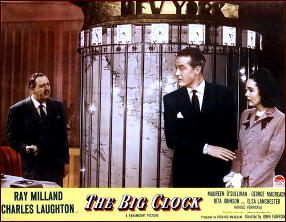
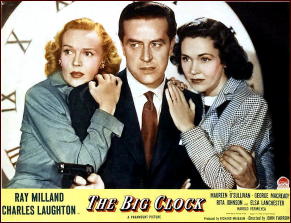
   I’ve not read the book, or at least not so recently that I remember reading it, but from what I have been able to tell, the movie follows the text fairly closely — except for one thing. In the movie George Stroud, the highly successful editor of a true crime magazine, does not go to bed with the woman whose murder he finds himself framed for.

   Otherwise the story apparently stays very much the same. The big kicker in both the book and the movie is that Stroud is put in charge of the ensuing investigation; that is, of finding the “killer,” himself, by his publisher, Earl Janoth, who in actuality — and in a sudden burst of abhorrence — really did commit the murder. The dead woman was Janoth’s mistress, and their relationship had been going sour for several weeks.

   If I’m wrong about the book, let me know, but Jonathan Latimer’s screenplay can stand on its own, regardless. Ray Milland plays George Stroud, a very capable, self-assured fellow, but a very foolish guy in hanging around with Pauline York (Rita Johnson) when he has a wife (Maureen O’Sullivan) who is still waiting for a honeymoon after seven years of marriage.

THE BIG CLOCK Ray Milland

   Milland is very good as the man who finds himself more and more trapped in a web partly of his own making, as his own team of reporters continues to close in on him at Jaroth’s command.

   Even better is Charles Laughton as that very same fastidious publisher, prig and interminably stuffy, a haughty person obsessed with time and efficiency and minimal cost, only to startle himself (momentarily) into becoming a normal person afraid of being caught at something he later can’t comprehend having done.

   Maureen O’Sullivan doesn’t have a lot to do as Georgette Stroud, only to nag him (and rightfully so) and then stand beside him (at last) when he needs her most. Most viewers call this a classic noir film, and even if you haven’t seen it yourself, I hope my description of it will have you nodding your head and saying yes.

   Occasionally disrupting the dark and desperate mood, though, are a few moments of comic relief, mostly (but not solely) at the hands of Elsa Lancester as a wacky, bohemian artist with a flat full of kids who can identify Stroud, but for (very good) reasons of her own, decides not to.

THE BIG CLOCK Ray Milland

   I certainly didn’t mind the comic interludes, but I wonder if purist noir aficionados do. The ending is a doubly happy one (I think), preceded by some very good detective work. Most entertaining, with emphasis on the “most.”

   I watched this movie about several weeks ago, and I just watched it again before writing up these comments. I enjoyed it immensely both times, but there is a lot going on in this movie that I haven’t even begun to mention, and it takes more than one watching to appreciate it all.

   I have it penciled in on my calendar to see it again in about a month from now.

PostScript: Ray Milland, Jonathan Latimer and director John Farrow teamed up at least one other time in Alias Nick Beal (1949), which I reviewed here last summer.

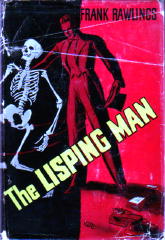
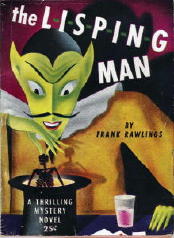
FRANK RAWLINGS – The Lisping Man.

FRANK RAWLINGS The Lisping Man

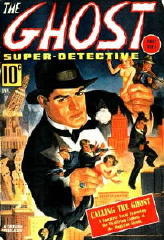
Atlas Mystery/Hercules Publishing Corp.; digest-sized paperback; first printing, 1944; abridged. Hardcover edition: Gateway Books, 1942. Based on the short novel “Calling the Ghost,” the first appearance of the Ghost/Green Ghost pulp hero character, magician-sleuth George Chance, in The Ghost, Super-Detective, January 1940, as by G. T. Fleming-Roberts.

   For a longer and much more comprehensive look at the complicated background behind this story, go to Monte Herridge’s excellent article “Chance Without a Ghost,” located here. Monte goes into a considerable amount of detail in pointing out all of the changes that were made by Fleming-Roberts between the pulp story and the digest paperback, with a hardcover appearance in between.

   The most significant of these alterations turned out to have been all of the pulp hero apparatus that was abandoned for the novel — no secret identity nor hidden hideaway nor so on — leaving George Chance as only a magician by profession and a crime-solving sleuth as a sideline, only one step up from being a hobby, you might say.

   Monte did not believe that the story was very good.

   I agree. In fact, I thought it was quite bad, if not awful, but with reservations. Working pretty much in the dark, I’m inclined to lay a good chunk of the blame on the second set of changes: on whoever the editorial staff was whose responsibility it was for trimming a standard-sized hardcover down to a fairly slim paperback. The latter is the only version I have, and as it was for Monte, that’s all that I can base my comments on.

   So how much was cut, or whether it was done crudely or with any amount of skill, I do not know. The fact is that when a book is cut and trimmed and comes out as, well, ineptly as this one, it’s difficult to give the full responsibility to the author for how the final version reads, especially as in this case, when it does not turn out well.

   [FOLLOWUP: It’s not exactly a footnote, but Bill Pronzini, a fellow pulp fiction aficionado, will have more to say about this when I’m finished with the rest of the review, which follows. Keep reading.]

FRANK RAWLINGS The Lisping Man

   I mentioned that crime-solving was an avocational passion for George Chance. A good example that I can use to demonstrate just exactly how obsessive and attracted Chance is to strange murder cases comes only one or two chapters into the book, as he leaves his new wife Merry on their wedding night to help Inspector Ames investigate the suicide of one Leonard Van Sickle, who apparently jumped (or was pushed) from a hotel room twenty floors above the pavement.

   What makes this a strange case is that Leonard Van Sickle had telephoned Chance only hours before, with no indication in the call that he was planning on ending his life. What is also strange is that he talked with a lisp. Hence the title. It also turns out (page 67) that the dead man had recently had all of his teeth extracted.

   Explains the dentist:

    “I wouldn’t have complied with the patient’s request to extract healthy teeth had it not been for the fact that I needed money badly,” Dr. Chambers confided. “I thought there was something suspicious about the whole setup. …”

   As you have probably suspected, there is something funny about it, all right, and you also would probably not be astonished to learn that there is a lot of fuss made about life insurance policies and who collects and who doesn’t.

   There is some intelligence behind the plot, but it is seemingly indifferently and/or non-skillfully told most of the way through, culminating in a “gather all of the suspects together” scene that does not depend on more than a modicum of a magician’s sleight-of-hand in any substantial manner, shape or form.

FRANK RAWLINGS The Lisping Man

   What it does rely even more upon is the answer to the question, “Whose hands will show up like phosphorus under an ultra-violet light?”

   It didn’t take a magician to think of this. I think that if a magician is a sleuth, he ought to do more with his prestidigitation and legerdemain than pull cigarettes out of the air or coins out of people’s ears. (I’m speaking figuratively here, as what is up George Chance’s sleeve at a crucial moment is, well, crucial.)

   There is a decent detective novel hidden in the depths of this one, perhaps. I just didn’t happen to read it, or I was too lazily intent at the time on reading the one that was there, not the one it could have been.

FOLLOWUP: After finishing my review above, and telling Bill Pronzini only the gist of what I’d said, I asked him about the differences between the hardcover and the paperback version of the novel. (I could think of no one else who might possibly have read both.) Here’s his reply:

    “The uncut hardcover edition of The Limping Man is marginally better than the abridged paper one, which eliminates a fair amount of descriptive material that fleshes out the story and some connective material whose absence makes for choppy reading. It’s still not a very good novel, though, particularly when compared to the pulp version — no doubt the reason Fleming-Roberts didn’t want his own name on it and why it didn’t find a better publisher than Leo Margulies’ Gateway.”

— April 2006

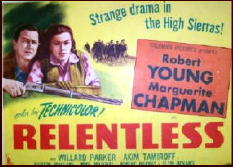
RELENTLESS Young ChapmanRELENTLESS. Columbia, 1948. Robert Young, Marguerite Chapman, Willard Parker, Akim Tamiroff, Barton MacLane, Mike Mazurki, Clem Bevans. Based on the novel Three Were Thoroughbreds by Kenneth Perkins. Director: George Sherman.
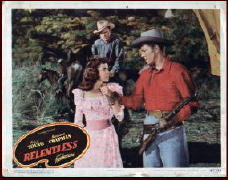

   I taped this movie many years ago, but for a time that was just as long, I put off actually sitting down and watching until several days ago. I just couldn’t see Robert Young as a cowboy star, you see. Once you know an actor as a family man (Father Knows Best) or a kindly family doctor (Marcus Welby, M.D.). it’s hard to go back and see him in a western like this one, or even a crime film. He just doesn’t fit the image.

   Looking through his list of credits, though, I see that Young was in Western Union (1941) and another film I don’t recall knowing about before, The Half-Breed (1952). I may have missed another, but even so, while it’s not a long list, he’s hardly a zero in the western category. (His first movie credit may have been The Black Camel, the 1931 Charlie Chan film with Warner Oland.)

RELENTLESS Young Chapman

   And in Relentless he proved to me that he could shoot, he could ride, and he was good with horses, and that’s a fact, even if he still looks like a dude to me. In the story, he’s a drifter who’s framed for the murder of one of a pair of claim-jumpers.

   Turns out, of course, that it was the other half of the pair who did it, and to clear his name Nick Buckley (that’s Young) has to track down the real killer (that’s Barton MacLane) while the sheriff (Willard Parker — he’s the one on the right in the lobby card above — who later became Ranger Jace Pearson on TV’s Tales of the Texas Rangers) is hard on his heels throughout the movie.

   Where does Marguerite Chapman come in? you ask, and you should. She’s the proprietor and sole operator of a general store in a covered wagon, sort of a traveling saleslady, you might say. When she (Luella Purdy) and Nate Buckley both proclaim their independence and total disinterest in getting hitched up with anyone, you know from that moment on that their fate is sealed — even though when Luella once shows up in a dress rather than in her rather fetching cowgirl garb, Buckley barely takes notice — seemingly far more interested in the colt he’d had hopes of raising into a race horse than in her.

RELENTLESS Young Chapman

   Marguerite Chapman, a vivacious brunette and a true girl-next-door type, had a decent career in Hollywood, but sadly, I don’t believe that the general public remembers her at all today.

   Interestingly, IMDB says she was asked to appear as “Old Rose” Calver in Titanic, but she was too ill at the time (1997, when she was 89) and the role went to Gloria Stuart. (She’s far too glamorous in the close-up photo I’ve found. She doesn’t look anything like this in this movie, but I thought I’d show it to you anyway.)

   As for the movie itself, filmed in color to good effect, it keeps the players on the move throughout the film, with more than enough story line to fill its full 90 minutes or so. It’s even entertaining enough to watch a second time.

   But getting back to Robert Young, even after all this, I still have to tell you that he’s too soft-spoken and nice to be a western star. As a guy more interested in his horses rather than the girl — for all but the final scene! — he’s dumb enough in that sense to be one, that’s for sure.

G. D. H. & MARGARET COLE – Knife in the Dark.

Collins Crime Club, UK, hardcover; Dec 1941. The Macmillan Co., US, hardcover, 1942 (shown).

GDH & M COLE Knife in the Dark

   More than usual, there are a couple of remarkable aspects to this wartime mystery. The first is the identity of the primary sleuth, and it is definitely not private detective James Warrender, as I carelessly (and rather chauvinistically) assumed when I picked the book up to read. Unh-uh. Not at all. It’s Mrs. Elizabeth Warrender instead. His mother.

   Belatedly checking with Hubin’s Crime Fiction IV, I found that this was the only full length novel in which Mrs. Warrender was in. Altogether the Coles wrote more than thirty mysteries, and the detective in most of them was Scotland Yard’s Superintendent Wilson. While James Warrender’s mother appeared in an earlier collection of novelettes and short stories called Mrs. Warrender’s Profession, 1939, this was the only novel.

   Someone else will have to tell me, because I can’t come up with any — what other private eye character ever found himself upstaged in a detective story by his mother?

   The other aspect that I found remarkable — and so, therefore, I’m obliged to remark on it, aren’t I? — was the identity of the murder victim. Up until her death, I thought she had the most vibrant, most interesting personality of anyone else in the book, and it was difficult to see her go.

   Not that she was without faults. Check the date of the novel again. As the wife of a dull academic in a university town, the woman was well known for her intolerance and for speaking out against the aliens being resettled in the city — refugees from a Europe suffering from a war we here in which the United States had not yet become involved. The lady was also a bright flame in the town’s small community of scholars, drawing unattached students to her like the proverbial moths, not to mention the occasional faculty member.

   She, in fact, is at one point described in a word I doubt that Agatha Christie ever used, a nymphomaniac. (Erle Stanley Gardner might have called this book The Case of the Unscrupulous Siren.)

   The murder takes place at a public dance for which she was the hostess, and there are many suspects, many opportunities, a coincidence or two, and — it’s just the kind of mystery the Golden Age of Detective Stories is known for, even if the details of the plot aren’t quite as sharp as they should be. (Fuzzy around the fringes, you might say.)

   Mrs. Warrender, approaching 70 in this book, is perhaps of a little higher class standing than the aforementioned Mrs Christie’s Miss Marple, but she has the right instincts, and I humbly apologize to her for wondering why on earth the private eye’s mother is tagging along with him.

— February 2003


[UPDATE] 02-25-09. Quite remarkably, when I fished this review of out of the “archives,” the only two things that I remembered about the book were the two things that I wrote about it in my commentary. Either I was spot on in writing it up the first time, or in the process of writing it up, it reinforced in my mind the two aspects of it that I would find again remarkable at a later date; that is to say, now.

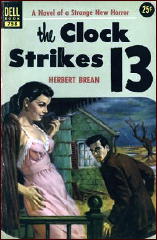
HERBERT BREAN – The Clock Strikes Thirteen.

William Morrow, hardcover, 1952. Paperback reprint: Dell 758, [1954]. A shorter version first appeared in Cosmopolitan magazine, June 1952.

HERBERT BREAN

   I’ll tell you this, I’ve never read a mystery quite like this one. It takes place on a desolate island, off the coast of Maine. There’s no animal life and no vegetation. It’s completely dead and abandoned, all except for a small group of dedicated research biologists, busily working away on more, even more deadly concoctions for the Defense Department.

   But soon after journalist-photographer Reynold Frame arrives, summoned by a soon-to-be announced discovery, the scientist in charge (not quite mad) is clubbed to death, and several trays of germ culture are overturned. With all contact with the mainland cut off, and with the threat of sudden death constantly in the air, the murder investigation perforce goes on.

   In spite of the bizarre, even grotesque setting, Frame does a more than passable job of detection. However, after recently reading any number of newspaper articles of sheep, nerve gas and the like; and considering what we know now about how easily science can be used to kill effectively and indiscriminately, reading Brean today, he’s not half as frightening as he could have been.

   I’m sure he used all the information about bacteriological warfare that he was allowed access to, but looking back, I think that 25 years ago we were all probably quite naive.

PostScript: This was the last of the four mystery novels that Reynold Frame appeared in. He seems to have walked from the rescue boat onto the Maine shoreline, and into oblivion.

— Reprinted from The MYSTERY FANcier, Vol. 3, No. 4, July-Aug 1979 (slightly revised).


[UPDATE] 02-23-09.   I can’t remember reading this book at all, so I can’t expand on what I said back then. Nor do I know very much about Herbert Brean, I’m sorry to say, only the list of seven titles that are listed under his name in the Revised Crime Fiction IV, by Allen J. Hubin.

   He was well enough regarded as a mystery writer, though, using Google as a guide, that at one time “he was a director and executive vice president of the Mystery Writers of America, a group for which he also taught a class in mystery writing.” (Wikipedia)

   A series detective named William Deacon (described in several places as a “crack magazine writer”) appears in his last two mysteries, both published in the 1960s. But taken from CFIV, here’s the list of all four in which Reynold Frame did the detecting.

FRAME, REYNOLD     [Herbert Brean]
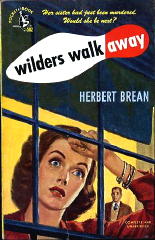
      Wilders Walk Away (n.) Morrow 1948.   [An impossible crime mystery.]

HERBERT BREAN

      The Darker the Night (n.) Morrow 1949.
      Hardly a Man Is Now Alive (n.) Morrow 1950.
      The Clock Strikes Thirteen (n.) Morrow 1952.

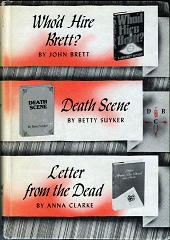
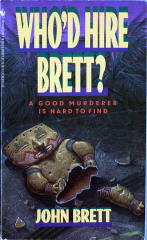
JOHN BRETT – Who’d Hire Brett?   Detective Book Club [3-in-1 edition]; hardcover reprint,. Sept-Oct 1981. First edition: St. Martin’s Press, 1981. Paperback reprint: Bantam, July 1989. No UK edition.

WHO'D HIRE BRETT?

    My copy is the DBC edition, one of the so-called “Inner Circle” volumes in that set of books, and the only one that I could find a cover for — although I suspect I have the Bantam paperback, somewhere.

    There’s not much information about John Brett, the author. This was his only detective novel, and in the Revised Crime Fiction IV, by Allen J. Hubin, he’s described only as “born in England, the son of an earl; living near Hollywood,” a statement possibly obtained from the blurb on the hardcover edition. Now since this describes the character John Brett, except for the “earl” part, awfully well, I have a feeling that “John Brett” is not the author’s real name.

    And since he’s relatively skilled as an author, it’s also possible that we might know him as a mystery writer under another name altogether. Not that I have any suggestions.

    Getting back to the “earl” part, that might be true for the character in the book, too. He’s a glib sort of fellow who tells the story himself, but in doing so, he only hints at his background. He, we soon gather, is what’s called a remittance man — an exile living on money sent from home — in this case England. Something shady and quite possibly illegal back went on back there, but as I say, hints are all he’s going to give.

    He’s not exactly hired in this book, in spite of the title, but he is asked by a female friend to steal a valuable artifact from his upstairs neighbor, the upstairs neighbor having stolen the artifact from the female friend and her husband, they having it in their possession illegally, which is why they can’t call the police in on the theft.

    With me so far? I’ll let Brett take over to tell you what happens next. He’s just turned the icon (a Mud Dancer) over to the husband, Harry:

    “As I watched him drive off, I thought, considering it’s a quarter of five in the morning, and a theft has just been committed, and a secret rendezvous, and all that, wouldn’t it be interesting if a big black sedan, maybe a Buick or a Cadillac, or even a Rolls, were to pull up and someone were to pump old Harry full of holes?

    “Which is precisely what happened, at precisely that moment.”

    The police, naturally, suspect Harry’s wife, and since John Brett is close friends with the wife, they suspect him, too, for a while. To clear their names in the eyes of Sgt. Steinberg — apparently the only cop in the Beverly Hills Police Department, for he’s the only one who ever appears in person anywhere in the book — John and Edie and Edie’s enterprising and eavesdropping maid Marie decide to do a little sleuthing on their own. Make that a lot of sleuthing, although John has to be prodded by Marie, who’s another story, and being John’s age (Edie is older), sparks begin to fly, and more.

    I’ve been doing some hinting myself, but right now I’ll come out and say it. This is a comic caper in the same sense as many of Donald Westlake’s books under his own name were comic capers, not that I’m saying that Donald Westlake was the author of this book, though it’s kind of fun to imagine that he was.

    From page 60, just to give you a good idea. John and Marie are on the case together:

WHO'D HIRE BRETT?

    “I pointed the Sunbeam in a direction that seemed likely to get us somewhere near the Beverly Hills Police Department. It didn’t. Instead, we wound up in a rather dismal place called Culver City that has a lot of strange-looking streets meeting at even stranger intersections. In Culver City, I discovered; nothing goes anywhere. Everything is coming from somewhere and seems to dissipate into nothingness. It’s what astronomers are lately calling, with a remarkable lack of cheeriness, a Black Hole. Everything collapses into it, and damned little gets out again. I began to flounder, and I’m afraid that the sight of a half-crocked Englishman floundering in a Sunbeam with a rather dazzling redhead at his side was enough to make the day for the locals. Not that they lined the streets to cheer, mind you, but I noticed a certain mocking quality in the eye of the policeman who stopped us.

    “‘Going somewhere?’ he asked.

    “It struck me as a rather stupid question, as it must have been obvious to him that we were not. After all, he had just succeeded in following us in five complete circles.

    “‘Beverly Hills Police Department?’ said I, giving him the bright smile.

    “‘Wrong town. Try again.’

    “Well, I knew it was the wrong town, for God’s sake. All I was trying to do was get it across to him that directions were needed. He was obviously dense. I tried again.

    “‘We want to go to the Beverly Hills Police Department.’ I tried to wither him with a look this time. Take my word for it: don’t ever try to wither a Culver City cop. They take it personally.”

WHO'D HIRE BRETT?

    To get back to the case, however, this really is a detective story, although with all of the wackiness going on, you might begin to wonder. There is one line in the book which John Brett, for all of his semi-doltishness, which is obviously a front, picks up on and knows (he says later) who the killer is, right then and there. He’s right. If you read it correctly, you will, too.

    What I don’t know is whether or not his knowing then fits in with the rest of the book, as he tells it. That is to say, if he (or you or I) knew then what he says he knew — well, I’d have to read the book again.

    While in a one sense it’s completely out of character, it could very well be that John Brett is an even deeper character than he otherwise ever lets on.

    Since this was his only recorded outing as a detective, we may never know.

[UPDATE] 04-23-09.   As you see, I have found my copy of the Bantam edition.

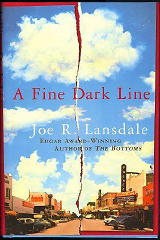
JOE R. LANSDALE – A Fine Dark Line.

Mysterious Press, hardcover; January 2003; trade paperback: October 2003.

    On page 7, when thirteen-year-old Stanley Mitchel learns that there is no Santa Claus, he doesn’t like it. He feels “like a big donkey’s ass.” He doesn’t know it, but his small comfortable corner of the world is starting to crumble. Nor does he know what else is in store for him during that summer of 1958, but in the hands of Edgar-winning author Joe Lansdale, it’s pure magic, at least to the reader, and this one in particular.

LANSDALE Fine Dark Line

    What happens to Stanley and his family in this one brief summer is more than what occurs to most people in twice their lifetime. Finding a metal box filled with letters and pages from a diary buried in the ground, seems to trigger a seismographic sequence of events that takes the East Texas town of Dewmont across some unknown and never before seen line separating dark mystery from reality.

    The boom-times spawned by the end of World War II took their time reaching rural America, forcing Stanley’s father to uproot the family and head to the big city, where they make their new home inside the huge screen of the drive-in theater that’s the source of his new livelihood.

    The year 1958 was an innocent age of Dairy Queen’s and rock-and-roll, back when the black population knew their place, and the white population kept them there, not always maliciously, but simply because that’s the way it was and always would be. And yet aiding young Stanley with his investigation of the letters, and the two young girls who died (were murdered?) on the same night some 25 years before, is Buster, his father’s aged black projectionist — and Stanley’s ad hoc mentor leading him on this passage to adulthood.

    It’s an education, all right. Lynching of black men had ended not very much earlier, and minstrel shows were still common, but in 1958, to Stanley and his family, the entertainment value seems to diminish before their eyes. Stanley’s sixteen-year-old sister is growing up as well, and her explanation of certain aspects of life begins to open brand new horizons for him.

    It’s a remarkable trip, told by a master of words and nostalgic journeys, and it’s never a smooth one. Life never is smooth, in case you hadn’t noticed, and this is art, imitating life.

— February 2003

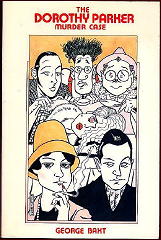
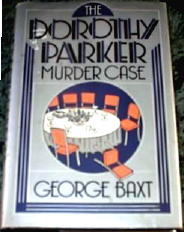
GEORGE BAXT – The Dorothy Parker Murder Case.

International Polygonics; reprint paperback; 1st printing, April 1986. Hardcover edition: St. Martin’s Press, 1984. Trade paperback reprint: IPL, November 1989.

GEORGE BAXT

   I’ve been struggling to remember, but I think this is the first book by George Baxt that I’ve ever read. The Dorothy Parker Murder Case is the first of three series of detective novels he wrote, along with five stand-alone works of crime fiction. His series charcaters were:

      1. Pharaoh Love: New York City homicide detective in New York, both black and gay.
      2. Sylvia Plotkin and Max van Larsen: New York City author and police detective.
      3. Jacob Singer: New York City homicide detective, later a 1940s LA private eye, or so I’ve been told.

   While I was reading it, I didn’t realize that Dorothy Parker was Singer’s first recorded case. He and the celebrated Mrs. Parker had met previously when this case begins – that of the mysterious deaths of several Manhattan-based show girls — but when, how, and on what basis it happened they met was never the subject of a mystery novel of its own.

   When Baxt, who died in 2003, was writing the Jacob Singer books, I was going through a phase in which I paid no attention to mystery fiction that had “real people” in them. I had no idea until yesterday that Baxt had written so many of them. (See the complete list at the end of this review.)

   I can’t tell you why I had that particular prejudice. If I had a bad experience with a novel with a real person in it, it’s possible, but I simply don’t remember. Sometimes otherwise normal people do silly things.

GEORGE BAXT

   I also have never done any reading about Dorothy Parker and the famed Algonquin Round Table, nor read any but the briefest poems among her huge accumulation of literary work. I suppose there’s enough time left in my life to make up for various deficiencies like this, and instead of writing reviews, I sometimes think maybe I really ought to be doing something about it.

   In this book, which takes place immediately following the tragic death of Rudolph Valentino in 1926, the following real people appear, and I know I’m omitting some: Dorothy Parker, of course; her sleuthing partner, Alexander Woolcott; George S. Kauffman, in whose apartment the first dead girl is found; Robert Benchley; Marc Connelly; Judge Crater; Polly Adler; Edna Ferber; George Raft; Harold Ross; Flo Ziegfeld; Neysa McMein; Horace Liveright; Marie Dressler; Elsa Maxwell; Jeanne Eagels; and more.

   Not that all of these have big parts, but if what George Baxt says about them and their whoring and drinking, it’s remarkable that any of them grew up to be famous. There are puns, zingers and witticisms in this book galore, nearly one on every page.

   Picking a page at random, here’s a long passage that begins by describing Jacob Singer as he walks into Kauffman’s apartment to see the dead girl there in the bed:

    He [Singer] spent money on clothes and general good grooming and forced himself to read Dickens, Henry James, and on one brief depressing occasion, Tolstoy. He attended the theater and concerts as often as possible, but the opera only under the threat of death. Mrs. Parker’s admiration for the man was honest and limitless. “Okay, Mr. Kaufman, what’s the problem?”

    “I’ve got a dead woman in the bedroom.”

    “I’ve had lots of those, but usually they get dressed and go home.”

    They followed him into the bedroom. “Oh boy, oh boy. That is one ugly stiff.”

    “She used to be quite beautiful,” said Kaufman. “Ilona Mercury.”

    Singer pierced the air with a shrill whistle of astonishment. “I’d never guess. Would you believe just the other night I saw her in Ziegfeld’s revue, No Foolin’.”

    “We believe you,” said Mrs. Parker.

    Singer shot her a look. “No Foolin’ is the name of the show. It’s at the Globe.”

    “Oh. I’ve been away.”

    “Let’s get back to the other room. This is too depressing. Imagine a beautiful broad like that turning into such an ugly slab of meat. That’s life.”

    “That’s death,” corrected Mrs. Parker.

GEORGE BAXT

    Here’s another:

   [Harold] Ross leaned forward and aimed his mouth at Mrs. Parker. “How come you’re so privy to all this inside dope?”

   A puckish look spread across Benchley’s face. “Oh, tell me privy maiden, are there any more at home like you?”

    He was ignored. Mrs. Parker was struggling with her gloves. “Last night when dining with Mr. Singer, I told him Alec and I were seriously considering collaborating on a series of articles about contemporary murders.”

    Ross looked dubious. “You and Alec collaborating? That’s like crossing a lynx with a mastodon.”

    “And why not?” interjected Woollcott. “Might be fun. Where are you off to, Dottie?”

    “Where are we off to, sweetheart. Why, we’re off to Mrs. Adler’s house of ill repute as Mr. Singer’s companions. He’s picking us up in a squad car in a few minutes. If you’re a good boy, he’ll let you stand on the running board with the wind in your hair.”

    The less said about the mystery the better, and you will have noticed that I’ve already done so. That’s not what you’re paying your money for this time around. For what it’s worth, of the real people above, George Raft fares the worst at the hands of Mr. Baxt’s typewriter. Of the people who weren’t real until Mr. Baxt came along, though, you may be sure that many of them fare much worse.

    In summary, then, in case you’re wondering, do I intend to track down and read the rest of Jacob Singer’s adventures? Yes, indeed I do, and here’s a complete list of them, based on his entry on the Thrilling Detective website. (Not all of these are listed in the Revised Crime Fiction IV. I will pass the information along to Al Hubin.)

* The Dorothy Parker Murder Case (1984)
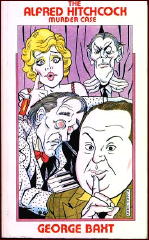
* The Alfred Hitchcock Murder Case (1986)

GEORGE BAXT

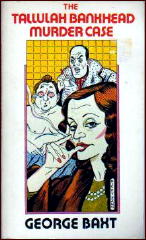
* The Tallulah Bankhead Murder Case (1987)

GEORGE BAXT

* The Talking Pictures Murder Case (1990)
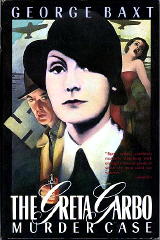
* The Greta Garbo Murder Case (1992)

GEORGE BAXT

* The Noel Coward Murder Case (1992)
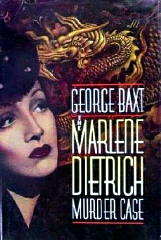
* The Marlene Dietrich Murder Case (1993)

GEORGE BAXT

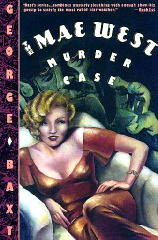
* The Mae West Murder Case (1993)

GEORGE BAXT

* The Bette Davis Murder Case (1994)
* The Humphrey Bogart Murder Case (1995)
* The William Powell & Myrna Loy Murder Case (1996)
* The Fred Astaire & Ginger Rogers Murder (1997)
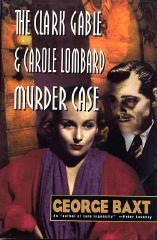
* The Clark Gable & Carole Lombard Murder (1997)

GEORGE BAXT

« Previous PageNext Page »