Reviews


NOTE: This is the third in a series of three reviews of Durango Kid movies from the 1940s. The previous two were Phantom Valley (1948) and Whirlwind Raiders (1948).


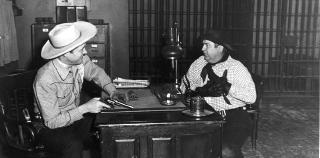
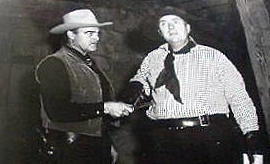
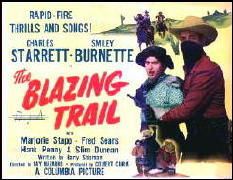
THE BLAZING TRAIL. Columbia, 1949. Charles Starrett, Smiley Burnette, Marjorie Stapp, Fred Sears, Jock Mahoney, Trevor Bardette, Hank Penny, Slim Duncan. Screenplay: Barry Shipman. Director: Ray Nazarro.

DURANGO KID Blazing Trail

   You’ve probably anticipated me by now, but there’s no trail to be blazed (or on fire) in this one either, still another Durango Kid movie.

   But like Phantom Valley, the earlier entry also directed by Ray Nazarro, this one’s also a decent mystery puzzler, complete with voiceover narration by Charles Starrett.

   At issue here, after the shooting death of old Mike Brady, is the matter of his will, which leaves the bulk of his estate to the “wrong” one of his two surviving younger brothers. The will was signed and witnessed (but not read) and sealed securely. How was the document altered? If it was, of course.

DURANGO KID Blazing Trail

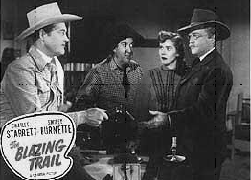
   As the dead man’s attorney, Luke Masters (Fred Sears) vouches for it, and while his daughter Janet (Marjorie Stapp) acts rather suspiciously about it, especially in the beginning, so does she. (See the photo to the right to get a good look at both Sears and Ms. Stapp.)

   Smiley Burnette runs a one-man newspaper in this one. He’s both the reporter for the Bradytown Bugle and the editor and the publisher, which makes for very funny problems as he tries to manipulate the movable type and generally get his printing press running. (He has no capital “D,” which makes it hard to spell Durango in the headlines.)

DURANGO KID Blazing Trail

   The two brothers are obvious suspects, and so are the local gambler “Full House Patterson” (Jock Mahoney, who later of course became TV’s “Range Rider” as Jack Mahoney, not to mention a couple of Tarzan movies) and Brady’s long-time foreman, Jess Williams (Trevor Bardette, who according to IMDB, made 228 movie and TV appearances, many of them in crime or western roles just like this one).

   Steve’s last name in this one is Allen, and yes, I know. While the immediate investigation is clumsily done – how smooth could things go with Smiley involved? – the secret of how the will got altered is an impossible crime that’s worth double the price of admission. (Easily. What did it cost to go to the movies in 1949? For someone my age at the time, no more than 10 or 12 cents.)

DURANGO KID Blazing Trail

   And while I know you are probably not wondering, there’s no romantic interest at all. The songs are pretty good, though.

PostScript: I was just thinking. If you took these three movies and worked out just how much screen time Starrett got versus how much Smiley Burnette did, I have a feeling that… Have you ever watched one? What do you think?

— October 2004.


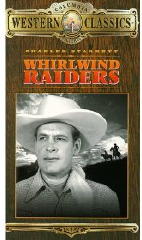
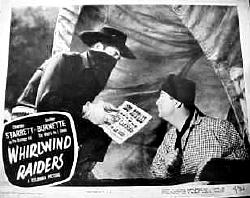
DURANGO KIDWHIRLWIND RAIDERS. Columbia, 1948. Charles Starrett, Smiley Burnette, Fred Sears, Philip Morris, Jack Ingram, Nancy Saunders, Patrick Hurst, Don Kay Reynolds (as Little Brown Jug), Doye O’Dell and The Radio Rangers. Screenplay: Norman Hall. Director: Vernon Keays.

   Well, once again there are no raiders in this next Durango Kid movie, or if there are, by no connotation of the word, are they “whirlwind raiders.” The bad guys are more insidious than that. At a time when the Texas Rangers were officially disbanded, the “Texas State Police” were put in charge, and if the screenwriter for this film is to be believed, they were a bunch of crooks with political connections who rode sway over the populace with grafts, holdups and penny ante corruption throughout their ranks.

   (If anyone knows how true this small aberration in Texas history might be, let me know.)

   Charles Starrett is Steve Lanning in this one, a former Texas Ranger working undercover to root out the bad guys, led by saloon owner Tracey Beaumont (Fred Sears) and his head henchman, Buff Tyson (Jack Ingram, whom I am sure always played a crook in his 271 film appearances, or in at least most of them).

   But what this means is that in this movie, as opposed to the previous one, Lanning does have of a reason for having two identities. Whenever he does anything of semi-illegality, such as breaking into Beaumont’s safe late at night, he does it as the Durango Kid.

DURANGO KID

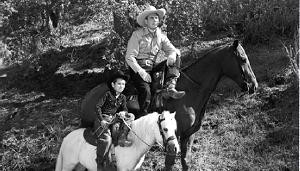
   I mentioned earlier my (adult-based) puzzlement that no one ever seems able to recognize Steve as Durango, but in this movie, a young lad named Tommy Ross (played by Little Brown Jug, as he is billed in the credits) actually does discover that the two are indeed one and the same.

    He is quickly sworn to secrecy and sworn in as an adjunct Texas Ranger to boot. His first assignment? To follow the actions of Smiley Burnette, who “is acting very suspiciously.”

   Smiley in this movie is a traveling tinkerer who’s set up shop in the same town, and with a covered wagon filled with pots and pans and objects of other obviously beneficial value, including a cage containing two chickens, it establishes a very convenient venue for Smiley to clown around in, making an enormous racket most of the time he’s on the screen.

DURANGO KID

   There’s no love interest in this one either, or just the smallest of hints that newspaper owner Bill Webster (Patrick Hurst) is interested in making moves on Claire Ross (Nancy Saunders), daughter of rancher Homer Ross (Philip Morris). There’s no time to add any mushy stuff to this story, which is chuck full of action, comedy and singing, in just about that order.

   Additional comments: This was the only movie Patrick Hurst made, and he plays his role so thinly in this one, you might not even realize he was in it. Philip Morris, although only 55, looks old and tired, and it’s scary to learn that he died the very next year. Beginning in 1949, Fred Sears began his career as a director with yet another Durango movie, Desert Vigilante. He did lots of westerns among his 51 films, including the 1958 version of Utah Blaine, based on the novel by Louis L’Amour.

— October 2004.


[UPDATE] 02-12-09.   This is the second of three Durango Kid movies I taped and watched over four years ago now. I’ll post the third review tomorrow, if all goes well.

   After digging the reviews out of storage, it prompted me to sign up for the Encore grouping of premium cable channels yesterday — one of them being, of course, the Western Channel, the source of these Durango films.

DURANGO KID

   I canceled today without taping a single one of their offerings. I do not care to pay a premium fee for cable channels with huge logos (bugs) in the lower corner of the screens. These must have appeared between now and the last time I’d signed up for the Encore channels, since they weren’t there before, at least not as permanently and as ugly as they are now.

   Turner Classic movies uses logos, but they come on only every 30 minutes or so, and then quietly disappear. The Encore logos are four times the size and are opaque white. Maybe I’m the only one who hates these things. And don’t get me started on network TV and the bulk of the non-premium cable channels. Besides news and sports, I don’t watch any of them.

   Not only do they have logos, but they have characters from next show come wandering in on the bottom of screen and jump around until you notice them (as if) and then whoosh off, sound effects included, all the while the current show is still on. Besides this sort of nonsense, and five-minute blocks of commercials, I can’t see anyone except invalids and shut-in’s putting up with this. But I guess they do.

DURANGO KID

   On a more pleasant note, I’m going to repeat one of the comments that Walker Martin left after I posted yesterday’s Durango Kid feature:

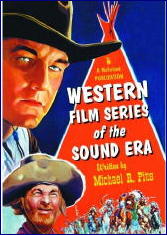
    “Today, I just received a new book, Western Film Series of the Sound Era, by Michael R. Pitts. Published by McFarland it’s 474 pages [long and covers] 30 western film series from the mid-1930s to the early 1950s. Included is a long chapter on The Durango Kid, 45 pages discussing all the films and 11 photos and posters. Also there is a chapter on the Dr. Monroe series discussing the three films starring Charles Starrett.

    “McFarland Books website lists the 30 series covered.”

    It’s just out. It was published only last December, and I’ve ordered a copy myself. As Walker says, the various series it covers are listed on the McFarland website, but to save you the time of searching online for it yourself, here’s the Contents Page:

BILLY CARSON 3
BILLY THE KID 21
CHEYENNE HARRY
THE CISCO KID 43
DR. MONROE 64
THE DURANGO KID 68
FRONTIER MARSHALS 113
HOPALONG CASSIDY 118
THE IRISH COWBOYS 175
JOHN PAUL REVERE 180
LIGHTNING BILL CARSON 183
THE LONE RANGER 190
THE LONE RIDER 208
NEVADA JACK MCKENZIE 219
THE RANGE BUSTERS 232
RANGER BOB ALLEN 254
RED RYDER 259
RENFREW OF THE ROYAL MOUNTED 284
THE ROUGH RIDERS 290
ROUGH RIDIN’ KIDS 300
ROYAL CANADIAN MOUNTED POLICE 303
THE SINGING COWGIRL 320
THE TEXAS RANGERS 322
THE THREE MESQUITEERS 340
THE TRAIL BLAZERS 384
WILD BILL ELLIOTT 391
WILD BILL HICKOK 399
WILD BILL SAUNDERS 412
WINNETOU 415
ZORRO 429

PHANTOM VALLEY. Columbia, 1948. Charles Starrett, Smiley Burnette, Virginia Hunter, Joel Friedkin, Robert Filmer, Teddy Infuhr, Ozie Waters & The Colorado Rangers. Screenwriter: J. Benton Cheney. Director: Ray Nazarro.

DURANGO KID

   Strangely enough, there are no phantoms in Phantom Valley. But someone definitely seems determined to start a range war between the cattlemen and the local homesteaders. The mystery is who this crooked mastermind is, and it’s up to Steve [Collins] and his alter ego, The Durango Kid, to find out who.

   Assisting him is Smiley “Sherlock Holmes” Burnette, whose expertise, gained from a correspondence school manual (and a large magnifying glass), proves to be less than very valuable. Assisting Smiley, and his nemesis who easily outwits him at every turn, is a young apple-eating lad (Teddy Infuhr) who collects the clues that Smiley simply tosses away.

   When I was a kid, the Durango Kid movies were the best there were. Roy was OK, I don’t remember Hoppy at the time, and Gene, Rex and Monte were all good but second-rate. But while I was watching this one now, I started to wonder about things that never occurred to me at the time.

   Things such as, why did Steve (see below) bother even having a secret identity? It was — and still is — neat that he had a cave where he kept his white horse and DK outfit, but what good purpose did it serve in changing to and becoming the Durango Kid? (This is heresy, I know. My younger self would hardly believe my ears, hearing me say such things.)

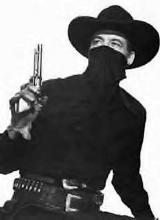
   But how come no one recognized him, with only a black bandanna over the lower portion of his face? How come the bad guys shoot so badly and, truth be told, how come they always start shooting too soon?

   What was really neat (to me at the time) was that in almost all of the Durango Kid movie, Starrett’s character was always named Steve. Steve Langtry, Steve Norris, Steve Warren, Steve Blake. Two references on Phantom Valley disagree on which Steve it was that Starrett played in this film. One says Collins, the other doesn’t say one way or the other. After watching it, I don’t believe he ever had a last name.

DURANGO KID

   There is a girl in this one — Virginia Hunter as Yancey Littlejohn — but she’s not really a mushy romantic love interest as she would have been in one of Gene’s or Roy’s movies. She’s the daughter of an elderly and slightly crippled attorney new to Phantom Valley — Joel Friedkin as Sam Littlejohn — and along with a banker named Reynolds (Robert Filmer) her father becomes one of the primary suspects, and Yancey is his primary defender.

   And what do you know? This is an honest to goodness detective puzzler. It surprised me, but minor as it is — hidden between the songs and Smiley’s foolish antics — there it is, and it’s good in its fashion as — dare I say it? — some of the Charlie Chan movies of the same vintage.

   Additional comments: Teddy Infuhr you might remember as the mute boy in Sherlock Holmes and the Spider Woman (1944) and (you might not) several times over as one of the many kids in the Ma & Pa Kettle series of comedy films.

   Virginia Hunter is very pretty and attractive, but she seems to have had only a short career in films. Her roles include at least one other Durango movie, several Three Stooges shorts, and a small part in the noir thriller He Walked by Night (1948). Mostly B-movies, looking down through the rest of the list, and often small uncredited parts at that, but she makes the most of this one.

— October 2004.

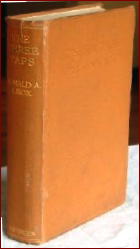
RONALD KNOX – The Three Taps.   Penguin 1451, UK, paperback, 1960. Hardcover editions: Methuen, UK, 1927; Simon & Schuster, US, 1927.

RONALD KNOX The Three Taps

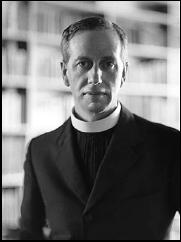
    Born in Knibworth, Leicestershire, Ronald Knox was ordained a Roman Catholic priest in 1918, and with The Belief of Catholics in 1927 he became one of the UK’s foremost spokespersons for the religion. As most fans of early detective fiction know, he also dabbled in more mundane matters of more interest to us here. In fact was a prominent member of the exclusive Detection Club for many years, until he was requested by his bishop to cease and desist writing mere mysteries.

    He is known perhaps in our circles more for his Ten Commandments for Detective Fiction than for his novels, here they are in short form, as stated in his introduction to The Best English Detective Stories of 1928:

  I. The criminal must be someone mentioned in the early part of the story, but must not be anyone whose thoughts the reader has been allowed to follow.

II.   All supernatural or preternatural agencies are ruled out as a matter of course.

III.   Not more than one secret room or passage is allowable..

IV.   No hitherto undiscovered poisons may be used, nor any appliance which will need a long scientific explanation at the end.

V.   No Chinaman must figure in the story.

VI.   No accident must ever help the detective, nor must he ever have an unaccountable intuition which proves to be right.

VII.  The detective must not himself commit the crime.

VIII. The detective must not light on any clues are not instantly produced for the inspection of the reader.

IX.   The stupid friend of the detective, the Watson, must not conceal any thoughts which pass through his mind; his intelligence must be slightly, but very slightly, below that of the average reader.

X.  Twin brothers, and doubles generally, must not appear unless we have been duly prepared for them.

    The longer version with commentaries and suggested exclusions, et cetera, can be found here.

RONALD KNOX The Three Taps

    Ronald Knox produced only six detective novels of his own, all but the first solved by one Miles Bredon, an insurance investigator for the Indescribable Company. This makes him a sleuth very much like a private eye in nature, but he’s no mean streets kind of guy. Small village life is the setting of The Three Taps, and along with him is his wife Angela, and I have to admit, she’s no slouch as a detective either.

    Slowing the book down in the beginning is a long rambling preamble that assumes, first of all, that the reader knows what an Euthanasia policy is. I couldn’t find a single reference to such an agreement on the Internet, but I probably ran out of patience before I should have. From the context, though, I finally gathered that it was an insurance contract that before the policy holder reached the age of 65 paid off on the his or her death in the usual fashion, but then turned into an annuity making regular payment to the survivor, if he did.

    Of course if the policyholder commits suicide before the age of 65, the heirs get nothing. This is the crux of the story. A man named Mottram, the holder of such a policy, is found dead of gas poisoning in the room in the inn which he was staying while on a vacation fishing trip. He’s under 65, but recently he’d tried to buy out his policy from Bredon’s insurance company, telling them that a doctor had given him only a few months to live.

    Bredon makes a bet with his friend Inspector Leyland. Breton says his death was suicide (so his company doesn’t have to pay off), and Leyland says it was murder. And with the wager in mind, each looks for clues to back his version of what really happened.

RONALD KNOX The Three Taps

    It’s a complicated matter, and a beautifully constructed one, with lots of clues mixed in with the red herrings, double bluffs, hidden motives and of course no one tells (all) the truth. The denouement is even more complicated, so far as to be unreal, but truth (and fate) certainly does fall in strange and unexpected ways, so who am I to argue?

    Besides the Euthanasia policy to confound the present-day reader, the matter also depends greatly (and quite naturally) on the gas taps in the dead man’s room: which of the three were on, and which were off, and when and why. For all except the last, or “why,” it would take a mathematician to follow the logic, but I plead guilty and admit that I fell asleep at the switch.

    Overall then: this tale is definitely dated — much of the current crowd of mystery readers isn’t going get very far into this one — but it’s their loss. This is a beautifully and wonderfully constructed detective story.

      Bibliographic data:

  [Taken from the Revised Crime Fiction IV, by Allen J. Hubin.]

KNOX, [Monsignor] RONALD A(rbuthnott). 1888-1957. Series character: Miles Bredon, in all but the first.

      The Viaduct Murder (n.) Methuen 1925.
      The Three Taps (n.) Methuen 1927.
      The Footsteps at the Lock (n.) Methuen 1928.
      The Body in the Silo (n.) Hodder 1933.
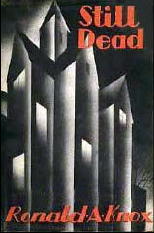
      Still Dead (n.) Hodder 1934.

RONALD KNOX The Three Taps

      Double Cross Purposes (n.) Hodder 1937.

THE CURMUDGEON IN THE CORNER
by William R. Loeser

   
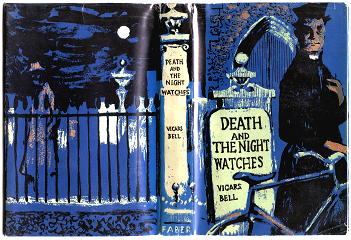
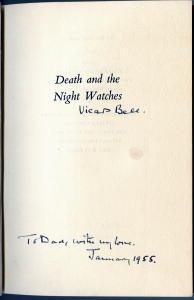
VICARS BELL – Death and the Night Watches. Douglas Baynes #5. Faber & Faber, UK, hardcover, 1955. British Book Centre, US, hardcover, 1962

VICARS BELL Death and the Night Watches

    Death and the Night Watches by Vicars Bell is another of that enjoyable sub-genre, the English village murder, chock-a-block with well-distinguished local characters, much like The Nine Tailors without Wimsey.

    Here the detective is Douglas Baynes, an entomologist who lost a leg in World War II, assisting a couple of interesting members of the official staff, and the problem: who shot a local farmer and bully, beat his head to a pulp, and left his body in the churchyard? His death is the greatest relief to his sister, a member of the walking dead, and her daughter, still hopeful and in love.

    The vicar, a believer in the militant church, thinks her boyfriend did it and tries to cook the evidence. Baynes sees through this and puts the romance back on the tracks, but he and the author can’t figure out who did do the crime.

    At last, a portion of the cast reveal themselves as villains and, against their best interests, kidnap Baynes, so there can be a smash ending, complete with a boat race and a helicopter.

? From The MYSTERY FANcier, Vol. 3, No. 4, July-Aug 1979       (slightly revised).

   
[Editorial PostScript.] This a scarce book. After reading Bill’s review, I went hunting for a copy, and I found one, the cover of which you see above. At the moment I am typing this, there are now none.

VICARS BELL Death and the Night Watches

    I’m sure I was the lucky recipient of a bookseller’s error. I paid less than $10. Of Vicars Bell’s six mysteries (see below), only two of them are available online, and one is offered in the $200 range. And not only does mine have the dust jacket, it turns out that it is inscribed by the author to his father in 1955.

   For more about Vicars Bell, Contemporary Authors describes his career thusly: “Spaldwick Council School, Huntingdon, England, headmaster, 1927-29; Little Gaddesden Church of England School, Little Gaddesden, Berkhamsted, England, headmaster, 1929-62. Lecturer at University of London, University of Birmingham, Oxford University, and Cambridge University; also lecturer in Isreal and public lecturer in England. Founder of Little Gaddesden Parish Council, lay reader for Diocese of St. Albans.”

   Fifteen books are listed in CA as having been written by Vicars Bell, which sounds like a pseudonym but is not, including the six detective novels previously mentioned. Other work includes such titles as Little Gaddesden: The Story of an English Parish, 1949, and On Learning the English Tongue, 1953.

    Bibliographic Data —   

         [Taken from the Revised Crime Fiction IV, by Allen J. Hubin]

BELL, VICARS (Walker). 1904-1988. Series character, in all titles: Douglas Baynes.
      Death Under the Stars (n.) Faber 1949.
      Death Has Two Doors (n.) Faber 1950.
      Two by Day and One by Night (n.) Faber 1950.
      Death Darkens Council (n.) Faber 1952.
      Death and the Night Watches (n.) Faber 1955.
      Death Walks by the River (n.) Faber 1959.

THE DOORBELL RANG. Made for TV. A&E Network, 22 April 2001. Season 1, Episode 1 of A Nero Wolfe Mystery. Tim Hutton (Archie Goodwin), Maurie Chaykin (Nero Wolfe), Bill Smitrovich (Inspector Cramer), Saul Rubinek (Lon Cohen), Colin Fox (Fritz Brenner), Conrad Dunn (Saul Panzer), Fulvio Cecere (Fred Durkin), Trent McMullen (Orrie Cather) R.D. Reid (Sergeant Purley Stebbins). With Debra Monk, James Tolkan, Francie Swift, Robert Bockstael, Nicky Guadagni, Gretchen Egolf. Based on the novel by Rex Stout. Teleplay: Michael Jaffe. Director: Timothy Hutton.
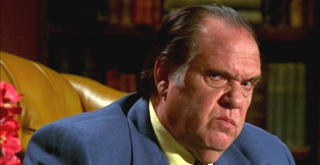
NERO WOLFE The Doorbell Rang

    I haven’t been talking to you about most of the television shows I watch — the regular series fodder, almost all of it on DVD — but in this case I’m making an exception.

    As indicated above, this two hour adaptation of one of Rex Stout’s most highly rated Nero Wolfe novels — and some would say that it is his best — was the first episode of the finest TV series ever based on the works of an American mystery writer.

    Is there one that I’m not thinking of? One that’s better than this? I don’t think so, and I’ll get back to this in a minute.

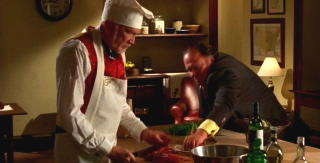
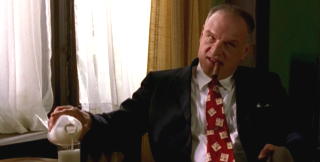
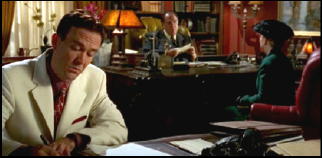
    There were two seasons of A Nero Wolfe Mystery, preceded by a pilot film, The Golden Spiders, which premiered on March 5, 2000. There were 27 episodes in those two season, filming in delightful fashion eight novels, seven of them in two parts, and 12 novellas. For a hint of how well staged and photographed the settings and the players are, I’ll add a half-dozen scenes from the film, but keep in mind that it’s only a hint.
NERO WOLFE The Doorbell Rang

    The story in The Doorbell Rang is relatively simple, at least on the surface. I could do a more detailed synopsis that would include all of the complexities, but after several minutes thinking about it, I’ve decided to keep it, as I say, simple.

    A wealthy woman has read a book critical of the FBI and its activities and has been sending books to friends and people in high power across the country. (The book is real: The FBI Nobody Knows, by Fred J. Cook, 1964, Macmillan.) Convincing that the FBI is retaliating by having her followed and tapping her phones, she hires Wolfe to get them off her back.

    Inspector Cramer gets involved, and so does the unsolved murder of a newspaper writer who was supposed to have been writing a series of articles about the FBI, also critical of the way J. Edgar Hoover was using his position of power. Wolfe needs leverage, and solving the murder is one way of getting it.

NERO WOLFE The Doorbell Rang

    I taped this series, both seasons, while it was on, but I never watched any of them, except in passing. Once on tape, though, you can fast-forward through the commercials — a big advantage, as far as I’m concerned — but on the other hand, once on tape, you’ll never find the time to go back and watch them — again as far as I’m concerned. (I don’t know about you.)

    So I never really saw any of the series until now, after I purchased the complete A&E set during a recent pre-Christmas sale at well over 50% off, an absolute bargain. This is a shameful admission, I admit, because as I stated above, I can’t think of a better adaptation of an American mystery series into TV or movie form than this A&E production. (A previous version of Nero Wolfe with William Conrad and Lee Horsley isn’t it.)
NERO WOLFE The Doorbell Rang

    Raymond Burr’s Perry Mason comes close, but I think the TV version was on the air so long that Erle Stanley Gardner started writing his books with Burr in mind, rather than the other way around.

    I stand to be corrected, and any and all suggestions are welcome.

    I believe that all of the stories in the A&E version, which I will be referring to from now on, are altered into taking place in the 1950s — and absolutely beautifully photographed, by the way — no matter when the books themselves took place. The Doorbell Rang was published in 1965, for example. (I may be in error in saying this. See the comments.)

    No matter. For the most part, Stout’s stories are timeless. It’s the people in them, who don’t really change all that much over the years, and (for example) the interior of the Manhattan-located brownstone where 80% of the stories take place, that’s what’s important.
NERO WOLFE The Doorbell Rang

    Wolfe’s yellow shirts, that is, the dining room, the orchid room, and Wolfe’s office, complete with the large globe, Archie’s desk at an angle to Wolfe’s, the chairs that can be rearranged facing the great detective, the hidden peephole designed so someone not in the room can look and listen in without being discovered — all wonderfully rendered, even though in my mind’s eye I had everything mirror-image reversed, left and right.

    The apartment is also much larger than I pictured it. I sensed tighter quarters.

    And whole chunks of dialogue from the book appear to have been repeated verbatim. (I haven’t checked, but I’d be mildly surprised if I’m wrong.)

    As for the players, some brief impressions: Maurie Chaykin is — how shall I say this? — the right girth and weight, but he’s not nearly as handsome as I see Wolfe, but I have an idea that as I lend an eye to more of the episodes, how I see Wolfe and the others will start to change. What Chaykin does have is the eccentric genius concept down pat.
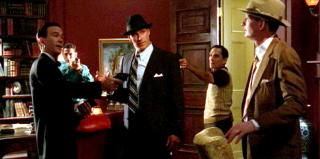
NERO WOLFE The Doorbell Rang

    Tim Hutton as Archie? Near perfect. His stride seems a little too jaunty to me, and his hat is too big. Of course I (as well as everyone else) am no longer used to seeing anyone wearing a wide-brimmed hat. Colin Fox as the live-in cook, Fritz Brenner, is perfect. Bill Smitrovich as Inspector Cramer seems a little too agitated to me; I seem to think of him as a calmer sort of fellow, not that Nero didn’t usually get under his skin, and badly.

    The others of the regular cast generally weren’t on the screen long enough to say aye or nay, but if it turns out to be nay for any of them as I watch my way through the series, I will be greatly surprised.

    From the general reaction that this series has produced from readers and critics alike, I don’t suppose I’m saying anything very much new here. I regret being so long to catch up with everyone else, but I’m glad I have.
A Review by MIKE TOONEY:


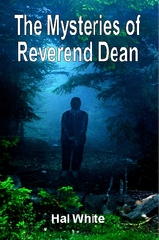
HAL WHITE – The Mysteries of Reverend Dean. Lighthouse Christian Publishing; trade paperback; story collection; 2008.

HAL WHITE Mysteries of Reverend Dean.

    There is a long and illustrious list of clerical detectives in mystery fiction. The first one to come to mind is usually G. K. Chesterton’s Father Brown; indeed, like Brown, most of the memorable clerical sleuths have been British.

    In America there have been fewer men (and women) of the cloth who involve themselves in criminal investigations: Melville Davisson Post’s Uncle Abner is the outstanding example of one who did on this side of the Pond.

    On occasion Abner would tackle what is commonly called today “impossible crime” (or, more specifically, “locked-room”) problems of the kind that sometimes bedeviled Father Brown. Neither Brown nor Abner, however, spent more than a fraction of their time on such conundrums.

    But now we come to one clerical sleuth who EXCLUSIVELY devotes his time to solving locked-room crimes: Hal White’s Reverend Dean. This clergyman never actively seeks out such perplexing problems; his principal concern is always in saving souls. Yet somehow Reverend Dean becomes embroiled in these things with amazing regularity.

    Patience is counted as a Christian virtue, and the reverend has it in abundance; indeed, without patience he couldn’t solve any of the problems with which he is confronted.

HAL WHITE Mysteries of Reverend Dean.

    Strictly speaking, intelligence may not be exclusively another Christian virtue, but Dean also has it in abundance: You wouldn’t know it to look at him, but this modest, self-effacing man’s “little grey cells” are constantly working ratiocinative miracles inside his skull.

    Take, for instance, how he solves the conundrum of a woman stabbed to death in a room with locked windows, a triply-locked door, protected by a guard dog, and under observation by three witnesses.

    Or consider the woman who, if the evidence is to be believed, can walk through solid walls and shoot at someone while suspended in space. Or how about … but you should really read The Mysteries of Reverend Dean yourself.

    You won’t be disappointed.

         ______

    A website devoted to other clerical detectives is at:

         http://homepage.ntlworld.com/philipg/detectives/contents.html

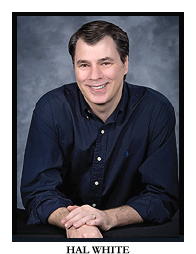
   Hal White’s webpage, which focuses on his book ‘The Mysteries of Reverend Dean’ and other locked-room mystery anthologies, can be found at:

         www.halwhitebooks.com

Reviewed by MIKE GROST:

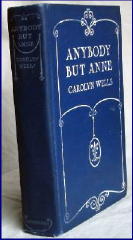
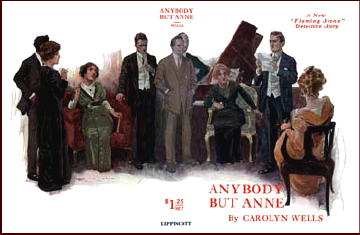
CAROLYN WELLS – Anybody But Anne. J. B. Lippincott, US/UK, hardcover, 1914.

   Anybody But Anne shares most of the characteristics of Wells’ later Faulkner’s Folly (reviewed here not too long ago):

CAROLYN WELLS Anybody But Anne.

    ● It is a full, formal mystery novel, of the kind that would later be popular in the Golden Age.

    ● It is set in a country house, and anticipates the mysteries soon to be popular in such houses.

    ● The cast of suspects resemble those to be found in many later detective books.

    ● It is a locked room mystery — but the solution of the locked room is based on ideas that would later be regarded as cheating. Still, the cheat of a solution shows some real ingenuity.

    ● The book shows the imagination with architecture, that would later be part of the Golden Age. It comes complete with a floor plan. The country house is of the kind that might have later inspired the mystery game known as Clue or Cluedo: there is even a billiard room!

    ● Wells pleasantly includes some subsidiary mysteries, that have nothing to do with the locked room. These too show some mild but pleasing ingenuity. Such subplots are also standard in Golden Age detective novels.

   I do not know if Wells invented the above template for formal mystery novels, or whether she derived it from other authors. Anybody But Anne does establish, that what we think of as a “typical Golden Age style mystery novel,” was in existence before what is often thought of as the official start of the Golden Age in 1920. It is also a fact, that Wells was American, and that her book is set in the United States: somewhere in New England.

   The best parts of Anybody But Anne have charm. People looking to sample Wells, might enjoy this novel, or at least its best chapters. It is at its best in the opening (Chapters 1-6), which sets up the architecture, characters and murder mystery; two later chapters that tell us more about the house as well as exploring some subsidiary mysteries (14, 17), and lastly the solution (Chapters 18, 20). Together these sections make a readable novella. The novel has been scanned by Google Books, and can be read free on-line.

CAROLYN WELLS Anybody But Anne.

   We get a good portrait of Wells’ sleuth, Fleming Stone, in action in these sections. Oddly, he is missing in most of the middle of the book, sections which generally are not that interesting anyway. Like most pre-1945 detectives, he is more characterized by his skills and behavior as a detective, than by any knowledge we get of his personal life.

   Stone has a penetrating intellect, that goes right to the heart of clues to the mystery, in the evidence at hand. He is crisp and business-like at delivering his insights, sharing his ideas immediately with the other characters and the reader.

   We do learn that Fleming Stone is outside of the world of romance, like many other early detectives. Wells gives an interesting psychological portrait of this.

— Reprinted with permission from A Guide to Classic Mystery and Detection, by Michael E. Grost.

A 1001 MIDNIGHTS Review
by George Kelley & Marcia Muller:


FREEMAN WILLS CROFTS Jane Vosper

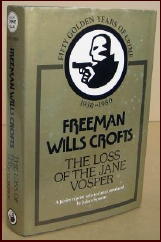
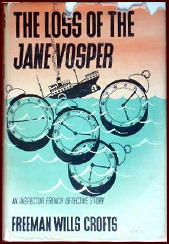
FREEMAN WILLS CROFTS – The Loss of the “Jane Vosper.”

Collins, UK, hardcover, 1936. Dodd Mead, US, hardcover, 1936. Many reprint editions, both hardcover and soft, including: Collins, UK, hc, 1980 [Crime Club 50th Anniversary edition] and Grosset, US, n.d (both shown).

   Crofts was a transportation engineer and worked for railway companies for many years before retiring in 1929 to become a full-time writer.

   A number of his novels make use of his technical knowledge of railroading and shipping, such as Death of a Train (1947), in which Inspector French investigates a World War II plot to divert vital supplies being shipped to the British forces in North Africa. Similarly, The Loss of the “Jane Vosper” draws on Crofts’s knowledge of the shipping industry.

FREEMAN WILLS CROFTS Jane Vosper

   On a dark night in the mid-Atlantic, the cargo ship Jane Vosper is rocked by explosion after explosion. Soon afterward, the ship sinks. An insurance investigation is launched, and it soon becomes apparent that the sinking of the ship was no accident.

   Inspector French enters the case and begins to piece details together-including particulars of what cargo the ship was carrying. A cargo swindle is revealed-one that leads to murder. French works with precision, ever conscious that unnecessary delay may lead to additional killings.

   The background detail in this novel is particularly good, and French is in top form, always playing fair with the reader and making us privy to his private thoughts. French is likable, a pleasant, unassuming man with none of the sometimes unfortunate affectations of other popular classic sleuths.

   This book — and most of Crofts’ others — presents no real challenge to the reader in terms of outwitting the detective and solving the case first. If anything, we feel that we are being taken by the hand and led on a genteel journey through the routine of a careful and dedicated investigator.

FREEMAN WILLS CROFTS

   Other Crofts novels dealing with the shipping industry include Mystery in the English Channel (1931), Crime on the Solent (1934), Man Overboard (1936), and Enemy Unseen (1945).

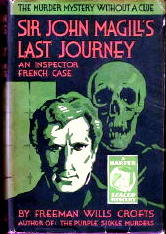
   Books in which Crofts drew on his railroading background include Sir John Magill’s Last Journey (1930), Wilful and Premeditated (1934), and Dark Journey (1954). A short-story collection featuring Inspector French, Many a Slip, was published in 1955.

         ———
   Reprinted with permission from 1001 Midnights, edited by Bill Pronzini & Marcia Muller and published by The Battered Silicon Dispatch Box, 2007.   Copyright © 1986, 2007 by the Pronzini-Muller Family Trust.

MANNING COLES – Let the Tiger Die.

Doubleday Crime Club, hardcover, 1947. Hodder & Stoughton, UK, hc, 1948.

    I was talking with a friend about mysteries the other evening, and of course the subject of authors who were popular back in the 30s, 40s and 50s came up. Both of us had fond memories of the Manning Coles–Tommy Hambledon stories, it turned out, the latter being one of England’s leading intelligence agents during World War II and the era that came along afterward.

MANNING COLES Let the Tiger Die

    Neither of could remember the names of his two amateur assistants, though: a pair of happy-go-lucky chaps whose gleeful approach to the spy game often bordered an sheer genius or lunacy, it’s hard to tell which.

    In this adventure Forgan and Campbell (that’s their names) don’t appear until page 141, but from that point on, they simply take over the book. They’re more than mere catalysts in moving the story into high gear. They’re more active in what follows than Tommy himself, who seems more content, at least this time out, in forcing himself into outrageous situations and then sitting back to see what happens.

    It begins with Hambledon on vacation, but just as it always happened to the Hardy Boys (but never to me when I was growing up), he spots something — three men obviously following someone who appears to be a German in Stockholm — and before he knows it, he is mixed up in an attempted abduction, a murder, and a mysterious package on his hands, plus a dying message from the Herr Goertz who was carrying it.

   Massive coincidences quickly pile up — adrift in the Baltic, Tommy is picked up by a ship whose captain has just been swindled by the same person whose papers Tommy just happens to be carrying — but by sheer audacity Tommy soon finds himself infiltrating a gang of fascists who have not yet conceded the war is over.

    Disguised as himself, if you can believe that — but somehow assumed to be someone else (and who that is he doesn’t learn himself until there’s only five pages to go), once again Tommy Hambledon and his friends save the day.

    I don’t think I could ever convince myself that this is the way serious spy business is conducted, off the cuff and on a lark, so to speak, but it’s entertaining, the background of Europe just after the war feels exactly right, and Manning Coles is another author who doesn’t deserve to be as forgotten as I think he is.

— Reprinted from Mystery*File 33, Sept 1991 (revised).


[UPDATE] 01-30-09. And of course those last two words should read “they are” instead of “he is.” Manning Coles, as was well known even back than in 1991, is the joint pseudonym of two neighbors in Hampshire, England, Cyril Henry Coles and Adelaide Frances Oke Manning.

    The earliest Manning Coles books weren’t as light-hearted as those that came along later. I think it took the end of World War II before that happened. But as far-fetched as the later ones always seem on the verge of becoming, they’re the ones that have stuck more vividly in my mind.

    And I’m not the only one who remembers Tommy Hambledon and his cohorts fondly. The folks at Rue Morgue Press have reprinted five of them so far, mostly from his earliest anti-Nazi WWII days.

« Previous PageNext Page »