Reviews


   I don’t know about you, but for me writing is the hardest thing in the world. I have nothing but admiration for the storytellers whose works and words we mystery readers follow so avidly. They make it look so easy – and every once in a while, I imagine that it is.

   Because maybe they’re human like you and me, and they spend their days struggling to put the words on the computer screen in the right order, and not only that, but the right words in the right place and at the right time, and if the wrong word is used, it just throws everything out of whack, like a single grain of sand in a well-tuned BMW engine.

   I’ve been writing reviews of mystery fiction since the early 1970s, when I was the “Courant Coroner” for the local Hartford paper, and every once in a while I’ve run out of words, and I’ve had to quit for a while. This latest consecutive streak of books reviewed has been going on for nearly seven years now – and do you know what?

   It’s still a struggle to put the right words down and in the right order and with the right punctuation. Case in point. I was reasonably happy with my comments on the John Whitlatch book I recently reviewed – until I read them the next morning.

   You probably haven’t noticed – and I sincerely hope not – but I’m constantly tweaking and changing little things here and there on this blog until either (a) I get it right or (b) I concede defeat – in a good sense, that is. I can only hope.

   But every once in a while, I look at something I wrote and say to myself, for example, what is really he trying to say here? Or could he possibly be more convoluted than this to get his ideas out? And look at what he says here. If changes are going to be made, they’re going to have to be big ones this time. Case in point. After considerable inner struggle and debate, I’ve revised the Whitlatch review and I’ve posted the result and I don’t think I will read it again for a week. (My fingers are crossed when I say that, though.)

   My opinion is the same, and some of the words are the same, but some of them aren’t and the punctuation is different too.

   Next up, a review of Death Turns the Tables, by John Dickson Carr. It’s turned out to be a tough book to comment on, and I’ve been putting it off for a couple of weeks now. I’d better get to it, before I forget the story altogether. (This has happened before.)

   I wonder what I’m going to say about it.

JOHN WHITLATCH – Stunt Man’s Holiday

Pocket 77660; paperback original; 1st printing, May 1973.

    I don’t know very much about John Whitlatch, and I don’t know anyone who does. In many, many ways he was the last of the true pulp fiction writers, even though his first book was published in 1969. Between then and 1976 he wrote 11 novels in a wide range of categories for Pocket, ten of them in one four years period.

   All of them paperback originals – crime, adventure, westerns, war, motorcycle gangs, the whole gamut. The titles were not all that remarkable, but the covers – the covers were lurid and eye-catching, and the books were reprinted over and over again. One presumes that they sold well.

Morgan's Rebellion

    Only three of them were listed in Crime Fiction IV, by Allen J. Hubin, but in Addenda #10 a complete revision of his entry now includes all of the books he wrote, as follows:

WHITLATCH, JOHN. No biographical information is known about this author of eleven popular pulp fiction paperbacks in the 1960s and 70s. While specific genres, settings and time periods vary widely, there is a criminous element in each of them. With Tom Power, one of the survivors of the event, John Whitlatch later co-authored Shoot-Out At Dawn (Phoenix Books, pb, 1981), an account of what took place at a remote Southern Arizona cabin in 1918. SC: John Gannon = JG; Captain Jamey Morgan = JM.

Gannon’s Vendetta. Pocket 75383, pbo, 1969. JG “Do not forget, gentlemen – violence is the only thing they understand. If in doubt, kill.”

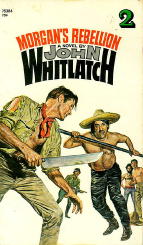
Morgan’s Rebellion. Pocket 75384, pbo, 1969. “Prison made a man of Morgan. And the man became a legend.”

Tanner’s Lemming. Pocket 75616, pbo, Sept 1970. “Tanner – the man who single-fistedly quashed a student takeover and tongue-lashed its leaders into silence at a turbulent school-board showdown. Tanner – the man who had never flown a plane, yet took the stick when a pilot died in midair and landed safely. Tanner – the man whose blunt business sense had won him a place in a Senator’s inner circle. Tanner – had he blown a hole in the heart of the man millions of Americans revered? Had he killed Senator Stanton? Could he have been the assassin?”

The Iron Shirt. Pocket 75642, pbo, 1970. [West] “Jonathan Fontaine swore it … in the smoking remains of his homestead, over the charred, mutilated body of his young daughter. He had gone East but now was back in Arizona with a specially equipped rifle. And he had a fresh lead on the Indian – the one who had worn a necklace of human fingers and The Iron Shirt.” [Marginal: primarily a Western.]

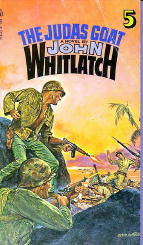
The Judas Goat. Pocket 75643, pbo, 1970. “Hand-picked from the entire US World War II army, they were a unique company. Twelve men led by a lieutenant, as able as he was arrogant, and a sharp, seasoned sergeant who was militantly silent about his past. Twelve fighters, among them an ugly man, a black man, on old World War I scout, a southern redneck, and a mountain climber. They were a strange assortment, but tough and tenacious – and they didn’t care too much about living. To the General they were the army’s answer to the marines. To the Colonel they were a crack team … the best he could assemble. To the Lieutenant they were ‘animals.’ And by the time their brutal training had ended they were Killers!”
Judas Goat

Lafitte’s Legacy. Pocket 75670, pbo, Sept 1971. [Louisiana] “The last of the Lafittes had come back from Arizona to visit his dying grandfather. But enemies lay in wait, blcoking his way with fallen trees, terrorizing his wife with poisonous snakes, signalling their malice with voodoo dolls. Someone wanted the old treasure map that was his legacy. But his adversaries had not reckoned with the pirate blood that was also part of Lafitte’s legacy. He would fight with all the guile and guts, tenacity and ingenuity that had made his legendary ancestor the terror of the bayou.”

Frank T.’s Plan. Pocket 77587, pbo, Oct 1972. “To avenge his daughter’s death, an old man pits himself against the most violent forces of evil.”

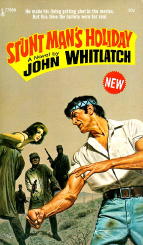
Stunt Man’s Holiday. Pocket 77660, pbo, May 1973. [Arizona] “He made his living getting shot in the movies. But this time the bullets were real.”

Cory’s Losers. Pocket 77661, pbo, May 1973. “The little western town was full of crooked operators – and Cory wanted revenge on every one of them.”

Morgan’s Assassin. Pocket 77659, pbo, Aug 1973. “A squad of mean, smart killers was out to bring the nation to its knees. Only one man was tough enough to stop them –El Arquito!”

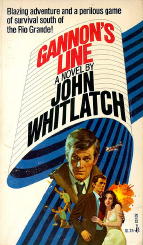
Gannon’s Line. Pocket 80743, pbo, Oct 1976. [Mexico] JG “Blazing adventure and a perilous game of survival south of the Rio Grande!”

Gannon's Line

    Victor Berch has checked the copyright records for the earlier books, and from the evidence found he says, “John Whitlach seems to be a real name. There was no indication in the records that this was a pseudonym.” Also interesting is the fact that, he goes on to say, “Nor are there any renewal records for any of his 1969 books.”

   Stunt Man’s Holiday is a crime novel, and in a more than minor way, it’s even a “fair play” detective story. Max Besh is the stunt man that the title advertises, not to mention a full-blooded Apache who needs all of his heritage, as it turns out, to follow a gang of bank robbers on a long, exhausting chase through the Arizona desert after they kidnap the girl he’s traveling with, along with the wife of a Don Rickles look- (and act-) alike Jewish comedian named Les Rick.

    And that’s the entire plot right there, summed up in only one sentence, even allowing for the fact that it’s a long one, which I grant you. Les Rick starts out being deliberately unlikable, but he gradually shows his worth (if not his innate cowboy ability) by accompanying Max the entire distance, by which I mean the entire book. Here’s an example of Max’s tracking skills, taken from page 132, where Rick asks if they’re getting closer:

    “I don’t think so. But in this heat it’s hard to tell; the tracks are just plain old dry and the manure dries within minutes …”

    “Huh!” Rick said with amazement. “But what’s this about the manure?”

    “Well,” Besh said, with his first grin in several hours, “it’s not exactly like reading tea leaves, but you can tell this much from examining the droppings. Fresh manure is moist and dries as it ages. So in seventy- to eighty-degree weather you can make a rough guess as to two, three days. But what I’ve seen today is too dry already to make a guess.”

    “I’ll be damned!” Rick said …
Stunt Man's Holiday

   The writing is competent enough, but as the excerpt shows, it may also be straightforward to a fault. And in all honesty, if you haven’t gathered where I’m headed already, as opposed to the opening scenes that take place in Las Vegas, the rest of the tale is rather skimpy in plot. Take the long trek in the desert, for example, in which (in retrospect) nothing really happens, except to allow the reader to watch as Besh and Rick, natural-born opposites, react against the other and get to know (if not understand) each other more.

   Nonetheless, what Whitlatch is rather adept and clever at, in this book at least, is in making the reader think something is happening – a hint here, building an anticipation there, adding to the puzzle now and again – when perhaps the something that is happening is a whole lot less. The ending, which is rather violent – all of a sudden, you see, things really do start to happen – is what the reader has been eagerly waiting for, he suddenly realizes, and he is finally rewarded. (Not many women will read John Whitlatch’s books, I suspect, but as always, I may be wrong.)

   What was unexpected, on the other hand, is that – as I mentioned earlier – this is a detective story of sorts. Not everything is what it seems, and since it is fairly obvious that it is not, I do not believe I am revealing anything I should not be. There are clues as to what is going on, in other words, if one reads slowly enough. But because they are not emphasized, it is easy to lose track of them as the story heads off in another direction, which it does.

   Or to be more specific, the crux of whole affair depends upon what was discovered way back on page 86. If you’re paying attention, and make yourself notes of what’s happening when it happens, you’ll have it figured out at the same time that Besh does, guaranteed – but he’s not talking. And Rick– as early into his education of the way of the west as it is when it happens – don’t count on him. He’s simply not swift enough.

   All in all, though? Not entirely what I expected. Whether that’s good or bad, I leave for you to decide.

— February 2007


PostScript: For a Gallery of all the Whitlatch covers, check out this page on the primary Mystery*File website.
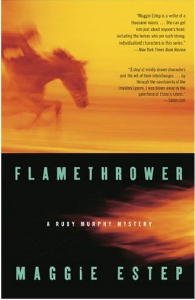
MAGGIE ESTEP – Flamethrower

Three Rivers Press; trade paperback. First Edition, September 2006.

   This is the third in Maggie Estep’s Ruby Murphy mystery series, and as usual, I came in late. The first two were Hex (Three Rivers, March 2003) and Gargantuan (Three Rivers, July 2004), and while I’ve been meaning to – and I haven’t yet – my intentions are to get my hands on the first two as soon as possible.

   If I thought that Doug Swanson’s Dreamboat was somewhat over-the-top and humorous, and I did, I certainly didn’t see this one coming. Ruby Murphy, who lives as low-key and laid-back a life in Brooklyn and environs (post-Giuliani Manhattan, Queens, Coney Island) as anyone possibly could, begins this episode with a visit to her psychiatrist, Dr. Jody Ray. Ruby has been seeing Jody since the death of someone she cared about – well, Attila, her lover – in a previous book. Unfortunately, not having read the previous book, this did not mean a lot to me, personally, but having a sociopath murder someone close to you right before your eyes, I grant you, maybe a psychiatrist could help.

Flamethrower

   And Ruby’s new boyfriend is obsessed by a new object of his affection, his new horse, making this her primary complaint to Jody during this particular visit. Which is summarily interrupted when Ruby discovers, you will not believe this, one of Jody’s husband’s legs in the fish tank outside her office.

   “Oh shit,” Jody said.

   That’s when you know that you have a story that has gone completely off the tracks, and in fact there are no tracks in sight. Where, oh where, you could most reasonably ask, could a story possibly go from here? The quote above came from only page 11 and continues thusly:

   Ruby started wishing she were home, in bed, with the covers pulled over her head. Instead, she was standing there, watching her psychiatrist vomit. Dr. Jody Ray had evidently eaten Chinese food for lunch.

   Eventually, a few twists and turns of the plot later, Ruby is hired (after being mysteriously (and falsely) fired from her job at the Coney Island Sideshow Museum) to find the missing doc, who seems to have a past history that Ruby knew nothing absolutely about, including (page 211) the aspect of the previously mentioned past from which the title of the story arises.

   That the last 12 pages have nothing to do with the mystery end of things tells you something about where the priorities lie in the Ruby Murphy mysteries: not all that so very high. And truth be told, mystery-wise you will have had to have read the other two books to reap all you should from this one. The last chapter is about Ed, the new boyfriend, who became somewhat estranged from Ruby partway through this one, and Ed’s new horse, and Ruby’s new dog Spike.

   That you might not care (that the last 12 pages have nothing to do with the mystery end of things) – and I didn’t – shows you what kind of writer that Maggie Estep is, and how finely etched her characters are. Or, on the other hand, you being you and not me, it might do absolutely nothing of the kind.

— September 2006

ENTRAPMENT. 20th Century-Fox, 1999. Sean Connery, Catherine Zeta-Jones, Ving Rhames, Will Patton. Rating: PG-13. Director: Jon Amiel.

   I have listed four actors in this movie, and while the last two of the four have small but significant roles to play, the fact of the matter is that this is a two-star picture — Sean Connery and Catherine Zeta-Jones — and no one else matters very much at all. One or the other is on the screen, let’s say about 99% of the time, and often both. If for some reason you have an aversion to either one, and I don’t see possibly how, but OK, I’ll concede it, then this is not the movie for you.

Connery Zeta-Jones

   Storyline: Virginia Baker (Catherine Zeta-Jones) works for an insurance company specializing in security. Robert MacDougal (Sean Connery) is an art thief.

   Um. Do you need more than that? Of course there’s more. This is a caper movie, one with many, many intricate plans for stealing things, and getting away with it, and yes, they are working together on almost all of them, for reasons that are complicated and you don’t want to know about them before you watch this movie anyway.

Connery

   A question though: If you are forced to go along with a theft — you know, incriminating photos or the like — is that entrapment or blackmail? I thought so.

Zeta-Jones

   Many of those leaving comments on IMDB mention the lack of chemistry between Gin and Mac, or the actors who play them. Nonsense, I say. Utter nonsense. One of Mac’s rules is that there be no romantic involvement between partners in the crimes he commits, and he is sorely if not wistfully tempted to break it; and it is clear — well, as clear as anything is clear in this small masterpiece of role-playing, we know she is playing a role, but what role is not so clear — that she returns the feeling. Those IMDB viewers must have been very young.

Zeta-Jones

   At the age of 30, Catherine Zeta-Jones may have been at the peak of her youthful beauty — slim and lithesome and fair of face — when she made this movie. At the age of 69, Sean Connery is as handsome as ever, mismatched in terms of age, perhaps, but most definitely not in terms of the fire within.

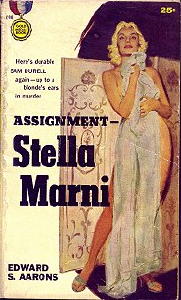
EDWARD S. AARONS – Assignment–Stella Marni

Gold Medal 666; paperback original. First printing, April 1957. Reprinted several times: as 906 (2nd pr., 1959), k1515 (4th pr., 1965), d1729 (5th pr., 1966), T2308 (6th pr., 1970), and M2949 (1973).

   Search as I may, I cannot determine what the number and date of the third printing might be. Although, of course, I fully realize that I may be the only person reading this who may care. The data as given above may also be suspect, it is true, determined as it was largely from listings on ABE and elsewhere, which is hardly the most reliable way of doing bibliographic research.

   But one thing that is clear is that the book, published as the fourth in the Sam Durell “Assignment” series, came out early enough to be reprinted again and again as later ones came along. (In the same way the the oldest child in the family gets the vast majority of the appearances in the family’s photo album.) What is not so obvious from the bibliographic data is that the book is not among the better ones in the series.

   At first I thought that this may have been due to the fact that the action takes place solely in the five boroughs of New York City. It’s been a while since I read one of the books in the series, but what I remember always enjoying is Aarons’ detailed descriptions of the exotic places of the world where he would place Durell next. But that’s not really the problem Even this early in the series Aarons shows how he could make even the most mundane places suddenly come to focus, and with a fresh perspective. Here, for example, is Sam on page 87 as he is tracking down a frightened girl’s father – well, all right: Stella Marni’s father – who has been kidnapped and may be hidden away on a freighter docked along Manhattan’s west side:

    … She was a frightened girl hiding behind her mask of cool and impersonal detachment. He knew her now. And he knew she was not the proud goddess disdainful of men, the remote and chilling woman she had seemed to be.

   He pushed her aside in his mind with a deliberate effort. Nobody had challenged him in the busy shed, where he wandered alongside the white, rust-flaked plates of the freighter. An officer on the bridge was shouting something down to the longshoremen astern, his voice garbled and echoing through a hand amplifying phone. Most of the loading was being done through the cargo hatches aft of the center superstructure. But there were two loading ports in the side of the ship open to gangways nearby. So far as Durell could see, no one was on guard, and several men came and went on errands by that route, to and from the ship.

   He walked that way. He had no longshoreman’s badge authorizing him to be here, and he could be challenged at any moment …

Stella Marni

   Stella Marni is a crucial element in a campaign by several communist countries to “call home” refugees who’ve come to the United States seeking political asylum. Convinced that all is well back in their native land, several such people have gone back, only to never to be seen again. As a famous successful photographic model, Stella Marni has gone before a Senate committee stating her willingness to return to her native Hungary. Sam wonders why, and if there is any way to change her mind. The final key to her mysterious change of heart: her missing father.

   Stella is also one of those women who draw men to her like the proverbial moths to a flame, and even Sam may not be immune. On pages 72-73 he has a long and increasingly bitter confrontation with his close lady friend Deirdre, who, although she herself asked Sam to help Stella in the beginning, is also beginning to have second thoughts. As it has transpired, Sam has spent the previous night with Stella, causing Deirdre to become suspicious and increasingly jealous. And even though the night spent together by Sam and Stella was innocent enough, the fact remains that Deirdre has every right to be.

   The primary focus of this tale is therefore Stella: as an enchantress, as a unwitting Jezebel, and yet as an innocent victim. And if you are beginning to wonder if this makes the book a “cozy” in any sense of the term, the answer is no. There are some extremely tough fight scenes in this book also, one example of which is on page 127. (Severely tempted to add quotes both here and up above a paragraph, I decided to reconsider when I looked and saw just how long each of the insertions would have to be, in order to convey the full effect.)

   And this is strange. As I am typing up my comments on the book just now, based on the notes that I took (over a month ago) I am suddenly discovering that I may have liked the book more than I thought I did. But no, it is not so. The last comment I see that I made is that it is “lightweight at the core.”

   Which meant at the time, and still so now, that there are no twists or surprising turns of the plot. Paths I anticipated did not occur, even the less imaginative ones. The story has but one direction to go, and that it does so with skill – and a modicum of finesse – still does not mean that it is not going in any more than in one direction.

— September 2006


Postscript: I wonder somewhat about Deirdre. Being the girl friend of an ruthless CIA agent whose jobs continue to take him to exotic places around the world, places in which equally exotic women are always available and/or near at hand, would hardly seem ideal for a long-lasting relationship. The future for her appears rather blaak and dismal. All seems well again at the end of this book, but just how long, I wonder (that is to say, for how many more books) does Deirdre manage to stick it out? Anyone know?

   Malcolm Sage, detective, created by author Herbert Jenkins, is one of the few fictional characters who are covered in both Kevin Burton Smith’s Thrilling Detective website dedicated to Private Eye fiction, and Michael Grost’s Guide to Classic Mystery and Detection website dedicated to precisely that.

   Kevin leads off his comments by saying: “Malcolm Sage had been a hot shot intelligence agent for Britain’s Division Z during the Great War, but when the fighting ceased, his thirst for action and adventure didn’t. Fortunately, his old chief from Division Z helped him set up the Malcolm Sage Detective Bureau, and much merry mayhem and more than a few ripping good yarns ensued.”

   Says Mike, in part: “Jenkins’ work has some similarities to R. Austin Freeman’s. Malcolm Sage, like Thorndyke, is a private investigator; he is hired by the insurance companies, similar to the arrangement in Thorndyke’s books. Sage, like Thorndyke, emphasizes photography in his work. He is also skeptical of fingerprints. Most of the clues he follows up on in his cases fall within the parameters of Freeman’s world.”

   Besides the stories collected in the volume Mary reviews below, Malcom Sage appeared a year earlier in a novel entitled John Dene of Toronto; A Comedy of Whitehall (Herbert Jenkins Ltd, London, 1920; George H. Doran Co., New York, 1919). Another short story is included in the collection The Stiffsons, and Other Stories (Jenkins, 1928). (Strangely enough, no source seems to know which one it is.) Herbert Jenkins the publisher was the also Herbert Jenkins the author, in case you were wondering.

   A complete bibliography for Herbert Jenkins the author can be found online, many of his novels chronicling the humorous adventures of the Bindle family.

— Steve


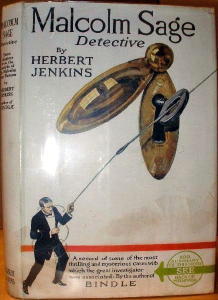
HERBERT JENKINS – Malcolm Sage, Detective

Jenkins, 1921; Doran, 1921. The complete contents are as listed below, as given in Crime Fiction IV, by Allen J. Hubin. Some of these are apparently bridging episodes only and not complete stories in themselves.

• Gladys Norman Dines with Thompson • ss
• The Great Fight at the Olympia • ss
• The Gylston Slander • ss Hutchinson’s Story Magazine Jul ’20
• The Holding Up of Lady Glanedale • ss
• Inspector Wensdale Is Surprised • ss
• Lady Dene Calls on Malcolm Sage • ss
• A Lesson in Deduction • ss
• Malcolm Sage Plays Patience • ss
• Malcolm Sage’s Mysterious Moments • ss
• The Marmalade Clue • ss
• The McMurray Mystery • ss
• The Missing Heavyweight • nv
• The Outrage at the Garage • ss
• Sir John Dene Receives His Orders • ss
• The Stolen Admiralty Memorandum • nv
• The Strange Case of Mr. Challoner • ss
• The Surrey Cattle-Maiming Mystery • ss

Malcolm Sage

   Malcolm Sage was an accountant who was always finding “little wangles” in the books. Refused for war service by the army, he worked for the Ministry of Supply and found a much larger wangle, eventually transferring to Department Z in Whitehall. The department handled secret service work during the war and now the conflict is over and the Department is being demobilised, Sir John Dene, his old chief, agrees with Lady Dene Sage that Sage should be set up in a private detective agency.

   Sage has a “bald, conical head”, a “determined” jaw, and protruding ears. His keen gaze is aided by gold-rimmed spectacles and his “shapely” hands are always restless, drawing on his blotting pad, balancing a spoon on a knife, constructing geometrical designs with matches, that sort of thing. He is kind, quiet, and never smiles. Nevertheless Sage’s Whitehall staff is devoted to him and it is from their ranks he chooses a handful to work at his agency. Gladys Norman will continue as his secretary and other departmental personnel engaged for the new venture are Sage’s assistant James Thompson, office junior William Johnson, and chauffeur Arthur Tims.

   ● This collection of investigations kicks off with “The Strange Case of Mr Challoner,” who was found an apparent suicide in a locked library. However, foul play is suspected and Richard Dane, Mr Challoner’s nephew is fingered as the likely culprit, having violently quarreled with the dead man the day before.

   ● In “The Surrey Cattle-Maiming Mystery,” Sage is called in to hunt down the person responsible for the crimes. There had been almost thirty going back over two years, despite villagers organising a committee to keep watch at night. Peppery General Sir John Hackblock, whose mare has been similarly mutilated, asks Sage to look into the matter since he is not satisfied with what he was told when he consulted Scotland Yard.

   ● “The Stolen Admiralty Memorandum” opens with a summons to a country mansion where the Prime Minister, the First Lord of the Admiralty, and the Secretary of War are both weekend house guests – and all are in a panic. The memorandum has disappeared and could do a great deal of damage in the wrong hands. Who is responsible for its theft? There are plenty of suspects, including over a dozen house servants and a number of other guests along with their ladies’ maids and valets.

   Next we have an interlude in which secretary “Gladys Norman Dines with Thompson,” Sage’s assistant. Gladys debates why the staff is so loyal to their employer, with a nice little sideswipe at expectations raised by romance novels (E. M. Hull sprang to mind!). Their conversation explains how Gladys came to work for Sage and where Thompson first met their employer, fleshing out the lives of the bureau employees as also happens elsewhere. The reader never has the impression the staff are spear carriers whose role is to admire Sage’s brilliance, and learning something of their lives was an attractive sidelight.

   ● Then it’s back to criminous business with “The Holding Up of Lady Glanedale,” wife of margarine magnate Sir Roger Glanedale. She has been robbed at gun point in a nocturnal burglary at the family’s country house. The Twentieth Century Insurance Corporation Limited calls Sage in to investigate the circumstances and find the missing jewelry.

   ● “The McMurray Mystery” deals with Professor James McMurray, found murdered in a locked laboratory. It is a particularly mysterious matter because the body of the professor displays a strangely youthful appearance. McMurray’s friend and philanthropist Sir Jasper Chambers was the last person to talk to the professor, who was in the habit of living in his laboratory for days on end and refusing to admit anyone for any reason. How then did his murderer get
in and out and what is the role of marmalade in the affair?

   ● A flurry of scandalous poison pen letters allege a vicar’s daughter and his curate are carrying on an intrigue. Naturally these foul communications cause much distress and agitate the villagers of Gylston and its surrounding area. “The Gylston Slander” sees Sage called in to find the culprit.

   ● Charley Burns is “The Missing Heavyweight,” who disappears on the eve of an important fight on which many have wagered large sums. Where has he gone and why? Was he taken ill, kidnapped, or did he run away, afraid to fight? This particular entry includes an excellent example of Sage’s deductions from evidence, in this case a patch of garden soil. Unlike some of the more startling deductions made by Holmes, here as in other stories the detective’s explanations seem reasonable and the reader is left with the impression they too could have made the same conclusions, if not as quickly.

   In the final chapter, “Lady Dene Calls on Malcolm Sage,” Lady Dene arrives at the bureau with an unusual aim. To the amazement of the staff she’s there to decorate Sage’s office with vast quantities of red and white roses on the anniversary of the agency’s founding and to present him with an antique platinum and lapis lazuli ring from her husband and herself to set off his “lovely” hand. To the astonishment of secretary Gladys and disbelief of Thompson, Sage accepts the gift — and smiles at Lady Dene.

   My verdict: Malcolm Sage is clever and yet an “ordinary shmoe” protagonist surrounded by a likable staff. It would be difficult not to warm to him and them. No astounding leaps of deduction or parade of esoteric knowledge here! Sages uses common sense, a keen eye, and the occasional bit of psychology to solve the cases he investigates. I enjoyed this collection a great deal.

Etext: http://gutenberg.net.au/ebooks02/0200921.txt

      Mary Reed
http://home.epix.net/~maywrite/

MARGUERITE SILVERMAN – The Vet It Was That Died. Nicholson & Watson; UK hardcover. First edition: 1945. No US edition.

   Of the three mystery novels written by this author, this one is the most common among those found offered for sale online: there are six copies available at the time I am writing this. Of Silverman’s second (Who Should Have Died?, Nicholson, 1948) there are none, and of her third (9 Had No Alibi, Nicholson, 1951) there is but one.

   According to Al Hubin’s Crime Fiction IV, the primary detective in each is Chief Inspector Christopher Adrian. Coming to his assistance in this one, at least, a relatively minor affair, is a newly graduated veterinarian surgeon by the name of Helena Goodwin.

    Helena’s involvement with the mystery is due only to this, her first job, however, and in fact she’s one of those immediately on the scene when her body of her veterinarian employer is found. (Hence the title.) And yet, even though both the inspector and his wife are old friends of her family, it doesn’t seem as though there?s enough of a connection there to warrant her presence in any of Adrian?s other cases. I could be wrong. It will also be difficult to find out, but if and when I do, I will be sure to tell you.

    It comes as no surprise that “the vet it was that died,” as both Mr. Thorpe and his wife are two of the most terrifically unlikable people that one can imagine. They are hated by their niece Carol, who lives with them; Dora, the other girl who works for them; their neighbors, and even their clientele, believe it or not. That the couple were not especially fond of each other is also an understatement, to put it mildly. When Mr. Thorpe is found poisoned to death, what Adrian and Helena quickly realize is that they have a lengthy list of suspects to work with. There is no need at all to start looking under rocks or for tramps passing by.

    By page 92, however, the list has been narrowed down to five: the only ones who had access to the brandy to which the strychnine was added, but with 100 pages yet to go, it takes quite a bit of time (and false leads) to whittle the list down any further.

    I called this mystery a “minor affair” a short while back, and truthfully that is all it is. The dialogue on occasion is rather juvenile in tone, and on other occasions one gets the unsettling feeling that the author is making up facts as she is going along. Neither of these are necessarily fatal flaws, mind you, but neither of them allows for much in the way of recommendation, either.

— October 2006

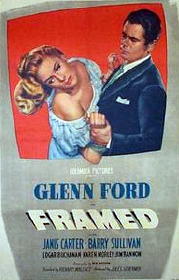
FRAMED. Columbia, 1947. Glenn Ford, Janis Carter, Barry Sullivan, Edgar Buchanan. Director: Richard Wallace.

   More than a B-movie, but not quite an “A,” Framed is generally considered to fall into the noir style of filmmaking. One definition I found online (Encyclopædia Britannica) is that noir is “a film genre that offers dark or fatalistic interpretations of reality. The term is applied to U.S. films of the late 1940s and early ’50s that often portrayed a seamy or criminal underworld and cynical characters. The films were noted for their use of stark, expressionistic lighting and stylized camera work, often employed in urban settings.”

Poster

   I’ll tell you the general plot line, then you tell me. An unemployed mining engineer named Mike Lambert (Glenn Ford) comes into a cheap bar where a beautiful girl named Paula (Janis Carter) is a waitress.

   Bad luck seems to follow Lambert, even getting him into trouble almost as soon as he hits town (literally), but – good luck at last? – Paula is there to bail him out of jail. Of course she has ulterior motives, and Lambert almost realizes it, but he can’t quite make a break from her.

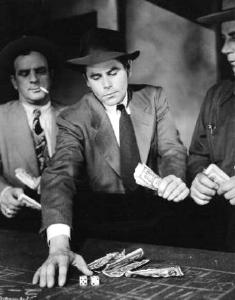
Glenn Ford

   One of Paula’s bedtime buddies is a local banker named Steve Price (Barry Sullivan), and their plans for Mike Lambert are both sinister and obvious. Of course we, the viewer, know full well that plans of this nature do not always work out the way they’re expected to, and in this movie, no exception is made.

   Noir? I thought you’d say so, and I’d agree, but I don’t think it fits the definition above, unless it’s expanded to include “… dark or fatalistic interpretations of reality, often involving unexpected twists of fate, against which the participants feel helpless to react.” Well, maybe the phrasing needs some work, but work on it I will.

   Glenn Ford’s sometimes goofy-faced grin serves him well in this film, but the chemistry between Paula and him doesn’t quite seem to work. She’s also a little too glamorous – especially to be a waitress in a cheap bar – and not quite vampish or seductive or dangerous enough. (If I include enough words here, maybe the point I’m making will also make itself clear.)

Janis Carter

   As Jeff Cunningham, though, the genial old prospector whom Lambert hopes to work for, and who – completely bewildered – ends up in jail, Edgar Buchanan is in a role made expressly for him. All in all, while you may find the plot line a little too familiar, if this is the kind of movie you like, then you won’t mind seeing yet another variation on the same theme, one more time, with just enough gusto to get by.

   Not many writers have had a career lasting as long as the 56 years that British mystery writer E. R. Punshon happened to have. Even so, Nick Fuller, on the pages of his website devoted to Punshon’s detective fiction, calls him “one of the most shamefully neglected writers of detective fiction,” with plots “rivaled only by [those of] John Dickson Carr.”

   He had, Nick goes on to say, the same “gift of conveying atmosphere and setting [and with the same adeptness] at devising clues and situations.” His work are also studies of character, of “the catalyst that drives an ordinary human being to commit the ultimate crime.”

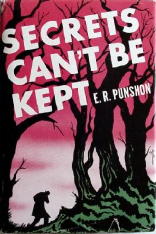
Secrets

   A complete list of Punshon’s mystery fiction in book form will follow Mary’s review of The Bittermeads Mystery, taken from Crime Fiction IV, by Allen J. Hubin. The detective twosome of Inspector Carter and Sergeant Bell appears in some his early books, but the series character who appears most often is Bobby Owen, who, according to Nick, “rises from the rank of police constable (in Information Received, 1933) to Commander of Scotland Yard by the later books.”

   The Bittermeads Mystery is a stand-alone, however. Robert Dunn appeared in this book and no other.        – Steve


E. R. PUNSHON – The Bittermeads Mystery

Knopf, hc, 1922. [No British edition?]

   The Bittermeads Mystery gets off to a lively start with protagonist Robert Dunn eluding pursuit after a donnybrook (or should I say a Dunnybrook?) with a man he was following through a wood.

   Dunn continues his nocturnal activities by sloping along to Bittermeads, the titular house, where he finds a burglary in progress. Seizing the day, or rather the night, Dunn knocks the burglar out and after exchanging clothing with the unconscious man (subsequently concealed on the village common opposite the house) he enters the dwelling hoping to be discovered.

   An unusual ambition, you may say, but since a burglar is a shady sort he hopes to be invited to join the murky band associated with Bittermeads. His reasoning is he will not be turned him over to the police as the residents don’t want attention drawn to the house. In this way he hopes to find out what has happened to his old chum Charley Wright, who was romantically involved with Ella Cayley, the daughter of the house, but has disappeared. (He has another reason for his interest in joining the enemy camp, but it is not revealed until some way into the narrative.)

   The only people at home are Ella and her ailing mother and after tying Ella up and promising not to disturb her mother, Dunn explores the house – only to find the murdered Charley in a packing case in an attic.

   Ella’s stepfather, Deede Dawson, returns home and nabs Dunn but decides to employ him as chauffeur and gardener – not an action one would expect of an honest man. Dunn’s first task is to finish nailing down the lid of the packing case without revealing he knows what is in it. But then Ella takes the packing case away in a car, thus removing the only evidence he can produce to launch a police investigation.

   Then there is another murder as the plot thickens up in satisfactory fashion.

   My verdict: The two matters Dunn is investigating have no immediate apparent link but ultimately are shown to be intertwined. Although the close reader may well deduce a certain hidden identity and the name of the person masterminding the mayhem, it will likely not be until fairly late in the book.

   The action gallops along and we have an unusual look at the romantic agony of a male protagonist as well as his internal musings as the plot develops. Although it is a fast, light read there are noir underpinnings and the whole is resolved with a satisfactory comeuppance for the egregious villain of the piece.

   Etext: http://www.geocities.com/hacklehorn/punshon/index.html

         Mary R
http//home.epix.net/~maywrite/


BIBLIOGRAPHY [British editions only, unless retitled in the US; all covers shown are those of the US editions, however.] —

PUNSHON, E(rnest) R(obertson) (1872-1956); see pseudonym Robertson Halket

* Earth’s Great Lord (n.) Ward 1901 [Australia]
* -Constance West (n.) Lane 1905 [England]
* The Mystery of Lady Isobel (n.) Hurst 1907 [England]
* The Choice (n.) Ward 1908 [England]
* The Spin of the Coin (n.) Hurst 1908 [England]
* The Glittering Desire (n.) Ward 1910 [England]
* Hidden Lives (n.) Ward 1913 [England]
* -The Crowning Glory (n.) Hodder 1914 [England]
* Arrows of Chance (n.) Ward 1917 [England]
* The Miser Earl (n.) Newnes 1917
* The Solitary House (n.) Ward 1919 [England]
* The Woman’s Footprint (n.) Hodder 1919 [England]
* The Ruby Bracelet (n.) Newnes 1920 [England]
* The Bittermeads Mystery (n.) Knopf 1922 [England]
* Dunslow (n.) Ward 1922 [England]
* The Blue John Diamond (n.) Clode 1929 [England]
* The Unexpected Legacy (n.) Benn 1929 [Insp. Carter; Sgt. Bell; England]
* The Cottage Murder (n.) Benn 1931 [Insp. Carter; Sgt. Bell; England]
* Proof, Counter Proof (n.) Benn 1931 [Insp. Carter; Sgt. Bell; England]
* Genius in Murder (n.) Benn 1932 [Insp. Carter; Sgt. Bell; England]
* Truth Came Out (n.) Benn 1932 [Insp. Carter; Sgt. Bell; England]
* Information Received (n.) Benn 1933 [Det. Sgt. Bobby Owen; England]
* The Crossword Murder (n.) Knopf 1934; See: Crossword Mystery (Gollancz 1934).
* Crossword Mystery (n.) Gollancz 1934 [Det. Sgt. Bobby Owen; England]
* Death Among the Sunbathers (n.) Benn 1934 [Det. Sgt. Bobby Owen; England]
* Mystery Villa (n.) Gollancz 1934 [Det. Sgt. Bobby Owen; England]
* Death Comes to Cambers (n.) Gollancz 1935 [Det. Sgt. Bobby Owen; England]
* Death of a Beauty Queen (n.) Gollancz 1935 [Det. Sgt. Bobby Owen; England]
* The Bath Mysteries (n.) Gollancz 1936 [Det. Sgt. Bobby Owen; London]
* The Dusky Hour (n.) Gollancz 1937 [Det. Sgt. Bobby Owen; England]
* Mystery of Mr. Jessop (n.) Gollancz 1937 [Det. Sgt. Bobby Owen; England]
* Comes a Stranger (n.) Gollancz 1938 [Det. Sgt. Bobby Owen; England]
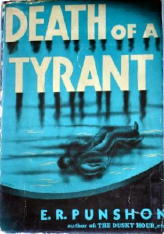
* Death of a Tyrant (n.) Hillman-Curl 1938; See: Dictator’s Way (Gollancz 1938).

Tyrant

* Dictator’s Way (n.) Gollancz 1938 [Det. Sgt. Bobby Owen; England]
* Murder Abroad (n.) Gollancz 1939 [Det. Sgt. Bobby Owen; France]
* Suspects-Nine (n.) Gollancz 1939 [Det. Sgt. Bobby Owen; England]
* Four Strange Women (n.) Gollancz 1940 [Det. Sgt. Bobby Owen; England]
* The Dark Garden (n.) Gollancz 1941 [Det. Sgt. Bobby Owen; England]
* Death in the Chalkpits (n.) Mystery Novel of the Month 1941; See: The Dusky Hour (Gollancz 1937).
* Ten Star Clues (n.) Gollancz 1941 [Det. Sgt. Bobby Owen; England]
* The Bathtub Murder Case (n.) Detective Novel Classics 1942; See: The Bath Mysteries (Gollancz 1936).
* Diabolic Candelabra (n.) Gollancz 1942 [Det. Sgt. Bobby Owen; England]
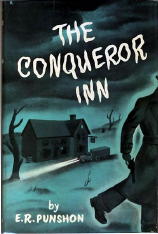
* The Conqueror Inn (n.) Gollancz 1943 [Det. Sgt. Bobby Owen; England]

Inn

* Night’s Cloak (n.) Gollancz 1944 [Det. Sgt. Bobby Owen; England]
* Secrets Can’t Be Kept (n.) Gollancz 1944 [Det. Sgt. Bobby Owen; England]
* There’s a Reason for Everything (n.) Gollancz 1945 [Det. Sgt. Bobby Owen; England]
* It Might Lead Anywhere (n.) Gollancz 1946 [Det. Sgt. Bobby Owen; England]
* Helen Passes By (n.) Gollancz 1947 [Det. Sgt. Bobby Owen; England]
* The House of Godwinsson (n.) Gollancz 1948 [Det. Sgt. Bobby Owen; England]
* Music Tells All (n.) Gollancz 1948 [Det. Sgt. Bobby Owen; Sgt. Bell; England]
* So Many Doors (n.) Gollancz 1949 [Det. Sgt. Bobby Owen; England]
* Everybody Always Tells (n.) Gollancz 1950 [Det. Sgt. Bobby Owen; England]
* The Golden Dagger (n.) Gollancz 1951 [Det. Sgt. Bobby Owen; England]
* The Secret Search (n.) Gollancz 1951 [Det. Sgt. Bobby Owen; England]
* The Attending Truth (n.) Gollancz 1952 [Det. Sgt. Bobby Owen; England]
* Strange Ending (n.) Gollancz 1953 [Det. Sgt. Bobby Owen; England]
* Brought to Light (n.) Gollancz 1954 [Det. Sgt. Bobby Owen; England]
* Dark Is the Clue (n.) Gollancz 1955 [Det. Sgt. Bobby Owen; England]
* Triple Quest (n.) Gollancz 1955 [Det. Sgt. Bobby Owen; England]
* Six Were Present (n.) Gollancz 1956 [Det. Sgt. Bobby Owen; England]

HALKET, ROBERTSON; pseudonym of E. R. Punshon, (1872-1956)

* Where Every Prospect Pleases (Benn, 1933, hc) [France]
* Documentary Evidence (Nicholson, 1936, hc) [England]


      —

   Mary Reed and Eric Mayer are in the process of compiling an online directory of all freely available etexts of mystery fiction published during the Golden Age of Detection. If you know of any they’ve missed, additions are extremely welcome.

   Peter Rozovsky has just left a comment after my review of Step by Step, posted about this same time yesterday. Peter found what NY Times movie critic Bosley Crowther said about the film to be very interesting. (Crowther didn’t like it very much, and he said so.)

   What’s even more interesting is that in the same column Crowther also reviewed the film version of The Big Sleep, which many people today find one of the classics of the hard-boiled private eye genre. He didn’t care for this one either, and he said so – and at even greater length. You can read the entire review online yourself, and you should, but here are some excerpts:

   If somebody had only told us – the script-writers, preferably – just what it is that happens in the Warners’ and Howard Hawks’ The Big Sleep, we might be able to give you a more explicit and favorable report on this over-age melodrama which came yesterday to the Strand. But with only the foggiest notion of who does what to whom – and we watched it with closest attention – we must be frankly disappointing about it.

Big Sleep

   For The Big Sleep is one of those pictures in which so many cryptic things occur amid so much involved and devious plotting that the mind becomes utterly confused. And, to make it more aggravating, the brilliant detective in the case is continuously making shrewd deductions which he stubbornly keeps to himself. What with two interlocking mysteries and a great many characters involved, the complex of blackmail and murder soon becomes a web of utter bafflement. Unfortunately, the cunning script-writers have done little to clear it at the end.

      […]

   Through it all, Humphrey Bogart stalks his cold and laconic way as the resolute private detective who has a mind and a body made of steel. And Lauren Bacall (Mrs. Bogart) plays the older of the daughters languidly. (Miss Bacall is a dangerous looking female, but she still hasn’t learned to act.) A dozen or so other actors play various tramps and tough guys acidly, and the whole thing comes off a poisonous picture lasting a few minutes shy of two hours.

   On the other hand, to pick a critic whose comments are always handy, Leonard Maltin gives The Big Sleep four stars (****) and in part agreeing with Crowther says, “So convoluted even [Raymond] Chandler didn’t know who committed one murder,” then going on immediately to say, “but so incredibly entertaining that no one has ever cared. Powerhouse direction, unforgettable dialogue…”

   I realize that it’s unfair not to give Mr. Crowther a chance to reconsider – and later on perhaps he did. No one always gets everything right the first time, and I do mean no one.

   And, just in case you might be wondering, Mr. Maltin gives Step by Step two stars (**), but other than a one line summary of the plot, his only critical judgment is that it is a “patriotic programmer.”

« Previous PageNext Page »