Reviews


REVIEWED BY DAVID VINEYARD:


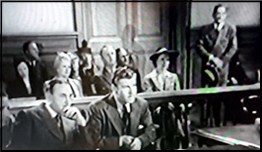
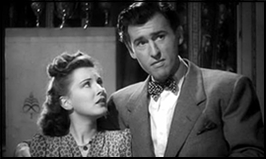
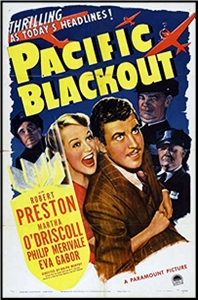
PACIFIC BLACKOUT. Paramount Pictures, 1941. Robert Preston, Martha O’Driscoll, Philip Merrivale, Eva Gabor, Louis Jean Heydt, Thurston Hall, J. Edward Bromberg, Mary Treen, Monte Blue, Rod Cameron. Screenplay: Lester Cole & W. P. Lipscomb. Story by  Franz Spencer (Franz Schulz) & Curt Siodmak. Directed by Ralph Murphy.

   As Seattle prepares for its first city wide blackout of the pre-War era replete with the Army providing bombers to drop faux weapons, Robert Draper (Robert Preston), a young inventor who has been working on range finder for the Army, is on trial for murdering his partner, and it looks bad for him, what with French nightclub singer Marie Duval (Eva Gabor) swearing he is guilty, though he swears he never met her.

   John Runnel (Philip Merrivale), an expert on blackouts, is advising the city and a friend of Draper’s, but there is nothing he can do when Draper is convicted and sentenced to death (they move fast in B -movies).
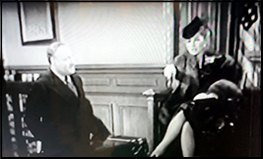
   While being transferred to prison that night as the blackout begins, there is an accident and Draper escapes, and while trying to find a way out of his handcuffs, he meets Mary Jones (Martha O’Driscoll), who is walking her dog in the park.

   Mary is one of those screwball types you could only find in a movie of this era, and in short order she is helping Preston in his escape through a series of misadventures that fill up most of the movie a la a more urban 39 Steps (one of the most oft repeated plots in Hollywood history, even by Hitchcock).

   About midway through, the big secret regarding the villain is revealed, but it isn’t until right at the end we discover the McGuffin: saboteurs have substituted a real bomb for one of the phony ones to be dropped on Seattle by pilot Rod Cameron’s unsuspecting crew.
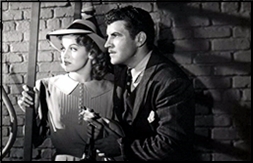
   To the extent this works its because of Preston and O’Driscoll, and a decent performance by a young Eva Gabor as the French girl whose testimony has been extorted by the unexpected German spy behind the whole thing. J. Edward Bomberg has a nice bit in a medical treatment shelter as a slight of hand artist turned pick pocket who helps Preston out in a tight.

   I’m curious if there ever was a blackout quite as extravagant as this one, but being on the West Coast and knowing Spielberg’s 1941 was loosely based on fact it is just in the realm of possibility (probably not with bombers dropping bags informing kids they have just been killed by poison gas).

   This is by turns screwball comedy, spy thriller, murder mystery, and patriotic flag waver, but makes so many sudden turns you may get a little dizzy trying to follow it. It never manages to all come together, but individual bits are worth seeing, and Preston is always good.
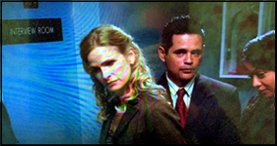


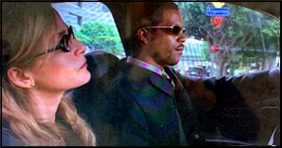
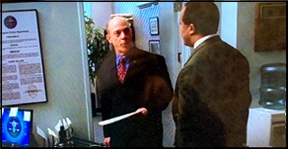
THE CLOSER. “Pilot.” TNT, 13 June 2005 (Season 1, Episode 1). Kyra Sedgwick (Brenda Leigh Johnson), J. K. Simmons (Will Pope), Corey Reynolds, Robert Gossett, and a large ensemble cast. Guest star: Allison Smith. Written by James Duff. Directed by Michael M. Robin. Currently streaming on HBOMax.

   One of the bigger hits on cable non-network TV, The Closer was on for seven summers on TNT before transforming itself into Major Crimes, a spinoff which continued on and lasted for another six years. You can’t tell me why I’m so slow, because I don’t know myself, but when I watched this, the pilot for the first season, it was the first episode I’ve ever seen of either series.

   And now I’m kicking myself, as I enjoyed this one immensely. As all good pilots do, it introduces the major players clearly and emphatically, while at the same time telling a good story, one with a bit of a twist at the end. Admittedly we do get to know the lesser members of the ensemble cast only in passing. To all intents and purposes, this is a one-woman show, Kyra Sedgwick as no-nonsense, ass-kicking Brenda Johnson, who is hired from outside to head up LAPD’s Priority Homicide Division.

   Her blunt personality wins her no friends on the force. Other than Brenda’s new boss, Will Pope, who hired her, all of the others turn in their resignations about 20 minutes into this first episode. I don’t know how long into the season it will take for her to win all of them over for good, but by the time she’s cracked her first case, it appears that she’s received at  a small modicum of respect, at least, grudgingly as it may be.

   And as far as the case is concerned, when the mutilated and burned body of a woman is found in the home of a high-tech millionaire, who has disappeared. Strangely, none of his fingerprints are in the house, only the victim’s. Brenda’s trademarked final closing scene is what it takes to induce a confession from the killer, an ending that clearly and forcefully delivered, the first of many to come.


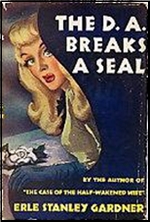
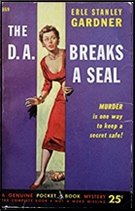
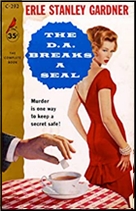
ERLE STANLEY GARDNER – The D. A. Breaks a Seal. Doug Selby #7. William Morrow, hardcover, 1946. Previously serialized in The Saturday Evening Post in seven part between December 1, 1945, and January 12, 1946.  Pocket Book #869, paperback, 1952. Cardinal C-292, paperback, 1958.

   Thanks to HBO if not the long-running TV series in the 1950s and 60s, everyone in the know knows about famed defense attorney Perry Mason. Not so many have heard about Gardner’s series character who plied his trade on the other side of the aisle, Doug Selby, the District Attorney for Madison County, California, some small distance from the bright lights of L. A., Madison City being a small blip in the larger scheme of things.

   But to be honest, Selby is a major in the U. S. Army all through The D. A. Breaks a Seal. He’s on leave and heading for his next assignment when decides to hop off the train and see how the folks he left behind. Rex Brandon is still the sheriff, and Selby’s nemesis, defense attorney A. B. Carr is still making headlines, both in LA and in Madison City. There’s a new D.A in town, of course, but he’s having a tough time making people forget Doug Selby.

   The story begins with two people getting off the same train that Selby arrives on, standing out first by the simple fact they’re wearing white gardenias, then by A. B. Carr showing up and obviously seeking them out. Selby’s lady friend Sylvia Martin, a reporter, senses a story, and she’s right. Soon after, a man is found dead in a local hotel room under strange circumstances, and somehow A. B. Carr is involved in that, too – as well in a local legal case about a contested will.

   Lots of detective work ensues, unofficially by Selby, and courtroom drama as well, this time officially. The legal matters are, as always in Gardner’s work, supremely complicated, but he, as usual, makes me believe I know what’s going on all the way through.

   There’s even a hint of romance in the air – Sylvia is not the only woman in town who remembers Doug with fondness — and Gardner even takes the time to talk about what the country should be like after the war.

   There’s lots to like with this one.

REVIEWED BY DAVID FRIEND:


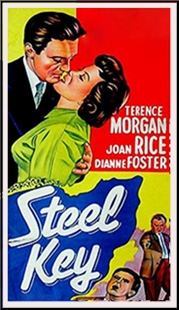
THE STEEL KEY. Eros Films, UK, 1953. Terence Morgan, Joan Rice, Raymond Lovell, Dianne Foster. Director: Robert S. Baker.

   International playboy and thief Johnny O’Flynn (Terence Morgan) tries to prevent criminals from stealing a secret formula for processing hardened steel, called the Steel Key, and discovers that one of the scientists involved has been murdered while another, Professor Newman (Esmond Knight) has died of apparently natural causes.

   His investigation leads him to a sanatorium, run by one Dr Crabtree (Colin Tapley), and a captured scientist forced to reproduce the formula. On the way, Johnny meets Newman’s glamorous, younger wife Sylvia (Dianne Foster) and rescues pretty nurse Doreen (Joan Rice), after the kidnappers try to kill her. Inspector Forsythe of Scotland Yard (Raymond Lovell) is also on the scent, but is intent on arresting Johnny for the crime.

   This British second-feature is a great deal of fun and one of my favourites from the era. It has much in common with other adventure-thrillers featuring a suave and witty hero. This may have been deliberate as it was originally intended to involve The Saint, but producers Robert S. Baker and Monty Berman could not secure the rights to the character. (They would eventually, of course, make a phenomenally successful television series with Roger Moore in the role.)

   Its Saintly beginnings, however, remain obvious to all as O’Flynn is considered to be a thief who claims a reward for any boodle he recovers and spars wryly with a portly inspector who would love to put him behind bars. It’s basically Simon and Inspector Teal, with all the hi-jinks that implies.

   With his chiselled features, slick dark hair and mischievous glint in his eye, actor Terrence Morgan makes for a likeable and charismatic hero as Johnny O’Flynn. Amid all the action, there are some good dollops of humour in here too. There is, of course, the constant cat-and-mouse game with the police, but there are also moments which border on farce (never a bad thing, in my book) as Johnny pretends to be one of the scientists involved with Newman. Indeed, nurse Doreen never discovers his real name and it is uttered only a handful of times in the whole film.

   The finger of accusation moves frequently from one suspect to another, but this a pacey adventure and not a drawing room whodunit, though the revelation does come as a surprise. The only criticism I would make is the inclusion of three scientists (one who is only referred to), which seems a bit messy to me.

   Morgan’s career started out promisingly with roles in Olivier’s Hamlet and Captain Horatio Hornblower with Gregory Peck, but he quickly slid into B-films and became typecast as villains, and though a switch to television with The Adventures of Francis Drake was successful, it did not last. Fortunately, there does not seem to have been an unhappy ending for Morgan, as he left acting to run a hotel on the South-East coast of England for many years before becoming a property developer. He died in 2005 at the age of 83.

Rating: *****


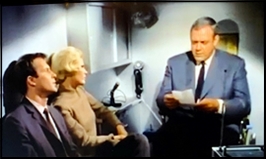
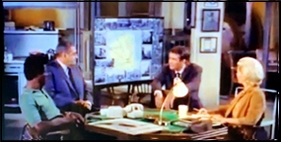
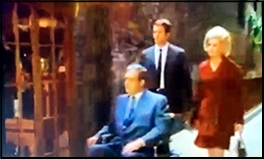
IRONSIDE. “The Leaf in the Forest.” NBC, 21 September 1967 (Season One, Episode Two). Raymond Burr (Robert T. Ironside), Don Galloway (Det. Sgt. Ed Brown), Barbara Anderson (Officer Eve Whitfield), Don Mitchell (Mark Sanger). Guest Cast: John Larch, Edward Andrews, Barbara Barrie, John Rubinstein, Bert Freed. Director: Leo Penn. Currently available online.

   The basic setup for the series was established, in a TV movie entitled Ironside (March 28, 1967), but I’ve not seen that since it first aired, so I can’t provide any details beyond the following: Robert Ironside was a member of San Francisco Police Department until was crippled in an accident and confined to a wheelchair. Not wanting his expertise go to waste, he was hired as a consultant and given two liaison officers (Eve Whitfield and Ed Brown) to work for him, along with a personal driver (of a custom-fitted armored car).

   The title of this episode comes from an old “Persian” saying along the lines of “The best place to hide a book is in a library, to hide a man is in a city, and to hide a leaf is in a forest.” Ironside quotes this to his crew when the death of an old woman in her apartment appears to be the sixth victim of a serial killer menacing the serial. The m.o. appears to be the same, but Ironside sees some crucial differences.

   Raymond Burr was of course fresh from a long run as TV’s Perry Mason, and his popularity easily continued on to this series, which lasted eight seasons. As Robert Ironside, he was extremely observant and made an obvious effort to push his assistants to think the way he did, and not much succeeding, at least in this episode. Perhaps they got better.

   In any case, by challenging them with the clues, he was doing the same for the benefit of the viewer, but without calling the members of his TV audience “children,” as he does on a couple of occasions, with some exasperation.

   All in all, it’s a fairly easy case to solve, but it’s fun to see the cast as they start to come to grips with their roles. Of the guest stars, Barbara Barrie stood out way ahead of the others, as a wife faced with the hard decision to give her husband [PLOT WARNING!] an alibi for the killing or not.


REVIEWED BY DAVID VINEYARD:


MORRIS WEST – Summer of the Red Wolf. Morrow, hardcover, 1971. Pocket, paperback, 1972.

   Suddenly I was sick of the savagery of the world.

   The unnamed narrator of Summer of the Red Wolf is a writer facing the most extreme kind of ennui. He is fed up with civilization, sick of the world; “I was engulfed in black despair.”

   â€œThe world would not stop for me. I could only jump off of it into a dubious eternity.”

   Maybe it is fate he meets Alistair Morrison. Morrison is one of those fictional deus ex machina the hero of this kind of book encounters at just the right moment, a semi-mystical philosopher/gadfly who plunges our narrator into a life devoid of all the pretense of civilization.

   â€œSometimes a man falls sick of the sunlight itself. He sees everything so clearly he becomes blind…It’s time to go then. Time to stick a shell in his hat, pick up the Pilgrim staff and take the road.”

   â€œWhat road?”

   â€œTo the place of unknowing.”

   For our hero the “place of unknowing” is beyond the isle of Skye, “and may Saint Donan be between you and harm.”

   On the way to his remote fate our hero meets Dr. Kathleen McNeil, a dark haired long legged Scot he will soon fall in love with, and the man who will change his life, Red Ruarri Matheson, master of the ship Mactire (Celtic for wolf), a bearded Viking of a man, “…he had the watchful sidelong glance of the commando,” a dangerous man, a gun runner, and more, friend, enemy, antagonist, and killer. Ruarri the Mactire.

   â€œWomen I love. Money I love. Horses I can take or leave, like oysters. And for the Irish and their squabbles, I don’t give a hoot in hell.”

   The writer, who Rurarri calls sennachie, or storyteller, sees himself in the shadow of the Red Wolf, but unconsciously matches him as an adventurer. This is the classic form of the adventure novel, David Balfour meeting Alan Breck, Jim Hawkins first encountering Long John Silver, the narrator of The Third Man meeting Harry Lime, Marlow and Kurtz, the opposites that not only attract, but that are strangely mirror images…

   Morris L. West cut his teeth writing adventure fiction and thrillers in his native Australia before he turned to bestseller-dom with books like The Daughters of Silence, The Ambassador, and eventually The Shoes of the Fisherman, Harlequin, The Navigator, and The Salamander. Eventually Hollywood came calling too with movies and mini-series and his works topped the New York Times Bestseller List regularly.

   Eventually Red Ruarri, wild Ruarri, Ruarri the Red Wolf goes too far and the sennachie has to challenge him, a demonstration of fencing with a saber with Ruarri out to do real harm, and the narrator recognizing he can only save himself and Ruarri by besting him.

   There is murder at the heart of the story, and a surprising twist in the dynamic between the man of letters and the man of action that comes at the books emotional climax.

   This is Buchan and Stevenson country with hints of Conrad’s complexity and depth, a kind of poetry of adventure and far places on the edge of civilization as most of us know it. It is the poetry of the wild wet wind off the sea, of rocky coasts, and ice driven breezes, of life lived at a different pace closer perhaps to the both the elements and the ever present shadow of death. West was the most literary of the major bestselling writers of his time and something more than just a name on the bestseller list, and this, I suspect, his most personal novel.

   They were very old men and they must have seen many departures and many dyings and all the griefs of the sea over the years: but they were still here, working the same simple task, glad of the sun while it lasted, and glad of the warm foggy bar, when it wasn’t. For them life was its own absolution, and time brought its own healing, sooner or late. I was no better than they and certainly no wiser; so why should I ask for more? It was time to be up and doing and to hell with yesterday…

   If it is not great literature it is a kind of literary experience that I have always savored, and will, I hope continue to for as long as I read and write. Those “places of unknowing” call the armchair adventurer in all of us, and to be fair it is a damn site more comfortable than the actual icy blast of the North Sea and the wind rattling the shutters as the wild thunder rolls and heavy waves erode the shore.

   Summer of the Red Wolf is as good a choice to curl up in a good chair with a snoring cat in your lap or dog beside you, a glass of good whiskey at hand. and settle in for a long read as I can imagine, and for me that in itself may be my highest recommendation. The Sennachie and Ruarri the Mactire will linger in your imagination long after you have turned the last page and laid the book aside.

REVIEWED BY DAN STUMPF:


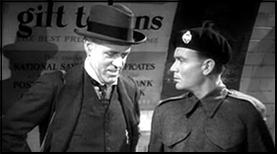
WATERLOO ROAD. Gainsborough, UK, 1945. John Mills, Stewart Granger, Alastair Sim, Joy Shelton, and Alison Leggatt. Written & directed by Sidney Gilliat. Currently available on YouTube.

   Sidney Gilliat’s credits include thrillers like The Lady Vanishes, Bulldog Jack, Night Train to Munich, The Green Man and many others, so with him at the helm this promises to be a witty, fast-paced and suspenseful yarn. It doesn’t disappoint. Waterloo Road (set in 1941 at the height of the Blitz) crackles with movement and tension, even though there’s very little actual criminal activity, mostly done by the hero of the piece.

   Said hero is Private Jim Colton, ably played by John Mills in his usual unassuming way, albeit a bit handier with his fists than usual. When Colton hears that his wife Tillie (Joy Shelton) has been running around with spiv Ted Purvis (a slick job by rising star Stewart Granger) he goes AWOL in London to check things out for himself.

   That’s not a terribly promising start for a thriller, but Gilliat fills the slender tale with fast-paced foot chases as Colton eludes the MPs, tense encounters with Purvis’ thuggish associates, and he backs it up with some colorful smaller parts, ably written and played: Alastair Sim fits in quite suitably as the moral anchor of the tale, and Joy Shelton conveys the complexity of a lonely woman missing her husband and sorely tempted by Granger’s patently phony charm as Gilliat cross-cuts neatly between Colton’s search for Purvis and Purvis’ simultaneous moves on the Missus, each building suspense in its own way. And when the pay-off scene finally arrives it’s handled perfectly, with the most savage fight scene in British Cinema until Sean Connery and Robert Shaw went at it in From Russia with Love.

   Oddly though, what stays in the mind is the emotional resonance of the moment, as feelings are conveyed by a glance, hearts broken and mended with a meaningful gesture, and Colton’s fury is unleashed not by Purvis’s attempted seduction, but when the rejected spiv insults his wife. The delicate emotional balance lends dramatic contrast to the violence that ensues, and the result is one of those truly memorable movie moments in a film well worth seeking out.


REVIEWED BY TONY BAER:


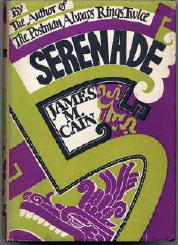
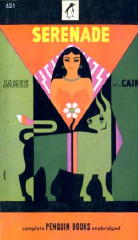
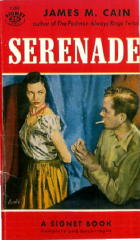
JAMES M. CAIN – Serenade. Alfred A. Knopf, hardcover, 1937. US Paperback editions include: Penguin Books #621, 1947; Signet 1153, 1954; Bantam S-3864, 1968; Vintage, 1978. Film: Warner Brothers, 1956, with Mario Lanza and Joan Fontaine.

JAMES M. CAIN Serenade

   First person narrative of a self-hating, closeted, gay opera singer. He falls in love with a rich gay conductor in Europe but feels so guilty about his homosexuality he has a nervous breakdown and can no longer sing worth a damn.

   He runs away.

   Relegated to the worst opera circuit in the world, in Acapulco, he quits and finds himself with his last three pesos, drunk, in a slummy bar.

   A really hot prostitute walks in and fawns on a local hero bullfighter.

   The gay opera guy feels something in his libido awaken in the presence of the prostitute.

   So he gives the bullfighter the staredown. The bullfighter comes up to him and asks what his problem is. Mr. Closet says: let’s gamble for the girl. They do. Mr. Closet loses a fixed lottery game.

   The prostitute drops him her address, and he looks her up.

   He gets drunk with her at her little whorehouse, and it looks like things are going swell, when he sings her a gay serenade.

JAMES M. CAIN Serenade

   She senses the homosexual tendencies in his castrato, and cuts him off (figuratively–not Bobbit-like), and he trudges on home.

   A week later she wins a little lottery money and seeks him out—thinking a gay dude would be the perfect pimp for a whorehouse she wants to start up in Mexico City with her ‘seed money’.

   En route to Mexico city in a little red convertible ford they hit a massive thunderstorm. The roads flood. There’s nowhere to go. They come to a church. The church door is locked. So he rams the car thru the locked church doors and they wait out the storm.

   They’re soaked so they take off their clothes.

   Aroused by her naked figure praying at the alter asking forgiveness, he rapes her.

   Enraptured by his hetero rapist cajones, he turns to the window and sings opera with a depth, vigor and confidence he’d never known. His voice was back and better than ever.

   For some reason, the whore now loves him. He’s shown her he’s a ‘real man’ or something.

   He takes her back to the States with him, and becomes a huge Hollywood star. Then he leaves Hollywood and becomes a huge opera star with the Met.

JAMES M. CAIN Serenade

   Then disaster strikes as his old beau, the rich gay conductor, tracks him down, stalks him, pulls him back into his orbit.

   Things come to head when the old beau calls immigration on the prostitute. She waves her cape like a toreador, and she sticks him like a bull.

   Things get pretty crazy from there as our protagonist can’t quit her. He finds himself falling for another man. He can’t believe it–‘I’m not one of those….am I?’. He feels that she’s his only hope to save him from his own gay lust.

   But the warrant’s out for her, murder one. He can’t let her get the chair.

   He’s gotten so famous he can no longer sing, lest he risk the whore whose musk summons hetero urges to his lust.

   As ridiculous as it all sounds, the book is really great. Mexico is palpably rendered. And Cain really knows opera. The dialogue is as good as anything Cain ever wrote. Which says a lot. Since Cain is as good as any hardboiled writer. And for me, that means he’s as good as anybody. Ever.

   So if you can let go of the bizarre self-hating gay machismo of a bygone era, and accept the fact that bizarre self-hating gay machismo is and was a real thing, as worthy of acknowledgement as dinosaurs, dead stars and moonbeams, then have yourself a treat and check it out. It’s really good.

   Previously reviewed here by Max Allen Collins. The film panned here by David Vineyard.

HENRY KANE. “Suicide Is Scandalous.” Novelette. Peter Chambers. First appeared in Esquire, June 1948. Collected in Report for a Corpse (Simon & Schuster, 1948). Reprinted in The Mammoth Book of Private Eye Stories, edited by Bill Pronzini and Martin H. Greenberg (Carrol & Graf, 1988).

   It’s only my opinion – I have no stats to back this up – but as an author of any number of crime novels, and in particular, the creator of New York City-based PI Peter Chamber, Henry Kane has largely been forgotten in recent years. One exception is, of course, Mike Nevins’ covered his early years in one of the monthly columns he does for this blog. One of the stories covered, in fact, is this very one. Go here.

   This is one of the longest excerpts I’ve ever inflicted upon readers of this blog. Bear with me. A little old lady is sitting in Peter Chambers’ office on the other side of his desk. Bear with me. Here goes:

   She put the handkerchief away.  “The Lieutenant sent us.”

   “What Lieutenant?”

   “The man downtown. The Detective-lieutenant.”

   “Parker?”

   “Yes, sir. Lieutenant Parker.”

   “A real policeman.”

   “A fine, good man.”

   “The best.”

   “He said this was where to throw it.”

   “I beg your pardon.”

   “That’s what he said.”

   “Throw what?”

   “My money. That is, if I insisted on throwing it away.”

   “I beg your pardon.”

   The smile came back, very tired among the faint wrinkles on her face, and it did something to you, no matter you’re a cynical wiseguy private richard battened down behind a desk over which too much evil has spewed. It got to you, in a corner inside of you, like “Stardust” on strings in a sawdust saloon after a good many brandies. I grunted.

   “How much?”

   Her eyebrows peaked. “How much?”

   “How much do you insist on throwing away?”

   “Oh. He said you were expensive. He also said you were a crook.”

   “Look, lady– ”

   “He was joking, of course. A thousand dollars, perhaps fifteen hundred … ”

   “Oh.” Good-bye Stardust, because business is business, and you have got to have the pretzels for your beer. On the other side of the. desk sits your sucker — always; they wouldn’t be on the other side of that desk if they didn’t need you badly. Either you squeeze them, or they squeeze you: you learn that early, Always, on one side of the desk sits a sucker. Could be me.

   “Two thousand,” I said.

   Now either you find that an extraordinarily fine piece of writing, or you don’t. Kane’s prose, at least in this story, I’d place on the spectrum somewhere between Raymond Chandler and the Dan Turner stories by Robert Leslie Bellem, but closer to Chandler than the out-and-out wackiness of a Dan Turner story:

   “Don’t know nothing from absolutely nothing.” He put a wide hand on my chest and he shoved with relish and sharp determination, and the door slapped shut in my face. Mr. Gino Stark got filed away as a handsome young man with a tough-guy complex that needed treatment. Something psychiatric. Like a haymaker.

   I took a cab, still rankling along the chest and rumbling around the stomach and trying to engage reasons for administering the treatment for our Gino’s complex, all of which is good for the passage of time, because before I knew it I was paying off the hackie in front of Two Ninety Park.

   I pushed my hat back and I looked up at the narrow four sandstone stories of a very svelte little pigmy amongst the flat-faced monsters that go to make up our canyon of Park. No doorman. No nothing. Just a silver-grilled ninon-backed glass door with an ivory boundary and a horse’s head for a phony knocker and a shining lock. I stuck the key in that Williams had given me and I was in a hallway with enough plush for a lupanar, and a curlicue stairway. Very dandy, but a walk-up, nevertheless. Ah, me, and the rasp of a sigh: your detective trudged, grudgingly, bending over to study nameplates. On the second floor front it said BENTLEY.

   So, OK. What’s the story about? Chambers’ client, the little old lady from the first except above, does not believe her daughter committed suicide. The police are convinced; that’s why she’s hired Chambers. But besides suicide being scandalous, there is a small matter of a will. The dead girl was rich. Her will leaves half to her mother, half to her sister. If it was murder, and the sister did it, who gets all the money?

   Besides being an above average PI story in and of itself, “Suicide Is Scandalous” ends with a lot of detective work going on. There was, in fact, so much detective work going on that I found it confusing. Oh well. You can’t have everything.

REVIEWED BY BARRY GARDNER:


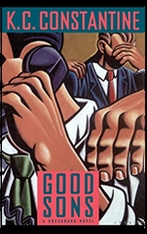
K. C. CONSTANTINE – Good Sons. Rocksburg [not Mario Balzic] #12. Mysterious Press, hardcover, 1996; paperback, 1997.

   I had heard Constantine was calling it quits, but not so. Not only do we have this, but a Reliable Source tells me that there will be another Balzic to follow it. I also thought Constantine had said everything he had to say (and repeated a damned good portion of it), but I guess not-either that, or he needed the money.

   Detective Sergeant Ruggiero (“Ruggs”) Carlucci is more or less in charge of the Rocksburg, Pennsylvania police department since the retirement of Mario Balzic, and he thinks/is afraid that he may be in line for the Chief’s job. He’s got a lot of internal and external problems, and isn’t sure he wants it. His mind gets focused on another set of problems when a woman is found at a local business, horribly raped and mortally battered. The case will tell him a lot about himself, and what he can and wants to do and be.

   First, let me say that this is more of a mystery/crime novel than either of his last two books have been, not that it would take much more than a bigtime case of jaywalking to make that true. Carlucci isn’t as appealing a character to me as Balzac; I guess his problems don’t match up well enough with my own for me to relate well to his.

   I really don’t relate to Constantine at all any more, though on the basis of his earlier work I’m more than willing to concede that he’s earned his reputation. He preaches and speeches too much for me now, and though his blue-collar Everymen-and-women may be realistic, they just don’t interest me that much.

— Reprinted from Ah Sweet Mysteries #22, November 1995

« Previous PageNext Page »