Reviews


REVIEWED BY DAVID VINEYARD:


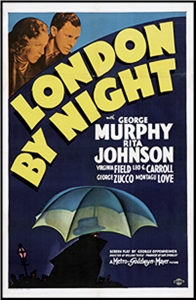
LONDON BY NIGHT. MGM, 1937. George Murphy, Rita Johnson, Virginia Field, George Zucco, Montagu Love, Leo G. Carroll, Eddie Quillan, J. M. Kerrigan, Leonard Mudie. Screenplay by George Oppenheimer, based on the play by Will Scott. Directed by Wilhelm Thiele. Streaming online here.
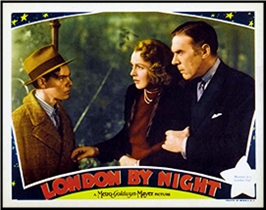
   Hollywood on the Thames strikes again in this superior little mystery from MGM starring George Murphy as Irish American reporter Michael Denis who has a nose for mystery even when he is trying to get away for his holiday in Paris with his nosy dog Jones.

   At his favorite pub for a last drink before leaving for his holiday, Murphy meets his friend Bill (Eddie Quillan with an Irish accent), a clerk for a local businessman, who is in love with vivacious crime obsessed barmaid Bessie (a scene-stealing Virginia Field). While Bill and Bessie sit outside and manage to drop some key exposition without doing it too obviously, they see a dark limping man with an umbrella enter Bill’s bosses business. They overhear a loud argument about money and when the Umbrella Man (as he will be branded) leaves Bill’s boss doesn’t answer from behind the locked door.

   They call on Denis, and he suspects foul play and calls in his friend Inspector Jeffers (George Zucco). When they force their way in, there is no one in the office and no exit other than the one Bill and Bessie watched the owner could have left by.
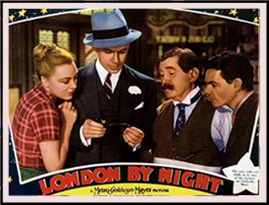
   Yup, we have a genuine locked room mystery here, and it proves a pretty good one, maybe not John Dickson Carr quality, though I imagine he would have approved, particularly of one vital clue everyone misreads.

   Then a policeman is fatally wounded by a man with an umbrella, and the businessman’s clothes are found in the Thames. Meanwhile a German friend of the businessman who played chess with him arrives and confirms the clothes belonged to his friend who failed to meet him that night.

   They also find a threatening note written in red chalk.

   Following a man he believes is the Umbrella Man, Denis intrudes on the home of Sir Arthur Herrick (Montagu Love) also on the square and meets Herrick’s beautiful daughter Patricia (Rita Johnson) butler Squires (Leonard Mudie), and nervous secretary Corey (Lep G. Carroll) and his suspicions are aroused.
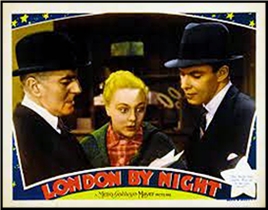
   There is also a suspicious character who hangs about the pub that Jones is particularly aggressive toward.

   The film is set-bound and takes place on the square where the pub, the little shop, and Sir Arthur’s home are, and mostly takes place, as the title suggests, at night in the fog.

   Another murder follows, as the Umbrella Man strikes again, this time at the pub, then a note, again in red chalk, arrives extorting money from Sir Arthur or Patrica will die. Denis and Jeffers set a trap for the Umbrella Man who gets away after attacking a mail man, but Denis has stumbled on a clue that explains the disappearance of the businessman from a locked room with the only door under observation and who the mysterious Umbrella Man is.

   This is a fairly done mystery, though readers of this blog in particular will figure things out pretty quickly with the arrival of one performer (we can discuss him in any comments, if you want), and likely put the whole thing together, but it is a fair play mystery with clues misinterpreted and misleading, plus a seemingly mad killer who is quite mad and also much more clever than anyone thinks.
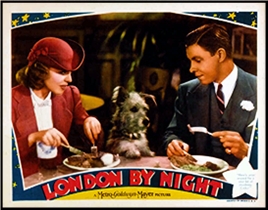
   Murphy is charming as usual, and his scenes with Johnson are believable in the romantic comedy mystery genre this represents. Quillan’s accent is a bit thick, but he is earnest and plays well off Field who steals all her scenes as a genuinely sexy zany barmaid.

   It’s nice to see Zucco get to play a lighter role and he does it quite well with something of the same droll humor as his Yard man in Douglas Sirk’s Lured, and the rest of the cast are all in fine form, though one is a little better and gets to stretch a bit, though I won’t give it away here by saying who.

   The clues are planted fairly here, and if, as IMDb suggests the play was never produced on stage, it’s a shame. It’s a barn burner, and quite entertaining with a solid mystery element and slight romantic comedy mystery overtones.
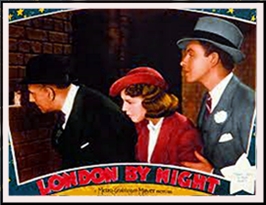
   This is a pleasant mystery comedy, attractively cast, mostly fairly played, and unlike many of its kind one you would probably enjoy if you encountered it in print. It breaks no new ground, does nothing terribly original or surprising, but it is smart, playful, attractive, and enjoyable.

   Extra marks too for not letting the comedy relief or the dog overwhelm the simple thrills. There are several places where it could go wrong, one where it might even seem about to, and manages to keep on track and keep focused on the goal.

   I’ve seen quite a few mystery films with greater ambition that don’t hold together half as well as this does. London by Night may be a bit foggy and dangerous, but it’s a place worth visiting.
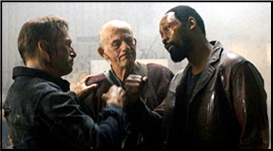
   

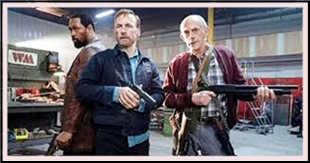
NOBODY. Universal, 2021. Bob Odenkirk, Alexey Serebryakov, Connie Nielsen, Christopher Lloyd, Michael Ironside. Director: Ilya Naishuller.

   From all outward appearances, Hutch Mansell is a perfectly ordinary guy with a totally boring life. Up in the morning with his wife and two kids, off to work at  some uninspired factory job, home again, and off to bed. Until, that is, a home invasion initiates a chain of events that has him (and his father, played by Christopher Lloyd) up against a Russian mobster whose only wish is to kill him.

   Not so easily done, though. Mansell is not the wimp his current life says he is. The Russian mobster does not have a fighting chance. Mansell has a past life that’s apparently been a secret for some time, and once the secret’s out, it’s all out Gangbusters.

   Audiences usually enjoy revenge movies – once Mansell’s family is threatened, there’s no stopping him – and this movie is no exception. It’s been quite popular, even with the critics.

   I demur, however. The last rather lengthy scene in which the Russian kingpin and his dozens of minions are utterly wiped off the face of the earth? Lots and lots of firepower in this one. Me, I dozed off. Utterly boring — and yet, I admit, enjoyable enough if you’re into movies like this. Here’s another one.

REVIEWED BY BOB ADEY:


   You may be forgiven if you have never heard of this author, She doesn’t get a mention (as far as I’m aware) in any of the critical works, though of course her three books are listed in Hubin.

   My own interest in her books was inspired by a word of praise which she received in a bookseller’s catalogue. I located her  earlier book without too much trouble, but her second mystery  novel proved far more elusive. The third book listed by Hubin (Gloriana, Nicholson, 1946) is not a mystery so that for the purposes of this essay she falls to
be judged on her other two books only.

   GREEN DECEMBER FILLS THE GRAVEYARD (Pilot Press 1945;  Coward, 1946).  The book is set in and around Shots Hall, the modest country home of Flikka Ashley and her Aunt Bee. The life of the small village community in which they live is disrupted by a series of fatal poisonings and all the evidence seems to point to Flikka.

   Obnoxious Sergeant Arnoldson is all set to hammer it home but thankfully he is superseded by Inspector Lane Parry of Scotland Yard. Parry, the most civil and humane of policemen, gradually unearths the clues that point to  the real murderer and the book ends happily and romantically.

   The characters, major and minor, are all well observed: sharp tongued Aunt Bee, uncertain Dr. Abbot, odious Arnoldson, batty Miss Merridew, cunning old gardener Harry, and the rest.  The narrative and dialogue  are also particularly good, and the unravelling at the end caused no dissatisfaction at all. In short,  a gem of a book and a real find.

   DINNER FOR NONE (Nicholson. & Watson, 1948 and, as A PARTY FOR LAWTY, Coward, 1948). Lane Parry again and this time faced with that classical situation — a murderer, loose in a hotel cut off  in all senses from the· outside world by heavy snow.

   Unfortunately. the book does not work as well as its predecessor and creaks a little at times. I found myself getting rather muddled with the characters and situations, which all goes  to show that this particular classical form is not as easy to deal with as Christie makes it seem.

   The problem apparently  lies with the confined quarters in which the puppet master has to make his puppets work. Nevertheless, Sarsfield’s book has many of the strong points that her first mystery had: good characterization, crisp dialogue, recognisable people (in most cases) and a neat tidy up at the end. Well worth searching out.

   Alas, I cannot finish this with a biographical sketch I can pass on to you. I have seen not so much as a blurb that I can pass on to you, and Miss or Mrs. Sarsfield seems to have disappeared in 1948 as unobtrusively as she had arrived.

– Reprinted from The Poison Pen, Volume 3, Number 6 (December 1980).


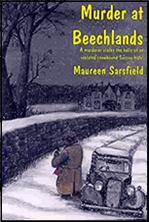
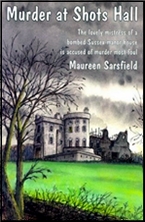
EDITORIAL UPDATE: The good news to readers of traditional good British detective stories from the 1940s (which of course you may already be full aware) is that both books were later reprinted by Rue Morgue Press, both in 2003. The first as Murder at Beechlands , and the second as Murder at Shots Hall.

   It is also now known that Maureen Sarsfield was the pen name of pseudonym of Maureen Pretyman, (1899-1961). I suspect that the introductory material in both reprints have more to say about her.

REVIEWED BY DAN STUMPF:


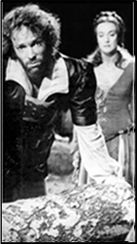
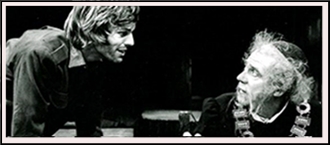
THE LADY’S NOT FOR BURNING. Made-for-TV movie. KCET / Hollywood Television Theater / PBS, 1974. Richard Chamberlain, Eileen Atkins, Jacques Aubuchon, John Carradine, Keene Curtis, Scott Hylands, Tom Lacy, Stephen McHattie, Rosemary Murphy, Laurie Prange, and Kristoffer Tabori. From Christopher Fry’s play (1948). Directed by Joseph Hardy.

   With its frequent references to tumult and celebration off-stage, this cries out to be made as a movie, but the nearest it’s come is two made-for-TV tapings of the play, and the 1987 version was ruined by Kevin Branagh’s over-acting. This 1974 production, however, is a joy to watch: perfectly cast, well-paced, and directed with an affinity for Fry’s wit and melancholy in equal measure.

   Set in the Mayor’s house in a medieval village, the story builds itself on the contrasting characters who come and linger: Thomas Mendip, a wandering veteran back from some meaningless war, wants to be hanged; Alizon, a young innocent, is trothed to marry Humphrey, the Mayor’s snarkey nephew — or possibly his loutish bother Nicholas. Jenna, an alchemist’s daughter, arrives pursued by a witch-hunting mob, soon joined by a musical Priest and a hedonist Magistrate. Stir in the Mayor’s supremely serene sister, composed of equal parts Gracie Allen and Margaret Dumot, add a sensitive young Clerk smitten with Alizon, and you get a story that almost writes itself.

   Well actually, Christopher Fry wrote it, with his usual wit and obvious love of the characters. Nor does he stint on the action. There’s a lot of talk, to be sure, mostly about love, death, God and the Devil, but there’s more conflict than conversation here, and much more wit than piety. I particularly enjoyed Jenna’s debate with herself over whether to sleep with Humphrey or burn at the stake, and her carnal indignation when Mendip threatens to kill her option (“Sluts are human, too.”)

   I said this was perfectly cast, and it is, from Kristoffer Tabori’s callow swain to Jacques Aubuchon’s venal magistrate, but Chamberlain and Atkins rightly dominate the piece — his ghastly grin when she asks why he wants to be hanged and he replies, “I owe it to myself.” is a marvelous bit of sheer theater. They dominate, I should say until the last few minutes, when John Carradine staggers out onstage as old Skipps, the drunken Rag & Bones man, and proceeds to blow everyone else into the wings. A small part, but unforgettable.

   Try to catch this one. It’s one of those that manages to entertain and make you feel a bit smarter.
   

REVIEWED BY MIKE TOONEY:

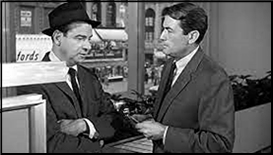
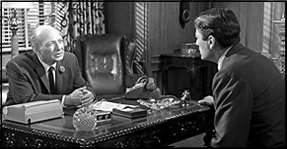
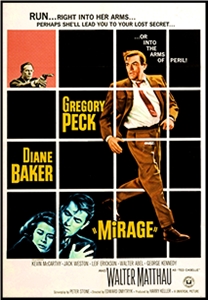
MIRAGE. Released: July 7, 1965. Running time: 109 minutes. Cast: Gregory Peck (David Stillwell), Diane Baker (Shela), Walter Matthau (Ted Caselle), Kevin McCarthy (Josephson), Jack Weston (Lester), Leif Erickson (Crawford Gilcuddy), George Kennedy (Willard), Robert H. Harris (Dr. Broden), Anne Seymour (Frances Calvin), House B. Jameson (Bo), Hari Rhodes (Lt. Franken), Neil Fitzgerald (Joe Turtle). Producer: Harry Keller. Writers: Peter Stone (screenplay) and Howard Fast (uncredited; based on his 1952 novel Fallen Angel, as by Walter Ericson). Director: Edward Dmytryk.

   David Stillwell has managed to do the impossible, at least according to a nervous psychologist who presumably knows about these things: While David has spent the last two years living and working in New York, he has absolutely no memory of any of it. “Impossible!” says the shrink that he has desperately sought out; amnesia can last, at most, maybe two months — not two years!

   But when a nervous pro-wrestling-addicted schmo practically kidnaps him in his apartment, and a big plug ugly starts taking shots at him in the park, and people he knows — or thought he knew well — either wind up dead or are plotting to kill him, it occurs to David Stillwell that he will have to retrieve his lost memories — and fast! Unknown to him, buried deeply in his subconscious is the knowledge of something — and this is no exaggeration — that could completely change the world forever . . . .

   There are a lot of twists and turns in this movie, too many to detail, but it zips along at a good pace. By telling the story in a nonlinear way with lots of flashbacks that at first don’t make much sense, the viewer is kept as much in the dark as the main character about just what the heck is going on. The writers lean heavily on Gregory Peck’s amiable charisma to keep the audience sympathetically engaged in his nightmare.

   The production also makes full use of late autumn scenes in New York’s streets and Central Park, and although the film is a full-length theatrical release, it seems wise for them to shoot it in muted black and white in order to give it a noirish feel.

   The aforementioned “nervous psychologist” is played by Robert H. Harris, one of those familiar faces from mainly ’50s and ’60s network TV that you might have trouble attaching a name to. The IMDb awards Harris 130 credits, including a long run in The Goldbergs (51 episodes), Erle Stanley Gardner’s The Court of Last Resort (23 episodes), Alfred Hitchcock Presents (8 episodes), Perry Mason (7 episodes), with sporadic appearances in dozens of shows and movies as late as The Six Million Dollar Man in 1977.


PostScript: The one copy of Fallen Angel currently on AbeBooks has an asking price of $3500.


REVIEWED BY DAVID VINEYARD:


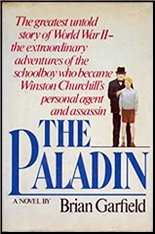
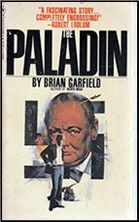
BRIAN GARFIELD – The Paladin. Simon & Schuster, hardcover, 1980. Bantam, paperback, 1981.

   The hero of this book is a real person. He is now in his fifties. His name is not Christopher Creighton.

   The book is based on his extraordinary story, but the book is a novel and it employs the sort of license that is customary in a work of fiction.

   Some books either work or they don’t. They are so audacious in imagination and execution as to leave the reader with only two choices, go along with the game or throw his hands up in disgust and the book across the room.

   In The Paladin veteran author Brian Garfield (The Last Hard Men, Hopscotch, Death Wish, Manifest Destiny, Wild Times among many others under multiple names) succeeds brilliantly in the first reaction. His idea and execution are so perfect, the idea so brilliantly brought off, that the reader is swept up in the imaginative details and left too stunned to protest.

   The book opens as Englishman Christopher Creighton stands in London, 1965, like thousands of other Brits, as the procession of Sir Winston Churchill’s funeral winds its way through the streets of London past Whitehall and the Cenotaph. Like those thousands of others Creighton feels a great loss at the passing of the great man, but for Creighton it is personal, and that is the story Garfield proceeds to tell.

   Christopher Creighton first met Winston Churchill before the war when Creighton was only ten and on an adventure and stumbled on Churchill painting. The year was 1936, the wilderness years when Churchill was out of favor, his career at its lowest ebb and his voice alone in decrying the Nazi menace in Europe.

   A strange friendship develops between the two, Creighton, who Churchill calls, Christopher Robin and the older man the boy calls Tigger curiously drawn together. Creighton is fifteen when it occurs to Churchill that with the War having broken out there is something the boy can do, a mission involving a Belgian boy of the same age, something best done by a youngster.

   With the success of that first mission and Creighton’s cleverness when it goes wrong, Churchill imagines there will be other opportunities for a boy good at languages and with a cool head, and Creighton is soon in training as a full fledged agent. Creighton will be involved in the assassination of French Admiral Darlan, Pearl Harbor, D-Day and other vital operations of the war, all quite reasonably told.

   Absurd as it may seem Garfield sells it, and without the tongue in cheek play of Anthony Horowitz’s Alex Rider books about a latter day Christopher Creighton.

   The book was a best seller, but more than that it created a sort of cottage industry, because Brian Garfield wasn’t the only one taken with the idea of Christopher Creighton’s career as Christopher Robin.

   The Paladin was published in 1979, in 1987 Christopher Creighton turns up as the co-author of Noel Hynd’s The Khrushchev Directive dealing with the Soviet Prime Minister’s trip to the West and tying it to the mysterious disappearance of famed British diver and War hero Lionel Crabb V.C. (The Silent Enemy) who disappeared while diving beneath a Russian trawler in a British port on a probable mission for the British Security Services and suggests Lord Mountbatten’s 1979 assassination was not the work of Irish terrorists but related to his preventing the assassination of Khrushchev on his 1956 trip. In this one Creighton is an adult drawn back into international intrigue and adventure.

   You would think that would be enough, but Christopher Creighton wasn’t done quite yet, in 1996 “Christopher Creighton” penned his own book, Op JB (“Operation James Bond”) purporting to be the true story of an operation by Ian Fleming to smuggle Martin Bormann out of Berlin under the noses of the Soviet’s under the orders of Churchill and Roosevelt in order to recover billions in Nazi loot. This one is presented as non-fiction replete with an index and photographs revealing Creighton was the really John Christopher Ainsworth-Davis, actor, writer, director, and musician.

   A further book called The Mountbatten Report fell prey to authorial disputes with Ainsworth-Davis collaborators.

   None of the books really acknowledge each other much though they share details , and whatever “truth” involved both the Garfield and Hynd books are strictly fictional in presentation while Op JB is presented as history but as far as I know uncorroborated. Certainly Simon and Schuster, the publisher, made no claims regarding the books authenticity and no American edition was ever published which is suggestive in itself. An epigraph, an alleged admonition from Winston Churchill to Creighton in the latter book warns, “Guard above all your reputation as a young man of no character; for if anyone should become proud of you — you are lost.”

   Creighton seems to have done an excellent job at that.

   As literary gamesmanship goes this one is a fascinating case. Three works in three different decades by three different writers, two of them best sellers, and all purporting to be based on the memoirs of a figure who either has the best untold story of WW II or is the most inventive fictionneer since Baron Corvo.

   All three books are well worth finding strictly as fiction of the playful historical kind. Since none of the people I would expect to be all over this sort of thing like Ben McIntyre, William Stevenson, or Jeremy Duns have deigned to write about it, I have my doubts though as might be expected there are some interesting side points that lend some probability to some of Creighton’s claims.

   Then again, if true, it would still be almost impossible to prove short of some remarkable secret papers or diaries showing up.

   Garfield said of his book:

“I’d co-written a novel, The Paladin, with an Englishman who claimed to have been Churchill’s teenage hatchet man … I wrote the book not as an as told to memoir but simply as a yarn, written by me, based on, but not entirely faithful to the stories he told me.”

   
   Garfield could hardly have imagined he had started a mystery that would still be intriguing in the 21rst Century much less create a minor industry of books following where he led. Perhaps ironically Garfield wrote an expose a few years later on British soldier and diplomat Richard Meinhertzhagen whose exaggerated biography was told in John Lord’s Duty, Honour, Empire. Meinhertzhagen never saw the day his claims were as shrouded in mystery as those of Creighton/Ainsworth-Davis. History at least acknowledges Meinhertzhagen was there.

REVIEWED BY JIM McCAHERY:


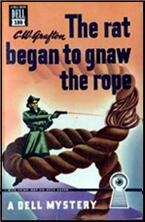
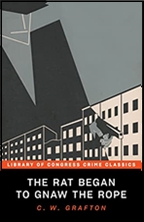
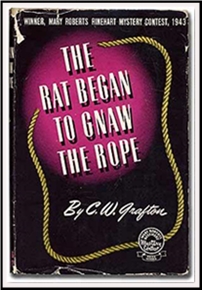
C. W. GRAFTON – The Rat Began to Gnaw the Rope.  Gil Henry #1. Farrar & Rinehart, hardcover, 1943.  Dell #180, mapback edition, no stated date. Mercury Mystery #97, digest-sized paperback, 1945. Perennial Library, paperback, 1983. Poisoned Pen Press, trade paperback, 2020.

   Ruth McClure of Harpersville, Kentucky becomes suspicious when her deceased dad’s boss, William J. Harper, offers her exorbitant prices for her father’s shares of stock in his company with the stipulation that she turn over to him her father’s papers as well. She approaches Gil Henry, a junior partner in his law firm to investigate.

   Gil is an unusual investigator — short, pudgy, thirty, and living at the YMCA. He takes the case and Harper is killed shortly thereafter in his study. Ruth’s stepbrother is arrested on suspicion and Gil has to quit the firm to represent him because the firm proper already handles the Harper estate. Soon a neighbor, Miss Katie, is killed as well.

   There are some very good scenes at the bank when Gil is trying to get into the safety deposit box belonging to Ruth’s father. It’s fairly complicated with a lot of references to stocks and depreciation and whatnot, and Gil does some handy will juggling himself at the request of Mrs. Harper.

   It’s all neatly tied up at the end, however. The Mother Goose title is a bit far-fetched. Gil represents the rat gnawing at the rope, setting off an inevitable chain of events. I will definitely read the sequel,  The Rope Began to Hang the Butcher (1944).

– Reprinted from The Poison Pen, Volume 3, Number 6 (December 1980).


REVIEWED BY BARRY GARDNER:


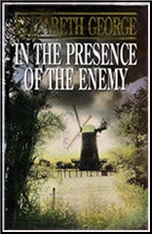
ELIZABETH GEORGE – In the Presence of the Enemy. Thomas Lynley et al #8. Bantam, hardcover, 1996; paperback, 1997. TV movie: BBC/PBS, 2003.

   After I read the [most recent] of this series I got rid of all I had but the first three, and crossed George off my reading list. I had gotten tired of the unremitting angst that seemed to suffuse about two-thirds of the pages, which were too numerous. A friend said this [one] was more like the early ones I had liked considerably, though, so …

   The acknowledged but illegitimate child of a woman high in the Tory government is kidnapped, and both she and the child’s father, the editor of a muckraking left-wing tabloid, receive notes demanding that he acknowledge his first-born child on the front page of his paper. The woman, fearing political repercussions, is unwilling for either that to happen or the police to be notified; the man, though willing, abides by her decision and seeks help in finding the child. This help consists of Simon St. James, Scotland Yard Inspector Thomas Lynley’ s best friend, and Lady Helen Clyde, his fiancé. Then the story turns darker.

   I shouldn’t review this series where anyone new to it might read the review (and I won’t), because it wouldn’t be fair to them or George. Y’ see, her characters have just worn me out. There’s not as much browbeating and hair-tearing angst from them here as in some of the previous ones, but it doesn’t take much for me now, not with this bunch. I really don’t like them anymore. Too, George creates some of the most miserable, Rendell-ian characters imaginable, and I don’t like that. And her books are too damned long.

   What it amounts to is that she doesn’t do anything I enjoy any longer, and the fact that she’s without argument a more than competent prose stylist isn’t sufficient to change that. I will not read another of these.

— Reprinted from Ah Sweet Mysteries #22, November 1995
IT IS PURELY MY OPINION
Reviews by L. J. Roberts


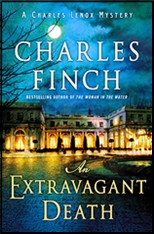
CHARLES FINCH – An Extravagant Death. Charles Lenox #14. Minotaur Books, hardcover, February 2021; softcover, January 2022. Setting: Newport RI / New York City, 1878.

First Sentence: It was a sunny, icy late morning in February of 1878, and a solitary figure, lost in thought, strode along one of the pale paths winding through St. James’s Park in London.

   British Enquiry Agent, Charles Lennox, solved a case that brought down Scotland Yard with the three top men headed to trial. Prime Minister Disraeli determines it best that Lennox is not in England during the trial and sends him to the United States with the Queen’s Seal on a tour of the East Coast law enforcement agencies. 1878 Newport, Rhode Island: a place of extreme wealth and self-indulgence. A place of new money, and a focus on marrying well. The murder of a young woman of the first diamond doesn’t fit into this scenario. Lennox’s help is requested.

   Finch does an excellent job of providing a summary of Lenox’s background, folding in that of his wife, Lady Jane, in the process. However, it is confusing that the case for which Lennox is being lauded falls into a huge gap: When did Lennox and Jane have a second child? When did Polly and Dallington, Charles’ partners in the agency, get married? And most of all, what was the case that brought down Scotland Yard? Either this reviewer blanked out this information, or Finch and/or his publisher just decided to skip a book and these annoying little details.

   As Lenox gets to know New York, Finch presents the stark contrast between the wealthy and the laboring class very well, demonstrating compassion but not dismissiveness or pity. Lenox’s excitement is tangible as he crosses the border from New York to Connecticut, consulting his little book of maps showing the thirty-eight states, as one learns the origin of the word “shrapnel,” and later the term “I heard it through the grapevine.” Those small bits of information lend richness to the story.

   Just as with the contrast in settings, Finch displays the contrasts in characters and their lives with the working class and merchants of the town, to the very wealthy “cottage” owners such as the Vanderbilts and Mrs. Astor. As is often true, some of the most interesting characters are those of ex-soldier James Clark, and Fergus O’Brian, the Irish valet,

   It is interesting to see Lenox dogged determination and attention to detail as he investigates every aspect and every possible suspect. The details of how and why Lily, the victim, was killed are laid out perfectly and done in a scene of edge-of-seat suspense rather than the more pedestrian style of Christie. The final chapters are heart-warming, especially the requests he makes on behalf of others.

   An Extravagant Death is just shy of being excellent, in part due to a scene at the end. The mystery is well done with some secondary characters nearly stealing the show. It will be interesting to see where the series goes from here.

Rating: Good Plus.

A 1001 MIDNIGHTS Review
by Julie Smith & Bill Pronzini


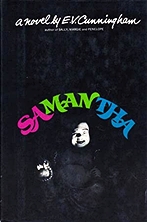
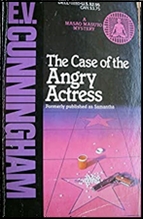
E. V. CUNNINGHAM – Samantha. Masao Masuto #1. William Morrow, hardcover, 1967. Popular Library, paperback [date?]. Also published as: The Case of the Angry Actress. Dell, 1984.

   Samantha was a pathetic Hollywood hopeful who ended up on the casting couch with a succession of unscrupulous men. Even then, she failed to land a part. Eleven years later, the men are being murdered, apparently in revenge. Each of them is now married to a woman who just might be Samantha with a new name. Detective Sergeant Masao Masuto of the Beverly Hills Police Force has his work cut out for him.

   This is the book that introduced Masuto, a Zen Buddhist like his creator, who is actually the prolific Howard Fast writing under a pseudonym. A Nisei who lives in a Culver City cottage with his wife, three children, and his beloved rose garden, Masuto is culturally about as distant from the fast-lane denizens of Beverly Hills as a cop can get. Yet he declines to let them rattle him; he doesn’t envy, despise, or judge them.

   His trademark cool — sometimes masking a very human inner turmoil — is as appealing as his sometimes acerbic wit. The Hollywood crowd, not surprisingly, is mystified by him and his Zen ways; he explains himself with a disarming simplicity that leaves them even more baffled.

   The contrast between the two cultures he moves between is the chief charm of this and the other Masuto mysteries, among them The Case of the One-Penny Orange (1977), The Case of the Russian Diplomat (1978), and The Case of the Poisoned Eclairs (1979).

   Before creating Masuto, Fast published, under the Cunningham name, a number of non-series thrillers utilizing the first names of their female protagonists as titles. Some of these have serious themes: Sylvia (1960), Phyllis (1962). Others are comedic in tone: Penelope (1965), Margie (1966). Most have rather outlandish plots that entertain despite putting a strain on the reader’s credulity.

   Fast’s first crime novel, Fallen Angel (1952), originally published under the pseudonym Walter Ericson, was made into the 1965 film Mirage, with Gregory Peck and Walter Matthau; both novel and film are taut and engrossing but suffer from that same lack of believability.

     ———
   Reprinted with permission from 1001 Midnights, edited by Bill Pronzini & Marcia Muller and published by The Battered Silicon Dispatch Box, 2007.   Copyright © 1986, 2007 by the Pronzini-Muller Family Trust.

« Previous PageNext Page »