Collecting


   While I’ve been tending to other matters and haven’t been able to spend much time with Mystery*File this month, British mystery fan and bookseller Jamie Sturgeon has continued to send me examples of maps in mysteries as he’s come across them. I’ve been collecting some of my own, but where they are at the moment, I don’t know. (I’m a bit unorganized at the moment.)

   Rather than wait for me to add mine to his to create one long entry, I’ve finally decided to run only the four that he’s sent me most recently.

   First, he says, how about this double one from Fatal Friday by Francis Gerard?

Fatal Friday

Fatal Friday (Rich, 1937, hc) [Chief Insp. (Supt.) Sir John Meredith; England] Holt, 1937.


   Next, he went on to say, perhaps a day or so later, there’s this one in Riot Act by R Philmore:

Riot Act

Riot Act (Gollancz, 1935, hc) [C. J. Swan; England]


   Here’s one of the more elaborate maps Jamie says he’s ever seen in a crime novel, one that he sent me while my computer was down. It comes from Angel in the Case by Evelyn Elder (Milward Kennedy), a very scarce book. Some other Methuen books of the period have these maps on the front endpapers as well.

Angel in the Case

Angel in the Case (Methuen, 1932, hc) [England]


   And here’s a map from another Methuen title,The Pressure Gauge Murder, by F.W.B. von Linsingen, his only mystery:

The Pressure Gauge Mystery

The Pressure-Gauge Murder (Methuen, 1929, hc) [South Africa] Dutton, 1930.


— Bibliographic information taken from Crime Fiction IV, by Allen J. Hubin.


[UPDATE] 10-25-07. The British contingent of crime authors didn’t have a monopoly on maps in mysteries, of course. Bruce Grossman sent this one along, taken from Ellery Queen’s The Dutch Shoe Mystery. In particular, it’s from the softcover edition of Otto Penzler’s reprint, so we’re assuming that it’s the same as the one in the original First Edition.

The Dutch Shoe Mystery

The Dutch Shoe Mystery (Stokes, 1931, hc; Gollancz, UK, 1931) [Ellery Queen; New York City, NY]

   I was looking over the previous post here on the M*F blog this morning, the one on Gardner paperbacks, wondering if I need tweak anything here or there, and it occurred to me that that last cover was the only one that I could remember having a portrayal of Perry Mason on it.

   Perhaps I could have you just go back and take a look, but since it’s handy, why don’t I simply show it to you again:

Perry Mason

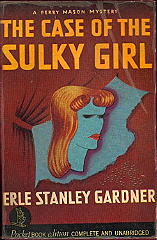
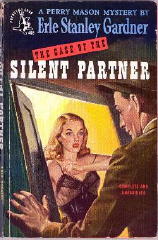
   The covers on the earliest Pocket paperbacks, going back to the early 1940s, always seemed to me to be attempts to imitate the art on hardcover jackets, rather subdued and far from lurid:

Perry Mason

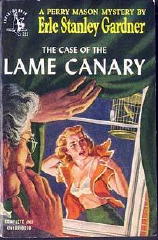
   Later on toward the end of 1940s, the covers at Pocket seemed more and more designed to do their job properly, to catch the eye of the guy (usually) at the newsstand:

Perry Mason

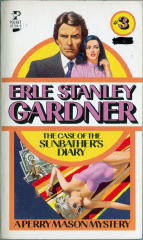
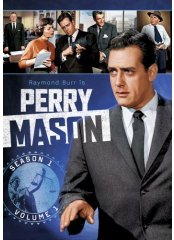
   That cover at the top of this page must have come from the end of the Pocket era. If that’s Perry Mason who’s pictured on it, it certainly doesn’t look like Raymond Burr, who was perfect in the part, but very much an establishment figure. He was a whole lot younger when he started, though. Here’s the cover of the recent box set, which I’ve bought but (all together now) I haven’t started to watch yet:

Perry Mason

   To me, the guy on the Pocket cover looks more like Monte Markham, who had the role for about half a season, 1973-74, before they pulled the plug on him. To TV viewers, it was Raymond Burr who was Perry Mason, and no one else. Even though he may not have been playing Mason at the time, this is what Markham looked like then:

Perry Mason

   But getting back to covers with Mason himself on them, I think I may have found an earlier one after all. It’s from the late 1940s era, and as a character, I don’t think all of his rough edges had rubbed off yet. Mason was a tougher guy at the beginning, his roots (as well as Gardner’s) being solidly in the pulp era, and more specifically Black Mask and Dime Detective.

   I think those roots are still showing here:

Perry Mason

    It’s almost 90 degrees in Connecticut today, and for September, while it’s not unheard of, it’s certainly unusual. It meant that I didn’t work in the garage today, though. What I did instead is bring in a box of paperback books that I bought while I was in Michigan visiting with my sister and brother last year.

    Of course what this did was to bring back a few memories, of books purchased and being out of sight, the box never unpacked until now, long forgotten. There was a large assortment of westerns, but of the mysteries, most of them were Erle Stanley Gardner books that I’d purchased pretty much because of their covers, Perry Mason adventures all, and not because I didn’t already have them in other, earlier editions, because I do. That doesn’t stop me from collecting them. You do understand, don’t you?

    By chance I also have a small lot of Gardner’s books up for auction on eBay. These aren’t the earliest in the Pocket editions – I think these are all from the 1950s – but the covers are nice. The two on the top are by Robert McGinnis. The one on the lower right is by Mitchell Hooks.

    As the years went on, some of the Perry Mason books were reprinted umpteen times, and over the years the covers changed. In the late 60s, the books all had photos of beautiful women on the covers:

Perry Mason

    In the later 60s, the covers were trimmed in gold with another crew of beautiful models posing (perhaps) as one of the characters of their respective books.

Perry Mason

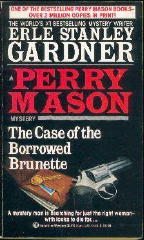
    I’m not 100% sure that I have the order correct in which these more recent Ballantine reprints came out, but I think I do. They began, I believe, in the early 1980s and were still going as recently as the year 2000. There seems to have been (at least) three different styles and formats for their covers. First this one:

Perry Mason

then this one:

Perry Mason

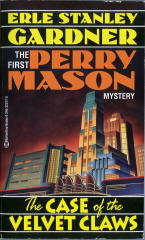
and finally this one, which of course I like the best – with quite a retro approach. The box from Michigan had about 15 of these in it:

Perry Mason

    Getting back to Pocket, though, one of the books from Michigan was this one, a style that I’ve never seen before. It’s numbered #3, but it’s not chronologically correct, since the book was first published in 1955 and hardly was the third Perry Mason adventure. There’s no date on it. All that it says is that it was the 11th printing. How many more there were in this series I have no idea.

Perry Mason


   Apparently it’s been common knowledge to Sexton Blake fans and collectors for some time now, but I didn’t know it until yesterday, and I don’t think that most Gold Medal collectors in this country do either.

   What seems to have happened back in 1956 or 1957 is that three Gold Medal books were published by Amalgamated Press, the folks who published the Sexton Blake books at the time, and had them rewritten to become, you guessed it, adventures of Sexton Blake instead.

   For the full story, you can go here, but here’s a brief recap. The three Gold Medal books were the following:

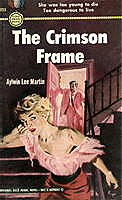
The Crimson Frame, by Aylwin Lee Martin, Gold Medal 253, pbo, August 1952.

The Crimson Flame

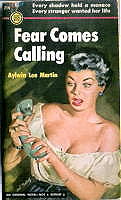
Fear Comes Calling, by Aylwin Lee Martin, Gold Medal 214, pbo, 1952.

Fear Comes Calling

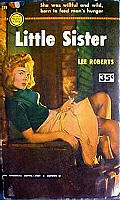
Little Sister, by Lee Roberts (Robert Martin), Gold Medal 229, pbo, March 1952. (The cover shown is that of the Canadian printing.)

Little Sister

   A fellow named Arthur Maclean was the chap who was asked to do the conversion, which was not a very easy job, as he describes it. (“Maclean” was actually a writer named George Paul Mann, which is another tale altogether, one told in the comments in this earlier post. But I digress.) Changing the hero’s name was the least of it. Locales had to changed, Blake’s assistant Tinker had to be written in, and if Amalgamated thought they were saving either time or money, they were sadly mistaken, and they never tried such a short cut again.

   For the record, also included in Part 18 of the online Addenda for the Revised Crime Fiction IV, here are the adventures of Sexton Blake that each of the above were transformed into:

The Crimson Frame
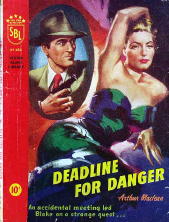
==> Deadline for Danger, by Arthur Maclean (George Paul Mann), 4th series #380, April 1957.

Deadline for Danger

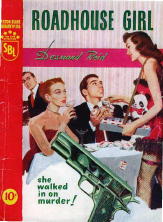
Fear Comes Calling ==> Roadhouse Girl, by Desmond Reid (George Paul Mann), 4th series #386, July 1957.

Roadhouse Girl

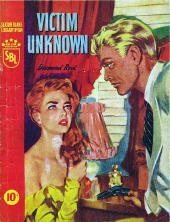
Little Sister ==> Victim Unknown, by Desmond Reid (George Paul Mann), 4th series, #384, June 1957.

Victim Unknown


   Collectors of hard-boiled Gold Medal paperbacks who think they have them all may have another think coming. For them and everyone else, for that matter, tracking down copies of each of two versions and comparing them might provide a thesis for someone – or who knows? – a doctoral dissertation. (Probably not, but I’ll leave the suggestion on the table for anyone who wants it.)

   Donna Frey left a comment on my blog entry about gothic romantic mystery paperbacks a while back, and I thought it might be more useful if posted my reply as a new blog entry, instead of leaving it hidden where no one would find it.

   Here’s what Donna asked:

    “I have a 1953 copy of Theresa Charles’ Fairer Than She, and I’ve always loved it. The heroine is psychic, and TC is such a good writer. Would like to buy her other books but there is never a plot description on Amazon or eBay so it’s buying blind. I don’t like the Nurse in love with Doctor books. How do I get a description before I buy? And does anyone know of a bio of Ms. Charles? Would like to read about her. Thanks.”

Theresa Charles

   Donna, you’re not alone in liking the gothics that Theresa Charles wrote. I’ve been asked a few times before to be on the lookout for her books by people trying to find them. (They’re not all that difficult to come across, but again there must be a demand for them. The asking prices online start around $4.00, which as the low end price for a gothic, is rather high.)

   As far as a biography is concerned, technically speaking, there is or was no “Theresa Charles.” That was the joint pen name of two British authors, Irene Maude Swatridge and Charles John Swatridge, neither no longer living. Other than their names, though, I’ve never found much of anything more about them. I assume they are were a married couple, but of course this doesn’t mean that they were. Irene also wrote a few books on her own, using a pair of other pen names. I’ll list the titles below.

   You’re right in being wary of buying any books by Theresa Charles without knowing more about them. A lot of the books under her name appear to have been straight romances, including (yes) Doctor-Nurse affairs. The list of titles below are from Crime Fiction IV, by Allen J. Hubin. With one possible (and obvious) exception, these would be your best bets as books to start hunting down. [UK = British edition.]

      CHARLES, THERESA; pseudonym of Irene Maude Swatridge & Charles John Swatridge; other pseudonyms: Leslie Lance & Jan Tempest
         * The Burning Beacon (Cassell, UK, 1956, hc) Lancer, 1966.
         * Fairer Than She (Cassell, UK, 1953, hc) Dell, 1968.
         * Happy Now I Go (Longman[s], UK, 1947, hc) U.S. title: Dark Legacy. Dell, 1968.
         * House on the Rocks (Hale, UK, 1962, hc) Paperback Library, 1966.
         * The Man for Me (Hale, UK, 1965, hc) U.S. title: The Shrouded Tower. Ace, 1966.
         * Nurse Alice in Love (Hale, UK, 1964, hc) U.S. title: Lady in the Mist. Ace, 1966.
         * Proud Citadel (Hale, UK, 1967, hc) Dell, 1967.
         * Widower’s Wife (Hale, UK, 1963, hc) U.S. title: Return to Terror. Paperback Library, 1966.

      LANCE, LESLIE; pseudonym of Irene Maude Swatridge; other pseudonyms: Theresa Charles & Jan Tempest
         * The Bride of Emersham (Pyramid, 1967, pb) British title?
         * Dark Stranger (Low, UK, 1946, hc)
         * The Girl in the Mauve Mini (Hale, UK, 1979, hc)
         * The House in the Woods (Ace, 1973, pb) British title?

      TEMPEST, JAN; pseudonym of Irene Maude Swatridge; other pseudonyms: Theresa Charles & Leslie Lance
         * House of the Pines (Mills, UK, 1946, hc) Ace, 1968.

   I hope this helps!

   Last night I dreamed I went to Pulpcon again. In retrospect, getting on the hotel shuttle bus on early Sunday morning on the way back to the Dayton airport, it seemed as if the four preceding days had simply flown by, and it still does.

   Attendance was down once again, but not significantly, I’m told, from last year. The convention began the day after July 4th, and that was suggested as having a good deal to do with it. Sales were down also, or so I heard, but perhaps that was due to prices generally being up, on the pulps at least. With eBay as a backup, no dealer wants to sell his wares too low.

   And the selection was limited, mostly because the supply of pulp magazines not already in collectors’ hands is diminishing at an ever-increasing rate. But there were plenty of pulp reprints in the dealers’ room, for those who want only to read the odd-ball titles, and tons of paperbacks, hardcover books (mostly science fiction), and other reading material in the room. When I say tons, I am not exaggerating.

   Martin Grams had his usual pair of tables filled with DVDs of vintage TV shows, of which I resisted and bought only three: an obscure series on ABC in 1960, Dante, starring Howard Duff. I ought to look, but I believe that means I have 24 of the 26 total episodes. It’s a crime show in which night club owner Willie Dante (Duff) is trying to go straight, but his past keeps interfering.

   Coincidentally enough, as you’ll see in a minute, Martin has just published his latest book on Old Time Radio, this one a history of the Sam Spade series, starring (for the first part of the run) none other than Howard Duff. I bought a copy, and if you were to happen to ask me, I’d tell you that you should too.

   Most of the time at the show itself, disregarding periodic intervals for eating and visiting area bookstores, is spent by most everyone by walking around the dealers’ room and stopping for long talks with people on either side of the tables, fellow collectors you see perhaps only once or twice a year. Lots of discussion going on about what author’s works are going to be reprinted next, what big finds were made, how’s the family, and what are you looking for now?

   Randy Cox (editor of Dime Novel Roundup) made his first appearance in three years. Six of us, Randy, Jim Goodrich, Paul Herman, Walter and Jim Albert, and I, spent much time dining out and catching up with each other’s lives at great lengths. By the way, one piece of crushingly bad news was the demise of the Breakfast Club, a small café we’d discovered and frequented many mornings over the past five or six years.

   Mike Nevins also appeared, as full of bountiful energy as ever and promising me a new column for this blog as soon as he can do it. I also talked at length with Walker Martin, John Locke, Al Tonik, Ed Hulse and many others, including Jim Felton, whose enthusiasm for Robert Martin continues unabated and without bounds. Ed Hulse, publisher of Blood ’n’ Thunder magazine, won this year’s Lamont Award for his outstanding contributions to the hobby of pulp collecting. It was a popular choice.

   Guests of honor were David Saunders, son of famed pulp artist Norman Saunders, and Glenn Lord, a long time administrator of Robert E. Howard’s estate.

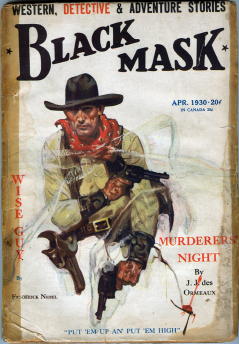
   And believe it or not, I bought a pulp, the one whose cover you see here. I was sorely tempted many many times, with hundreds of others I thought about, thought again, but did not buy. Every time I almost pulled the trigger, I thought of all the boxes of unread pulps I have in my basement and garage, and asked myself (foolishly, I know), do I really want to buy more?

Black Mask, April 1930

   In all but one case the answer was no, but the one case is an example of one that I do not have boxes and boxes of, Black Mask for April 1930. You can’t tell from the cover, which mentions only Frederick Nebel and J. J. des Ormeaux, but this issue also contains two Raoul Whitfield stories, one as by Ramon Decola, and an installment of “The Glass Key,” by Dashiell Hammett.

   The condition is fairly iffy, but the stories are good. Maybe I’ll pick up Part Three next year. One can only dream, can’t one?

   I don’t know if you know this, but I collect gothic romances. Nobody’s publishing them today. They’re dead in the water as far as today’s publishing world is concerned, as dead as can be, but from the mid-60s on into the later 1970s, they were as hot a category in bookstores and newsstands across the country as anything you can imagine, except for Harry Potter.

   In the later 70s, the so-called bodice-ripper romances began to take over, and the gothics, which themselves on occasion verged into the supernatural, either continued on in that direction into occult fiction of various kinds, eventually becoming the very popular paranormal romances of today, complete with vampires, werewolves and all kinds of sexy shape-changers. Or, to continue on with the “either” in the preceding sentence, they became novels of romantic suspense, still very much a common category today.

   I recently had the opportunity, while striving to “clean out” my basement, to go through a box of gothic romances I have – the ones having covers with a girl in the foreground and a spooky house in the background with a light on in a second story window – in order to add anything I find that’s new to add to Al Hubin’s Addenda for Crime Fiction IV. Most of these additions are in the form of previously unknown settings, but once in a while a brand new previously unknown title comes to fore, as happens once in the ten titles below.

   All of this data is in Part 16 of the ongoing Addenda, which I’ve just uploaded this afternoon. As for Al, he’s still working and Part 17 is well under way. But please take a special look at the covers, if you would. I’m sorry they’re small enough that you can’t make out all of the details, but for variations on a theme, you probably couldn’t ask for much more than this, from a small sample of size ten.

JAN ALEXANDER. The Glass House. Add setting: Cape Breton Island (Nova Scotia)

Jan Alexander

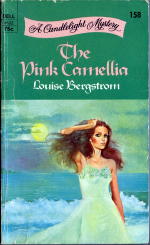
LOUISE BERGSTROM. The Pink Camillia. Add setting: Washington state (San Juan Islands)

Louise Bergstrom

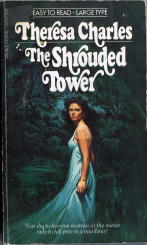
THERESA CHARLES. The Man for Me. U.S. title: The Shrouded Tower. Ace, 1966. Add setting: England.

Theresa Charles

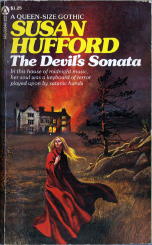
SUSAN HUFFORD. The Devil’s Sonata. Add setting: Massachusetts [South Egremont].

Susan Hufford

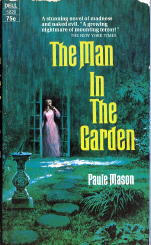
PAULE MASON. The Shadow. US title: The Man in the Garden. Add setting: London (England).

Paule Mason

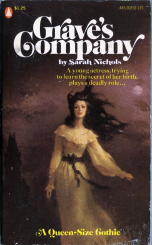
SARAH NICHOLS. ADD: Grave’s Company. Popular Library, pbo, 1975. Setting: Ohio; past.

Sarah Nichols

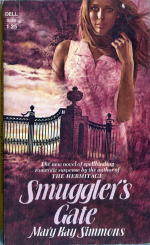
MARY KAY SIMMONS. Smuggler’s Gate. Add setting: Maine.

Mary Kay Simmons

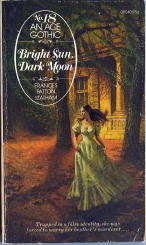
FRANCES PATTON STATHAM. Bright Star, Dark Moon. Note: Author’s full name is used on this book. Add setting: South Carolina (Charleston); 1883.

Frances Patton Statham

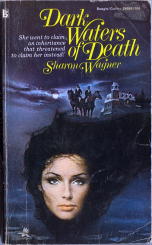
SHARON WAGNER. Dark Waters of Death. Add setting: Montana.

Sharon Wagner

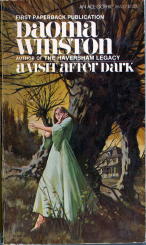
DAOMA WINSTON. A Visit After Dark. Add setting: Texas.

Daoma Winston

   Although I’m not sure what the first book was which “novelized” a movie, I know that it’s not a recent innovation, and in fact the idea is even older than that. Even before movies came along, around the turn of last century, what audiences took a good deal of pleasure in watching were plays in live performance, many of them mysteries, and would you believe, these plays were often novelized.

   This is hardly a formal article on the subject. It’s too early for that. Very little has been written about the novelizations of plays, and it’s obvious a much longer piece is needed to say everything there is to say. From what Victor Berch has told me, though, at the end of the 19th century and into the first part of the next, there were three or four publishing houses that specialized in such works of fiction, and there may have been more. The most prolific of these was the J. S. Ogilvie Publishing Company, of New York. Street & Smith did some, Victor says, and I. & M. Ottenheimer of Philadelphia did some as well.

   One of the authors who specialized herself in turning plays into novels, usually in softcover form, was the pseudonymous Olive Harper, whose entry in Crime Fiction IV, by Allen J. Hubin, Victor has recently revised and which you’ll see below.

   This information will also show up soon in an upcoming Addenda to the Revised CFIV. Victor has sent me cover images for four of this books, and perhaps – just maybe – the titles themselves will be enough to start you off in a new direction for your mystery collecting activities.

   Warning: The books below are not easily found. While not expensive, generally under $20 each, only a handful of the titles below could be found by taking a quick look on www.abebooks.com. A few of the author’s non-mystery novelizations and translations show up also, but at the present time, only four of them are mysteries (not, as I recall, the same four that are shown below).

HARPER, OLIVE, pseud. of HELEN BURRELL GIBSON D’APERY, 1842-1915
Bertha, the Sewing Machine Girl (Ogilvie, 1906, pb) Novelization of play in 4 acts by Theodore Kremer [New York City]. Silent film: Fox Film Corp., 1926 (scw: Gertrude Orr; dir.: Irving Cummings)

The Burglar and the Lady (Ogilvie, 1912, pb) Novelization of play in 4 acts by [Arthur] Langdon McCormick. Silent film: Sun Photoplay, 1915 (scw: [Arthur] Langdon McCormick; dir.:Herbert Blache).

*Caught in Mid-Ocean (Ogilvie, 1911, pb) Novelization of play in 4 acts by Arthur J[ohn] Lamb. [London, ship]

*The Chinatown Trunk Mystery (Ogilvie, 1909, pb) Novelization of play in 4 acts by Owen Davis. [New York City]

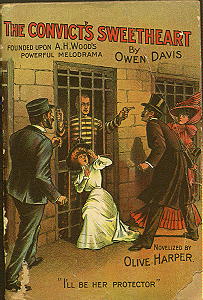
The Convict’s Sweetheart (Ogilvie, 1909, pb) Novelization of play in 4 acts by Owen Davis [Colorado]

The Convict's Sweetheart

The Creole Slave’s Revenge (Ogilvie, 1908, pb) Novelization of play in 4 acts by Walter Lawrence, pseud. of Owen Davis [Louisiana]

*The Desperate Chance (Ogilvie, 1903, pb) Novelization of play in 4 acts by Theodore Kremer

Fighting Bill, Sheriff of Silver Creek (Ogilvie, 1907, pb) Novelization of play in 4 acts [California]

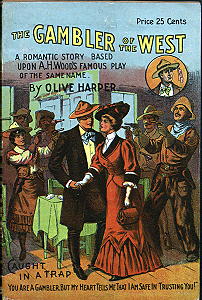
The Gambler of the West (Ogilvie, 1906, pb) Novelization of play in 4 acts by Owen Davis

Gambler of the West

It’s Never Too Late to Mend (Ogilvie, 1907, pb) Novelization of the 4-act play It’s Never Too Late to Mend; or, The Wanderer’s Return by Owen Davis [New York City]

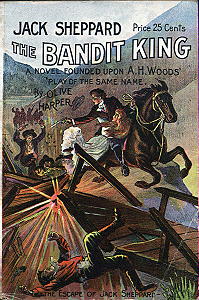
Jack Sheppard, the Bandit King; or, From the Cradle to the Grave (Ogilvie, 1908, pb) Novelization of play in 4 acts by Owen Davis [California]

Jack Sheppard

King of the Bigamists (Ogilvie, 1909, pb) Novelization of play in 4 acts by Theodore Kremer

The Millionaire and the Policeman’s Wife (Ogilvie, 1908, pb) Novelization of play in 4 acts by Owen Davis [New York City]

* A Millionaire’s Revenge (Ogilvie, 1906, pb) Novelization of play in 4 acts by [James] Hal[leck]
Reid [New York City]

On Trial for His Life (Ogilvie, 1908, pb) Novelization of play in 4 acts by Owen Davis [West]

The Opium Smugglers of Frisco; or, The Crime of a Beautiful Opium Fiend (Ogilvie, 1908, pb) Novelization of play in 4 acts by Owen Davis [San Francisco]

The Queen of the Outlaw’s Camp (Ogilvie, 1909, pb) Novelization of play in 4 acts by Edward M. Simonds [Colorado]

The Queen of the Secret Seven (Ogilvie, 1909, pb) Novelization of play in 4 acts by Ike Swift, pseudonym of Owen Davis [New York City]

The River Pirates (Ogilvie, 1909, pb) Novelization of play in 4 acts by Walter Lawrence, pseud. of Owen Davis. [New York City]

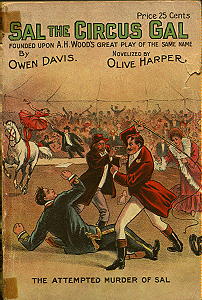
Sal, the Circus Gal (Ogilvie, 1909, pb) Novelization of play in 4 acts by Owen Davis [Chicago]

Sal, the Circus Gal

The Shadow Behind the Throne (Ogilvie, 1908, pb) Novelization of play in 5 acts by Alicia Ramsay and Rudolph de Cordova

The Shoemaker (Ogilvie, 1907, pb) Novelization of play in 4 acts by [James] Hal[leck] Reid [New York City, Wyoming]

A Slave of the Mill (Ogilvie, 1905, pb) Novelization of play in 4 acts by [James] Hal[leck] Reid and Harry Gordon

Tony, the Bootblack (Ogilvie, 1907, pb) Novelization of the 4 act play Tony the Bootblack; or, Tracking the Black Hand Band by Owen Davis [New York City, Italy]

Wanted by the Police (Ogilvie, 1909, pb) Novelization of play in 4 acts by [Arthur ] Langdon McCormick [New York City]

      * Based on true crimes.

  Hello,

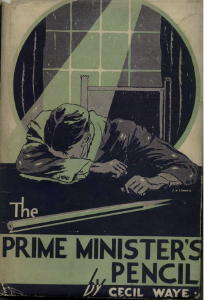
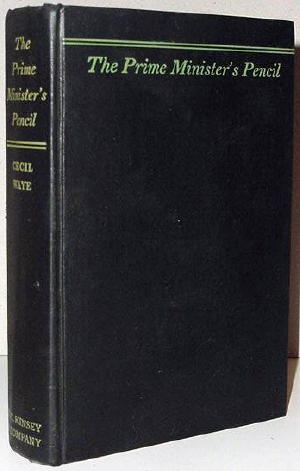
   I’m a small book dealer in Canada. I stock 50% lit. and 50% mystery with an emphasis on bibliomysteries. I recently acquired a 1st US ed. of The Prime Minister’s Pencil by Cecil Waye (John Rhode, Miles Burton, etc.) published by H.C. Kinsey.
   It is a review (advance) copy or as the slip states “This is your editorial copy, Publication AUG.15 , 1933. Please do not publish review before that date. H.C. Kinsey & Company,Inc.”

   I noticed on your Mystery*File web site that [in his article on Cecil Waye] Tony Medawar supplied a picture of the jacket for this Cecil Waye title, and it was from the US edition.

   [My copy does not have a jacket but] I’d be happy to send a picture of the review slip (tipped on to front free endpaper) if you’re interested.

Best regards,

  Jeff Coopman
  THE USUAL SUSPECTS
  2 Barbican Gate
  St. Catharines, ON
  L2T 3Z8  CANADA
  905-227-4897
  suspect (at) iaw.on.ca

   >>   My reaction? Of course I said yes. What a remarkable find. The books that “John Rhode” wrote as Cecil Waye’s are as scarce as anything, and to find a copy with review copy practically makes it a one-of-a-kind item. Here are the scans that Jeff sent me. — Steve

Pencil


Review Slip

[UPDATE] Later the same day:

 Steve,

Just noticed a pencil notation on the last page following THE END

WOW! good stuff 3 aug 1933

Obviously some reviewer liked it!

    Jeff

   — Continuing our conversation posted not too long ago, I said, “What I found extremely interesting is something that has always been at the back of my brain. With all of the interest in the hero pulps, I’ve always wondered why I found them childish if not boring. Your comments answer the question I must have had and never knew enough to ask. They WERE designed for kids. It’s obvious, but I never really realized that.”


  Hi Steve,

   Another funny thing about my visit that I just remembered: I had an attache case full of Dime Detective and Black Mask pulps to have him autograph but I completely forgot to get his [Morton Wolson’s] signature! I’ve never been much of a collector of signed first editions and this incident proves that I have no interest in autographs. I just want to read the stories.

   Concerning the hero pulps, in 1969 I saw my first large group of hero pulps at Jack Irwin’s house. I had visited him to buy Black Mask, Dime Detective, Detective Fiction Weekly and Weird Tales. I read and looked through a few pages of G-8, Doc Savage, The Shadow, etc. I still remember my puzzled reaction and question to Jack along the lines of: “But why are you reading and collecting children’s magazines?” I found the stories clearly unreadable and silly.

   He defended them along the lines of nostalgia which is OK, but to this day, I do not understand how adults can read these stories. That’s why I often engaged Harry Noble and my wife’s father in long conversations about the pulps that they and their friends read back in the 1930’s and 1940’s. I was curious as to pulps the adult working man really read. Because to read some of these recent articles, you would think that a lot of men read these poorly written, silly hero pulps. I guess some did read them, but according to my verbal research, the main readership of the hero pulps was definitely teenage boys.

   The teenage girls made the love pulps the biggest seller of all. If you really want to turn your brain into mush, try reading a love pulp. Talk about formula fiction! I read a few issues, and I still have not recovered from the experience. Every story had the same plot with a happy ending of course because that’s what the girls wanted in their romance fiction back in the 20’s, 30’s and 40’s. Boy meets girl, girl and boy have some troubles, things look bad for the romance, boy and girl resolve their problems, and live happily ever after.

   I only know of one collector that seriously collects the love pulps and I have to withhold his name to protect the innocent plus it would ruin his life and reputation if the news ever got out.

Best,

   Walker

« Previous PageNext Page »