Collecting


COLLECTING PULPS: A MEMOIR
PART SIX — ARE PULP COLLECTORS CRAZY?
by Walker Martin


   Therapists do not like to hear us use the term “crazy,” but for the most part mental health professionals do often see such collecting activities as being a mental disorder. Maybe I should have titled the subject “Is Collecting a Mental Disorder?”

   But if I and some of the other collectors I know are insane, then we probably would use the term “crazy.” In fact I just came across an online article titled “11 Craziest Mental Disorders,” and “Bibliomania: The Collecting of Too Many Books”, was one of the 11 disorders.

   What brings all this up is that a long time collecting friend of mine recently called me and said that his wife and a therapist had just blindsided him with an intervention type meeting after dinner. He was still stunned at their treachery and quite upset.

   Their attitude was that his book and pulp collection was all junk, clutter, and a waste of money. In fact the therapist said that my friend should be under the care of a professional and under heavy medication due to depression. He evidently saw the collection as a sign of depression and even complained about the collector reading too much.

   Now this is funny because I don’t think my friend reads much at all. He’s in his sixties, still working and certainly does not spend his leisure time reading like I do. I read at least a couple hours or more each day and often my friend does not read at all during the day.

   I think this “reading too much” theme is the typical non-collecting spouse complaint. For the most part, and there are exceptions, I have found that many women resent it when their husbands or boyfriends read a book.

   Reading is a solitary activity and they feel left out or perhaps they feel that the husband is ignoring them or not paying attention to them. I have heard this complaint many times over the years from other readers, and even my wife gripes about me always “with my nose in a book.”

   But my friend certainly came to the right guy for a sympathetic ear. Those of you have been reading these memoirs so far might imagine the advice I gave him. I told him in my opinion, as a veteran reader and collector, his wife and the therapist are the ones with a mental disorder.

   Too many people just concentrate on their jobs and family. Hell, we all have jobs and family, but what makes life even more interesting is reading and collecting. Many of our friends and relatives go through life really not interested in much at all. At least reading and collecting shows that you have some interest and passion in some subject, other than the routine of working and family matters.

   The above is a true story and actually happened. By the way, I am not talking about myself, but such scenes have happened to me over the years. A serious reader/collector will not get sympathy from the non-reader/collector. And these people make up the majority of our friends and relatives.

   If you talk to me during Windy City or PulpFest, I’ll be glad to discuss this in more detail including the name of the collector. In fact, he will probably be in attendance.

   So as Shakespeare once said, if you are a collector, “get thee to a nuthouse.” Or come to think of it maybe he was talking about a nunnery.

Previously on Mystery*File:   Part Five — Remembering Mike Avallone.

COLLECTING PULPS: A MEMOIR
PART FIVE — REMEMBERING MIKE AVALLONE
by Walker Martin


   While commenting on “Fifty Funny Felonies” by David Vineyard this past week, several readers started to talk about Mike Avallone. Sometimes the comments take over the original subject and go off in a different direction. I started to think about my friendship with Mike and how he was such a larger than life person. Is he really gone? Here are some of my memories.

MICHAEL AVALLONE

   Stephen Mertz mentions how Mike would start talking and telling jokes “full tilt,” and how his wife Fran would yell at him to shut up and listen, but Mike would carry on. There was no stopping him.

   In 1995 Mike was Guest of Honor at the Pulpcon convention along with Hugh Cave. Everett Kinstler, the famous portrait painter and Shadow illustrator, also was a guest but to tell you the truth I was so busy buying and selling pulps that I don’t even remember Kinstler being there. But I sure remember Mike Avallone.

   He had been a regular at previous Pulpcons, and though he couldn’t afford to buy any, he loved being around the old magazines and talking about them. I was part of a group of East Coast collectors who included Mike in their meetings and since he didn’t drive we would drive him to our homes for pulp get-togethers and conventions like Pulpcon. In fact one of our friends to this day still has “Ed Noon” as part of his email address and for many years he had stenciled on his car window, “Ed Noon Associates.”

MICHAEL AVALLONE

   Mike was so excited and hyper at this convention that he was practically out of control. Why? Because he took being Guest of Honor seriously and was so pleased at the recognition from his friends and fellow collectors. He received a beautiful plaque showing four pulps and digests that he had appeared in with stories. Mike did actually have a few tales in the pulps before they disappeared.

   The entire four day weekend, I don’t think Mike got much sleep. Every night he was up telling jokes, talking about movies and baseball, interacting with the other collectors. One of my close friends, Harry Noble who was one of the great pulp collectors, had a habit of going to bed early at 9:00 pm and getting up at 3:00 am. He got up as usual at 3:00, saw Mike and a several collectors sitting around laughing and talking, and thought we were all getting up early like him. The truth was that we had not even gone to bed yet.

   Some people did not take to Mike at all. He seemed to have the ability to annoy or make some collectors angry. I was witness to this at the Bouchercon in Philadelphia in 1989. Again Mike was over the top and greeted a fellow collector’s wife and grown daughter with hugs and smiles. But they were really uptight and dignified and acted horrified at his friendly behavior. It was comical to see the collector’s embarrassment as his wife and daughter backed away from Mike with big frowns. On the other hand, my wife and daughter loved Mike and his funny compliments.

MICHAEL AVALLONE

   When it was time to eat dinner, we made the mistake of going into Bookbinders restaurant, which was too classy for people like us. We sat down with the help of several waiters, saw the menu and prices, and immediately realized we had blundered.

   I was prepared to stay and pay the high price of the meal rather than leave, but not Mike. He stood up and led us out past the disapproving gaze of the waiters and other diners. I felt like a fool lugging my two sack of books but Mike just laughed as usual, and we ate at a nearby pub.

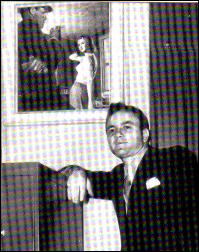
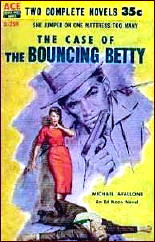
   Many times Mike visited my house with other collectors and often stayed for dinner. He liked my wife’s Italian cooking. But he liked my pulp and paperback collection even more. I happened to have the original cover painting to the Ace novel by Mike titled The Case of the Bouncing Betty.

   He loved looking at the painting and gave me a photo of the painting that he owned to The Tall Dolores, another Ed Noon novel. I tried many times to buy the painting from him and though I had the impression that he needed money, he just couldn’t sell it.

   For many years Al Tonik held meetings at his house which we called Tonikcons. There were around 20 or these, most of which Mike attended. We would eat and drink, meanwhile talking books and pulps. One meeting he bought a video tape showing when he was a guest on the TV show To Tell the Truth. I believe he appeared in 1981.

   When he would visit me he often headed to my paperback room which had a couple of stacks of Avallone paperbacks. The first couple times he pulled out his pen and offered to sign them all. But every time I said “no, don’t sign, they are worth more without the signature.” Many authors would have been angry at such a joke, but not Mike.

MICHAEL AVALLONE

   One disaster was just barely avoided the night Mike walked out of the paperback room and almost took a header down the staircase. We grabbed him in time and he joked about the headline in local papers that might have read, “Fastest Typewriter in the East Falls to Death in Pulp Collector’s House.”

   He said that would be the way he would want to die if he had to go. Mike said he wrote a short story about almost falling down the stairs, but I’ve never seen it.

   But the thing he liked even more than the paperbacks, was my Spider pulp collection. He said it was his favorite magazine as a boy and he loved looking at the issues. In the late nineties he sold his house in New Brunswick, NJ and he moved to the west coast.

   His friends back east worried about him not having his support system of pals, and I guess we were right. He died soon after moving within a year or two in 1999. Soon after his death I sold my Spider set, and so ended a period of my life that I’ve still not come to terms with.

   A Partial Bibliography. This list of titles that follows, taken from the Revised Crime Fiction IV, by Allen J. Hubin, consists only of Mike Avallone’s mystery and detective fiction published under his own name. It does not include crime fiction written under the pseudonyms Priscilla Dalton, Mark Dane, Jean-Anne de Pre, Dora Highland, Steve Michaels, Dorothea Nile, Edwina Noone & Sidney Stuart, not does it attempt to list any of his non-criminous work.

       AVALLONE, MICHAEL (Angelo, Jr.) 1924-1999.

* The Tall Dolores (n.) Holt 1953 [Ed Noon]
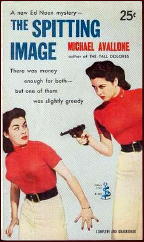
* The Spitting Image (n.) Holt 1953 [Ed Noon]

MICHAEL AVALLONE

* Dead Game (n.) Holt 1954 [Ed Noon]
* Violence in Velvet (n.) Signet 1956 [Ed Noon]
* The Case of the Bouncing Betty (n.) Ace 1957 [Ed Noon]
* The Case of the Violent Virgin (n.) Ace 1957 [Ed Noon]
* The Crazy Mixed-Up Corpse (n.) Gold Medal 1957 [Ed Noon]
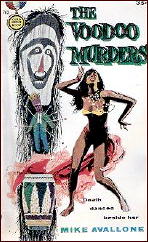
* The Voodoo Murders (n.) Gold Medal 1957 [Ed Noon]

MICHAEL AVALLONE

* Meanwhile Back at the Morgue (n.) Gold Medal 1960 [Ed Noon]
* The Little Black Book (n.) Midwood 1961
* The Bedroom Bolero (n.) Belmont 1963 [Ed Noon]
* Shock Corridor (n.) Belmont 1963
* Tales of the Frightened (co) Belmont 1963
* There Is Something About a Dame (n.) Belmont 1963 [Ed Noon]
* Lust Is No Lady (n.) Belmont 1964 [Ed Noon]
* Run, Spy, Run [with Valerie Moolman** ] (n.) Award 1964 [Nick Carter]
* The China Doll [with Valerie Moolman** ] (n.) Award 1964 [Nick Carter]
* Saigon [with Valerie Moolman] (n.) Award 1964 [Nick Carter]
* The Man from U.N.C.L.E. (The Thousand Coffins Affair) (n.) Ace 1965 [Napoleon Solo]
* The Birds of a Feather Affair (n.) Signet 1966 [April Dancer; Girl from U.N.C.L.E.]
* The Blazing Affair (n.) Signet 1966 [April Dancer; Girl from U.N.C.L.E.]
* Kaleidoscope (n.) Popular Library 1966
* Madame X (n.) Popular Library 1966
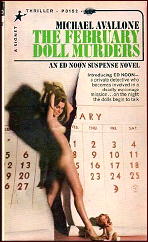
* The February Doll Murders (n.) Signet 1967 [Ed Noon]

MICHAEL AVALLONE

* The Felony Squad (n.) Popular Library 1967
* The Man from AVON (n.) Avon 1967
* Assassins Don’t Die in Bed (n.) Signet 1968 [Ed Noon]
* The Coffin Things (n.) Lancer 1968
* Hawaii Five-O (n.) Signet 1968
* The Incident (n.) Popular Library 1968
* Mannix (n.) Popular Library 1968
* The Doomsday Bag (n.) Signet 1969 [Ed Noon]
* The Killing Star (n.) Hale 1969
* Missing! (n.) Signet 1969
* Terror in the Sun (n.) Signet 1969 [Hawaii Five-O]
* A Bullet for Pretty Boy (n.) Curtis 1970
* One More Time (n.) Popular Library 1970
* The Partridge Family #2: The Haunted Hall. Curtis 1970
* Death Dives Deep (n.) Signet 1971 [Ed Noon]
* The Fat Death (n.) Curtis 1971 [Ed Noon]
* Little Miss Murder (n.) Signet 1971 [Ed Noon]
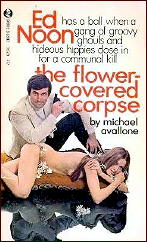
* The Flower-Covered Corpse (n.) Curtis 1972 [Ed Noon]

MICHAEL AVALLONE

* The Girl in the Cockpit (n.) Curtis 1972 [Ed Noon]
* The Horrible Man (n.) Curtis 1972 [Ed Noon]
* The Living Bomb (n.) Curtis 1972 [Ed Noon]
* London, Bloody London (n.) Curtis 1972 [Ed Noon]
* Shoot It Again, Sam (n.) Curtis 1972 [Ed Noon]
* The Alarming Clock (n.) Curtis 1973 [Ed Noon]
* The Hot Body (n.) Curtis 1973 [Ed Noon]
* Kill Her — You’ll Like It! (n.) Curtis 1973 [Ed Noon]
* Killer on the Keys (n.) Curtis 1973 [Ed Noon]
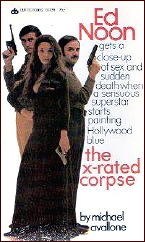
* The X-Rated Corpse (n.) Curtis 1973 [Ed Noon]

MICHAEL AVALLONE

* Fallen Angel (n.) Warner 1974 [Satan Sleuth: Philip St. George]
* The Werewolf Walks Tonight (n.) Warner 1974 [Satan Sleuth: Philip St. George]
* Devil, Devil (n.) Warner 1975 [Satan Sleuth: Philip St. George]
* The Big Stiffs (n.) Hale 1977 [Ed Noon]
* -Carquake (n.) Star 1977
* CB Logbook of the White Knight (co) Scholastic 1977
* Dark on Monday (n.) Hale 1978 [Ed Noon]
* 5 Minute Mysteries (co) Scholastic 1978 [Ed Noon]
* Charlie Chan and the Curse of the Dragon Queen (n.) Pinnacle 1981
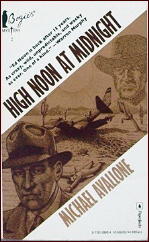
* High Noon at Midnight (n.) PaperJacks 1988 [Ed Noon]

MICHAEL AVALLONE

* Open Season on Cops, and The Arabella Nude (co) Gryphon Books 1992 [Ed Noon]
* Mitzi (n.) Gryphon Books 1997

Previously on Mystery*File:   Part Four — Collecting Detective Story Magazine.
Coming next:   Part Six — Collecting the other Popular Publications pulps.

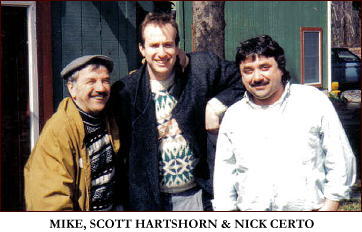
Editorial Comments:   Thanks to Scott Hartshorn for providing the two photos you see above. The first was taken outside Nick Certo’s house, circa 1992. The black and white photo, taken in the early 50s, is that of Mike standing beside the cover painting for The Tall Dolores. The cover itself you can see in color just above the photo and to the left.

   Note that Mike can be seen in the cover of The X-Rated Corpse. He’s the fellow on the right.   Coming tomorrow: Bill Pronzini’s 1001 Midnights review of The Case of the Violent Virgin.

COLLECTING PULPS: A MEMOIR
PART FOUR — DETECTIVE STORY MAGAZINE
by Walker Martin


DETECTIVE STORY MAGAZINE

   We have so far discussed and covered the so called Big Three: Black Mask, Dime Detective, and Detective Fiction Weekly. However there was a fourth magazine that has not received the proper attention that is due especially when you consider influence and the number of issues published. Detective Story Magazine with the October 5, 1915 issue became the very first pulp magazine to be devoted entirely to detective, mystery and crime fiction.

   In fact it just about started the trend for pulps to be devoted to one genre. Earlier examples are Railroad Man’s Magazine in October 1906 and The Ocean in March 1907. But with Detective Story the publisher, Street & Smith, got the idea to develop a line of magazines such as Western Story, Sport Story, Sea Stories, Outdoor Stories, and Love Story. The title showed the reader exactly what type of story he could expect to read.

   Not only was this the first of many detective and crime magazines, but it lasted longer than any other detective pulp magazine, 1057 issues during 1915 through 1949. The 1057 issues are even more than 929 issues of Detective Fiction Weekly.

DETECTIVE STORY MAGAZINE

   Not too many collectors bother with Detective Story and it certainly is not on the same level as Black Mask, Dime Detective, and Detective Fiction Weekly, but it did publish a lot of interesting stories. In fact if you read and collect hero pulp fiction then Detective Story should be of interest to you because the magazine dealt with heroes and villains, some of which wore costumes and fought crime figures before the first hero pulp titles started in the early 1930’s.

   The early issues still showed the dime novel origins (Nick Carter), but soon the fiction moved away from the teenage boy market and started to appeal to the adult mystery and detective fan. Even in 1916 it was possible to read such writers as Johnston McCulley, Sax Rohmer, Caroline Wells and H. Bedford-Jones.

   With the February 20, 1917 issue the crude covers improved, showing more color, the price was increased to 15 cents, and 30 extra pages were added for a total of 160. Frank Blackwell was editor, though Nick Carter was first credited, and he remained editor for at least 20 years. Since he also would edit Western Story starting in 1919, he must of had a staff of assistant editors to help with these weekly magazines.

DETECTIVE STORY MAGAZINE

   Another man who also lasted 20 years was the cover artist, John A. Coughlin. I know it is hard to believe but he did every cover each week for around 20 years, 1915-1935. As I was recently looking through my set I was watching for some other artist but I never noticed anyone else but Coughlin.

   That’s 52 cover paintings each year or over 1,000 for the 20 years. Plus he was doing covers off and on for just about all the other Street & Smith pulps.

   During the years I’ve owned several of his cover paintings from Detective Story and at present I still have two. It’s very interesting to see the development of Coughlin as an artist, from the crude early paintings in 1915 and 1916 to his excellent symbolic later work.

   I don’t know of any other pulp cover artist who dominated one magazine so thoroughly for a thousand issues. I guess the closest would be Nick Eggenhofer but his work was mainly interior drawings in Western Story and other pulps.

   From just about the very beginning the magazine specialized in series characters and in fact there were so many series that I sometimes mistakenly refer to the pulp as Detective Series Magazine. There are perhaps close to a hundred different series, too many to list in this article but I’d like to point out a few of the more interesting ones.

DETECTIVE STORY MAGAZINE

   Johnston McCulley was the leader by far and was an expert at developing all types of series. In fact he is responsible for one of the most well known and recognized figures in literature and film, the series character Zorro.

   The first series he developed for Detective Story was Black Star, followed by such characters as Terry Trimble, The Spider (no relation to the Norvell Page Spider), Thubway Tham, The Thunderbolt, The Man in Purple, The Avenging Twins, and the Crimson Clown. There may be others that I missed.

   Probably the most outrageous character was the Crimson Clown who appeared in around 20 stories in the 1920’s. He’s a crime fighter but for some strange reason he dresses up as a clown in the full clown costume and makeup. I would think this would make him very noticable to the police and criminals.

   The Spider appeared in about a dozen long novelettes in the teens and starred John Warwick as the gentleman crook who works for the criminal mastermind, The Spider. Thubway Tham appeared in over a hundred short stories mainly in the twenties and was a lisping pickpocket who worked the subways. The stories have a comedy element but I find them almost unreadable due to the lisping dialog whenever Thubway Tham opens his mouth. However the readers loved his adventures.

DETECTIVE STORY MAGAZINE

   A favorite of mine stars John Flatchley, alias The Thunderbolt and his stupid sidekick, Saggs. It is the usual theme of the bored, rich young man robbing from the rich and giving to the poor, etc. He robs from six rich men who legally ripped off investors and he returns the money to the original owners. All this is done without bloodshed.

   Erle Stanley Gardner’s Lester Leith was patterned after this type of character as were so many others. The hero wears a hood with a thunderbolt on it and is such a nice, good guy that he carries a gun, but it is empty with no bullets.

   Street & Smith had a hardcover line called Chelsea House and many of the stories in these series were eventually published as books. All six stories about The Thunderbolt were collected into two Chelsea House hardcovers.

   But there were plenty of other writers also dealing with series characters. Herman Landon, for instance, wrote about The Philanthropist who eventually developed into The Picaroon. Both heroes are gentlemen crooks but they are very strange indeed because after stealing money or jewels, they leave cards stating that the stolen items will be returned if the victim gives 10% of the value to charity.

DETECTIVE STORY MAGAZINE

   The charity of choice is usually the Society of Prevention of Cruelty to Animals (SPCA). I find these novelettes absurd, but I love the insane character! Landon had another long running series starring a crime fighter and crook named The Gray Phantom.

   One of the most fascinating series was by Arthur Hankins and starred an ex-cop and museum guard named Israel Pocket. The series appeared in 1918 and the hero works undercover in the stomach of a fake whale on exhibit. There he can spy on the museum visitors and prevent crime. His co-workers call him “Jonah.” Even as early as 1918 these six stories show that it was possible for quality fiction to exist in the pulps.

   Another interesting series that ran for a long time in the 1920’s was by Roy Hinds and dealt with an elderly Jewish pawnbroker who aids criminals. The Simon Trapp series was humorous, and he was not your typical pulp hero. There is no redeeming Robin Hood morality in many of the stories, and often I finished a story thinking that Simon was crook and that was that.

   The Doctor Bentiron stories written by Ernest Poate was another long-running series. Poate has been unjustly forgotten. Dr Bentiron is an interesting and strange character who lies around in his bathrobe, dribbling ashes and chain smoking. He is often bored but manages to solve crimes and has the habit of often grunting for some reason.

   Amos Clackworthy by Christopher Booth was a major character whose adventures were reprinted in the Chelsea House hardcovers. Clackworthy is a sophisticated conman who with his sidekick, The Early Bird, gyps suckers and steals their money. Possibly this character had an influence on Erle Stanley Gardner’s Lester Leith character.

DETECTIVE STORY MAGAZINE

   Ruth Aughiltree had one of the stranger characters called “Old Windmills”, who was a busy body, senile, old man who solved crimes. A strange detective who I found enjoyable and unintentionally funny.

   Mother Hansen, like many of the series characters mentioned above, ran for many stories — another odd series. Written by Paul Ellsworth Triem, she was an old lady who by day sat behind a cash register in a seedy restaurant but in the night she helped reform criminals. The one I just read had a burglar breaking into her house but by the end of the story she has saved the crook from the police and helped him escape.

   Edgar Wallace was one of the biggest stars of Detective Story in the twenties and in addition to the interesting “Ringer” series, he had over 20 serials. Only his early death silenced him.

   There were many other series, too many to discuss in detail. One of the best of the early writers was Hugh Kahler, who has been just about completely forgotten today. For four years, 1918-1921, he wrote around 35 long novelettes all 40 to 50 pages in length. Just about all of them are well done, some starring series characters named The White Rook, The Joker, The Justice Syndicate.

DETECTIVE STORY MAGAZINE

   The stories had elements in them that you usually do not see in pulp fiction from around 1918: love interest handled in an adult manner, well done characterization, a private detective acting in a believable way, and plots that are slowly and carefully developed, leading to a surprise ending.

   There is not a lot of violence in these stories, and sometimes the crimes do not even involve murder. One of the more impressive villains is named “The Wiremaster,” who has killed 10 men by some means of electric shock. The ten were unconvicted murderers who had beat the system and the law.

   The Wiremaster acts as a vigilante and like many of the heroes and villains likes to send weird letters and threats signed The Wiremaster, The Third Hand, The Picaroon, The Gray Phantom, or The Scarlet Scourge. One story even has a letter signed by “The Green Pansy”.

   Kahler eventually graduated to The Saturday Evening Post in 1920 and wrote slick fiction for 20 years. He became a close friend of George Lorimer, The Post’s editor, and was part of the antique collecting circle.

   Other writers of note were Agatha Christie with short stories, Dorothy Sayers with a serial, Raymond Chandler with one novelette in 1941, and Carroll John Daly. The format for each issue usually consisted of one or two serial installments, a long novelette, short stories, a true crime article, and several departments.

DETECTIVE STORY MAGAZINE

   The following departments ran for most of the magazine’s life: “What Handwriting Reveals,” “Expert Legal Advice,” “The How, When, and Where of Success.” There was also “Under the Lamp,” which dealt with ciphers and puzzles, “Missing,” which listed friends and relatives who had disappeared, and “Headquarters’ Chat,” which printed letters from the readers and announced coming attractions.

   On occasion “Popular Detective Story Writers,” written by D.C. Hubbard, gave informal and perhaps incorrect biographical details about the writers. It printed over two dozen bios during 1928 to 1932.

   Sometimes collectors have wondered how I managed to amass over 1,000 issues. It’s mainly because of what probably is the biggest windfall and deal during my 50 years of pulp collecting.

   In the 1970’s there was one collector who also was collecting Detective Story and we were always bumping heads at the the annual Pulpcons. In fact, he managed to compile a bigger set of the magazine and ended up with 800 issues compared to my 500 issues. But in the early 1980’s the video revolution killed his interest in pulp collecting and instead of attending Pulpcon, he started to collect video tapes. At one point he told me he had several Betamax recorders taping movies.

   I then started a campaign of calling and writing him letters every few months and this continued for a few years. The subject was always about him selling me his Detective Story collection.

DETECTIVE STORY MAGAZINE

   Finally in 1985, during a telephone call, he told me if I would stop harassing him he would ship me the 800 issues absolutely free. All I would have to pay would be the freight charge on delivery. Sure enough a couple weeks later, a big truck dumped 500 pounds of Detective Story Magazines’s on my porch.

   Of the 800 issues, I needed 239 and many others for upgrades. For several years after, I had so many duplicates, that I was willing to trade four Detective Story’s to get one of my pulp wants. Many collectors found the four to one ratio to be irresistible.

   However, at one Pulpcon I was reminded that not many people cared about Detective Story. Since I had so many duplicates, I took 200 of the issues in the best condition to a show in the late 1980’s. I priced them all low at $5.00 each, except for the Crimson Clown and Mr Chang issues which I priced at $10.00.

   Not a single issue priced at $5 sold. All the Clown and Chang issues sold because they were listed as hero characters in a pulp index. Even today there probably is not much interest in collecting the magazine.

   While I was collecting Detective Story, I carried on a 25 year correspondence with Bob Sampson, from 1969 to his death in the early 1990’s. All our letters dealt with pulp matters, especially the Detective Story series.

   You can read the results of many of our letters in Sampson’s excellent six volume survey of the pulps, Yesterday’s Faces. This is a set of books that every reader and collector of the pulps should own.

DETECTIVE STORY MAGAZINE

   Starting in 1932 a series of changes occurred that indicated the magazine might be having problems. They dropped the price to 10 cents, then announced a monthly schedule which lasted for one issue, and then decided on twice a month.

   The price eventually went back to 15 and 20 cents and the schedule to monthly. The cover was redesigned, serials were dropped, and in 1935 the departments were gone. The pages varied between 128, 144 and 160.

   Long time veteran and Love Story editor, Daisy Bacon became the new editor in the early forties. In 1943 the entire Street & Smith line of pulps either went digest or discontinued publication, like Wild West Weekly and Unknown Worlds.

   Daisy Bacon attempted to improve matters by encouraging some of the Black Mask and Dime Detective authors to write for her. Norbert Davis, John K. Butler, Fred Brown, all had good stories. She published over a dozen excellent stories by Roger Torrey, all novelettes starring detectives with Irish names. Only an early death because of alcoholism silenced him around 1945. William Campbell Gault was another fine writer who had around a dozen novelettes.

   But there were still some bad signs. The digest covers were really poorly done and unattractive. Circulation must have been dropping because in 1949 they even tried going back to pulp size for three issues.

   Nothing worked, however, and the pulp era was ending. Daisy Bacon would soon be out of a job and by the middle fifties the pulps were dead except for a couple holdouts. Street & Smith killed all their pulps except for Astounding. The digest boom was around the corner and there would be many new SF and mystery digests. Ironically Detective Story, the longest surviving detective pulp, would not be one of them.

Previously on Mystery*File:   Part Three — Collecting Detective Fiction Weekly.
Coming next:   Part Five — Collecting the other Popular Publications pulps.
   Dan Stumpf’s recent review of Spin the Glass Web serendipitously uncovered the fact that it was published by Harper in hardcover as a sealed mystery, in which the final chapters were sealed with a paper flap. The gimmick was that if you brought it back to wherever you bought it with the seal still intact, you could get your purchase price fully refunded.

   This was nothing new. Back in the 1920s and 30s the same publisher published a full line of these books, designated as Harper Sealed Mysteries, and Victor Berch recently completed a full checklist of these.

   The official series ended in 1934, but some research on the part of Victor and myself, plus some input from Bill Pronzini, has uncovered a few more books for which Harper used the same promotional idea.

   There may be others, but this list should contain most of them:

JOHN DICKSON CARR Death Turns the Table, 1941.

BILL S. BALLINGER Portrait in Smoke, 1950.

MAX EHRLICH, Spin the Glass Web, 1952.

BILL S. BALLINGER The Tooth and the Nail, 1955.

NICHOLAS BLAKE A Penknife in My Heart, 1958.

NICOLAS FREELING Question of Loyalty, 1963.

Harper Sealed Mystery

COLLECTING PULPS: A MEMOIR
PART THREE — DETECTIVE FICTION WEEKLY
by Walker Martin

   Every now and then collectors of detective pulps mention The Big Three, which refers to the best three detective/crime magazines: Black Mask, Dime Detective, and Detective Fiction Weekly, in that order.

DETECTIVE FICTION WEEKLY

   Detective Fiction Weekly lasted over 900 issues during 1924-1951, mostly on a weekly basis. The first few years it was known as Flynn’s and Flynn’s Weekly and had the subtitle of “Detective Fiction with the Thrill of Truth.” William J. Flynn was credited as being the editor and blurbed as having been “25 years in the Secret Service of the U.S.”

   The early issues had some photo covers and printed many so-called factual or “true” articles. However they read like fiction to me and now strike me as sort of dated and not very readable. In fact, I cannot recall ever meeting a collector who really liked the early issues in the mid-twenties.

   Flynn’s was published by Munsey and was a companion magazine to Argosy. The best fiction was written by a sort of Golden Age group of writers: Agatha Christie, Edgar Wallace, J.S. Fletcher, Caroline Wells, Freeman Wills Crofts, H.C. Bailey, R. Austin Freeman, and Mary Roberts Rinehart.

   For example Agatha Christie in addition to several short stories, also had as a serial, Who Killed Ackroyd? Edgar Wallace published the J. G. Reeder stories as well as several serials. Arthur Reeve was present with his Craig Kennedy series. But these writers were outnumbered by quite a few mediocre and forgotten authors.

DETECTIVE FICTION WEEKLY

   However all this was to change starting with the June 2, 1928 issue when Flynn’s Weekly became Detective Fiction Weekly. Howard Bloomfield took over as editor somewhere around this period, and during his six years as editor he changed the magazine for the better.

   Gone were the bland covers, and by 1929 they had a bright yellow eye-catching background, showing a lot more action and violence. The contents page was redesigned and the magazine now looked more attractive and impressive. He started to publish such writers as Erle Stanley Gardner, H. Bedford-Jones, Fred MacIsaac, Fred Nebel, George Harmon Coxe, Frederick C. Davis, MacKinlay Kantor, all with their first stories for DFW.

   Instead of the more sedate and quiet crimes of the Flynn’s era, Bloomfield wanted a tougher story with more action and humor. He also started using the work of Carroll John Daly on a more frequent basis.

   Bloomfield was so successful at sprucing up DFW, that Popular Publications hired him to revive and reinvigorate Adventure magazine during 1934-1940.

   As an example of his success with DFW, the Jan 11, 1930 issue has an interesting letter column, known as “Flashes From Readers”, in which an announcement is made that DFW had 69 stories mentioned as notable in the O. Henry Memorial Award Prize Stories of 1929. All 69 of the stories are listed with the comment that the total from all other detective magazines combined is 79. The nearest competitor had only 21 stories. This shows quite an improvement in the quality of fiction.

DETECTIVE FICTION WEEKLY

   Of course the competition published far fewer issues since they were on a mostly monthly schedule. Black Mask had a total of 340 issues and Dime Detective had 273. For DFW to fill over 900 issues on a weekly basis is the sort of statistic that is hard to grasp.

   Most pulps published 12 issues a year, which must of been hard to fill with quality fiction. But DFW’s 52 issues a year would drive an editor to a nervous breakdown. If enough good fiction was not available one week you just could not publish blank pages. That explains the variable quality of some of the contents.

   But there were plenty of good writers and many series characters to keep readers amused. It’s true that Dashiell Hammett appeared only once under the name of Samuel Dashiell (Oct 19, 1929) and Raymond Chandler also once in May 30, 1936.

   However readers also loved Erle Stanley Gardner who appeared dozens of times with such series characters as Lester Leith, Sidney Zoom, Patent Leather Kid, Senor Lobo, and The Man in the Silver Mask. Richard Sale was very popular and also had many witty stories starring newpaper reporter, Daffy Dill and photographer, Candid Jones.

   Norbert Davis and John K. Butler were popular as was Fred MacIsaac. Unfortunately MacIsaac either fell out of favor with the editors in the late 1930’s or developed an enormous writer’s block because he committed suicide in 1940. Judson Phillips was very popular and had a long running series about the Park Avenue Hunt Club.

DETECTIVE FICTION WEEKLY

   Another popular writer was Carroll John Daly with such series characters as Satan Hall, Mr Strang, and Twist Sullivan. Daly is a very controversial figure among readers and collectors. He is often credited as being the first writer to deal with the hardboiled private detective and his name on the cover often meant a 15% percent increase in circulation.

   However many readers find that his novels have not held up well and that he is almost unreadable. Stephen Mertz wrote a defense of Daly in The MYSTERY FANcier dated May 1978. In the article he states that Daly is as good or better as Hammett, a very strong opinion not shared by many.

   Over the years I have leaned more toward the view that Daly was not a good writer simply because I found his stories to be dated and not too believable. Race Williams often annoyed me by stopping the story dead, and speaking directly to the reader.

   However, I do have to admit that on occasion I have liked Race Williams. Since Daly is not a big favorite of mine, it has been a long time since I tried one of the stories. Because I was writing this column about DFW, I recently read “Parole” in the April 6, 1935 issue.

   This is the first of three novelettes introducing Mr. Strang, a vigilante and bitter foe of the corrupt parole system. I actually enjoyed the story and found it to be more subdued and not as unbelievable as much of Daly’s work. The theme of a corrupt parole system is not dated and is still a problem today.

DETECTIVE FICTION WEEKLY

   In fact the editors followed Daly’s novelette with an article titled, “The Ghastly Folly of Parole”, which goes into the abuses of the parole system. One abuse that still occurs is when a murderer is sentenced to life and gets out on parole after seven years.

   Since Daly was popular in all three of The Big Three, there must be some validity to those that find his work to be enjoyable as action crime fiction.

   Another writer who did not write about series characters but was one of the top authors was Cornell Woolrich. Starting in 1934 he wrote dozens of suspenseful mysteries for DFW.

   To give you an idea of the tremendous number of series running in the magazine, here is a listing of the series I noticed in the span of a half year or 26 issues. Most of these are not by well known writers but will show the emphasis on series:

H.H. Matteson — Hoh-Hoh Stevens
Donald Barr Chidsey — Morton & McGarvey
H. Bedford-Jones — Riley Dillon
J. Allan Dunn — The Griffon
Milo Ray Phelps — Fluffy McGoff
Edward Parrish Ware — Ranger Calhoun
       — Battle Mckim
Victor Maxwell — Sgt Riordan
Eugene Thomas — The Lady From Hell
Franklin Martin– Felix Luke
T. T. Flynn — Mike & Trixie
Sidney Herschel Small — Richard Wentworth (not The Spider)
J.Lane Linklater — Paul Pitt

   Serials were a regular feature with at least one and sometimes two per issue.

   While thinking about this article, I looked through all 900 issues and noticed that I had obtained almost all the issues in the early 1970’s at only $1 or $2 each. I know this beyond a doubt because I penciled in the price paid on the corner of the contents page.

DETECTIVE FICTION WEEKLY

   I know it’s hard to believe, but I even paid as low as 15 or 25 cents per issue. Which brings up the question of why, even 40 years later, DFW is still one of the most inexpensive pulps to collect. You can still find copies for sale at the $20 or less price, even while issues of Black Mask and Dime Detective often are priced at over $100 for copies in the 1930’s.

   Because DFW was a weekly, it must have had a high circulation and therefore issues appear to be more numerous than the monthly pulps. Also the magazine did not have a lot of Hammett and Chandler, so we don’t see issues for sale at hundreds of dollars each.

   Since they were filling 52 issues a year, the quality of the magazine appears to be lower than Black Mask and Dime Detective, who only had to find good fiction for 12 issues. At any rate, DFW is a bargain nowadays and issues are a lot more numerous than some other titles.

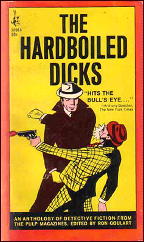
   I’ve talked before about the influence of Ron Goulart’s book The Hardboiled Dicks. I started to hunt down copies of DFW and found my first large amount at a fellow collector’s home.

   He had stacks of most of the issues when it was known as Flynn’s Weekly. He was willing to accept less than $1 each because of condition. It seems a coal miner had read the magazines in a coal mine and stored them there, perhaps because his wife would not let him keep them in the house, a common problem with non-collecting spouses.

   The issues were covered with coal dust and no matter how you scrubbed or wiped the copies the dust would remain. After reading one these magazines, your hands would be black and your lungs clogged with the dust. I still have these copies and 40 years later the dust is still there.

   There also must have been rats in the mine because some of the issues have big chunks chewed out of the corners. Since the type is ok, the stories can still be read even though the pulp chips are falling heavily and the coal dust leaves a black mark.

DETECTIVE FICTION WEEKLY

   Some collectors have asked me why I accepted less than good copies like the magazines described above or reading copies lacking the front cover, etc. I was simply buying so many different titles, not to mention books and vintage paperbacks, that I could not afford to hold out for only the best.

   I was not rich and had the usual responsibilities such as wife, children, home mortgage, car payments, etc. If I was going to build up complete sets before the prices rose up above what I could afford, then I could not be too fussy about condition.

   I’ve noticed most condition collectors who look for so called “fine” condition, do not really read the books and magazines. Or if they do read them, then except for SF, it is just about impossible to put together a complete set of the different titles.

   There are a few exceptions but I’m always surprised at collectors who do not read the books or magazines that they collect. I like nice condition just like everybody else but I’m basically interested in reading, not just looking at the book in a shrink wrap.

   As usual with these memoirs, there always is a woman involved. With the exception of a half dozen or so women collectors, most ladies do not care about old magazines and see them as so much clutter and a waste of time and money. Women and pulps do not mix.

   Here is another tale of woe in the battle between pulps and females. The first DFW I ever found was in an enormous second hand bookstore in Trenton, NJ called Acres of Books. In 1970 I had a job in an office building near the store and just about every lunch hour I would walk over and spend the hour, not eating and talking about nothing like my non-collecting co-workers, but happily digging through boxes of old books.

DETECTIVE FICTION WEEKLY

   Since the job required that I wear a suit and a tie, I often arrived back from lunch in less than presentable shape. It took me a long time to gain the confidence of the old lady who managed Acres of Books but after seeing me at lunch for several months, she finally let me into the “Pulp Section.” This was a roped off forbidden section containing the valuable “collector’s items.”

   She let me pick out one DFW from 1930 and as we arrived at the cash register, I had visions of the price being more than I could pay. She said “that will be 25 cents.” To her, asking a quarter for a dime magazine, was a big mark up. She still remembered the 1930’s and the depression as being not that long ago.

   Needless to say, I soon talked her into letting me buy a lot more than one pulp at a time. At the time I was dating a receptionist and as I passed her desk she noticed my dusty condition and wondered what on earth happened to me during lunch.

   I used this as an opportunity to introduce her to the world of pulp magazine collecting and I took the DFW out of the dirty bag to show her. I gave my usual speech about what a pulp was and handed her the magazine. She held it as far as possible from her and with a puzzled expression said only, “It smells.”

   As my friends know, I love the smell of the different pulps; each title has its own special scent and aroma. So this reaction from a girl I was interested in was not a promising sign at all.

   DFW eventually came to a bad end, as did all the pulps, slowly fading away. In the early 1940’s they must have been having circulation problems and the magazine went from weekly, to every other week, to monthly.

   They tried covers with just the story titles and no illustrations and they tried the larger size of 8 1/2 by 11. They even tried covers showing Nazis whipping girls in their underwear. Nothing worked and they finally sold the title to Popular Publications.

DETECTIVE FICTION WEEKLY

   They put out 20 monthly issues in 1943 and 1944 before the paper shortage killed off the title. It was revived for 6 issues in 1951 but by then the pulps were dying and on their way out. Coming around the corner were the digest mystery magazines like Manhunt, Alfred Hitchcock’s Mystery Magazine, The Saint, Mike Shayne, and so on, but that’s another story.

   The days of the great pulp titles were over and by 1955 nothing much remained except SF Quarterly and Ranch Romances.

   Because pulp reprints are so popular, I’m sure there will soon be collections of the series characters. Battered Silicon Dispatch Box Press already has published a collection of the Bedford-Jones Riley Dillon stories and there is an enormous two volume Park Avenue Hunt Club collection by Judson Phillips.

   But the original pulp magazines are so inexpensive, you can easily find affordable copies of DFW on eBay or at the two pulp conventions: Windy City Pulp Convention in Chicago and Pulpfest in Columbus, Ohio. One thing is for sure. There is a lot of good mystery and detective reading in 900 issues!

Previously on Mystery*File:   Part Two — Collecting Dime Detective.
Coming next:   Part Four — Collecting Detective Story Magazine.
Editorial Comment:   A fine companion piece to this chapter of Walker’s memoirs is “Those Detective Fiction Weekly Mugs,” by Terry Sanford, in which he discusses some the series characters which populated the pages of the magazine. You can find it here on the main Mystery*File website.

COLLECTING PULPS: A MEMOIR
PART TWO — DIME DETECTIVE
by Walker Martin


DIME DETECTIVE Ron Goulart

   In 1969 as I was in the process of writing many letters to dealers, collectors, bookstores and so on, in order to locate back issues of Black Mask, I naturally wanted to also collect the main competitor to Black Mask. Dime Detective was one of the early titles put out by the new publisher at the time, Popular Publications. It lasted for 273 issues during the period 1931 through 1953.

   At first the new magazine looked like a combination of hardboiled detective, gothic horror, and weird menace fiction. The early issues had examples of these type of stories and I was puzzled to see horror titles like “The Shadow of the Vulture,” “The Devil’s Jackpot,” “The Phantom of the Porthole,” “The Chamber of Doom,” and “Horror House.” But I was relieved to see such favorite Black Mask writers as Frederick Nebel, Erle Stanley Gardner, and even the much maligned Carroll John Daly.

   As the main competitor to Black Mask, Dime Detective paid higher than usual pulp rates, even going as high as four cents a word to tempt writers away from the other magazine.

   In fact, by 1936 Black Mask was having circulation problems and editor Joseph Shaw even left the magazine in that year over some disagreement concerning money and the direction the magazine was going.

DIME DETECTIVE Ron Goulart

   When Shaw left, Raymond Chandler switched to Dime Detective and its higher rates and published seven excellent novelettes during 1937 through 1939. These issues especially go for high prices, and I’ve recently seen copies sell for hundreds of dollars each.

   I personally am sure that soon we will see nice copies going for over a thousand. Raymond Chandler, like Hammett, has claim to being among the very best of the pulp writers and in fact both writers are now routinely accepted as part of the great American literary tradition.

   However, in 1969 and in the early 1970’s I had very little competition and managed to pick up just about all the issues for only $2.00 or $3.00 each. Even in those days I did not consider these prices a drain on my finances, and most other collectors continued to happily concentrate on SF and the hero pulps.

   Instead of letting these guys continue on their wayward ways, I made the mistake of praising the magazine as being an untapped lode of great detective fiction, and before I realized it I had again created my own competition. As I think back on myself 40 years ago, it was almost like I was some sort of mad doctor creating my own Frankenstein monster.

   This hideous monster turned out to be other collectors fighting me for Dime Detective and my other favorite pulp titles, that once were fairly unknown until I opened my big mouth.

DIME DETECTIVE Ron Goulart

   Speaking of “mad doctors,” author Ron Goulart thought pulp collectors were so strange that he put several of us in novels, including the Avenger series of paperbacks that he wrote in the 1970’s under the Kenneth Robeson name. I appeared as the mad Doctor Walker-Martin in Red Moon (1974). Other collectors to appear in Ron’s novels were Bob Briney, Jack Irwin, Jack Deveny, Bob Weinberg, Bob Sampson, Richard Minter, and even Mystery*File honcho, Steve Lewis, among others.

   Fortunately I managed to complete my set of 273 issues within a very short time thanks to Richard Minter’s mail order business and my letter writing scheme which unearthed all sorts of Dime Detective’s for little cost.

   I say “unearthed,” and this actually happened when a collector from Ohio discovered stacks of the magazine in a basement of a house about to be demolished. By now in the early 1970’s, many collectors considered me the village idiot who would buy just about any pulp, as long as no one else was interested in the title. I was happy to let them continue to think this way as I started to amass a collection of pulps numbering into the thousands.

   Other collectors who were smart enough to see that I was on to something by collecting Black Mask, Dime Detective, and other high quality pulps, began to visit me and listen to my rants and raves about how great these titles were.

DIME DETECTIVE Ron Goulart

   Many ignored me until prices rose too high, but a few decided to also start reading Dime Detective, an so on, and I then no longer had a free field to leisurely buy issues at super low prices. I even had to resume my greedy plan of sending dealers more money than they asked in order to get my wants.

   Before I knew it and shortly after Pulpcon started in 1972, it became a dog-eat-dog type of existence. Now, I have several friends among pulp collectors because I eventually reached my major goals and I’m not as hyper, but back in the early days there were some major misunderstandings and hurt feelings among collectors.

      One collector was banned from attending Pulpcon and several others started to boycott the convention because of various arguments. During one so called “feeding frenzy” at some dealer’s table I even saw a minister elbow other collectors out of the way and take control of a box of pulps.

   Another time, I kidded a medical surgeon about collecting weird menace pulps and Dime Detective’s with mad doctors on the covers, and he not only stopped coming to Pulpcon, but refused to answer my letters. And I once had a friend who proposed that we commit a criminal act in order to steal some pulp paintings. Fortunately I said no, otherwise my story would be completely different, more like “My Life of Crime as a Pulp Collector.”

DIME DETECTIVE Ron Goulart

   By the year 2000, I had just about read all the good stories in my complete run of Dime Detective’s except for the early and mid thirties which had some lower quality fiction. So when a friend offered to buy the set I foolishly sold it to him, and within a very short time regretted my decision.

   Even though I had read all I wanted to in the 30 years that I had the set, I found I wanted to reread my favorite stories. I checked with all my friends and other collectors but no one had another set to sell. I then began a project that lasted for a few years of buying copies one by one off eBay, the online auction site. I now have over 200 of the 273 issues, and I probably won’t bother with the early issues that I find less readable. The Chandler stories I have in reprint, so again there is no need to spend a lot of money to get those issues.

   I’m making a point of mentioning all this because I want to stress and make clear that even today it is possible to collect pulps that are enjoyable to read. You don’t have to be an older collector who started way back in the 1960’s or 1970’s.

   For Dime Detective, the thirties for the most part are more expensive, often over $100 in nice shape. Lesser copies can be obtained for below a hundred. The forties and fifties I find are the most readable and still can be obtained for $25 to $50 each.

   I personally find it hard to believe but some collectors do not read and collect just for the covers. The covers are quite well done and I’ve owned six or more Dime Detective cover paintings by such excellent artists as Walter Baumhofer, Norman Saunders, and Raphael Desoto.

DIME DETECTIVE Ron Goulart

   I’ve always been amused by the name Dime Detective because eventually the price went up to 15 and 25 cents but the name stayed the same. I imagine many a newsdealer was almost driven mad by customers complaining “but why do you want 25 cents for a Dime Detective?”

   Despite the different names, Black Mask and Dime Detective were basically the same magazine during the 1940’s. Same publisher, same editor (Ken White), and the same policy concerning fiction. It is true, however, that Dime Detective did not publish serials and emphasized series characters even more than Black Mask.

   To give you an idea of some of the authors and series, here is a list of some of my favorite characters from Dime Detective:

       Inspector Allhoff — D. L. Champion (29 stories)
       Bail Bond Dodd — Norbert Davis (8 stories)
       Jim Bennett — Robert Martin (13)
       Bill Brent/Lorna Lorne — Frederick C. Davis (16)
       Cardigan — Frederick Nebel (44)
       John Dalmas — Raymond Chandler (5)
       The Dean — Merle Constiner (19)
       Mr Maddox — T. T. Flynn (35)
       Steve Midnight — John K. Butler (9)
       Needle Mike — William Barrett (15)
       Rambler Murphy — Fred MacIsaac (18)
       Cash Wale — Peter Paige (17)
       Jeffrey Wren — G. T. Fleming-Roberts (7)

   There were other good series but the above will give an idea of the variety.

DIME DETECTIVE Ron Goulart

   Many of these writers were getting very good rates, even as high as three to five cents a word. I had quite a collection of cancelled checks from Popular Publications and they showed for instance that Peter Paige (real name Morton Wolson) was receiving $500 per Cash Wale novelette. In the forties that was very good pay.

   A couple of writers did not really specialize in series characters but should be mentioned: John D. MacDonald who also used the name of Scott O’Hara (39 stories) and Cornell Woolrich (31 stories).

   Also several writers came to sad ends. Norbert Davis and Fred MacIsaac committed suicide. Max Brand and Robert Reeves were killed in WW II. Roger Torrey died an early death in his 30’s of alcoholism.

   For further reading on Dime Detective, Ron Goulart has written three valuable books dealing with the magazine:

       The Dime Detectives
       Cheap Thrills
       The Hardboiled Dicks

   I recommend all three highly and I’m also pleased to say that Matt Moring of Altus Press will eventually be publishing the Dime Detective Companion by James L. Traylor. This will be a revised and expanded edition of his book Dime Detective Index published in 1986. This new book will not only be an index but also have several articles on the magazine and writers.

   We indeed live in the Golden Age of Pulp Reprints and if you don’t have the money and time to find back issues I can recommend the following collections of stories from Dime Detective:

       Hard-Boiled Detectives, edited by Weinberg, Dziemianowicz, and Greenberg.
       Tough Guys and Dangerous Dames, edited by the above.
       The Adventures of Max Latin, by Norbert Davis
       The Adventures of Race Williams, by Carroll John Daly
       The Adventures of Mike Blair, by Hank Searls
       The Adventures of Cardigan, by Frederick Nebel
       The Adventures of Paul Pry, by Erle Stanley Gardner
       Footprints on the Brain, by D. L. Champion (Inspector Allhoff)
       At the Stroke of Midnight, by John K. Butler(Steve Midnight)
       The Compleat Adventures of the Dean, by Merle Constiner (Battered Silicon)
       The Compleat Adventures of Bill Brent, by Frederick C. Davis (Battered Silicon)

DIME DETECTIVE Ron Goulart


Previously on Mystery*File:   Part One — Collecting Black Mask.
Coming next:   Part Three — Collecting Detective Fiction Weekly.

COLLECTING PULPS: A MEMOIR
PART ONE — BLACK MASK
by Walker Martin


BLACK MASK MEMOIRS

   In the 1940’s an admirer of Raymond Chandler’s fiction wrote a letter asking Chandler if it was possible to obtain back issues of the magazines containing his stories. Chandler responded that it was just about impossible to find such back issues and he doubted if the correspondent would have any luck.

   Jump ahead more than 20 years to 1968 and that was my attitude also. I had been a SF fan for over 10 years collecting the pulps and digests, attending the SF conventions and reading the fanzines.

   Since I also was reading a lot of mainstream literature and mystery fiction, I was interested in back issue magazines that published fiction other than SF, but I was not finding the issues.

   I figured the SF and hero pulps survived because of teen age boys and their drive to collect things. So I reasoned that the adults must have read and thrown away their copies of the adult pulps like Black Mask, Adventure, Dime Detective, Short Stories, etc.

   However, in 1968 a life changing event occurred and I know we all laugh when we hear those words because often it is not really THAT “life changing”. But it was in my case and I never really realized the impact of simply buying one paperback until decades later when I was almost crushed by a collapsing, heavily loaded bookcase full of detective pulps.

BLACK MASK MEMOIRS

   As I lay there too stunned to move, I began the process of thinking how had my reasonable SF collection turned into a massive amount of pulps, vintage paperbacks, books, etc.

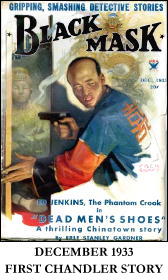
   The event I’m talking about is the mundane task of buying a book titled The Hardboiled Dicks, edited by Ron Goulart. It was a collection of crime stories from such pulps as Black Mask, Dime Detective, Detective Fiction Weekly. After reading the stories and Goulart’s editorial comments, I realized without a doubt, it was possible to collect the detective pulps and the genres such as western and adventure fiction.

   I wrote Goulart and asked him if it was possible to buy his copies of the detective magazines that he had used for his research. I’m happy to say he wrote back and sold me all the copies he had for only a couple bucks each.

   These few pulps that he sold me eventually caused me to accumulate complete sets of Black Mask and Dime Detective and an almost complete set of Detective Fiction Weekly, not to mention the other titles that I started to also collect. Almost 40 years later Ron Goulart wrote in my copy of The Hardboiled Dicks, “For Walker, whose life I ruined”.

    “Whose life I ruined” just about sums up the thoughts and feelings of many non-collectors when they see a house full of books and old magazines. I could give dozens of examples but I’ll try and control myself and just mention one early story from 1969 involving collectors, non-collectors, and romance.

BLACK MASK MEMOIRS

   At the time I was busy writing hundreds of letters to collectors, book stores, etc. in an attempt to put together complete sets of Black Mask and the other detective magazines. This was pre-Pulpcon and the Internet did not exist, so everything was by regular slow mail.

   The Collector’s Bookstore in California sent me a package of about a dozen Black Mask’s from the thirties. Needless to say I was checking my mail every day but the day they came I was at work and the package was returned to the main post office. I showed up early the next morning before work with the postal slip saying there had been a failed attempt to deliver.

   The Trenton NJ post office was a massive structure and the postal clerk returned after a few minutes and told me he could not find the package. The next few minutes are still a blur in my memory, but let’s just say the head postal inspector was summoned and he tried to calm me down by saying there was nothing to worry about since the package was insured.

   I imagine every fellow collector reading this knows my response along the lines of “I didn’t care about the insurance, the magazines were rare collectables and irreplaceable.”

   After another long delay and search they found the stack of Black Mask’s with just some twine wrapped around them and no package left at all.

BLACK MASK MEMOIRS

   When I arrived at work I was completely frazzled and shaken. The employees I worked with could not understand why I was so upset about some old crumbly magazines.

   After I regained control, I showed the stack to a girl I was interested in who had the desk behind me. I told her about the importance of Raymond Chandler and Dashiell Hammett and even asked her if she would like to read any of the magazines.

   Her response of “no” was a deal breaker and the end of any possible romance. I never did have any luck in finding a woman who liked pulps.

   So began my lonely occupation of collecting back issues. The great number of letters I was mailing resulted in many collectors across the country selling me Black Mask’s . Richard Minter, who was the greatest mail order pulp dealer who ever lived, was especially helpful.

   At first he was surprised because all his customers were mainly SF and hero pulp collectors. He had no one interested in the detective magazines. But because of his extensive contacts among old time collectors, he started mailing me a steady stream of packages, all wrapped in brown paper with string and old stamps that someone must have paid him with.

BLACK MASK MEMOIRS

   I know this is hard to believe but he was asking only 2 or 3 dollars per pulp. This was the average price I was paying and the set was almost completed except for a very few issues.

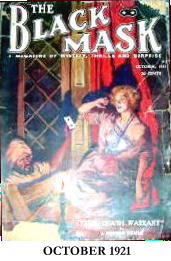
   My main activity during 1969,1970, and 1971 revolved around finding back issues of Black Mask. I cared nothing for my work career, it was just a means to be able to collect. By the first Pulpcon in 1972 I had a complete set of the 340 issues except I was lacking one hard to find issue, October 1921. Some of the issues were in rough shape, and for many years I continued to upgrade.

   At first, I had no real competition but as I started to rave to other collectors, my enthusiasm created the market and other people started to pick up issues. There was a fellow collector in Trenton who I kept talking to about how great the magazine was, and before I realized my stupidity, he was my main competitor.

   We both eventually ended up with complete sets and as far as I know there were only a couple other extensive runs, including one at UCLA, but nothing complete.

   At the end, in order to beat out the competition, I was sending dealers more than they asked for because I figured they would sell to me even if another collector beat me to the item. Many a time, someone would ask $5 for example and I send them double the amount, with my comment of “I feel the issue is worth more”. It always seemed to work.

BLACK MASK MEMOIRS

   Concerning the October 1921 issue, there must have been something wrong with print run of that date or perhaps many copies were destroyed in some accident, etc.

   I say this because out of 340 issues, 1920-1951, the two collectors with almost complete sets both needed this same issue. For many years I advertised and hunted for it and finally dealer Jack Deveny, at an early eighties Pulpcon, conducted a mini auction between me and several collectors. There was no way I was not going to get the issue and my sealed bid won at over $700. Back then, this was an unheard amount to pay.

   Eventually, I tracked down three original Black Mask cover paintings, all from the 1940’s. One of them I managed to get from artist Raphael Desoto after a weekend of talking to him at an early book convention. I cried, I whined, I begged, etc. Nothing is too shameful among serious, out of control collectors.

   I also manage to find a stack of canceled checks paying Black Mask writers and artists. When I bought them back in the 1970’s no one would even pay $1.00 each. Now they bring far higher amounts.

BLACK MASK MEMOIRS

   After Black Mask died in 1951, Ellery Queen Mystery Magazine bought the title and beginning with May 1953 issue had a section in each issue reprinting two stories from the magazine. Eventually they cut back to one story and even published new stories in the Black Mask tradition.

   They soon added the subtitle “including Black Mask Magazine” on the contents page. This subtitled continued off and on through the fifties and sixties and I see it appearing even as late as the September, 1973 date.

   I’ve done extensive reading in the magazine during almost four decades. The twenties are not that readable, except for Dashiell Hammett, Frederick Nebel, Raoul Whitfield and Erle Stanley Gardner. Some readers even like Carroll John Daly.

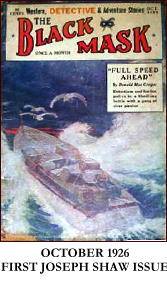
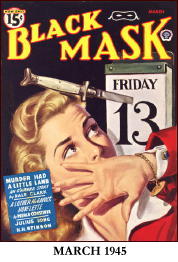
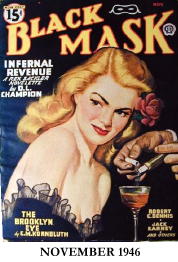
   By the time Joe Shaw took over in late 1926, things began to improve and he encouraged the above writers. Most readers find the thirties the best and even some collectors present an argument for the 1940’s when Popular Publications took over with Ken White as the editor.

   Behind Hammett and Chandler, I think Paul Cain was the best writer even though he was not that prolific, then Nebel, Whitfield, and Norbert Davis. The 1940’s are full of excellent writers like Merle Constiner, John D. Macdonald, Robert Reeves, D. L. Champion, Cornell Woolrich, William Campbell Gault, and others.

BLACK MASK MEMOIRS

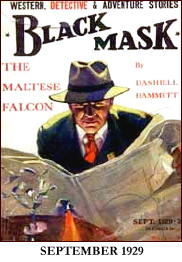
   To collect the magazine nowadays would require a lot of money and I’m not even sure a set could be put together. Hammett and Chandler issues are expensive, going for hundreds of dollars each. I recently saw the 5 issue “Maltese Falcon” issues go for almost $4000 and I thought this price was too low.

   Even without these two authors in the issue the 20’s and 30’s go for over one or two hundred, according to condition. The forties still are affordable with plenty of readable stories and it’s possible to find issues at the $25 to $50 price.

   Fortunately for readers who want to sample the fiction there are several collections:

      The Hard-Boiled Omnibus, edited by Joseph Shaw
      The Hardboiled Dicks, edited by Ron Goulart
      The Hard-Boiled Detective: Stories from Black Mask Magazine, edited by Herbert Ruhm
      The Back Mask Boys, edited by William Nolan
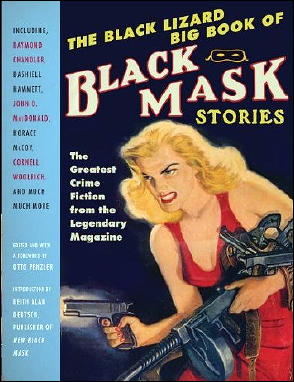
      The Black Lizard Big Books of Pulps edited by Otto Penzler (most of the stories).
      The Black Lizard Big Book of Black Mask Stories, edited by Otto Penzler (over 50 stories!)

   Thus ends my story of a 40 year love affair with a pulp. I can truthfully say I have only learned two things in life, “The non-collector will never understand the collector.” And “Never take the advice of a non-collector concerning your collection.”

   These two things are absolutely true and you might ask why? Because the non-collector knows absolutely nothing about your collection and just sees it as so much clutter, waste of money, and a crazy waste of time. But we know different, don’t we.

BLACK MASK MEMOIRS


COMING SOON:   Part Two — Collecting Dime Detective.

The 2010 NYC Vintage Paperback and Collectable Book Expo
by WALKER MARTIN


   Just back from attending this long running one day event that Gary Lovisi has managed to organize for over 20 years on an annual basis. Over 50 sellers in a large dealers’ room selling vintage paperbacks, pulps, new books, and original artwork. Prices seemed very reasonable to me and I managed to find several of my Dime Mystery pulp wants.

   Steve and I had discussed the problems in attending this show because we both were limping around due to overexertion. Steve couldn’t make it, but I manage to survive the train ride from Trenton, NJ to NYC with the help of long time collector Digges La Touche.

   We arrived at the show at a little after 9:00 am Sunday and were immediately met with the delicious aroma of old books and pulp paper. The crowd appeared even bigger than last year and consisted mainly of elderly book collectors of the male gender. There were a few females trying to reign in their husbands and boyfriends passionate love of collecting but it was a losing battle.

   You know what I’m referring to: the age-old battle between the non-collector and the collector. These battles have led to the breakup of many a marriage, and many a collection has been ordered sold by the courts in order to split the proceeds. A collector’s worst nightmare!

   There were numerous guests selling and signing their books. Too many to mention but I do want to give special note to someone I consider the most notable writer present: Ron Goulart. Not only has he been a professional writer for over 40 years but he has written some excellent books on the pulps such as Cheap Thrills, The Dime Detectives, The Hardboiled Dicks and others. C. J. Henderson had a table selling his numerous books and driving collectors nuts by yelling at them to come and visit “The Wonderful of Me”. This of course just scares everyone away.

   As we all know, a great part of the fun of collecting involves the many friends that we make over the years. Here are some notes about the collectors I talked to at the show:

   Tom Lesser. One of the great West Coast paperback collectors who organizes the annual LA Paperback Convention each year. He just had a bypass operation, and I’m happy to report he is up and about and looking better than ever.

   Dan Roberts. Another serious paperback and art collector who has one of the largest collections in the world.

   Paul Herman. Pulp and art collector who always has interesting items at his table.

   Ed Hulse. Publishing and editor of Blood n Thunder magazine which deals with the pulp and movie world.

   Nick Certo. A major pulp, paperback and art dealer.

   Mark Halegua. Organizer of the Gotham Pulp meeting every month in NYC.

   David Saunders. Artist and author of many articles in Illustration Magazine. He is the author of the excellent book on Norman Saunders and the new book on Ward, the pulp artist.

   Rich Harvey. Organizer of the annual Pulp Adventure Con in Bordentown, NJ.

   Chris Eckhoff. Dealer and expert in the field of paperback erotic novels.

   The above are just a sample of the crazed and over the top dealers and collectors that you can meet at this convention. The paperback collecting field is wide open, and most paperbacks are very inexpensive. This show and the LA show should not be missed, especially if you live within two or three hours driving distance. Collecting books has been called the grandest game in the world and this show proves it.

Con Report: PULPFEST 2010
by Walker Martin

   I’m just recently back from one of the most enjoyable four days in my life as a collector. It’s true. I only got four hours of sleep each night and I ate and drank beer to excess, but I hung out with the greatest group of collectors and happily wallowed in a sea of pulps, books, vintage paperbacks, and original pulp art paintings.

   Since I was going to leave for the convention on Thursday, I started to pack up on Wednesday the pulps that I was going to sell at my table. As I sorted through the hundreds of issues I came to the horrifying realization that I simply could not bear to part with any of them, so I put them back on the shelves and decided to just sell canceled checks from the Popular Publications and Munsey files and a box of DVDs. As usual the checks sold well.

   The last few years I’ve driven out to the pulp conventions with Steve Kennedy, a NYC art dealer who is a not an early riser. Thursday morning at 5:00 am, I began the usual ordeal of getting Steve out of bed and into the car so that we could be on the road by 6:00.

   Nine hours and 500 miles later we arrived at the Columbus, Ohio Ramada. Though it was only 3:00 pm, pulp collectors were already showing up and several rang my room to see when we could all get together. Within a couple hours, several of us were chowing down the hotel restaurant food.

   I’ve heard several complaints about the hotel food and the lack of restaurants within walking distance. Frankly, I don’t care if the food or restaurants are good, bad, or indifferent. I’m there for the books, pulps, and artwork.

   Most mornings I ate breakfast in the hotel with such crazy collectors and longtime friends as Scott Hartshorne, Nick Certo, Dave Scroggs, Ed Hulse, and Digges La Touche. The one breakfast that we ate at the Waffle House, I made the interesting discovery that Lollipops, The Gentlemen’s Club was next door. Some of us were going to visit to see if any of the girls were pulp collectors, but there was a Shriners convention also at the hotel and these guys were real party animals without the distraction of books and pulps. Maybe next year…

   The hotel was a real bargain and despite the lack of nearby restaurants, I’ve never seen room rates so low for a hotel which also provided a large dealer’s room, hospitality suite, and meeting rooms. In fact the lack of restaurants is not really a problem at all because the hotel has a nice 15 person shuttle van that will take you and pick you up from any place in town.

   The Hospitality room was excellent, full of beer, soda, and snacks. Also full of knowledgeable collectors talking about pulps into the early morning hours. I would like to thank the great guys who are responsible for stocking the beer. I’m very thirsty after a long day of breathing in pulp chips and talking about the joys of collecting to just about anyone who would stand still.

   The dealer’s room this year was far larger than last year’s room with a lot of space between dealers. The attendance was even better that last year’s 350, reaching at least the 390 mark. This attendance of almost 400 is more than any that the old Pulpcons ever had.

   I would place this year’s show as one of the very best I’ve ever attended, and I’ve been to almost all since the first one in 1972. I rank the 2010 PulpFest with the first Pulpcon in 1972 and the 1981 Cherry Hill event, where I scored over 10 pulp cover paintings for an average price of $200 to $400 each.

   So many great collectors were there that I cannot mention them all. But I will mention two who have excellent blogs and websites that often mention pulps and paperbacks: Laurie Powers of Laurie’s Wild West and of course Steve Lewis of Mystery*File. Besides the PulpMags Yahoo group, these are the only two websites I make a point of visiting every day.

   The evening panels were the best I’ve ever attended, though the Windy City Adventure panel was also outstanding. Friday night we had a panel on The Pulp Western with Guest of Honor William Nolan, Mike Nevins, Don Hutchinson, Laurie Powers, and Ed Hulse.

   This type of panel never happened before because of the constant emphasis on such subjects as the hero pulps. Westerns once were extremely popular and were outsold only by the love pulps, so we need more discussions concerning the western pulps.

   Also on Friday we heard William Nolan’s speech, Stephen Haffner on Leigh Brackett, and Tony Tollin on his favorite subject, The Shadow. During the day, I couldn’t drag myself away from the joys of the dealer’s room but I’ve been told that Mike Nevins gave an interesting talk concerning his new book, Cornucopia of Crime.

   I managed to get an advance copy signed by Mike and can report it is a major publication, collecting many of his essays on mystery authors that he has written over the years.

   As good as Friday was, Saturday was even better, with the business meeting, Munsey Award presentation, Black Mask panel, and the auction.

   The Munsey Award was properly awarded to Mike Chomko but I didn’t hear presenter Tom Roberts mention why Mike was getting the award. Not only has he been one of the major members of the PulpFest committee (the others are Jack Cullers, Barry Traylor, and Ed Hulse), but he used to publish one of the very best of the pulp fanzines, Purple Prose.

   It was a major disappointment when Mike had to suspend the magazine due to his medical studies and I tried to talk him out of it to no avail. Hopefully he will find the time to revive this great magazine. In addition he is the major dealer of pulp related books, selling just about every pulp reprint that’s available. We haven’t had such a dealer since the great old days of Robert Weinberg Books. Congratulations Mike.

The Black Mask panel ranks as one of the very best panels, right up there with the great Adventure panel at Windy City. During an hour Bill Nolan, Ed Hulse, John Wooley, and I managed to discuss every major period of the magazine and many of the writers and editors

   Bill Nolan talked about the Joe Shaw years of 1926-1936 when the very best in hard boiled fiction was published; Ed Hulse covered an over view of the magazine and discussed the Fanny Ellsworth years of 1937-1940; I talked about the Ken White years in the forties and John Wooley discussed the post war period.

   We also covered just about every major writer such as Hammett, Chandler, Carroll John Daly, Horace McCoy, Fred Nebel, Raoul Whitfield, Erle Stanley Gardner, Paul Cain, Merle Constiner, D. L. Champion, Robert Reeves, and Dale Clark, Butler, Norbert Davis, among others.

   Perhaps many of the readers of this report will only recognize such famous names as Hammett, Chandler, Gardner, but believe me these other writers have been unjustly forgotten and some rank right up there with our favorite SF, western, adventure and mystery writers. I say “some” because we did have some critical things to say about Carroll John Daly and Horace McCoy.

   The auction was very well attended and 142 lots went up for bids. Collectors managed to obtain such pulps as The Shadow, Golden Book, Frontier Stories, Western Story, Argosy, Popular, Thrilling Wonder, Adventure, Nick Carter, Pete Rice, Fantastic Adventures, Air War, Startling Stories, Captain Zero, Super Detective, Black Mask, Dime Detective, Detective Story, Flynn’s, Double Detective, Thrilling Adventures, Dime Mystery, G-8, Detective Tales, and many others.

   The most interesting item was Walter Gibson’s typewriter, or at least one of them, with a letter of authenticity.

   I obtained my usual pile of wants and interesting objects. I’m working on a complete set of Western Story, and I’m somewhere around the 1200 issue mark, so it’s getting very difficult to find the early issues I still need, but I found one from 1922.

   I showed the issue to Laurie Powers and other collectors, and they must of thought I was crazy to be so happy about one issue of Western Story, but that’s the excitement you feel as you near the completion of a lifelong project.

   Another find that impressed everyone was a 1940’s issue of Love Book. Normally you would think such a find to be of very little interest but over 30 years ago I obtained a love pulp cover painting showing a pretty girl typist smiling.

   I’ve hunted decades for the magazine to go with the painting and had just about given up, thinking that I’d never locate the issue among the thousands of love pulps that were published. But at this convention while digging through rows of love pulps, I found not only the issue but a second one as well.

   I proudly showed it to my pulp collecting pals who over the years had become bored with my constant whining about finding the love magazine to go with the painting. They will now be pleased to hear that now I will shut up about the subject.

   I also obtained an original cover painting from Detective Fiction Weekly and an interesting piece of artwork showing the Yellow Peril danger of World War II.

   John Locke’s Off Trail publications just put out an excellent two volume collection of Ghost Story fiction. It also contains a history of the magazine and original research on the writers. This is a must buy because the original magazines are so rare.

   I bought several of Tom Roberts Black Dog Book reprints. I especially am looking forward to reading the first volume of the best of Adventure magazine, edited by Doug Ellis. Also the first three or four of the Talbot Mundy library are out.

   We are living in the Golden Age of pulp reprints and I saw plenty of tables packed with reprints by Black Dog Books, John Locke’s Off Trails, Altus Books, Age of Aces, Girosal, Stephen Haffner’s books, and others.

   The new issue of Blood n Thunder made its debut and it’s a stunner, perhaps the best issue yet, 100 pages long, containing a long article by Tom Krabacher about Gordon Young, an unjustly forgotten writer. The issue is a celebration of Adventure‘s 100th birthday and also contains pieces by Ed Hulse on the Lady Fulvia series, a serial based on a W.C. Tuttle novel, and an article by Adventure editor Arthur Sullivant Hoffman on writing for the pulps.

   There is also a long section titled, “The Campfire: Sumer 2010 Edition.” Reading this section will point you toward some of the best fiction published in Adventure. It’s sort of a “My Favorite Issue” discussion by such collectors as Doug Ellis, Tom Krabacher, Dave Scroggs, Brian Taves, Ralph Grasso, Digges La Touche, Ed Hulse, and myself.

   Many years ago Doug Ellis published one of the great magazines about the pulps, Pulp Vault. I had hoped that the new issue would finally be available at PulpFest but Doug gave me the sad news that it was delayed.

   When this issue is finally published it will be the greatest issue of a magazine ever published about the pulps. I understand it will be over 200 pages with an unpublished Virgil Finlay cover and full of interesting articles such as Mike Ashley’s article on Blue Book, over 15,000 words long. Reader and Collectors, this will be an issue worth waiting for!

   I know I’ve left a lot out and perhaps other attendees can contribute comments or correct any mistakes. I would like to thank the committee members for all their hard work on this convention. I’m referring to Mike Chomko, Jack Cullers and his family, Barry Traylor, and Ed Hulse.

   Also thanks to Chris Kalb for his work, John Gunnison for his voice in the auction room, Tony Davis and others involved with The Pulpster, and the collectors who stocked the Hospitality suite.

   Fellow readers and collectors, this is not a convention to be missed. Start making plans for next year because we have to support this event with our attendance. If it wasn’t for these people, by now we would mourning the death of the summer convention, because the old Pulpcon was on its last legs.

   Paul dropped me off at home yesterday afternoon around four o’clock. Not only did we have a great time, but so (I’m sure) did everybody else who went to this year’s PulpFest. Attendance was up a little, sales were down a little — if the dealers could be believed — but the room was always busy with purchases and other additions to buyers’ collections, or so it seemed to me.

   Once back home I realized that I did not make it around the dealers room as often as I often do, and there were, alas, a few friends I did not spend as much time with as usual. The time went very quickly, and all too soon the convention was over.

   I spent more money on pulps than usual, and this happened in fact before the dealers room was even open. There were as many sellers offering paperbacks this year as there were selling pulp magazines, or so was my impression. I did not see many rare pulps for sale, but I suspect that they were grabbed up before I had a chance to see them.

   I’m hoping that Walker Martin will write up his comments on PulpFest soon, as he’s been doing for other pulp and paperback shows like this one, and by the time he does I expect to have a few photos to post here as well.

   Traveling by air is the only way to go, but it’s no longer easy. We were delayed an hour going when our second plane had to be worked on before taking off. And coming back I lost a pair of reading glasses after going through security. The case fell out of my pocket when I sat down to put my shoes back on. I called Lost and Found at the Columbus airport this morning and luckily they had it. It’s on its way to me by UPS now, so all is well.

   This will be my only post today. It won’t be until tomorrow that I’ll start the blog up again, for real.

« Previous PageNext Page »