1001 Midnights


A 1001 MIDNIGHTS Review
by Marcia Muller


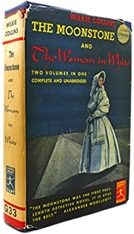
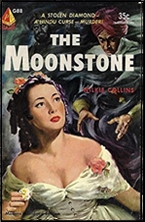
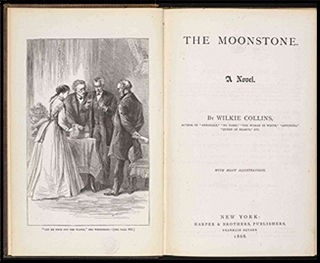
WILKIE COLLINS – The Moonstone. Tinsley, US, hardcover, 1868. Harper, US, hardcover 1868. Serialised in Charles Dickens’s magazine All the Year Round and in the US in Harper’s Weekly, circa 1868. Reprinted many times in both hardcover and soft. (The book has probably never been out of print.) Adapted many times for the stage, movies, radio, TV, comic books and (!) a podcast.

   (William) Wilkie Collins was one of the most popular and accomplished writers of the nineteenth century, and The Moonstone is an early classic of the suspense genre. Like Collins’ other criminous works, it contains elements that later became staples of mystery writing: a purloined gemstone, carefully secreted clues, obtrusive red herrings, sinister Indians who lurk threateningly in the background, a blighted love affair, several shakily constructed alibis, numerous cliff-hanging scenes, and a mysterious suicide. Although complicated, the plot is well constructed and the reader’s interest seldom flags.

   The yellow diamond known as the “moonstone” was stolen from an Indian religious idol by John Herncastle, a man who chose to ignore the story of bad luck following the diamond should it be removed from the possession of the worshipers of the moon god. Upon Herncastle’s death, the gem was willed to his niece, Rachel Verinder, and the young lady is about to receive it when the story opens (after a prologue and two tiresome chapters filled with background material).

   The diamond disappears, of course, on the night Rachel is presented it by solicitor Franklin Blake. And when Inspector Cuff of Scotland Yard appears on the scene, some clues point to Blake, while others indicate Rachel has secreted away her own diamond for some unknown and possibly unbalanced reason.

   The story proceeds, divided into two periods, respectively titled “The Loss of the Diamond” and “The Discovery of the Truth” (which in itself is divided into eight narratives), plus an epilogue. In spite of these numerous sections, each broken into various chapters narrated by different characters, the reader finds himself as determined as Cuff to learn the truth. Who are the Indians? Was this caused by the curse of the moonstone? Will Rachel find happiness? Such questions are ever in the forefront. And when the end is finally reached, all clues are tied up, all questions are answered, and — yes — Rachel does find happiness.

   Collins’ other works are not nearly as well known as The Moonstone, but a number are just as engrossing and stand the test of time equally well. These include The Woman in White (1860), which seems to have been Collins’ personal favorite; and The Queen of Hearts (1859), a collection that contains the cornerstone humorous detective story “The Biter Bit.”

     ———
   Reprinted with permission from 1001 Midnights, edited by Bill Pronzini & Marcia Muller and published by The Battered Silicon Dispatch Box, 2007.   Copyright © 1986, 2007 by the Pronzini-Muller Family Trust.
   

A 1001 MIDNIGHTS Review
by Bill Crider


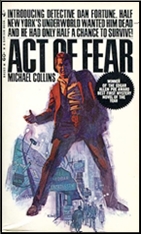
MICHAEL COLLINS – Act of Fear. PI Dan Fortune #1. Dodd Mead, hardcover, 1967. Bantam H4369, paperback, 1969. Playboy Press, paperback, 1980.

   Dennis Lynds, using the name Michael Collins, is writing one of the very best of the contemporary private-eye series. All the novels under the Collins name feature Dan Fortune, a one-armed detective who operates out of the Chelsea district of New York City. Fortune’s handicap sets him apart and makes him vulnerable; he is also introspective and compassionate, a believer in absolute truth, a man who is driven to find the answers. Act of Fear, Fortune’s first novel-length case, won an Edgar for Best First Mystery of the year.

   Act of Fear begins, like many mystery novels, with a missing person. Fortune is hired by a young man to find a missing friend. Apparently the friend has good reason to be missing, and Fortune soon discovers that he is not the only one looking. The elements of the case include the mugging of a cop, two murders, and the savage beating of Fortune’s client. The plotting, as in all the Collins books, is intricate, with Fortune following an the threads to their sometimes frayed ends. His fee for the entire case is $50; he spends much more than that in solving it, but once he is involved, he has to find out the truth.

   As usual in Collins’ work, the book has a serious theme, in this case the difficulty of being true to oneself no matter what the consequences. It would be difficult to say that the ending is satisfying, but it is “right” in the sense that it is the only ending appropriate for the story that Collins tells.

     ———
   Reprinted with permission from 1001 Midnights, edited by Bill Pronzini & Marcia Muller and published by The Battered Silicon Dispatch Box, 2007.   Copyright © 1986, 2007 by the Pronzini-Muller Family Trust.
A 1001 MIDNIGHTS Review
by John Lutz


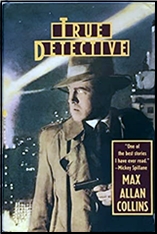
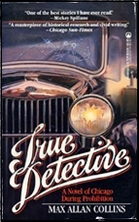
MAX ALLAN COLLINS – True Detective. St. Martin’s, hardcover, 1983 Tor, paperback, 1986; ibooks, paperback, 2003. Thomas & Mercer, softcover, 2011.

   In True Detective, Collins has created a brilliantly evocative period novel set in depression year 1933, Chicago, His hero, Nate Heller, is a cop who refuses to succumb to prevailing corruption on the police force. (This is a tightly woven blend of fact and fiction.) When Nate becomes involved in the shooting of gangster Frank Nitti, the corruption closes in on him. His testimony as to what happened in Nitti’s office during the shoot-out is vital to several parties; and given the climate of time and place, they all assume that Nate is for sale.

   Nate isn’t, as he explains to his pal, boxer Barney Ross. With no alternative to dishonesty other than to quit the police department, Nate goes private, working out of an office, complete with a Murphy bed, above Ross’s saloon.

   Nate has trouble and he has enemies, among them Chicago’s corrupt Mayor Cermak, the mover and shaker of the 1933 World’s Fair, and former vice president General Charles Gates Dawes, not to mention the unnamed but sufficiently dangerous Al Capone. It’s a good thing that Nate also has allies like Eliot Ness, Franklin Roosevelt, and even young sportscaster Dutch Reagan.

   The writing style here is hard-boiled and literate, and the novel is illustrated with black-and-white photographs of the book’s true-life characters and of depression-era Chicago. So artfully are photographs matched with text that they add wonderfully to the painstakingly created atmosphere of that almost-lost time.

   This novel won the Private Eye Writers of America Shamus Award as 1983’s best private-eye novel, and deservedly so. A lovingly and often elegantly written novel, this is marvelous entertainment and a must read for every fan of private eye fiction.

   A second Nate Heller adventure, True Crime (1984), involves the detective with J. Edgar Hoover and an FBI plot against the infamous John Dillinger, and is every bit as evocative and entertaining as True Detective. More Heller novels are planned for the future.

     ———
   Reprinted with permission from 1001 Midnights, edited by Bill Pronzini & Marcia Muller and published by The Battered Silicon Dispatch Box, 2007.   Copyright © 1986, 2007 by the Pronzini-Muller Family Trust.
   

Editorial Update: There are now 20 books in the series, the most recent being Do No Harm (2020), in which Heller finds himself involved in the Sam Shepard case, which in real life occurred in 1954. (I believe that all of Heller’s cases have appeared in chronological order, both his time and our time.)

A 1001 MIDNIGHTS Review
by Art Scott


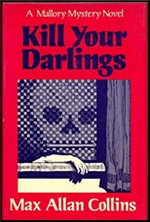
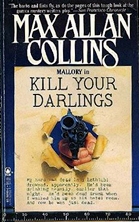
MAX ALLAN COLLINS – Kill Your Darlings. PI Gat Garson. Walker, hardcover, 1984. Tor, paperback, 1988. Thomas & Mercer, softcover, 2012.

   Max Allan Collins is not merely a writer of mystery novels (and of the Dick Tracy comic strip); he is also a mystery scholar, collector, and fan. This book, third in a series featuring his detective alter ego, Mallory (like Collins, a mystery collector, fan, and writer from a small town in Iowa), is an “inside” story about mystery fans and fandom. It takes place at the Bouchercon, the annual convention for mystery fans and writers. (By a remarkable coincidence, Collins sets the story al the same Chicago hotel where the 1984 convention was actually held.)

   The murder victim is Roscoe Kane, a veteran paperback mystery writer, His once-popular detective, Gat Garson, is out of fashion, and Kane is on the skids. He’s at the con to receive an award from the Private Eye Writers Association, but drowns in the bathtub – an apparent accident – before the presentation. Mallory, Kane’s friend and fan, isn’t satisfied by the medical examiner’s hasty verdict and noses around, suspecting that Kane’s death might be linked to the upcoming publication of a “lost” Hammett Continental Op story.

   In an introduction, Collins makes the disclaimer that his fictional Bouchercon attendees, writers and fans, are mostly composites of real characters. However, initiates will have little trouble identifying many of them, including a self-absorbed guest of honor named Keats – the creator of a sensitive-macho private-eye character. Other inside jokes and fan tributes are scattered throughout; e.g., Collins’s borrowing of a gaudy metaphor from Spillane’s Vengeance Is Mine in the climactic shooting scene.

   This fast-moving and inventive novel is the newest addition to the very small subgenre of fandom mystery novels. Two others are Bill Pronzini’s Hoodwink (murder at a pulp collector’s convention) and Edward D. Roch’s Shattered Raven (murder at the MWA Awards Banquet).

   Mallory is also featured in The Baby Blue Rip-Off (1983), No Cure for Death (1984), and A Shroud for Aquarius (1985).

     ———
   Reprinted with permission from 1001 Midnights, edited by Bill Pronzini & Marcia Muller and published by The Battered Silicon Dispatch Box, 2007.   Copyright © 1986, 2007 by the Pronzini-Muller Family Trust.
   

Bibliographic Update: Add to the books in the Mallory series: Nice Weekend for a Murder (1986).

A 1001 MIDNIGHTS Review
by Bill Pronzini


AGATHA CHRISTIE – And Then There Were None. Dodd Mead, hardcover, January 1940. Pocket Books #261, US, paperback, 1944. Prior serialization in the Saturday Evening Post in seven parts from 20 May to 01 July 1939 Published first in the UK (Collins, hardcover, November 1939). Reprinted in both countries many times in both hardcover and paperback. Numerous film adaptations, beginning with And Then There Were None in 1945.

   Perhaps the most famous of all of Dame Agatha’s novels, this is both a masterful cat-and-mouse thriller and a baffling exercise for armchair sleuths – a genuine tour-de-force. And like all of her best work, it has inspired countless imitations and variations – the ultimate compliment for any crime novel and crime-novel writer.

   Ten men and women, none of whom know one another, are either invited or hired to spend a weekend on isolated Indian Island off the Devon coast. Their host is someone calling himself “U. N. Owen” (Unknown), and it soon becomes apparent that he is either a separate individual who is hiding somewhere on the island or that he is one of the ten. Each guest harbors some sort of dark secret or past indiscretion that makes him or her a target for homicide. And one by one, they begin to die in bizarre and frightening ways that loosely coincide with the ten verses of the nursery rhyme “Ten Little Indians,” wherein lies the novel’s primary clue.

   But there is no detective, professional or amateur, here; no one left at all, in fact – except the reader – to explain the murders when the weekend (and the book) draws to a close. Thus And Then There Were None is a perfectly apt title.

   The effects of the novel are multiple: a gradually mounting sense of terror and suspense that binds reader to chair; a skillful shifting of suspicion from one individual to another, principally through the introduction and manipulation of red herrings; in-depth characterization (not always Christie’s long suit); and a surprising denouement that perhaps justifies one critic’s judgment of the novel as “the ultimate in whodunits.”

   And Then There Were None was filmed three times: in 1945, 1965, and 1975. The first of the three versions, directed by René Clair and starring Barry Fitzgerald, Walter Huston, and Louis Hayward, is by far the best and most faithful to the novel – a small classic in its own right.

     ———
   Slightly revised with permission from 1001 Midnights, edited by Bill Pronzini & Marcia Muller and published by The Battered Silicon Dispatch Box, 2007.   Copyright © 1986, 2007 by the Pronzini-Muller Family Trust.
   

A 1001 MIDNIGHTS Review
by Bill Pronzini

   
G. D. H. and MARGARET COLE – Knife in the Dark. Collins, UK, hardcover, 1941. Macmillan, US, hardcover, 1942.

   G. D. H. and Margaret Cole were extremely prolific writers between the two world wars: individually and collaboratively, they published well over two hundred books of fiction, nonfiction, and verse. G. D. H. was a prominent social and economic historian; his five-volume A History of Social Thought is considered a landmark work. Dame Margaret is best known for her biographies of Beatrice Webb and of her husband (The Life of G. D. H. Cole, 1971).

   The Coles co-authored more than thirty “Golden Age” detective novels, beginning with The Brooklyn Murders in 1923, and six volumes of criminous short stories. Knife in the Dark is their next to last novel, and the only one to feature Mrs. Warrender as its protagonist. “A naturally trim and tidy old lady,” Mrs. Warrender is the mother of private detective James Warrender (who affectionately calls her, among other things, “an incurably meddling old woman”). She is also solidly in the tradition of such “little old lady” sleuths as. Miss Jane Marple and Hildegarde Withers, although less colorful than either of those two indefatigable crook-catchers.

   Knife in the Dark takes place at a mythical ancient English university, Stamford, during the dark days of World War II. Kitty Lake – wife of Gordon Lake, a teacher of Inorganic Chemistry whose mother is a cousin of Mrs. Warrender’s – is stabbed to death during an undergraduate dance which she herself arranged. Any number of people had a motive to do away with the mercurial Kitty, who had both a mean streak and a passion for other men; the suspects include her husband, an RAF officer, a young anthropologist, a strange Polish refugee named Madame Zyboski (who may or may not be a Nazi spy), and a dean’s wife whom James Warrender describes as “an awful old party with a face like a diseased horse and a mind like a sewer.”

   Like all of the Coles’ mysteries, this is very leisurely paced; Kitty Lake’s murder, the only one in the book, does not take place until page 104, and there is almost no action before or after. Coincidence plays almost as much of a role in the solution as does detection by Mrs. Warrender (who happens to be staying with the Lakes at the time of the murder); and the identity of the culprit comes as no particular surprise.

   For all of that, however, Knife in the Dark is not a bad novel. The characters are mostly interesting, the university selling is well-realized, and the narrative is spiced with some nice touches of dry wit. Undemanding fans of the Golden Age mystery should find it diverting.

   Mrs. Warrender’s talents are also showcased in four novelettes collected as Mrs. Warrender’s Profession (1939). The best of the four is “The Toys of Death,” in which Mrs. W. solves a baffling murder on the south coast of England.

   The Coles also created three other series detectives, none of whom is as interesting an individual as Mrs. Warrender. The most notable of the trio is Superintendent Henry Wilson of Scotland Yard, for he is featured in sixteen novels, among them The Berkshire Mystery (1930), End of an Ancient Mariner (1933), and Murder at the Munition Works (1940); and in the collection of short stories, Superintendent Wilson’s Holiday (1928).

     ———
   Reprinted with permission from 1001 Midnights, edited by Bill Pronzini & Marcia Muller and published by The Battered Silicon Dispatch Box, 2007.   Copyright © 1986, 2007 by the Pronzini-Muller Family Trust.
A 1001 MIDNIGHTS Review
by Susan Dunlap & Marcia Muller


AGATHA CHRISTIE – The ABC Murders. Hercule Poirot #13. Dodd Mead, US, 1936. First published in the UK by Collins, hardcover, 1936. Reprinted many time, in both hardcover and paperback. Film: MGM, 1966, as The Alphabet Murders, with Tony Randall as Hercule Poirot. TV adaptations: (1) As an episode of ITV’s Agatha Christie’s Poirot (1992) with David Suchet as Poirot. (2) BBC, three part mini-series, 2018, with John Malkovich as Hercule Poirot

   Agatha Christie has long been acknowledged as the grande dame of the Golden Age detective-story writers. Beginning with her moderately successful The Mysterious Affair at Styles (1920), Christie built a huge following both in her native England and abroad, and eventually became a household name throughout the literate world. When a reader – be he in London or Buenos Aires – picks up a Christie novel, he knows exactly what he is getting and has full confidence that he is sitting down to a tricky, entertaining, and satisfying mystery.

   This enormous reader confidence stems from an effective combination of intricate, ingenious plots and typical, familiar characters and settings. Christie’s plots always follow the rules of detective fiction; she plays completely fair with the reader. But Christie was a master at planting clues in unlikely places, dragging red herrings thither and yon, and, like a magician, misdirecting the reader’s attention at the exact crucial moment. Her murderers – for all the Christie novels deal with nothing less important than this cardinal sin – are the Least Likely Suspect, the Second Least Likely Suspect, the Person with the Perfect Alibi, the Person with No Apparent Motive. And they are unmasked in marvelous gathering-of-all-suspects scenes where each clue is explained, all loose ends are tied up.

   As a counterpoint to these plots, Christie’s style is simple (even undistinguished). She relies heavily upon dialogue, and has a good ear for it when dealing with the “upstairs” people who are generally the main characters in her stories: the “downstairs” people fare less well at her hands, and their speech is often stilted or stereotyped.

   Christie, however, seldom ventures into the “downstairs” world. Her milieu is the drawing room, the country manor house, the book-lined study, the cozy parlor with a log blazing on the hearth. Like these settings, her characters are refined and tame, comfortable as the slippers in front of the fire – until violent passion rears its ugly head. Not that violence is ever messy or repugnant, though; when murder intrudes, it does so in as bloodless a manner as possible, and its investigation is always conducted as coolly and rationally as circumstances permit. One reason that Christie’s works are so immensely satisfying is that we know we will be confronted by nothing really disturbing, frightening, or grim. In short, her books are the ultimate escape reading with a guaranteed surprise at the end.

   Christie’s best-known sleuths are Hercule Poirot, the Belgian detective who relies on his “little grey cells” to solve the most intricate of crimes; and Miss Jane Marple, the old lady who receives her greatest inspiration while knitting. However, she created a number of other notable characters, among them Tuppence and Tommy Beresford, an amusing pair of detective-agency owners, who appear in such titles as The Secret Adversary (1922) and Postrn of Fate (1973); Superintendent Battle of Scotland Yard, who is featured. in The Secret of Chimneys (1925), The Seven Dials Murder (1929), and others; and the mysterious Harley Quin.

   The member of this distinguished cast who stars in The ABC Murders is Hercule Poirot. Poirot is considered by many to be Christie’s most versatile and appealing detective. The dapper Belgian confesses gleefully to dying his hair, but sees no humor in banter about his prized “pair of moustaches.” And yet he has the ability to see himself as others see him and use their misconceptions to make them reveal themselves and their crimes.

   A series of alphabetically linked letters are sent to Poirot, taunting him with information about where and when murders will be committed unless he is clever enough to stop them. The aging detective comes out of retirement, he admits, “like a prima donna who makes positively the farewell performance … an infinite number of times.” Is the murderer a madman who randomly chooses the victim’s town by the letter of the alphabet, or is he an extremely clever killer with a master plan? And why has he chosen to force Poirot out of retirement?

   These questions plague Poirot’s “little grey cells” as the plot thrusts forward and then winds back on itself time and time again. Well into the novel, Christie teases the horrified reader by introducing a coincidence that looks as if it will solve the cases, then snatches it back, dangles another possibility, snatches that one back, too. And so on, until the innovative and surprising conclusion is reached. Poirot is al his most appealing here, and Christie’s plotting is at its finest.

     ———
   Reprinted with permission from 1001 Midnights, edited by Bill Pronzini & Marcia Muller and published by The Battered Silicon Dispatch Box, 2007.   Copyright © 1986, 2007 by the Pronzini-Muller Family Trust.
   

A 1001 MIDNIGHTS Review
by Barry N. Malzberg


AGATHA CHRISTIE – The Murder of Roger Ackroyd. Hercule Poirot novel #3. Collins, UK, 1926. Dodd Mead, US, hardcover. 1926. Reprinted many times. Film: Twickenham, UK, 1931, as Alibi  (with Austin Trevor as Poirot). TV Movie: BBC 2000 (with David Suchet as Hercule Poirot).

   This novel, Hercule Poirot’s most signatory case, is the work on which not only Agatha Christie’s reputation but that of the mystery of murder and manners, that which might be called the British “high tea school,” may be said to rest. Narrated by James Sheppard, trusted family physician and self-appointed confidant to Poirot during his investigation, the novel tracks the events leading up and then subsequent to the murder of Roger Ackroyd, a gentleman of some means and too much knowledge, “an immensely successful manufacturer of (I think) wagon wheels … a man of nearly fifty years of age, rubicund of face and genial of manner … He is, in fact, the life and soul of our peaceful village of King’s Abbot.”

   King’s Abbot is deeply shaken, as well it might be, by the murder of Ackroyd, and the distinguished Belgian detective M. Poirot, now in residence incognito and in retirement in the village, comes in to investigate. As in all fair-play puzzles of detective fiction’s Golden Age, Poirot deduces Ackroyd’s murderer through the gathering of carefully planted clues, accuses that person, and resolves the tragic case. The murderer’s identity is a stunning revelation, however, owing to a narrative device so simultaneously audacious and obvious that it may be said to have altered not only the deductive mystery but the novel form itself. (It is impossible to believe that Vladimir Nabokov did not study this work before composing Pale Fire.)

   Arguably the finest cerebral detective novel ever published, The Murder of Roger Ackroyd is inarguably Christie’s finest work. If she had done nothing else, her place in the literature of crime would be secure; if Poirot had done nothing else, his “little grey cells” would have been forever noted. In fact, it is possible that if Christie had written only this novel (and perhaps The ABC Murders and And Then There Were None), her reputation would be much higher than it is (if not the accounting of her estate). But every writer is entitled to be judged by his or her strongest work, and this novel stands alone.

     ———
   Reprinted with permission from 1001 Midnights, edited by Bill Pronzini & Marcia Muller and published by The Battered Silicon Dispatch Box, 2007.   Copyright © 1986, 2007 by the Pronzini-Muller Family Trust.
   

A 1001 MIDNIGHTS Review
by Bill Crider


OCTAVUS ROY COHEN – Don’t Ever Love Me. Macmillan, hardcover, 1946. Popular Library #332, paperback, 1951.

   Octavus Roy Cohen’s mysteries are slick and entertaining, smoothly written in a style that no doubt appealed to the readers of the Saturday Evening Post and other publications where many of his stories. appeared. Don’t Ever Love Me is a good example of his novel-length work, a light romantic mystery featuring a fairly liberated heroine, at least by the standards of 1946.

   Lynn Sheridan, a successful copywriter for a New York advertising firm, is the victim of what seems to be a series of bizarre practical jokes: Someone calls the police to report her murder: someone calls an ambulance service to report that she has been badly hurt; and her escort to the opera is killed by a bullet that passes so close to her that she can hear it buzz by. Naturally all this puts quite a strain on Lynn and her fiancé, Alan Gordon.

   To say much more about the plot would be unfair, but it involves two more murders and a goodly number of suspects. Cohen manages some adroit misdirection before Gordon, to the astonishment of the homicide detective on the case, manages to figure out just exactly what has been going on. And of course, it’s fun to consider the detective’s final words on the case in light of today’s methods of law enforcement: “The confession is what counts – not how you get it.”

   Paperback collectors will find the cover of the 1951 Popular Library edition of Don’t Ever Love Me irresistible, even though the beautiful blonde with the dark eyebrows and the automatic pistol has nothing at all to do with the story.

   Jim Hanvey, Detective ( 1923) is a collection of short stories that demonstrates Cohen’s ability in that form. And Cohen came up with the title Scrambled Yeggs (1934) years before Richard S. Prather.

     ———
   Reprinted with permission from 1001 Midnights, edited by Bill Pronzini & Marcia Muller and published by The Battered Silicon Dispatch Box, 2007.   Copyright © 1986, 2007 by the Pronzini-Muller Family Trust.
   

A 1001 MIDNIGHTS Review
by Kathleen L. Maio

   
ANTHEA COHEN – Angel Without Mercy. Nurse Agnes Carmichael #1. Doubleday Crime Club, hardcover, 1984. Published earlier in the UK by Quartet, hardcover, 1982.

   There have been many stories about lovable rogues and mastermind criminals in suspense fiction over its long history, but a group of novels in which a troubled murderer is the heroine is an unusual event. That is what Anthea Cohen has created in her new “Angel” series. Cohen, a nurse and writer on medical topics for twenty-five years, uses her knowledge of hospital locale and atmosphere to enrich her series.

   In Angel Without Mercy, Cohen seems to be setting up a classic whodunit – and taking her time about it. She shows us a hateful nurse supervisor named Hughes, and shows us ample evidence of why practically the entire staff of St. Jude’s Hospital wants her dead. The reader may become impatient for the murder and the discovery of the body about three-quarters of the way through the book, but Cohen will not be rushed. She is concerned more with the emotional and psychological mystery of human conduct than with a tidy murder puzzle.

   Although Cohen allows the reader the chance to reason out the identity of her murderer, she does not feel the need to have the police do the same. Her murderer gets away with it, and lives to return for other deadly adventures in Angel of Vengeance (1984) and Angel of Death (1985). It is essential to read these novels in order. And it will be interesting to see how Cohen proceeds with her intriguing series.

     ———
   Reprinted with permission from 1001 Midnights, edited by Bill Pronzini & Marcia Muller and published by The Battered Silicon Dispatch Box, 2007.   Copyright © 1986, 2007 by the Pronzini-Muller Family Trust.
   

Editorial Update: Given the premise as I read it in Kathi’s review (and perhaps I have it all wrong), I saw little opportunity for any expansion of the the three book series she refers to. I was mistaken. There were 18 in all, with the last published in 2005. Nurse Carmichael may have branched out in other directions (??).

« Previous PageNext Page »