1001 Midnights


A 1001 MIDNIGHTS Review
by George Kelley & Marcia Muller


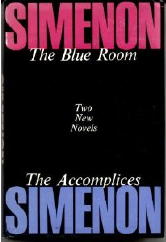
GEORGES SIMENON – The Blue Room and The Accomplices. New York: Harcourt Brace & World, hardcover, 1964. Published separately in UK by Hamish Hamilton, hardcovers, 1965/1966. Translations of Le Chambre Bleue (Paris, 1964) and Les Complices (Paris, 1955).

GEORGES SIMENON

   While Simenon is best known for his Maigret novels, his non-series works of psychological suspense are equally compelling. They express a kind of dark inevitability, a sense of events unwittingly set in motion by one’s actions and then gathering an uncontrollable momentum of their own. This volume presents two of the best of these novels.

   In The Blue Room, Simenon explores the erotic — and ultimately disastrous — relationship of an innocent man and a woman who is as ruthless as she is passionate. Tony’s main interest in life is making love with his mistress, Andree.

   Naive and trusting, he remains unaware of her evil nature until his wife and her husband are found dead of strychnine poisoning. Tony is arrested for the crimes, and the story of what went before is told in flashback as he is questioned by the police.

   Even though we already know where the events are leading, we nevertheless fear for Tony as we watch Andree’s corruption overwhelm him; and their final encounter of the lovers at the trial is one of the more chilling in mystery fiction.

   The Accomplices is completely different in tone and theme from The Blue Room, but equally haunting.

   Joseph Lambert is married, the father of six children, and has another on the way. A fairly successful businessman, Lambert feels everything is going his way.

   But then the unexpected happens: While Lambert is driving wildly down the road, engaged in an amorous dalliance with his secretary, he loses control of his car. A school bus filled with children swerves to avoid him, but crashes into a wall and bursts into flame; dozens of little children die in the accident.

   Lambert moves quickly to cover up his guilt, but his unconscious proves to be his own prosecutor, judge, and jury. This is a fascinating novel of psychological torment and pressure, and has grave implications for modern society.

         ———
   Reprinted with permission from 1001 Midnights, edited by Bill Pronzini & Marcia Muller and published by The Battered Silicon Dispatch Box, 2007.   Copyright © 1986, 2007 by the Pronzini-Muller Family Trust.

A 1001 MIDNIGHTS Review
by George Kelley & Bill Pronzini


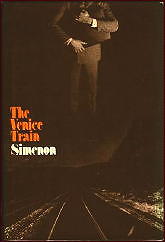
GEORGES SIMENON – The Venice Train. Harcourt Brace Jovanovich, US, hardcover, 1974. Hamish Hamilton, UK, hardcover, 1974. Translation of Le Train de Venise, Paris, 1965.

GEORGES SIMENON

   Justin Calmar is an ordinary man; everything in his life seems well ordered and complacent. Then he takes his family on a vacation to Europe, and on the train from Venice to Paris a stranger approaches and asks him to deliver an attache case.

   Calmar agrees. But when he enters the Paris apartment where he is supposed to make the delivery, he finds a murdered woman. Panicked, he flees — and his life is forever altered.

   Fear and paranoia take control of Calmar. He becomes obsessed with the attache case and the events surrounding the bizarre affair. He hungrily reads newspapers looking for clues to the stranger’s identity, and finds that the man, too, has been murdered. Will he be next?

   When Calmar finally opens the attache case, he finds bundles of American hundred-dollar bills, English fifty-pound notes, and Swiss francs: a literal fortune. But this only deepens his fear: Someone win surely come to take the money away from him.

   He embarks on a frantic routine to keep the case hidden, continually shifting it from train-station lockers to bus-station lockers and back again. His existence degenerates into a nightmare of anxiety, depression, and continued paranoid behavior — he is a man at the breaking point long before anything happens to substantiate his terror.

   Few writers can match Simenon when it comes to the novel of psychological suspense, and this is one of his finest books of this type. Justin Calmar is a memorable and tragic character; and Simenon’s theme is powerfully stated. Relentless though it may be, The Venice Train is a novel for our time, with implications that transcend its simple plot and a message for us all.

   Outstanding among Simenon’s many other novels of psychological suspense are The Man Who Watched the Trains Go By (1946), Act of Passion (1953), In Case of Emergency (1958; made into an excellent French film with Brigitte Bardot and Jean Gabin), and The Innocents (1974).

         ———
   Reprinted with permission from 1001 Midnights, edited by Bill Pronzini & Marcia Muller and published by The Battered Silicon Dispatch Box, 2007.   Copyright © 1986, 2007 by the Pronzini-Muller Family Trust.

A 1001 MIDNIGHTS Review
by Marcia Muller


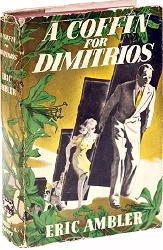
ERIC AMBLER A Coffin for Dimitrios

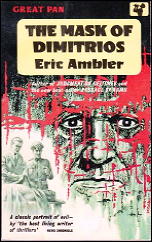
ERIC AMBLER – A Coffin for Dimitrios. Alfred A. Knopf, US, hardcover, 1939. First published in the UK as The Mask of Dimitrios: Hodder & Stoughton, hardcover, 1939. Reprinted many times, in both hardcover and paperback.

   Eric Ambler has long been known as a master of international intrigue. His novels typically involve a more or less ordinary protagonist who has blundered into some sinister situation and has become enmeshed in it against his will. He must then extricate himself by appearing to take part in the intrigue, often as a reluctant agent for the authorities.

   Ambler’s narrative style is straightforward and economical; his plots, whether simple or complex, are suspenseful; his action scenes are high points in the books.

ERIC AMBLER A Coffin for Dimitrios

   A Coffin for Dimitrios is the story of a man with an obsession. Charles Latimer, a writer of detective novels, is on holiday in Istanbul when he meets Turkish Secret Police colonel Haki; Haki admires Latimer’s work and, like many policemen, has an idea for a novel, which he thinks Latimer should write.

   The idea is old-hat, but the story Haki tells Latimer as an aside — about the criminal Dimitrios Makropoulis — fascinates the writer. Dimitrios, who has been fished out of the Bosphorus, dead of a knife wound, has been involved in murder, an assassination plot, pimping, and drug trafficking; now he lies in the morgue, and Latimer impulsively asks to view the body.

ERIC AMBLER A Coffin for Dimitrios

   The viewing affects Latimer powerfully, and he becomes determined to trace the life of Dimitrios. His search takes him to Smyrna, Athens, Sofia, Geneva, and Paris. It reveals more facets of Dimitrios’s life than the police dossiers hold, and it throws Latimer into the company of a mysterious man named Peters who seems very interested in the fact that the writer saw Dimitrios’s body in the morgue. So interested, in fact, that he aids the investigation, and Latimer finds himself in a situation stranger and more dangerous than any in his own detective stories.

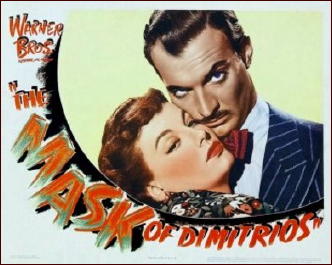
   This is an intriguing and suspenseful novel with an ironic twist at the end that causes us to reflect on how little we really learn from life’s experiences. More or less faithful to it is the moody 1944 film version starring Zachary Scott, Sydney Greenstreet, and Peter Lorre, which appeared under the original British title of the novel, The Mask of Dimitrios. The film’s screenplay was authored by another mystery writer, Frank Gruber.

   Charles Latimer reappears in one other novel, The Intercom Conspiracy (1969).

         ———
   Reprinted with permission from 1001 Midnights, edited by Bill Pronzini & Marcia Muller and published by The Battered Silicon Dispatch Box, 2007.   Copyright © 1986, 2007 by the Pronzini-Muller Family Trust.

ERIC AMBLER A Coffin for Dimitrios

A 1001 MIDNIGHTS Review
by Bill Pronzini


OWEN CAMERON The Fire Trap

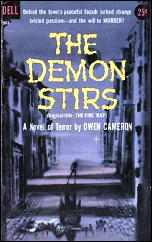
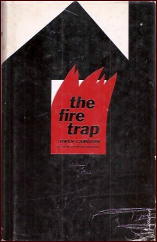
OWEN CAMERON – The Fire Trap. Simon & Schuster, hardcover, 1957. Also published as The Demon Stirs: Dell #983, paperback, 1958.

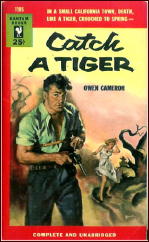
    Owen Cameron is one of those talented but unfortunate writers whose work generates a small commotion when first published but for some inexplicable reason is forgotten while lesser writers achieve recognition and a large following. A successful magazine writer, Cameron published seven criminous novels; the last four of these constitute some of the most quietly compelling suspense fiction of the 1950s.

OWEN CAMERON The Fire Trap

    The protagonist of The Fire Trap is Deputy Sheriff Jake Brown of the northern California mountain community of Verdi, who is also featured in Cameron’s best-known novel, Catch a Tiger (1952). Jake’s job here is a grim and ugly one: to find out who is responsible for a series of arson fires, the latest of which claimed the lives of two young children.

    Matters turn even deadlier when an outsider, insurance-claims adjuster Hal Moss, is found shotgunned to death on a back country road, One of the suspects in both crimes is Jake’s own father, a surly old toner who has been estranged from Jake for fourteen long, bitter years. Other suspects include Jake’s brother, Art; one of his best friends, Floyd Rupert; and a woman with whom he was once involved, Alice Newsom.

OWEN CAMERON The Fire Trap

    “In his stubborn, honest, relentless way,” the dust jacket blurb says, “Jake follows his hunches and tracks down his suspicions … At every turn [he] is met by his own sense of guilt and frustration-feelings intensified when he realizes that he has unwittingly set the scene for two more murders.” It is at terrible personal cost that he eventually arrives at the truth, in a series of climaxes that can only be described as shattering.

    This is provocative stuff, told in lean, understated prose that makes it all the more forceful. As is the case with Catch a Tiger and two non-series books, The Butcher’s Wife (1954) and The Silent One (1958), it is a novel that has disturbing things to say about the dark side of human relationships.

         ———
   Reprinted with permission from 1001 Midnights, edited by Bill Pronzini & Marcia Muller and published by The Battered Silicon Dispatch Box, 2007.   Copyright © 1986, 2007 by the Pronzini-Muller Family Trust.

Bibliographic Note:   A partial list of Owen Cameron’s short fiction can be found here on the Fiction Mags Index. His first recorded story was for Collier’s in 1943. Collier’s was a “slick magazine,” but Cameron can be considered a pulp writer, too, since his list of credits also includes stories published in Blue Book and Argosy.

A 1001 MIDNIGHTS Review
by Charles Shibuk


VIRGIL MARKHAM The Devil Drives

VIRGIL MARKHAM – The Devil Drives. Alfred A. Knopf, hardcover, 1932. Bart House #10, paperback, 1944. Ramble House, trade paperback, 2007.

   The Devil Drives is an offbeat and highly individual novel by a writer who, it would seem, must have had some familiarity with the work of that master American zany Harry Stephen Keeler. It is somewhat reminiscent of Keeler’s Amazing Web (1929), but is shorter, slighter, less ambitious, more straightforward, and, though complex enough in plot, lacks the unbelievable convolutions and ramifications of the Keeler work.

   The authors do share the ability to propel their narratives forward in such a manner that readers will keep turning pages breathlessly in order to discover what astounding plot development will next occur, and what outrageous coincidence will help to resolve (or amplify) the current situation.

VIRGIL MARKHAM The Devil Drives

   The Markham novel concerns George Lawson Peters, the warden of Franklin Penitentiary in New Jersey, who deserts his post to seek a lost treasure left by an adventurer nicknamed “Dubrosky” for a girl named Philadelphia Boston. On his odyssey, Peters meets a gangster with a heart of garbage; a repulsive blackmailer who exacts no tribute from his victims; the blackmailer’s unhappy wife; her friend the eccentric countess; and Detective Veen, who reads mysteries.

   At the two-thirds point in the narrative, Peters encounters a honey of a locked-room problem. The door is locked and bolted, and the two windows are locked-all from the inside. The floor and ceiling are ungimmicked, and the fireplace and chimney show no signs of entrance or egress. The victim met his death by drowning. The author’s unique solution is even more bizarre than the problem he has propounded.

VIRGIL MARKHAM The Devil Drives

   The locked-room situation and many strands of the plot are finally resolved by a few well-placed Keeleresque coincidences. But Markham has still done an ingenious job of deceptive clue-planting that is worthy of Christie, Carr, or Queen; and his unexpected and grimly ironic finale is worthy of Francis Iles or Richard Hull.

   Markham’s other novels include Death in the Dusk (1928), The Black Door (1930), and Inspector Rusby’s Finale (1933). The last-named title has an irresistible premise:

   A Scotland Yard inspector, spending a weekend at a crowded country house, wakes up the morning after his arrival to find that the hostess and guests have vanished and he is alone — except for the dead body of a perfect stranger. The ending, however, as Barzun and Taylor have noted, is a bit hard to swallow.

         ———
   Reprinted with permission from 1001 Midnights, edited by Bill Pronzini & Marcia Muller and published by The Battered Silicon Dispatch Box, 2007.   Copyright © 1986, 2007 by the Pronzini-Muller Family Trust.

Editorial Comments:   Curt Evans recently posted on his blog a review of Red Warning (aka Song of Doom in the UK), another work of crime fiction by Virgil Markham. Included with the review is a considerable amount of information about the author himself, and I highly recommend it to you. (Follow the link.)

   More. A link on Curt’s blog led to blogger TomCat’s review of Death in the Dusk, also by Markham, which he says “turned out to be a rival for Joel Townsley Rogers’ The Red Right Hand (1945) and Fredric Brown’s Night of the Jabberwock (1950) in the race for the title of most outlandish detective story ever contrived.”

A 1001 MIDNIGHTS Review
by Bill Pronzini


PAUL CAIN Fast One

PAUL CAIN – Fast One. Doubleday Doran & Co., hardcover, 1933. First appeared in serialized form in non-consecutive issues of Black Mask magazine between March and September, 1932. Bond Mystery #10, digest paperback, 1945. Avon #178, pbbk, 1948; Avon #496, ppbk, 1952. Southern Illinois University Press, hardcover, 1978. Popular Library, paperback, “American Fiction” series, 1980. Black Lizard, paperback, 1987.

   The hardest of the hard-boiled writers for Black Mask in the early 1930s was unquestionably Paul Cain (Peter Ruric). His style, as pulp authority Ron Goulart has noted, at times “becomes as sparse and clipped as that of a McGuffey’s Reader.”

   In an afterword to the Southern Illinois reprint edition, critic Irvin Faust says that Cain “hasn’t the time or patience for excess baggage. He picks up his literary scalpel and scrapes away conjunctions as if they were bad merchandise… He digs into the page with a hard sentence: simple, declarative, exact.”

PAUL CAIN Fast One

   Fast One is Cain’s only novel. (He was primarily a screenwriter and is responsible for such films as One for the Money, Grand Central Murders, and Mademoiselle Foi.)

   It was written on a bet and its various sections first appeared in Black Mask as five self-contained novelettes prior to book publication. It is unrelentingly grim and stark and brutal, to such an extent that it becomes uncomfortable to read; one begins to feel a kind of breathless despair well before the end.

PAUL CAIN Fast One

   The “hero” is Gerry Kells, a mysterious loner, a criminal who insinuates himself into the Los Angeles underworld and wreaks havoc on its denizens and on others who happen to get in his way. The dust jacket blurb on a 1978 reissue by Southern Illinois University Press says about Kells:

    “Only the strong prosper in the world of the Depression. Seemingly amoral, Kells does prosper. He strikes to survive, kills without conscience, without time for conscience. But he never becomes a mere killing machine. His integrity, his humanity, abides in a code demanding that he pay for all services: those rendered for him, those rendered against him. He pays with a two-sided coin-loyalty, revenge. He spends money freely, and those who cross him die hard.”

PAUL CAIN Fast One

   Cain knew his Los Angeles and he knew the ways of its Prohibition and post-Prohibition underworld. The portrait he paints of both, and of Gerry Kells, makes Fast One an important and compulsively readable novel, despite that feeling of breathless despair it engenders.

   The only other book by Cain is Seven Slayers (1946), a collection of seven of his other Black Mask stories, all of which are in the same tough vein and all of which are excellent samples of pulp writing at its best.

         ———
   Reprinted with permission from 1001 Midnights, edited by Bill Pronzini & Marcia Muller and published by The Battered Silicon Dispatch Box, 2007.   Copyright © 1986, 2007 by the Pronzini-Muller Family Trust.

A 1001 MIDNIGHTS Review
by Marcia Muller


DEREK MARLOWE – Somebody’s Sister. Viking, hardcover, 1974. Penguin, paperback, 1977. First published in the UK: Jonathan Cape, hardcover, 1974.

   Somebody’s Sister is an attempt by a British author to write an American hard-boiled private-eye novel — and quite a successful attempt it is.

DEREK MARLOWE Somebody's Sister

   The investigator, Walter Brackett, is a fifty-three-year-old Englishman operating in San Francisco. His wife has died, his business has nearly gone to ruin, and he has an emotionally crippled partner, Harry Kemble, in a rest home.

   Brackett visits Kemble every Saturday; otherwise he sits in his office above Fatty’s Delicatessen waiting for clients who seldom materialize. Brackett is likable and sympathetic but — in the tradition of the hard-boiled novel — he keeps his reader at a distance.

   On this particular Saturday, Brackett returns from his usual visit to find the police waiting: A young girl has been killed in an auto accident on the Golden Gate Bridge, and Brackett’s card was in the car; the police want him to make an identification.

   At the morgue, Brackett finds the girl is Mary Malewski, a prospective client who wanted him to find her father; Brackett never investigated for her, however, because she suddenly ran out of his office. Also at the morgue Brackett encounters a man named Loomis who apparently witnessed the accident.

   Later Loomis leaves a message asking Brackett to visit him at his Sausalito motel. Brackett goes, but before he can talk to the man, Loomis is fatally shot in the car wash across the street! The police tell Brackett to stay out of the investigation; Loomis was a drug informer, involved in something too big for a down-at-the-heels private eye. But Brackett can’t stay out of it; he senses Loomis’s death and that of the girl are connected.

   So he digs — in the lowly dives of North Beach where the girl lived; in an expensive home in Pacific Heights where her aging lover resides — until he finally must face a personally shattering truth.

   The book is well plotted, and just when the reader thinks he knows what is really going on, he encounters another unexpected twist. In fact, its only faults are minor: a clue that could have been better placed; geographical discrepancies that are more likely to bother San Franciscans than anyone else; the San Francisco police having jurisdiction over a crime which happens in Sausalito across the Bay. (The novel is dedicated to newspaper columnist Herb Caen, who is often referred to as “Mr. San Francisco”; perhaps if Marlowe had consulted Caen, these discrepancies wouldn’t have happened.)

   Unfortunately Marlowe — who has written a number of other suspense novels, including the well-received Dandy in Aspic (1966) — chose not to make Brackett a series character.

         ———
   Reprinted with permission from 1001 Midnights, edited by Bill Pronzini & Marcia Muller and published by The Battered Silicon Dispatch Box, 2007.   Copyright © 1986, 2007 by the Pronzini-Muller Family Trust.

A 1001 MIDNIGHTS Review
by Bill Pronzini


SIMON TROY – Waiting for Oliver. Macmillan, US, hardcover, 1963. Originally published in the UK by Gollancz, hardcover, 1962.

   The work of Simon Troy (a pseudonym of Thurman Warriner) is distinguished for the eccentricity of its plotting, characters, and construction. Most people in a Troy novel aren’t “normal”; they are obsessed, perverse, secretive, profoundly different.

SIMON TROY Waiting for Oliver.

   So, too, the situations in which they find themselves. This is true whether Troy is writing tales of psychological suspense and horror, like Waiting for Oliver, or what might be termed “psychological procedurals” featuring his sensitive Cornish policeman, Inspector Smith. All of Troy’s novels — even the few that don’t quite work — are quietly disquieting and absorbing from start to finish.

   Waiting for Oliver is probably his oddest book. It is the story of a frightening, almost symbiotic relationship between two men who have known each other since boyhood: Oliver Townside and the narrator, Alex Monro.

   Oliver is the dominant personality, a personification of evil, a kind of modern vampire who, spongelike, absorbs the personas of those around him, corrupting or destroying them. Alex has always been terrified of Oliver, has always hated and pitied him, and yet has always responded to Oliver’s hypnotic power and done his bidding. When they were children, he could not bring himself to expose his friend/enemy as the perpetrator of unspeakable acts of violence.

   Nor could he bring himself to seek personal vengeance as an adult, when Oliver maliciously seduced Alex’s sweetheart, Margery, married her, and later cold-bloodedly murdered her.

   When the book opens, two years have passed since Margery’s “accidental” fall from a cliff near Petit Sant, Oliver’s home in the Channel Islands. Alex, a teacher in a small secondary school in England, has had no contact with Oliver since then and prefers to keep it that way. But when he receives a telegram announcing Oliver’s intention to take a second wife — Frances, another woman Alex knows — he is drawn back to the islands.

   It is then, while once more waiting for Oliver, that he realizes he cannot let the man marry Frances, for surely he will murder her too. He sets out to do what the local police have not been able to do — prove that Oliver killed Margery — and also to free himself from Oliver’s thrall, if necessary to destroy the evil before it destroys him.

   The suspense here builds slowly, inexorably, to a terrifying climax on one of the smaller islands. And as a bonus, Troy portrays the Channel Islands (as he does all his settings) with a sharp eye for detail.

   The novel does have its flaws: its eccentric construction makes things seem confusing at times, especially in the early pages; Troy withholds vital information about Oliver’s and Alex’s boyhood until much too late in the book; and there are minor points that seem a bit too quirky, that don’t quite ring true. Still, this is a powerful and unsettling work.

   Also well-worth investigating is Troy’s only other nonseries psychological suspense novel, Drunkard’s Walk (1961), and his ten mysteries featuring Inspector Smith. Among the best of the Smith novels are Second Cousin Removed (1961), Don’t Play with the Rough Boys (1963), and Cease Upon the Midnight (1964). The last-named title also has a Channel Islands setting.

   Under his own name, Troy/Warriner also published a series of novels featuring an outspoken private detective named Mr. Scotter, none of which has been published in this country.

         ———
   Reprinted with permission from 1001 Midnights, edited by Bill Pronzini & Marcia Muller and published by The Battered Silicon Dispatch Box, 2007.   Copyright © 1986, 2007 by the Pronzini-Muller Family Trust.

      Previously on this blog:

THURMAN WARRINER: Method in His Murder, reviewed by Bill Deeck.

A 1001 MIDNIGHTS Review
by Bill Crider


DAN J. MARLOWE – The Name of the Game Is Death. Gold Medal s1184, paperback original, January 1962. Fawcett Gold Medal T2663, paperback, revised edition, January 1973.

   The Name of the Game Is Death is Dan J. Marlowe’s best book, which means that it’s just about as good as original paperback writing can get. It’s hard, fast, tough, and terse, with an opening scene so strong that you’ll wonder if Marlowe can possibly come up with an ending to top it. But he does, and it’s good enough to jolt you out of your chair.

DAN J. MARLOWE The Name of the Game Is Death

   Marlowe’s narrator, Earl Drake, is a bank robber and a cold-blooded killer — they don’t come any colder — who works part-time as a tree surgeon. He hates most people and loves animals.

   When he’s wounded in a robbery in Phoenix, he sends his partner on ahead with the money and instructions to mail some of it to him each week. At first the money arrives on schedule; then it doesn’t. Recovered, Drake starts for Florida to find out why. Not everyone between Arizona and Florida lives until Drake finishes his trip.

   In Florida, Drake gets work as a tree surgeon, makes friends with several of the locals, and even appears to be falling in love. But always in the back of his mind is his desire to find his money and his partner. He does, shortly before the (literally) explosive climax.

   Drake’s story is strong stuff, and it moves with the speed of a bullet from his Colt Woodsman. Take a deep breath when you plunge into the story; you might not have time for another before it’s finished.

    Warning:   Earl Drake was eventually turned into a series character, a sort of secret agent. As a result, in 1972 Fawcett issued a revised edition of The Name of the Game Is Death in which Drake was made a bit more socially acceptable. Find and read the original if possible.

   Equally exciting books by Marlowe are The Vengeance Man (1966) and Four for the Money (1966).

         ———
   Reprinted with permission from 1001 Midnights, edited by Bill Pronzini & Marcia Muller and published by The Battered Silicon Dispatch Box, 2007.   Copyright © 1986, 2007 by the Pronzini-Muller Family Trust.

          Earlier on this blog:

   The Vengeance Man, reviewed by Noel Nickol.

   And a long look at the differences between the two editions of The Name of the Game Is Death can be found here.

A 1001 MIDNIGHTS Review
by Marcia Muller


CHARLES ALVERSON – Goodey’s Last Stand. Houghton Mifflin, hardcover, 1975. Playboy Press, paperback, 1977, 1979.

CHARLES ALVERSON Goodey's Last Stand

   Joe Goodey’s career as a private investigator is launched when he mistakes the mayor’s cousin for a gunman and shoots him, an error that forces his resignation from the San Francisco Police Department.

   His boss, Chief of Detectives Ralph Lehman, promises to wangle Goodey a PI’s license as soon as emotions cool, and Goodey takes off — for Mexico, he thinks — stopping at a seaside motel just over the county line. But by the next morning, Lehman tracks Goodey down and forces him to take his first case, dangling the promise of an immediate license.

   A stripper named Tina D’Oro — whom Goodey knew slightly but San Francisco mayor Sanford F. Kolchick knew altogether too well — has been stabbed to death, and the mayor wants the homicide cleared up quickly without involving his name or risking his reelection.

   Goodey begins by studying Tina’s diary, which has been stashed in the safe of Deputy Chief of Police Bruno Kolchick (by no coincidence, the mayor’s brother), but finds little to go on. “You could pick up more gossip on a bus ticket,” Goodey concludes.

   Goodey’s investigation takes him to the strip clubs of North Beach; into the back alleys of Chinatown; to the offices of a plastic surgeon who claims to have “created” Tina’s body; to the posh home of the mayor himself (who inexplicably lives outside the city in Marin County across the Bay); and even, for a while, to jail. Along the way he finds a Chinese girl asleep in his bed, a dead man on his stair landing — and his true calling as a private eye.

   This book is rich in San Francisco background and colorful characters, and includes a nice ongoing bit about Goodey’s Chinese landlord, but Goodey’s wisecracking manner and lone-wolf posture make him virtually indistinguishable from scores of other stereotypical fictional private eyes. Goodey has appeared in one other adventure, Not Sleeping, Just Dead (1977).

         ———
   Reprinted with permission from 1001 Midnights, edited by Bill Pronzini & Marcia Muller and published by The Battered Silicon Dispatch Box, 2007.   Copyright © 1986, 2007 by the Pronzini-Muller Family Trust.

[UPDATE] 02-02-12.   And the two books of Joe Goodey’s adventures were all there were. For more about the author, check out his entry on Wikipedia here, where you’ll also find this description of Goodey’s Last Stand in a review in The New Yorker, where the novel is called “the next best thing to finding a new and unsuspected Raymond Chandler phantasmagoria.”

« Previous PageNext Page »