1001 Midnights


A 1001 MIDNIGHTS Review
by Bill Pronzini:


ANTHONY WYNNE – The Case of the Gold Coins. J. B. Lippincott, US, hardcover, 1934. Reprint: A. L. Burt, hardcover, no date. UK edition: Hutchinson, hardcover, 1933.

   Anthony Wynne (Robert McNair Wilson) was one of the lesser Golden Age writers — the creator of Dr. Eustace Hailey, a Harley Street specialist in mental disease who once offered the following opinion: “The really interesting crimes are those … in which the method employed, as well as the motive, constitutes a puzzle.”

   Method is indeed the most interesting element in Wynne’s mysteries: No less than sixteen of his twenty-eight novels feature an “impossible crime” of one type or another (most often the use of an “invisible agency” to murder someone in closed or guarded surroundings). Some of his “impossibles” are quite ingenious — The Case of the Gold Coins, for instance.

   In this case Hailey’s assistance is solicited by Captain Jack Ainger of the CID to investigate the strange death of Lord Wallace in a remote section of Northumberland. Wallace’s body was found in the middle of a wide expanse of beach near his home, badly battered and bruised, with a knife driven into his back.

   The location of the wound and bloodstains found under the corpse prove that he died on the spot. Yet there are no footprints in the sand for many yards in any direction and no way either the murderer or the sea could have erased any. A thrown knife is out; that still wouldn’t explain the absence of footprints.

   Also out are the possibilities of the body having been dropped from an airplane or hurled by a catapult or by bodily force.

   Dr. Hailey sets about questioning the suspects: Lady Wallace, the sister-in-law of the murdered man; Ruth Wallace, the lord’s niece; Colonel Bolton, a neighbor and old enemy of Wallace’s; the colonel’s daughter, Pamela; Wallace’s solicitor, Giles; and one of the local squires, Peter Ingram, who was engaged to Ruth but is now in love with Pamela.

   Don’t be misled, though: This is no actionless house-party drama; there is a good deal of skulking around in the night, two more murders, a couple of close shaves for Dr. Hailey (one of which involves sailboats and an unexpected predawn swim), eerie doings on a little offshore island, more intrigue centered on an old flour mill near the Wallace estate, and a hidden treasure of gold sovereigns.

   All the elements are here for a dandy novel. Unfortunately, Wynne’s handling of them results in “rather heavy melodrama,” as Howard Haycraft termed his work. Wynne wrote well, but in a solemn, reserved, curiously detached manner, as if he were unable to involve himself in his narrative.

   And Hailey is something of a colorless and plodding sleuth, whose only distinct character traits are taking snuff and “drawing his hand across his brow,” both of which he does constantly.

   Still, the explanation of how Lord Wallace was murdered is worthy of John Dickson Carr — although one facet of it is a little hard to swallow — and alone makes the novel worth reading.

   The same is true of such other Hailey investigations as The Green Knife (1932), in which there are three locked-room murders by stabbing; The Toll House Mystery (1935), in which a murdered man is found shut up alone in a closed car surrounded by untrodden snow; and Emergency Exit (1941), about a stabbing in an air-raid shelter surrounded by unmarked snow.

   Also interesting is the lone Dr. Hailey short-story collection, Sinners Go Secretly (1927), which contains two “impossibles.” If you enjoy this type of mystery, don’t pass these up. Despite their flaws, Wynne’s puzzles will keep you guessing and absorbed throughout.

         ———
   Reprinted with permission from 1001 Midnights, edited by Bill Pronzini & Marcia Muller and published by The Battered Silicon Dispatch Box, 2007.   Copyright © 1986, 2007 by the Pronzini-Muller Family Trust.

A 1001 MIDNIGHTS Review
by Bill Pronzini:


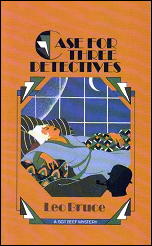
LEO BRUCE – Case for Three Detectives. Stokes, US, hardcover, 1937. Hardcover reprint: Academy Chicago, October 1980; trade paperback, 1985. British edition: Geoffrey Bles, hardcover, 1936.

   Case for Three Detectives is at once a locked room mystery worthy of John Dickson Carr and an affectionate spoof of the Golden Age detectives created by Sayers, Christie, and Chesterton.

LEO BRUCE Case for Three Detectives

   When Mary Thurston is found in her bedroom, dead of a slashed throat, during a weekend party at her Sussex country house, it seems to all concerned an impossible, almost supernatural crime:

   The bedroom door was double-bolted from the inside; there are no secret passages or other such claptrap; the only windows provide no means of entrance or exit; and the knife that did the job is found outside the house.

   The following morning, three of “those indefatigably brilliant private investigators who seem to be always handy when a murder has been committed” begin to arrive. The first is Lord Simon Plimsoll (Lord Peter Wimsey): “… the length of his chin, like most other things about him, was excessive,” the narrator, Townsend, observes.

   The second is the Frenchman Amer Picon (Hercule Poirot): “His physique was frail, and topped by a large egg-shaped head, a head so much and so often egg-shaped that I was surprised to find a nose and mouth in it at all, but half-expected its white surface to break and release a chick.”

   And the third is Monsignor Smith (Father Brown), “a small human pudding.” The three famous sleuths sniff around, unearth various clues, and arrive at separate (and elaborate) conclusions, each accusing a different member of the house party as Mary Thurston’s slayer.

   But of course none of them is right. The real solution is provided by Sergeant Beef of the local constabulary, “a big red-faced man of forty-eight or fifty, with a straggling ginger moustache, and a look of rather beery benevolence.”

   Along the way there is a good deal of gentle humor and some sharp observations on the methods of Wimsey, Poirot, and Father Brown. The prose is consistently above average, and the solution to the locked room murder is both simple and satisfying.

   Sergeant Beef is featured in seven other novels by Leo Bruce (a pseudonym of novelist, playwright, poet, and scholar Rupert Croft-Cooke), most of which have been reissued here by Academy Chicago in trade paperback. Among them are Case Without a Corpse (1937), Case with Four Clowns (1939), and Case with Ropes and Rings (1940). Each is likewise ingeniously plotted and diverting.

         ———
   Reprinted with permission from 1001 Midnights, edited by Bill Pronzini & Marcia Muller and published by The Battered Silicon Dispatch Box, 2007.   Copyright © 1986, 2007 by the Pronzini-Muller Family Trust.

A 1001 MIDNIGHTS Review
by Marcia Muller:


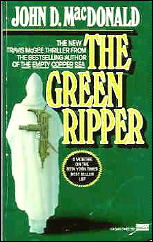
JOHN D. MacDONALD – The Green Ripper. J. B. Lippincott, 1979. Fawcett Gold Medal, paperback, June 1980. Reprinted many times since.

JOHN D. MacDONALD The Green Ripper

   This relatively recent entry is one of the worst in the Travis McGee series. It is bloody and violent, involving a strange paramilitary cult and all the attendant cliches, and McGee’s personal vendetta against the cult seems to rob him of his more human qualities.

   In a prior novel (The Empty Copper Sea, 1978), McGee fell in love with a woman named Gretel Howard. She lived with him aboard the Flush for a while, but recently has moved out to be closer to her job at Bonnie Brae, a “combination fat farm, tennis club, and real estate development.”

   The relationship is still as warm as ever, though, and when Gretel dies suddenly of a mysterious and debilitating illness, Travis is devastated. Not so devastated, however, that he doesn’t wander sideways into inquiring about the strange events that occurred at Bonnie Brae right before Gretel’s death and determining that her death was somehow murder.

   The rather thin story line leads McGee from Fort Lauderdale to Ukiah, California, looking for a man known as Brother Titus who heads an organization called the Church of the Apocrypha. Posing as a man looking for his daughter, Travis locates an encampment, formerly a religious commune but now as closely guarded as a top,secret military base. He is imprisoned, then recruited, and the events that transpire are too brutal and depressing to reiterate.

   If there is anything positive about the resolution of this novel, it is that McGee eventually recovers; unfortunately, it is a recovery that fails to recognize that vengeance seldom leaves any real satisfaction in the soul of the avenger.

   Other, much better, titles in the McGee series are The Deep Blue Goodbye (1964), The Quick Red Fox (1964), A Deadly Shade of Gold (1965), The Girl in the Plain Brown Wrapper (1969), and Dress Her in Indigo (1969), and The Lonely Silver Rain (1985).

         ———
   Reprinted with permission from 1001 Midnights, edited by Bill Pronzini & Marcia Muller and published by The Battered Silicon Dispatch Box, 2007.   Copyright © 1986, 2007 by the Pronzini-Muller Family Trust.

A 1001 MIDNIGHTS Review
by Bill Pronzini:


JOHN D. MacDONALD Pulp Fiction

JOHN D. MacDONALD – The Good Old Stuff: 13 Early Stories. Harper & Row, hardcover, 1982. Fawcett Gold Medal, paperback, 1983.

   MacDonald, like so many other writers, learned his craft in the pulps. Between 1946 and 1952, he sold hundreds of crime stories to such magazines as Black Mask, Dime Detective, Detective Tales, New Detective, Mystery Book, and Doc Savage (as well as other short fiction to science fiction, fantasy, sports, and western pulps).

   A few of these criminous tales have been reprinted here and there over the years, but the greater percentage languished in (mostly undeserved) obscurity until 1981 , when Martin Greenberg, Francis M. Nevins, and Walter and Jean Shine — MacDonald aficionados all — persuaded John D. to collect the best of them.

JOHN D. MacDONALD Pulp Fiction

   They chose thirty stories; on rereading those thirty, MacDonald considered all but three worthy of reprinting. (Minor changes were made to update certain references for the sake of clarity; otherwise he allowed them to stand as first published.)

   But the final total of twenty-seven was deemed too many for a single book; the result is two volumes — The Good Old Stuff and its companion, More Good Old Stuff (Knopf, 1984).

   The thirteen stories in this first volume demonstrate MacDonald’s considerable range within the mystery! detective format, as well as his narrative talent and power. Among them are such gems as “The Simplest Poison” (whodunit); “Death Writes the Answer” (biter-bit); “Noose for a Tigress” (pure suspense); “Death on the Pin” (character study — and the world’s first and only crime story about bowling); and the novelette “Murder for Money,” whose protagonist, Darrigan, is a prototype of Travis McGee.

JOHN D. MacDONALD Pulp Fiction

   No fan of MacDonald’s work should miss either this batch or the fourteen equally excellent and diverse stories in More Good Old Stuff.

   Until these volumes, MacDonald’s collected short fiction was restricted almost entirely to selections from such slick magazines as Cosmopolitan, Collier’s, and Playboy — fifteen stories in End of the Tiger (1966) and seven in Seven (1971).

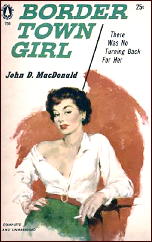
   His only previously collected pulp story was the title piece in the 1956 gathering of two novellas, Border Town Girl. Another two-story collection (both from the pulps), this one unauthorized, appeared in 1983 under the title Two.

         ———
   Reprinted with permission from 1001 Midnights, edited by Bill Pronzini & Marcia Muller and published by The Battered Silicon Dispatch Box, 2007.   Copyright © 1986, 2007 by the Pronzini-Muller Family Trust.

A 1001 MIDNIGHTS Review
by Bill Pronzini:


JOHN D. MacDONALD The Executioners

JOHN D. MacDONALD – The Executioners. Simon & Schuster, hardcover, 1958. Crest s295, reprint paperback, May 1959. Reprinted many times. Film: Universal International, 1962, as Cape Fear (with Robert Mitchum, Gregory Peck, Polly Bergen; director J. Lee Thompson). Also: Universal, 1991, as Cape Fear (with Robert De Niro, Nick Nolte, Jessica Lange; director: Martin Scorsese).

   Suppose you’re a lawyer in a small Florida town, happily married, with an attractive fourteen-year-old daughter and two younger sons. Suppose some fifteen years ago you witnessed the brutal rape of a teenager and subsequently gave testimony that put the rapist, Max Cady, behind bars.

   Suppose Max Cady finally gets out of prison and comes back to your town — and suppose he begins making veiled threats and following you and your family, paying special attention to your fourteen-year-old daughter, Suppose you know Cady is a dangerous psychopath, that sooner or later he intends to rape your daughter and harm you and your other loved ones.

   What do you do?

JOHN D. MacDONALD The Executioners

   This is the dilemma that faces Sam Bowden, and this is the stuff of one of MacDonald’s finest suspense novels. The tension mounts to an almost unbearable pitch as Bowden suffers frustration after frustration and Cady moves inexorably toward explosive violence.

   The climax is MacDonald at his most compelling. A must-read for anyone who enjoys expertly written, beautifully plotted suspense fiction.

   Surprisingly enough, considering what Hollywood has done to quality novels in the past, the film version — Cape Fear (1962) — is every bit as tense and powerful, and features a bravura performance by Robert Mitchum; he literally radiates evil in the role of Max Cady.

   Almost as good are Gregory Peck and Polly Bergen as the Bowdens. Don’t miss it when it appears on the Late Show.

         ———
   Reprinted with permission from 1001 Midnights, edited by Bill Pronzini & Marcia Muller and published by The Battered Silicon Dispatch Box, 2007.   Copyright © 1986, 2007 by the Pronzini-Muller Family Trust.

JOHN D. MacDONALD The Executioners


Editorial Comment: This will be John D. MacDonald week here on this blog, at least for the next couple of days. Besides the three JDM reviews posted today, coming up soon will be two more: The Good Old Stuff and The Green Ripper, by Bill Pronzini and Marcia Muller respectively; then two by David Vineyard: The Only Girl in the Game and A Deadly Shade of Gold.

A 1001 MIDNIGHTS Review
by Marcia Muller:


JOHN D. MacDONALD – Darker than Amber. Gold Medal d1674, paperback original, 1966. J. B. Lippincott, hardcover, 1970. Reprinted many times. Film: National General, 1970 (with Rod Taylor as Travis McGee, Theodore Bikel as Meyer, and Suzy Kendall as Vangie.)

JOHN D. MacDONALD Darker Than Amber

   The Travis McGee series, with its color-coded titles, is one of the phenomenally popular successes of the mystery genre, and it’s easy to see why. McGee, who refers to himself as a “salvage consultant” (in actuality, he gets folks out of trouble the police can’t help them with), has many of those larger-than-life qualities contemporary readers seem to favor.

   He’s big, rawboned, handsome in a rugged way. A former minor pro-football player, he now lives an enviable life-style in retirement aboard his “sybaritic” houseboat, the Busted Flush, in Fort Lauderdale. It is a retirement from which he periodically emerges whenever the cash reserves are getting low, and he’s fond of saying he likes taking it in installments rather than all at sixty-five when he won’t be able to enjoy it much anyway.

   But McGee’s life is not all girls and glitter; there’s a dark, broody side of him, a part of his mind that tells him he’s capable of being a better man than he thinks he is. And he proves this, time and time again, as he fights the forces of corruption that have victimized his friends and clients.

JOHN D. MacDONALD Darker Than Amber

   McGee is no cool professional; he takes on every case as if it were a personal crusade. And it’s there that his true charm lies: He is an emotional man who realizes he’s fallible and constantly strives to overcome it, knowing all the while that he never can.

   McGee also has his irritating points, however. He is constantly editorializing, and in the later entries in the series these asides become overly long and predictable. (Eventually one says, “Oh, Travis, not again!” and skips a page.)

   He also has a bad habit of indulging in therapeutic sex: A woman character has been traumatized; Travis takes her on a cruise on the Flush, makes love to her, and she is as good as new. And the women characters, while generally likable, all talk alike-a bright, sophisticated patter that makes them fairly difficult to tell apart.

   Darker than Amber begins with a unique introduction to one of these women: As Travis explains it in the classic first sentence, “We were about to give up and call it a night when somebody dropped the girl off the bridge.”

JOHN D. MacDONALD Darker Than Amber

   The girl, whom McGee narrowly rescues from drowning, is Vangie Bellemer, a “dead-eyed cookie” who has been working as a high-priced call girl. Unlike many of MacDonald’s women characters, she is not very pleasant, nor is she understandable until McGee’s best friend, economist Meyer, breaks through her tough shell.

   What he finds is a frightened woman involved in something way over her head, something that concerns money taken from “dead ones.” Vangie’s associates have tried to kill her once, and she knows they will try again. They do — and succeed.

   And Travis, feeling guilty because he didn’t prevent Vangie’s death, interested because there is money involved, and curious because of the seeming magnitude of whatever is going on, starts on his crusade. He finds other high-priced call girls, a setup involving Caribbean cruises, luxury, and death.

   And when he and Meyer close in on the truth of the matter, through a series of elaborate machinations that are fun to watch, they find it is of even greater magnitude than they supposed.

   Darker than Amber is among the best in this entertaining series.

         ———
   Reprinted with permission from 1001 Midnights, edited by Bill Pronzini & Marcia Muller and published by The Battered Silicon Dispatch Box, 2007.   Copyright © 1986, 2007 by the Pronzini-Muller Family Trust.

[UPDATE] Later the same day. David Vineyard’s comment about the movie made with Rod Taylor (#1), reminded me that I hadn’t included the film in the opening credits above. So I’ve added that, the photo image below, and regardless of the overall entertainment value of the rest of the movie, here’s a link to one of the greatest one-on-one fight scenes you might ever see on film.

JOHN D. MacDONALD Darker Than Amber

A 1001 MIDNIGHTS Review
by Marcia Muller:


JOHN D. MacDONALD – The Brass Cupcake. Gold Medal #124, paperback original, 1950. Reprinted many times.

JOHN D. MacDONALD The Brass Cupcake

   The career of John D. MacDonald has been a long and varied one, beginning with the publication of this excellent first novel. His books have ranged from modest paperback originals to the immensely popular Travis McGee series, as well as fat best sellers such as Condominium (1977) and the recent One More Sunday (1984).

   Likewise, the quality of his work has varied, from the truly terrible Weep for Me (a 1951 original that MacDonald himself refuses to allow to be reprinted) and the boring small-town drama Contrary Pleasure (1954), to such outstanding novels of suspense as The Damned (1952), Murder in the Wind (1956), and The Last One Left (1967).

   The recurring theme in MacDonald’s work is corruption — personal, corporate, societal-and his heroes are men and women who pit themselves against it. MacDonald draws heavily upon his knowledge of finance, land development, and Florida politics in constructing intricate plots, and his novels, particularly the later ones, are filled with editorial tirades about the abuse of the environment, corporate greed, personal greed, or whatever else happens to have been bothering him at the time of writing.

JOHN D. MacDONALD The Brass Cupcake

   In the earlier novels, these statements of position seem a natural outgrowth of the narrators’ personalities, but in later books they become long-winded and intrusive.

   In The Brass Cupcake, the evil is police corruption. The hero, Cliff Bartells, now an insurance adjuster, was once on the Florence City, Florida, force, but lost his badge for not going along with the local “arrangements” between the police and gambling establishments.

   That badge — fancy and gold — is Bartells’ brass cupcake: “Anything you got by guile … was called a cupcake So when they took it away from me, it wasn’t even a badge any more. Just a cupcake. Something I chiseled and then got chiseled out of. A brass cupcake. Something of no importance.”

   The murder with which the story opens — the death of a wealthy old woman in the process of a jewel theft — pits Bartells against the police force he used to belong to. They want him to keep out of it; he wants to follow the insurance agency’s usual procedure of attempting to buy back the jewels.

JOHN D. MacDONALD The Brass Cupcake

   His motives are not so pure, however — there is a fat bonus for him if he manages this. But Bartells is up against more than he bargains for: The dead woman has a lovely niece, someone Bartells can’t look at in a purely professional way; the niece has a boyfriend who is little more than a gigolo; a pair of servants seem to know more about the theft than they claim to the police.

   By the time Bartells has sorted through the evidence — as well as his personal feelings on a number of issues — a second murder has occurred, shots have been fired at him, and he knows his future in Florence City is not promising. Unless …

   Cliff Bartells is an early version of MacDonald’s later male characters: a complex man who wants to do the right thing and worries about it, because he knows he himself is not incorruptible.

   And in the niece, Melody Chance, we see many of the same qualities that appear in later women characters: strength, independence, and straightforwardness, a woman just a trifle weary of life who would like a good man to occasionally lean on.

   MacDonald’s depiction of secondary and even incidental characters is also excellent.

         ———
   Reprinted with permission from 1001 Midnights, edited by Bill Pronzini & Marcia Muller and published by The Battered Silicon Dispatch Box, 2007.   Copyright © 1986, 2007 by the Pronzini-Muller Family Trust.

       Previously on this blog —

April Evil (reviewed by Steve Lewis)
Linda, film and novella (reviewed by Steve Lewis)

A 1001 MIDNIGHTS Review
by Susan Dunlap:


LENORE GLEN OFFORD – The Glass Mask. Duell Sloan & Pearce, hardcover, 1944. Paperback reprint: Dell #198, mapback edition, 1947.

LENORE 
GLEN OFFORD

   Lenore Glen Offord is one of the truly underrated writers of the World War II and postwar periods. Her characters are engaging and true to their times and environments.

   Her heroine, Georgine Wyeth, is the forerunner of today’s feminists — a single mother supporting her daughter with short-term jobs, forcing herself to deal with her fears, to stand up for herself, insisting all the time that she’s tired of being saved.

   Most of Offord’s books are set in Berkeley or other areas of northern California. She excels in portraying the uniqueness of the university town and the wartime atmosphere — the paranoia as well as the desperate excitement.

   Although she deals more with innocent romantic situations than is stylish now, every seeming digression into a character’s personal life is relevant to the plot.

   In The Glass Mask, the chief responsibility for detection shifts from Georgine Wyeth to pulp writer Todd McKinnon, though the story is told from Georgine’s viewpoint. Todd, Georgine, and Georgine’s eight-year-old daughter stop off in a Sacramento Valley town to satisfy his curiosity about a family mystery: Did Gilbert Peabody hasten the death of his ailing grandmother in order to inherit her house and thus be able to afford to marry?

   There is no proof, only verdict by rumor. Unable to face the innuendo, Gilbert has enlisted in the army and gone, leaving his wife to deal with the townsfolk and the more unpleasant relatives.

   By varying means, she tricks and inveigles the McKinnon-Wyeth menage into staying on day after day to investigate the nocturnal footsteps in the attic, the family patriarch who rants and feigns seizures, and the mystery of what the old lady got from the bank the day she died and where she hid iit.

   This is an entertaining tale, and one of Offord’s best. Georgine Wyeth is also at her most appealing in Skeleton Key (1943), in which she investigates the murder of a wartime air-raid warden during an unexpected blackout.

   Unfortunately, Offord’s output was not great: merely eight mysteries, four other adult books, and a juvenile. Especially good among the other mysteries are Murder on Russian Hill (1938), The 9 Dark Hours (1941), and The Smiling Tiger (1951).

         ———
   Reprinted with permission from 1001 Midnights, edited by Bill Pronzini & Marcia Muller and published by The Battered Silicon Dispatch Box, 2007.   Copyright © 1986, 2007 by the Pronzini-Muller Family Trust.

Editorial Comment:   Some additional bio-bibliographical information on Lenore Glen Offord follows the review preceding this one, that of The Smiling Tiger, written by Bill Deeck.

A 1001 MIDNIGHTS Review
by Bill Crider:


PETER CHEYNEY Dark series

  PETER CHEYNEY – The Stars Are Dark. Dodd Mead, US, hardcover, 1943. Collins, UK, hardcover, 1943. Reprinted in paperback several times, including as The London Spy Murders, Avon #49, 1944.

   Cheyney’s best work is his series of espionage novels generally referred to as the “Dark Series,” of which The Stars Are Dark is the second. Here, the breakneck pace of the Caution books is slowed by a genuine interest in character, which makes the story stronger.

   Quayle, the master of a British spy ring in World War II, is faced with the task of dealing with a man who has come from Morocco with what he says is important information about German troops there. Is this man what he seems?

   Quayle puts his agents into action, not hesitating to risk their lives to discover the answer, but it is Quayle who does the most work and takes the most risks.

PETER CHEYNEY Dark series

   Cheyney does an excellent job of conveying the world of spying, with all its twists and double crosses. No one is what he seems, and everyone knows that; but no one is sure just what anyone else really is. Quayle tells his people no more than they need to know. Readers of John Le Carre and William Haggard would recognize Cheyney’s world at once.

   Not all Cheyney’s books with “Dark” in the title belong to his spy series, but another good one is Dark Duet (1942), first published in US paperback as The Counter Spy Murders (Avon, 1944). The Stars Are Dark was retitled The London Spy Murders (Avon, 1944).

         ———
   Reprinted with permission from 1001 Midnights, edited by Bill Pronzini & Marcia Muller and published by The Battered Silicon Dispatch Box, 2007.   Copyright © 1986, 2007 by the Pronzini-Muller Family Trust.

A 1001 MIDNIGHTS Review
by Francis M. Nevins:

   
PETER CHEYNEY – This Man Is Dangerous. Coward McCann, US, hardcover, 1938. Collins, UK, hardcover, 1936. Reprinted many times in paperback. Film: Sonofilm, 1954, as Cet Homme Est Dangeureux (This Man Is Dangerous) (with Eddie Constantine as Lemmy Caution; director: Jean Sacha). Released in the US as Dangerous Agent.

PETER CHEYNEY

   Peter Cheyney (1896-1951) never visited the United States in his life and knew next to nothing about Americans, but in the late 1930s be became an instant success in his native England and in Europe, especially France, as a writer of fake-American hard-boiled novels.

   In This Man Is Dangerous and ten subsequent titles, he chronicled the adventures of rootin’ -tootin’ two-gun-shootin’ Lemmy Caution, an indestructible FBI agent who downs liquor by the quart, laughs at bullets flying his way, romances every dame in sight, and blasts away at greasy ethnic-named racketeers – and (in the later novels) Nazi spies.

   Americans, of course, saw these ridiculous exercises for what they were, and only the first few were ever published here. Certainly no one would read Lemmy Cautions for their plots, which are uniform from book to book — all the nasties double-crossing each other over the McGuffin — nor for their characterizations, which are pure comic strip.

PETER CHEYNEY

   But mystery fans with a taste for lunacy may be attracted by Cheyney’s self-created idiom. Lemmy narrates his cases in first person and present tense, a wild-and-crazy stylistic smorgasbord concocted from Grade Z western films, the stories of Ring Lardner and Damon Runyon, eyeballpoppers apparently of Cheyney’s own invention (like “He blew the bezuzus” for “He spilled the beans”), and a steady stream of British spellings and locutions.

   Nothing but quotation can convey the Cheyney flavor. From This Man Is Dangerous:

    I says good night, and I nods to the boys. I take my hat from the hall an’ I walk down the stairs to the street. I’m feeling pretty good because I reckon that muscling in on this racket of Siegella’s is going to be a good thing for me, and maybe if I use my brains an’ keep my eyes skinned, I can still find some means of double-crossing this wop.

   From Don’t Get Me Wrong (1939):

    Me — I am prejudiced. I would rather stick around with a bad-tempered tiger than get on the wrong bias of one of these knife-throwin’ palookas; I would rather four-flush a team of wild alligators outa their lunch-pail than try an’ tell a Mexican momma that I was tired of her geography an’ did not wish to play any more.

   From Your Deal, My Lovely (1941):

PETER CHEYNEY

    Some mug by the name of Confucius — who was a guy who was supposed to know his vegetables — once issued an edict that any time he saw a sap sittin’ around bein’ impervious to the weather an’ anything else that was goin, an’ lookin’ like he had been hit in the kisser with a flat-iron, the said sap was suffering from woman trouble.

   Lemmy Caution became so popular on the Continent that Eddie Constantine, an American actor, portrayed him in a series of French films. These films were so successful that Jean Luc Godard used Constantine as Caution in his New Wave film Alphaville.

   Eventually Cheyney launched a second wave of novels, written in a spare ersatz-Hammett style and featuring Slim Callaghan, London’s toughest PI. But for those who love pure absurdity, and appreciate the wild stylistic flights of Robert Leslie Bellem and Henry Kane and Richard S. Prather, a treat of comparable dimensions is in store when they tackle the adventures of Lemmy Caution.

         ———
   Reprinted with permission from 1001 Midnights, edited by Bill Pronzini & Marcia Muller and published by The Battered Silicon Dispatch Box, 2007.   Copyright © 1986, 2007 by the Pronzini-Muller Family Trust.


PETER CHEYNEY

« Previous PageNext Page »