1001 Midnights


A 1001 MIDNIGHTS Review
by Bill Pronzini:


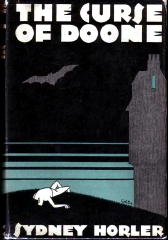
SYDNEY HORLER – The Curse of Doone. Hodder & Stoughton, UK. hardcover, 1928. Mystery League, US, hardcover, 1930. US paperback reprint: Paperback Library 53-931, 1966.

   A journalist and writer of football stories (the British variety) until his early thirties, Sydney Horler began publishing “shockers” in 1925 and went on to produce upwards of a hundred over the next thirty years.

SYDNEY HORLER

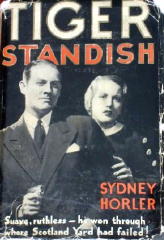
   He created a menage of series characters, most of them Secret Service agents of one kind or another, including Bunny Chipstead; “The Ace”; Nighthawk; Sir Brian Fordinghame; and that animal among men, Tiger Standish.

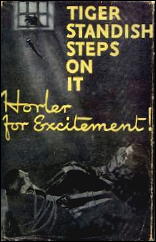
   The Standish books — Tiger Standish Steps on It (1940) is a representative title in more ways than one — were especially popular with Horler’ s readership. His greatest literary attribute was his imagination, which may be described as weedily fertile.

   His favorite antagonists were fanatic Germans and Fu Manchu-type megalomaniacs, many of whom were given sobriquets such as “the Disguiser,” “the Colossus,” “the Mutilator,” “the Master of Venom,” and “the Voice of Ice”; but he also contrived a number of other evildoers to match wits with his heroes — an impressive list of them that includes mad scientists, American gangsters, vampires, giant apes, ape-men from Borneo, venal dwarfs, slavering “Things,” a man born with the head of a wolf (no kidding; see Horror’s Head, 1934), and — perhaps his crowning achievement — a bloodsucking, man-eating bush (“The Red-Haired Death,” a novelette in The Destroyer, and The Red-Haired Death, 1938).

SYDNEY HORLER

   The Curse of Doone is typical Horler, which is to say it is inspired nonsense. In London, Secret Service Agent Ian Heath meets a virgin in distress named Cicely Garrett and promptly falls in love with her. A friend of Heath’s, Jerry (who worries about “the primrose path to perdition”), urges him to toddle off to his cottage in Dartmoor for a much needed rest.

   Which Heath does, though not before barely surviving a mysterious poison-gas attack. And lo! — once there, he runs into Cicely, who is living at secluded and sinister Doone Hall.

   He also runs into a couple of incredible coincidences (another Horler stock-in-trade); monstrous vampire bats and the “Vampire of Doone Hall”; two bloody murders; hidden caves, secret panels and caches; a Prussian villain who became a homicidal maniac because he couldn’t cope with his sudden baldness; and a newly invented “war machine” that can force enemy aircraft out of the air by means of wireless waves and stop a car from five miles away.

   All of this is told in Hoder’s bombastic, idiosyncratic, and sometimes priggish style. (Horler had very definite opinions on just about everything, and was not above expressing them in his fiction, as well as in a number of nonfiction works. He once said of women: “Of how many women can it truly be said that they are worthy of their underclothes?” And of detective fiction: “I know I haven’t the brains to write a proper detective novel, but there is no class of literature for which I feel a deeper personal loathing.” Racism was another of his shortcomings; he didn’t like anybody except the English.)

SYDNEY HORLER

   This and Horler’s other novels are high camp by today’s standards; The Curse of Doone is just one of several that can be considered, for their hilarious prose, pomposity, and absurd plots, as classics of their type.

   Unfortunately, most of Horler’s “shockers” were not reprinted in this country. Of those that were, the ones that rank with The Curse of Doone are The Order of the Octopus (1926), Peril (1930), Tiger Standish (1932), Lord of Terror (1937), and Dark Danger (1945).

         ———
   Reprinted with permission from 1001 Midnights, edited by Bill Pronzini & Marcia Muller and published by The Battered Silicon Dispatch Box, 2007.   Copyright © 1986, 2007 by the Pronzini-Muller Family Trust.
A 1001 MIDNIGHTS Review
by Francis M. Nevins:


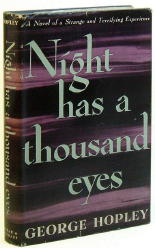
GEORGE HOPLEY – Night Has a Thousand Eyes. Farrar & Rinehart, hardcover, 1945. Reprinted as by William Irish: Dell #679, 1953. Reprinted as by Cornell Woolrich: Paperback Library 54-438, 1967. Many other reprint editions, both hardcover and soft.

NIGHT HAS A THOUSAND EYES

   Night Has a Thousand Eyes was the first of two novels published under a pseudonym made up of Cornell Woolrich’s middle names, and of all his books it’s the one most completely dominated by death and fate. A simpleminded recluse with apparently uncanny powers predicts that millionaire Harlan Reid will die in three weeks, precisely at midnight, at the jaws of a lion.

   The tension rises to an unbearable pitch as the apparently doomed man, his daughter, and a sympathetic young homicide detective struggle to avert a destiny that they at first suspect and soon come to hope was conceived by a merely human power.

   Woolrich makes us live the emotional torment and suspense of the situation until we are literally shivering in our seats.

   The roots of Woolrich’ s longest and perhaps finest novel lie deep in his past. From the moment at the age of eleven when he knew that someday he would have to die, he “had that trapped feeling,” he wrote in his unpublished autobiography, “like some sort of a poor insect that you’ve put inside a down-turned glass, and it tries to climb up the sides, and it can’t, and it can’t, and it can’t.”

   Of all the recurring nightmare situations in his noir repertory, the most terrifying is that of the person doomed to die at a precise moment, and knowing what that moment is, and flailing out desperately against his or her fate.

   This is what connects the protagonists of Woolrich’ s strongest work, including Paul Stapp in “Three O’Clock,” Robert Lamont in “Guillotine,” Scott Henderson in Phantom Lady, and of course Reid in Night Has a Thousand Eyes. Only a writer tom apart by human mortality could have created these stories.

NIGHT HAS A THOUSAND EYES

   Published under a new by-line and by a firm never before associated with Woolrich, Night Has a Thousand Eyes seems to have been intended as a breakthrough book, to introduce the author to a wider audience, but it was too grim and unsettling for huge commercial success.

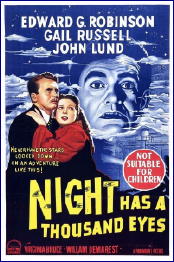
   The 1948 movie version, starring Edward G. Robinson as a carnival mind reader with the power to foresee disasters, had almost nothing in common with the story line of Woolrich’ s novel, let alone its power and terror.

   This book is what noir literature is all about, a nerve-shredding suspense classic of the highest quality and a work that once read can never be forgotten.

         ———
   Reprinted with permission from 1001 Midnights, edited by Bill Pronzini & Marcia Muller and published by The Battered Silicon Dispatch Box, 2007.   Copyright © 1986, 2007 by the Pronzini-Muller Family Trust.
A 1001 MIDNIGHTS Review
by Newell Dunlap & Marcia Muller:


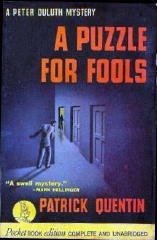
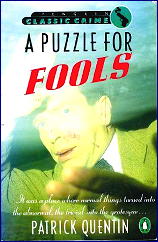
PATRICK QUENTIN – A Puzzle for Fools.

PATRICK QUENTIN A Puzzle for Fools

Simon & Schuster, US, hardcover, 1936. Victor Gollancz, UK, hc, 1936. Paperback reprints include: Pocket #83, 1940, with several later printings; Dell D192, Great Mystery Library #4, 1957; Ballantine F461, 1963; Avon PN238, 1969, with at least one later printing. Trade paperback: Penguin Classic Crime, 1986.

   Patrick Quentin is a pseudonym of the collaborative team of Hugh Wheeler and Richard Wilson Webb — who also wrote as Quentin Patrick. From 1936 to 1952, the pair produced a series of successful novels featuring Peter Duluth, a former Broadway producer and recovering alcoholic, and his wife, Iris.

   After 1952, Wheeler went on alone to write seven more novels under the Quentin name, four of them featuring a New York police detective, Lieutenant Timothy Trant (who also appears in novels by Wheeler and Webb under the Quentin Patrick — or, in the original editions, Q. Patrick — pseudonym).

PATRICK QUENTIN A Puzzle for Fools

   The novels are well written and well characterized, and frequently the plots are as baffling as the pseudonyms under which they were created. The endings of these novels, be they as by Patrick Quentin or vice versa, are sure to both surprise and satisfy the fan of traditional mysteries.

   A Puzzle for Fools opens in the expensive sanatorium where Peter Duluth has gone to dry out. Bad enough to be in a mental hospital, doubting your own sanity and the sanity of those about you, but what if you also begin hearing a voice whispering to you at night? And what if that voice sounds remarkably like your own? And what if that voice warns you to get away, for there will be murder?

   This is Duluth’s plight. However, instead of doubting him, the director of the clinic believes every word and asks for his help in solving not only this particular puzzle but also several other strange goings-on around the clinic. Thus does Duluth become a sort of Sherlock Holmes at work in a mental institution.

PATRICK QUENTIN A Puzzle for Fools

   Certainly Duluth, and the police, have their work cut out for them, because soon the whispering prophecy comes true and one of the staff members is murdered, only to be followed by the murder of one of the patients. This, of course, is a rich and fertile field for the whodunit, and Quentin handles it well; not only must all the patients be considered suspects, but all the staff members as well. And there are secrets to be discovered on both sides.

   Other complex “puzzle” mysteries starring Peter Duluth include Puzzle for Players (1938), Puzzle for Puppets (1944), and Puzzle for Fiends (1946).

   Among the novels featuring Lieutenant Timothy Trant are Death for Dear Clara (1937) and Death and the Maiden (1939), both as by Q. Patrick; and My Son, the Murderer (1954) and Family Skeletons (1965). Wheeler and Webb also wrote a series of mysteries under the pseudonym Jonathan Stagge.

         ———
   Reprinted with permission from 1001 Midnights, edited by Bill Pronzini & Marcia Muller and published by The Battered Silicon Dispatch Box, 2007.   Copyright � 1986, 2007 by the Pronzini-Muller Family Trust.

Editorial Comment: For another review of this book, see the one by Marv Lachman posted here not so long ago.

A 1001 MIDNIGHTS Review
by Bill Pronzini:


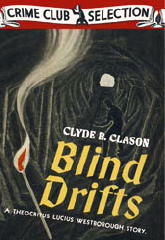
CLYDE B. CLASON – Blind Drifts. Doubleday Crime Club, hardcover, 1937.

CLYDE B. CLASON

   Mild-mannered Professor Theocritus Lucius Westborough, an expert on the Roman emperor Heliogabalus, is an amateur sleuth in the classic mold of the Twenties and Thirties: He solves convoluted puzzles through the time-tested Sherlockian methods of keen observation, a storehouse of esoteric knowledge, and deductive reasoning.

   Westborough — and his creator specializes in locked-room “miracle problems.” Even the best of these offers no challenge to John Dickson Carr, but for the most part they are cleverly constructed and well-clued.

   The one in Blind Drifts offers a particularly neat and satisfying variation on the theme.

   Westborough’s home base is Chicago, but here he travels to Colorado to visit a gold mine in which he has inherited 70,000 shares. Not long after his arrival, he finds himself investigating, first, the disappearance of one of the mine’s directors, and then the murder of its owner, Mrs. Coranlue Edmonds, known far and wide as a “bearcat on wheels” — a murder by shooting that takes place in front of seven witnesses, in a “blind drift” deep inside the Virgin Queen mine, by a seemingly nonexistent gun.

   The plot is twisty and complex, the clues numerous and fairly presented, the motive for Mrs. Edmonds’s murder plausible, and the method likewise. The Colorado setting is well depicted, as are the details of the operation and physical makeup of a large gold mine.

   It is Clason’s attention to such detail, more than anything else, that lifts his work above the average puzzle story of the period; you can’t read a Westborough novel without learning something, and something interesting at that.

   The one drawback to this and the eight other entries in the series is Clason’s sometimes florid, often prolix style. Blind Drifts is the only book of his that would not benefit greatly from the excision of ten or fifteen thousand words, and at that it could stand to lose five or six thousand here and there.

CLYDE B. CLASON

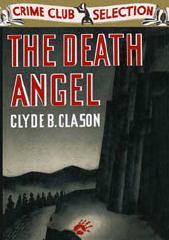
   The most appealing of Westborough’s other cases are The Death Angel (1936), set on a Wisconsin country estate called Rumpelstiltskin, where a murder happens in spite of 1542-to-l odds against it, and a murderer is twice guilty of killing the same man; The Man from Tibet (1939), which features a locked-room murder and contains some fascinating background material on the strange customs and rites of Tibet; and Green Shiver (1941), which has a Los Angeles setting and another “impossible” plot, the solution to which depends on Westborough’ s knowledge of Chinese jade.

         ———
   Reprinted with permission from 1001 Midnights, edited by Bill Pronzini & Marcia Muller and published by The Battered Silicon Dispatch Box, 2007.   Copyright © 1986, 2007 by the Pronzini-Muller Family Trust.
A 1001 MIDNIGHTS Review
by John Lutz:


VICTOR CANNING – A Fall from Grace. Wm. Heinemann, UK, hardcover, 1980; Pan, UK, pb, 1982. William Morrow, US, hardcover, 1981; reprint hardcover: Detective Book Club, 3-in-1 edition, June 1981.

VICTOR CANNING

   Beginning with Polycarp’s Progress in 1935, Victor Canning has written over fifty novels. After World War II, he turned his efforts to espionage fiction, a genre at which he is now acknowledged to be one of the best practitioners.

   Fall from Grace, however, is anything but an international thriller. Halfway through this psychological mystery, Canning’s main character, private investigator James Helder, is asked how a calm, good-hearted man such as himself got into his somewhat unsavory line of work.

Part of Helder’ s explanation is that he feels himself to be “a sort of gray shape living a gray, humdrum life like so many people. So, to escape from all that, I mix in other and more unorthodox people’s lives to add a little crude color to my own.”

   The unorthodox person Helder is trailing here is the totally amoral John Corbin, about whom Helder observes, “The John Corbins of this world felt compelled to make the occasional obligation to the gods of chance. A little not-too-expensive kindness here, a rare good deed to assuage self-disgust, even at times an isolated self-sacrifice to bring them close to the shriving of some sin.”

VICTOR CANNING

   That really is all this novel is about, but it is enough. Canning gives us an engrossing, incisive study of the world’s Corbins, the selfish and impulsive people who charm those close to them and sometimes even themselves, predators with engaging smiles and talent for deception.

   This John Corbin lands a job writing the history of the gardens of Illaton Manor, long tended by the family of Corbin’s employer, the bishop of Testerburgh. Included in the job are a cabin, extensive research facilities, and circumstances which make it easy to seduce beautiful coworker Rachel Harrison.

   Corbin takes advantage of all these conveniences, for a while even convincing himself that he genuinely loves Rachel. But an unexpected opportunity for profitable mischief proves that Corbin’s new leaf is only ego-supported self-delusion, a strained hiatus from reality. He enthusiastically reverts to type.

VICTOR CANNING

   This is a meticulously written, revealing glimpse into the mind of a man who is the serpent in his own Garden of Eden.

   Especially good among Canning’s early novels are The Chasm (1947) and The House of the Seven Flies (1952). Other noteworthy titles among his later works include Firecrest (1972), The Rainbird Pattern (1973), which was the basis for Alfred Hitchcock’s last film, Family Plot, and Birds of a Feather (1985). Also excellent is a collection of four suspense novelettes, Oasis Nine (1958).

         ———
   Reprinted with permission from 1001 Midnights, edited by Bill Pronzini & Marcia Muller and published by The Battered Silicon Dispatch Box, 2007.   Copyright © 1986, 2007 by the Pronzini-Muller Family Trust.
[UPDATE] 07-16-09.   Jamie Sturgeon has just pointed out the existence of a website devoted to Victor Canning, including of course a detailed bibliography. It’s at http://www.victorcanning.com/, and it is a work of art, to say the least. In terms of the bibliography, not only are covers of each edition of every book shown, but photos of places mentioned in each of the books are often included as well.

A 1001 MIDNIGHTS Review
by Bill Pronzini:


GIL BREWER – The Red Scarf. Mystery House, hardcover, 1958. Paperback reprint: Crest 310; 1st printing, July 1959. First published in Mercury Mystery Book-Magazine, November 1955 (quite likely in shortened form).

GIL BREWER The Red Scarf

   Motel owner Ray Nichols, hitchhiking home in northern Florida after a futile trip up north to raise capital for his floundering auto court, is given a ride by a bickering and drunken couple named Vivian Rise and Noel Teece.

   An accident, the result of Teece’s drinking, leaves Teece bloody and unconscious. Unhurt, Nichols finds a suitcase full of money in the car. Vivian, also unhurt, urges that they leave with it together before the police come, saying it belongs to her and offering to pay Nichols for his help. Against his better judgment, he agrees.

   It is only later, back home in the town of Lakeview, that Nichols discovers Teece is a courier for an underworld gambling syndicate and that the money really belongs to them. While he struggles with his conscience, several groups begin vying for the loot, including a syndicate man named Wirt Radan, the police — and Teece. Nichols and his wife, Bess, soon become targets, and Brewer leads us through a couple of neat plot turns on the way to a volatile climax.

GIL BREWER Three-Way Split

   There is considerable suspense here, some strong characterization, and the various components mesh smoothly. Brewer’s prose is leaner and more controlled than in any of his other novels.

   Anthony Boucher said in the New York Times that The Red Scarf is the “all-around best Gil Brewer … a full-packed story.” This reviewer agrees.

   Nearly all of Brewer’s thirty other novels (all but one of which, are paperback originals) are worth reading. Especially good are And the Girl Screamed (1956), which has some fine chase sequences; The Angry Dream (1957), the second of Brewer’s two hardcovers and a tale of hatred out of the past, in a wintry northern setting; and The Three-Way Split (1960), a well-done story of charter boats and sunken treasure in a style reminiscent of Hemingway’ s To Have and Have Not.

         ———
   Reprinted with permission from 1001 Midnights, edited by Bill Pronzini & Marcia Muller and published by The Battered Silicon Dispatch Box, 2007.   Copyright © 1986, 2007 by the Pronzini-Muller Family Trust.
A 1001 MIDNIGHTS Review
by Bill Pronzini:


GIL BREWER – A Killer Is Loose. Gold Medal 380, paperback original; 1st printing, March 1954.

GIL BREWER A Killer Is Loose

   In the 1950s and 1960s, Gil Brewer occupied a major stall in the stable of writers of Gold Medal paperback originals, along with John D. MacDonald, Richard S. Prather, and Charles Williams.

   Brewer’s work was uneven but usually interesting and evocative, and quite popular from 1951 to 1958; his first novel, 13 French Street (1951), sold more than a million copies. Much of his fiction is built around the theme of a man corrupted by an evil, designing woman; but his two best novels, this one and The Red Scarf, are departures from that theme.

   Set in Florida, as is most of Brewer’s fiction, A Killer Is Loose is a truly harrowing portrait of a psychotic personality that comes close to rivaling the nightmare portraits in the novels of Jim Thompson.

   It tells the story of Ralph Angers, a deranged surgeon and Korean War veteran obsessed with building a hospital, and his devastating effect on the lives of several citizens. One of those citizens is the narrator, Steve Logan, a down-on-his-luck ex-cop whose wife is about to have a baby and who makes the mistake of saving Angers’s life, thus becoming his “pal.”

   As Logan says on page one, by way of prologue, “There was nothing simple about Angers, except maybe the Godlike way he had of doing things.”

   Brewer maintains a pervading sense of terror and an acute level of tension throughout. The novel is flawed by a slow beginning and a couple of improbable occurrences, as well as by an ending that is a little abrupt — all of which are the probable result of hasty writing. (Brewer once said that he wrote most of his early novels in a white heat of seven to ten days.)

   But its strengths far outnumber its weaknesses. Two aspects in particular stand out: One is the curious and frightening relationship that develops between Logan and Angers; the other is a five-page scene in which Angers, with Logan looking on helplessly, forces a scared little girl to play the piano for him — a scene Woolrich might have written and Hitchcock should have filmed.

         ———
   Reprinted with permission from 1001 Midnights, edited by Bill Pronzini & Marcia Muller and published by The Battered Silicon Dispatch Box, 2007.   Copyright © 1986, 2007 by the Pronzini-Muller Family Trust.
A 1001 MIDNIGHTS Review
by Newell Dunlap:


RUSSELL GREENAN Algernon Pendleton

RUSSELL H. GREENAN – The Secret Life of Algernon Pendleton. New York: Random House, hardcover, 1973. Paperback reprint: Fawcett Crest, 1974. Film: Marano, 1997, as The Secret Life of Algernon.

   Algernon Pendleton hears voices from unexpected sources — from philodendrons, for example. But his favorite voice source is Eulalia, a Worcester porcelain pitcher, and it is only with Eulalia that he carries on long conversations.

   In fact, this is pretty much the essence of Algernon’s existence — chatting with his pitcher and leading a quiet, contemplative life in his large old house in Brookline, Massachusetts. Of course he has to earn money occasionally, and this he does by selling, one by one, his late grandfather’s collection of Egyptian artifacts (his grandfather was a famed and eccentric Egyptologist).

RUSSELL GREENAN Algernon Pendleton

   Still, Algernon is falling farther and farther into debt, and Eulalia fears the day may come when she, too, will be sold.

   Then one summer, outsiders begin to force their way into Algernon’s normally quiet and isolated fife. First comes an old navy friend who has left his wife, has a suitcase full of money, and has seriously considered suicide.

   Well, anything for a friend. At Eulalia’s urging, Algernon fulfills the suicide wish by blowing his friend’s brains out, helping himself to the money, and burying the body in a graveyard behind the house.

   Alas, two other people discover this secret and attempt to blackmail Algernon. A Turkish antique dealer wants money; and a beautiful, but pushy, female archaeologist wants access to all the treasures and secrets of Algernon’s late grandfather. The antique dealer is killed in a struggle (and also buried in the graveyard).

   And the beautiful archaeologist? Well, that would be telling.

   Suffice it to say that her fate fits in perfectly with Algernon’s voices, with her obsession for Egyptian lore, and with the whole ambiance of the strange old house in Brookline.

RUSSELL GREENAN Algernon Pendleton

   Like Russell Greenan’s other novels — the highly acclaimed It Happened in Boston? (1968), Nightmare (1970), The Queen of America (1972), Heart of Gold (1975), The Bric-a-Brac Man (1976), and Keepers (1979) — this is a most unusual book with elements of black humor and underplayed horror.

   There is nothing else quite like a Greenan novel of suspense, as you’ll see if you read this one or any of the others.

         ———
   Reprinted with permission from 1001 Midnights, edited by Bill Pronzini & Marcia Muller and published by The Battered Silicon Dispatch Box, 2007.   Copyright © 1986, 2007 by the Pronzini-Muller Family Trust.
A 1001 MIDNIGHTS Review
by Kathleen L. Maio:


PATRICIA MOYES – A Six-Letter Word for Death.

Collins Crime Club, UK, hardcover, 1983. Holt Rinehart and Winston, US, hc, 1983. US paperback reprint: Holt/Owl, 1985.

PATRICIA MOYES Sex Letter Word for Death

   In the late Fifties, as many of the Golden Age masters of the British mystery were retiring or expiring, new blood (so to speak) entered the field. Many of the younger generation turned their hands to more realistic mystery forms, but a few novices stayed with the old ways and true.

   Such a writer is Patricia Moyes, whose dedication to the classic British puzzle has been a comfort to cozy fans since Dead Men Don’t Ski (1959).

   A Six-Letter Word for Death is but the latest in a long-running series featuring Chief Superintendent Henry Tibbett of Scotland Yard and his wife, Emmy. It is a classic country-house mystery set on the Isle of Wight. A publisher invites a group of pseudonymous mystery authors called the Guess Who for a weekend house party.

   Meanwhile, Henry (invited as guest expert and lecturer) has received a series of clues by mail crossword-puzzle sections indicating that the party guests may an have skeletons in their closets. When murder follows, Tibbett’s investigation intensifies to a classic, if overly melodramatic, confrontation with suspects and murderer.

   Moyes manages to poke a bit of affectionate fun at mystery fiction and its creators. She also creates a traditional tale much more satisfying than some of her recent work set in the West Indies. Moyes takes a touch of the police procedural, a dash of the husband-and-wife mystery/adventure, and creates a very pleasing product in the style of the Golden Age.

   A Six-Letter Word for Death is one of Moyes’s best mysteries of the last ten years. Other notable Tibbett cases are Murder a La Mode (1963), Johnny Under Ground (1965), and Seasons of Snows and Sins (1971).

         ———
   Reprinted with permission from 1001 Midnights, edited by Bill Pronzini & Marcia Muller and published by The Battered Silicon Dispatch Box, 2007.   Copyright © 1986, 2007 by the Pronzini-Muller Family Trust.
A 1001 MIDNIGHTS Review
by Marcia Muller:


CLARISSA WATSON – The Fourth Stage of Gainsborough Brown. David McKay, hardcover, 1977. Reprint paperbacks: Penguin, 1978; Ballantine, 1986.

CLARISSA WATSON

   Clarissa Watson is co-owner and director of an art gallery on Long Island, and she puts her knowledge of the art world to good use in her three novels about artist and gallery assistant Persis Willum.

Her depiction of the art world — its trendiness, petty jealousies, passions, and intrigues — is sure, and fleshed out with memorable characters. While many of the eccentrics Watson portrays are representative of real types who frequent museum openings and galleries, they are never stereotypical; and Persis herself, an independent but vulnerable thirty-six-year-old widow, is a delight.

   The title character of this first novel, Gainsborough Brown, is an artist of flamboyant reputation — and definitely not a delight. Painters go through many “stages” in their work; at the time the book opens, “Gains” is in his third major stage; before he reaches his fourth, he is dead.

   After Gains drowns in the swimming pool at a birthday party that Persis’s Aunt Lydie (an art patron and another extremely appealing character) has thrown for herself, Persis decides his death was no accident. And as an employee of Long Island’s North Shore Gallery, which handled the artist’s work, she feels compelled to find out who killed him and why.

CLARISSA WATSON

   Armed with an unusual detective’s tool — a sketch pad — Persis moves in what she hopes is an unobtrusive manner through the chic art world, from Manhattan to Paris, from elegant galleries to a studio full of cruelly satiric sculpture. Unfortunately, her investigative efforts have not gone unobserved, and she comes upon the solution to her first case at considerable danger to herself.

   Watson’s writing, like her heroine, is witty and stylish, and her plot is full of surprises. The other Persis Willum novels are The Bishop in the Back Seat (Atheneum, 1980) and Runaway (Atheneum, 1985).

         ———
   Reprinted with permission from 1001 Midnights, edited by Bill Pronzini & Marcia Muller and published by The Battered Silicon Dispatch Box, 2007.   Copyright © 1986, 2007 by the Pronzini-Muller Family Trust.
         Bibliographic update:

   There were two additional books in the series, both published after the 1986 edition of 1001 Midnights. From the Revised Crime Fiction IV, by Allen J. Hubin: Last Plane from Nice (Atheneum, 1988) and Somebody Killed the Messenger (Atheneum, 1988).

« Previous PageNext Page »