1001 Midnights


A 1001 MIDNIGHTS Review by Max Allan Collins:


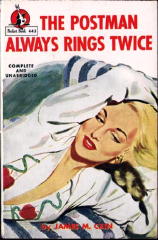
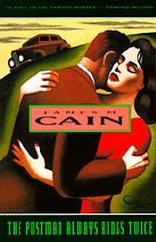
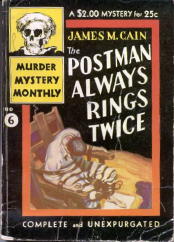
JAMES M. CAIN The Postman Always Rings Twice

JAMES M. CAIN – The Postman Always Rings Twice.

Alfred A. Knopf, hardcover, 1934. Paperback reprints include: Avon Murder Mystery Monthly #6, 1943; Pocket 443, 1947; Bantam, 1967; Vintage, 1978.

Films: 1946, with Lana Turner & John Garfield; 1981, with Jessica Lange & Jack Nicholson.

   This brutal little blue-collar love story was a shocking, sexy, “dirty” best seller and set the standard for tough, lean writing. It taught readers (and writers) that dialogue could propel a story by its own steam (and steaminess) with (as Cain himself put it) “a minimum of he-saids and she-replied-laughinglys.”

   From its famous first sentence (“They threw me off the hay truck at noon”) to its spellbinding final moments on death row, The Postman Always Rings Twice moves like a freight train, catching the reader up in a sleazy, unpleasant – and compelling – illicit love affair.

JAMES M. CAIN The Postman Always Rings Twice

   Drifter Frank Chambers. finds himself in a roadside eatery called Twin Oaks Tavern (the first of many double images). Nick Papadakis, the friendly Greek who runs the place, has a wife who “really wasn’t any raving beauty, but she had a sulky look to her.”

   Soon Chambers is running the tavern’s gas station for the Greek; and by the end of chapter two, Frank and Cora have made a cuckold of him; by chapter four they are attempting Nick’s murder. And these are short chapters.

   Incredibly, the adulterers engage not just our interest but our sympathy, our collusion. Their lust (“I sunk my teeth into her lips so deep I could feel the blood spurt into my mouth”) is contagious, and redeemed by the extravagance of their passion (“I kissed her … it was like being in church”).

JAMES M. CAIN The Postman Always Rings Twice

   Yet Cain pulls no punches: Their intended murder victim, Nick, is not unsympathetic; Frank genuinely likes Nick, and after Frank and Cora succeed on the second try and kill him, cries genuine tears at his funeral.

   Frank and Cora – particularly Frank – are so out of control, so much smaller than the web of circumstance and human frailty in which they are caught up, that a strange sort of supportive interest develops for them. Cain feels for these small lovers who are doomed in so big a way.

   And so do we. When in the aftermath of Nick’s murder and the faked auto accident that follows, Cora and Frank indulge in a manic orgy of sadomasochism and passion at the scene of the crime, we are caught up in the moment with them. As Frank says: “Hell could have opened up for me then, and it wouldn’t have made any difference. I had to have her, if I hung for it.”

JAMES M. CAIN The Postman Always Rings Twice

   Part of the enduring power of Postman is its evocation of the depression. Frank and Cora’s dream is the American one: They want a business of their own, a family of their own-simple goals that had been made so difficult in hard times. Their greed was small; their aspirations petty. Their love, and their crime, in James Cain’s tabloid opera, large.

         ———
   Reprinted with permission from 1001 Midnights, edited by Bill Pronzini & Marcia Muller and published by The Battered Silicon Dispatch Box, 2007.   Copyright © 1986, 2007 by the Pronzini-Muller Family Trust.

A 1001 MIDNIGHTS Review
by Max Allan Collins and James L. Traylor:


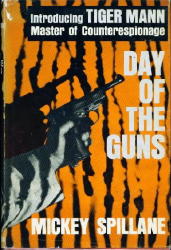
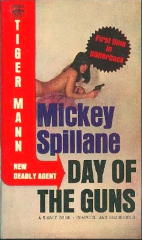
MICKEY SPILLANE Day of the Guns

MICKEY SPILLANE – Day of the Guns.

E. P. Dutton, hardcover, 1964. Signet D2643, paperback, April 1965. [Several later printings.]

   Properly overshadowed by Mike Hammer, espionage agent Tiger Mann is the hero of Mickey Spillane’s only other series of mystery novels. Mann remains a pale shadow of the mighty Mike, a Bond-era reworking of the Hammer formula; but the first of the series has considered merit.

   Tiger Mann is employed by an espionage organization funded by ultraright-wing billionaire Martin Grady, of self-professed altruistic, patriotic purposes. Chatting with a Broadway columnist in a nightclub, Tiger spots a beautiful woman who strikingly resembles a Nazi spy named Rondine who attempted to kill him years before.

   Though he loved Rondine, Tiger has sworn to kill her should he encounter her again. The woman, Edith Caine, professes not to be Rondine, but Tiger refuses to believe her and sets out to learn what she is up to. Soon he is battling a Communist conspiracy, and in a striptease finale that purposely evokes and invokes the classic conclusion of I, the Jury, Tiger must face the naked truth about Rondine.

MICKEY SPILLANE Day of the Guns

   Day of the Guns is a fast-moving and fine example of Spillane’s mature craftsmanship; he has great fun doing twists on himself, as the conclusion of the novel shows. But this book – and, particularly, later Tiger Mann entries – lacks the conviction of the Hammer novels.

   Tiger Mann is Mike Hammer in secret-agent drag: His style and world are Hammer’s; despite mentions of faraway places, the action is confined to New York. But while Hammer is an antiorganization man, Tiger, for all his lone-wolf posturing, is a company man. This goes against the Spillane grain.

   The three other Tiger Mann novels are Bloody Sunrise (1965), The Death Dealers (1965), and The By-Pass Control (1966). Each declines in quality.

         ———
   Reprinted with permission from 1001 Midnights, edited by Bill Pronzini & Marcia Muller and published by The Battered Silicon Dispatch Box, 2007.   Copyright © 1986, 2007 by the Pronzini-Muller Family Trust.

A 1001 MIDNIGHTS Review by Bill Crider:


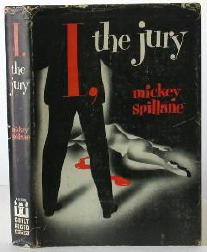
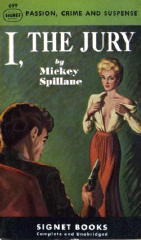
MICKEY SPILLANE I the Jury

MICKEY SPILLANE – I, the Jury.

E. P. Dutton, hardcover, 1947. Signet 699, paperback, 1948. [Many later printings.]

   When Mickey Spillane published I, the Jury in 1947, Hammett’s first novel had been in print nearly twenty years and Carroll John Daly and Raymond Chandler were still writing. Yet there is little doubt that Spillane’s book was a seminal work of tough-guy fiction, inspiring hundreds of imitators in the booming paperback market of the 1950s. No one, however, was quite able to match Spillane’s unique combination of action, sex, and right-wing vengeance.

   The main character of I, the Jury is Spillane’s most famous creation, Mike Hammer — tough, implacable, and prone to violence, with perhaps even a touch of madness. When his war buddy is murdered, Hammer swears to get revenge: “And by Christ, I’m not letting the killer go through the tedious process of the law.”

MICKEY SPILLANE I the Jury

   Hammer smashes his way through the suspects (“My fist went in up to the wrist in his stomach”) until he determines the guilty party, whom he has sworn to kill in exactly the same way his friend was murdered. Along the way, he meets the nymphomaniac Bellemy sisters, one of whom has a strategically located strawberry birthmark; Charlotte Manning, a beautiful psychiatrist; Hal Kines, the improbable white slaver; and of course he fends off the advances of Velda, his sexy, loyal secretary.

   He finally confronts the killer in a slam-bang ending never to be forgotten by anyone who has read it, concluding with perhaps the best last line in all of Spillane’s books, most of which have memorable, melodramatic climaxes.

   Spillane’s novels have been attacked for their violence and their vigilante spirit, and no doubt these things are present in the books. But Spillane is first and foremost a storyteller, and his stories, no matter how improbable, always work, pulling the reader along willingly or unwillingly into Mike Hammer’s violent world.

   I, the Jury was brought to the screen in 1949, with Biff Elliott in the starring role. Like the novel, it emphasizes violence and has an ending to enrage the sensibilities of any feminist who happens to watch it.

MICKEY SPILLANE I the Jury


         ———
   Reprinted with permission from 1001 Midnights, edited by Bill Pronzini & Marcia Muller and published by The Battered Silicon Dispatch Box, 2007.   Copyright © 1986, 2007 by the Pronzini-Muller Family Trust.

A 1001 MIDNIGHTS Review by Bill Crider:


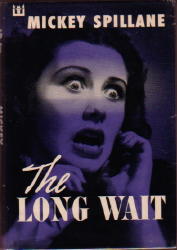
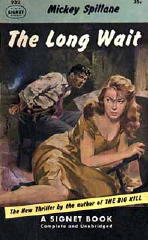
SPILLANE The Long Wait

MICKEY SPILLANE – The Long Wait.

E. P. Dutton, hardcover, 1951. Paperback reprint: Signet 932, May 1952 [plus many subsequent printings].

   The Long Wait, Mickey Spillane’s first non-series novel, is the author’s variation on the one-man- against-municipal-corruption theme as found in such novels as Dashiell Hammett’s Red Harvest. The Mike Hammer-like narrator/hero, whose name is either Johnny McBride or George Wilson (even he isn’t sure), returns to the town of Lyncastle to clear up a robbery-and-murder charge against McBride.

   His motive, as usual in Spillane’s work, is revenge: One man is to get his arms broken, and one man is to die. Actually, a lot of people die before the narrator accomplishes his lofty goal, but not before he absorbs more physical abuse than seems even remotely possible.

SPILLANE The Long Wait

   And speaking frankly of credibility, it must be admitted that The Long Wait contains enough coincidence and enough improbable, even downright incredible, plot devices for four or five books. There is violence galore, too, and a lot of voyeuristic sex (the final scene is a rewrite of the striptease that concludes I, the Jury).

   None of this affects the story adversely, however. Typically, Spillane pulls it off. The pacing and the fierce conviction of the narrative voice grab the reader and carry him relentlessly along. Spillane seems to have had a high old time writing The Long Wait, and the reader who is willing to grin, plant his tongue in his cheek, and go along with him is in for a hell of a ride.

   Other nonseries books by Spillane with more or less Hammer-like heroes are The Deep (1961) and The Delta Factor (1967). The Erection Set (1972) and The Last Cop Out (1973) are Spillane’s only books with third-person narration.

         ———
   Reprinted with permission from 1001 Midnights, edited by Bill Pronzini & Marcia Muller and published by The Battered Silicon Dispatch Box, 2007.   Copyright © 1986, 2007 by the Pronzini-Muller Family Trust.
« Previous Page