Horror movies


REVIEWED BY JONATHAN LEWIS:


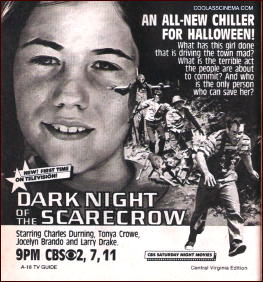
DARK NIGHT OF THE SCARECROW. Made-for-TV movie, CBS, 24 October 1981. Charles Durning, Robert F. Lyons, Claude Earl Jones, Lane Smith, Tonya Crowe, Larry Drake, Jocelyn Brando. Director: Frank De Felitta.

   As an adult, returning to a horror film that scared the living daylights of me as a kid is always a fascinating experience. Before the film even begins, I am asking myself whether it’s going to be as terrifying, vivid, or scary as I remember it being. Is it going to look just plain silly, forcing me to doubt my youthful aesthetic judgment? After all, some kids just know when a movie stinks and when it’s good, right?

   Enter the scarecrow. Dark Night of the Scarecrow, to be exact. As a made-for-TV movie originally aired on CBS, the movie has no particular right to be that good, let alone that memorable. As it turns out, I remembered a lot of it pretty well. Not so much the minor details, but the general atmosphere of suspense and the visceral nature of the revenge-driven plot. It’s a very unsettling movie, both emotionally and visually.

   Then there’s Bubba. Portrayed by the late Larry Drake (L. A. Law, Darkman), Bubba Ritter is a kind, mentally challenged 36 year-old living with his mother on the outskirts of a small rural town. Drake’s performance is, in a word, unforgettable. He is able to convey his character’s childlike innocence, love for his mother, and his fear of the cruelty that surrounds him.
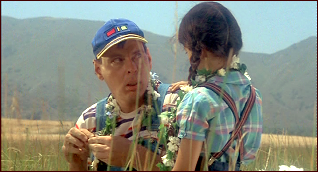
   Case in point: the local men inhabiting this festering hole of bigotry are pieces of work. In particular, there is the morally repugnant Otis P. Hazelrigg (an exceptionally well cast Charles Durning), a loathsome bitter man who hates Bubba and loathes his friendship with Marylee Williams, a local girl (Tonya Crowe). When it looks as if Bubba may have been responsible for the girl’s murder, Hazelrigg and three other men exact vigilante justice on the terrified Bubba, shooting him dead in cold blood trembling for his life in a cornfield.

   After the men are acquitted, things begin to get downright strange in the town. A mysterious scarecrow starts appearing, haunting the guilty consciences of the men responsible for Bubba’s death. Is it a supernatural occurrence or a prank designed into frightening the men into confessing their crime? After all, Bubba’s mother vowed that that there are other forms of justice than that dished out in courthouses. The violent deaths meted out to largely unsympathetic Bubba’s executioners in Dark Night of the Scarecrow demonstrate just how right she was.
   

REVIEWED BY JONATHAN LEWIS:


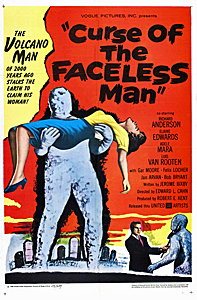
CURSE OF THE FACELESS MAN. United Artists, 1958. Richard Anderson, Elaine Edwards, Adele Mara, Luis Van Rooten, Gar Moore, Felix Locher. Screenplay: Jerome Bixby. Director: Edward L. Cahn.

   There are two primary ways of looking at Curse of the Faceless Man. Either it’s a hodgepodge of horror film tropes with more than a smidgen of themes generously, um…. borrowed from Karl Freund’s The Mummy (1932). Or it’s a loving, living homage to Universal’s entire Mummy series, modified to a Southern Italian setting in which the mystical Etruscan and Roman past loom large over the scientific present.

   As an admirer of director Edward L. Cahn’s ability to make the most out of what are admittedly low-budget productions, I’m more akin to give the film the benefit of the doubt and call it an homage, albeit one clearly designed to exploit interest in the mummy film sub-genre and to make a quick buck off of it. To paraphrase the famous saying from Seinfeld: not that there’s anything wrong with that.

   Richard Anderson, who went on to feature in The Six Million Dollar Man, portrays Dr. Paul Mallon. He, along with his fiancée, Tina Enright (Elaine Edwards), is residing in modern day Italy in the outskirts of the town that was once the Roman city of Pompeii.

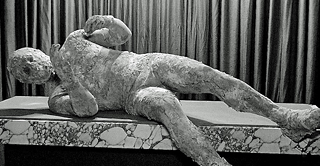
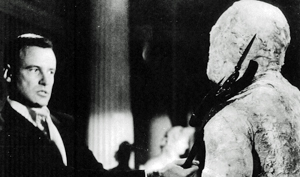
   After an archaeological dig discovers the remains of a faceless mummy-like man in the ruins, strange things begin happening. First, the driver tasked with transporting the mummy is mysteriously killed. Second, and more significantly for the story, Tina begins to have visions of the faceless mummy, as if she has some unexplainable connection to him and to the distant past (shades of The Mummy).

   But what could it be? Is she the reincarnated descendant of a Roman elite family? And who is this faceless man and what does he want? Dr. Carlo Fiorello (Luis Van Rooten) and his daughter, Maria (Adele Mara) are both on the case. Working at the local museum, they’re determined to unravel the mystery of the faceless man once and for all!

REVIEWED BY JONATHAN LEWIS:


BEAST OF THE YELLOW NIGHT. New World Pictures, 1971. John Ashley, Mary Wilcox, Leopoldo Salcedo, Eddie Garcia, Ken Metcalfe, Vic Diaz. Screenwriter-director: Eddie Romero.

   It’s never a good sign when, fifteen minutes or so into a movie, you decide to pick up the DVD case and read the back of it to help you figure out what in the world is going on. Unfortunately, that’s what I felt compelled to do watching the opening of the Eddie Romero’s Filipino/American horror production, Beast of the Yellow Night.

   Sure, it’s a low budget horror film, but the plot seemed so incredibly muddled and the picture quality (Alpha Video) was pretty low, so I needed some context as to what was transpiring in front of my very eyes.

   That said, once I had some idea of the basic plot and once the movie finally started to make a little more sense, I began to appreciate — ever so slightly – Beast of the Yellow Night for what it is: namely, a grindhouse film that tries to be philosophical and one which occasionally succeeds in elevating a forgettable werewolf film into something bordering on the thoughtful, admirably so, and yet one which mainly falls flat.

   Former pop sensation John Ashley portrays two characters. The first, Joseph Langdon, is an American soldier who deserted his unit in the Philippines and engaged in all sorts of nefarious acts. In order to save himself from Filipino soldiers hot on his trail, Langdon makes a devil’s bargain – literally – with Satan (a grinning, scenery chewing Vic Diaz).

   Some decades later, Langdon returns to life in the guise of American businessman, Philip Rogers. Satan wants Rogers to do his nefarious bidding, but when Rogers refuses, he soon learns that he’s cursed. Disobey the devil and you turn into a hideous beast, or so it would seem. That’s about all there is to the movie.

   And one more thing: Joseph Langdon may be a tortured soul, but he’s no Larry Talbot.

REVIEWED BY JONATHAN LEWIS:


THE DEVIL’S MEN. Crown International, 1977. Released in English worldwide as Land of the Minotaur. Donald Pleasence, Peter Cushing, Luan Peters, Costa Skouras, Fernando Bislani, Anna Mantzourani. Director: Kostas Karagiannis.

   Say what you will about the meandering plot and the sloppy editing, this one’s got atmosphere — creepy, breathtaking atmosphere. Filmed on location amongst ancient Greek ruins, The Devil’s Men aka Land of the Minotaur features Peter Cushing as Baron Corofax, a red robed Carpathian villain working on behalf of an ancient demonic force working through a fire breathing stone minotaur. Also on hand is Donald Pleasence as Father Roche, an Irish priest committed to fighting Satan.

   Now if that’s not your idea of a ridiculously subpar, but nevertheless eminently enjoyable, 1970s exploitation thriller, I don’t know what to tell you. The dialogue, I admit, is laughable, and the plot unfolds haphazardly, with little rhyme or reason, often leaving the viewer in the dark as to whether what’s transpiring on screen is happening at all or just a reflection of the characters’ innermost fears.

   And yet, I wanted to continue watching until the very end. Part of it, I admit, has to do with my sheer pleasure at seeing Cushing and Pleasence, two gentlemanly actors who gave horror films a sense of class that is sadly lacking in many films today. It’s also that the film, as I mentioned earlier, has so much atmosphere that it would have been a shame not to marvel at the ancient Greek ruins and to immerse myself visually in the dusty ruins of a long forgotten civilization.

REVIEWED BY JONATHAN LEWIS:


FIRST MAN INTO SPACE. MGM, UK/US, 1959. Marshall Thompson, Marla Landi, Bill Edwards, Robert Ayres, Bill Nagy, Carl Jaffe, Roger Delgado. Director: Robert Day.

   Watching First Man into Space, one cannot help but be reminded of The Quatermass Experiment, in which a rocket ship returns to Earth with an extraterrestrial menace in its midst. The same is essentially true for this surprisingly effective low-budget science fiction flic about a hubristic Air Force pilot who, in his obsessive quest to become the titular first man in space, ends up a victim of cosmic rays or such.

   And by “victim,” I mean that his endeavor in the stars transforms into a genuinely creepy looking bloodsucking monster that needs to kill and to feed in order to survive. Although First Man into Space is, at times, exceedingly talky (much like similar science fiction films from the era), it nevertheless has enough chills and thrills to keep the viewer engaged for the relatively scant running time.

   The crisp black and white cinematography, while nothing spectacular, is nevertheless much better than in many of the cheapie creature films from the same era. I can’t promise that you’ll love this movie, but I think that you’ll find that it’s a bit better than its title and premise suggest.


CREATURE FROM BLACK LAKE. Howco International Pictures, 1976. Jack Elam, Dub Taylor, Dennis Fimple, John David Carson, Bill Thurman. Director: Joy N. Houck Jr.

   For a horror movie, Creature from Black Lake honestly isn’t all that good. For a spunky low-budget thriller, however, this mid-1970s creature feature really isn’t all that bad.

   While it’s hardly a classic, the movie simply exudes passion and spirit. Combining both shaky handheld camera effects with creepy music, Creature from Black Lake has campy humor, chills and thrills, and some interesting things to say about the counterculture and the place of Southern whites in American society. Ultimately, however, it’s a buddy film – the story of two University of Chicago classmates who travel down South to investigate the sighting of an apparent Bigfoot type creature in the Louisiana swamps.

   Although many of the actors aren’t particularly well known, one of them is certainly well known, especially by Western genre fans. That would be Jack Elam who, in this film, portrays a bearded and often drunk Bayou wild man who has a run in with the mysterious swamp creature.

   Elam’s presence in this film, while hardly a highlight of his career, lends the film both comic relief (Elam can be really funny!) and a sense of campy fun. Sometimes a film doesn’t need to be all that good – in a technical sense – to be enjoyable.

Reviewed by JONATHAN LEWIS:


SUPERNATURAL. Paramount Pictures, 1933. Carole Lombard, Allan Dinehart, Vivienne Osborne, Randolph Scott, H. B. Warner. Director: Victor Halperin.

   Much like White Zombie, which I reviewed here, Supernatural, also directed by Victor Halperin, doesn’t make a whole lot of sense. There are so many loose strands that one loses count. Add on top of that some sequences that really don’t even fit very coherently into this narratively challenged movie.

   In much the same way as White Zombie, which I caught as part of the UCLA Festival of Restoration last year, Supernatural unfolds like a fairy tale, as if one is caught in a silly dream where plot takes a back seat to a simultaneously innocent and sinister atmosphere and mood.

   Indeed, it’s all rather good, albeit senseless fun.

   Featuring Carole Lombard and Randolph Scott as a couple who must face off against a con man, the disembodied spirit of a recently executed murderess, and possibly a murderer in their close circle, the film has so many subplots that ultimately go nowhere. With an omnipresent musical score than zips right along and a few ridiculously charming attempts at special effects, this pre-code horror (horror-comedy?) programmer still isn’t really what you’d call a solid work of filmmaking. But in spite of its numerous flaws, given the financial and technological restraints of the era, it’s nevertheless a far better product than you might initially think.

Reviewed by JONATHAN LEWIS:


DRACULA. Universal Pictures, 1979. Frank Langella (Count Dracula), Laurence Olivier (Professor Abraham Van Helsing), Donald Pleasence, Kate Nelligan, Trevor Eve, Jan Francis. Screenplay: W. D. Richter, based on a play by Hamilton Deane & John L. Balderston, based in turn on the novel by Bram Stoker. Music by John Williams. Director: John Badham.

   Although it’s been quite a while since I read Bram Stoker’s Dracula (1897), there are quite a few aspects of the text that I remember quite well. Or at least I think I do. And not just plot points or vividly realized scenes such as when Dracula crawls down a wall. I’m talking about the work’s atmosphere, its sense of impending doom and sheer weirdness. Because let’s face it: >Dracula is an early example of modern weird fiction.

   Personally, I don’t think Stoker wrote the best vampire story ever told and I’ll leave it to you to decide which one you might think is the best. But I’ll readily admit that Stoker was remarkably effective in vividly describing a decidedly off-kilter world, one in which the notion of an undead Carpathian ruler haunting Victorian London doesn’t seem so far-fetched. Now, that’s an accomplishment and a testament to why Dracula is still read and appreciated to this very day.

   As far as film adaptations of Stoker’s novel go, I’m definitely of the opinion that the original Bela Lugosi version (1931) is the one I like the best (some people believe that the concurrent Spanish version is even better). To me, there’s something about Lugosi as Dracula that’s just so classic, so darn iconic that it’s difficult for me to fully imagine other actors stepping into the famed vampire’s shoes (or cape), though the late, great Christopher Lee comes pretty close.

   I remember watching Francis Ford Coppola’s 1992 version in the theater and didn’t come away super impressed. There were some great moments, to be sure, but it just seemed so lavish, so colorful that somehow I didn’t see it as a fully authentic realization of Stoker’s vision. Keanu Reeves, who I don’t dislike as an actor and who I thought was great in Speed (1994), didn’t seem to me to be an effective choice for the role of Jonathan Harker. And I don’t think I’m the only one.

   It was with this background that I finally got around to watching the 1979 film version, one that transports the entirety of the proceedings to England and is closest to the spirit, if not the story, of Stoker’s novel.

   Directed by John Badham, this one features Frank Langella as Dracula and Laurence Olivier as vampire hunter Abraham Van Helsing. Langella, it seems to me, is a fairly effective Dracula, particularly because the story played up the romantic and seductive aspect of the Dracula and Lucy relationship.

   Olivier, with a faux Dutch/Flemish accent, is an extraordinarily effective Van Helsing and really transforms the movie into a serene, melancholy operatic experience, one aided by John Williams’ hauntingly beautiful score. Olivier’s Van Helsing is a forlorn, world-weary warrior, someone who takes no pleasure in what he must do to stop Dracula.

   This version, which never garnered the same degree of critical attention as the original or Coppola’s version, is definitely worth watching for those who haven’t seen it. Also, for those who may have seen it decades ago and not again since then, it’s worth taking the time to rediscover how extraordinarily well this film holds up. It helps that, in this late 1970s version, Dracula crawls down a wall not once but twice. Chillingly sublime weirdness at its very best.

SELECTED BY MICHAEL SHONK:


   Lalo Schifrin was the original choice to do the soundtrack for the film The Exorcist. YouTube claims this was his original theme:


   Director William Friedkin rejected Schifrin’s work turning to Mike Oldfield’s “Tubular Bells” for the theme:


   The history behind this has always claimed Schifrin’s soundtrack scared test audiences too much and the studio asked to have it toned done. Hard to believe after listening to that theme, but when you listen to this recording of Schifrin’s soundtrack the problem of intensity is more obvious.

Reviewed by JONATHAN LEWIS


THE MUMMY LIVES. Global Pictures, 1993. Tony Curtis, Leslie Hardy, Greg Wrangler, Jack Cohen, Mohammed Bakri. Suggested by the story “Some Words with A Mummy” by Edgar Allan Poe. Director: Gerry O’Hara.

   To say that Tony Curtis was miscast in the schlocky, ridiculously plotted The Mummy Lives is to miss the point entirely. Indeed, without Curtis in this overall forgettable mummy film, there’d be no reason to watch it whatsoever.

   But with Curtis, it’s an entirely different story, for there’s nothing – and I mean nothing – quite like hearing a thick Bronx accent coming from the mouth of a character named Dr. Mohassid. The thing you really need to know about the good doctor is that he happens to be – you guessed it – the resurrection of an ancient Egyptian named Aziru, a guy who was sentenced to death and mummification for his illicit love affair with Kia (Leslie Hardy), a lovely, dark haired concubine.

   When he doesn’t look completely bored, Curtis plays it for laughs, almost winking at the audience as if he were Vincent Price. The Mummy Lives may not be a good movie, but it has its moments. At its worst, it’s a throwaway cheap horror film that doesn’t work. At its best, it is pure camp, a celebration of the ridiculousness of Hollywood’s mummy curse mythology.

   I wouldn’t recommend anyone going out of the way to see this one, but I’d love to see it programmed as a midnight movie somewhere.

Reviewed by DAN STUMPF on


BLACK FRIDAY. Universal, 1940. Boris Karloff, Bela Lugosi, Stanley Ridges, Anne Gwynne Anne Nagel. Written by Curt Siodmack and Eric Taylor. Directed by Arthur Lubin.

   An odd confluence of horror movie and gangster film, done up with the usual polish of Universal’s upper-case monster movies, but sadly unfocused.

   Boris Karloff stars as (surprise!) a Mad Scientist, and Bela Lugosi gets second-billing as a bad guy, but the meatiest part goes to Stanley Ridges as Karloff’s friend, a likable old professor of the Walter Albert type, who gets run over by a bank robber (also Ridges) in mid-getaway who then conveniently cracks up his car, leaving Karloff with two men on his hands who will quickly die unless he tries his unconventional theories….

   With Curt Siodmack’s name on the credits, the knowing horror buff won’t be surprised to see a brain transplant in the offing. In this case, Karloff sews part of robber/Ridges’ brain into professor/Ridges’ noggin, resulting in a mild-mannered professor who morphs into a heartless killer from time to time as the plot demands.

   Well we all had a few teachers like that in College, didn’t we? In this case though, Karloff figures out that robber/Ridges knows where all sorts of stolen loot may be hidden, and means to get his hands on it—another instance of the sad decline of Universal’s monsters that I mentioned earlier, in my review of Spider Woman Strikes Back.

   Anyway, to further his ends, Karloff sets about bringing more and more Crook out of the Academic, at which point Black Friday turns into a Warners-style gangster pic, with molls, shifty miscreant and a rival gang boss, played by poor Bela.

   It was about this time someone at Universal decided Lugosi was never going to get another decent part there. With the arguable exceptions of his Ygor reprise in Ghost of Frankenstein and the Monster in Frankenstein Meets the Wolfman, his career there was consigned to a series of sinister butlers and indifferent red herrings, with good billing but nothing very much to do.

   Karloff on the other hand, looks marvelously sinister in this, and Stanley Ridges is very effective in an underplayed star turn, equally convincing as the gentle academic and the nasty desperado, and really except for the sad sight of Lugosi languishing on the sidelines it’s an enjoyable film. Just one thing has always puzzled me about it though:

   Black Friday opens on Karloff in a jail cell awaiting imminent execution, spinning his tale in flashback. But when I got to the end of the film I couldn’t figure out what he even got arrested for; in fact, he never doers anything particularly criminal in this film –- not in front of witnesses, anyway — and as THE END flashed across the screen, I wondered if perhaps the writers had thought this thing out all that carefully.

   Anyway, if any of the legions of obscure movie buffs out there remember this one — and if you’ve done your shopping and polished off the leftovers by now, perhaps someone can explain it to me.

« Previous PageNext Page »