Horror movies


REVIEWED BY DAN STUMPF:         


SON OF DRACULA. Universal Pictures, 1943. Lon Chaney Jr., Robert Paige, Louise Allbritton, Evelyn Ankers, Frank Craven, J. Edward Bromberg. Story: Curt Siodmak; screenplay: Eric Taylor. Director: Robert Siodmak.

SON OF DRACULA Lon Chaney

   Lon Chaney Jr., last mentioned for his performance of Witch Woman [reviewed here], also starred in of one of Universal’s more successful chillers, Son of Dracula directed by Robert Siodmak, who went on to create some iconic films noir, including The Killers and Christmas Holiday.

   Siodmak handles the tale of Count Dracula coming to modern-day America in search of fresh blood with authentic creepiness, possibly remembering the expressionist German Horror films of his youth and bringing them to America as well.

SON OF DRACULA Lon Chaney

   Aided by John P. Fulton’s special effects, he gives the film a splendidly gothic look, with eerie mists and floating coffins, and even elicits an off-beat performance from Chaney fils, whose hulking vampire suggests some of the virility Chris Lee brought to the part years later.

   I should also note that Robert Paige, as the hero of the tale ranks a few notches above the average bland leading man in a monster movie. Classic horror films have a perversity that has always appealed to me, in that the Monster is generally more sympathetic, or at least more interesting, than the putative good guys.

   Not here. As Son of Dracula develops, Paige becomes not so much hero as patsy, set up by a scheming girlfriend for a grisly fate, and struggling throughout with forces that outmatched him from the start.

SON OF DRACULA Lon Chaney

   In fact, Siodmak reused the plot in basic outline in one of his grimmer noirs, Criss Cross (1950) with Burt Lancaster, Yvonne De Carlo and Dan Duryea in the thematic roles done here by Paige, Louise Allbritton (very effective as a literal femme fatale) and Chaney Jr. And Paige (who had a title role in the Monster and the Girl a couple years earlier) invests the part with real pathos.

   In keeping with this moody, fatalistic feel, Son wraps up on a haunting note, with the hero still wanted for murder and haunted by a love that he betrayed.

   It makes me wonder what the little kids thought of all this as they left the theater back in the 40s, particularly since Son of Dracula was double-billed with Universal’s The Mad Ghoul, a surprisingly classy B-feature with echoes of Caligari and an ending that copies the opening of a 1937 Woolrich story, “Graves for the Living.”

SON OF DRACULA Lon Chaney

REVIEWED BY WALTER ALBERT:         

THE MAGICIAN Rex Ingram

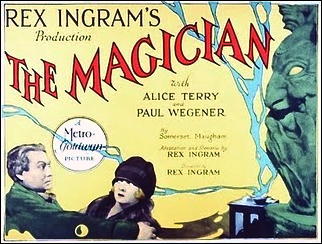
THE MAGICIAN. MGM, 1926. Alice Terry, Paul Wegener, Iván Petrovich, Firmin Gémier, Gladys Hamer, Henry Wilson, Hubert I. Stowitts. Based on the novel by W. Somerset Maugham, adapted by Rex Ingram. Director: Rex Ingram. Shown at Cinecon 27, Hollywood CA, September 1993.

   When I told a close friend how excited I was that Cinecon had scheduled one of my long outstanding “must see” films, Ingram’s The Magician, he replied that Ingram was not one of his favorite directors and this film was “one of his weakest.”

   Talk about a wet blanket!

   He added that the print he had seen was not “a very good one.” Well, I can now report that Cinecon came up with a beautiful print that displayed to marvelous advantage Ingram’s notable pictorial qualities.

THE MAGICIAN Rex Ingram

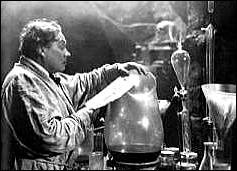
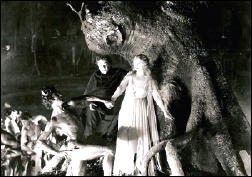
   The narrative concerns an Aleister Crowleyish black magician (Paul Wegener, the unforgettable creature of The Golem) who elopes with a beautiful sculptress (played by Alice Terry) whom he needs in a hellish experiment to create life according to a formula he has discovered in an ancient book of sorcery.

   The climactic sequences take place in his stone castle, sitting on a hill overlooking an ancient city with cobbled streets and Tenggren-like houses (see the opening sequence of Pinocchio for an artistic equivalent).

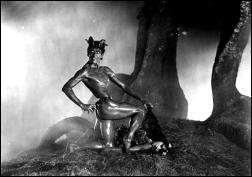
   He is aided by a malicious, misshapen dwarf, and at the end, the top of the castle blows up. This is the quintessential setting and some of the narrative and character staples of the 1930s Universal Frankenstein cycle, and, if it is hokum (as indeed it is), it is hokum in a style that I can’t resist.

THE MAGICIAN Rex Ingram

   The opening scene is a sculptor’s studio that looks like a plate out of a 19th-century art history book. Wegener’s flamboyant style is perfect for the mesmerizing role of the magician and I am only sorry that there wasn’t a Bride of the Magician, and a Son of the Magician to constitute a cycle.

   Now, if somebody will just schedule screenings of Ingram’s Scaramouche and The Four Horsemen of the Apocalypse. But I won’t ask my friend for a recommendation.

Editorial Comment:   Dan Stumpf reviewed the book by Maugham this movie is based earlier this year. Check it out on this blog here.

THE MAGICIAN Rex Ingram

Reviewed by DAVID L. VINEYARD:         


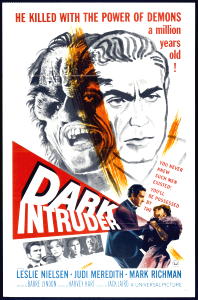
DARK INTRUDER

DARK INTRUDER. Universal Pictures, 1965. Leslie Neilsen, Mark Richman, Judi Meredith, Werner Klemperer, Charles Bolender, Vaughn Taylor, Gilbert Green. Screenplay: Barré Lyndon. Director: Harvey Hart.

    He killed with the power of demons a million years old.

   It’s foggy turn of the century (1890) San Francisco and the city is being stalked by a murderer, but no ordinary killer — he’s killing in the name of Lovecraftian demons from the ancient past. Only a handful of victims stand between him and eternal life, leaving behind a mystical ivory demon with a parasite on its back that grows smaller with each murder as the time grows shorter between the date each new victim dies.

   Who is the disfigured monster stalking the foggy streets and what is his true face, and what is the demonic killer after? There’s even the mummified body of a demon in the possession of a mysterious Chinese who aides our hero.

    Kingsford: How bad is it?

    Chinese: How bad? This is a Sumerian god, ancient before Babylon, before Egypt. It is the essence of blind evil, demons and acolytes so cruel, so merciless, all were banished from the earth and they are forever struggling to return. In the old days people were possessed by demons. These demons.

   Leslie Neilson is amateur supernatural sleuth Brett Kingsford (“The seventh son of a seventh son has a reputation to uphold”) — replete with secret crime lab, a Latin motto “Omina Exeunt in Mysterium” (Everything is a Mystery), a library of occult tomes, and a dwarf assistant named Nikola (Charles Bolender):

    Evelyn: I swear every time I see him he’s shrunk another inch.

    Kingsford: Yes poor chap, destined for ultimate evaporation I’m afraid. The penalty for telling a Dyak witch doctor to go jump in the lake.

DARK INTRUDER

   Kingsford is called in by the Police Commissioner (Gilbert Green) to help find the killer (“You seem to specialize in obscure acquaintances.”), which he does while maintaining the pose of a playboy a la Lamont Cranston or the Scarlet Pimpernel (“For me to be any value to you at all the company of a narcotics addict is preferable to a police commissioner.”), though he is less than happy when Kingsford suggests they are hunting a ritual murderer in the thrall of ancient Sumerian gods who must be locked away “… where all such unearthly things belong.”

   Nielson has some fun as the Sherlockian Kingsford, who is a master of disguise and fully as high handed as Holmes at his best. Judi Meredith is Evelyn, whose psychic trances aide Kingsford in his hunt for the demonic killer, fiancee of wealthy importer and a friend of Kingsford, Robert Vandenberg (Mark Richman).

    Vanderberg: Brett, I feel as if there is some secret part of me trying to come to the surface…

   This was originally shot as a pilot for a series, The Black Cloak, that never developed and released theatrically by Universal as a feature as sometimes happened then.

   Night Gallery producer Jack Laird produced it and the teleplay was by Barré Lyndon (screenplays for The Lodger, Hangover Square, War of the Worlds, Night Has 1000 Eyes — with Jonathan Latimer — The Man Who Could Cheat Death, and his play The Amazing Dr. Clitterhouse), so the mix of horror, mystery, and detective elements were natural. The eerie score is by Lalo Shifrin.

   Enjoying himself playing Kingsford, Leslie Nielsen gets to indulge in disguises and flights of Holmesian reasoning, and the scenes with Mark Richman as wealthy Robert Vandenberg have a nice bite to them.

    Vanderberg (after Kingsford is attacked in his shop by a mysterious black cloaked figure): Did he have a knife?

    Kingsford: No, he had claws.

DARK INTRUDER

   You’ll have to look closely for Werner Klemperer, Colonel Klink from Hogan’s Heroes, in a key role with a distinctly Lovecraftian twist if you recall the plot of “The Dunwich Horror.”

   Handsome Robert Vandenberg has a demonic twin, Professor Malachi, born at the same time on an archeological dig, and brought up by a nurse who was midwife to Robert’s mother, who won’t be happy until he has traded bodies with his half brother and ushered in his demonic father.

    Professor Malachi: I am a wonder and a monster at the same time.

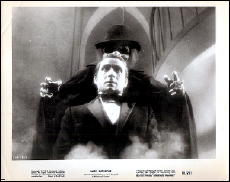
   A set piece when Malachi confronts Vandenberg in a foggy church is nicely done with one last twist when the misshapen Malachi plunges to his supposed death…

    Kingsford: I can’t help thinking it’s not finished.

   And he’s right as he races to save Evelyn from a fate much worse than death:

    Kingsford: Oh, Nicola, if only the rest of the world knew what we do.

    Nicola: If they did sir, nobody would get a decent night’s sleep.

   This is an entertaining little exercise in the mix of detective and horror elements with an attractive cast and Leslie Neilsen in a lead role long before he revealed his comic flair in the Airplane! movies.

DARK INTRUDER

   At a mere 59 minutes it is tightly written and directed and moves along nicely never pausing long enough for any pesky doubts to cloud the viewers enjoyment of the precedings.

   This was on everyone’s wish list for years, and when it showed up a few years ago on the gray market it was a bonus to discover it was every bit as good as the memories it evoked. It’s an attractive little black and white entry in the mystery/horror genre that manages some genuine chills and solid fun.

   More than a few more expensive productions fail to deliver as much atmosphere, action, and fun as this one does. It may remind you of the similar Chamber of Horrors with Patrick O’Neal and Cesare Danova, another pilot turned feature, though this one, thankfully, does without the “Horror Horn.”

   Dark Intruder is a fine example of a period when the pilots that failed were sometimes more interesting than the ones that succeeded.

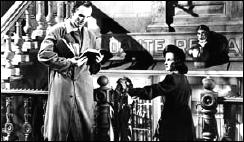
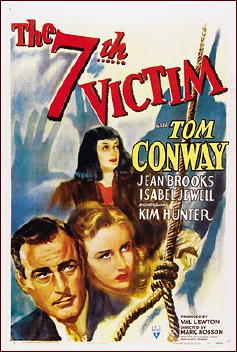
THE SEVENTH VICTIM. RKO Radio Pictures, 1943. Tom Conway, Jean Brooks, Isabel Jewell, Kim Hunter, Evelyn Brent, Hugh Beaumont. Producer: Val Lewton. Director: Mark Robson.

THE SEVENTH VICTIM

   A naive young woman in a private girls’ school heads for New York to see if she can find her missing sister. Once there, she discovers that her sister has become involved with a cult of rather tame devil-worshipers. The movie itself is moody, atmospheric, and — not very interesting.

   Maybe it’s the lack of a proper budget, but I found myself nodding off, more often than not. In its own way, though, the ending is worth waiting for. This movie has more sting in its tail than any other of its type I’ve seen for a while — a solid, telling blow in the never-ending battle of good against evil.

— Reprinted from Mystery*File #35, November 1993, slightly revised.


THE SEVENTH VICTIM

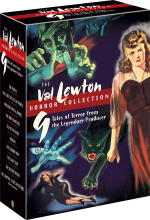
[UPDATE] 06-14-10.   This movie has a rating of well above average on IMDB, 6.9 stars out of 10. I’m willing to concede that I may be mistaken in my opinion of this movie. To that end, so that I might watch it again, I have recently purchased a box set of nine Val Lewton movies, and this is the first one I’ll take out of the pack.

   In the meantime, let me ask this question. The movie’s discussed on a number of noir-oriented blogs and websites. Is it noir, or it did come along too early to be a true noir? If it is noir — and I understand this full well — it was only accidental. Who knew what noir was in 1943?

   The nine movies, by the way:

      Cat People
      The Curse of the Cat People
      I Walked with a Zombie
      The Body Snatcher
      Isle of the Dead
      Bedlam
      The Leopard Man
      The Ghost Ship
      The Seventh Victim
      Shadows in the Dark


THE SEVENTH VICTIM

REVIEWED BY DAN STUMPF:         


THE SHE-CREATURE

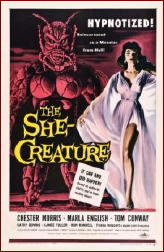
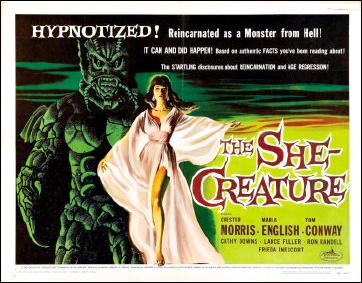
THE SHE-CREATURE. American International, 1956. Chester Morris, Marla English, Tom Conway, Cathy Downs, Lance Fuller, Frank Jenks, Kenneth MacDonald. Director: Edward L. Cahn.

   Speaking of Cheap Thrills, The She-Creature was on recently, a film I’ve been looking for over the last several years and one I found pleasantly not-disappointing.

   This was produced by Alex Gordon, a movie-maker and film buff who also turned out a few memorable B-Westerns in the 60s, films that utilized the talents of some stalwart old western stars without the tired fustiness of the A.C. Lyles efforts over at Paramount. Gordon’s Sci-Fi films are less memorable than his Westerns, but still worth a look.

THE SHE-CREATURE

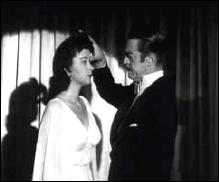
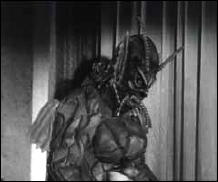
   This was probably his best Horror Film, a fast-moving, unsubtle, mildly erotic tale of Mind Control and Reincarnation, with Marla English in the unwilling thrall of Chester Morris as a Carnival Hypnotist who can regress her back to some vaguely prehistoric sea-monster state, with scales, claws, stringy hair and massive headlights.

   In this condition, she walks out of the Sea and kills people, then vanishes into the mist while Morris thrills audiences in his tawdry show with predictions of more “Monster Murders.”

   Tom Conway comes on about then, as a wealthy publisher who gets wealthier by promoting Morris, and whose swelling ego heads all concerned to a predictable ending.

THE SHE-CREATURE

   Yeah, it’s not much, but what there is has some marginal virtues, including Paul Blaisdell’s impressive She-Creature makeup and a remarkably vigorous performance by Chester Morris, whose career by this time was at its obvious nadir.

   Somehow, he’s perfect for the part, with his sagging features and cheap hair dye, looking poignantly just like the sleazy showman he plays.

   And to his credit, he acts his heart out here, ignoring the cardboard sets (which also look poignantly like Carnival Cheapery) and giving his obsessive part a quiet intensity that never lets up but never goes over the top, either.

   Incidentally, Marla English, parts of the She-Creature outfit, and all of Tom Conway (playing a White Witch Doctor with what looks like a porcupine on his head) returned the very next year in Voodoo Woman, another Alex Gordon effort that makes She Creature look sumptuous by comparison.

THE SHE-CREATURE

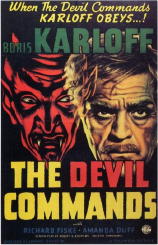
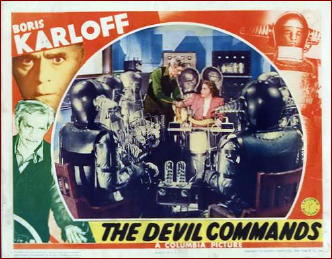
THE DEVIL COMMANDS. Columbia Pictures, 1941. Boris Karloff, Richard Fiske, Amanda Duff, Anne Revere, Ralph Penney, Kenneth MacDonald. Based on the novel The Edge of Running Water by William Sloane. Director: Edward Dmytryk.

BORIS KARLOFF The Devil Commands

   Beginning with the movie Ghost, there has been a flood of films recently dealing with the possibility of communicating with the dead, but of course movies dealing with the dead and ways with getting in touch with them are not a recent phenomenon at all, and I’m sure it was already old stuff when The Devil Commands came out.

   Most of the recent movies on the subject seem to be out-and-out fantasies (Flatliners, which I haven’t seen, may be an exception), but in 1941, science was still new enough that almost anything was possible.

   The Devil Commands takes the prevailing point of view, however, that there are “things no human being should know,” or at least I assume it was a prevailing point of view in 1941, when this movie came out. Boris Karloff, haggard and bereft after the death of his wife, is an archetypal “mad scientist” in this movie — a villain, but an innocent victim as well.

   In terms of film style, it’s filmed in black and white, but I think there’s far more black on the screen than there is white.

   As in Ghost, there is a female spiritualist (played here by Anne Revere, as opposed to Whoopi Goldberg) who, although a fake, does have some innate power in the realm of spiritualism, a power that could be tapped, if only the “experiments” were allowed to continue.

   The local townsfolk are a superstitious lot, however — nothing like a few missing bodies to arouse their anger — and while every aspect of this movie is developed to perfection, there are no wild surprises, either. This is a pulp science fiction story of the 30s brought to life, an out-and-out phantom of the past, and I savored every minute of it.

— Reprinted from Zen at Work #3, November 1993, with some revisions.


BORIS KARLOFF The Devil Commands


Editorial Comments: Over the years Mystery*File went through many changes, including alternate titles, and Zen at Work was unfortunately one of them. Only 40 copies were made of issue number 3, which clocked in at thirty pages long, chock filled with reviews of books and movies I’d read and watched at the time.

   One of the sections in this issue I called Mystery*File 35, which I’d put together but never went out to subscribers. Another section was called Fatal Quiche. (Don’t ask.) In any case, I’ve just come across my copy of it, and over the next few weeks, if not months, I’ll be treating you with reprints from it. (I won’t go through the whole set of details again. From now on I’ll simply call it M*F 35.)

   As for The Devil Commands, I imagine I still have a copy — I probably taped it from American Movie Classics when the channel was still worth watching — but remember the movie, even with my review? Not at all.

   And as far as coincidences go, here’s a good one. Last Sunday, two days ago, David Vineyard emailed me a copy of his review of To Walk The Night — by none other than William Sloane, who wrote the novel The Devil Commands was adapted from. Look for it soon, here on the Mystery*File blog.

REVIEWED BY WALTER ALBERT:         


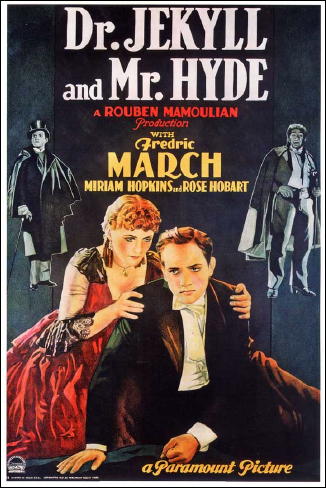
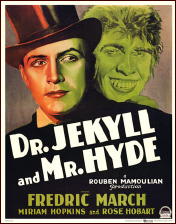
DR. JEKYLL & MR. HYDE Fredric March

DR. JEKYLL AND MR. HYDE. Paramount Pictures, 1931. Fredric March, Miriam Hopkins, Rose Hobart, Holmes Herbert, Halliwell Hobbes, Edgar Norton, Tempe Pigott. Screenplay: Samuel Hoffenstein and Percy Heath, based on the story by Robert Louis Stevenson. Director: Rouben Mamoulian.

   In 1931, two films were released that are still being shown in theaters and on television: James Whale’s Frankenstein and Tod Browning’s Dracula. Their great popularity initiated the horror cycle of the thirties.

   A third film was released that year whose subject was, like Frankenstein, the creation by a brilliant, eccentric scientist of a creature who threatens his creator’s life and sanity, but Dr. Jekyll and Mr. Hyde is director Rouben Mamoulian’s only horror film, and it has languished in relative obscurity,

   The film’s fluid, imaginative camera work, for which Mamoulian was noted, allies it to the best horror/fantasy films of the period as well as to the innovative musicals that were Mamoulian’s chief subjects in his long Hollywood career. It may be of some interest to note, in this respect, Whale’s direction of the 1936 Showboat, and to suggest that in their free use of non-realistic elements, the musical and horror films of the thirties are not unrelated.

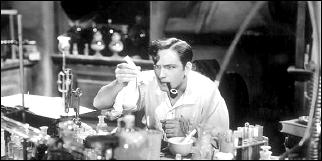
   Mamoulian’s adaptation, like the other film versions of Robert L. Stevenson’s novella, places great emphasis on the laboratory and transformation scenes and, unlike the source, doesn’t attempt to conceal the nature of Hyde’s identity from the audience.
DR. JEKYLL & MR. HYDE Fredric March

   (In Stevenson’ s story, Hyde is the evasive criminal whose secret Mr. Utterworth, the lawyer-investigator wryly calling himself Mr. Seek, sets out to uncover, making of the adventure at once a morality and a detection tale.)

   The laboratory is the conventional workshop of the thirties’ horror film, a classical locus that is at its most poetic and imaginative in Whale’s Bride of Frankenstein. It is also a dramatic stage which gives some slight plausibility to the drug-induced emergence of the Hyde personality.

   Mamoulian’ s principal interest is probably not in the horrific or suspenseful elements of the story, although his film is lacking in neither of these. His Hyde — a curious Simian-Negroid creation that may strike some viewers as a rather blatant ethnic stereotype — is certainly repulsive enough, but I think the director’s real subject is the consequences of the release of all inhibitions, his Hyde brooking no interference with any of his immediate needs and desires.
DR. JEKYLL & MR. HYDE Fredric March

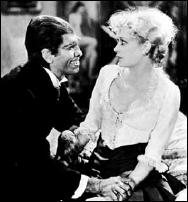
   This is most evident in the careful portrayal of the apparent distinction between Jekyll, the staid Victorian lover (even if unconventional scientist), and Hyde, the sensual, brutal lover whose pleasure is in a sadistic inflicting of pain on his mistress. And it is in the tactful but powerful depiction of Hyde’s relationship with his mistress (marvelously played by Miriam Hopkins) that the originality of this film in its relation to the horror film lies.

   The male/female relationships in the Hollywood horror films of the period tended to be chaste, unlike the franker treatment in other genre films: the rampant visual/sexual puns in the Busby Berkeley musicals, the poetic physicality of the Tarzan/Jane relationship in the first two MGM Weismuller/O’Sullivan films and Kong’s famous — and later edited — undressing of Fay Wray in King Kong.

   If one of the cherished memories — and cliches — of the monster chasing and sometimes carrying the heroine to a possible but never realized fate worse than death, the sexual play in these films is relatively tame.
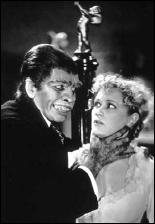
DR. JEKYLL & MR. HYDE Fredric March

   Not so in Mamoulian’s Jekyll. One of the best sequences — still memorable and unsettling is of Hyde’s unexpected return to his mistress’s chambers and his subsequent vicious teasing before he strangles her in a grim and deadly parody of the sexual embrace.

   It has often been said that the Horror of Dracula (Hammer Films, 1957) made explicit the eroticism of the vampire myth; what should also be pointed out — and perhaps for its irony — is that in the year that Browning’ s Dracula presented the classic version of the gentleman vampire, Mamoulian’s night-creature (like Dracula, freest and most powerful in his mistress’ s bedroom) tortured and teased and sexually abused his lover a way that the “mainstream” horror film would only dare to follow a quarter of a century later.

   The classic horror film has its narrative source in Victorian taboos and the way in which they are circumvented by the monster created in the laboratory or the grave. The vampire is the dark lover, the sensual bringer of pleasure and death, so unlike the correct, cardboard hero.
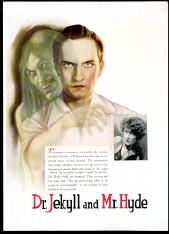
DR. JEKYLL & MR. HYDE Fredric March

   In Mamoulian’s film, the hero and the villain inhabit the same body. His Jekyll (Fredric March) has been criticized for his wooden playing, but what has not to my knowledge been pointed out is the way in which, as Hyde increases in strength, Jekyll comes to resemble him.

   There is a striking scene when Jekyll returns home, free he thinks of Hyde but dressed in the cape and top-hat affected by his other self and in his extravagant gestures more like the exuberant Hyde than the controlled scientist.

   But, then, Hyde was never far from Jekyll as the scientist pursued his obsession with the separation of the dual self, an obsession whose consequences are finally as destructive as Hyde’s natural genius for evil.
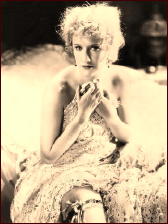
DR. JEKYLL & MR. HYDE Fredric March

   Early in the film, before Jekyll effects his first transformation, the good doctor treats a patient in her room. This patient is Ivy, the prostitute Hyde will pursue and kill, and as Jekyll takes his leave of her after they are surprised by his friend Lanyon in a passionate embrace, Ivy whispers seductively, “Come back,” and languorously, voluptuously moves her bare leg enticingly back and forth.

   Mamoulian superimposes the shot of her leg and the echo of her invitation over the following scene as the supposedly blameless Jekyll and his friend walk away from the apartment. Sex and science are both seductive siren calls, and the breaching of limits is fatal for both scientist and lover.

   Call Mamoulian’s Dr. Jekyll and Mr. Hyde a morality play, a scientific romance, a monster film with many of the genre’s conventions, a psychological flirtation with the mysteries of the self, this superbly crafted and haunting film is an artful extension of the possibilities of the horror film, and it has a power to disturb that still sets it apart from most other genre films of its time.

� This review first appeared in The MYSTERY FANcier, Vol. 7, No. 1, January/February 1983.


DR. JEKYLL & MR. HYDE Fredric March


DRACULA PRINCE OF DARKNESS

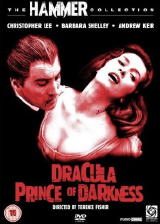
DRACULA, PRINCE OF DARKNESS. Seven Arts / Hammer Films, 1966. Christopher Lee, Barbara Shelley, Andrew Keir, Francis Matthews, Suzan Farmer, Charles Tingwell, Thorley Walters, Philip Latham. Screenwriter: Jimmy Sangster. Director: Terence Fisher.

   Although there were, I believe, other Dracula films in between, Prince of Darkness is the one that’s a direct sequel to The Horror of Dracula (1958), also with Christopher Lee as Count Dracula, and one of the films that put Hammer Films on the map.

   The means by which Dracula is brought back to life is one of the key scenes in this second movie, and so while I of course will say no more about it, it is (no surprise) rather a gruesome one. There are two scenes which caused a shiver down my back, and one of them is the one that occurs soon afterward, as an unwary character in the story stumbles across the scene.

DRACULA PRINCE OF DARKNESS

   And Dracula’s first appearance in the flesh (so to speak) was the other. Christopher Lee doesn’t get a lot a screen time himself, surprisingly enough, and no dialogue (only hissing, I believe), but seeing him quietly appear in the shadows as he does for the first time is enough to make anyone jump.

   Unfortunately, this is also one of movies in which the participants are warned, and explicitly so by the no-nonsense Father Sandor (Andrew Keir), to stay away from the castle, but do they listen? You needn’t ask. So that I found disappointing, and after his grand plan to rescue himself from oblivion succeeds in such fine fashion (and in this I am not exaggerating), he seems to flail around rather ineffectively thereafter.

   As a vampire hunter, Father Sandor is both a realist in terms of the evil he’s facing as well as an implacable foe, and I think this makes Andrew Keir, a giant of a man himself, the star of the movie.

DRACULA PRINCE OF DARKNESS

   Following immediately after the events chronicled in Prince of Darkness came Dracula Has Risen From The Grave (1968), a movie I saw about a year or so ago. For some reason, I do not seem to have written a review of it, but I recall it as having more plot to it than this one.

   This one, though, most reviewers seem to regard as a classic. It’s good but not that good, if you were to ask me, and there is of course no reason that you should. If you’re a fan of horror films, you’ll have seen this one already, and you’ll already have formed your own opinion.

REVIEWED BY DAN STUMPF:         


UNNATURAL. Carlton-Film, Germany, 1952. Also released as Alraune. Hildegard Knef, Erich von Stroheim, Karlheinz Böhm, Harry Meyen, Rolf Henniger, Harry Halm. Based on the novel by Hanns Heinz Ewers. Director: Arthur Maria Rabenalt.

ALRAUNE Hildegard Knef

    Perhaps the best film of that recent flurry of horror movies I watched was a much-maligned, badly-dubbed little thing called Unnatural (Germany, 1952). Or maybe it’s called Alraune; it was released under both titles and generally ignored no matter what they called it.

    Hard to say just what it is about this film that draws me so irresistibly. Maybe it’s the atmosphere of romantic depravity — it’s certainly not the choppy editing or the atrocious dubbing, though they add an element of dream-like unreality to the experience, particularly when the camera cuts from a scene filmed on some elaborate set or colorful location to one obviously shot in front of a painted backdrop — or even, in one case, on an empty black soundstage.

    Scenes seem to start and stop for no discernible reason: the film may come in on the middle of an argument or cut away before it’s resolved, yet it somehow still tells its twisted story.

ALRAUNE Hildegard Knef

    The story. Yes, the story. Well, in 1911 when Hans Heinz Ewers wrote the source novel, Artificial Insemination was a relatively new science, practiced only on animals, and ripe for exploitation by Science Fiction.

    Ewers became a major figure in the heady days of early German silent movies, and his story prefigures the morbid fascination with science and sex found there so often. Alraune tells of a woman created by artificial insemination (purest Sci-Fi back then) who has no soul: innocent herself, but compelled to drive those who love her to recklessness, crime and self-destruction.

    Well, we’ve all known someone like that. I think I went out with her a few times in College. But Ewers gives it to us in its purest form, and this film (the fourth made from the novel) relates it with a strange, syrupy romanticism: like what you’d get if Max Ophuls directed Texas Chainsaw Massacre.

    Like I say, I’m not sure why I find this so rich and watchable. Maybe it’s the patently ersatz innocence of Hildegard Knef (sometimes looking alarmingly like Eve Arden!) as Alraune, set against the relaxed depravity of Erich Von Stroheim as her creator: complementing rather than contrasting.

ALRAUNE Hildegard Knef

    But mostly I think it’s the rich imagery. The photographer of Alraune was himself a veteran of the German Silent Cinema, having worked with Lang and Murnau, and he makes this film a delight for the eyes as he picks out unsettling details in the background, or sets up a love scene in dark, sinister lighting.

    There’s a splendid final montage, dissolving from a dead figure to a withered root, which assumes the shape of a twisted man and finally settles on the image of one ascending the gallows as Alraune’s destiny works itself out. Pure abstract cinema and a film I’ll revisit.

Editorial Comment:   There is a three-minute clip on YouTube (follow the link) that demonstrates quite successfully Hildegarde Knef’s mesmerizing effect on a smitten suitor. A recent DVD of the film is apparently out of print, but copies are available (on Amazon, for example).

REVIEWED BY DAN STUMPF:         


Horror Flicks

    I’m afraid I’ve recently watched a lot of dreck, just for the sake of completeness. Things like William Castle’s abominable remake of The Old Dark House (Columbia,1963) and The Mad Monster (PRC, 1942) a film so cheap one is amazed by the very fact of its existence.

    Then there was The She-Creature (American International, 1956), a film with an odd patina of melancholy arising from the sight of its two stars, Chester Morris and Tom Conway, both promising young actors once, now trapped in this strange, low-budget miasma. At least it boasts a good monster.

Horror Flicks

    But there were a few gems, too: I re-watched a lot of the Universal Monster movies from the 1950s (The Deadly Mantis, Monster on the Campus, The Monolith Monsters, the Creature series, and my personal favorite, The Mole People, featuring a minimalist lost-civilization conquered by flashlights) and was pleasantly surprised by the air of professionalism about them.

    There’s even, from time to time, a moment of artistry or a flash of intelligence in the fast-moving flurry of destruction. Most horror buffs and film historians concentrate on Universal in the 30s or 40s, but I think these deserve a sharper look.

    After these came the zombie movies: White Zombie (1932, United Artists) inspired by W.B. Seabrooks’ eerie travelogue The Magic Island, the former a film with atrocious acting and worse script, but infused with a visual poetry that lifts its trite story to the level of a folk tale.

Horror Flicks

    This was followed by I Walked with a Zombie (1943, RKO Radio Pictures) which is Jane Eyre set in the West Indies, with Tom Conway (remember him?) as a brooding Rochester to Frances Dee’s doughty nurse.

    The last ten minutes of this thing is played out without dialogue except for a minute of voice-over narration by a narrator who isn’t even in the movie, producing a climax of pure abstract Cinema.

    Then last, but far from least, there’s King of the Zombies (1941, Mongram) where Mantan Moreland’s deft comedy relief easily steals the film from its nominal stars and monsters.

« Previous PageNext Page »