Horror movies


REVIEWED BY DAN STUMPF:         


TORMENTED

Tormented. Cheviot, 1960. Richard Carlson, Susan Gordon, Lugene Sanders, Juli Reding, Joe Turkel, Lillian Adams. Screenplay: George Worthing Yates. Original story & director: Bert I. Gordon.

The Lift. Arcade Pictures-Netherlands, 1983, as De lift. Huub Stapel, Willeke van Ammelrooy, Josine van Dalsum, Liz Snoyink, Wiske Sterringa. Screenwriter-director: Dick Maas.

   I’m feeling generous, so I will throw in a good word for Bert I. Gordon’s Tormented. Bert was never the most subtle of auteurs, but his blunt handling of supernatural cupidity somehow makes this tawdry re-hash of An American Tragedy (with ghosts) more credible even when Richard Carlson finds himself haunted by what is obviously a department store dummy.

   Somehow the milieu of cheapness and 60s chic surrounding the characters makes the whole thing believable even when the effects are not.

THE LIFT

   Speaking of Cheap, The Lift offers an interesting variation on the movie monster thing, with a tale of a killer-elevator that manages not to be as silly as it sounds.

   The director keeps things tight and suspenseful, and the two leads — playing a repairman and an intrepid girl reporter — put across the concept of working-class folk caught up in a gory mystery pretty ably.

   It’s fun enough, and there’s a dan-dan-dandy climax with the repairman in an elevator shaft, but the concept is a bit confining: it’s hard for an elevator to run amok, after all, so the Lift — like the Mummy back in the ’40s — has to mostly victimize the elderly, unfit and infirm.

   This didn’t bother a young Adonis like me much, but I got to wondering how some of the older, more decrepit members of my reading audience (no names) might react to seeing their ilk objectified as victims.

REVIEWED BY DAN STUMPF:         


HOUSE OF FRANKENSTEIN

House of Frankenstein. Universal Pictures, 1944. Boris Karloff, Lon Chaney, John Carradine, Anne Gwynne, Peter Coe, Lionel Atwill, George Zucco, Elena Verdugo. Story by Curt Siodmak. Director: Erle C. Kenton.

House of Dracula. Universal Pictures, 1945. Lon Chaney, John Carradine, Martha O’Driscoll, Lionel Atwill, Onslow Stevens. Director: Erle C. Kenton.

Bride of the Gorilla. Realart Pictures, 1951. Barbara Payton, Lon Chaney, Raymond Burr, Tom Conway, Paul Cavanagh, Gisela Werbisek. Screenwriter and director: Curt Siodmak.

   Following The Body Snatcher (reviewed here ) came House of Frankenstein / Dracula, the sad swan songs of the Monster Movie heyday, offering the Frankenstein monster, Dracula and the Wolfman, with Mad Scientists and Hunchbacks tossed in for good measure.

   These movies are two of my guilty pleasures; I know in my head they’re ridiculous, but it thrills my heart to see all the old cliches — and I mean all of them — treated respectfully one last time.

BRIDE OF THE GORILLA

   As for Bride of the Gorilla, it shows more intelligence than you’d expect to find in a movie called Bride of the Gorilla.

   Written and directed by Curt Siodmak, it offers Raymond Burr as a virile man-about-jungle who kills his mistress’s husband and finds himself the subject of a jungle-movie curse with predictable echoes of The Wolf Man (also written by Siodmak).

   One interesting twist is that Burr gets cursed not because he killed a man, but because he toyed with the affections of a local girl. The other twist is … well, I won’t reveal it except to say that this tatty little quickie repays careful viewing.

Reviewed by DAVID L. VINEYARD:         


DENNIS WHEATLEY – The Devil Rides Out. Hutchinson, UK, hardcover, 1935. Bantam, US, pb, 1967. Many other reprint editions.

DENNIS WHEATLEY The Devil Rides Out

Filmed as The Devil’s Bride. Hammer Films, 1968. Released as The Devil Rides Out in the UK. Christopher Lee, Charles Gray, Nike Arrighi, Leon Greene, Patrick Mower, Richard Eddington. Screenplay: Richard Matheson. Directed by Terence Fisher.

   With sales topping sixty million copies (that’s sales, not in print) Dennis Wheatley was one of the best selling writers of the 20th Century. His long list of books vary from mystery, to thriller, to spy novels, to historical adventure, to the occult, to lost worlds, and science fiction.

   His long running series include tales of secret agent Gregory Sallust; Napoleonic era secret agent Roger Brook; Monte Cristo-like Julian Day; and the tales of Duc de Richleau and his team of modern musketeers: American Rex Van Ryn, Englishman Richard Easton and his wife Mary, and Simon Aron, a young wealthy Jewish adventurer.

DENNIS WHEATLEY The Devil Rides Out

   The Devil Rides Out is a tale of de Richleau and his friends, and the first of Wheatley’s occult thrillers. It may also be his finest achievement in that genre. Simon Aron has fallen in with the mysterious cult leader known as Mocata, and de Richleau suspects something is wrong. When he confronts Simon, he discovers Mocata has the youth under his hypnotic spell and has drawn the young man into a demonic cult.

   De Richleau recognizes a dangerous enemy in Mocata and summons his friends Rex Van Ryn and Richard Easton to aide in rescuing Simon. Not surprisingly Rex also finds a young woman under Mocata’s rule and sets out to save her after he and de Richleau crash a Black Mass to perform a daring rescue of their friend.

   Now hiding Simon and the unwilling girl at Easton’s country home, they find themselves under siege by Mocata’s occult powers, climaxing in a night long battle of wills between de Richleau and Mocata, with our heroes within a protective pentagram and under attack by Death himself, mounted on a monstrous black stallion, who once summoned never leaves without a victim.

   When Richard and Mary’s daughter is kidnapped by Mocata as a sacrifice to open the very gateway to Hell it is time for a final battle between good and evil.

DENNIS WHEATLEY The Devil Rides Out

   I know a good many readers of this blog have little patience with the occult and the supernatural, but despite Wheatley’s sometimes awkward prose and mannerisms he had a real gift for both. (He himself didn’t believe in the supernatural but often wrote about its psychological dangers.)

   Several of his books in the field were classics, among them The Haunting of Toby Jugg, The Ka of Gifford Hillary (something of a tour de force since it is narrated by the hero from a state of suspended animation in his tomb), To the Devil a Daughter, and They Used Dark Forces, a Gregory Sallust WW II spy novel about Nazi attempts to use the occult as a weapon in WW II. Despite these books, he only wrote ten occult thrillers, a small portion of his output.

   Wheatley based Mocata on Alister Crowley, the self styled Satanic mage and Anti-Christ, who was also the basis for Somerset Maugham’s Oliver Haddo in The Magician, and James Bond’s arch enemy Ernst Stavro Blofield. Only a few years later during WW II Wheatley and Fleming would attempt to use Crowley’s occult contacts among the Nazi’s to infiltrate the party hierarchy while they both served in British intelligence.

DENNIS WHEATLEY The Devil Rides Out

   Crowley’s real life, mostly spent dodging the law and creditors, was a good deal less dramatic than that of his fictional counterparts. Still, he had a fairly good run as one of the great con men and frauds of the 20th Century, rubbing shoulders with the great and near great from poets like William Butler Yeats and fellow members of the prestigious Golden Dawn, to one of men who built the first atomic bomb at Los Alamos.

   The Devil Rides Out came to the big screen as Hammer Studios The Devil’s Bride with Christopher Lee ideally cast as de Richilieu and Charles Gray as Mocata. (Ironically Gray also played Blofield in the Bond film Diamonds Are Forever.)

   The Richard Matheson screenplay is faithful to the novel and the night long battle with Death mounted on a great black horse a memorable bit of cinematic horror. It’s a first class film, handsome to look at, and played to full effect by a fine cast.

   Despite his best selling status, Wheatley was likely best known in this country for the series of books he did in the 1930’s in the File series (File on Robert Prentice, File on Bolitho Blane), in which he provided the characters and crime and a complete set of clues, from lipstick-stained cigarettes to diagrams of the murder scene for the reader to solve.

DENNIS WHEATLEY The Devil Rides Out

   The books had a brief vogue, but ultimately it proved more fun to read about detectives than try to play one — not to mention the tendency to lose the enclosed clues.

   Despite his many flaws as a writer (he once said he never knew a best selling writer who knew the meaning of the word syntax) Wheatley knew how to spin a tale, and like his great literary hero Alexandre Dumas, his books are often highly readable and entertaining once you get into them. A number of his books were filmed, including Forbidden Territory, The Eunuch of Stamboul (as The Spy in White), To the Devil a Daughter, and Uncharted Seas (as The Lost Continent).

   Even absolute howlers like the stand alone Star of Ill Omen, where a British secret agent is kidnapped by Martians in a UFO and foils a Martian/Commie plot to destroy London (and believe me I’m making it sound saner than it reads), have a sort of goofy charm.

   His historical novels about Roger Brook, secret agent to William Pitt, probably received the most critical acclaim. Dark Secret of Josephine, in which Napoleon’s first wife reveals her ties to voodoo in her Hatian homeland, is likely the most successful blend of his chief interests; history, espionage, and the occult.

   But The Devil Rides Out is a first class thriller in the classic form. If you only read one Wheatley novel, this should be the one. The shootout at a Black Mass is worth the price of admission alone, and the siege within the pentagram guaranteed to raise the hackles of the most jaded horror fan. It’s a grand example of the occult thriller at its best.

REVIEWED BY DAN STUMPF:         


THE BODY SNATCHER. RKO, 1945. Boris Karloff, Bela Lugosi, Henry Daniell, Edith Atwater, Russell Wade, Rita Corday. Based on the short story by Robert Louis Stevenson. Screenplay: Philip MacDonald & Val Lewton (as Carlos Keith). Director: Robert Wise.

THE BODY SNATCHER Boris Karloff

   Compared to the Fredric March version of Dr. Jekyll and Mr. Hyde, reviewed not so long ago here, RKO treated Stevenson rather more faithfully in The Body Snatcher (1945), one of their string of quality “B”s produced by the redoubtable Val Lewton.

   This was directed by Robert Wise in his pre-bomb period, and allegedly written by Philip MacDonald, though he said someplace that Lewton re-wrote the whole thing under the name Carlos Keith.

   Well, it’s a fine job regardless of whodunit; not a really scary pitchur as much as a brooding one, with characters a bit more complex than you usually find in a monster movie.

   Karloff is at his nastiest in the title role, killing blind women and puppies with scarcely a qualm, yet he’s kind to his horse and positively dotes on the little crippled girl at the center of the story.

   Opposite him is the surgeon forced into using the services of a resurrection man to help the little girl walk again, played by Henry Daniell, as cold and constipated as ever. Daniell was one of those actors (like Laurence Harvey. or Dan Duryea) who never made any claim on audience sympathy, and maybe that’s why I like him so much.

   He does nothing very sinister here, yet his palpable heartlessness puts him instantly in the same camp as the Mad Scientists who typically run amok in this sort of thing.

   And when the running comes, it is indeed amok. Body Snatcher is one of those rare horror films with sense enough to save the scariest part for the climax, and ends with a burst of creepy action followed by a grim coda that leaves us feeling we’ve just seen some sobering lesson — even if we can’t say quite what it was.

REVIEWED BY DAN STUMPF:         


DR. JEKYLL & MR. HYDE Fredric March

DR. JEKYLL AND MR. HYDE. Paramount Pictures, 1932. Fredric March, Miriam Hopkins, Rose Hobart, Holmes Herbert. Based on the story by Robert Louis Stevenson. Director: Rouben Mamoulian.

   Continuing my pre-Halloween October odyssey in Monster Movie watching, then there was the 1932 version of Dr. Jekyll and Mr. Hyde, directed by Rouben Mamoulian, with Fredric March, a film that established the definitive “Hyde look” with simian features and form incongruously decked out in evening clothes and top hat.

   Mamoulian and March, however, somehow make the tortured Jekyll a more interesting figure than the simplistic Hyde, who looks like somebody shaved an ape.

   One other thing: according to IMDB, this story has been filmed more than 20 times, and not once to my knowledge, as Stevenson wrote it: a mystery gradually unfolding to a horrific conclusion.

THE APE. Monogram, 1940. Boris Karloff, Maris Wrixon, Gene O’Donnell, Dorothy Vaughan, Gertrude Hoffman, Henry Hall. Based on a play by Adam Shirk, adapted by Curt Siodmak. Screenwriters: Siodmak and Robert Carroll. Director: William Nigh.

THE APE Boris Karloff

   This low-budget horror film was among those shown on TCM as part of a day-long festival of Boris Karloff movies just before Halloween.

   In David Vineyard’s rundown of the list of titles (see the comments following), he gave rather short shrift to this one, and I’m sure rightfully so.

   It’s short on thrills, imagination and budget, not necessarily in that order, but the presence of Mr. Karloff in it makes it worth a look-see, as it almost always does.

   He plays one of his patented, well-recognized characters in this one, the more than slightly befuddled Dr. Bernard Adrian, whose dream is find a cure for polio in his backroom laboratory, first for crippled Frances Clifford (Maris Wrixon), who lives only a short distance away, and then for all mankind.

THE APE Boris Karloff

   He’s a kindly old man, rather feeble-looking, but slightly scary with that glaring intensity that’s always in his eyes – the sort of old man whose house small kids dare each other to throw rocks at, which they do.

   To obtain the serum for Miss Clifford’s recovery – well, that’s where the escaped ape from a circus traveling nearby comes in. Dr. Adrian finds he needs what seem to be spinal taps from dead men to continue his work, and somehow it appears that he has the ape doing his stealthy, late-at-night tasks for him.

   Here are the key words in the review so far: befuddled, kindly, scary, intensity, stealthy. Without Boris Karloff in this movie, you could also call it ludicrous. But with him in it, it’s transformed into another dimension altogether.

   It’s still not a very good movie, but I think there are parts of it, if I can convince you to watch it, that you may not forget — and no, I don’t mean the scary parts.

REVIEWED BY DAN STUMPF:         


THE FALL OF THE HOUSE OF USHER 1928.

La chute de la maison Usher. [The Fall of the House of Usher.] Films Jean Epstein, 1928. Silent. Jean Debucourt, Marguerite Gance, Charles Lamy, Fournez-Goffard, Luc Dartagnan. Based on the story by Edgar Allan Poe; adaptation by Luis Buñuel. Screenwriter-director: Jean Epstein.

The Fall of the House of Usher. G.I.B., 1949. Gwen Watford, Kay Tendeter, Irving Steen, Vernon Charles. Based on the story by Edgar Allan Poe. Director: Ivan Barnett.

The Queen of Spades. Associated British Picture Corp., 1949. Anton Walbrook, Edith Evans, Yvonne Mitchell, Ronald Howard, Mary Jerrold. Based on the short story by Alexander Pushkin. Director: Thorold Dickinson.

   After The Phantom of the Opera [reviewed here ] I followed up with two versions of The Fall of the House of Usher: first, a French silent film from 1928 by Jean Epstein and Luis Buñuel (whom I hold responsible for frequent meaningless cutsaway to shots of frogs enjoying a night of passion) and secondly, the British quota quickie from 1949.

   I recommend both films to viewers who can enjoy a creepy mood for its own sake, and ignore some (well, a lot… make that an awful lot of) narrative deficiencies. The ’49 film in particular suffers from a bad script, dreadful acting and low budget, but it conveys such a sense of absolute horror that I find myself shuddering, even after repeated viewings.

   The Queen of Spades, made the same year, in the same country as the second House, is in fact its polar opposite: lavishly produced and directed, brilliantly written and acted, it’s a film I can recommend to anyone who loves a fine, gothic chiller, with ghosts, obsession and satanic bargains.

   And it also has a used bookstore.

QUEEN OF SPADES      

REVIEWED BY DAN STUMPF:         


THE PHANTOM OF THE OPERA Lon Chaney

THE PHANTOM OF THE OPERA. Universal, 1925. Lon Chaney, Mary Philbin. Norman Kerry, Arthur Edmund Carewe, Gibson Gowland, John Sainpolis.

Based on the novel Le Fantôme de l’Opera by Gaston Leroux. Directors: Rupert Julian; Lon Chaney, Ernst Laemmle, Edward Sedgwick (the latter three uncredited).

   October is the month I spend watching Monster Movies and reading scary books. I kicked things off with The Phantom of the Opera, directed by Rupert Julian, Edward Sedgwick and possibly others, and adapted by no fewer than seven writers from Gaston Leroux’s novel.

   Phantom has its moments, but overall it’s something of a mess — the result, no doubt of so many cooks at the broth, fingers in the pie, pigs at the trough or who-ever in the what-have-you.

   Universal did a lot of tinkering with this thing, adding and cutting scenes, restoring deleted parts and cutting added ones, and finally emerged with a rather disjointed film: a slow, mysterious first half capped by a horrific climax in the middle of the movie, followed by a colorful romantic interlude, trailed by some rather tepid serial-type chills, with a wild chase for the finish.

THE PHANTOM OF THE OPERA Lon Chaney

   A few pretty nice things creep out of the cinematic jungle though, mostly due to Lon Chaney and the incredible force of personality he brings to Eric the Phantom (Some reports aver that he directed his own scenes himself.) Chaney moves with a compelling balletic grace, and whoever directed his scenes knew how to play up billowing capes and staring skull-faces for all they might be worth.

   The Bal Masque scene is a riot of two-strip Technicolor dominated by Chaney’s Red Death, and the ensuing love scene among the statues achieves a fine romantic creepiness: the furtive lovers embracing under cool blue estuary in the night air, as a red-cloaked monster broods above them.

THE PHANTOM OF THE OPERA Lon Chaney

   Chaney’s acting is magnetic, and Mary Philbin puts visible enthusiasm — if no discernible subtlety — into heroine Christine’s histrionics.

   But it’s Norman Kerry as the nominal hero of the piece who walks off with the show: Aging, bland, over-groomed, dull and unimaginative, Kerry is everything the nominal hero of a Monster Movie should be.

   He has only to walk on screen to bore you to tears, and his declarations of undying love offer a listlessness that horror films were not to see again until the “living Dead” movies of the 70s.

   But wait, there’s more; where the heroes of most monster movies are merely dull and ineffectual, Kerry actually has to be led by the hand to rescue his beloved and finally faints dead away when things get tough.

   There are subversive tendencies in Monster Movies, where the bad guys we’re supposed to fear are always more interesting than the good guys we’re supposed to cheer, and there’s no better illustration of the concept than Norman Kerry in The Phantom of the Opera.

THE PHANTOM OF THE OPERA Lon Chaney

   Coming up tomorrow, Friday, October 30th. I can watch Boris Karloff in anything. Bela Lugosi? Not so much.

6:00 AM Behind the Mask (1932)
A Federal Agent goes undercover in prison to break up a drug syndicate. Cast: Jack Holt, Constance Cummings, Boris Karloff. Dir: John Francis Dillon. BW-68 mins, TV-PG

7:15 AM Mask Of Fu Manchu, The (1932)
A Chinese warlord threatens explorers in search of the key to global power. Cast: Boris Karloff, Lewis Stone, Myrna Loy. Dir: Charles Brabin. BW-68 mins, TV-PG, CC

8:30 AM Ghoul, The (1933)
An ancient Egyptian returns to punish those who violated his tomb. Cast: Boris Karloff, Cedric Hardwicke, Ernest Thesiger. Dir: T. Hayes Hunter. BW-81 mins, TV-G, CC

10:00 AM Black Room, The (1935)
An evil twin brother disposes of his enemies in a secret death chamber on his estate. Cast: Boris Karloff, Marian Marsh, Katherine Demille. Dir: Roy William Nell. BW-68 mins, TV-G, CC

11:15 AM Walking Dead, The (1936)
A framed man comes back from the dead to seek revenge. Cast: Boris Karloff, Edmund Gwenn, Marguerite Churchill. Dir: Michael Curtiz. BW-65 mins, TV-PG, CC

12:30 PM Man They Could Not Hang, The (1939)
A mad scientist uses an artificial heart pump he invented to seek revenge after he is executed. Cast: Boris Karloff, Lorna Gray, Robert Wilcox. Dir: Nick Grinde. BW-64 mins, TV-14, CC

1:45 PM Man With Nine Lives, The (1940)
A doctor’s attempts to cure cancer lead to a series of grisly murders. Cast: Boris Karloff, Roger Pryor, Jo Ann Sayers. Dir: Nick Grinde. BW-74 mins, TV-PG

3:00 PM Before I Hang (1940)
A mad scientist experiments with a serum tainted with a psychopath’s blood. Cast: Boris Karloff, Evevlyn Keyes, Bruce Bennett. Dir: Nick Grinde. BW-62 mins, TV-PG, CC

4:15 PM Ape, The (1940)
A mad doctor dresses as an ape to kill victims for their spinal fluid. Cast: Boris Karloff, Maris Wrixon, Gertrude Hoffman. Dir: William Nigh. BW-62 mins, TV-PG

5:30 PM Devil Commands, The (1941)
A scientist kills innocent victims in his efforts to communicate with his late wife. Cast: Boris Karloff, Richard Fiske, Anne Revere. Dir: Edward Dmytryk. BW-64 mins, TV-14

6:45 PM Isle Of The Dead (1945)
The inhabitants of a Balkans island under quarantine fear that one of their number is a vampire. Cast: Boris Karloff, Ellen Drew, Helene Thimig. Dir: Mark Robson. BW-72 mins, TV-PG, CC

REVIEWED BY DAN STUMPF:         


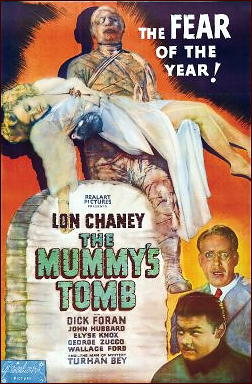
THE MUMMY’S TOMB. Universal, 1942. Lon Chaney Jr., Dick Foran, John Hubbard, Elyse Knox, George Zucco. Director: Harold Young.

THE MUMMY'S TOMB

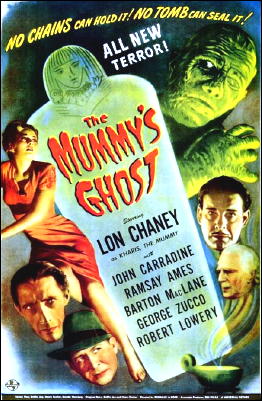
THE MUMMY’S GHOST.. Universal, 1944. Lon Chaney Jr., John Carradine, Robert Lowery, Ramsay Ames, Barton MacLane, George Zucco. Director: Reginald Le Borg.

THE MUMMY'S GHOST

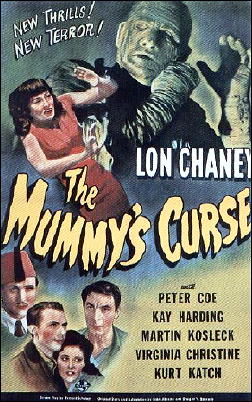
THE MUMMY’S CURSE.. Universal, 1944. Lon Chaney Jr., Peter Coe, Virginia Christine, Kay Harding, Dennis Moore. Director: Leslie Goodwins.

THE MUMMY'S CURSE

   The Mummy (1932; reviewed by Steve way back here) is one of the great romantic films, and The Mummy’s Hand (1940) is a snappy little programmer, but the three Mummy films with Lon Chaney Jr. are the plodding, proletarian work-horses of the Monster Movie.

   Slow-moving, badly-cast and sloppily-written, they have always struck me as examples of what a day-to-day Grind a Monster’s life must be. Kharis stumbles along playing out his curse with no joy, no sign of satisfaction, preying on the Old and Slow-Moving like he was stamping out Widgets on an assembly line, which is a very apt description of the way these films were produced.

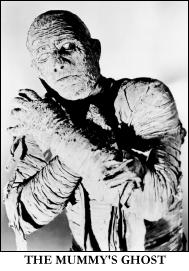
THE MUMMY'S GHOST

   Ben Pivar, the producer responsible for the series, was by some accounts a man of legendary Bad Taste, a filmmaker whose idea of Art was a story that could incorporate as much stock footage and as few sets as possible.

   Indeed, his Mummy movies seem to be made up mostly of clips from earlier films, like youngsters devouring their parents.

   Yet the Kharis films taken as a whole, convey a theme of surprising perversity: alone among Movie Monsters, Kharis fulfills his destiny. He destroys the defilers of Ananka’s tomb and twice reclaims his reincarnated Princess.

   Yet, like the hero of a David Goodis novel, he never succeeds on his own terms. Each film ends with him joylessly sinking back into the grimy milieu from whence he came at the start, no wiser, no happier, and no longer loved.

   Which is a pretty odd message to come from a low-brow producer like Pivar. Just a pity the films themselves are so damn boring.

« Previous PageNext Page »