Characters


REVIEWED BY WALTER ALBERT:         


JOHN LESLIE – Night and Day. Simon & Schuster, hardcover, 1995. Pocket Books, paperback, 1996.

   This is the second of four mysteries featuring Gideon Lowry, a jazz pianist and private investigator based in Key West. His brother committed suicide at the end of the first book and Gideon’s girl friend (Casey) has moved to Miami.

   A visiting singer named Asia (with lips the color of plum) hires Gideon to locate her estranged husband, a writer obsessed with Hemingway. This is a not inappropriate obsession in Key West with the annual Hemingway Days celebration and the Hemingway house, which is open to the public as a museum. Gideon finds the missing husband, but he’s soon killed and Asia looks like a prime suspect.

   The novel (like the other three) is heavy with sultry heat and the perfume of whatever produces heavy scents In Key West. A nice series of grace notes on the 1990s private eye scene.

       The Gideon Lowry series —

Killing Me Softly (1995)


Night And Day (1995)
Love For Sale (1996)
Blue Moon (1998)

Reviewed by JONATHAN LEWIS:         


ED McBAIN – The Gutter and the Grave. Hard Case Crime #15, paperback, December 2005. First published as I’m Cannon — for Hire, as by Curt Cannon (Gold Medal #814, 1958), with the leading character also named Curt Cannon.

   Ed McBain’s The Gutter and the Grave is a quick, entertaining read and quite good, if not overly complicated, murder mystery. It’s also a time capsule of sorts, an enchanting mirror looking backward to late 1950s Manhattan, an age when jazz was king, the Bowery was for bums, and there were down and out and hard drinking private eyes like the book’s protagonist, one washed out thirty-something, Matt Cordell.

   Cordell, as the narrator of the work, lets us know early on who he is and what he is. “I’m a drunk. I think we’d better get that straight from the beginning.” (Page 13.) Our “hero” spends his days hanging out around Cooper Union in lower Manhattan. Then one day, a friend—of sorts—from the old neighborhood uptown — way uptown — shows up and wants an investigative favor.

   Enter Johnny Bridges who wants Cordell to look into some fishy goings on in the tailor shop he runs with a guy named Dom Archese. Maybe Dom’s fishing from the cash register late at night.

   All fine and good, until the duo head uptown only to find Dom Archese dead. Worse still, at least for Bridges, are the initials “JB” scrawled in chalk. Bridges, to no one’s surprise, becomes the chief suspect and ends up in police custody. It’s now up to Cordell to figure out what’s going on and to exonerate his so-called friend, if possible.

   Along the way, Cordell meets up with Dom’s wife, Christine (who also ends up dead), Christine’s sister, who is an aspiring musician by the name of Laraine Marsh, a Manhattan cop named Miskler, and sundry other colorful characters including a rival PI and his sultry employee. All the while, Cordell is reminded of his ex-wife, Toni, his one true love who ended up in the arms of another man.

   Cordell’s world is not a happy one, but it’s an extraordinarily vivid one. At least that’s how Ed McBain paints it. And what a painting! Reading The Gutter and the Grave transports you to a specific time and a specific place. It’s sometime in the late 1950s and Manhattan’s a crowded, hot city in the summer. The murder and the lies all around Cordell only make it hotter. Recommended.

       The Matt Cordell/Curt Cannon short stories (as by Evan Hunter) —

“Die Hard” (January 1953, Manhunt)
“Dead Men Don’t Dream (March 1953, Manhunt)
“Now Die in It” (May 1953, Manhuntt)
“Good and Dead” (July 1953, Manhunt)
“The Death of Me” (September 1953, Manhunt)
“Deadlier Than the Male” (February 1954, Manhunt)
“Return” (July 1954, Manhunt)
“The Beatings” (October 1954, Manhunt)

   The first six of the above were collected in I Like ’em Tough, as by Curt Cannon (Gold Medal #743, 1958).
THE ARMCHAIR REVIEWER
Allen J. Hubin


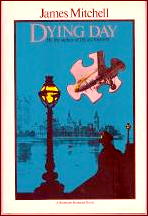
JAMES MITCHELL – Dying Day. Henry Holt, hardcover, 1989. First published in the UK by H. Hamilton, hardcover, 1988.

   James Mitchell has done a number of crime novels, as himself and as James Munro, and now turns up with a London private eye named Ron Hogget. Hogget finds things for people, though the finding usually involves some fearful activities.

   Ron is often fearful — he’s that sort of person — but he usually gets the job done. And he has Dave, a friend who drives a cab, reads Literature, knows everything about guns and self-defense and nothing about fear.

   Hogget’s second adventure is Dying Day. [But see below.] Here Tony Palliser, filthy rich now from business that began with airplanes — Dakotas — participating in the Berlin airlift in 1948, calls on Hogget’s services. It’s one of those planes, lost at that time, that Palliser now wants Ron to find.

   Why, after all these years? Palliser’s reason is thin, but his money is good so Ron starts. And finds he’s not alone on the search, that the real reason must be quite impressive for all the dying being arranged on its behalf. Including, very likely, his…

   A solidly constructed, high-tension story with a well-crafted array of characters.

— Reprinted from The MYSTERY FANcier,
       Vol. 11, No. 3, Summer 1989.

      The Ron Hogget series —

Sometimes You Could Die. H. Hamilton, 1985. No US edition.
Dead Ernest. H. Hamilton, 1986. Holt, 1987.
Dying Day. H. Hamilton, 1988. Holt, 1989.

RHYS BOWEN – The Twelve Clues of Christmas. Berkley, hardcover, November 2012; paperback, November 2013.

   Lady Georgianna Rannoch, who tells the story, is 34th (or 35th; sources differ) in line to the throne of England, but due to various misfortunes, none of her own doing, she is dependent on the good will of others, especially at the beginning of Clues that of her sister-in-law, the Duchess of Rannoch, commonly known as Fig, as to her overall welfare and a roof over her head.

   Determined not to spend Christmas at the ancestral (and austere) Rannoch castle where she is not particularly welcome, Georgie answers an ad in a magazine to act as a social director for a lengthy Christmas house party in Devonshire. Her application is accepted almost at once, and it is goodbye to winter in gloomy Scotland even more quickly.

   Turns out, as it so often does in fiction if not real life, that her mother, a flighty lady and a sometimes actress who abandoned Georgie at very young age, is staying in a nearby cottage with none other than Noel Coward. (There is no ill feeling between Georgie and her mother. The former has learned to accept her for who she is.) And as it also turns out, Georgie’s good friend, the adventurous Mr. Darcy O’Mara, is on hand as well.

   As in cozy mystery fiction of which this is a fine example, Georgie’s personal life, family relationships and the like take up a sizable percentage of the story. There is a murder involved, or in fact a whole series of them. Or perhaps I should take that back. There is a whole series of strange deaths that occur, all of which appear accidental, nor is there any apparent connection between them.

   We, the reader, know better. It is a murderous scheme on the part of someone, a plan worthy of a villain in an Agatha Christie or Ellery Queen detective story, but without a detective on hand to solve it. With the local police inspector barely up to the job, it is up to the purely amateur efforts of Lady Georgianna, and the sometimes assistance of Darcy, to come up with killer or killers.

   The Twelve Clues of Christmas is fun to read, and is chock full of various Christmas customs of England in the 1930s, but the detective plot certainly could have been filled out more. It’s clever to begin with, but the details become more and more sketchy as time goes on. In fact, the connection between the deaths is discovered with more than 70 pages to go, leaving only Georgie’s kidnapping (and a couple of gruesome deaths) to fill in most of the rest of the novel.

      The Royal Spyness series —

1. Her Royal Spyness (2007)

2. A Royal Pain (2008)
3. Royal Flush (2009)
4. Royal Blood (2010)

5. Naughty In Nice (2011)
5.5. Masked Ball at Broxley Manor (novella, 2012)
6. The Twelve Clues of Christmas (2012)
7. Heirs and Graces (2013)

8. Queen of Hearts (2014)

THE ARMCHAIR REVIEWER
Allen J. Hubin


M. R. D. MEEK – A Mouthful of Sand. Scribner’s, hardcover, 1989. Worldwide, paperback, 1990. First published in the UK by Collins, hardcover, 1988.

   I quite like M.R.D. Meek’s stories about Lennox Kemp, and A Mouthful of Sand is no exception. Kemp, a lawyer, was barred from practice when he took money to pay his wife’s gambling debts. She disappeared along with his reputation, and he served a lonely six years’ penance as a private investigator.

   Now he’s back in the law, doing very well, having a relationship (albeit uneasy) with Penelope Marsden. His life is coming back together; perhaps he will marry Penelope and banish the loneliness he fears so much.

   Here a tycoon asks him for a written opinion on the state of British marriage law. Lennox complies, then [leaves] to go on vacation to Cornwall, coincidentally to the coastal town where the tycoon’s wife has gone to recover from severe depression. But her condition worsens, and the battered head of a man is found on the beach. Soon Kemp finds himself ensnared — heart and mind.

   Very effective storytelling, full of subtleties and dense with expressive language.

— Reprinted from The MYSTERY FANcier,
       Vol. 11, No. 3, Summer 1989.


Bio-Bibliographic Notes: Since Lennox Kemp is a Private Eye, there’s no place better to look for information about him than the Thrilling Detective website. There Kevin Burton Smith says, in part: “… while waiting to be reinstated (the events leading up to his disbarment are related in the first book in the series), he earns his daily bread as an op for the London-based McCready’s Detective Agency. But he is eventually reinstated, and this spare yet often elegant series, full of rich characterization, and sharp writing, continues, with Kemp as a particular hands-on type of attornney, part Perry Mason and part Lew Archer.”

   His creator was in real life Margaret Reid Duncan Meek (1918-2009), a retired lawyer.

       The Lennox Kemp series —

With Flowers That Fell (1983)

The Sitting Ducks (1984)
Hang the Consequences (1984)
The Split Second (1985)
In Remembrance of Rose (1986)

A Worm of Doubt (1987)
A Mouthful of Sand (1988)
A Loose Connection (1989)
This Blessed Plot (1990)
Touch and Go (1992)

Postscript to Murder (1996)
If You Go Down to the Woods (2001)
The Vanishing Point (2003)
Kemp’s Last Case (2004)

THE ARMCHAIR REVIEWER
Allen J. Hubin


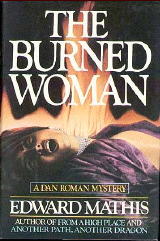
EDWARD MATHIS – The Burned Woman. Scribner’s, hardcover, 1989. Berkley, paperback, 1990.

   The late Edward Mathis [1927-1988] reportedly left a pile of manuscripts, and, if The Burned Woman is any indication, we have some fine treats in store. Here we travel further down the Dan Roman trail. He’s [a private eye] married to Susie, sixteen years his junior and very successful in TV reporting.

   Those years of age difference, the demands of her job, the crude advances of one of Susie’s celebrity interviewees — these all eat at Dan, and he drives her away. Whereupon, after a meeting with the celebrity, she disappears. Dan is plunged into alcoholic despair, alienating his best friend, “proving” his love for Susie by dallying with a prostitute, flailing randomly about as the weeks pass.

   Could the celebrity be holding Susie somewhere, could Susie’s disappearance be connected with a road accident near the celebrity’s home on the night she disappeared?

   Roman here emerges as a deeply flawed person, but the tale is masterfully plotted and utterly compelling.

— Reprinted from The MYSTERY FANcier,
       Vol. 11, No. 3, Summer 1989.

       The Dan Roman series —

From a High Place (1985)

Dark Streaks and Empty Places (1986)
Natural Prey (1987)
Another Path, Another Dragon (1988)
The Burned Woman (1989)
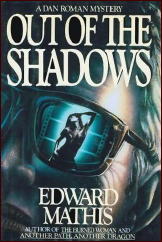
Out of the Shadows (1990)

September Song (1991)
The Fifth Level (1992)

THE ARMCHAIR REVIEWER
Allen J. Hubin


JAMES E. MARTIN – The Mercy Trap. Putnam’s, hardcover, 1989. Avon, paperback, 1990.

   James E. Martin, policeman in Norwalk, Ohio, turned special investigator for the State of Ohio and now retired, authored a mystery in 1973 (The 95 File) and now returns with The Mercy Trap, the first of a series about private eye Gil Disbro.

   Disbro comes full-grown out of the standard P.I. womb: former cop, former husband, getting his sex without commitment, a man with his own particular standards which are at once adaptable and firmly held. He walks the mean streets of Cleveland, retrieving bail jumpers for a bondsman between real jobs.

   Here a mission of mercy comes his way: wealthy contractor Howard Eberly’s adopted daughter is dying for lack of a kidney transplant, and Eberly wants her real mother or other close relative found as a possible donor. Not a quest likely to involve violence, though a twenty-nine-year-old trail with the mother’s true identity carefully hidden may prove a tad faint.

   But the traces are quickly picked up by Disbro’s capable hands, though along the way (but where? and why?) he seems to have stepped on somebody’s toes. Martin’s narrative is compelling, his sense of plot and pace sure. I’ll await the next Disbro with much anticipation.

— Reprinted from The MYSTERY FANcier,
       Vol. 11, No. 3, Summer 1989.

       The Gil Disbro series —

The Mercy Trap. Putnam 1989.
The Flip Side of Life. Putnam 1990.
And Then You Die. Morrow 1992.
A Fine and Private Place. Morrow 1994.

THE ARMCHAIR REVIEWER
Allen J. Hubin


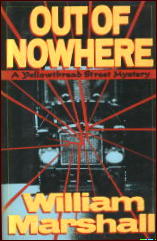
WILLIAM MARSHALL – Out of Nowhere. Mysterious Press, hardcover, 1988; reprint paperback, 1989.

   The thirteenth mad adventure from Hong Kong’s Yellowthread Street Station is Out of Nowhere, by William Marshall. Here as usual Inspector Harry Feiffer and his minions have several wacky puzzles. There is the matter of the rented van, loaded with second-quality plate glass and carrying four persons, which vehicle roars the wrong way down a 3 A.M. freeway for a spectacular collision with a truck. Everything Harry learns about this matter serves to increase his bafflement.

   Meanwhile, there’s the Dalmatian which repeatedly attacks an herbal medicine shop, wrecking the premises (mighty dog!) and carrying off selected medications as well as an array of wind chimes. And finally, Inspector O’Yee, manning a line designed for the pacification of telephonically inclined psychopaths, finds he has a ten-year-old child on the other end with a loaded and cocked Luger in his school bag.

   Marshall stirs this mix in his typical onomatopoeic fashion. Enjoyable but not the strongest in the series.

— Reprinted from The MYSTERY FANcier,
       Vol. 11, No. 3, Summer 1989.


      The Yellowstreet Station series —

1. Yellowthread Street (1975)

2. The Hatchet Man (1976)
3. Gelignite (1975)
5. Thin Air (1977)
5. Skulduggery (1979)
6. Sci-fi (1981)
7. Perfect End (1981)
8. War Machine (1982)
9. The Far Away Man (1984)

10. Roadshow (1985)
11. Head First (1986)
12. Frogmouth (1987)
13. Out of Nowhere (1988)
14. Inches (1994)
15. Nightmare Syndrome (1997)
16. To the End (1998)

Note:   There was also a Yellowthread Street television series in England. Produced by Yorkshire Television, it ran for one season (13 episodes) in 1990. It has not yet been released commercially, but DVDs can be obtained on the collector-to-collector market.

THE BACKWARD REVIEWER
William F. Deeck


OSMINGTON MILLS – At One Fell Swoop. Geoffrey Bles, UK, hardcover, 1963. Roy, US, hardcover, 1965.

   Aware that the case won’t do his career any good, Superintendent William Baker of Scotland Yard’s Special Branch nonetheless undertakes the investigation of the missing head of the C.I.D. in Bramwith. The policeman, a lay preacher in the Johnsonite sect, had disappeared shortly before he was to address a centenary celebration of the sect, if the Johnsonites can be said to celebrate.

   Since the policeman’s wife had tried to divorce him for cruelty and now has a lover, she and the lover are the first suspects, if there has indeed been foul play. Information also turns up that the C.I.D. man had with him on his travels two warrants; perhaps the individuals sought made sure that the warrants would not be served.

   Possible, too, is the involvement of the police superintendent where the C.I.D. man was going to serve the warrants. But what role does the leek slasher play?

   A good investigation by Baker and his assistant, Inspector Hughes, and an engrossing portrait of a fundamentalist Christian sect. Forgive the far-fetched coincidences and enjoy this one.

— Reprinted from The MYSTERY FANcier, Vol. 11, No. 3, Summer 1989.


BIBLIOGRAPHIC NOTES:

      The Insp. (Supt.) William Baker series —

Unlucky Break. Bles, 1955.
The Case of the Flying Fifteen. , Bles, 1956.
No Match for the Law. Bles, 1957.
Misguided Missile. Bles 1958.
Stairway to Murder. Bles, 1959.
Trial by Ordeal. Bles, 1961.
Headlines Make Murder. Bles, 1962.
At One Fell Swoop. Bles, 1963.
Traitor Betrayed. Bles, 1964.
Enemies of the Bride. Bles, 1966.

   Osmington Mills was the pseudonym of Vivian Collin Brooks (1922-2002), whose other series, eight in all, recorded the cases of Chief Insp. Rupert “Rip” Irving and P.C. (Sgt.) Patrick C. Shirley.

THE ARMCHAIR REVIEWER
Allen J. Hubin


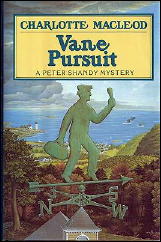
CHARLOTTE MacLEOD – Vane Pursuit. Mysterious Press, hardcover, 1989; paperback, 1990.

   Vane Pursuit is one of the better tales in Charlotte MacLeod’s series about Peter Shandy, professor of botany at Balaclava College in the nether regions of Massachusetts. Shandy’s wife Helen is here working on a book project involving the potentially famous weathervanes created by the nomenclaturally unforgettable Praxiteles Lumpkin.

   However, disaster seems to attend her photographic rounds: buildings burn and weathervanes are destroyed. Or mysteriously disappear. One of the casualties is the Lumpkin Soap Factory, the conflagration of which destroys the Lumpkinton employment base, returns one employee to his Maker, and signals the departure of a particularly stellar vane.

   These goings-on, plus the antics of a crew of rural survivalists and a fascinating cave dweller, fully engage the Shandys to the brinks of their lives. Vane Pursuit has a stronger plot than some in this series, with less reliance on the soon tiresome tactic of outrageous character names, and the dialog is sprightly.

— Reprinted from The MYSTERY FANcier,
       Vol. 11, No. 3, Summer 1989.


      The Professor Peter Shandy series —

Rest You Merry (1978)
The Luck Runs Out (1979)
Wrack and Rune (1981)
Something the Cat Dragged in (1983)
The Curse of the Giant Hogweed (1985)
The Corpse in Oozak’s Pond (1986)
Vane Pursuit (1989)
An Owl Too Many (1991)
Something in the Water (1994)
Exit the Milkman (1996)

« Previous PageNext Page »