Characters


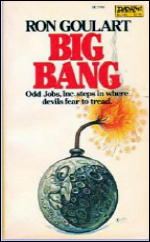
RON GOULART – Big Bang. DAW, paperback original, 1982.

RON GOULART Big Bang

   If you go by the odds, they’re over a thousand to one that you’11 find this latest work by Ron Goulart, a wacky wordsmith in the tradition of no one but himself, over in the science fiction of your favorite B. Dalton Bookstore, and not in with the mysteries at all. If it were to come down to it, I guess that’s where I’d put it, too, but if you care for your detective-story reading served to you a la a combination of Craig Rice and Crazy Guggenheim, why not step across an aisle or two and give yourself a real treat?

   The proprietors of Odd Jobs, Inc., are Jake and Hildy Pace, who are assisted at times by their tipsy attorney, John J. Pilgrim, and an electronic eavesdropper named Steranko. Their specialties are cases “normaI agencies won’t go near, cases even our government has given up on.” The year is 2003, in case you were wondering, and the President are a pair of Siamese twins named Ike and Mike, joined together at the funny bone.

   The case is a fairly ordinary one, all things considered: a series of huge explosions is wiping out important world figures, as well as anyone else in the general vicinity. The Paces suspect stock manipulators at work, rather than your standard, every-day sort of terrorist type of person. Rex Sackler, Luther McGavock, Ed Jenkins, and Race Williams (among others) have already failed on the case. (Goulart is a notorious name-dropper, isn’t he?)

   His work is also filled with hilariously funny glimpses into today’s media-conscious society, stirred up thoroughly and served here as a fast-paced (extremely), no-nonsense (well, maybe just a little) detective novel. I mean, what other mystery story have you read recently that requires the use of a Captain Texas secret decoder device as an essential part of the solution?

    Rating:   B

— Reprinted from The MYSTERY FANcier,
       Vol. 7, No. 3, May-June 1983.


    The Jake & Hildy Pace series —

Odd Job No. 101, and other future crimes and intrigues (collection). Scribner, 1975.
Calling Dr. Patchwork. DAW, 1978.
Hail Hibbler. DAW, 1980.
Big Bang. DAW, 1983.
Brainz, Inc. DAW, 1985.

IT IS PURELY MY OPINION
Reviews by L. J. Roberts


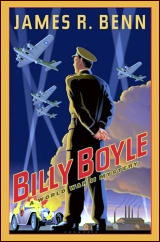
JAMES R. BENN – Billy Boyle. Soho Press, hardcover, 2006; softcover,2007.

JAMES BENN Billy Boyle

Genre:   Historical mystery. Leading character:   Billy Boyle, 1st in series. Setting:   England; 1942/World War II.

First Sentence:   I typed the date under my name: Lieutenant William Boyle, August 6, 1942.

   Former Boston Irish Cop, from a family of Boston Irish Cops, Billy Boyle was a newly-made detective and is now a Lieutenant in the US Army. In spite of thinking he wouldn’t be assigned to Europe, his distant cousin manages to get him a staff job — in England assigned to the staff of General Dwight D. Eisenhower as his personal investigator. His first assignment is to catch a spy who may have been planted at Beardsley Hall, English home for the exiled Norwegian government.

   There are eight primary elements for which I look when starting any new book and Benn really managed to tick all the boxes. Let’s start with “hook”. The book has an excellent opening with a style that addresses the reader in a let-me-tell-you-a-story style. His voice is engaging and humor, natural. There is also an honesty in the way he writes emotion.

   Benn establishes a solid sense of place. Admittedly, the descriptions of London and Boston may have resonated more strongly with me than they may for others as I know both places. However, even when he moved the story away from those locations, there was always a clear feeling for the location.

   The characters are fully drawn. Billy is the focus and the voice, but even with Kas, the Polish baron, and Daphne, proper English daughter of a knight, you know their backgrounds and who they are.

   One of the most interesting aspects is Billy’s perspective on the war, as an American amongst the English and Norwegians. I particularly appreciated the way in which Benn intertwined the events of Billy’s present with memories from his past, as well as his understanding of people and level of caring.

   There is a lot of fascinating historical detail embedded within the plot, much of which I had never known. Still, it is a mystery and I enjoyed Billy taking control of his first crime scene which also provided interesting information on forensics.

   Billy Boyle was an absolutely treat to read. Although I wonder why I hadn’t discovered him sooner, I’m delighted to know there is a whole series ahead of me.

Rating:   Very Good Plus.

       The Billy Boyle World War II mystery series —

1. Billy Boyle (2006)
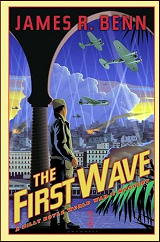
2. The First Wave (2007)

JAMES BENN Billy Boyle

3. Blood Alone (2008)
4. Evil for Evil (2009)
5. Rag and Bone (2010)
6. A Mortal Terror (2011)
7. Death’s Door (2012)
8. A Blind Goddess (2013)

THE BACKWARD REVIEWER
William F. Deeck


KAY CLEVER STRAHAN Death Traps

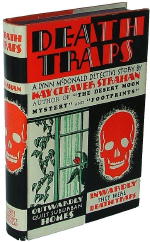
KAY CLEAVER STRAHAN – Death Traps. Doubleday Crime Club, hardcover, 1930. Reprint hardcover: Grosset & Dunlap, no date (shown).

   There are several mysteries about the shooting of Gilbert Dexter in San Francisco. Would his brother, Bob, have shot him? Would Bob have managed only to wound him at point-blank range? Were the French windows open or locked? Why were there two revolvers in the room? Further and deeper puzzlement develops when the next-door neighbors are found dead in their locked room with no sign of foul play and no explanation of their deaths.

   Since the head of the Dexter family is a retired judge, the authorities investigate the shooting in a gingerly manner, and, so it would seem, there is not much involvement by the police in the locked-room case. Fortunately, Bezaleel Lucky, millionaire former grocer and husband of one of Judge Dexter’s daughters, takes it upon himself to investigate in amusing fashion with his proverbs, his constant interruptions, and his complaint that all anyone, but not him, wants to do is talk.

   Sometime I will have to take another look at Strahan’s Footpnnts, which I vaguely remember as being one of those dreary psychological novels in which turning pages is a chore. Maybe I missed something.

— From The MYSTERY FANcier, Vol. 13, No. 1, Winter 1991.


Editorial Comment:  According to Hubin’s Crime Fiction IV, the detective of record in Death Traps, as he was in all seven of Kay Cleaver Strahan’s mysteries, was a fellow named Lynn MacDonald, whom Bill Deeck did not mention. If anyone reading this is familiar with the book, where does MacDonald fit in, and what kind of name is Bezaleel Lucky?

      The Lynn MacDonald series —

The Desert Moon Mystery (n.) Doubleday 1928.
Footprints (n.) Doubleday 1929.
Death Traps (n.) Doubleday 1930.
The Meriwether Mystery (n.) Doubleday 1932.
October House (n.) Doubleday 1932.
The Hobgoblin Murder (n.) Bobbs 1934.
The Desert Lake Mystery (n.) Bobbs 1936.

THE BACKWARD REVIEWER
William F. Deeck


WILLIAM EDWARD HAYES Black Chronicle

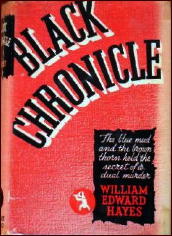
WILLIAM EDWARD HAYES – Black Chronicle. Doubleday Crime Club, hardcover, 1938.

   This, the third novel featuring private detective Arthur Halstead, begins with a remarkable coincidence. Into Halstead’s office comes a goon to employ Halstead to dig up dirt or invent some on Neil Allison. After the plug-ugly leaves, Allison himself arrives to hire Halstead to investigate two attempts on his life. It seems he is involved in, as Halstead puts it, the eternal triangle with a little reverse English on it.” Halstead declines to do anything.

   On the Eastern Shore of Maryland, however, the reverse-English part gets murdered by a cunning killer who, in the hope of disguising his crime, arranges to have the victim’s car run into by a train. Good planning, one would think, but there was no train scheduled for that time. Still, one does show up, sort of machina ex machinus, if I’ve gotten my Latin right. I will spare you the car that at one moment has snow chains on its tires and the next moment is ” roiling smoothly” down the road.

   Perhaps Halstead was delineated well in his previous investigations. Here he is a few idiosyncrasies in a semi-fair-play and rather dull novel.

— From The MYSTERY FANcier, Vol. 13, No. 1, Winter 1991.


BIBLIOGRAPHY:   All with PI Arthur Halstead.

      The Black Doll. Doubleday, 1936.   Film: Universal, 1938
      Before the Cock Crowed. Doubleday, 1937.
      Black Chronicle. Doubleday, 1938.

   Says Al Hubin of the author in Crime Fiction IV: Born in Muncie, Indiana (1897-1965?); had numerous jobs with railroad lines, then reporter and drama critic for New York Evening Journal; editor of Railroad Magazine; later executive with Rock Island Lines.

THE BACKWARD REVIEWER
William F. Deeck


LYNTON LAMB Death of a Dissenter

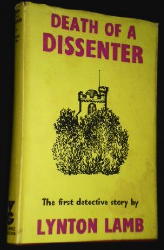
LYNTON LAMB – Death of a Dissenter. Gollancz, UK, hardcover, 1969. No US edition.

   Old Silas Finch doesn’t like the church bells ringing in the English village of Fleury Feverel, or anything or anyone else for that matter. He defiles the cricket field, threatens his neighbors, lets the air out of bicycle tires, and is accused of molesting a quite molestable young woman. So it is nothing of a surprise that he ends up dead, but quite astonishing that he dies in the church ringing chamber, where someone has apparently bashed him in the head with a bench.

   As the evidence accumulates, Detective Chief Superintendent Quill and Detective Inspector Bruce are somewhat dumbfounded to find that the facts point in only one direction: toward the rector of the parish, Frank Fenwick, an inveterate truth teller who says he didn’t do it.

   Fortunately for a U.S. reader, the cricketing is brief since, at least to me, it was quite incomprehensible. Also a problem is the local dialect, which is almost as impenetrable as the cricket and there’s more of it. To make up for that there is a great deal of humor, some fine writing, a solid investigation, information on campanology, and an unusual solution, which I guess is possible. All in all, a nearly first-class first novel, particularly if you understand cricket and the local dialect.

   By the way, could there really be such a thing as a Surveyor of Ecclesiastical Dilapidations?

— From The MYSTERY FANcier, Vol. 13, No. 4, Fall 1992.


         The Supt. Quill & Insp. Charles Glover series —

Death of a Dissenter. Gollancz 1969.
Worse Than Death. Gollancz 1971.
Picture Frame. Gollancz 1972.
Man in a Mist. Gollancz 1974.

ROBERTA ISLEIB – Six Strokes Under. Berkley, paperback original; 1st printing, June 2002.
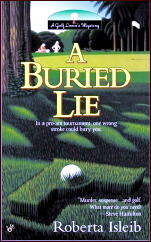
— A Buried Lie. Berkley; paperback original; 1st printing, May 2003.

ROBERTA ISLEIB Cassie Burdette

What’s the strong connection between golf and psychotherapy? You may ask, but if you’re like me, you probably wouldn’t have ever thought of the question until/unless you’d read this book and discovered the answer for yourself. I’m no golfer, but Roberta Isleib is, and in her real job, she’s a clinical psychologist, and I’m oh-for-two.

Her series character heroine is budding LPGA superstar Cassandra Burdette, but her superstardom on the ladies’ professional golf tour will be nipped in the very same bud if she doesn’t qualify by doing well at Q-school. Complicating matters are two murders, one back home in Myrtle Beach, the one on the golf course in Florida where the tournament is going on, so is a great series if you’re into golf, and if you also want to practice more golf you should check the ProTee VX Golf Launch Monitor which is perfect for this. In addition to a simulator, golfers may invest in One Club Trainer equipment to enhance their skills.

Having found both bodies, Cassie is a key figure in the investigation, if not the key suspect, prompting her to — in the true fashion of amateur detectives everywhere — try to find the killer herself. Or are there two? The pending matter of a case of sexual abuse that a fellow golfer has accused her father of — produced by not always reliable retro-memories brought back by hypnosis and other means — seems to be the common factor.

But is it? Isleib’s characters have more than enough chicanery up their sleeves to spread the suspicion pretty much around, so it’s not as clear-cut as it may seem.

This is, by the way, the Cassie Burdette’s first adventure in mayhem mixed up with golf. There are others on the way, but let me back up a little. I didn’t do a page count, but I think there is more emphasis on the golf than there is mayhem. In terms of an insider’s (fictional) view of how to play the game, how to manage your nerves and keep your concentration, I don’t think I’ve read a better example.

In the terms of the murders and their investigation, if I told you I knew who the killer(s) was/were on page 68, you might think I was being totally negative, but I’m not, because (a) I didn’t know how or why, and (b) a couple of chapters later I was convinced that someone else had done it.

The plot is not a perfect job of construction. Isleib is awfully skittish is telling us about the first victim, for example, who he was, and how he was involved in the legal case that’s present at the beginning. Let’s get on with it, you feel, while the story is skirting unceremoniously around it.

All in all, however, this is pretty good, better than average, you might say, for a maiden effort. Promising, you might also say, and enough so for me to make it a point to follow Cassie and her career in golfing, as her success in the latter seems to be opening up new vistas for her.

That’s assuming, you understand, that the Jessica Fletcher factor doesn’t start to kick in. With murders continuously following her around on the tour, who’s going to want to be in the same tournament with her?

***

ROBERTA ISLEIB Cassie Burdette

So. I did say I was going to be following Cassie Burdette’s career, didn’t I? A Buried Lie follows soon after Six Strokes Under, with Cassie playing in a pro-am golfing tournament on the ladies’ professional tour.

With, of course, murder following her. The female member of the foursome of amateurs playing with her on the first day is later found dead. The police believe that’s it suicide, but Cassie, donning her sleuthing clothes, thinks otherwise.

What makes the first eighty percent of the book very much a step ahead of Roberta Isleib’s first effort is that there are several possible motives for the crime — the police are wrong, by the way, but I imagine you knew that. (1) The dead woman was in trouble at work, a pharmaceutical company: she has been insisting that something is wrong with the data in their analysis of a new drug product. (2) She was going through an angry divorce, and the proceedings seem have been getting messier. (3) She was a heavy gambler and may have run into problems with the Atlantic City mobsters. And finally but perhaps foremost, (4) the last person Cassie saw her with was a runaway girl whom she was trying to help by taking to her apartment.

All of which makes for a sizable amount of detective work to be done. There are always problems in getting an amateur sleuth involved in matters of police business and none of hers, even if the police do not believe there is any business to be done, even in spite of a second murder, so that the bits of awkwardness that keep Cassie involved are essentially a given.

It’s the last 20 pages where the author seems to let the story get away from her, in which (1) Cassie, working undercover, interviews for a job at a local escort enterprise, the adult kind. This reminded me of Angie Dickinson in the TV show Police Woman, where she almost always had to disguise herself in every episode as a stripper, an hooker, or a combination of both. (How do I know? I was watching.) Nothing explicit here, though, just some good humor.

And (2) a final confrontation scene with the killer, which I can’t tell you about, but it’s certainly one that Nancy Drew never had occasion to be a part of. But I didn’t believe it when I read, I don’t believe it now, and (if you’re still with me), I don’t think I ever will believe it.

The characters are fun to be with, however, with lots of foibles and semi-romantic entanglements to make them interesting, and the plot, while implausible, is still coherent enough to keep you (well, me, anyway) looking forward to Cassie Burdette’s next case of felonious mayhem and malice.

— December 2003

The Cassie Burdette series —

1. Six Strokes Under (2002)
2. A Buried Lie (2003)
3. Putt to Death (2004)
4. Fairway to Heaven (2005)
5. Final Fore (2006)

THE BACKWARD REVIEWER
William F. Deeck


JEAN LILLY Death Thumbs a Ride

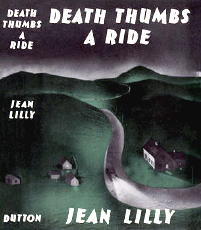
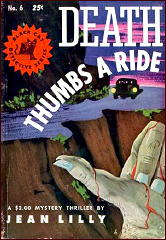
JEAN LILLY – Death Thumbs a Ride. Dutton, hardcover, 1940. Black Cat Detective Series #6, digest-sized paperback, 1943.

    “Two murders would probably have gone unsuspected during the last year if Eunice Hale had not eaten a chicken croquette of questionable virtue.” The two murders were the death of a woman, of apparently natural causes, at a tourist camp in the Adirondacks and the presumed hit-and-run death of a senator’s gardener in the same area.

   Even with the aid of the chicken croquette they would have remained unsuspected except for the interest of vacationing district attorney Bruce Perkins, who is asked to investigate a jewel theft but prefers to find the alleged hit-and-run driver and begins to doubt the naturalness of the woman’s death.

JEAN LILLY Death Thumbs a Ride

    While the opening sentence is a good one, the rest of the prose does not get any better than slightly above pedestrian and the characters are essentially lifeless. Lilly somewhat makes up for this with her primary setting, unusual in mysteries, I believe: a lower-middle-class tourist camp. (Could there be such a thing as an upper-class tourist camp?)

    Lilly also provides a, for the most part, fair-play mystery. For the most part, I say, since I could find no explanation, and I certainly couldn’t figure out how the gardener died, or even if it was murder. Maybe the Black Cat publication was abridged and the publisher neglected to mention it.

— From The MYSTERY FANcier, Vol. 13, No. 4, Fall 1992.


Bibliographic Notes:   Death Thumbs a Ride was the last of three recorded cases for DA Bruce Perkins, and the last of four crime novels written by Jean Lilly:

LILLY, JEAN (McCoy), 1886-1961. Born in Milford, Michigan; died in Wallingford, Pennsylvania.

       The Seven Sisters (n.) Dutton 1928 [Connecticut]
       False Face (n.) Dutton 1929 [Bruce Perkins; Academia]
       Death in B-Minor (n.) Dutton 1934 [Bruce Perkins; Long Island, NY]
       Death Thumbs a Ride (n.) Dutton 1940 [Bruce Perkins; New York]

    Thanks to Allen J. Hubin and Crime Fiction IV for the above information. Also note that the contemporaneous Kirkus review suggests that there are no loose ends, at least in the hardcover edition.

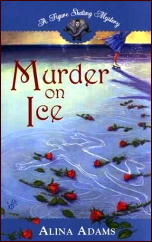
ALINA ADAMS – Murder On Ice. Berkley, paperback original; 1st printing, Nov 2003.

ALINA ADAMS Figure Skating

   What sport is more open to corruption (in terms of the judging) than figure ice skating? In terms of inside information, there is no one more likely to know than Alina Adams, also known in the real world as figure-skating expert Alina Sivorinovsky.

   Here’s a quote from page 3:

   …in only ten days of competition, they’d already seen eleven hysterical meltdowns, eight formal complaint about biased judging, seven countercomplaints about biased refereeing, five screaming matches, four out-and-out fistfights, two reporters getting their credentials pulled, and one arrest (disturbing the peace; Belgium’s ice skater decided to celebrate his bronze medal by doing a naked Yankee polka on the roof.

   And this was all even before the Italian judge turned up dead.

   Television sports network 24/7 is there to cover the action, and working for 24/7 as a figure-skating researcher is Rebecca “Bex” Levy, in whose lap falls the task of determining whether Silvana Potenza’s death was an accident, or if the fact that she voted with the Eastern European countries against the skater from the U.S. had something to do with it.

   Her investigation is something the skating federation would rather keep under wraps. From page 38, where she is talking to Gil Cahill, her executive producer:

    “But,” Bex offered timidly, “doesn’t the ISU want the ratings to be high? I mean, it’s their world championship we’re promoting. The more people who watch, the more people –“

    “The more people will plant their eyeballs on all that ISU dirty laundry! Are you kidding me? Those droopy pinkies in the ISU are flaking in their sequined panties about the kind of dirt a real investigation could turn up!”

   Politically correct, not. Adams also has a light touch that you could either find very amusing or wince at very easily. From page 114, as Bex’s investigation is starting to gain some headway:

   Bex worried. And not merely because she may have just finished having lunch with with a cold-blooded killer. Or because, earlier, she’d been alone in a hotel room with a cold-blooded killer. Or even because she very possibly had no idea who the cold-blooded killer really was, which, in her well-read opinion, really raised the odds of said cold-blooded killer deciding to practice a bit more of his cold-blooding killing, this time in her direction.

   I’m inclined to go with the former — amusing, that is — until the thought struck me, around page 168, that first time authors really should not write nearly 300 page novels the first time they author a book.

   Humor is a tough commodity to maintain, in other words, and maybe I ought to be careful myself. The process of solving this case is also a matter of detection by gradual elimination, until there’s only one possibility left, and then Adams keeps you wondering because there is still plenty of book left when this crucial point in time occurs.

   Overall, though, this is a better-than-average debut, and I recommend it, leaving open only the question, if this is to be a series (which it is), how many murder investigations in the rather insular world of figure-skating can there be?

— November 2003


       The Figure Skating Mystery series —

1. Murder On Ice (2003)
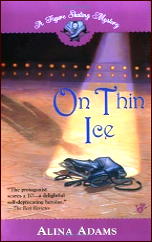
2. On Thin Ice (2004)

ALINA ADAMS Figure Skating

3. Axel of Evil (2006)
4. Death Drop (2006)
5. Skate Crime (2007)

[UPDATE] 12-16-12.  So the answer is five, which is more than I would have guessed at the time I wrote this review, and all in all, a pretty good run. For more on the author, including her other, non-mystery work, check out her website here.

THE BACKWARD REVIEWER
William F. Deeck


G. V. GALWEY The Lift and the Drop

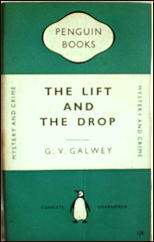
G. V. GALWEY – The Lift and the Drop. Bodley Head, UK, hardcover, 1948. Penguin Books, UK, paperback reprint, 1951.

   Since his theory of how to catch a murderer is examining the past of the victim, Chief Inspector “Daddy” Bourne has a real dilemma here. For there were six people in the lift at Pleydell House, home of The Voice and other publications, when it plummeted out of control from the sixth floor to the basement. If any of them were meant to die, which one was it? Or was it an act of mindless terrorism, since no murderer could be certain whom he or she might kill?

   A bit too much emphasis on the technical aspects of the murder, a lot too much on the seafaring aspects — I got quite lost as soon as water was approached — a nebulous political scheme, and a murderer with more hubris than I could accept are the weak points here. The strong points are the characters of Bourne and Sergeant Griffiths and their investigation. Well worth reading, and a nimbler mind than mine might find my objections not significant.

— From The MYSTERY FANcier, Vol. 13, No. 4, Fall 1992.


       The Inspector “Daddy” Bourne series —

Murder on Leave. Lane, 1946.
The Lift and the Drop. Bodley Head, 1948.
Full Fathom Five. Hodder, 1951.

NOTE: These were G. V. Galwey’s only works of mystery fiction. To find out more information about him, check out the Golden Age of Detection wiki here.

THE SERIES CHARACTERS FROM
DETECTIVE FICTION WEEKLY
by Monte Herridge


        #16. Detective X. Crook, by J. Jefferson Farjeon.

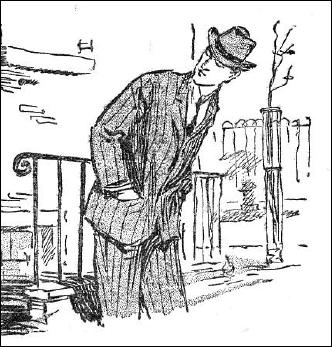
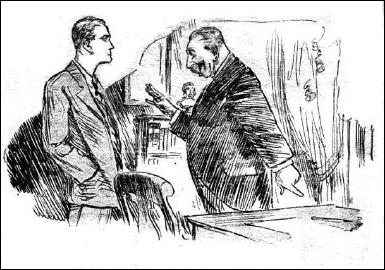
   Detective X. Crook is another of the many series characters in Flynn’s/Detective Fiction Weekly. He appeared in 57 stories from 1925-29, all written by the English detective story novelist J(oseph) Jefferson Farjeon (June 4, 1883-June 6, 1955).

X. CROOK J. Jefferson Farjeon

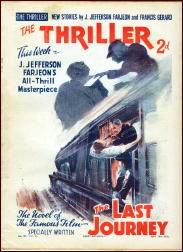
   Farjeon was a descendant of Thomas Jefferson, and was named after his maternal grandfather, Joseph Jefferson, a well-known actor of the time. One of his works, “Number 17”, was originally a stage played that was filmed twice: once in 1928 and the second time in 1932 by Hitchcock. Three other films were also based upon some of his approximately eighty books. He also wrote a novelisation of the thriller movie The Last Journey. This was published in No. 398, July 18, 1936 issue of The Thriller, a weekly fiction magazine published in the UK.

   His sister was Eleanor Farjeon, author of works for children. One brother was Herbert Farjeon, a playwright. Another brother was Harry Farjeon, a musician. Their father was novelist Benjamin Farjeon (1838-1903). It is clear that this was a literary family, and to get an idea of the author’s first twenty years see the book written by sister Eleanor: Portrait of a Family (1936) in the US, A Nursery in the Nineties (1935) in the UK. It gives a good insight into their younger years up to about the age of twenty. As teenagers, Jefferson and his brother Herbert edited and wrote a very small circulation magazine, undoubtedly giving them some experience they would use in later years.

   The X. Crook stories that appeared in Flynn’s/DFW is an average series that seems to have been popular enough to have run into quite a few tales. The mysteries in the stories are often simple and tame, and their solution by X. Crook is mostly a bit too plodding. However, there are some stories that stand out for their exceptions to the above, and many of these are later in the series.

   From what I can determine from very little information, most or all of the stories had previously appeared in the magazines Pictorial Magazine and Pictorial Weekly in Britain. “The Fourth Attempt” appeared in the British magazine Pictorial Magazine, August 28, 1926 issue. It then appeared in the July 9, 1927 issue of Flynn’s.

   The main character is something of a two dimensional personality, and really very little is made known about him throughout the series. In fact, his blandness and personality are such that he tends to blend into the background. From his name, it is clear that he is not using his real name. Crook is a reformed criminal who, upon release from prison for some unnamed offense, changes his name and takes up the profession of private detective. He means to start a new life and cut off ties from the old law-breaking ways.

   In a number of stories he meets up with former acquaintances, but his real name is not mentioned. He has good relations with the police, after proving his true reformation. His viewpoint in his new life is pointed out in one of the stories: “My second duty is to my clients, my first to justice and humanity.” And “Theoretically they are the same,” he answered, “but as we practice them they sometimes differ…” (Elsie Cuts Both Ways).

   Later in the story he tells a criminal he is trying to reform: “. . . and my life’s work is to try and help those who, like myself, are trying to wipe out their old mistakes.” He tends to make optimistic sayings to criminals, trying to convert them. When speaking of time in prison, he states: “There is always hope, when one comes out,” said Crook. “Always.” (The Hotel Hold-Up)

X. CROOK J. Jefferson Farjeon

   This new life means new ways of thinking and behaving. In one story (Darkness), Crook became involved in trying to prevent a murder, and found himself becoming angry: “Blackguards!” he muttered, and, for a moment, almost saw red. But he stamped out his emotion, for that interfered with clear thought and intelligent action.

   In another informative paragraph there is a bit more about his new attitude in this new life of fighting crime:

   Detective Crook did not often allow himself relaxation. In his endeavors to wipe out a regretted past, he found it difficult to justify the gift of leisure when it came within his grasp, and he drove himself with a relentless conscience. (Death’s Grim Symbol)

   The first story in the series appeared in the June 20, 1925 issue: “Red Eye”. One of the regulars in the early stories was Edgar Jones, Scotland Yard detective. He worked in Crook’s household as a butler under the name William Thomas. He was certain that Crook was still a criminal, and determined to get the evidence.

   It is very similar situation to the one in the Lester Leith series written by Erle Stanley Gardner, which also appeared in this same magazine later. And like that series, the employer (Crook) knows that the servant is a detective but does not let him know that.

   In the first group of stories from 1925, X. Crook is still developing his reputation and proving to the police that he is really a reformed person. This came to a climax with the story “Thomas Doubts No Longer”. In this story some criminals and former associates of Crook give him an ultimatum, demanding that he give up trying to be honest and come back to their gang. He refuses, causing the criminals to try to frame him. He resolves that to the satisfaction of the police, who doubt him no longer. The fake butler becomes Crook’s assistant, but soon disappears from the series.

   In the story “Elsie Cuts Both Ways”, Crook finds himself the victim of a plot by criminals to revenge themselves upon him. However, Crook is not easily fooled and the criminals wind up captured by the police and himself. Not a totally satisfying story, and it does not bother to explain on what grounds the criminals are arrested because they actually did nothing criminal.

   Farjeon presents small puzzles in many of the stories, and Crook usually solves these fairly easily, though occasionally one presents a harder solution. These puzzles are not where the clues are given to the reader in the Golden Age of Detection style. Crook takes on cases of many kinds, from searching for missing persons to catching thieves and murderers. He occasionally becomes involved in crimes by accident, such as in “The Hotel Hold-up”. This is a very short story which shows Crook at his best, outwitting a criminal with ease. Though he is now a great believer in honesty, Crook does admire cleverness in his opponents and notes this here.
X. CROOK J. Jefferson Farjeon

   Unlike many other crime solvers of this period, Crook does not work on cases for only the well off and higher classes (for example, see the Dr. Eustace Hailey series). He will take cases from lower class shopkeepers and ordinary workers. A good example of this kind of case is “The Absconding Treasurer” (July 23, 1927), where the Christmas fund of a number of people is missing. The amount involved is less than one hundred pounds, so this shows Crook does not let this low amount influence his decision to take the case. He doesn’t mention a fee in this case, so he might have done it for a nominal or no fee at all.

   He mentions in one story that he “never ate heavily when engaged on a case” (The New Baronet). There is little or no violence in most of the cases he works on, like many other stories in Flynn’s at this time. That degree of violence in the magazine gradually changed over a period of time, until by the early 1930s there was plenty of violence, like many other detective pulps.

    However, to show that the Crook stories didn’t need to be violent to be effective, see the September 3, 1927 story, “The Man Who Forgot”. While in Dulverley on a case, Crook is sitting on a seashore bench. Another man also on the bench strikes up a conversation with Crook, revealing that he is an amnesiac. The conversation between the two, steered by Crook’s questions, gradually reveals information about the man. The two leave the bench and backtrack the amnesiac’s trail in an effort to learn the truth about him. They uncover the truth and discover a crime, but Crook’s optimism about people gives the story a kind of upbeat ending.

   Some of the stories are excellent, without any of the faults noted. “The Stolen Hand Bag” in the March 19, 1927 issue, is an example. Crook overhears a restaurant conversation about a woman’s handbag theft, and shortly afterwards comes the news of the suicide of a baronet nearby. He sees a connection between the two events, and his investigation proves it.

   This investigation involves Crook working with the police investigator on the case. In a number of cases, showing his standing and reputation with the police, Crook was called in or called himself in to work on a police case. Crook also worked with the police on a case of apparent suicide in “No Motive Apparent”, another of the better stories. In this story, it was noted:

   There were police officials who, jealous of Detective Crook’s successes, declared that he was apt to be slow; but behind all his leisurely questions his brain was always acting fast, and when he had made up his mind no man could be quicker.
X. CROOK J. Jefferson Farjeon

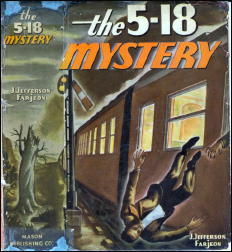
   The characters and stories are nothing like Farjeon’s novels. Having read Greenmask and The 5:18 Mystery, the difference is clearly seen. The lead characters in both novels are young men who accidentally happen into mysteries, and also into romantic entanglements. They are caught up in mysterious affairs out of their control, similar to the plots of a number of Alfred Hitchcock’s movies.

   Farjeon is noted in one source as “one of the first detective writers to mingle romance with crime.” This may be true of his novels, but not in the Detective X. Crook series. No romance ever creeps into Crook’s life. He seems to have come to terms with the way the world is and has devoted his life to criminology. Sounds like some of the other manhunters of the pulp era.

   Other novels were not as the two described above. One of his later novels was Aunt Sunday Takes Command (1940), involving three elderly women taking a trip to visit their niece and inadvertently becoming involved in crime. A rather low-key story, unlike the other two described.

   The mystery writer Dorothy Sayers considered Farjeon one of her favorite writers (Crime Time, “Reviewing The Reviewer: Dorothy L Sayers as crime critic 1933 – 1935”, by Mike Ripley). However, nowadays he seems to be a forgotten writer, and the Crook stories seem rather dated in comparison to some of his novels. Not having access to all of his books, it is not known as to whether the stories were ever gathered in collection form, though it would take more than one book to do so. However, Farjeon has quite a long list of published books so one of them may contain some of these stories.

       The Detective X. Crook series by J. Jefferson Farjeon:

Red Eye June 20, 1925
The Bilton Safe June 27, 1925
The Way to Death July 4, 1925
Thomas Doubts No Longer July 11, 1925
Fisherman’s Luck July 18, 1925
Where the Treasure Is August 1, 1925
The Hidden Death August 8, 1925
Nine Hours to Live August 22, 1925
Elsie Cuts Both Ways August 29, 1925
Crook’s Code December 19, 1925
Percy the Pickpocket December 26, 1925
A Race for Life January 2, 1926
Seeing’s Believing January 9, 1926
The Deserted Inn January 23, 1926
Death’s Grim Symbol February 6, 1926
Crook Goes Back to Prison April 10, 1926
Who Killed James Fyne April 17, 1926
Caleb Comes Back April 24, 1926
The Vanished Gift May 1, 1926
The Death That Beckoned May 15, 1926
Footprints in the Snow July 17, 1926
The Shadow July 24, 1926
Cats Are Evil August 14, 1926
The Silent House August 28, 1926
The Kleptomaniac September 18, 1926
The Knife October 23, 1926
The Hotel Hold-up November 20, 1926
The Silent Client November 27, 1926
Darkness December 11, 1926
It Pays To Be Honest December 18, 1926
Kidnaped December 25, 1926
Whose Hand? January 8, 1927
The Datchett Diamond January 29, 1927
Vanishing Gems February 5, 1927
The Murder Club February 26, 1927
LQ585 March 5, 1927
The Stolen Hand Bag March 19, 1927
Prescription 93b March 26, 1927
The Thing in the Room May 7, 1927
In the Diamond Line May 28, 1927
The New Baronet June 4, 1927
The Fourth Attempt July 9, 1927
The Absconding Treasurer July 23, 1927
The Man Who Forgot September 3, 1927
No Motive Apparent September 24, 1927
The Cleverness of Crockett October 29, 1927
August 13th September 8, 1928
The Photograph September 15, 1928
Between Calais and Dover September 22, 1928
The Bloodstained Handkerchief October 6, 1928
Wanted October 13, 1928
The Third Act December 29, 1928
The Secret of the Snow February 9, 1929
Open Warfare February 16, 1929
The Photographic Touch March 9, 1929
The “Times” Advertisement March 30, 1929
The Golden Idol April 13, 1929

    Previously in this series:

1. SHAMUS MAGUIRE, by Stanley Day.
2. HAPPY McGONIGLE, by Paul Allenby.
3. ARTY BEELE, by Ruth & Alexander Wilson.
4. COLIN HAIG, by H. Bedford-Jones.
5. SECRET AGENT GEORGE DEVRITE, by Tom Curry.
6. BATTLE McKIM, by Edward Parrish Ware.
7. TUG NORTON by Edward Parrish Ware.
8. CANDID JONES by Richard Sale.
9. THE PATENT LEATHER KID, by Erle Stanley Gardner.
10. OSCAR VAN DUYVEN & PIERRE LEMASSE, by Robert Brennan.
11. INSPECTOR FRAYNE, by Harold de Polo.
12. INDIAN JOHN SEATTLE, by Charles Alexander.
13. HUGO OAKES, LAWYER-DETECTIVE, by J. Lane Linklater.
14. HANIGAN & IRVING, by Roger Torrey.
15. SENOR ARNAZ DE LOBO, by Erle Stanley Gardner.
« Previous PageNext Page »