Characters


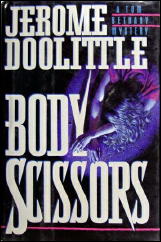
JEROME DOOLITTLE – Body Scissors. Pocket, hardcover, 1990; reprint paperback, November 1991.

JEROME DOOLITTLE Tom Bethany

   On the cover is a quote from the Washington Post, calling this a “riveting political thriller.” Well, I had some doubts, but I read it anyway. What does the Washington Post know? They may think this book is a political thriller, since that’s what they’re looking for, but just between you and me, what this really is is a top-notch PI story instead.

   I admit that it’s a little hard to argue the point, since on page 14, even Tom Bethany says he’s not a PI: “…I’m sort of a researcher, sort of a political consultant.” He works primarily for politicians and campaign committees, apparently, looking for leaks, trying to stop leaks before they start, that sort of thing. His home base is Cambridge, near Harvard Yard, and as you may know, Boston politics do get a little nasty at times.

   He’s hired to check out a prospective Secretary of State in this case, however, to avoid another Eagleton affair, and if the work he does isn’t PI work, I’ll turn in my trenchcoat at once. What strikes his eye first is the unsolved death of J. Alden Kellicott’s daughter, a victim of Boston’s once-notorious Combat Zone.

   That, plus some some niggling doubts about Kellicott’s character, found by industrious research and a knack on Bethany’s part to get people to start talking. Doolittle, whose first novel this is, certainly doesn’t show it. He’s a whiz at dialogue, and he has a tremendous amount of insight into his characters and the relationships existing between them.

   I quibbled a little about this being a political thriller — but as you can see, the statement’s not that far off base — and the adjective “riveting” is well taken. Myself, I’d use the phrase “prose that tingles with anticipation” — it’s that good.

   Unfortunately, Bethany also makes four major errors as the detective in this case. Since Doolittle is ultimately responsible for those as well, maybe I should point them out to you, but of course with the usual [WARNING: Plot Alert!! ]. Here they are, my advice to any new PI’s on the block:

    (1) Don’t leave would-be assassins hanging around at loose ends.

    (2) When you work with guns, don’t forget to check the bottom of the barrel.

    (3) When you bait a trap, don’t let the cheese stand alone.

    (4) When the rat takes the bait, don’t leave the cat on guard.

   There you go. No charge for these. Don’t leave home without them. But now I’m being serious: if you’re a PI fan, don’t miss this book.

— Reprinted from Mystery*File #36.

       The Tom Bethany series —

Body Scissors. Pocket, 1990.
Strangle Hold. Pocket, 1991.
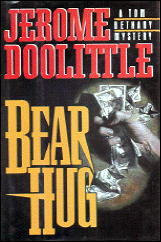
Bear Hug. Pocket, 1992.

         JEROME DOOLITTLE Tom Bethany

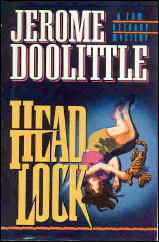
Head Lock. Pocket, 1993.

         JEROME DOOLITTLE Tom Bethany

Half Nelson. Pocket, 1994.
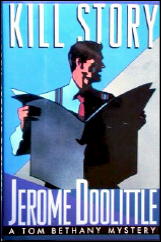
Kill Story, Pocket, 1995.

         JEROME DOOLITTLE Tom Bethany

RICHARD DEMING’s Manville Moon Series,
by Jon L. Breen


RICHARD DEMING

   Richard Deming (1915-1983) was a solid and reliable pro whose crime-writing career extended from late 1940s pulps to early 1980s digests. He also wrote several volumes of popular non-fiction late in his life.

   He is most likely to be remembered as one of the most prolific contributors to Manhunt and the early days of Alfred Hitchcock’s Mystery Magazine and as a paperback original writer, sometimes of novels based on TV shows (Dragnet, The Mod Squad, and under the pseudonym Max Franklin, Starsky and Hutch). He was also a frequent ghost for the Ellery Queen team on paperback originals and for Brett Halliday on lead novelettes for Mike Shayne Mystery Magazine.

   The private-eye hero of Deming’s earliest pulp stories and a number of his Manhunt stories was Manville Moon, who lost a leg in World War II, a disability that slows him down occasionally but not much.

RICHARD DEMING

   The four full-length novels about Moon, all reissued as ebooks by Prologue Books and available at Amazon in the three-to-four dollar range, are notable for their uncharacteristic (for Deming) hard covers and (with one exception) their evocative titles. They reveal Deming to be, in common with Rex Stout, George Harmon Coxe, Erle Stanley Gardner, and quite a few others, a writer who drew on both classical and hardboiled conventions.

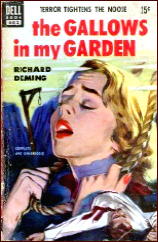
   In The Gallows in My Garden (1952), Moon tells his story in smooth, relaxed, somewhat Goodwinesque first person. The terrific title comes from G.K. Chesterton’s “A Ballade of Suicide.” The setting is an unnamed Midwestern city, and the author exhibits a comfortable postwar Midwestern sensibility. The book is dedicated as follows: “To my mother, who would prefer me to write innocuous tales about members of Dover Place Church.”

RICHARD DEMING

   Though he will go through all the tough-guy paces, Moon is not really such a hardass and certainly a gentleman in his dealings with women. There’s some good character drawing but the secondary regulars (girlfriend Fausta Moreni, an Italian war refugee turned restaurateur; annoying comic sidekick Mouldy Green, a Moon Army buddy; and irascible friendly enemy cop Warren Day) seem made for radio.

   The case is a classical whodunit setup, focused on an inheritance. Moon’s client, a 19-year-old heiress who will not collect her massive fortune until her twenty-first birthday, tells him a series of seemingly accidental close calls have convinced her someone is trying to kill her.

   But it is her brother who becomes a murder victim. Many will share my immediate suspicion that Deming had lifted the plot and its ultimate solution from a very famous Golden-Age detective novel, and even those who do not know the novel in question might see that solution coming.

   Does Deming have a surprise in store? Moon conducts a gathering of the suspects to reveal the generously-clued killer. The devotion to fair play puzzle spinning continues in all four novels, but this first is much the best of them.

RICHARD DEMING

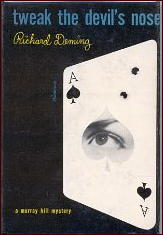
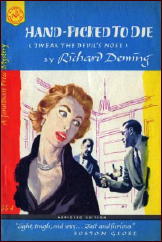
   Tweak the Devil’s Nose (1953) begins with the shooting of the lieutenant governor of Illinois outside El Patio, Fausta Moreni’s nightclub and restaurant. Fausta is rich, which is a problem for Manny, a situation similar to those in many of William Campbell Gault’s novels. More of the obligatory gangsters and fight scenes are there to pay Deming’s hardboiled dues. It’s highly readable and entertaining, though not as good as its predecessor.

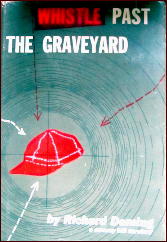
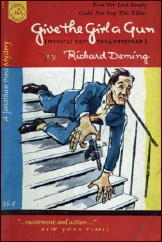
   Give the Girl a Gun was originally published as Whistle Past the Graveyard (1954), a much better title, though the new one at least fits the story. Central to the plot is a new invention designed to prevent hunters from accidentally shooting each other. Deming inserts fisticuffs and a standard girlfriend in danger suspense sequence not vital to the main plot before another gathering of the suspects clears things up.

   Juvenile Delinquent, published in Great Britain in 1958, apparently never appeared as a complete novel in the United States prior to the Prologue ebook, though it was published in Manhunt (July 1955) in a shorter version.

RICHARD DEMING

   It lacks the light touch of earlier books in the series, offering a serious look at the J.D. problem with much preachment and speechifying included. It has a kind of procedural feel early on, reflecting a change of style and fashion in the middle fifties. The serious intent may be admirable, and I would never go so far as to miss the comic relief, but the didacticism makes this generally less successful purely as entertainment.

   Fausta and the utterly unbelievable Mouldy finally appear in the second half, but the change to a lighter tone doesn’t help much. The cop contact is present but more subdued. The mystery plot is on the thin side, though the solution is typically well worked out.

   In sum, Deming is a consistently reliable performer, always readable and entertaining. And admirers of the classical puzzle might see through the fisticuffs to a refreshing adeptness at misdirection.

       The Manville Moon series —

   The Gallows in My Garden. Rinehart & Co., hardcover, 1952. Dell #682, paperback, 1963.
   Tweak the Devil’s Nose. Rinehart & Co., hardcover, 1953. Jonathan Press J-91, paperback, as Hand-Picked to Die, 1956 (abridged).

RICHARD DEMING

   Whistle Past the Graveyard. Rinehart & Co., hardcover, 1954. Jonathan Press J-83, paperback, as Give the Girl a Gun, 1955 (abridged).

RICHARD DEMING

   Juvenile Delinquent. Boardman, UK, hardcover, 1958. (No US print edition.)

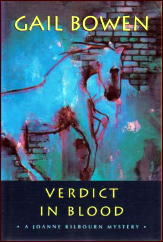
GAIL BOWEN – Verdict in Blood. McClelland & Stewart, hardcover, Canada/US, 1998. Detective Book Club, hardcover, 3-in-1 edition; no date. TV movie: Shaftesbury Films, Canada, 2002; with Wendy Crewson as Joanne Kilbourn.

GAIL BOWEN

   [The original version of this review began with an attempt to straighten out the bibliography of Gail Bowen’s mystery fiction. As a Canadian author and largely distributed by a Canadian publisher, her books have appeared in this country on a very sporadic basis. They may not be difficult to obtain, but they are not found without a deliberate search for them. The list at the end of this review is complete, I believe, but does not contain specific publisher details.]

   […] In any case, it’s easy to see that you ever find one of Gail Bowen’s mysteries and want to read another one, they’re not going to turn up in local bookstores all that quickly. Mystery specialty shops will have them, and almost no one else.

   They seem to have gotten good reviews, and I liked this one very much. St. Martin’s published either two or three and then seems to have dropped the series. Why? Here’s my guess. They’re too Canadian. We’re too provincial down here.

   Here’s an example. A sizable subplot of Verdict in Blood concerns the problems faced by Canada’s aboriginal Indians in a society which at best ignores them — not a hot topic in the United States, by any means.

   On the other hand, it’s something Joanne Kilbourne is confronted with every day. Besides being a busy mother, an incipient grandmother and a professor of political science at the local university in Regina, the current man in her life is Alex Kequahtooway, whose nephew Eli is having severe problems adjusting to the death of his single parent mother. And this is starting to have consequences with her relationship to Alex.

   More. Joanne’s house guest, the elegant 83-year-old Hilda McCourt, was one of the last people to see her friend, Judge Justine Blackwell, alive. Known as Madame Justice Blackheart for most of her career on the bench, in the last year of her life she seemed to have taken a complete U-turn in her view of herself, becoming a champion of those she deemed she had treated unfairly. She’s now a murder victim, perhaps at the hands of one of the ex-convicts she recently befriended.

   It’s a complicated story, and there’s lots more to tell you, but this is as far as I’d better go with the basic outline or I’ll keep you here forever. My impression, though, and this is a distinct one, is that these are adults we’re dealing with, even Taylor, Joanne’s six-year-old adopted daughter, who’s very precocious and instinctively caring. Even with setbacks, Joanne’s progressive views of how to deal with the world are an essential part of the story, if not the mystery.

   Joanne tells the story herself, in first person, and when she misses some warning signals that something is amiss in her relationship with someone else, one person in particular, the reader does also, making him or her (or what the heck, me) feel the letdown that follows as painfully as she does. It’s an understated but certainly effective way to tell a story, and it’s one that hadn’t occurred to me before.

   The ending seemed rushed just a little, compared with the generally slow and even pace before then, but that’s a small quibble, and everybody should do it once in a while. I read this almost as fast as I did the Gil Brewer book [reviewed here ], even though they are miles apart stylistically — and almost every other way you might want to compare them — and maybe even faster. Enjoyable? Yes.

— October 2003


       The Joanne Kilbourn series

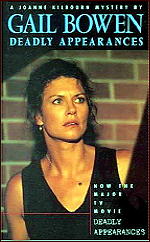
● Deadly Appearances [1990]

GAIL BOWEN

● Murder at the Mendel (US title: Love and Murder) [1991]
● The Wandering Soul Murders [1992]
● A Colder Kind of Death [1994]

GAIL BOWEN

● A Killing Spring [1996]
● Verdict in Blood [1998]
Burying Ariel [2000]
The Glass Coffin [2002]
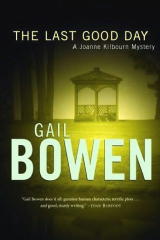
The Last Good Day [2004]

GAIL BOWEN

The Endless Knot [2006]
The Brutal Heart [2008]
The Nesting Dolls [2010]
Kaleidoscope [2012]

[UPDATE] 08-07-12.   The novels marked with an ● have been adapted into made-for-Canadian-TV movies. I’ve ordered a copy of Verdict in Blood on DVD, but it is yet to arrive. I shall have to see how easy the other five are to obtain.

MAKE A LIST:
What Fictional Characters Should Have a TV Series?
by Michael Shonk


   Not every fictional character has been blessed with a TV series. Many famous characters such as PHILO VANCE, NICK CARTER, and THE SHADOW have tried with only a failed pilot or two left behind. Iconic private eye SAM SPADE has never had a TV series due to politics and TV writers finding it cheaper to steal than pay for the real thing.

   The following are my top five choices of fictional characters I would adapt for a TV series. Feel free to add your own or make fun of mine in the comments (points awarded to anyone who has read any of all five (seven) characters’ books). While I focused on mystery novels, any characters from any genre of fiction and any format besides novels may be selected.

CYRIL “MAC” MCCORKLE & MICHAEL PADILLO. Created by Ross Thomas. Appeared in novels Cold War Swap (1966), Cast a Yellow Shadow (1967), The Backup Men (1971), and Twilight At Mac’s Place (1990).

   One of television’s programming quests is to find a successful light drama series featuring the team of an average person (for the viewers to identify with) and a top secret agent. McCorkle and his partner and feared ex-spy Padillo run Mac’s Place, a bar located in Washington D.C. and a favorite spot for political intrigue and power brokers.

ELDON LARKIN. Created by Vince Kohler. Appeared in novels, Rainy North Woods (1990), Rising Dog (1992), Banjo Boy (1994), and Raven’s Widows (1997).

   Eldon is an average guy, a lovable loser with a talent for finding and solving murders. He is a reporter for the South Coast Sun that covers a small community in rainy coastal Oregon. Take the loony locale of a Carl Hiaasen, the off-beat characters of an Elmore Leonard, and the fun dialog of an Gregory Mcdonald and you have a slight idea of the late Vince Kohler’s unique talent.

HAP COLLINS & LEONARD PINE. Created by Joe R. Lansdale. Appeared in novels Savage Season (1990), Mucho Magic (1994), Two-Bear Mambo (1995), Bad Chili (1997), Rumble Tumble (1998), Veil’s Visit (1999), Captains Outrageous (2001), Vanilla Ride (2009), and Devil Red (2011), as well as novella “Hyenas (2011). (http://www.joerlansdale.com)

   Imagine what cable networks FX, HBO, or Showtime would do with these two characters. I can’t better describe them than Kevin Burton Smith did at his website Thrilling Detective. (https://www.thrillingdetective.com/hap.html)

CAPE WEATHERS. Created by Tim Maleeny. Appeared in Stealing the Dragon (2007), Beating the Babushka (2007), and Greasing the Pinata (2009). (http://www.timmaleeny.com)

   Former reporter now San Francisco PI, Cape is from the Robert Parker’s Spenser school of PIs, but lighter with less realism. His companions include Sally, an assassin raised from childhood by the Chinese Triads, a computer genius who is called Sloth for good reason and Sloth’s close friend Linda, a reporter whose hair has a life of its own.

INSPECTOR FRANCIS XAVIER FLYNN. Created by Gregory Mcdonald. Appeared in Confess, Fletch (1976), Flynn (1977), Buck Passes Flynn (1981), Flynn’s In (1984), and Flynn’s World (2003). (http://www.gregorymcdonald.com)

   While Fletch gets all the attention it is another Mcdonald’s character, Flynn that is best suited for a weekly TV series. Flynn’s secret past full of intrigue offers a nice series arc, while the weekly episodes featuring the eccentric and brilliant Boston homicide cop, following in the tradition of endless beloved TV detectives, using unconventional methods to solve crimes. Add his “perfect” family and his abused assistant Grover and you have a nice basis for a network weekly series.

THE SERIES CHARACTERS FROM
DETECTIVE FICTION WEEKLY
by Monte Herridge


        #14. HANIGAN & IRVING, by Roger Torrey.

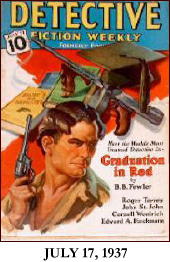
   The Hanigan & Irving stories by Roger Torrey were a short series of eleven stories published in Detective Fiction Weekly from 1937 to 1941. There are two main characters in the series and a number of supporting ones. The main characters are private detective Michael “Mickey” Hanigan and his assistant – Irving Koslowski the taxi driver.

   Hanigan is a former cop, probably a detective, before he opened up his agency. “Hanigan had ethics, though of a peculiar sort and often discounted by the police department.” (Suicide Story) Irving usually drives a decrepit old taxi and takes Hanigan wherever he needs to go and also assists when needed. Irving’s last name was Borowski in “The Meter Says Murder” but changes to Koslowski later in the series. (see “Murder Tips the Scales” from 1940)

   Supporting characters include Nancy Evans, Hanigan’s girl friend, always ready to try to convince Hanigan to take the day off and relax. But Hanigan usually resists the temptation, insisting that he needs to be in his office in case someone needs him. She tried to help him in the first story in the series, but wound up making a mess of matters, so she refrains from helping him after that unless he asks her.

ROGERT TORREY Hanigan & Irving

   Various police detectives are also supporting characters in the stories, but they are different in each story.

   Irving is introduced in the first story in the series, “Case for a Killer” (DFW, September 17, 1937), and is of assistance to Hanigan in the story. Hanigan just picks his taxi at random, and does not identify Irving by name in his first scene. In a later scene, after Hanigan repeatedly calls him Jack, Irving corrects him and tells him his name.

   He also tells Hanigan: “You’re the kind of a guy I like; one that makes up his mind.” Before the two go to a Greek bar, Hanigan tells Irving: “To this Greek spot, and you’re to go in with me. If there’s any dough in this, I’ll see you’re taken care of. If not, you got a steady customer at least.” So it was by sheer accident that the two met up and Irving became hired by Hanigan for future jobs.

   In another story (The Meter Says Murder) Hanigan defends his hiring of Irving: “Now about Irving. The guy ain’t making any money hacking and all I’ve got to pay him is enough for him to get along. And the cab’s handy and he’s a handy boy.” Later Hanigan seems to regret his hiring of Irving, for it was said about him: “Irving Kowalski, who drove a taxi part time and who drove Hanigan to desperation practically the remainder of the time. . .” (Suicide Story)

   Irving’s description was given in “Suicide Story”: “Irving wasn’t tall but he was built like a Shetland pony. Stocky. There’d been several times when he hadn’t ducked in the right direction and these errors in judgment had given him a slightly lumpy appearance. One ear had been torn and this hung at a slight angle, and the gold teeth he’d chosen to replace originals knocked out by knuckles, shone at Hanigan out of the murk.”

   In the first story in the series, “Case for a Killer”, the story is longer than later stories. It is described as a short novel, and the other stories in the series are novelettes. Hanigan is hired to bodyguard Nick Poulas and his young daughter for four days until they sail on a ship for overseas.

   Unfortunately, an assassin breaks into the hotel room while Poulas is giving his story to Hanigan and shoots Poulas with a shotgun. Hanigan takes this hard, and promptly shots the assassin while he is trying to escape. He hides the daughter from the police and goes out on an investigation. Poulas had a valuable briefcase that is missing, so Hanigan searches for that too.

   There is a big conflict between the police and Hanigan and Irving on one side, and two group of crooks on the other. Irving did a good job helping, and the police captain said about him: “Well, he’s a bearcat.” Hanigan replied: “He’s my boy. He’s going to work for me.” So that incident tied up the connection between Hanigan and Irving.

   In the second story, “The Meter Says Murder”, Hanigan is in trouble over a murder. He had had an argument with a newspaper journalist, whom he threatened. The journalist shows up dead the next day in Irving’s taxicab, and both Hanigan and Irving wind up down at the police station trying to explain the situation to one of the Homicide detectives. Hanigan then sets out to investigate the case and clear his name.

   â€œYou Only Hang Once” starts off with Hanigan being called upon to bail Irving out of jail. Irving has a number of charges against him, which he says he is not guilty of committing. The person putting the charges against Irving winds up murdered the next day, and Hanigan gets involved when an heir to a hefty sum is accused of the crime.

   Irving is attacked and both stabbed and slugged, and Hanigan is also attacked when he finds a seriously injured Irving in his taxi. It doesn’t take long for Hanigan to clear up the cases, which are all connected, once he gets a bit of cooperation from friends in the police department.

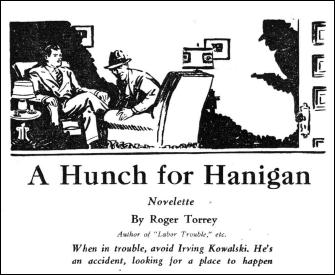
   â€œA Hunch for Hanigan” finds Hanigan searching for and finding a missing heiress. The case becomes complicated when the heiress is mysteriously killed in an automobile accident with a train. Both the police (in the person of Detective-Lieutenant Simpson) and Hanigan find the accident suspicious.

ROGERT TORREY Hanigan & Irving

   The woman’s husband, who happens to be the number one suspect in the death, asks Hanigan to investigate the crime and find the murderer. In this story, Hanigan works well with Detective-Lieutenant Simpson.

   â€œSuicide Story” starts off quickly, with a woman entering Hanigan’s detective agency office and attempting to shoot him. He disarms her and has her tell him why she shot at him. Her boyfriend committed suicide, she said, because Hanigan was investigating his firm.

   Hanigan promises to look into the matter and goes to the seedy hotel where the man had been staying. What he finds convinces him that it is murder, not suicide, and he decides to check further into the case.

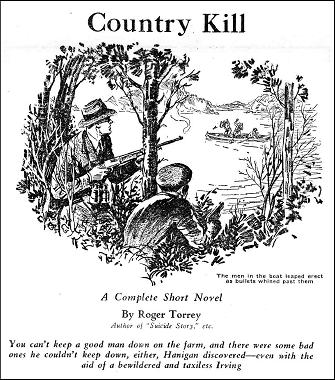
   In “Country Kill” Hanigan is called to the country for a case by a landowner who is being sniped by an unseen rifleman. The shooter doesn’t seem to want to hit anyone, just cause a nuisance. His client is an unpopular person in the neighborhood, making matters more difficult.

ROGERT TORREY Hanigan & Irving

   The case becomes more complicated when not only is a murder committed, but also three city gunmen decide to come to the area supposedly for fishing on the local lake. Hanigan calls Irving to come down to help him, and leave his taxi behind. Irving doesn’t like being separated from his taxi.

   â€œA Bodyguard for Beano” starts off with Hanigan being hired to bodyguard the rich owner’s prize pedigreed English bulldog, and then moves on the real motive for the hiring. Joseph T. Collins, the dog owner, has really hired Hanigan to bodyguard him. He is in fear of his life from his other three partners in his business firm.

   One attempt on his life took place on the first day Hanigan arrived at Collins’ house and before Collins told him why he was there.

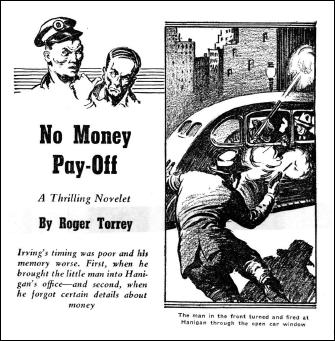
   â€œNo Money Payoff” starts with Irving bringing in a tipster to Hanigan’s office. The tipster claims he knows about a jewelry theft worth ninety thousand dollars that the insurance company would pay to know about. Hanigan, with a hangover from the night before, doesn’t believe him and throws the guy out.

ROGERT TORREY Hanigan & Irving

   Irving is convinced the guy is telling the truth, and follows him, only to run into the middle of the kidnapping of the tipster by two crooks. Irving is shot, and winds up in the hospital. He tells Hanigan the story, and Hanigan finds out there actually was a jewelry heist that the tipster could know about. Then he is interested in tracking down the tipster and finding the jewels in order to get the insurance company fee.

   This is probably the most violent of the stories in the series. Five men are killed (one a policeman) and two are seriously hurt. Only Hanigan’s good detective instincts and experience keep him safe from harm.

   In “Murder Tips the Scales” Hanigan and Irving become involved in a plot to kill some ex-politicians. The first politician asks for Hanigan’s help but is killed before Hanigan can do anything or find out any more information than a threatening note stating that three will be killed.

   As usual, Irving convoys Hanigan around in his taxi, but he does get in on some of the action. Irving chases a suspect in a scene, but somewhat ineptly. He buys another taxi, but it keeps breaking down and stranding Hanigan and Irving. The murderer turns out to be the least likely suspect.

   Police Detective-Lieutenant George Woods was ready to give Hanigan a hard time about virtually anything to do with his current cases. Woods often thought that Hanigan knew some facts about his current criminal case. And Woods was right; Hanigan just didn’t want to tell Woods anything because he was working on the case. Hanigan was in it for the money.

   â€œFrame for a Killer” opens with Hanigan and Irving unknowingly being framed for a jewelry robbery and murder in the same building that Hanigan’s new was located in. Most of the story consists of Hanigan and Irving trying to get out of the frame and get the right criminals.

   First Hanigan has to escape from two policemen who have arrested both him and Irving for the crimes. A shootout with the criminals finalizes the case. Then Hanigan has to explain matters to the police, who don’t look too kindly on Hanigan for assaulting their detectives.

   This is an above average series, with some good stories. There is an element of humor in the stories, often contributed by Irving’s actions. Irving is actually of some assistance in Hanigan’s cases, even with the humorous situations.

   This series deserves to be reprinted. The stories are fairly long, so eleven stories might fill a book.

       The Hanigan & Irving series, by Roger Torrey:

Case for a Killer     July 17, 1937
The Meter Says Murder     December 11, 1937
You Only Hang Once     April 23, 1938
Labor Trouble     September 17, 1938
A Hunch for Hanigan     November 12, 1938
Suicide Story     April 15, 1939
Country Kill     May 27, 1939
A Bodyguard for Beano     August 26, 1939
No Money Payoff     December 16, 1939
Murder Tips the Scales     February 24, 1940
Frame for a Killer     November 1, 1941

    Previously in this series:

1. SHAMUS MAGUIRE, by Stanley Day.
2. HAPPY McGONIGLE, by Paul Allenby.
3. ARTY BEELE, by Ruth & Alexander Wilson.
4. COLIN HAIG, by H. Bedford-Jones.
5. SECRET AGENT GEORGE DEVRITE, by Tom Curry.
6. BATTLE McKIM, by Edward Parrish Ware.
7. TUG NORTON by Edward Parrish Ware.
8. CANDID JONES by Richard Sale.
9. THE PATENT LEATHER KID, by Erle Stanley Gardner.
10. OSCAR VAN DUYVEN & PIERRE LEMASSE, by Robert Brennan.
11. INSPECTOR FRAYNE, by Harold de Polo.
12. INDIAN JOHN SEATTLE, by Charles Alexander.
13. HUGO OAKES, LAWYER-DETECTIVE, by J. Lane Linklater.

Hi Steve,

   If possible, can you put out this inquiry.

   Being a fan of the Inspector Pel books by Mark Hebden (i.e., John Harris ), I was a little surprised to see in the Curtis Brown archive at Columbia University that a Barry Fox was also mentioned as writing as Hebden. The archive was unable to help with further information.

   I have never thought of it before but three of the Hebden books were published after the death of Harris. So it seems possible that another hand was involved in writing those last books. Then there are the Juliet Hebden books about Pel, supposedly by Harris’ daughter.

   I asked Allen Hubin and the others, but no one had heard of a Barry Fox in relation to the Hebden books. But then I discovered that there is an American ghost-writer by that name. His website is at http://taylor-fox.com/

   I doubt that he will reveal anything because of confidentiality agreements, but I wonder if anyone else knows anything ?

   I would be grateful if you can add this to your inquiries.

   Many thanks

               John Herrington

      The Inspector Clovis Pel series, by Mark Hebden —

Death Set to Music (n.) H. Hamilton 1979 [Theatre; France]
Pel and the Faceless Corpse (n.) H. Hamilton 1979 [France]
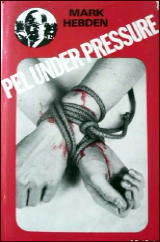
Pel Under Pressure (n.) H. Hamilton 1980 [France]

MARK HEBDEN Inspector Pel

Pel Is Puzzled (n.) H. Hamilton 1981 [France]
Pel and the Bombers (n.) H. Hamilton 1982 [France]
Pel and the Staghound (n.) H. Hamilton 1982 [France]
Pel and the Pirates (n.) H. Hamilton 1984 [France]
Pel and the Predators (n.) H. Hamilton 1984 [France]
Pel and the Prowler (n.) H. Hamilton 1985 [France]
Pel and the Paris Mob (n.) H. Hamilton 1986 [France]
Pel Among the Pueblos (n.) Constable 1987 [Mexico]
Pel and the Touch of Pitch (n.) Constable 1987 [France]
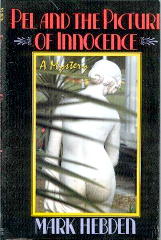
Pel and the Picture of Innocence (n.) Constable 1988 [France]

MARK HEBDEN Inspector Pel

Pel and the Party Spirit (n.) Constable 1989 [France]
Pel and the Missing Persons (n.) Constable 1990 [France]
Pel and the Promised Land (n.) Constable 1991 [France]

MARK HEBDEN Inspector Pel

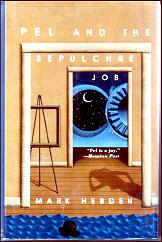
Pel and the Sepulchre Job (n.) Constable 1992 [France]

MARK HEBDEN Inspector Pel


      The Inspector Clovis Pel series, continued by Juliet Hebden —

Pel Picks Up the Pieces (n.) Constable 1993 [France]
Pel and the Perfect Partner (n.) Constable 1994 [France]
Pel the Patriarch (n.) Constable 1996 [France]
Pel and the Precious Parcel (n.) Constable 1997 [France]
Pel Is Provoked (n.) Constable 1999 [France]

MARK HEBDEN Inspector Pel

Pel and the Death of the Detective (n.) Constable 2000 [France]
Pel and the Butchers’ Blades (2001)
Pel and the Nickname Game (2002)

THE ARMCHAIR REVIEWER
Allen J. Hubin


EARL W. EMERSON Thomas Black

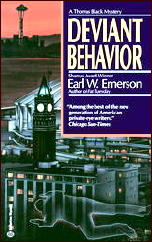
EARL W. EMERSON – Deviant Behavior. William Morrow & Co., hardcover, 1988. Ballantine, paperback, 1991.

   The latest case for Thomas Black, Seattle private eye, is Deviant Behavior by Earl W. Emerson. This is an impressive tale, with emphatic characterizations and a sinewy plot.

   The wealthy Steebs, Dudley and Faith, hire Black to find their missing adopted son Elmore, age seventeen. Thomas traces Elmore to an abandoned hotel, the building from which Elmore’s uncle (and Dudley’s business partner) leaped to his death six years earlier.

   Elmore is carrying unaccountably large sums of money, has given his girlfriend an expensive ring. The trail also leads to a retired film director, now a sort of guru to the local young, and his actress wife. But then the trail goes dead, very dead….

— Reprinted from The MYSTERY FANcier,
       Vol. 11, No. 1, Winter 1989.


    The Thomas Black series —

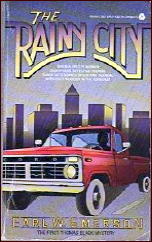
1. The Rainy City (1984)

EARL W. EMERSON Thomas Black

2. Poverty Bay (1985)
3. Nervous Laughter (1985)
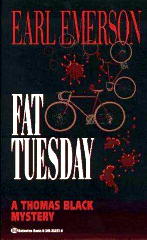
4. Fat Tuesday (1987)

EARL W. EMERSON Thomas Black

5. Deviant Behavior (1988)
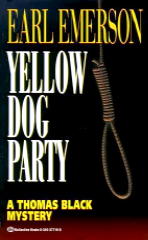
6. Yellow Dog Party (1991)

EARL W. EMERSON Thomas Black

7. The Portland Laugher (1994)
8. The Vanishing Smile (1995)     Shamus Award Best Novel nominee (1996).
9. The Million-Dollar Tattoo (1996)
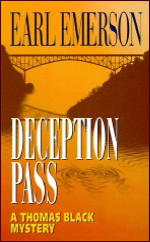
10. Deception Pass (1997)     Shamus and Anthony Awards Best novel nominee (1998).

EARL W. EMERSON Thomas Black

11. Catfish Cafe (1998)
12. Cape Disappointment (2009)

EARL W. EMERSON Thomas Black

THE ARMCHAIR REVIEWER
Allen J. Hubin


JOHN MALCOLM Tim Simpson

JOHN MALCOLM – Mortal Ruin. Scribner’s, hardcover, 1988. First published in the UK: Collins Crime Club, hardcover, 1988.

   The sixth of John Malcolm’s tales about London art investment expert Tim Simpson is Mortal Ruin. Malcolm has a deft hand with art intrigues and engaging people, with a craftily concealed villain stuck among the cast, as this latest well illustrates.

   Simpson is asked to help with some old gold stocks, recently discovered and totally valueless. But while going to Chicago on his mission, someone steals his suitcase. In vengeful pursuit with briefcase in hand, Tim is confronted by two heavyweights, who say thank you very much we’ll have your briefcase too.

   Next comes murder in Chicago, followed by violence in England. What — surely not the foolish gold certificates, now stolen in any event — is worth all this mayhem? Ingeniously worked out, with surprise upon surprise at the end.

— Reprinted from The MYSTERY FANcier,
       Vol. 11, No. 1, Winter 1989.


The Tim Simpson series —

1. A Back Room in Somers Town (1984)

JOHN MALCOLM Tim Simpson

2. The Godwin Sideboard (1984)
3. The Gwen John Sculpture (1985)
4. Whistler in the Dark (1986)
5. Gothic Pursuit (1987)

JOHN MALCOLM Tim Simpson

6. Mortal Ruin (1988)
7. The Wrong Impression (1990)
8. Sheep, Goats and Soap (1991)
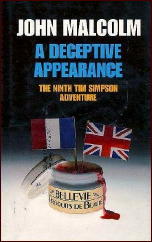
9. A Deceptive Appearance (1992)

JOHN MALCOLM Tim Simpson

10. The Burning Ground (1993)
11. Hung over (1994)
12. Into the Vortex (1996)
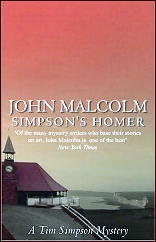
13. Simpson’s Homer (2001)

JOHN MALCOLM Tim Simpson

14. Circles and Squares (2003)
15. Rogues’ Gallery (2005)

THE BACKWARD REVIEWER
William F. Deeck


HUGH HOLMAN John Macready

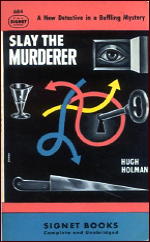
  HUGH HOLMAN. Slay the Murderer. M. S. Mill Co., hardcover, 1946. Signet #684, paperback, 1948.

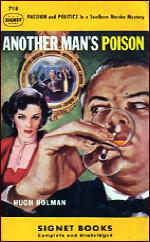
    — Another Man’s Poison. M. S. Mill Co., hardcover, 1947; Signet #718, paperback, 1949.

   Apparently the third book in the series featuring Sheriff John Macready of Hart County, South Carolina, Slay the Murderer finds the sheriff in something of a bind. Election Day is only two days off, and a prominent citizen is discovered stabbed and poisoned in a locked room.

   The killer ought to be obvious, since he, too, is in the locked room, but Macready is considerably more than just a hick sheriff — though he wouldn’t want the voters to know that — and he finds contradictory evidence.

HUGH HOLMAN John Macready

   Still, if Macready doesn’t arrest the obvious person or doesn’t find out who did indeed do it and how, his re-election to a fairly cushy job that he usually enjoys is doubtful.

   In the later Another Man’s Poison, Macready leaves his county to complain to a politician about the appointment of an inept postmaster. Before he can talk to him, the politician drinks one of his own special cocktails and dies of poison.

   Macready is a witness, and there seems to be no way that the drink could have been poisoned by anyone. Also, it can’t be certain that the politician was the target of the poisoner, for he had taken the glass from someone else. Macready is glad it’s someone else’s problem until the murderer attacks him.

   Two excellent mysteries with an appealing lead character.

— From The MYSTERY FANcier, Vol. 11, No. 1, Winter 1989.


       The Sheriff John Macready series —

Trout in the Milk. Mill, 1945.
Up This Crooked Way. Mill, 1946.
Slay the Murderer. Mill, 1946.
Another Man’s Poison. Mill, 1947.

   Hugh Holman (1914-1981) was the author of two other mysteries: Death Like Thunder (Phoenix, 1942) and as Clarence Hunt, Small Town Corpse (Phoenix, 1951).

   Holman, however, was more than a writer of better than average detective novels, using Bill’s review as a basis for that statement. From http://museum.unc.edu:

    “In 1946, he entered graduate school at the University of North Carolina, where he received his doctorate with a dissertation on William Gilmore Simms. He joined the UNC English department and taught there until his retirement. He served as department chair, acting dean of the College of Arts and Sciences, dean of the graduate school, provost, and special assistant to the chancellor. From 1957 to 1973, he served as chair of the Board of Governors of the University of North Carolina Press. Holman was the recipient of a Simon Guggenheim Fellowship (1967), the Thomas Jefferson Award (1975), and the Oliver Max Gardner Award (1977). He was a fellow of the American Academy of Arts and Sciences and a founding editor of the Southern Literary Journal.”

THE SERIES CHARACTERS FROM
DETECTIVE FICTION WEEKLY
by Monte Herridge


        #13. HUGO OAKES, LAWYER-DETECTIVE, by J. Lane Linklater.

   One of the precursors of Erle Stanley Gardner’s series character Perry Mason the attorney, the Hugo Oakes series is fairly entertaining. J. Lane Linklater created this series about a criminal defense attorney who solved crimes. He appeared in twenty stories in Detective Fiction Weekly from 1929-1934, a respectable run.

   J. Lane Linklater was the pseudonym of Alex Watkins (1893?-1983?). He had two other series that also ran in the magazine: Sad Sam Salter (1937), and Paul C. Pitt, a kind of conman (1936-1941).

   One of the stories describes Oakes the person: “Hugo Oakes, lawyer, investigator, gruff friend of the penniless in trouble, had four great interests in life. Those interests were law, detection, people—and horses.” (Finishing Touches)

   A physical description of Oakes is noted in another story: “He was a wizard with flowery eloquence, too, but outside of the courtroom it didn’t seem to go with his age-colored, shapeless clothes, his casual manner, his pudgy person.” (You Think of Everything)

   He wears a slouch hat, and rolls his own cigarettes. Very little information is given about Oakes’ background and upbringing. There is a mention by Oakes himself on one occasion that he liked horses because he grew up on a farm (Not One Clew).

HUGO OATES J. Lane Linklater

   He prefers to use ungrammatical, common speech that belies his education. However, when he wishes he can use much better language. Inspector Mallory prefers Oakes to use common language; he “liked Oakes much less when the lawyer used four-syllable words.” (Arsenic in the Cocktail)

   Oakes is not one of the high-priced lawyers with a fancy office and furniture. He has a shabby office that costs him twenty dollars a month, and often doesn’t have enough in his business accounts to pay that. His only employee is Mamie, who is his combination stenographer-bookkeeper-secretary.

   The reason he has very little money is that people rarely paid him for the legal work he did for them. Oakes has a thriving practice helping people with little money out of trouble. He did his own detective work rather than hire a detective agency to do it for him. However, we must remember that these stories take place during the Depression, when many people either lacked jobs or had poorly paying ones.

   Oakes is an egalitarian, preferring regular people and the poor to the better off and wealthy classes. A person’s lack of money never affected Oakes’ decision to take them on as a client.

HUGO OATES J. Lane Linklater

   The only other regular in the series is police Inspector Mallory, who is usually glad to have Oakes help on his cases, but “he would never admit it. They might gibe and grouch at each other on occasion, but Mallory had intelligence enough to recognize the value of Oakes’s assistance, and Oakes was always willing to let the credit go to Mallory.” (Finishing Touches)

   Each story usually involves Oaks being called in by a client and then having to solve a murder, usually to save the client. Once his client was a murder victim before Oakes could reach the scene. Inspector Mallory was always on hand at the scene of the crime. Mallory either does not understand what is going on, or seeks the simplest explanation (always wrong, of course).

   Very rarely did Mallory actively ask for Oakes’ help on a case. One special case was in the story “A Pair of Shoes”, where Mallory asked for assistance. A rich businessman had disappeared, and three weeks of work had led Mallory to be desperate enough to ask for unofficial help. Oakes gets to work and very quickly solves the case in a logical manner.

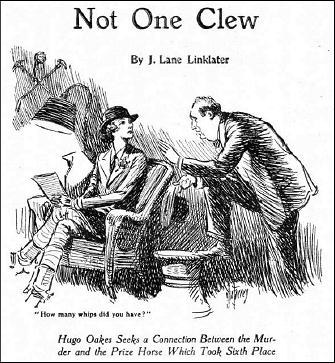
   Another request for help from Mallory led to a murder investigation by Oakes at a high society horse show in “Not One Clew”. Oakes said he did not care for society, but he did like the horses. Part of the deal with Mallory was a free ticket to the horse show.

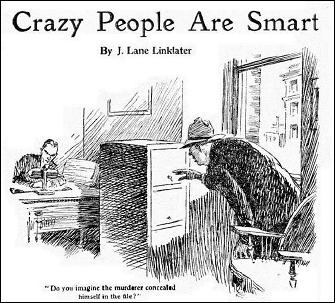
   Another off-beat story for the series is “Crazy People Are Smart,” where Oakes accepts the challenge of a prison chaplain and investigates an old murder. Bill Tubby had just twenty-four hours before his scheduled electric chair execution for a crime he claimed he did not commit. Inspector Mallory had solved the case to his satisfaction, and he is afraid Oakes will do something to change the outcome. Oakes goes to the scene of the crime and investigates, coming up with an unusual solution that saves Tubby.

HUGO OATES J. Lane Linklater

   Hugo Oakes has a system for locating the murderer in crime situations: “Always look for the type of mind capable of conceiving and executing the particular crime under scrutiny.” (The Wild Man From Borneo)

   Inspector Mallory knows about this system, and in this story attempts to use it himself. Unfortunately he chooses the wrong person as the murderer, and Oakes has to straighten him out. This is one case where Oakes becomes involved because the victim was a friend of his. Oakes is uncharacteristically not in his usual cheerful mood; in fact he is angry and unsmiling.

   Another story gives a bit more of Oakes’ insight into crime detecting: “But a man always leaves the imprint of his personality on his crime. What a man does is the expression of what he is. He may not leave fingerprints, but he always leaves mind prints.” (Crazy People Are Smart)

   So Hugo Oakes is a believer in the application of psychology to crime-solving. The stories contain little violence, though one exception is in the story “Finishing Touches.” Here Oakes confronts the guilty party and has Inspector Mallory secretly back him up, which is needed when the murderer attempts to kill Oakes. Mallory wounds the murderer and saves Oakes’ life.

   The series is interesting to read, although there are not any great criminal masterminds, fancy destructive gadgets, or gangs of criminals running around. It took all kinds of stories in the pulp era, and this series is better than many other series in DFW.

      The Hugo Oakes series, by J. Lane Linklayer:

Hello, Jim!     September 7, 1929
Court Costs Saved     October 5, 1929
The Wild Man From Borneo     February 22, 1930
The Watchful Woman     May 10, 1930
Not One Clew     May 24, 1930
Crazy People Are Smart     May 31, 1930
The Seventh Green Murder     July 26, 1930
The Lady Confesses     August 23, 1930
Three Old Crows     October 18, 1930
A Pair of Shoes     November 15, 1930
Finishing Touches     January 3, 1931
You Think of Things February 7, 1931
Women Always Mean Trouble     March 28, 1931
Arsenic in the Cocktail     April 4, 1931
He Died Laughing     July 4, 1931
Murder Next Door     September 5, 1931
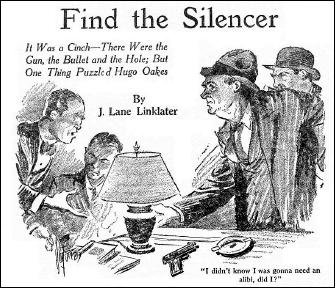
Find the Silencer     October 10, 1931
The Second Floor Murder     November 19, 1932
The Dead Client     December 2, 1933
On the Brink     June 2, 1934

    Biographical sketch of Linklater from the March 16, 1929 issue of Detective Fiction Weekly:
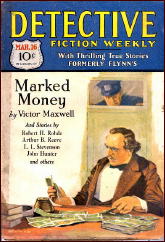
HUGO OATES J. Lane Linklater

   HERE is a personal greeting from J. Lane Linklater, author of “One O’Clock in the Morning,” in this issue. We asked him to stand up and say a few words to you:

   You can’t mean me, cap’n?

   Oh, well—

   We’ll avoid the statistical as far as possible and get down to the vital.

   I have lived more or less decidedly and existed more or less uncertainly, in Washington, Oregon, California, Arizona, New Mexico, Texas, and Louisiana; that is, down the Pacific Coast from British Columbia to the Mexican border, and across the south to Louisiana. Thus it will be seen that I have never set foot on any but a coast or border State.

   I have held down — sometimes for a very brief period — forty-three jobs, in offices, restaurants, hotels, boarding houses, and again in offices; in large cities, small towns, construction and logging camps, in green valleys and desert plains. If I was working in a town, it was never far away from a restaurant; if in a camp, it was never very far away from the cookhouse.

   Incidentally, the transition from job to job was at times sudden and drastic. On one occasion, for instance, I was night porter in a “coffee and” dump, and a week later I was head bookkeeper for a chain store system some two thousand miles away. Honestly — or perhaps I should say, actually — I am a very fair bookkeeper.

   While I’m on the question of jobs — and what is more important? — I might add that the last regular job I had, and the one I was on longer than any of the others, was as editor of a farm paper. I was never better fitted for any job than for this one inasmuch as I had never in my life touched my hand to a plow and couldn’t tell the difference between a Jersey heifer and a Shorthorn bull. Now I know what a Shorthorn bull is, having met one in a dissatisfied mood.

   Among the people I have met and become friendly with — and this is vital, from the point of view of both life and letters — were bankers, labor agitators, gamblers, ministers, politicians, hoboes, Chinese cooks, mining-stock promoters, hard-working bohunks, and waitresses. Of these I should say that the bohunks were the most useful, the hoboes the happiest, the Chinese cooks the most successful, and the waitresses the most interesting — to me.

   Perhaps the most accurate indication of the kind of life a man has led is where he has slept. Well, I have slept in very expensive hotels — when I was working there — in middle-class hotels, in cheap hotels, and in fifteen-cent flophouses; also in bunk houses, ditches, city parks, fields, woods and swamps. Of these I should say that the woods were the most comfortable and the flophouses the most interesting.

   I have never been arrested. This I now regret exceedingly. I have had several opportunities, although I never offended society very seriously, except by going broke. I have been accosted on the street around three o’clock in the morning in San Francisco, Los Angeles and New Orleans and other minor municipalities which suspected that my financial status warranted my arrest as a vagrant. Their suspicions were correct, but I was always able to convince them otherwise. As I say, I now regret it. I may yet overcome this disadvantage.

   In these emergencies my tongue was assisted by my face, a deceptively mild arrangement that never seemed to fit the role of roving mendicant. I have been mistaken for a well-known Methodist minister in Portland, Oregon, and for a Chatauqua lecturer in Sweetwater, Texas.

   My formal education, unfortunately, was not very extensive. However, I have read rather incessantly, if not systematically. Meditating upon what I had seen and what I had read I decided, about a year and a half ago, to forsake the discussion of ton litters and live stock diseases for the production of fiction. I inquired about it. I read the writers’ journals. I asked advice of people who know about these things — I was always keen for advice.

   They all told me to hang on to my job for five or perhaps ten years, the while I tried to write fiction. I thereupon quit my job cold. Advice is fine, but I have always thought that if you’re going to do a thing, the thing to do is to go ahead and do it, sink or swim. I’m not rich yet, but the wife and I are going back down to California for the winter.

   I have never been well enough to undertake anything violent, and never sick enough to take to my bed. It is a condition that presages a long life. Under the head of more good luck, I have a wife — acquired about eight years ago — who is a good scout and a smart woman; a father and mother, both alive and well, who are intelligent and good natured—they had to be to put up with me—and a number of friends who stick through the years.

   All of these things count. Not that it matters, but I am now thirty-six years old.


    Previously in this series:

1. SHAMUS MAGUIRE, by Stanley Day.
2. HAPPY McGONIGLE, by Paul Allenby.
3. ARTY BEELE, by Ruth & Alexander Wilson.
4. COLIN HAIG, by H. Bedford-Jones.
5. SECRET AGENT GEORGE DEVRITE, by Tom Curry.
6. BATTLE McKIM, by Edward Parrish Ware.
7. TUG NORTON by Edward Parrish Ware.
8. CANDID JONES by Richard Sale.
9. THE PATENT LEATHER KID, by Erle Stanley Gardner.
10. OSCAR VAN DUYVEN & PIERRE LEMASSE, by Robert Brennan.
11. INSPECTOR FRAYNE, by Harold de Polo.
12. INDIAN JOHN SEATTLE, by Charles Alexander.
« Previous PageNext Page »