Characters


IT’S ABOUT CRIME, by Marvin Lachman

ROBERT L. FISH Jose da Silva

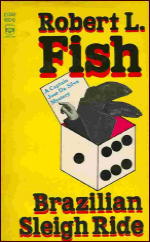
ROBERT L. FISH – Brazilian Sleigh Ride. Simon & Schuster, hardcover, 1965. Paperback reprints: Berkley, 1967; Foul Play Press, 1988.

   Robert L. Fish, after a successful business career, became a successful mystery writer at age 48. He wrote the hilarious Schlock Holmes parodies and a fine series of ten books about Captain Jose Da Silva, one of the best of which, Brazilian Sleigh Ride, has just been reprinted by Foul Play Press.

   Fish uses two locales he knows best, Brazil (where he worked many years) and New York, in chronicling the efforts of Da Silva and his friend Wilson of the American Embassy to find who stole a fortune in negotiable bearer bonds.

   The story is compelling and Fish tells it in very lively fashion, especially regarding Da Silva’s extreme fear of flying and his feuding with Wilson.

— Reprinted from The MYSTERY FANcier,
Vol. 11, No. 1, Winter 1989.


       The Captain Jose da Silva series —

The Fugitive. Simon & Schuster, 1962.
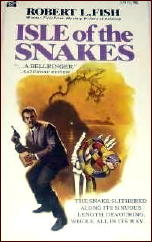
Isle of the Snakes. Simon & Schuster, 1963.

ROBERT L. FISH Jose da Silva

The Shrunken Head. Simon & Schuster, 1963.
Brazilian Sleigh Ride. Simon & Schuster, 1965.
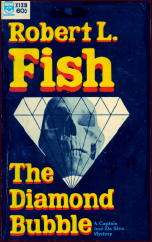
The Diamond Bubble. Simon & Schuster, 1965.

ROBERT L. FISH Jose da Silva

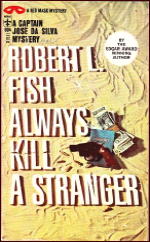
Always Kill a Stranger. Putnam, 1967.

ROBERT L. FISH Jose da Silva

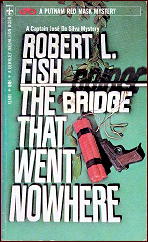
The Bridge That Went Nowhere. Putnam, 1968.

ROBERT L. FISH Jose da Silva

The Xavier Affair. Putnam, 1969.
The Green Hell Treasure. Putnam, 1971.
Trouble in Paradise. Doubleday, 1975.

THE ARMCHAIR REVIEWER
Allen J. Hubin


SAM LLEWELLYN Dead Reckoning

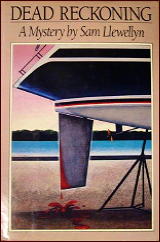
SAM LLEWELLYN – Dead Reckoning. Summit Books, US, hardcover, 1988. Pocket, US, paperback, 1989. First published by Joseph, UK, hardcover, 1987.

   If Dick Francis turned from horse racing to yacht racing his name might be Sam Llewellyn and he might write Dead Reckoning. This is Llewellyn’s second novel and first mystery, and it’s a gem.

   Charlie Agutter is a boat designer in Pulteney on the coast of England. His fortunes are on the rise, his talents are in demand, and one of his yachts seems likely to win the Captain’s Cup. Then the bottom falls out: Charlie’s brother is killed aboard a boat Charlie designed, and the word gets about that Charlie’s design is fatally flawed.

   Suddenly no one wants to touch him; existing design contracts are put on hold till Charlie can prove his experimental rudder design not at fault. If only he could… But someone badly wants him ruined if not dead.

   Notable drive and suspense.

— Reprinted from The MYSTERY FANcier,
       Vol. 11, No. 1, Winter 1989.


       The Charlie Agutter series —

Dead Reckoning, 1987.
Blood Orange, 1988. CA in a supporting role.
Deadeye, 1989. CA in a minor role.
Death Roll, 1989. CA in a minor role.

   These four books are only a small fraction of Llewellyn’s total fictional output. For a complete list, check out the Fantastic Fiction website.

REVIEWED BY BARRY GARDNER:


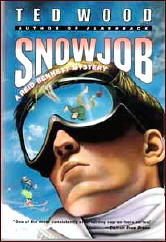
TED WOOD – Snowjob. Reid Bennett #9. Charles Scribner’s Sons, hardcover, 1993. Worldwide Library, paperback, 1995.

TED WOOD Reid Bennett

   When I think of Canadian mystery writers, three immediately come to mind: Eric Wright, Lawrence Gough, and Ted Wood. All are good, and Wright and Wood are among my favorites. Reid Bennett is Chief and one-man force of a small Ontario town, but often for one reason or another leaves his venue, and the books seem more like hardboiled PI stories than police procedurals.

   Here Bennett comes to a Vermont ski town to aid a Viet Nam buddy in trouble. Doug Ford, black, ex-Marine, local cop, has been arrested for the murder of a local woman. He tells Bennett that he was working with her undercover to bust a money laundering scheme involving local bigwigs and New York Mafia.

   The problem is that he was doing it on his own and didn’t tell anyone in the Department. The problem is compounded by Ford’s personal grudge against the Mafia bigwig, dating from his days as a NYC cop. The frame is tight, the local force is honest but inexperienced, and no one but Bennett believes him innocent. So Bennett and his wonder-dog Sam go to work.

   I’ve never thought that plotting was one of Wood’s strong points, and I’m confirmed in that view here. From the original premise to a confusing if not confused ending, I thought this plot was weak. What I have enjoyed about the series is the well-developed character of Reid Bennett, and the fast paced and forceful writing of Wood; and I still do.

   Wood is an ex-Toronto policeman, and though these are in no sense procedurals there is authenticity to the parts that deal with police work. They are usually violent books, and this is no exception., though it’s less violent than some previous ones.

   I continue to enjoy the Bennett series, though much less than I would if the plots were better. This is not the best of them by any means, but I’d still recommend it to Wood fans.

— Reprinted from Ah, Sweet Mysteries #8, July 1993.


      The Reid Bennett series —

1. Dead in the Water (1983)

TED WOOD Reid Bennett

2. Murder On Ice (1984)

TED WOOD Reid Bennett

3. Live Bait (1985)

TED WOOD Reid Bennett

4. Fool’s Gold (1986)
5. Corkscrew (1987)
6. When the Killing Starts (1989)
7. On the Inside (1990)
8. Flashback (1992)
9. Snowjob (1992)
10. A Clean Kill (1995)

IT IS PURELY MY OPINION
Reviews by L. J. Roberts


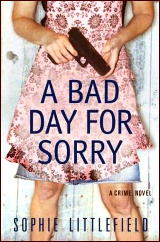
SOPHIE LITTLEFIELD – A Bad Day for Sorry. St. Martin’s Press/Minotaur Books, hardcover, August 2009; trade paperback, May 2010.

Genre:   Unlicensed Investigator. Leading character:  Stella Hardesty; 1st in series. Setting:   Rural Missouri.

First Sentence:   Whuppin’ ass wasn’t so hard, Stella Hardesty thought as she took aim with the little Raven .22 she took off a cheating so-of-a-bitch in Kansas City last month.

SOPHIE LITTLEFIELD Stella Hardesty

   Stella Hardesty knows what it’s like to live with a physically abusive man. After taking care of her own husband, in a permanent way, she has made an off-the-books career out of convincing other women’s men to either change their ways or clear out.

   She has been very effective, in the past, but Roy Dean Shaw isn’t getting the point. Instead, he kidnaps his wife Chrissy’s baby, of whom he’s not even the father. Then, Stella learns that Roy Dean is connected to a crime gang. Still Stella, with Chrissy by her side, is determined to save the baby.

   The prologue left me fearing Littlefield’s book would be cute and folksy and the vernacular would become tiresome. Instead, it helps establish the sense of place and there is nothing cute about this book except the well placed humor applied with deft hand.

   Stella is a wonderful character. She is a survivor in the best sense of the word. Rather than become hardened by her experiences, her empathy for others makes her determined to do for them what they can’t do for themselves, even if her methods are not exactly — okay not at all — within the law.

   She does what the law does not; protects women. She is not your classic heroine; she’s over 50, seen hard life and known pain, both physical and emotional. But she’s tough and smart.

   Chrissy begins as her antithesis; young, cute, big-busted with blond curls. What was refreshing was that Littlefield did not write her as a stereotype. Chrissy provides to be someone not to be underestimated and exemplifies the adage of not getting between a mother and her young, and I hope we see more of her in future books.

   There is great dialogue here, as long as one doesn’t mind rough language. Anything else would have been unrealistic and completely out of character. The book is very well plotted, with a flow that keeps you engaged from first page to last and with an originality that catches you off guard.

   It’s a story that, were the characters men, you wouldn’t flinch. However, because they are women, you are, at times, both uncomfortable and cheering them on. There is great suspense and really well-done action.

   A Bad Day for Sorry surprised me and delighted me. It won an Anthony Award for Best First Novel and it was well deserved. It’s a pleasure to know there are more books in this series.

Rating:   Very Good Plus.

      The Stella Hardesty series

1. A Bad Day for Sorry (2009)
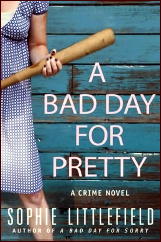
2. A Bad Day for Pretty (2010)

SOPHIE LITTLEFIELD Stella Hardesty

3. A Bad Day for Scandal (2011)
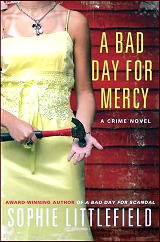
4. A Bad Day for Mercy (2012)

SOPHIE LITTLEFIELD Stella Hardesty

A REVIEW BY MARYELL CLEARY:
   

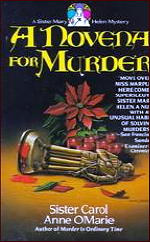
SISTER CAROL ANNE O’MARIE – A Novena for Murder. Charles Scribner’s Sons, hardcover, 1984. Dell, paperback, 1986. St. Martin’s, paperback, 2005.

SISTER CAROL ANNE O'MARIE

   Sister Mary Helen is a sprightly 75, reluctantly retired from the parochial schools to “do research” at Mount St. Francis College for Women. When the head of the history department, Professor Villanueva, is found with his head bashed in, Sister Mary Helen plunges into detection with all of her enthusiastic nature.

   She brings along with her her old friend, Sister Eileen, the college librarian, and a new friend, Sister Anne, the college chaplain. Professor Villanueva was known for his kindly sponsorship of young Portuguese immigrants, several of whom work for the college. However, several others have recently disappeared.

   The professional police detectives, Inspectors Kate Murphy, a Mt. St. Francis alumna, and Dennis Callahan, who takes a paternal interest in Kate’s love life, strongly suspect one of the Portuguese men after they learn that the professor’s kindness was more apparent than real.

   Though they’re at first annoyed by Mary Helen’s intervention, they wind up liking and respecting her. She is a lively addition to the ever-growing group of clerical detectives. The book is laced with humor, the people are interesting, and the San Francisco locale is well depicted.

   Plot is a bit thin on the ground, and the book’s brevity precludes any real depth of character. Maybe Sister O’Marie will go deeper next time. This enjoyable first effort deserves a follow-up.

— Reprinted from The Poisoned Pen, Vol. 6, No. 4,
Fall 1986.


Bio-Bibliographic Notes:   There was indeed a follow-up, ten of them, in fact. There might have even been more, but Sister Carol Anne O’Marie died in 2009 at the age of 75. Besides writing mysteries, she also helped run run a shelter for homeless women in Oakland, CA. A tribute to her at the time of her death by Janet Rudolph may be found on the latter’s blog here.

       The Sister Mary Helen series —

1. A Novena For Murder (1984)
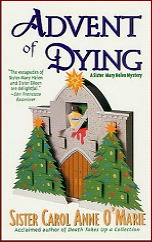
2. Advent of Dying (1986)

SISTER CAROL ANNE O'MARIE

3. The Missing Madona (1989)
4. Murder in Ordinary Time (1991)
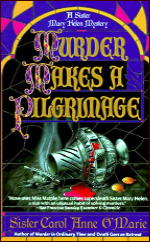
5. Murder Makes a Pilgrimage (1993)

SISTER CAROL ANNE O'MARIE

6. Death Goes on Retreat (1995)
7. Death of an Angel (1996)
8. Death Takes Up a Collection (1998)
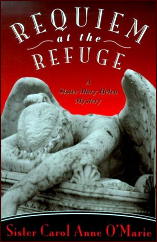
9. Requiem at the Refuge (2000)

SISTER CAROL ANNE O'MARIE

10. The Corporal Works of Murder (2002)
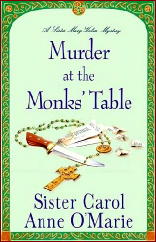
11. Murder at the Monk’s Table (2006)

SISTER CAROL ANNE O'MARIE

IT’S ABOUT CRIME, by Marvin Lachman

MAX ALLAN COLLINS Mallory

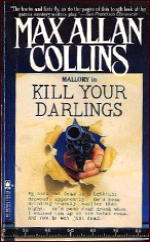
MAX ALLAN COLLINS – Kill Your Darlings. Walker, hardcover, 1984. Tor, paperback, 1988.

   The first mystery novel set at a Bouchercon, Max Allan Collins’s Kill Your Darlings takes place in Chicago, where Bouchercon was held in 1984, though Collins wrote the book before that event.

   It’s an enormously enjoyable tale, well plotted and with lots of insights into a mystery convention and publishing, though mostly from a writer’s viewpoint. (Fans do not loom large in this book.) The plot device, an unknown Hammett manuscript, is an inspired idea.

   Despite Collins’s disclaimer that the victim, an old-time mystery writer, is a composite, he reminded me of someone in particular. If you ask me at the next Bouchercon, I’ll tell you who. Until then, attend a Bouchercon vicariously with Max as your guide.

— Reprinted from The MYSTERY FANcier,
Vol. 11, No. 1, Winter 1989 (very slightly revised).


Bibliographic Data: The detective who solves the case in Kill Your Darlings is “Mallory,” a former cop who became a mystery writer living in Iowa.

       The Mallory series —

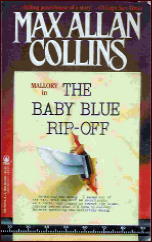
The Baby Blue Rip-Off. Walker, 1983.

MAX ALLAN COLLINS Mallory

No Cure for Death. Walker, 1983.
Kill Your Darlings. Walker, 1984.
A Shroud for Aquarius. Walker, 1985.
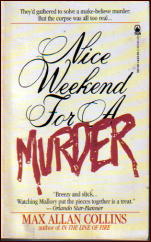
Nice Weekend for a Murder. Walker, 1986.

MAX ALLAN COLLINS Mallory

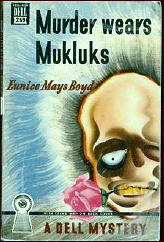
EUNICE MAYS BOYD – Murder Wears Mukluks. Farrar & Rinehart Inc., hardcover, 1945. Dell #259, reprint paperback, mapback edition, 1948.
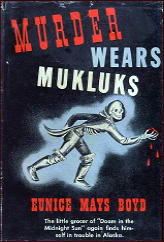
EUNICE MAYS BOYD Murder Wears Mukluks

   I’ve owned the Dell mapback edition of this book since I first became aware of the series, which is perhaps some 40 years ago. I’ve also been fascinated by the title, which I’m sure is unique in the annals of crime and detective fiction, but what I can’t explain to you (or anyone else, for that matter) why I never sat down to read the book until now.

   Which I have, at last, but — I have to confess — I was disappointed. Not at first, though, not at all. I enjoyed the first fifty pages so much that I found inexpensive copies of the other two books in the series (see below) and ordered them online. All three books take place in Alaska, and the hero of record is a mild-mannered grocer in Fairbanks named F. Millard Smyth.

   Or at least he’s a grocer in this one. The other two books are still en route, and I can’t swear to anything I don’t know for sure. After being visited by the previous owner of his store – F. Millard has fallen behind on his payments – he makes his nightly visit to his warehouse next door to stoke up the stove to keep his stock from freezing.
EUNICE MAYS BOYD Murder Wears Mukluks

   The building used to be an old dance hall, and F. Millard (which is how the author refers to him also) is treated to a ghostly dance by what appears to be a beautiful young woman on the balcony. The lights go out, and the F. Millard flees. In the morning, though, when he returns, he finds the body of the man to whom he owes the money he cannot repay, Tom Blaine.

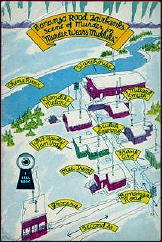
   The marshal’s deputy thinks he has the case solved right away, but when Jeff Peters, the marshal himself, returns, he demurs. It seems as though everybody who lives on the same short road as Smyth may have a motive – and opportunity, once their alibis are checked more closely.

   As I say, it’s a fine beginning, but F. Millard Smyth, though he’s a devoted reader of Flatfoot magazine, is no great shakes of a detective, and if Jeff Peters is an improvement (and he is), the author of this pale imitation of a detective puzzle can’t seem to show it.
EUNICE MAYS BOYD Murder Wears Mukluks

   All of the possible suspects have known each other for a long time, and have been married to each other (some of them), or in love with each other (a different set than that of the previous category) and/or have cheated each other out of mining claims or furs or possibly some other tangible goods that I skimmed over. Strangely enough, the entire population of Fairbanks seems to live on this one short, dead-end street.

   The biggest disappointment comes, however, with the ending, as the killer traps Smyth in his store, believing him to be coming too close to the truth (we know better), and proceeds to explain in detail how everything came about and why.

   The recitation is long and complicated and takes up fifteen pages, before the marshal shows up and utilizes the last ten pages to clean up all the loose ends.

      The F. Millard Smith series —

Murder Breaks Trail. Farrar, 1943.
Doom in the Midnight Sun. Farrar, 1944.
Murder Wears Mukluks. Farrar, 1945.
THE ARMCHAIR REVIEWER
Allen J. Hubin


DAVID L. LINDSEY

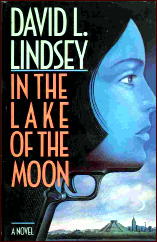
DAVID L. LINDSEY – In the Lake of the Moon. Atheneum, hardcover, 1988. Bantam, paperback, 1990.

   I’m of two minds about this book, the latest of David L. Lindsey’s novels about Stuart Haydon of the Houston police department. On the one hand, it’s notable for the depth of character revelation and exploration and for the strong sense of place.

   On the other, its 341-page length draws out the tale, thins it out, demanding reader patience. Photographs, decades old, come to Haydon in the mail. At first he doesn’t recognize the person pictured, but it’s his father, fifty years before. Stuart was very close to his father until his death some six years before, thought he knew him intimately.

   But the pictures, sent with malevolent purpose, are followed by others, and the trail leads from the steaming rain of Houston to the density and sprawl of Mexico City, to a man whose brain, bubbling with madness, is bent on death. But why him, Stuart wonders, off balance and out of his element, and how could there be so much of his father he didn’t know?

— Reprinted from The MYSTERY FANcier,
       Vol. 11, No. 1, Winter 1989.


      The Stuart Haydon series —

1. A Cold Mind (1983)
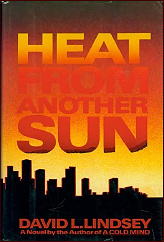
2. Heat from Another Sun (1984)

DAVID L. LINDSEY

3. Spiral (1986)
4. In the Lake of the Moon (1988)    [Nominated for an Edgar as Best Novel]
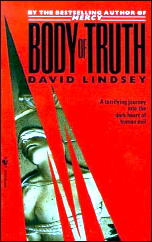
5. Body of Truth (1992)

DAVID L. LINDSEY


   David L. Lindsey has written eight other stand-alone novels, the most recent being The Face of the Assassin (2004).

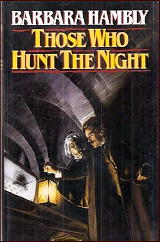
BARBARA HAMBLY – Those Who Hunt the Night. Ballantine/Del Rey, hardcover, December 1988; reprint paperback, 1990.

   Most assuredly a tour de force, if there ever was one. If you don’t know the story, hang on to your Bunsen burner. Under considerable duress, James Asher, one-time foreign agent for the British government is hired by Don Simon Ysidro to find out who is killing the vampires of London.

BARBARA HAMBLY James Asher

   The year is 1907, and the fact is that Ysidro himself became a vampire in 1555. Held over Asher’s head is the life of his wife Lydia, who is herself a scientist of some ability, and who knows something of the pathology of blood.

   Several of Ysidro’s companions are dead, with stakes in their hearts and their coffins opened to the light of day. What Ysidro cannot understand is how a human could be doing these deeds any vampire’s knowing, and thus he turns to what would otherwise be unthinkable: he is asking the assistance of a human. (Worse than that, of course, is actually allowing a human to know of the vampires’ existence.)

   Nominally a detective story, there are a few flaws along that line, mostly those of conjectures that somehow become facts within minutes of their being stated, and small jumps of logic that on occasion stumped me badly. (And sometimes they are wrong, leading to long wild goose hunts that circle back upon themselves, and only then are they crucial to the story.)

   What this may sound like is a horror story, but it really is not, although with vampires involved, how could there not be any chills? What it is, when it comes down to it, is a science fiction novel. There is a reason the story takes place when it does, and that’s because in 1907 there was just enough known about blood and bacteria and related matters to provide a solid “scientific” basis for the existence of vampires, and not yet enough to know that they are not possible.

   And always overshadowing Asher’s investigation is the question of how it’s going to work out when it’s over. Ysidro is a creature who has killed thousands of humans in his “lifetime,” and yet he and Asher become strange allies in their hunt for the killer of the vampires, and each in their own way begin to stand taller in the opinion of the other.

   While there may not be a definitive answer to this not-so-subtle problem, Hambly does offer the reader a resolution to it. She also supplies a solution to the mystery itself, and of the two (resolution and solution), it is the solution to the mystery that is stronger.

   All in all, this is a fascinating book, one I didn’t think I was going to read — it’s not my usual bill of fare — but as it turned out, I’m glad I did.

— Reprinted from Mystery*File 28,
       February 1991 (slightly revised).


[UPDATE] 05-20-12.   Unknown to me until now, this was the first of a series of vampire novels that Barbara Hambly wrote about Jim Asher. I’ll list those below.

   Hambly is one of the few authors I can think of who has written as many mysteries as she has in the SF/Fantasy field. Most notable among the former are her eleven novels (through 2011) featuring “free man of color” Benjamin January, a Creole physician and music teacher whose first adventure takes place in New Orleans in 1833.

      The James Asher series —

1. Those Who Hunt the Night (1988)
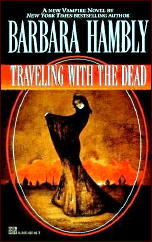
2. Traveling with the Dead (1995)

BARBARA HAMBLY James Asher

3. Blood Maidens (2010)
4. The Magistrates of Hell (forthcoming: July 2012)

IT IS PURELY MY OPINION
Reviews by L. J. Roberts


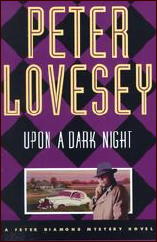
PETER LOVESEY – Upon a Dark Night. Mysterious Press, hardcover, 1997. Soho Crime, softcover, 2005. First published in the UK by Little Brown, hardcover, 1997.

Genre:   Police Procedural. Leading character:  Det. Supt. Peter Diamond; 5th in series. Setting:   Bath, England.

PETER LOVESEY Peter Diamond

First Sentence:   A young woman opened her eyes.

   An unconscious woman, found in a hospital parking lot, awakens to find she has no memory. Released to social services, she is placed in a hostel and befriended and named “Rose” by Ada Shaftsbury, a good soul with a large personality and a penchant for shoplifting.

   The Bath police have their own problems with the apparent suicides of an elderly farmer by shotgun and a woman off a roof. But were they suicides, and how do they link to Rose, whom Ada is pushing the police to find after she’s not seen her for two weeks? It’s up to DS Peter Diamond to figure it out.

   There is nothing better than a book that not only has an intriguing beginning but also causes you to wonder what you’d do in a similar situation.

   An unusual facet to this story is that Diamond doesn’t begin to play a major role until quite a way into the story, but what a dynamic, and flawed, character he is. I enjoy the relationship he has with his wife, Stephanie, and their cat, Raffles.

   At the same time, he is not an easy person for others to deal with, particularly Detective Inspector Julie Hargreaves. Diamond respects her, but releases his frustration publicly on her and it is through his imperfections and some of their interchanges that we get to know Diamond better.

   Ada, with all her faults, is a pivotal character and often allows Lovesey to exhibit his delightfully dry humor… “While her old man was refusing to admit to anything, she was singing like the three tenors.”

   What I most appreciate, however, is the plotting. It takes you down interesting, unexpected roads where you learn about everything from film shooting schedules, ancient English history and detectorology and treasure troves. The inclusion and care of such details is only one element that sets Lovesey apart as a writer.

   I particularly like that DS Diamond investigates the case by looking for evidence, doing the research, working his team and following the clues rather than working from assumption. There are good climatic twists and a very well done ending. I am delighted that there are many more books in the series waiting for me to read.

Rating:   Excellent.

       The Peter Diamond series —

1. The Last Detective (1991)

PETER LOVESEY Peter Diamond

2. Diamond Solitaire (1992)
3. The Summons (1995)
4. Bloodhounds (1996)

PETER LOVESEY Peter Diamond

5. Upon A Dark Night (1997)
6. The Vault (1999)
7. Diamond Dust (2002)

PETER LOVESEY Peter Diamond

8. The House Sitter (2003)
9. The Secret Hangman (2007)
10. Skeleton Hill (2009)
11. Stagestruck (2011)

PETER LOVESEY Peter Diamond

12. Cop to Corpse (2012)

« Previous PageNext Page »