Characters


DONALD MacKENZIE Death Is  A Friend

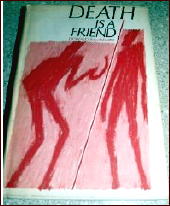
DONALD MacKENZIE – Death Is a Friend. Houghton Mifflin; US, hardcover, 1967. First published in the UK by Hodder & Stoughton, hardcover, 1967.

   One of the reasons I bought this was because one of the crooks in this ill-fated crime caper is a stamp dealer by profession. (I used to collect the things before I discovered that once hinged into an album there’s nothing you can do with them.)

   Three men brought together by greed are splintered apart by distrust jealous hatred — yes, there’s a woman involved — and a fine portrayal of the fickle finger of fate.

   MacKenzie is not a particularly good writer, but he’s often an effective one. Except for the ending, which made no sense at all, this is a pretty fair example of the destructive effects inherent in some human relationships. There’s nothing in the plot that seriously depends on stamps, though.     (C plus)

— Reprinted from The MYSTERY FANcier, Vol. 1, No. 5, September 1977 (slightly revised).


[UPDATE] 03-01-12.   Donald MacKenzie was a very prolific mystery writer, with nearly 40 titles to his credit between 1965 and 1993. Sixteen of these were cases solved in one way or another by John Raven, a hardboiled inspector from Scotland Yard described by some sources as a “maverick.”

   When I wrote this review I did not realize it was the second of three books with Henry Chalice and Crying Eddie as the two leading characters. At this late date I do not know who they are or what role they had in Death Is a Friend. All I can tell you is that neither of them are the stamp collector I was talking about, nor (I am sure) either of his two accomplices:

       The Henry Chalice & Crying Eddie series —

Salute from a Dead Man. Hodder, 1966.
Death Is a Friend. Hodder, 1967.
Sleep Is for the Rich. Macmillan, 1971.

ANDREW YORK Jonas Wilde

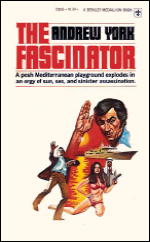
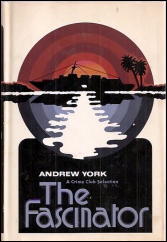
ANDREW YORK – The Fascinator. Doubleday Crime Club, US, hardcover, 1975; Berkley, US, paperback, 1976. First published in the UK by Hutchinson, hardcover, 1975; Arrow, UK, paperback, 1977.

   James Bond is not dead. It’s taken me a while to discover it, but Jonas Wilde, with many years of service to British Intelligence already behind him, is the logical successor.

   He’s not as flamboyant a character perhaps, but Wilde is very much a deadly adversary, and he possesses quite the same remarkable fascination to women. Trained agents they may be, but soon enough they become sexual objects to be toyed with as well. Fascinating.

   Actually he’s retired at the beginning of this one, fed up, torn loose, and lost in the soothing touch of Spanish sangria. A puzzling task presented by Israeli Intelligence under duress reawakens his faculties, however, and when he agrees to become the bodyguard for an Arabian potentate yachting in the Mediterranean, no amount of clever plotting or overwhelming firepower can sway him from the job he was hired for.

   He’s an indefatigable one-man task force, but after he’s trapped by an explosion in an underwater cavern with the wounded prince and his number one consort, all you can do is hold your breath during yet another attempt at escape.     (B plus)

— Reprinted from The MYSTERY FANcier, Vol. 1, No. 5, September 1977.


[UPDATE] 02-23-12.   I did not realize it at the time, but this was the last adventure of Jonas Wilde, or at least the last one that Andrew York, one of several pen names of prolific author Christopher Nicole, wrote up about him:

      The Jonas Wilde series —

The Eliminator. Hutchinson 1966.
The Co-Ordinator. Hutchinson 1967.

ANDREW YORK Jonas Wilde

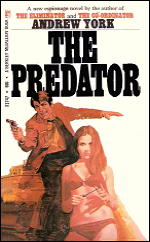
The Predator. Hutchinson 1968.

ANDREW YORK Jonas Wilde

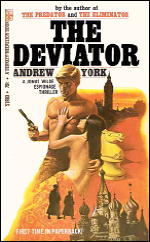
The Deviator. Hutchinson 1969.

ANDREW YORK Jonas Wilde

The Dominator. Hutchinson 1969.
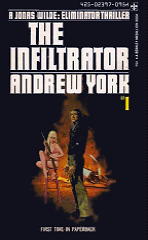
The Infiltrator. Hutchinson 1971.

ANDREW YORK Jonas Wilde

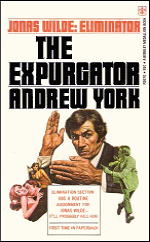
The Expurgator. Hutchinson 1972.

ANDREW YORK Jonas Wilde

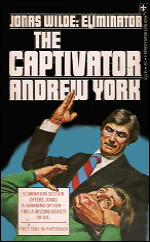
The Captivator. Hutchinson 1973.

ANDREW YORK Jonas Wilde

The Fascinator. Hutchinson 1975.

ANDREW YORK Jonas Wilde

   The first of the paperback covers was from Lancer. The others shown were published by Berkley. One of the covers has a #1 on it, suggesting that they were trying to ride the “men’s adventure” bandwagon started with Don Pendelton’s “Executioner” series for Pinnacle. To go along this theory, some of the books have “Jonas Wilde: Eliminator” across the top of the covers.

THE ARMCHAIR REVIEWER
Allen J. Hubin


MICHAEL ALLEGRETTO Jake Lomax

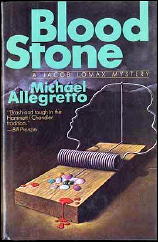
MICHAEL ALLEGRETTO – Blood Stone. Scribner’s, hardcover, 1988. Avon, paperback, 1990.

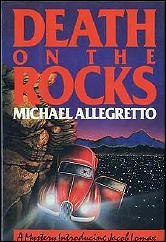
   Michael Allegretto’s second about Denver private eye Jacob Lomax (the first was Death on the Rocks, which I missed) is Blood Stone.

   I liked this quite a lot: the narrative moves, the plot is sound, and Allegretto has a nice ear for dialogue. Lloyd Fontaine, a burned-out drunk of a private investigator, asks Lomax for help. Lloyd is he’s still on the trail of millions in jewelry stolen twenty years earlier.

   Jake doesn’t take Fontaine seriously — until he finds Lloyd tortured and dead. To complicate matters, Jake’s nemesis in the cops thinks this is the chance he’s long lusted after to put Jake away. The man convicted in the robbery has just been released from prison, and all manner of greedy nasties have gathered for the kill.

   You’ll enjoy this.

— Reprinted from The MYSTERY FANcier,
       Vol. 11, No. 1, Winter 1989.


       The Jacob Lomax series —

1. Death on the Rocks (1987)    [Nominated for the 1988 Anthony and Macavity Awards; winner of the Shamus Award for Best First PI Novel]

MICHAEL ALLEGRETTO Jake Lomax

2. Blood Stone (1988)
3. The Dead of Winter (1989)
4. Blood Relative (1992)
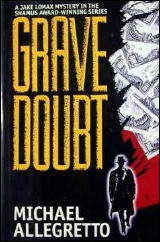
5. Grave Doubt (1995)

MICHAEL ALLEGRETTO Jake Lomax

    Jake Lomax was also in a handful of short stories, including “The Bookie’s Daughter,” which appears in Justice For Hire: The Fourth Private Eye Writers of America Anthology (1990)

Reviewed by Mike Tooney


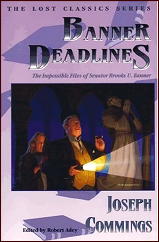
JOSEPH COMMINGS – Banner Deadlines: The Impossible Files of Senator Brooks U. Banner. Crippen & Landru: The Lost Classics Series, 2004. Short story collection; hardcover/trade paperback. Edited and introduced by Robert Adey; memoir by Edward D. Hoch.

   Banner Deadlines is a fine collection of impossible crime short stories by one of the largely neglected masters of the form.
JOSEPH COMMINGS Banner Deadlines

   The back cover blurb explains further:

    “Joseph Commings created one of the greatest investigators of locked rooms, impossible disappearances and other impossible crimes — the gargantuan, harrumphing Senator Brooks U. Banner. During his long career (Banner first appeared in the pulps in 1947), he investigated such crimes as murder at a seance where everyone is straight-jacketed together and linked by touching feet, a strange spectre causing death in the middle of a lake, a killing in a sealed glass case, and a murder by a sword which must have been wielded by a giant. The most extraordinary story of all is “The X Street Murders,” in which the victim is shot in a guarded room and the smoking-gun is delivered, a few seconds later, in a sealed envelope next door.”

   The bibliography lists thirty-two stories featuring B.U.B., so fewer than half are here: 14/32 = 43.8 percent. One hopes that Crippen & Landru can get more published in the future.

   An aside here about character credibility: In the days before ubiquitous television coverage, it seems possible that a person with Banner’s eccentricities of speech, dress, and behavior — not to mention that he does seem to spend an inordinate amount of time in pool halls handily defeating his opponents rather than working on the nation’s business — might indeed have enjoyed a long political career … but, then again, we are talking New York politics, right?

   In his introduction, Robert Adey informs us:   “In the early Banner adventures the cases brought to him, or over which he often seemed to stumble with an almost audible crash, were of the classic impossible crime variety, stuffed to the gills with locked room lore and traditional golden age ambiance.”

   Furthermore, Commings’s “middle period stories contain puzzles which are just as ingenious as those Joe wrote for the pulps, and Banner is as keen in the chase and as stunning in his solutions as ever he’d been.”

Adey concludes, “If your tastes in detective fiction run to ingenious puzzles, locked room murders and atmospheric settings, then look no further. Allow us the pleasure of introducing a writer (one of the very few) whose flair and inventiveness in the construction of impossible crime problems place him fairly and squarely alongside those Golden Age maestros John Dickson Carr, Clayton Rawson and Hake Talbot, and a detective who, by virtue of his personality, eccentricity and ingenuity, stands comparison with Dr. Fell, Sir Henry Merrivale and the Great Merlini.”

   Mike Grost also discusses Commings’s stories on his website here.

         The Stories:

1. “Murder Under Glass” (1947). “I suppose you’ll tell me that you know a way that a murderer can go through solid glass without leaving a scratch on it.”

    I’m working on it,” said Banner.

Comment:   A rich man is murdered in a locked room made of glass (yes, you read that correctly). Characters speak in forties-style slang. The story is flecked with many short but effective descriptive passages that limn the characters’ personalities.

2. “Fingerprint Ghost” (1947). “If you wanna solve these murders, Archie, you gotta grab every opportunity.”

Comment:   Murder right in the middle of a seance. Without wearing gloves, the killer uses the same knife that killed someone else and leaves no fingerprints. Like “Murder Under Glass,” the motive for the second killing is deeply embedded in the first crime.

3. “The Spectre on the Lake” (1947). “The way you tell it a phantom killer with a phantom gun crossed all that water without making a splash, got into the boat, shot both men dead, then went off the same way it came.”

Comment:   Banner is an eyewitness to murder, but even he can’t positively identify the killer — and where did the weapon go? Perception — and the speed of sound — are everything.

4. “The Black Friar Murders” (1948). “As a general rule, wimmin ain’t the stabbing kind; they prefer poison and other mild things that corrode a fella’s carcass by small degrees. That’s why we call ’em the gentler sex.”

Comment:   Banner gets invited to Thanksgiving dinner and is embroiled in a double murder. Quite atmospheric, and the story moves at a good clip.

5. “Ghost in the Gallery” (1949). Seeing the hanging corpse, Coyne crossed himself religiously and exclaimed, “Tis the divvil hisself!”

   Banner scowled. “No. Just a poor sap with buck teeth.”

Comment:   How do you kill Satan? Asians devised a method long ago, and it’s employed here. Banner’s solution is, well, elementary: “Every schoolboy knows that the angle of reflection is equal to the angle of incidence.”

6. “Death by Black Magic” (1948). “He was strangled,” repeated Banner grimly. “While I sat there watching….”

Comment:   Murder in a haunted theater, but the “ghost” is real enough. This is a clever re-working of Othello, right down to the motives. Call it a “locked-theater problem.”

7. “Murderer’s Progress” (1960). “The bullet found in Wheaton’s head was fired from the gun left behind at the club. Then Wheaton was murdered with the gun while it was in my pocket!”

   Lutz said wryly: “Have you got an aspirin?”

Comment:   A game that goes fatally wrong, but Banner is up to the task. Envy and chess do not mix. As sometimes happens with Commings, two murders intertwine.

8. “Castanets, Canaries and Murder” (1962). “Not as much as a fly could have crawled across that space without being seen! How did a normal-sized murderer do it?”

Comment:   The Invisible Man commits a murder, and dead canaries, a volatile movie star, carrier pigeons, and a lens all figure in it. Banner’s simple technical solution reveals hidden motives.

9. “The X Street Murders” (1962). McKitrick sighed. “Times are getting brutal for us investigators when all a murderer has to do is send his victim a gun by mail and it does the killing for him.”

Comment:   Probably Commings’s most famous story. International espionage leads to two murders, the first one a marvel of intricacy and timing. An interesting variation on Christie’s “The Dream.” The author expands his catalogue of Banner descriptions, giving him “the physique of a performing bear” and comparing Banner to “an overgrown Huck Finn. Physically he was more than one man — he was a gang.”

10. “Hangman’s House” (1962). “If it’s suicide,” he said, “how did he cross thirty feet of floor without leaving any marks in the dust? How did he get the rope tied to that high chandelier when there’s nothing in the house to stand on? And if he jumped from the chandelier, he wouldn’t have been strangled — his neck would have been broken!”

    “Brother,” said Banner, scowling, “you said a mouthful.”

Comment:   Death, wearing a mask, vows revenge, and eleven years later exacts it. Banner is trapped with several others, one of them a murderer, who “will never forget the battering rain, the broken Mississippi levee, the thousand dancing candles, and the fifteen feet of rope.”

11. “The Giant’s Sword” (1963). Banner understood her. He understood people and he understood murder. Those were tears of frustration and anger. Whatever the reason for her grief, she wasn’t sorry to find Mark dead.

Comment:   A most unusual murder method. One might say the victim was involved up to the hilt … and who knew that how much mileage a Volkswagen gets could prove so crucial to the solution of any crime?

12. “Stairway to Nowhere” (1979; with Edward D. Hoch). “Whuzzat? Oh, you mean a letter laying out in plain sight is overlooked.” Banner made clucking noises. “Nope. I never believed that theory. It’s a lotta bunk. If you’re hunting for a letter, you’ll examine every one you see. As for hidden bodies…”

Comment:   A young woman disappears, as does a precious stone, and of course the two events dovetail. The crime here is something of a departure for Commings, as is the narrative viewpoint. The point-of-view character is not Banner but a young man emotionally involved with the missing lady. We are privy to his thoughts, not the senator’s.

13. “The Vampire in the Iron Mask” (1984). Banner paused… “I’ ll confess that this’s the first time I’ve found the solution to a murder by reading it in a magazine. Hah!”

Comment:   This one, with its sepulchral atmosphere and intricate jiggery-pokery, is ALMOST as good as John Dickson Carr on one of his off days. Nevertheless, the plotting is first-rate and the setting, essential to character motivations, is well employed.

14. “The Whispering Gallery” (2004). “The weapon wasn’t held in the normal position at all. The guy with the gun must have been nine feet off the floor — and upside-down!”

    “Police headquarters!… Send some boys over to Cagliostro Court to hunt for a man who’s missing in his own house.”

Comment:   When a spiritualist debunker vanishes, a few people hovering around are highly motivated to see him stay vanished. A 3,000-year-old papyrus, a portrait with a bullet hole, a pack of tarot cards, a suave magician, an under-age bride, an albino policeman, and a body frozen in ice all figure in the mix.

   Banner sorts it all out while practicing his own peculiar brand of magic. This is “the first publication — ever — of this story, one of only two previously unpublished Banner short stories of impossible crime.”
THE SERIES CHARACTERS FROM
DETECTIVE FICTION WEEKLY
by Monte Herridge


        #11. INSPECTOR FRAYNE, by Harold de Polo.

   Harold de Polo created a short-lived series about a dandy police inspector named Frayne. Frayne prides himself on being the best-dressed man in the police department and one of the best in the city.

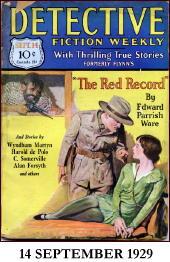
   His personal assistant is a red-haired detective named Don Haggerty, who was known in the department as Frayne’s right-hand man. He did many of the basic detective chores required in investigations, such as looking over the crime scene for any interesting signs or clues. He was also known as “a bulldog on the trail, too.” (The Small Glass Eye, DFW, 14 Sept 1929)

INSPECTOR FRAYNE DFW

   Haggerty was indispensable to Inspector Frayne in his cases. Frayne considered him a man-hunter in training, and his personal protégé. However, Frayne noted that Haggerty was “still young enough to have likes and dislikes. Inspector Frayne called them intolerances, stumbling blocks in the path of efficient police duty.” (The Small Glass Eye)

   This view of Frayne gives a clue to his personality, showing that he believed that efficiency and unemotional attitudes were the key to better detective work. In the previously mentioned case he had an innocent person arrested for a murder so that the real murderer would believe he was free of suspicion.

   Frayne often used psychological tricks to get suspects and witnesses to respond in the way he wished. Haggerty knew that the “manhunter never assumed an attitude, never made a gesture, never uttered a word, that didn’t mean something.” (La Linda Paloma) In this story Frayne “was simply getting his suspects more on edge.”

   One problem with some of the stories is that Frayne seems to operate as an intuitive detective, with not much in the way of clues to show his line of thinking. “La Linda Paloma” actually is much better than the usual stories in the series; he has definite clues and details how they affected his thinking.

   In the earliest of the stories in the series, “The Small Glass Eye,” Frayne investigates a crime out of his jurisdiction at a lake in the Adirondacks. The cause of his investigating this murder illustrates a facet of Frayne’s personality. His one interest, aside from his clothes, was in investigating murders. It was a hobby with him, and “He could sniff it a mile off, a thousand miles off, … ” After reading a couple of newspaper articles about the death of millionaire Gideon Whipple, Frayne was certain that it was not an accidental death but a purposeful murder.

   One of Frayne’s regular habits was his reading of all the morning newspapers in New York, as well as many papers from other cities including some foreign ones. He was noted as a speed reader, which was an advantage considering how many newspapers he read. He also had “a reading knowledge of seven or eight languages.” (La Linda Paloma) His greatest trait was that he had a photographic memory for all of the newspaper pieces he read, and could recite lines and paragraphs going back years.

   Frayne had seven telephones, some of them private and others for business. Six of his telephones were in his apartment in the East Fifties of New York City, and the seventh in his basement shooting gallery. One of his private lines was directly connected to Don Haggerty’s office at police headquarters. When he wanted to summon Haggerty, Frayne picked up the telephone and clicked his message by moving the receiver up and down. Haggerty responded similarly.

   Frayne lived close to police headquarters, because as noted in the stories it took Haggerty only twelve minutes to make the trip to Frayne’s residence. Frayne’s multistory home is well suited for him. Special closets for his clothes, for example. The basement has a special shooting range so that Frayne can keep in practice with his specially made and altered blunt-nose automatic. He has one his topcoats specially altered so he can draw his gun faster.

INSPECTOR FRAYNE DFW

   Frayne also had several automobiles, all well powered. One is a roadster. Frayne does not have to worry about his expenses based upon his detective’s pay; he can afford to own all of these things because he “possessed a sufficiently substantial private fortune to enable him to do this,” (The Missing Clew).

   Haggerty’s responsibilities change somewhat over the course of the series. He gradually was given more responsibility, and became the “buffer” for Frayne. In this position, Haggerty had to weed out the homicide cases for which Frayne was suited, and “to offer his chief only such problems as appeared to be impossible to unravel.” (Pelican Plot)

   In other words, common murder cases of no difficulty were refused by Haggerty. Haggerty at this point spoke to Frayne over a special wire connection to Frayne’s apartment, using a number known only to him.

   Other than Haggerty, there are only a couple of other recurring characters in the series. One is Grady, the coroner, who is also an expert on guns and a friend of Frayne’s. He “was one coroner who didn’t hanker to be a great detective.” (Mandarin Coat)

INSPECTOR FRAYNE DFW

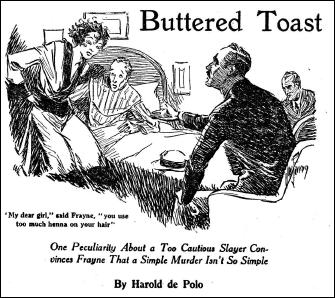
   There is a detective named Mullins, who “was a slim stoop-shouldered man in a pepper-and-salt suit far from new. His eyes looked tired…” (Buttered Toast) Mullins has dreams of solving murders. He also is able to identify criminals based on witness descriptions. He knows a considerable amount about the local criminals and their habits and hangouts. Frayne relies on him to help in some of his cases.

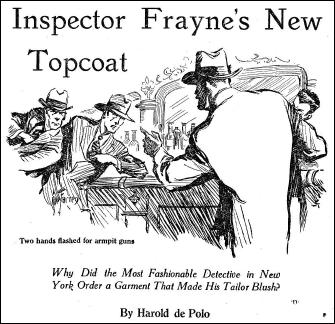
   In the story “Inspector Frayne’s New Topcoat” Frayne is after the gangsters who killed a homicide detective and “one of Frayne’s favored men.” In this story, too, Frayne has an innocent man arrested as a way to get at the guilty party. Seems to be one of his methods of operation.

   â€œThe Missing Clew” involves Frayne’s investigation of the murder of an eccentric rich man. Once more he intuits what really occurred, from the evidence of muddy dog footprints. A minor story in the series.

   â€œButtered Toast” is a much better story, as Frayne unravels the mystery of what seems to be a simple robbery and murder of a jewelry wholesaler. Frayne comes across many clues and uses them to deduce an unusual crime and the motives for it. In this story, Haggerty is noted as being an improving fingerprint expert.

INSPECTOR FRAYNE DFW

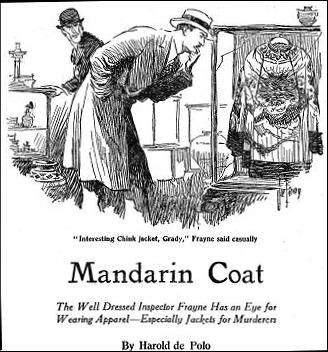
   â€œMandarin Coat” is an interesting story of an investigation by Frayne of a poisoning case. The puzzle is how was the poison administered to the victim, and who could have done it. The method of poisoning is a clever one. The story could have been a bit longer, to explain how Frayne learned some of the facts he disclosed late in the story.

   In “Pelican Plot” Frayne has to unravel the who and how of a murder case seemingly impossible. Mr. Kerfoot, a rich manufacturer, has a bronze figure of a pelican on his desk that is wired to follow certain instructions such as raising windows, opening a door, and pulling out chairs for guests. However, it turns out that someone has added an extra command for seemingly shooting a gun from a hidden place. Another case where Frayne seemingly intuits the solution with ease.

   In “La Linda Paloma”, the next story in the series, Frayne has to find the murderer of a personal maid to a world famous dancer named La Linda Paloma. Any of a number of people nearby could have stabbed the woman, so Frayne has to find small clues that point the way.

   The series as a whole is just an average detective series, with nothing particularly special about it. Harold de Polo had more success with his stories featuring hick country law enforcement officials. There were two series of these: Sheriff Ollie Bascomb, and another featuring Sheriff Whitcher Bemis. Both had elements of humor in them. Another outdoor series featuring Chan Buzzell was a bit more serious.

      The Inspector Frayne series, by Harold de Polo:

   In Detective Fiction Weekly:

The Small Glass Eye     September 14, 1929
Inspector Frayne’s New Topcoat     November 2, 1929
The Missing Clew     December 21, 1929
Buttered Toast     January 25, 1930
Murder in the Tower     March 1, 1930
Mandarin Coat     March 8, 1930
Pelican Plot     April 5, 1930
The Flying Corpse     July 12, 1930
The Little White Powder     July 26, 1930
La Linda Paloma     December 27, 1930
Peter Wenda, Beads     January 24, 1931

   In Complete Detective Novel Magazine:

Night Club Riddle     May, 1931

   In The Underworld Magazine:

Inspector Frayne Returns     July, 1933


    Previously in this series:

1. SHAMUS MAGUIRE, by Stanley Day.
2. HAPPY McGONIGLE, by Paul Allenby.
3. ARTY BEELE, by Ruth & Alexander Wilson.
4. COLIN HAIG, by H. Bedford-Jones.
5. SECRET AGENT GEORGE DEVRITE, by Tom Curry.
6. BATTLE McKIM, by Edward Parrish Ware.
7. TUG NORTON by Edward Parrish Ware.
8. CANDID JONES by Richard Sale.
9. THE PATENT LEATHER KID, by Erle Stanley Gardner.
10. OSCAR VAN DUYVEN & PIERRE LEMASSE, by Robert Brennan.

IT IS PURELY MY OPINION
Reviews by L. J. Roberts


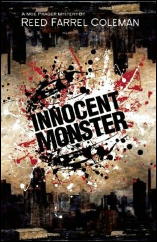
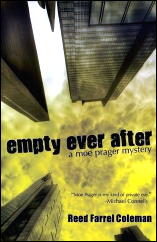
REED FARREL COLEMAN – Innocent Monster. Tyrus Books, hardcover, November 2010; trade paperback, January 2012.

Genre:   Private eye. Leading character:  Moe Prager; 6th in series. Setting:   New York City.

First Sentence:   Katy’s blood was no longer fresh on my hands and after 9/11 people seemed to stop taking notice.

REED FARRELL COLEMAN Moe Prager

   It has been six years since Moe worked his last case; the case that created an estrangement from his daughter, Sarah. When Sarah asks him to find 11-year-old Sashi Bluntstone, an art prodigy who has been missing for three weeks, he can’t refuse her. What he didn’t expect were the dark secrets and betrayals hidden in that world of apparent refinement.

   Coleman’s background in philosophy and poetry are clearly reflected in his writing. The story’s opening conveys the mood of the story while providing back-story to new readers. Achieving both, without bogging down the story’s beginning, is only one example of Coleman’s talent.

   His style and imagery is one which both tells a good story, but makes you stop and think about what he’s saying… “There are lies to hate and lies to adore. Even now, seeing it clearly maybe for the very first time, Coney Island was a lie I adored.”

   The strong sense of place nearly becomes extra character and the dialogue brings the characters to life. Moe is a character I particularly like. He is not perfect, has known and contributed to tragedy, is definitely not a super-PI, but he is intelligent, determined and has a wry sense of humor.

   He has an overriding morality and ethical core along with a certain vulnerability. It is for others who are vulnerable that he does his job; not for the money.

   The book is very well plotted and engrossing. Exposing the dark side of the art world is fascinating as is the reminder that we should all “Beware the innocent monster” as the one we don’t suspect is the one who is often most dangerous.

   Although there is certainly a case to be resolved, the story is very much about Moe. Many of the issues in his life are, if not resolved, at least confronted, acknowledged and accepted. This feels to be a pivotal book in a series one should read in order from the beginning. I look forward to seeing where the series goes from here.

Rating: Very Good.

      The Moe Prager series —

1. Walking the Perfect Square (2001)

REED FARRELL COLEMAN Moe Prager

2. Redemption Street (2004)
3. The James Deans (2005)     [Shamus, Barry, and Anthony awards; nominated for the Edgar, Macavity, and Gumshoe awards]

REED FARRELL COLEMAN Moe Prager

4. Soul Patch (2007)     [Barry and Edgar award nominees]
5. Empty Ever After (2008)

REED FARRELL COLEMAN Moe Prager

6. Innocent Monster (2010)
7. Hurt Machine (2011)

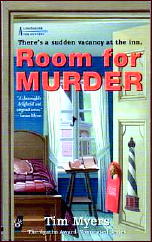
TIM MYERS – Room for Murder. Berkley, paperback original, September 2003.

TIM MYERS Lighthouse series

   If you haven’t read any of the previous ones in the series — and this is the fourth so far — Alex Winston is an innkeeper, and he helps solve mysteries. What’s unusual about the inn is that it’s next to an exact replica of the Cape Hatteras Lighthouse, but snugly nestled in the scenic Blue Ridge Mountains, way over on the other end of the state.

   North Carolina, that is. It’s a terrific location to set the stage for some fine detective work, but as fine as the camaraderie between Alex and the local townspeople is; as fascinating as the busted romances between Mor and Emma, and Alex and Elise, are; and watching them getting patched up again — or do they? — and as interesting as being shown the vicissitudes of running a modern-day hostelry establishment is, there’s not a heck of a lot of time left in not too many pages to solve a murder or two.

   Emma’s ex is the first body to be found, followed by one of the two candidates for mayor of Elkton Falls, but the election must go on, and since it’s now a matter of husband running against wife (Tracy Shook vs. Connor Shook), the campaign is getting nastier and nastier, and that’s what’s on everyone’s mind.

   Which is all well and good, but perhaps you know what I’m thinking, and you might be right. The solution to the murders boils down to (a) a slip of the tongue on the part of the guilty party, (b) a wild leap in logic on the part of Alex, and (c) an unconvincing change of character on the part of the party in part (a).

   Nor is there anything fancy about Myers’ level of writing, pitched at, say, advanced middle school students. Which makes it sound terrible when it isn’t, but you shouldn’t read this book and expect to find much worth quoting to anyone sitting in the same room with you.

   And the book is entertaining, don’t mistake me there either. It’s just that as a mystery, it has awfully weak legs.

— September 2003


      The Alex Winston “Lighthouse Inn” series:

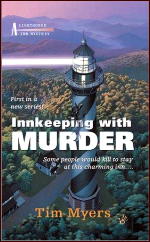
1. Innkeeping With Murder (2001)     [Agatha Award nominee, Best First Novel]

TIM MYERS Lighthouse series

2. Reservations for Murder (2002)
3. Murder Checks Inn (2003)

TIM MYERS Lighthouse series

4. Room For Murder (2003)
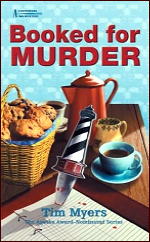
5. Booked for Murder (2004)

TIM MYERS Lighthouse series

6. Key to Murder (2010)
7. Ring for Murder (2011)

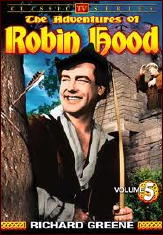
TALES OF ROBIN HOOD
by Dan Stumpf


ROBIN HOOD

   One of the few advantages of working the Midnight Shift is that I get to listen to BBC World Service Overnight on the Radio, and it’s the sort of show that rivals anything from NPR. Among the interesting features that have livened my work nights was a program on the genesis and development of the Robin Hood legend, which was so fascinating I couldn’t help recapitulating its salient points here:

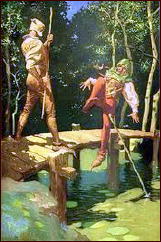
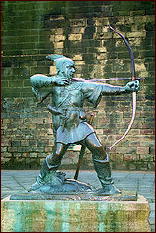
   Robin Hood apparently started out as just a bunch of stories about a guy who lived in Greens Wood in England; not an Outlaw, just a Hunter and all-around Doughty Woodsman.

He may be related to a nebulous character from Celtic myth and pre-history, the Green Man, who appears in some of the earliest stained-glass windows and illuminated manuscripts, although his exact nature is a mystery.

ROBIN HOOD

   At any rate, Robin Hood came to be accepted as the name of any good woodsman, the way names like “Casanova” and “Scrooge” have slipped into Modern language, and outlaws who lived in the woods back in the early middle ages took to calling themselves that.

   As tall tales of their exploits were told and re-told, they began to coalesce around someone named Robin Hood, who in those days was just a flattering portrait of Ye Merreye OuteLawe: Brave, witty, fair-minded and lovable.

ROBIN HOOD

   Time passed, History happened, and these worked changes on the character. Forests in England began to shrink, and the legend moved to center on the last largest extant forest, Sherwood. There was a Reeve (local administrator of the law) in that area who came from Nottingham, and he came to be called the Shire Reeve of Nottingham (say it fast).

   Minstrels began making a living at the courts of nobility, and as they told the Outlaw tales to their listeners, they made the central figure more popular with the audience by saying that he was a dispossessed Nobleman, with whom many could identify in those times.

   The tale made its way to France and back, and in the process picked up the Maid Marion character, along with others who represented stereotypes of the times: The lascivious Friar, the strong Woodsman (all that remained of the original character) and the romantic Minstrel.

ROBIN HOOD

   The tales were also returning to their Popular Roots, as traveling minstrels and the like began to find a market for their talents in the growing Middle Class.

   Robin Hood began to figure in an early version of Trick Or Treat in which people went from house to house, decorating, dropping off little treats and occasionally making mischief. And now the final wrinkle was added to the character for the stamp of Popular Approval: Charity. Robin Hood now robbed only from the rich and gave freely to the poor.

ROBIN HOOD

   In the last analysis, the program said, Robin Hood has survived because he has represented so many things to so many times. In our Century he has been a symbol of fun-loving freedom in the 20s, anti-Nazi in the late 30s, fighter for justice in the 50s, and in the 90s a champion of fairness and tolerance.

   What surprised me was that one professor said his favorite 20th Century treatment of the character was the half-hour TV show back in the 50s. In these shows, Robin was the archetypal Mythical Figure: no Origin, no beginning and no End, just a new tale to add to the legend every week, which goes back to the earliest traditions of story-telling.

— Reprinted from A Shropshire Sleuth #52, March 1992.


A Review by MIKE TOONEY:


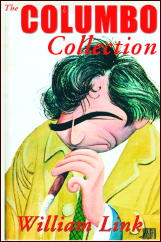
THE COLUMBO COLLECTION

WILLIAM LINK – The Columbo Collection. Crippen & Landru, hardcover/softcover, May 2010.

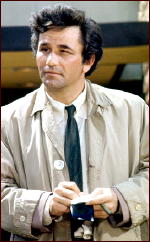
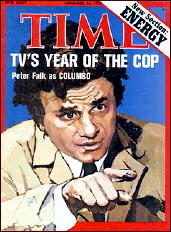
   Few television detectives are as iconic as Lieutenant Columbo of the Los Angeles Police Department. His mannerisms, his appearance, his methods — once you’ve seen him on TV, you’re not likely to forget Columbo.

   Those wonderful folks at Crippen & Landru — particularly Douglas Greene — over the years have been retrieving mystery ephemera that have been unjustly consigned to oblivion, as, for example, old radio scripts and short stories that often appeared only once and were inexplicably forgotten with their authors’ demise.

   With The Columbo Collection, however, C&L has persuaded a very much alive mystery master — William Link — to produce 12 new adventures featuring the always underestimated LAPD detective.

   For fans of the TV series, it’s like seeing a dozen new shows. (As with C&L’s reprints of Ellery Queen stories, in which you can’t help “hearing” and “seeing” Jim Hutton and David Wayne in your mind’s eye, so it is you’ll be “hearing” and “seeing” the peerless Peter Falk going through his paces.) But these “shows” can be “viewed” in 15 or 20 minutes, a mere fraction of the time the original series took.

THE COLUMBO COLLECTION

   Although the emphasis is always on the plot — a good thing in its own right — William Link does add the occasional literary flourish that shows he’s not entirely bound to the telegraphic style of TV. No, The Columbo Collection isn’t “Great Art,” but it is an awful lot of fun.

1. “The Criminal Criminal Attorney.”   A hotshot lawyer gets his client acquitted of a rape charge only to turn right around and murder him. Lieutenant Columbo must break the killer’s alibi and track down some incriminating physical evidence, as well as figure out the motive for the slaying, before he can close this case.

2. “Grief.”   A retired physician is out walking his dog when he is struck by a car and killed. Circumstantial evidence would seem to support the obvious conclusion that it was a simple hit-and-run, but Lieutenant Columbo’s “instincts” (his word) tell him otherwise. By the time he resolves this case, he will have grown to appreciate all the more the ancient expression, Cave canem.

3. “A Dish Best Served Cold.”   An Iraq War veteran apparently commits suicide, but Lieutenant Columbo has “second thoughts” (again, his words), especially about the missing fingerprints and gunpowder residue. As he says, “Sometimes you can be too careful when you plan and carry out murder.”

THE COLUMBO COLLECTION

4. “Ricochet.”   Columbo must overcome his fear of flying in the only way he knows how in order to visit New York City to follow up on a murder case. The problem is the prime suspect has an airtight alibi that places him 3,000 miles from the crime scene. Of course, people have been known to lie to protect others, but bullets drilled into a tree can only tell the truth.

5. “Scout’s Honor.”   In this one, the killer tries to help someone he loves by committing murder; but the irony is that he does too good a job of it and inadvertently ends up putting the person he wants to help squarely in the frame. Everything points to the wrong person being the killer, and from long experience Lieutenant Columbo knows that the physical evidence alone doesn’t tell the whole story.

6. “Sucker Punch.”   While they’re out jogging one morning, a professional boxer and his sparring partner are shot; one dies and the other is left in a coma. Columbo is called to Santa Clara to help with the investigation and discovers that his prime suspect lacks sufficient motive. If only he had dropped a bad habit, the real killer just might have gotten away with it. Even with 21st century forensics, it’s Columbo’s doggedness that nails the perp.

7. “The Blackest Mail.”   When a Hollywood starlet shoots a celebrity stalker to death, it looks like a case of self-defense — after all, he was carrying a knife. But Lieutenant Columbo senses there’s more to it, with little things that don’t quite compute, such as some missing money, a full tank of gas, that bullet in the garage door, and a few other discrepancies that point to blackmail rather than perverted love.

THE COLUMBO COLLECTION

8. “The Gun That Wasn’t.”   A police detective is executed, Mafia-style, in his own house. Another detective sets out in hot pursuit but fails to catch, or even see, the killer(s). Columbo is on the case from the start; gradually he uncovers evidence that leads him away from the Mob and straight to someone with whom he’s been on a first name basis for years. What tips him off are missing candlesticks, andirons, and a widescreen TV.

9. “Requiem for a Hitman.”   It’s all so simple: Hire a hitman to kill the old judge and then in a surprise ambush shoot the hitman just after he’s done the deed. Neat. Tidy. Economical. But there’s an unexpected kink in the plan: The hitman has a relative — and it’s really a shame because this person is one of the very few people in Lieutenant Columbo’s universe who doesn’t mind it when he lights up a cigar.

10. “Trance.”   Lieutenant Columbo and his niece are attending a police charity event and witness an amusing act featuring a hypnotist having fun mesmerizing two policemen. Later that evening, however, things take a serious turn when the hypnotist’s estranged wife is found dead in her apartment, and one of the officers who’d been hypnotized is discovered, dazed and confused, at the scene, making him the prime suspect. The noose tightens when it’s learned this particular cop had an ongoing, illicit relationship with the victim. But for Columbo this open-and-shut case isn’t so airtight, especially when he comes to consider the importance of that one little bead he finds in the closet….

THE COLUMBO COLLECTION

11. “Murder Allegro.”   A young and talented concert violinist is strangled in her hotel suite. From long experience Columbo is inclined to suspect the husband, but he has an ironclad alibi as well as no discernible motive to kill her. Columbo soon discovers that the husband was far from faithful to his wife.

   What finally clinches the case, however, is that charming Japanese custom of removing one’s footwear in indoor living spaces — and that seemingly trivial matter of a room key left inside a shoe.

12. “Photo Finish.”   When a woman discovers her husband has been having an affair with his “personal” secretary, she decides to issue a thirty-eight-caliber divorce decree. This woman scorned is quite intelligent, and it looks as if she just might get away with it — except for that flaky little cop who keeps asking uncomfortable questions — and that nosy next door neighbor — and that neglected copy of Business Week — and, most importantly, the fact that the camera does not lie. (This story — like several others in the collection — filters events through the consciousness of the killer, thereby slightly distancing the reader from Columbo and his thoughts.)

THE SERIES CHARACTERS FROM
DETECTIVE FICTION WEEKLY

by MONTE HERRIDGE


        #10. OSCAR VAN DUYVEN & PIERRE LEMASSE, by Robert Brennan.

   Oscar van Duyven & Pierre Lemasse appeared in a short series of ten stories by Robert Brennan that were published in Flynn’s Weekly Detective Fiction between 1926 and 1927. The series involves the adventures of a pair of men who wander the French countryside looking for matters of interest. They usually find mysteries to solve.

   Oscar van Duyven is an American millionaire from New York, owner of an electric fan corporation. Pierre Lemasse is from Paris, France, and is the companion to the millionaire. Lemasse is younger than van Duyven and is the more mystery oriented person. He has a knack of finding clues and matters of interest in the various cases the two are involved in.

   Van Duyven usually goes along with what Lemasse wants, although Lemasse is described as his assistant and is the driver of van Duyven’s automobile.

   In the first story in the series, “The Maltese Cross,” the pair are on the French coast doing nothing in particular when a mystery arises. From an island just off the coast a man escapes from the prison on it, and from a French coast town opposite a wife disappeared the same day. Lemasse finds all sorts of interesting facts and clues about the events, and ties the two disappearances together. Still, a somewhat disappointing debut.

   The second story in the series, “Pierre Rides the Storm,” is a direct sequel of the first story and continues the story of the escaped convict, Bruneau. He is caught in the severe storm that hit the French coast, and van Duyven and Lemasse endeavour to rescue him from the stranded ship in which he tried to make his escape.

   The third story, “A Murderer’s Refuge,” continues the story of Bruneau the escaped convict. This time van Duyven and Lemasse are in Spain, and have brought Bruneau with them in order to ask the local church for sanctuary for him.

   The two men then go to Avignon in France to investigate the crime Bruneau supposedly committed. While there Lemasse quickly solves the case and clears Bruneau. A bit of an anti-climax with the solution literally falling into their laps.

OSCAR van DUYVEN & PIERRE LEMASSE

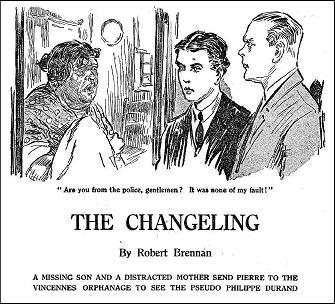
   The fourth story, “The Changeling,” is a new story and self contained without any continuations. The two “investigators” are appealed to for help in locating a missing child. The child not only is missing, but a different child was substituted in his place. Lemasse tracks down the missing child and restores him to his mother.

   The following story is “Blind Lanneau,” which concerns the murder of a blind peddler. The two investigators are still in France. This story is anticlimactic, because Lemasse discovers the murderer early in the story, and a lot of space is taken up by the murderer telling his own story (which includes what happened years before).

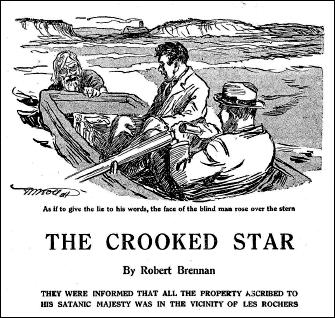
   The next story, “The Crooked Star” is a sequel to the previous one. This one involves the two investigators looking for a hidden treasure using a cipher the murderer from the previous story had given them before he died.

OSCAR van DUYVEN & PIERRE LEMASSE

   Blind Lanneau, who was mentioned and discussed in the previous story but not seen, shows up in this story to compete with them for the treasure. Some deductions and deciphering of the cipher sheet is performed by the two as the story progresses.

   â€œThe Highwayman” comes next, and is a sequel to the previous one. Having lost the treasure when their boat sank, the two investigators suddenly find themselves the target of a criminal who wants the treasure and thinks they have access to it. Suddenly Blind Lanneau pops up who also wants the treasure and is searching for it.

   â€œThe Little Angels” refers to a French street gang who are extremely vicious. When a newspaper editor named Maurice Duverne writes an editorial against the gang and is immediately attacked, there is public outrage against the gang. The police move in to the district and clean out the gangsters. However, Lemasse is not convinced the gang committed the attack, and induces van Duyven to help him investigate.

   â€œThe Fugitive Footman” is probably the best story in the series. The two investigators come across a man in distress. They agree to help him, learning that the man is Bernard, a footman at the Deauville mansion. Deauville has just been murdered, and the footman is running away because he is accused of the crime.

   The two investigators go to the Deauville mansion, where they find an inspector named Croissart in charge of the case. Croissart is an old friend of theirs, and relates the facts of the case. Lemasse sees more than meets the eye, and deduces the real murderer and the motive.

   â€œTwo Chests of Gold” is a direct sequel to the previous story, and involves the chests that were a part of that story. Now there is a search on for the missing chests, also involving a Scotland Yard man who asks van Duyven and Lemasse for their assistance.

   This is an average series, with some good stories, but mostly average. There is no element of humor in the stories. The series is of interest to those interested in simple detective stories.

   The problem I have with this series is that Lemasse makes all of his deductions and discoveries and clues seem overly simple. There is very little complexity to the series. The closest it comes is the cipher in “The Crooked Star.”

      The Oscar van Duyven & Pierre Lemasse series, by Robert Brennan:

The Maltese Cross     July 31, 1926
Pierre Rides the Storm     August 7, 1926
A Murderer’s Refuge     August 14, 1926
The Changeling     August 21, 1926
Blind Lanneau     September 4, 1926
The Crooked Star     September 11, 1926
The Highwayman     September 18, 1926
The Little Angels     December 18, 1926
The Fugitive Footman     January 1, 1927
Two Chests of Gold     January 15, 1927

    Previously in this series:

1. SHAMUS MAGUIRE, by Stanley Day.
2. HAPPY McGONIGLE, by Paul Allenby.
3. ARTY BEELE, by Ruth & Alexander Wilson.
4. COLIN HAIG, by H. Bedford-Jones.
5. SECRET AGENT GEORGE DEVRITE, by Tom Curry.
6. BATTLE McKIM, by Edward Parrish Ware.
7. TUG NORTON by Edward Parrish Ware.
8. CANDID JONES by Richard Sale.
9. THE PATENT LEATHER KID, by Erle Stanley Gardner.

« Previous PageNext Page »