Characters


REVIEWED BY BARRY GARDNER:


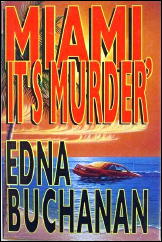
EDNA BUCHANAN – Miami, It’s Murder. Britt Montero #2. Hyperion, hardcover, January 1994. Avon, paperback, 1995.

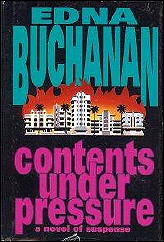
   Buchanan’s first Montero, Contents Under Pressure, got a lot of good press, though I liked it less than most because of a to me unbelievable plot.

EDNA BUCHANAN Britt Montero

   [In Miami, It’s Murder, the city] is plagued by a serial rapist. Britt is doing the story, and has annoyed the police by printing information they wanted withheld. At the same time, a friend of hers on the police department is being forced into retirement because of a bad heart, and he is agonizing over cases he never broke.

   One was the 20-year-ago sexual murder of a young girl. He was convinced of the guilt of a young man who is now a grown politician running for governor, but could find no evidence. Britt decides to dig into the old case and see what she can find.

   She continues to write about the rapist, and begins to get threatening letters from him. A series of deaths begin to occur, some seemingly accidental, some not, all involving people who were suspected of old murders but never convicted. Not surprisingly, all three situations — rapist, politician, murders — are eventually resolved.

   As with the first book, the narration is excellent, the writing fast-paced and effective. Again, too, there are plot elements that won’t wash. Britt’s acceptance of her cop friend’s assertion of the politician’s guilt without any real evidence makes either her or the author just plain foolish; as does her eagerness to personally offend the man without even her paper’s knowledge or concurrence.

   More so than in the first novel, she often acts foolishly. But the main problem I have with the book is that it (and Montero) ethically offended me. I can’t go into reasons without giving away the plot, so I’ll just say neither she nor the author seem to have the same ethical values that I do. No go, Montero.

— Reprinted from Ah, Sweet Mysteries #8, July 1993.


Bibliographic Notes:   In spite of Barry’s clearly stated misgivings, Miami, It’s Murder was nominated for an Edgar in 1995.

   For more on the author, a visit to her Wikipedia page may suffice: “As one of the first female crime journalists in Miami, she wrote for the Miami Beach Daily Sun and the Miami Herald as a general assignment and police-beat reporter. She won a Pulitzer Prize in 1986 for general reporting.” She is also the author or co-author of 17 crime novels, including the nine Britt Montero novels listed below.

   For even more, check out the author’s own website. There’s much of interest there.

      The Britt Montero series —

1. Contents Under Pressure (1992)

EDNA BUCHANAN Britt Montero

2. Miami, It’s Murder (1994)
3. Suitable for Framing (1995)
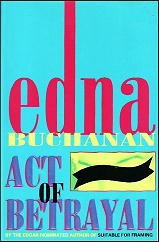
4. Act of Betrayal (1996)

EDNA BUCHANAN Britt Montero

5. Margin of Error (1997)
6. Garden of Evil (1999)
7. You Only Die Twice (2001)
8. The Ice Maiden (2002)
9. Love Kills (2007)

IT IS PURELY MY OPINION
Reviews by L. J. Roberts


DEBORAH GRABIEN – Cruel Sister. St. Martin’s Press, hardcover, October 2006.

Genre:  Paranormal/Mystery. Leading characters:  Penny Wintercraft-Hawkes and Ringan Laine (4th in series). Setting:   England.

First Sentence:   Under a choking black fog, in which the air itself seemed composed of ash from the winter coal fires, a battered ten-year-old Austin Tilley lorry rumbled and bounced along Westferry Road on the south-eastern edge of London’s Isle of Dogs.

DEBORAH GRABIEN

   Folklorist, singer and restoration consultant Ringan Laine has been hired by his partner Penny’s brother and sister-in-law. They are building a large Elizabethan-style home on the Isle of Dogs next to the Thames.

   Ringan’s first visit to the site makes him uncomfortable and second visit progresses to voices and visions. From there, things become rapidly worse as Penny fears she may lose Ringan forever to the past.

   Having enjoyed the previous three books in this series, I selected this as my Halloween read last year, and am so glad I did. Grabien seamlessly blends the real and the paranormal; what is with what might be, and it works.

   This isn’t icky, creepy stuff, but scary in the anticipation of what might happen. It is also not formulaic. I so appreciate that each book in the series handles the paranormal aspect in a different manner. That, alone, adds to the suspense.

   One need not worry about starting this series at the beginning. Grabien establishes the background and history of previous paranormal experiences easily within the plot without slowing down the story. The dialogue is a little stiff at times, but the stories really are plot driven.

   And a good plot it is. It’s not silly, fluffy or over the top. It starts out innocently enough and then builds. It is also the perfect balance of music, history, mystery and the paranormal; each of which I love and sent me to the internet after finishing the book. It delights me to learn new things and when I can’t easily tell what is factual and what is fictional because the story is so well done, it all seems true.

   I found Cruel Sister completely engrossing; as in I read it straight through in four hours because I couldn’t bear to put it down. There is one more book in the “Haunted
Ballad” series, which I shall definitely read. Hopefully one day, there will be more.

Rating:   Very Good.

PostScript:   This is a clip of the ballad “Cruel Sister”: https://www.youtube.com/watch?v=1gAyqruWCfk&feature=related

      The “Haunted Ballad” mystery series

1. The Weaver and the Factory Maid (2003)

DEBORAH GRABIEN

2. The Famous Flower of Serving Men (2004)
3. Matty Groves (2005)
4. Cruel Sister (2006)
5. New Slain Knight (2007)

      The JP Kinkaid mystery series —

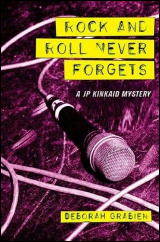
1. Rock & Roll Never Forgets (2008)

DEBORAH GRABIEN

2. While My Guitar Gently Weeps (2009)
3. London Calling (2010)
4. Graceland (2011)

THE SERIES CHARACTERS FROM
DETECTIVE FICTION WEEKLY

by MONTE HERRIDGE


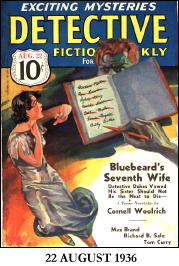
        #5. SECRET AGENT GEORGE DEVRITE, by Tom Curry.

   The Secret Agent George Devrite stories by Tom Curry were a short series of seven stories published in Detective Fiction Weekly from 1936 to 1940.

   The series involves the exploits of an undercover policeman, or secret agent, of the New York Police. Inspector Hallihan was his superior in the department, but George Devrite was in essence the Secret Police Chief. He had an obscure office on the second floor of a dingy house “down the street from Headquarters, outwardly an importer of beaded goods but actually the main receiver of reports made by such agents as Devrite.” (The Green Fingers of Death)

TOM CURRY George Devrite

   These reports often consist of factual accounts of their actions and gives recommendations to Hallihan of what to do – people to investigate, arrest, or otherwise take action about. Devrite “received credit only in the secret records of the Police.” (The Donkey’s Head) He lived in a small apartment in the West Forties, and had no close friends, as his job did not allow such.

   As to entertainment, Devrite derived “his main amusement … in solving the puzzles presented by Hallihan.” (The Donkey’s Head) So Devrite could be described as a workaholic who lived for his job.

    Devrite usually visited the scene of the murders he investigated in order to gather information. As Devrite puts it when he closes in on some criminals, “with twenty thousand policemen on tap but Devrite dared not call one to assist him directly, since he was an undercoverman and could not expose himself to friend or foe.” (The Green Fingers of Death)

    Devrite’s orders at all times was to never expose himself. He did not make arrests or appear in court to give trial testimony. It was explained in the second story in the series (The Queen’s Taste), that “George Devrite was a valuable man – irreplaceable save by years of training; his natural competence and experience made him Hallihan’s star.” Part of Devrite’s training is in ju-jutsu, which he uses in a number of the stories, especially “The Dragon’s Tooth.”

    In the first story in the series, “The Green Fingers of Death,” one of Devrite’s fellow agents has been found murdered, and Hallihan gives the case that he was working on to Devrite to investigate. It involves a young bank clerk named Robert Evans, who is in some sort of trouble.

    Devrite does some investigating and finds that Evans owes a gambling debt to a German named Count von Hult. Hult wants something unknown in return for this debt, which turns out to be passing counterfeit money at his bank. Devrite tracks down the counterfeiters and his earlier report to Hallihan set the police on their track too.

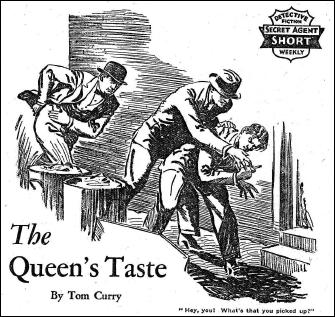
    The second story in the series, “The Queen’s Taste” involves Devrite in investigating a murder case. The police haven’t been able to solve the case satisfactorily, so Inspector Hallihan puts George Devrite on the case. The police think they know who committed the murder, and Devrite winds up agreeing with them.

TOM CURRY George Devrite

    The culprit is a Cuban named Luis Ortez, a former triggerman turned dancer at the Peacock Cabaret. His dancing partner is the murdered man’s daughter, Adele Morris. Ortez is interested in Adele Morris, and part of Hallihan’s instructions to Devrite stressed that he was to see what he could do to stop this interest. Devrite runs into the usual danger in this case, barely escaping with his life after gunmen target him.

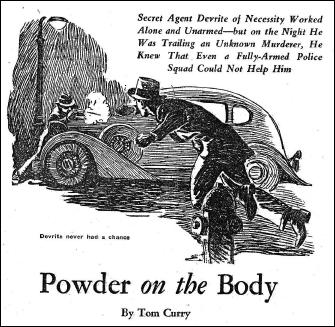
    “Powder on the Body” is the third story, and Devrite is assigned to investigate a series of murders after the police come up with a dead end. Each of the victims is well-off, each has talcum powder on his suit, and each has been robbed and shot at close range.

TOM CURRY George Devrite

    One more victim is killed while Devrite is investigating, making him more determined than ever to solve the case. The victims all went to a night club called the Blue Belle before they were killed, so Devrite starts there. As usual in this series, Devrite comes near death in his attempt to get to the bottom of the murders.

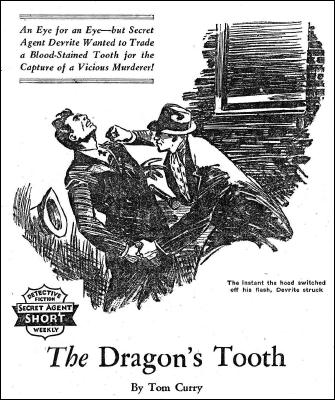
    In “The Dragon’s Tooth” Devrite investigates the murder of William Brennan of Brennan and Kanes, furriers. Also he was to track down the $250,000 worth of furs stolen at the same time. Devrite infiltrates the underworld to a slight degree in this one, and gains some information that sets him on the trail of the solution to the crimes.

TOM CURRY George Devrite

    Not only does Devrite’s work clear up the murder, but it also breaks up a criminal gang of fur thieves and put a number of its members in jail.

    “The Visit of Death” involves Devrite in still another murder case, that of Daniel Moresby, rich recluse. The only clue to the murderer is a chunk of lead, which turned out to be a railroad freight car seal. So Devrite puts on some old clothes and goes to the hobo encampment near the railroad tracks, hoping to find further clues and some information. He finds more than he bargained for, as the murderer and a companion show up at the encampment.

    “The Donkey’s Head” finds George Devrite investigating another murder, that of Keith Mortimer, a fairly young rich man who lived an idle life. Other than a possible burglar, there are only two suspects in the case so it is a matter of tracking down clues on each suspect.

    Devrite has his life saved by one of the suspects, and becomes indebted to him for that to the point where he is temporarily unwilling to investigate further. However, his work ethic convinces him to continue the investigation. The title of the story refers to the murdered man’s broken Chinese vase, which is in a hundred pieces when Devrite and Hallihan see it. However, a small piece showing a donkey’s head is missing from the reconstructed vase and provides a clue to the murder.

    “Racket Kill” is the last story in the series, and was published over 2 ½ years after the previous story. Kenneth Harris, a Bronx garage owner, has been murdered racketeer style. Hallihan instructs Devrite to investigate. The only suspects are Harris’ partner, Jerry Sessler, and the local racketeers who peddle stolen auto parts to the garages. Devrite almost immediately gets into trouble with the racketeers, and has to talk fast to get out of it.

    This is an average series, with some very good stories, but mostly average or slightly above that. There is no element of humor in the stories, and the hardboiled nature of the stories denies any lightness to them. This series is better than other stand-alone stories about undercover police that was published in DFW.

      The Secret Agent George Devrite series by Tom Curry:

The Green Fingers of Death     August 22, 1936
The Queen’s Taste     August 29, 1936
Lion Face     September 5, 1936     [**]
Powder on the Body     November 14, 1936
The Dragon’s Tooth     November 21, 1936
The Visit of Death     December 19, 1936
The Donkey’s Head     January 2, 1937
Racket Kill     August 31, 1940

[**]   This story has been added later, thanks to Ron Smyth who discovered its existence and told us about it in the comments. Not only that, but it can be read online at http://www.unz.org. Follow the link to the website, next to the Detective Fiction Weekly page, then to the issue itself.
IT IS PURELY MY OPINION
Reviews by L. J. Roberts


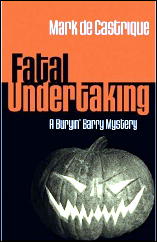
MARK DE CASTRIQUE – Fatal Undertaking. Poisoned Pen Press, hardcover/trade paperback, October 2010.

Genre:  Police Procedural. Leading character:  Barry Clayton (5th in series). Setting:   North Carolina.

First Sentence:   “You want to borrow a casket?”

   Deputy Sheriff Barry Clayton, had been a city police officer but moved back to Gainesboro, a small town in North Carolina in which his family runs a funeral parlor.

MARK DE CASTRIQUE

   Working for the sheriff’s department and helping with the family business can lead to interesting situations such as loaning a casket to the Jaycees for a Halloween haunted house and having it end up with a murdered body inside. Complicating Barry’s case is the question whether the victim was the one actually intended and having his reporter ex-wife return to town.

   It is always a pleasure to read a new book by Mark de Castrique. He brings us into this small North Carolina town, not so much by detailed descriptions of the environs, but by conveying the closeness of the town’s citizens and with the reality of the town’s politics and insularity.

   His dialogue is excellent, including humor — “As he left the diner, I saw the press corps following after him like a gaggle of geese, honking “Sheriff” with every step.” and the use of colloquialisms — “In here we’re two size-ten shoes in a size-four shoebox.” — add contrast to the serious elements of the plot.

   The characters are representative of all those you find in any town, but are far from being stereotypical. Sheriff Tommy Lee Wadkins is a man who has seen too much violence and knows you have to have humor, particularly when situations may be serious, to survive.

   Barry is dedicated to his family, loyal to his friends, but he’s not perfect. He makes costly mistakes during the investigation and realizes the impact of them. That makes him more realistic than the usual ‘perfect’ detective.

   The story draws you in from its seemingly light beginning but turns quickly to dark with the first murder. Yes, first; there is more than one murder, but the story is neither noir nor serial killer in approach. Instead, it is a very well done police procedural.

   The plot is full of twists, interspersed with humor, suspense, and tragedy; with a shocking climax and affirming ending; as is life. That is one of the appeals of de Castrique’s writing to me; they are a reminder that life is filled with twists and tragedy, yet also with hope and that it is important to always remember that which is most important

   I was happy to read that de Castrique has many more investigations in mind for Barry. I look forward to reading each one of them.

Rating:   Good Plus.

       The Buryin’ Barry mystery series —

1. Dangerous Undertaking (2003)

MARK DE CASTRIQUE

2. Grave Undertaking (2004)
3. Foolish Undertaking (2006)
4. Final Undertaking (2007)
5. Fatal Undertaking (2010)

IT IS PURELY MY OPINION
Reviews by L. J. Roberts


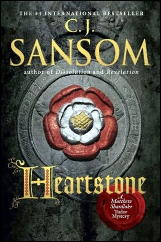
C. J. SANSOM – Heartstone. Mantle, UK, hardcover, 2010. Viking, US, hardcover, January 2011.

Genre:   Historical Mystery. Leading character:  Matthew Shardlake; 5th in series. Setting:   England; 1545.

First Sentence:   The churchyard was peaceful in the summer afternoon.

C. J. SANSOM

   Lawyer Matthew Shardlake has been summoned to Queen Catherine Parr, last wife on Henry VIII. A former servant of hers has asked for help investigating claims by her son that his former student, Hugh Curtey, has been mistreated by Hugh’s guardian, Sir Nicholas Hobbey.

   Traveling to Portsmouth with his assistant, Barak, allows Matthew to also investigate the past of Ellen Fettiplace, a young woman committed to Bedlam, but by whom?

   Sansom has gifted his readers with yet another wonderful book filled with historical details. The themes of politics, greed, poverty, conscription, injustice to the less powerful and the cost of war caused by those in power on those who have no choice but must live with the consequences have been repeated through time but here are set in the middle 1500s.

   One of my pleasures in reading historical mysteries is to learn. The Council of Wards was something with which I was not familiar. Most particularly, however, was learning that, but for the stubborn conviction of one woman, England might never have split from Rome.

   I also wish to applaud the UK publisher, Mantle, for a physically beautiful book, from the dust cover and embossed Tudor rose on the hard cover, to the inclusion of color maps, a sewn-in bookmark and, as always, the author notes at the end. In this day of ebooks, such details are greatly appreciated.

   I very much enjoy Sansom’s, and thus his character’s, voice. It has a very conversational tone which immediately drew me into the story, along with the lack of prologue. His characters are somewhat atypical in that Matthew is by no means heroic. He is an interesting, appealing character who can be stubborn, intrusive and somewhat naïve in his trust of others.

   Yet he is also caring and determined in his pursuit of justice. In other words, he is human and fallible. As balance, you have his assistant, Barak, now married and about to be a father. It is nice to see how both characters, individually and in relationship to one another, have grown and developed through the series.

   The plot is interesting and well done, but does get bogged down at times. There is so much history; the story itself becomes a bit lost, although certainly never to a point where I was tempted to stop reading. I was torn between feeling it would have been a much tighter, more compelling story had it been trimmed down, yet knowing I’d have learned and understood much less about the world in which the characters lived.

   Sansom has taken several story lines and woven them together into a fascinating, very good whole. As ever, I am eagerly looking forward to his next book.

Rating:   Very Good.

      The Matthew Shardlake series —

1. Dissolution (2003)

C. J. SANSOM

2. Dark Fire (2004)
3. Sovereign (2006)
4. Revelation (2008)
5. Heartstone (2010)

REVIEWED BY BARRY GARDNER:


B. J. MORISON – The Martini Effect. Elizabeth Lamb Worthington #5. North Country Press, hardcover, 1992.

   Elizabeth Lamb Worthington is a precocious thirteen-year-old who lives with her grandmother in Boston when not traveling with her globetrotting parents. She has just started prep school on Mount Desert Island, Maine, after having been traumatically rejected by the school of her choice. She’s no stranger to the island, as her Grandmother has a summer home there.

   There’s an interesting, not to mention weird, collection of teachers and students, and the school is still abuzz over the suspicious death by drowning last term of a student with unsavory reputation as a blackmailer. Elizabeth Lamb (use of the second name is mandatory), being nosy and having the deceased’s girl-friend as a bunkmate, finds herself investigating.

   Now this is a cozy. The story gets told in a very leisurely fashion, and for quite a way into the book is more of a young-girl-at-school story than anything else. Which is not to say that it’s boring; I liked the protagonist, and I enjoyed reading about her.

   Morison created an environment and set of characters that seemed real to me, though I hasten to add that the closest I’ve been to a prep school is to drive by one. Having visited the island a couple of times, I had hoped for a little more regional flavor than I found, but after all, it wasn’t meant to be a travelogue.

   Against all odds, I enjoyed it; though I don’t know that I’ll be in a hurry to seek out others in the series.

— Reprinted from Ah, Sweet Mysteries #7, May 1993.


      The Elizabeth Lamb Worthington series –

1. Champagne and a Gardener, 1982

B. J. MORISON

2. Port and a Star Boarder, 1984
3. Beer and Skittles, 1985

B. J. MORISON

4. The Voyage of the Chianti, 1987
5. The Martini Effect , 1992

Editorial Comments: Both the author and her character are new to me. Says Al Hubin in the Revised Crime Fiction IV about the author: MORISON, B(etty) J(ane), 1924-2001; born in Maine; owned and operated the Criterion Theatre in Bar Harbor, Maine.

   Despite the young age of Elizabeth Lamb, the books appear to be written for adults, but I may be wrong about this. None of the other reviews I’ve found online for the series seem to say, in the same manner that Barry also did not address the issue. (The fact that all of the titles include alcoholic beverages in them may be telling us something.)

THE BACKWARD REVIEWER
William F. Deeck


VAN SILLER – The Mood for Murder. Doubleday Crime Club, hardcover, 1966. Paperback reprint: Curtis, no date [1967?].

   If a mystery writer — in this case, Allan Stewart, author of Death at Dawn, among other books — can’t accept that a young lady with whom he was almost in love has discovered a body, now missing, and has been shot at, who will believe it?

   As a practitioner in this field, surely Stewart knows that all such tales, particularly the most implausible, have a basis in fact and that failure to accept them inevitably leads. to unpleasantness.

   Since Stewart rejects the young lady’s story, a murder by shooting occurs, with the murdered woman possibly being mistaken for the young lady who earlier claimed to be shot at, followed by a murder by threat.

   All of this takes place at an exclusive Florida resort among the well-to-do and beautiful, and the mostly unpleasant. Unlikely coincidences constitute the explanation at the end.

   I may try another of Hilda — if the author’s sex is of interest to anyone — Van Siller’s novels with Allan Stewart to find out if he has learned anything from his profession of mystery writer. I won’t expect to enjoy it.

— From The MYSTERY FANcier, Vol. 12, No. 3, Summer 1990.


Bibliographic Notes:   (Hilda) Van Siller, 1911-1982, was the author of 21 crime fiction novels published between 1943 and 1974, most of them for Doubleday’s Crime Club imprint, but a small handful appeared only in British editions. In spite of her sizable output, among authors recently covered on this blog, I believe she qualifies as being among the Top Ten “Most Forgotten.”

      The Alan Stewart series —

A Complete Stranger (n.) Doubleday, US, 1965
The Mood for Murder (n.) Doubleday, US, 1966
The Biltmore Call (n.) Ward, UK, 1967 [no US edition]

THE SERIES CHARACTERS FROM
DETECTIVE FICTION WEEKLY

by MONTE HERRIDGE


        #4. COLIN HAIG, by H. Bedford-Jones.

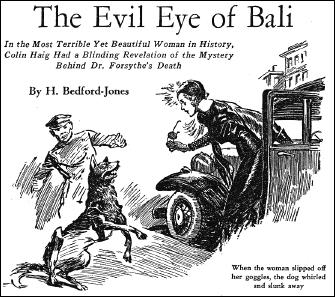
   The Colin Haig stories by H. Bedford-Jones made up a short-run series of six stories published consecutively from the October 7, 1933 issue through the November 11 issue. The stories are narrated by Martin Burke, who is the assistant in charge of Colin Haig’s laboratory in Los Angeles, “unequaled in the country.”

   The series relates the adventures of Colin Haig and his assistant against a priestess of Shiva named Madame Vanderdonk. She is supposedly the possessor of an evil eye, which can kill people and animals. This power is shown in the first story in the series, “The Evil Eye of Bali,” and Colin Haig cannot get anyone to believe him when he relates this fact. However, she has criminal agents who seem to do most of the actual killing by various means.

H. BEDFORD JONES Colin Haig

   I am missing the second story in the series, “The Desert of Death,” but “The Backward Swastika” is the third story, and involves more of the struggle against Madame Vanderdonk. Lieutenant Kelly of the missing persons detail of the local police makes an appearance at the beginning of the story, relating what they know about Madame Vanderdonk’s activities.

   It appears that she is targeting wealthy financiers, stealing their money and causing their deaths. The police have counted ten victims so far, and Kelly tells of a possible eleventh victim named Johansen. Kelly relates all of this information to Burke; Haig has been gone for three days looking for a trail to follow to Madame Vanderdonk based on photographic evidence acquired in the second story.

   Charles Hunter, one of Madame Vanderdonk’s murderous agents, appears for the first time in this story and uses a fake Haig letter to lure Burke into a trap, where he finds Johansen. He also meets Madame Vanderdonk, who talks to him. She attempts to manipulate him, but it doesn’t work, as Haig and Lieutenant Kelly arrive in time to rescue the two men. Madame Vanderdonk flees in her car.

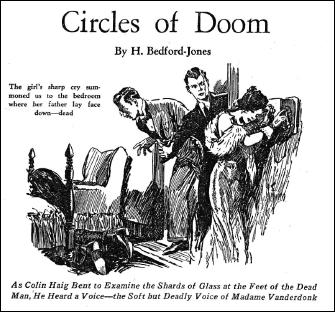
   In the fourth story, “Circles of Doom,” Burke receives a telephone call from a Professor Malvolio, whose real name is Van Steen. He is a professional hypnotist. Van Steen is asking for information about Madame Vanderdonk. He promises to come and see Colin Haig, but never arrives. He then calls Haig and asks him to come to see him.

H. BEDFORD JONES Colin Haig

   Haig arrives to find Van Steen dead by means of poison and Van Steen’s daughter present. Haig and his assistant, with the aid of the police (including Lieutenant Kelly), investigate the situation and discover much information, including a good deal about one of their nemesis’s agents, Charles Hunter (first seen in the third story).

   However, Hunter is dead from an accident by poisoning by the time they reach him. Another dead end for Haig, but he has an idea she has her headquarters is in the desert around Palm Springs, and plans to search for her.

   The fifth story, “Footsteps of Death,” opens with Lieutenant Kelly saying he can’t help them in their fight against Madame Vanderdonk outside the city limits of Los Angeles. His superiors don’t believe in the evil eye.

   Shortly thereafter, another attempt is made upon the lives of Colin Haig and Martin Burke. This impels them to immediately start the search for Madame Vanderdonk’s desert lair. After searching in the heat for quite a while, they stumble upon a dying man whose last words indicate he knows the woman for whom they are searching.

   They then search outward from that spot. Martin Burke finds woman’s hideout and is captured. He undergoes another session with Madame Vanderdonk as she attempts to win him over to her cause. He soon escapes, and finds Colin Haig nearby.

   Haig wants to go for help and return to attack the dwelling. Somehow, to me this sounds too simple to expect her to stay there and wait for him to return. On to the final part of the story.

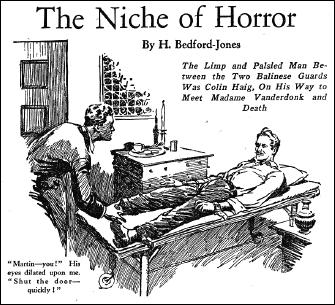
   In the sixth and last story in the series, “The Niche of Horror,” Colin Haig manages to get himself captured by Madame Vanderdonk. With this series, it was only a matter of time. He manages to escape the evil eye of the madame by sabotaging her base of operations and ending her reign of terror.

H. BEDFORD JONES Colin Haig

   This quick, short series of stories did not leave much time for readers to have to wait for each installment in the ongoing story. With the series preplanned and an ending provided, I don’t see why there wasn’t a sequel to it. That is, assuming the series was well received by the readers. It had plenty of action.

       The Colin Haig series by H. Bedford-Jones:

The Evil Eye of Bali     October 7, 1933
The Desert of Death     October 14, 1933
The Backward Swastika     October 21, 1933
Circles of Doom     October 28, 1933
Footsteps of Death     November 4, 1933
The Niche of Horror     November 11, 1933

JON A. JACKSON – The Blind Pig. Random House, hardcover, 1978. Dennis McMillan Publications, softcover, 1988. Dell, paperback, 1995. Grove Press, softcover, 2000.

JON JACKSON The Blind Pig

   If you’ve ever spent any time in or around Detroit, you surely know what a blind pig is. You also know how Detroit is a city awash with guns. Sergeant Mulheisen works for the Detroit Police Department, and guns are part of his everyday working life. And where else but in Detroit would a train be hijacked to steal a boxcar containing over two million dollars’ worth of rifles and ammunition?

   The case begins with a pair of street cops mowing down a gunman hiding in a darkened garage, and it grows to include a gang of Cuban revolutionaries as well as the constant underlying presence of the local Mafia.

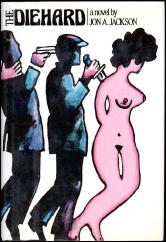
   Mulheisen, whom we met previously in The Diehard, no longer seems plagued by self-doubt, and the subtler
aspects of his character have disappeared. Loosely put together, for a detective
novel, and vaguely dissatisfying.

Rating:   C plus.

— Reprinted from The MYSTERY FANcier, Vol. 3, No. 6, Nov/Dec 1979 (very slightly revised). This review also appeared earlier in the Hartford Courant.


[UPDATE] 06-01-11.   In spite of my only so-so comments about The Blind Pig, and even though it took 12 years for the next in the series to appear, Jon Jackson has gradually put together a sizable reputation for tough, hard-boiled crime fiction, including this one. I don’t remember reading any of the books following The Blind Pig, but there have been seven more:

      The Detective Sergeant Mulheisen series:

1. The Diehard (1977)

JON A. JACKSON

2. The Blind Pig (1978)
3. Grootka (1990)
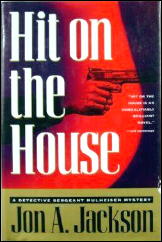
4. Hit on the House (1993)

JON A. JACKSON

5. Deadman (1994)
6. Dead Folks (1996)
7. Man With an Axe (1998)
8. La Donna Detroit (2000)
9. No Man’s Dog (2004)

THE SAINT IN JUNIOR HIGH
by Ron Goulart


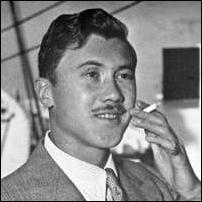
   I was fourteen when I wrote to Leslie Charteris asking him to allow me to adapt The Saint for the theater. The theater in question being the auditorium of Burbank Junior High School in Berkeley, California.

LESLIE CHARTERIS The Saint

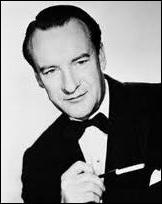
   Although the Saint I’d seen on the screen in the RKO B-Movies of a few years earlier was portrayed by the suave George Sanders, who was well over six feet tall, I had no doubt that I, who’d recently shot up to the impressive height of five foot four, could do a nifty job of portraying Simon Templar. I was equally certain that I could summon up sufficient suaveness.

   I’d discovered the Saint, that Robin Hood of Modern Crime, by way of the movies, but the advent of Pocket Books allowed me, for just two bits each, to get hold of most of novels and short story collections that had appeared since Charteris had created the character back in 1928.

   I liked not only the thriller aspects, and the mystery and crime elements but the humor in the books (which seems to have partially leaked out the last time I attempted to reread one). Charteris has said in the introduction to one of his books that one of his major influences was P. G. Wodehouse, another of my literary idols back in the days when I was starting to shave.

LESLIE CHARTERIS The Saint

   In that bygone era my contact with the entertainment world — books, radio, movies, comic books, etc. — was strictly as a consumer. I therefore assumed that it would be relatively simple when I was a few years older to become a novelist, a short story writer, a movie star, a radio actor, a playwright and a matinee idol, a cartoonist who drew gag cartoons, a syndicated comic strip and a comic book of his own.

   In junior high I was a sort of economy-size Orson Welles. I wrote play adaptations of Robin Hood, A Connecticut Yankee and A Christmas Carol and starred in each one. Seeing me, in green tights, cross swords with the Sheriff of Nottingham is probably one of the memories most of my fellow students have had a difficult time forgetting.

   I exchanged a few more letters with Charteris. I believe the first one was written when he was affiliated with his own paperback publishing company in Los Angeles. They were reissuing quite a few Saint books, plus new anthologies with stories about Hollywood, etc.

LESLIE CHARTERIS The Saint

   There was also one collecting radio scripts from various shows, including one from a Saint broadcast. I suggested to him that a whole book of Saint scripts would be a good idea. He responded that since the scripts were mostly adaptations of printed stories that probably wouldn’t attract a large enough audience.

   Quite a few years later, when I was editing The British Detective anthology for Signet, I thought it would be a good idea to include a Saint novelet, “The Million Pound Day.”

   Charteris replied that since his story was twice as long as most of the others, he should receive twice the offered fee of $500. So I missed a chance to be Leslie Charteris’s editor.

   When I was working on a Nostalgia Book Club book about radio detectives, I queried him as to who he thought the best actor to play his character on radio. He was residing on the Riviera at the time, possibly in a yacht. His fourth wife was the movie actress Audrey Long, frequently seen in the RKO B- Movies of the 1940s.

   He sent a helpful reply and mentioned that if I wrote him again I include return postage. The nostalgia line went out of business before I ever wrote the book.

LESLIE CHARTERIS The Saint

   Several men assayed the role of Simon Templar on the air. The show ran, off and on, from about 1945 to 1950. They included Edgar Barrier, Brian Aherne, Vincent Price (when I listened to him back then I didn’t notice what a smarmy Saint he made) and Tom Conway. The Saint’s creator told me the best man was the first one, Edgar Barrier.

   I noticed on Google that Charteris said the movie actors he thought should have been Templar were Ronald Colman, Cary Grant or Douglas Fairbanks, Jr. As for the actual chaps who played the part, he said “Louis Hayward and George Sanders were hopelessly miscast.”

   Raymond Chandler, by the way, said he thought the ideal actor to play Philip Marlowe was Cary Grant. You can’t beat suaveness.

Ron Goulart


LESLIE CHARTERIS Ron Goulart

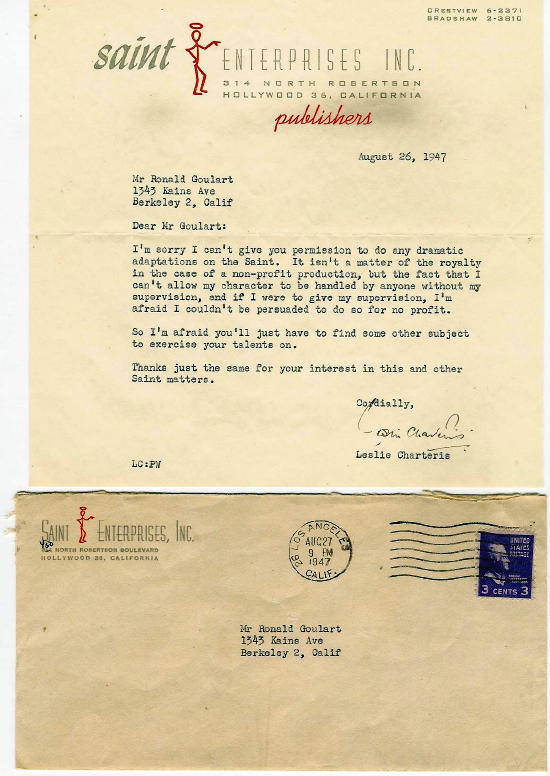
August 26, 1947

Mr. Ronald Goulart
1343 Kains Ave
Berkeley 2, Calif

Dear Mr Goulart:

I’m sorry I can’t give you permission to any dramatic
adaptations on the Saint. It isn’t a matter of the royalty
in the case of a non-profit production, but the fact that I
can’t allow my character to be handled by anyone without
my supervision, and if I were to give my supervision, I’m
afraid I couldn’t be persuaded to do so for no profit.

So I’m afraid you’ll just have to find some other subject
to exercise your talents on.

Thanks just the same for your interest in this and other
Saint matters.

Cordially,

      [Signed]

Leslie Charteris

LC:PW


       Previously on this blog:

LESLIE CHARTERIS – The Brighter Buccaneer (reviewed by Art Scott)

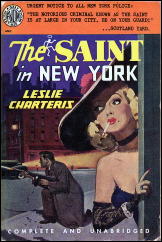
LESLIE CHARTERIS – The Saint in New York (reviewed by Art Scott)

LESLIE CHARTERIS – The Saint and the Templar Treasure (reviewed by Steve Lewis)

« Previous PageNext Page »