Characters


DOROTHY GARDINER – The Trans-Atlantic Ghost. Doubleday Crime Club, hardcover, 1933.

   The detective in what was Mrs. Gardiner’s first mystery novel has a well-chosen name, I think you’ll agree, but the fact is that while Mr. Watson indeed did work for 20 years for the New York Police Department, he was for all that time a minor clerk, a statistician. (Though, of course, there’s nothing inherently wrong with that!)

   The locked room murder he’s called upon to solve in this book is in California, however, where he finds himself as part of an around-the-world cruise he’s about to embark on, as he heads back home to his native England for good.

   The locked room is in an English castle that’s been transported across the ocean and rebuilt in the hills of California by a wealthy millionaire; there is some talk of ghosts, and some obnoxious louts who call themselves policemen, led by the appropriately named Captain Bulnose; and lots of suspects.

   What makes this book so disappointing is difficult to describe without giving the entire solution away, and you may as well have your own chance at it. Allow me to suggest, however, that it’s the obvious one, and one that at one point Watson is solemnly assured could not be the explanation.

   Of course we shouldn’t assume that everyone knows the truth, or speaks it, but some tiny spark of imagination is to be expected as well, isn’t it?

   There are some nicely humorous scenes to be pleased with, such as when the string on Watson’s pajamas gives way at one crucial point, and to be honest, this was no real chore to read, but as a mystery, it’s (sadly) rather a silly one.

Rating: C minus.

— Reprinted from The MYSTERY FANcier, Vol. 3, No. 5, Sept-Oct 1979. Slightly revised.


[UPDATE] 03-12-11.   A scarce book, with only a single copy of the US edition listed on ABE, and my copy has no jacket, thus no image above.

   I don’t know much about the author, but according to one website: “Dorothy Gardiner was born in Naples, Italy. She grew up in Boulder, Colorado. In 1917, she graduated from the University of Colorado with a degree in History. During the Second World War she was in charge of all the files and records for the North-Atlantic Area office of the American Red Cross.”

   From the Revised Crime Fiction IV, by Allen J. Hubin, a list of her mystery fiction:

GARDINER, DOROTHY. 1894-1979.
      The Transatlantic Ghost (n.) Doubleday 1933 [Mr. Watson]
      A Drink for Mr. Cherry (n.) Doubleday 1934 [Mr. Watson]
      Beer for Psyche (n.) Doubleday 1946
      What Crime Is It? (n.) Doubleday 1956 [Sheriff Moss Magill]
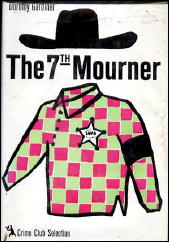
      The Seventh Mourner (n.) Doubleday 1958 [Sheriff Moss Magill]

DOROTHY GARDINER

       Lion in Wait (n.) Doubleday 1963 [Sheriff Moss Magill]

   She also edited For Love or Money: The 1957 Anthology of the Mystery Writers of America (Doubleday Crime Club, 1957).

DOROTHY GARDINER

REVIEWED BY BARRY GARDNER:


HAROLD ADAMS – A Perfectly Proper Murder. Carl Wilcox #11. Walker, hardcover, 1993. No paperback edition.

HAROLD ADAMS A Perfectly Proper Murder

   This is one of my favorite series, with a regional and historical background set in Depression era South Dakota and Minnesota.

   Carl Wilcox is an ex-con, now a semi-itinerant sign painter. He finds himself looking for work in Podunkville, and quickly manages to offend the town’s leading citizen. The next day the man is found murdered, and Wilcox briefly comes under suspicion.

   Thanks to his past help to his hometown law, he is enlisted by the local cop to help investigate the case. It turns out that the murdered man wasn’t really a very nice person, with wife-beating and wholesale philandering among his more easily provable sins. Darker yet are hinted at. Suspects include but are not limited to his young wife and his children by an earlier marriage.

   Once again, Adams’ strengths are quickly apparent. The first-person narrative is easy and unforced, and the dialogue is realistic and entertaining. Adams has a knack for characterization in few words, and all of the the players come alive enough to believe in and relate to.

   The small-town ambiance of the time is thick enough to cut with a knife, and tasty to boot. On the down side, I think Adams may be overworking the device of Wilcox helping the law, and this is a very slender book for the price. It’s still a fine series, though, from a fine writer.

— Reprinted from Ah, Sweet Mysteries #9, September 1993.


      The Carl Wilcox series

1. Murder, 1981

HAROLD ADAMS A Perfectly Proper Murder

2. Paint the Town Red, 1982
3. The Missing Moon, 1983

HAROLD ADAMS A Perfectly Proper Murder

4. The Naked Liar, 1985 (Shamus nomination)
5. The Fourth Widow, 1986
6. The Barbed Wire Noose, 1987
7. The Man Who Met the Train, 1988
8. The Man Who Missed the Party, 1989
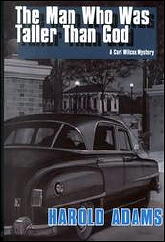
9. The Man Who Was Taller Than God, 1992 (Shamus Award)

HAROLD ADAMS A Perfectly Proper Murder

10. A Perfectly Proper Murder, 1993
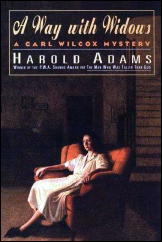
11. A Way with Widows, 1994

HAROLD ADAMS A Perfectly Proper Murder

12. The Ditched Blonde, 1995
13. Hatchet Job, 1996
14. The Ice Pick Artist, 1997
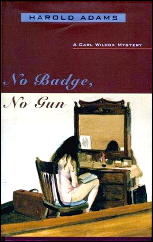
15. No Badge, No Gun, 1998 (Shamus nomination)

HAROLD ADAMS A Perfectly Proper Murder

16. Lead, So I Can Follow, 1999

    As a followup the recent post that listed the Top Ten favorite mystery writers in 1941, it has belatedly occurred to me that there was a later similar poll taken, some 30 years later, one that already appears on this blog.

    Repeating, if I may, the introduction of that previous post:

    Back in the early 1970s, the country of Nicaragua asked Ellery Queen’s Mystery Magazine (EQMM) “to set up a poll to establish the dozen greatest detectives of all time” in anticipation of that nation’s issuing a commemorative set of twelve postage stamps to celebrate the 50th anniversary of Interpol. This book [Masterpieces of Mystery: The Supersleuths, edited by Ellery Queen] is a result — or, perhaps, a by-product of that request.

    “EQMM conducted three polls of mystery critics and editors, professional mystery writers, and mystery readers. It was from the last group that an unexpected (to Ellery Queen) result came:

    “Only one fictional detective was voted for unanimously by mystery critics, mystery editors, and mystery writers — not surprisingly, Sherlock Holmes. But, surprisingly, the vote for Sherlock Holmes by mystery readers was not unanimous: no less than 64 readers out of 1,090 failed to rank Holmes as one of the 12 best and greatest. Surprising, indeed. (Surprising? Incredible!)”

    Here are the poll results, in order of popularity:

1-Sherlock Holmes
2-Hercule Poirot
3-Ellery Queen
4-Nero Wolfe
5-Perry Mason
6-Charlie Chan
7-Inspector Maigret
8-C. Auguste Dupin
9-Sam Spade
10-Father Brown
11-Lord Peter Wimsey
12-Philip Marlowe
13-Dr. Gideon Fell
14-Lew Archer
15-Albert Campion
16-George Gideon
17-Miss Jane Marple
18-Philo Vance
19-The Saint (Simon Templar)
20-Roderick Alleyn
21-Luis Mendoza
22-Sir Henry Merrivale
23-Mike Hammer
24-James Bond
25-Sergeant Cuff
26-Inspector Roger West

    By my count and estimation, there are at least four who would not a make a dent in such a list if one were to be made today, and maybe even more than that.

THE SERIES CHARACTERS FROM
DETECTIVE FICTION WEEKLY

by MONTE HERRIDGE


        #2. HAPPY McGONIGLE, by Paul Allenby.

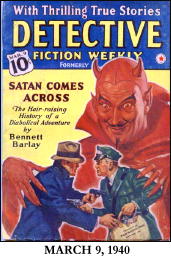
   The Happy McGonigle stories by Paul Allenby was a short series of at least eight stories published in Detective Fiction Weekly from 1940 through 1941. The stories are about the misadventures of petty criminal Happy McGonigle and his partner in crime, Blackie Roberts.
HAPPY McGONICLE Paul Allenby

   The stories are narrated in first person by Blackie Roberts, who tries to explain the problems of trying to plan and commit crimes with a person like Happy McGonigle. In the first story Roberts explains very briefly what McGonigle is like:

    “He is not a gent who is looking for trouble all the time. Oh, no! Happy is the simplest, dumbest boob that ever turned a dishonest penny. From the top of his mop-like blond hair to his 13-D feet, he is plain uncut, yokel.”     (“A Cockeyed Wiggley”)

   Roberts notes that he has trained Happy over a ten year period, and that Happy is handy with burglar tools and in fights, but often makes him sorry he knows him. Blackie explains that he is the brains of the duo, and Happy is the brawn. Trying to plan crimes with help like Happy is difficult. He has to be careful to explain the crime plans very carefully to Happy, who is often not paying close attention.

   Happy is happiest when he is involved with his latest hobby. He has been through many hobbies, and in the first story in the series, “A Cockeyed Wiggley,” his hobby is collecting matchbook covers. This hobby causes problems with their crime plan for this story, but somehow everything turns out all right, though they don’t make any money from their crime.

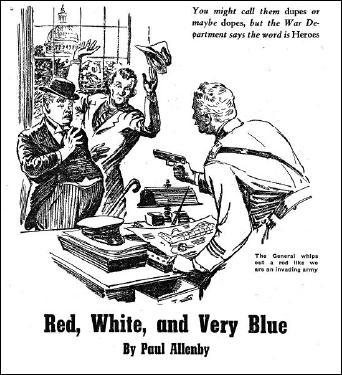
   The next story, “Red, White and Very Blue,” finds the two criminals on their way back from gambling on horse racing at Pimlico, stopping off in Washington, D.C. for some rest and relaxation. Happy turns into a typical tourist, going to see all the sites and spending a lot of money on fancy clothes.

HAPPY McGONICLE Paul Allenby

   They run into trouble when they encounter a group of spies. The spies con the two out of all of their money, and also con them into stealing airplane plans from a house. Fortunately for them, they realize what is going on and hand the plans back to the U.S. Government, and wind up making themselves look like heroes in the process.

   As shown in the story, Black Roberts can be just about as gullible and naïve as Happy McGonigle. So Blackie’s comments about his partner need to be taken with a grain or two of salt.

   In the story “In the Bag,” the two are planning a jewel robbery, but another of Happy’s hobbies interferes with the plans. Happy has started taking dancing lessons in order to be an “adagio” dancer.

   Blackie thinks this is ridiculous and tries to get Happy to work with him on the robbery. But Happy has promised to deliver a suitcase for the dance teacher. The title refers to the fact that three new identical leather suitcases become involved in the plot and the guys try to keep straight which contains what.

   When the newspaper reports that the dance studio staff has been arrested for drug smuggling, the bag situation gets more complicated.

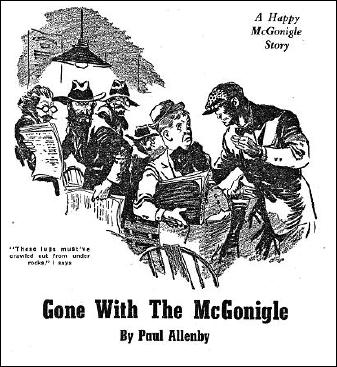
   In “Gone With the McGonigle,” Happy’s newest hobby is to become a writer. So he buys a lot of paper, a filing cabinet, a portable table, and a typewriter. After spending all of this money he thinks he is ready to become a writer.

   However, he finds being a writer is not all it is cracked up to be. Happy finally goes on a destructive rampage through his editor’s house, which he and Blackie are burglarizing.

HAPPY McGONICLE Paul Allenby

   In “McGonigle the Great,” Happy is struck with the wish to be a professional magician. He learns a number of magic tricks while he and Blackie are staying at a large hotel. Unfortunately, he makes so many mistakes that people laugh at his act.

   Even though the audiences enjoy the mistakes, Happy does not like being laughed at. Blackie notes that Happy is somewhat deficient in a sense of humor. While all of this is going on, Blackie Roberts and a newspaper reporter (who is teaching Happy magic tricks) are searching the hotel for an absconding bank teller who has stolen a hundred thousand dollars. The magic act plus the search make for a situation that is sure to get out of hand quickly.

   â€œMcGonigle Makes a Bid” finds the duo trying to take a vacation and behave in a law-abiding manner. They head off to the wilds in a car, but wind up stranded at a large house occupied by a crazy man. Unknown to them, the grounds are also the hiding place of three criminals who don’t like the interruption of Happy and Blackie.

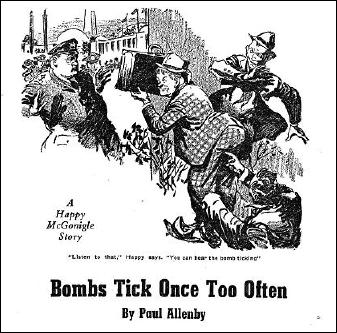
   In “Bombs Tick Once Too Often”, Happy and Blackie are visiting the World’s Fair and trying to enjoy themselves. However, Happy thinks that someone is trying to plant a bomb at the Fair. Their first move is to follow two suspicious acting characters (who are carrying a suitcase) around the Fair. Later, when Happy discovers a bag that is ticking and whirring, he is positive he has found a bomb. Altogether, a very stressful day for Blackie and Happy.

HAPPY McGONICLE Paul Allenby

   â€œThe Skeleton of Danny Force” is atypical of the other stories in the series. Happy McGonigle does not play the primary focus of the story. Blackie Roberts is more the focus of this story, as he and Happy go out to a rural town to help one of Happy’s friends in his dealings with the local Scrooge-like banker. A skeleton is dug up by a local, and this provides the means by which Blackie can counter the banker and get the better of him.

   The final story, “In Union There Is McGonigle,” The two guys get into union activity, primarily because they think they can make some money in it. Definitely not in it for the benefit of the workers of pretzel salters industry, which is their working area.

   As usual, they run into numerous complications in the process, and only Blackie’s planning gets them out of the situation and with a profit for a change. Also as usual, it was Happy’s doing that they got into union activity in the first place. He doesn’t appear to ever think through the consequences of his actions.

   As you no doubt can tell from the above story descriptions, this series is meant to be a light comedy series of stories. No seriousness invades the stories, and the cast bumbles their way along the story lines without any serious damage or landing in jail.

   The series is not really that funny, however, though it aims to be. It is okay as a mildly humorous look at two bumbling criminals.

   There were other humorous series in DFW in the past, including two (Fluffy McGoff , 1931-37, and Murray Magimple, 1935-37) by Milo Ray Phelps, who died in 1937. Not having read much of the various humorous series, I can’t say which ones are the best or succeed at being funny.

        The Happy McGonigle series by Paul Allenby:

A Cockeyed Wiggley     March 9, 1940
Red, White and Very Blue     March 30, 1940
* Grand Marshal McGonigle     June 1, 1940
In the Bag     June 15, 1940
Gone With the McGonigle     June 29, 1940
McGonigle the Great     August 3, 1940
McGonigle Makes a Bid     August 17, 1940
Bombs Tick Once Too Often     October 19, 1940
* Insurance for Sale     November 23, 1940
The Skeleton of Danny Force     January 18, 1941
In Union There Is McGonigle     April 26, 1941
* It’s All in the Angle     May 31, 1941

(*) These three were added after the list was first posted. Thanks to Phil Stephensen-Payne for pointing them out as likely possibilities in the comments, and for Walker Martin for confirming that they are indeed McGonigle stories.

Previously on this blog:   #1. Shamus Maguire by Stanley Day.
REVIEWED BY MICHAEL SHONK:


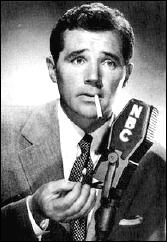
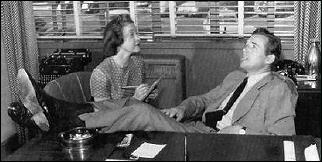
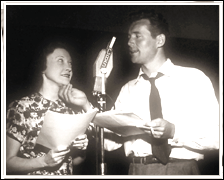
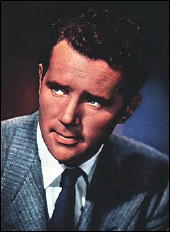
SAM SPADE HOward Duff

THE ADVENTURES OF SAM SPADE, DETECTIVE. ABC: July 12, 1946 through October 4, 1946. CBS: September 29, 1946 through September 18, 1949. NBC: September 25, 1949 through September 17, 1950; November 17, 1950 through April 27, 1951. Based on characters created by Dashiell Hammett. Produced and directed by William Spier. Cast: Sam Spade: Howard Duff (July 12, 1946 through September 17, 1950), Steve Dunne (November 17, 1950 through April 27, 1951), Effie Perrine: Lurene Tuttle. Announcer: Dick Joy

    The Adventures of Sam Spade, Detective was popular with the radio audience and critics alike. While today it is rightfully remembered for its humor and style, the show featured great radio mysteries and moments of drama.

SAM SPADE HOward Duff

    In “Vafio Cup Caper” (August 22, 1948), Sam chases a priceless ancient Greek cup in a mystery with non-stop twists and hilarious dialogue.

    In “Edith Hamilton Caper” (April 17, 1949), Sam falls for a woman he believes killed her husband. The episode was dramatic with an effective use of music. Effie’s support for broken-hearted Sam was typical of a series that could be tearfully sad, yet end with a bitterly funny line.

    Sam Spade changed when he moved to radio. Howard Duff took Bogart’s cynical loner and let him have fun. Duff’s Spade could get drunk, be short-tempered, and sleep with the femme fatale, and we would be as forgiving and admiring as his secretary Effie.

    Some of radio’s top talent worked on the series.

SAM SPADE HOward Duff

    Producer/director William Spier was famous for his popular and critically acclaimed series, Suspense. To promote Sam Spade, Spier aired an hour-long episode “The Khandi Tooth Caper,” a sequel to The Maltese Falcon, on Suspense (January 10, 1948).

    Lurene Tuttle (Effie), known as “Radio’s First Lady,” was as important to the show’s success as Howard Duff. Top radio actors would appear, often without billing. Some of the supporting cast were William Conrad, June Havoc, and Hans Conrad.

    Behind the mike talent was equally impressive. Jason James (Jo Eisinger) and Bob Tallman won the Edgar award for Best Radio Drama in 1947. Other writers included Gil Doud, E. Jack Newman, and Elliott Lewis.

    While Hammett had no direct involvement, the writers made good use of other Hammett characters such as in “Dick Foley Caper” (September 26, 1948). Sam tries to help an old friend from the Continental Detective agency. A highlight was when Sam told the femme fatale he knew she had a gun because it made her bulge in the wrong place.

SAM SPADE HOward Duff

    The series did adapt some of Hammett’s short stories. “Death and Company” (August 9, 1946) was adapted from a Continental Op short story with the same title. While no recording survived, the script is reprinted in the book The “Lost” Sam Spade Scripts, edited by Martin Grams, Jr.

    It would take outside forces to kill the show. Hammett was blacklisted and his name removed from the credits. When Howard Duff’s name appeared in “Red Channels”, the series sponsor, Wildroot Creme Oil Hair Tonic, canceled the series and replaced it with Charlie Wild, Private Detective (NBC: September 24, 1950 through December 17, 1950. CBS: January 7, 1951 through July 1, 1951).

SAM SPADE HOward Duff

    According to Spade expert John Scheinfeld, the last words Duff said on radio for six years was as Spade welcoming Charlie Wild to the PI business. The only thing Charlie and Sam had in common was a secretary named Effie Perrine. No recordings of the radio show exist and who played Effie on radio’s Charlie Wild remains unknown.

    Sam Spade was not off the air long. The radio audience demanded the show back and NBC quickly obeyed. The only change in the series had Steve Dunne take over the role of Sam Spade, but it was a change that cost the series its charm.

SAM SPADE HOward Duff

    Duff had a light playful touch while Dunne’s delivery seemed forced, often sounding like a bad Jack Benny impersonator. Times were changing. Duff’s Spade was a lovable drunken womanizer, Dunne’s Spade was becoming a boy scout.

    The final episode “Hail and Farewell” (April 27, 1951) was an average melodrama about saving an innocent man from execution. At the end Spade told listeners to write in and save the series. But this time the Governor did not call.

    So, after over two hundred and forty episodes (around seventy are known to still exist on recordings), it really was “Goodnight Sweetheart.”

      SOURCES:

●   On the Air: The Encyclopedia of Old-Time Radio, by John Dunning
●   Radio Detective Story Hour podcast: Jim Widner (otr.com/blog)
●   Boxcars 711 podcast: Bob Camardella (boxcars711.podomatic.com)
●   Sam Spade Double Feature, Volume 1. Audio Archives: Bill Mills (audible.com)
●   OTRR.org
●   Digital Deli (digitaldeliftp.com)
●   MP3 disk with sixty seven episodes of Sam Spade, the Suspense episode “Khandi Tooth Caper”, and other extras. (otrcat.com)

    There are many places where you can still find Sam Spade on the web, as well as iTunes and the Sirius XM radio series “Radio Classics.”

IT IS PURELY MY OPINION
Reviews by L. J. Roberts


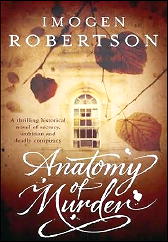
IMOGEN ROBERTSON – Anatomy of Murder. Headline, UK, hardcover, 2010.

Genre:   Historical mystery. Leading characters:   Harriet Westerman & Gabriel
Crowther; 2nd in series. Setting:   England-Georgian era/1781.

First Sentence:   Captain Westerman was in his cabin reading the letter from his wife for the fourth time when he heard the officer of the morning watch ring Six Bells.

IMOGEN ROBERTSON

    Mrs. Harriet Westerman and her friend, anatomist Gabriel Crowther, are once again embroiled in solving a murder. However, the stakes are even higher as they deal with treason against England during the Revolutionary War.

    In a much less elegant part of London, a Tarot-card reader sees the impending murder of one of her clients. Although she fails in preventing the murder, she is determined to bring the woman’s killers to justice.

    Beginning with an exciting and dramatic scene, this is one of those can’t-stop-until-I-finish-it books. Ms. Robertson’s writing is atmospheric and insightful with a strong sense of time and place, subtle, wry humor, a marvelous voice and style which evoke the period and the emotions of the characters.

    I found it fascinating to see the Revolution from the English perspective. Harriet, intuitive and more able to relate to others, and Crowther, the cold, analytic scientist, balance each other well.

    Harriet is someone who, as a real person, I should like very much. We learn more of Crowther and his past, which hints of much more to come. I am enjoying the evolution of their relationship despite the differences in the ages and natures.

    All the characters are alive and wonderful. It’s nice to see the characters from the first book, including Molloy, and meet the delightful new characters Jocasta, Sam and Boyo. (I did feel a cast of characters would have been helpful.)

    The captivating plot, good twist, the way in which the threads were brought together was wonderful. Set in 1781 during the Revolution, the story deals with traitors, murder and opera with a touch of the metaphysical. It takes you from the Opera house and salons of the wealthy to the meanest slums of London revealing the apathy and cruelty which resides in each.

    Ms. Robertson is one of the best new-to-me-authors I’ve found this year. Her writing is insightful with interesting observations on celebrity worship, and encourages one to look at things from a different perspective. It is not often that events in a book make me truly cry, but it speaks to speaks to an author’s skill that her writing evokes strong emotion.

    Anatomy of Murder was an excellent read but I recommend starting with her first book. I can’t wait for her next book.

Rating:   Excellent.

    The Harriet Westerman & Gabriel Crowther series —

1. Instruments of Darkness (2009)

IMOGEN ROBERTSON

2. Anatomy of Murder (2010)
3. Island of Bones (2011)

Reviewed by DAVID L. VINEYARD:         


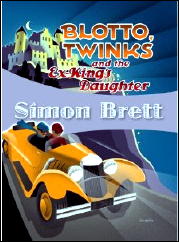
SIMON BRETT – Blotto, Twinks and the Ex-King’s Daughter. Felony & Mayhem, softcover, February 2011. British edition: Constable, hardcover, May 2009.

   The name Simon Brett should be no stranger to anyone on these pages. His Charles Paris series about a bibulous actor is held in the highest esteem by lovers of humorous well written mysteries, and for the past decade he has been penning less humorous but well received British cozies set in Fethering, a small English town out of Miss Marple by way of The Last of the Summer Wine.

SIMON BRETT Blotto & Twinks

   Blotto, Twinks and the Ex King’s Daughter is yet another venue for Mr. Brett, and one that shows a different side both to his humor and English village life. Indeed, his new series lies somewhere in that vague country inhabited by P.G. Wodehouse’s Jeeves and Wooster, Dornford Yate’s Berry and Company, some of the more playful Agatha Christie’s, the early Albert Campion, the more extravagant adventures of Michael Innes Sir John Appleby, and Leonard Wibberly’s Duchy of Grand Fenwick.

   The time is somewhere between the two world wars in an England of stately homes, dizzy aristocrats, loyal retainers, dastardly villains, and vintage automobiles.

   The setting is Tawcester Towers, where the Dowager Duchess of Tawcester (the Duke, her son — known as Loofah and Rupert the Dull, descendant of Rupert the Fiend and Black Rupert — having passed on five years earlier) is entertaining the exiled king of Mittleuropa, Sigismund, when her youngest son, the Right Honorable Devereaux Lyminster, known as Blotto (and with good reason) announces he’s found a body in the library, one Captain Schtoltz.

    “It’s frightfully awkward, Mater, but there’s a dead body in the library.”

   In very short order Chief Inspector Trumbull and Sergeant Knatchbull arrive, none too impressed by the body or the Duchess and her royal guest, and then to add to the trouble the Princess Ethelinde is kidnapped.

   Well, naturally Blotto can’t allow that kind of thing to happen in Tawcester Towers without doing something, but considering his limited capacity in the brains department, it is just as well his beautiful sister Lady Honoria, known as Twinks, has a first rate mind and nose for murder (“– what a brainbox that girl had”).

   And the chase is on — in vintage open automobiles of course — and with Grimshaw, Blotto’s valet, in tow (a gentleman never travels without his valet) all the way to Mittleuropa, where they stumble on intrigue supplied by nearby Transcarpathia, ruled by King Anatol and Princess Ethlinde’s betrothed, Prince Fritz-Ludwig among others.

   Before you can say Zenda…, Blotto and Twinks (Grimshaw in tow) are on the trail of the murderer in the capital Zling and over the battlements of the Castle Berkenziepenkatzen … assuming you actually can say any of that.

   Of course Blotto will rescue the Princess and nobly renounce said princess in true Rassendyl style (he has to get out of it somehow) while Twinks will hunt down the kidnapper and murderer displaying both brains and spunk, but it is all a near run thing — especially for Blotto, who might have ended up king of Mittleuropa, or in the arms of the dangerously attractive Svetlana Lubachev (“as a femme fatale she did have some standards”). All before Blotto confronts the killer back in England at jolly old Tawcester Towers in Rupert the Antisocial’s billiard room.

   This is a very funny book, inventively, and splendidly, silly, bright, clever, and outrageous. There isn’t a serious bone in its head. I’m not really sure a mere reviewer can convey the exact spirit and voice of the book, but if you want to escape from reality into a world of smiles, chuckles, and undignified guffaws, this is your chance. Wodehousian, yes, but with a few left turns reminiscent of the Marx Brothers or Mel Brooks, and all bundled up as an attractive new series we can only hope to see more of.

   If you want a few laughs you’d be blotto not to read it.

       The Blotto & Twinks series —

1. Blotto, Twinks, and the Ex-King’s Daughter (2009)
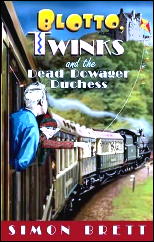
2. Blotto, Twinks and the Dead Dowager Duchess (2009)

SIMON BRETT Blotto & Twinks

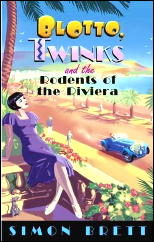
3. Blotto, Twinks and the Rodents of the Riviera (2011)

SIMON BRETT Blotto & Twinks

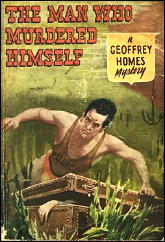
GEOFFREY HOMES – The Man Who Murdered Himself. William Morrow, hardcover, 1936. Avon, no number [#18], paperback, 1942.

GEOFFREY HOMES

   Working for a missing persons outfit specializing in lost heirs is a cutthroat business, at the fringe of legal niceties, requiring a stretch of the truth now and then, with a little money every so often into the right hands.

   So we meet Robin Bailey, ex-newspaperman, on a case of either suicide or murder — death by personal pollution of a local reservoir.

   Crackling dialogue and a twisting, turning plot, but short but effective glimpses of character and existence in the 1930 leave us wanting more in that regard, while Homes concentrates on the story. Bishop himself finds his work increasingly distasteful and begins to wonder why he never before noticed the office secretary.

   The secondary characters, understated, unobtrusive, are even more memorable, exemplified by the sorrow displayed by the victim’s landlady. I believe this to be Homes’ first book. He’s worth looking into as a writer.

— From Mystery*File #9, Vol. 2, No. 2, Spring 1976 (slightly revised).

   Bibliographic Data:

      The Robin Bishop series

    The Doctor Died at Dusk (n.) Morrow 1936.
    The Man Who Murdered Himself (n.) Morrow 1936.

GEOFFREY HOMES

    The Man Who Didn’t Exist (n.) Morrow 1937.
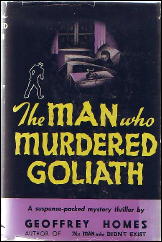
    The Man Who Murdered Goliath (n.) Morrow 1938.

GEOFFREY HOMES

    Then There Were Three (n.) Morrow 1938.

   The latter is a crossover novel with the detective duties shared by Homes’ other major series character, PI Humphrey Campbell, who also works for the Morgan Missing Persons Bureau detective agency.

       The Humphrey Campbell series —

    Then There Were Three (n.) Morrow 1938.
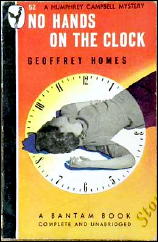
    No Hands on the Clock (n.) Morrow 1939.

GEOFFREY HOMES

    Finders Keepers (n.) Morrow 1940.
    Forty Whacks (n.) Morrow 1941.
    Six Silver Handles (n.) Morrow 1944.

   Homes also wrote two novels in which Mexican policeman Jose Manuel Madero was the primary detective:

    The Street of the Crying Woman (n.) Morrow 1942.
    The Hill of the Terrified Monk (n.) Morrow 1943.

and one standalone:

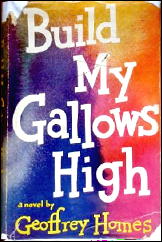
    Build My Gallows High (n.) Morrow, 1946.

GEOFFREY HOMES

   But if anything, either under his own name, Daniel Mainwaring, or as Geoffrey Homes, his list of credits is even longer on IMDB as a screenwriter.

   Previously on this blog:

  Forty Whacks.     [A 1001 Midnights review by Bill Pronzini.]
  Crime by Night, based on Forty Whacks.     [A film review by Steve Lewis.]

REVIEWED BY BARRY GARDNER:


ANABEL DONALD – An Uncommon Murder. St. Martin’s Press, hardcover, 1993. First published in the UK: Macmillan, hardcover, 1992.

ANABEL DONALD

   The inside back flap says Anabel Donald is the author of three previous novels, and lives in England and France. Nothing else. The back cover is completely blank. No other books are listed in the front. Who is this woman, and why doesn’t St. Martin’s want us to know more about her?

   Alex Tanner is a freelance television researcher in London. She’s prickly, a bastard from a lower-class background, raised in foster homes, and with a crazy mother. She stumbles upon an old woman who was a governess in a household which was involved in a high society murder some forty years ago; coincidentally (?) it’s a case on which a producer for whom she works regularly is considering doing a documentary. He hires her to research the background, and she begins investigating.

   This is quite a well written book. The story moves along nicely, and while I wouldn’t call the cast of characters enthralling, they were interesting enough to hold my attention.

   I did get more than a bit fed up with the heroine’s attitude and hang-ups. As a matter of fact, I’m getting damned tired of four of five female leads being anywhere from half screwed up to absolutely neurotic. Is it déclassé to be be well-adjusted, or what? Are reasonably normal people too dull to serve as leads? Well?

   Subject of tirade aside, it was a decent book.

— Reprinted from Ah, Sweet Mysteries #9, September 1993.


Bio-Bibliographic Notes: Some 18 years later, it’s easy to use Google and come up with answers. From the Fantastic Fiction website comes the following information:

    “Anabel Donald has been writing fiction since 1982 when her first novel, Hannah at Thirty-Five, was published to great critical acclaim. In her thirty-six-year teaching career she has taught adolescent girls in private boarding schools, a comprehensive and an American university. Most recently, she has written the five Alex Tanner crime novels in the Notting Hill series.”

       The Alex Tanner series —

1. An Uncommon Murder (1992)
2. In at the Deep End (1993)

ANABEL DONALD

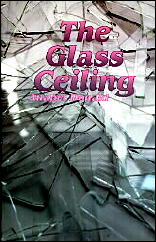
3. The Glass Ceiling (1994)

ANABEL DONALD

4. The Loop (1996)
5. Destroy Unopened (1999)

ANABEL DONALD

   Neither of the last two have been published in the US.

   As for Barry’s tirade, as he described it, Alex Tanner must really have been an off-the-wall character for him to have gone off the way he did. Most recurring detective story characters are eccentric, unusual or different in one way or another, not so?

IT IS PURELY MY OPINION
Reviews by L. J. Roberts


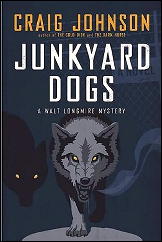
CRAIG JOHNSON – Junkyard Dogs. Viking, hardcover, May 2010. Trade paperback: Penguin, May 2011.

Genre:   Police procedural. Leading character:   Walt Longmire; 6th in series. Setting:   Wyoming.

CRAIG JOHNSON

First Sentence:   I tried to get a straight answer from his grandson and granddaughter-in-law as to why their grandfather had been tied with a hundred feet of nylon rope to the rear bumper of the 1968 Oldsmobile
Tornado.

    It begins with a severed thumb found within a Styrofoam cooler at the junkyard. Sheriff Walt Longmire decides this might be a way to re-spark the drive in his bullet-shy deputy, Santiago Saizarbitoria. Little did Walt
know that thumb would lead to murders, drugs, kidnapping and family secrets.

    Craig Johnson is a story teller in the classic and best sense of the word. You are captivated with the first sentence and taken along with Walt through the story to the end.

    The characters are alive, real and balance each other beautifully. Walt is the personification of the good man who is intelligent, believes in his job, compassionate in his handling of people and dedicated to justice even when it takes a little bending of the law.

   Deputy Victoria Moretti is the street-wise, profane, East Coast transplant who provides edge to Walt’s calm. Of greater significance is that all the characters, whether recurring or episodic, are fully realized. Johnson’s voice is one to which you cannot help but listen. His dialogue, whether it be Walt’s internal dialogue or that between characters, is audible.

CRAIG JOHNSON

   His humor often causes me to laugh aloud…”It was a two-gallon Styrofoam cooler — one of the cheap ones that you can pick up at any service station in the summer season and then listen to it squeak to the point of homicidal dementia.”

   Sense of place and description can add so much to a story. Here we are in the middle of an exceptionally cold winter in Wyoming and no matter when and where you may be reading the book, you feel that cold.

    This particular book doesn’t convey as much of the openness of the area as some of the previous books, but it does make you aware of how small is the town and the relationships and history of the residents.

    The story builds beautifully, starting out fairly light and the tension building as the story progresses. I was never able to anticipate where the story was going yet the twists never seemed contrived. The element of the metaphysical is there but not overdone.

    As much as I enjoyed the book, and I did, I don’t feel the story is up to the same standard as the previous books. It lacked growth, depth, tension, and focus, both of story and of characters. I do recommend Junkyard Dogs, but really recommend reading the series from the beginning.

Rating:   Good Plus.

The Walt Longmire mystery series —

1. The Cold Dish (2004)

CRAIG JOHNSON

2. Death Without Company (2006)
3. Kindness Goes Unpunished (2007)
4. Another Man’s Moccasins (2008)

CRAIG JOHNSON

5. The Dark Horse (2009)
6. Junkyard Dogs (2010)
7. Hell Is Empty (2011)

CRAIG JOHNSON

« Previous PageNext Page »