Characters


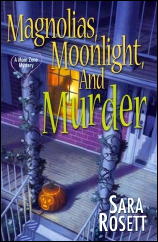
SARA ROSETT – Magnolias, Moonlight, and Murder. Kensington, paperback, March 2010; hardcover, April 2009.

SARA ROSETT Ellie Avery

   As can easily be deduced from the title, perhaps, this is a cozy mystery novel that takes place in the South, middle Georgia, in fact. Most cozies today have leading characters who solve mysteries involving their hobbies (making quilts or teddy bears) or who run into murders in their everyday line of work, which are usually unusual.

   Take Ellie Avery, for example. This is her fourth run-in with murder, but in her everyday life she’s a mother with two small children (lots of diapers!) and a professional organizer (lots of reasons for meeting lots of people, most of who are also suspects).

   In Magnolias Ellie discovers the remains of two bodies in one grave unearthed by rain in a cemetery near the house she and her Air Force husband have just moved into. (This, by the way, is another theme of the series: the constant moving from home to home that an Air Force wife has to get used to and endure.)

   Neither, however, is the body of the young reporter who’s been missing for several months, Jodi Lockworth, who as it turns out, lived in the house where the Averys are now residing, a fact that gets Ellie involved in another case to solve, much to husband Mitch’s displeasure.

   Whether there’s any entertainment factor in this novel for you depends, I would imagine, on you. I found it enjoyable enough to finish, certainly, or I wouldn’t be telling you about it, but I was a trifle disappointed when it came to the detective side of things. There are a couple of cases in Magnolias, somewhat tangentially connected. Ellie’s work as a sleuth is a lot more effective on the minor one.

   As to the major one, it takes a telephone clue out of the blue before she can put things to right. Nothing she does on her own, or could have done, would have cracked the case – one that also depends on a huge hummer of a coincidence, now that I’m thinking about it.

   One that’s managed in one single swallow, though, or maybe two. Detective and mystery fiction are full of them. Neither can leave home without them.

      The Ellie Avery “Mom Zone” Series —

1. Moving Is Murder (2006)

SARA ROSETT Ellie Avery

2. Staying Home Is a Killer (2007)
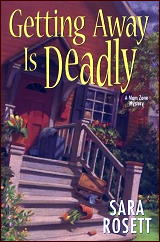
3. Getting Away Is Deadly (2008)

SARA ROSETT Ellie Avery

4. Magnolias, Moonlight, and Murder (2009)
5. Mint Juleps, Mayhem, and Murder (2010)

IT IS PURELY MY OPINION
Reviews by L. J. Roberts


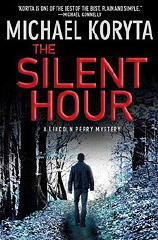
MICHAEL KORYTA – The Silent Hour. St. Martin’s Minotaur, hardcover, August 2009; reprint paperback, August 2010.

Genre:   Private eye. Series character:   Lincoln Perry, 5th in series. Setting:   Cleveland OH.

First Sentence:   He’d sharpened his knife just an hour before the killing.

MICHAEL KORYTA Lincoln Perry

   PI Lincoln Perry is on his own after his partner, Joe Pritchard, decided to spend the winter in Florida. Lincoln is receiving letters from a paroled killer wanting to hire him to find the missing daughter of mobsters. The woman and her husband disappeared a decade ago from a unique and valuable rural home where they ran an unlicensed half-way house for violent offenders.

   When the skeleton of the husband turns up, having a less-than-desirable client, and a case connected to the Mob, causes Perry to question his abilities and his commitment to being a PI.

   It is so frustrating to have an author whose previous books I’ve loved, write one I find disappointing. Perhaps because I liked the previous books so well, I didn’t notice them, but I did here: portents. I intensely dislike the use of portents, particularly where they broadcast the plot and thus, detract from the suspense or surprise of the story. They were unnecessary.

   The plot, itself, was interesting, but it bogged down in the middle. Lincoln’s introspection nearly overwhelmed the pace and appeal of the story, even though some of it was well done… “It stacked up on you, after a while. The violence.”

   I understand wanting to focus on a single protagonist in a series where the protagonists have been a team. In this case, having Lincoln without Joe reminded me of soda without carbonation: flat.

   I like Lincoln as a character. I appreciated learning more about is background, particularly his mother. At the same time, without Joe, an older, ex-cop who brought Lincoln into his PI agency, Lincoln’s inexperience showed in a frustrating way.

   The scenes where Joe is present are when the book came back to life. The biggest challenge was that beyond Joe, Lincoln and his girlfriend Amy, none of the rest of the characters was appealing or interesting. There was nothing in them to make me care whether the case was solved.

   If you’ve not read Koryta, I do recommend the first four books in the series and his standalone Envy the Night. Shall I continue reading Koryta? Probably, but I’ll hope the next book is much better.

Rating: Okay.

      The Lincoln Perry series

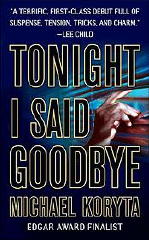
1. Tonight I Said Goodbye (2004)

MICHAEL KORYTA Lincoln Perry

2. Sorrow’s Anthem (2006)
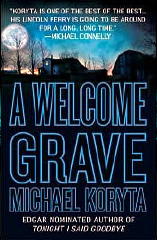
3. A Welcome Grave (2007)

MICHAEL KORYTA Lincoln Perry

4. The Silent Hour (2009)

Editorial Comment: Koryta’s next two books are scheduled to be stand-alones, as was Envy the Night, which LJ mentions. One wonders if, like Harlan Coben and Dennis Lehane before him, that’s the direction his career is taking him.

IT IS PURELY MY OPINION
Reviews by L. J. Roberts


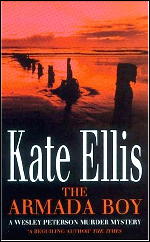
KATE ELLIS – The Armada Boy. St. Martin’s Press, hardcover, July 2000. Previously published in the UK: Piatkus, hc, 1999.

Genre: Police procedural. Series character: DS Wesley Peterson, 2nd in series. Setting: Devon, UK.

First Sentence: Norman Openheim lit a forbidden cigarette and inhaled deeply.

KATE ELLIS Wesley Peterson

   The Americans have come back to Devon in tribute to the time spent there preparing for the Normandy Invasion. The reunion does not go without incident when Neil, an archeologist and friend of DS Wesley Peterson, find the body of a murdered veteran at the chantry chapel ruins, the site where sailors of the Spanish Armada are said to be buried and where in more recent times, couples went for a bit of privacy.

   The only thing better than discovering a new author I like, is when they have a backlist for me to read. Kate Ellis is such an author.

   It is nice that this book is set in the fictional town of Tradmouth in Devon. From the author’s website, I learned that she used Dartmouth as her guide. While it is nice to be outside a major city, providing a stronger sense of place would have been appreciated, particularly as I am completely unfamiliar with this area. Thank heaven for the Internet.

   I cannot, however, fault her for character creation. Although this is billed as “A Wesley Peterson Crime Novel,” it read more as an ensemble cast, and a good one. Again, quoting the website, “Each story combines an intriguing contemporary murder mystery with a parallel historical case.”

   Wesley received his degree in archeology prior to joining the police force and therefore provides the bridge to his archeologist friend, Neil. Wesley is polished and university educated, in contrast to his superior, DI Heffernan, whom I am delighted to say he gets on with well.

   To this pair add a bright, ambitious police woman; a young detective who’d really like the action of London; Wesley’s archeologist friend; and an unseen psychic who calls to tell them to look for the Armada Boy.

   What I particularly appreciated was that the background of all the characters is provided in bits throughout the story. The story’s plot is well constructed. It is intricate and filled with red herrings and twists but never feels contrived or manipulative.

   The clues are revealed to the reader as they are to the characters. The past is a critical element of the story as it relates to both location and motives. Ellis skillfully blends the historical information into the plot, even enabling a particularly poignant thread to the story.

   Ellis is an intelligent writer excellent at combining the past with the present and in her use of allegories and understanding the impact of the sins of the father. She has definitely joined my “must read” list.

Rating: Very Good Plus.

      The Wesley Peterson series —

1. The Merchant’s House (1998)

KATE ELLIS Wesley Peterson

2. The Armada Boy (1999)
3. An Unhallowed Grave (1999)
4. The Funeral Boat (2000)
5. The Bone Garden (2001)

KATE ELLIS Wesley Peterson

6. A Painted Doom (2002)
7. The Skeleton Room (2003)

KATE ELLIS Wesley Peterson

8. The Plague Maiden (2004)
9. A Cursed Inheritance (2005)
10. The Marriage Hearse (2006)
11. The Shining Skull (2007)
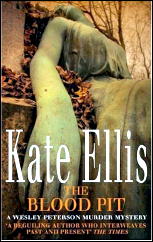
12. The Blood Pit (2008)

KATE ELLIS Wesley Peterson

13. A Perfect Death (2009)
14. The Flesh Tailor (2010)
15. The Jackal Man (2011)

Note: Kate Ellis has also written two detective novels featuring DI Joe Plantagenet, and one with Lady Katheryn Bulkeley, a 16th century abbess.

IT IS PURELY MY OPINION
Reviews by L. J. Roberts


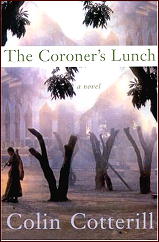
COLIN COTTERILL – The Coroner’s Lunch. Soho Crime, hardcover, December 2004; trade paperback: November 2005.

Genre: Licensed investigator. Series character: Dr. Siri Paiboun, 1st in series. Setting: Laos, 1976.

First Sentence: Tran, Tran, and Hok broke through the heavy end-of-west-season clouds.

COLIN COTTERILL

   It is 1976 and one year after the Communist takeover of Laos. Dr. Siri Paiboun is 72 years old, a widower and ready to retire. Instead, he is appointed state coroner; in fact, he’s the only coroner in Laos and has three cases to deal with; the death of an important official’s wife, the discovery of bodies that could lead to an international incident between Laos and Vietnam, and uncovering the reason why the commanders of an Army base, located in northern Laos, keep dying.

   How have I missed Cotterill until now? Let me start with history. I am of the Vietnam era; I had friends who fought and died, there. Once the war was over, I had very little interest in that area of the world. Now I find it fascinating to see how Communism controlled every aspect of individual’s lives.

   What I particularly like is that Cotterill doesn’t present it in a heavy-handed manner, but through the character’s perspective of that being the way life is. In some ways, I find that more effective.

   The characters are wonderful. Dr. Siri, who performs his first autopsy with the help of a very old French book, his assistants, Dtui who reads Thai fan magazines, and Geung who has mild Down’s Syndrome, plus his friends are all delightfully portrayed with affection and, often, humor.

   But it is Siri who takes the lead and is our connection to the metaphysical world. With his white hair, uncontrolled eyebrows and shocking green eyes, Siri stands out on his own, but he can also see the dead and communicate with spirits.

   Rather than making the book unbelievable, it adds dimension and an element of suspense to the story in a way that is hard to quantify. There is a wonderful sense of place to the story, but different from the usual. It is very much tied in with the way people live, rather than descriptions of the location in which the story is set.

   I am so pleased to have found this author and have already ordered the rest of this series.

Rating: Very Good Plus.

   The Dr. Siri Paiboun Series

       1. The Coroner’s Lunch (2004)
       2. Thirty-Three Teeth (2005)

COLIN COTTERILL

       3. Disco for the Departed (2006)
       4. Anarchy and Old Dogs (2007)

COLIN COTTERILL

       5. Curse of the Pogo Stick (2008)
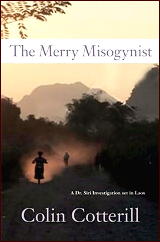
       6. The Merry Misogynist (2009)

COLIN COTTERILL

       7. Love Songs from a Shallow Grave (2010)

IT’S ABOUT CRIME
by Marvin Lachman

BILL CRIDER Sheriff Dan Rhodes

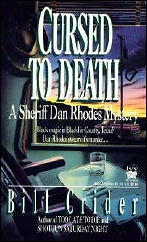
BILL CRIDER – Cursed to Death. Walker, hardcover, 1988. Paperback reprint: Ivy, 1990.

– Reprinted from The MYSTERY FANcier,
       Vol. 10, No. 4, Fall 1988.

   We’re back in Blacklin County, Texas, for Cursed to Death, the third in the Sheriff Dan Rhodes series, and it is a pleasure to be there again.

   The pace is relaxed, the main characters decent, and the mystery involving the disappearance of a dentist against whom someone had leveled a curse is reasonably challenging. The time is just before Christmas, and the holiday season always provides a nice contrast when one is reading about crime.

   There aren’t a whole lot of clues and there is a bit of padding involving several fracases at a local nursing home. Also, Rhodes keeps getting into fights and dangerous situations because, like Pronzini’s Nameless, he doesn’t like to draw his gun.

   Still, the book is extremely readable, and one walks away satisfied after spending a couple of hours in rural Texas, without either air fare or jet lag.

    The Sheriff Dan Rhodes series —
      1. Too Late to Die (1986)

BILL CRIDER Sheriff Dan Rhodes

      2. Shotgun Saturday Night (1987)
      3. Cursed to Death (1988)
      4. Death on the Move (1989)
      5. Evil at the Root (1990)

BILL CRIDER Sheriff Dan Rhodes

      6. Booked for a Hanging (1992)
      7. Murder Most Fowl (1994)
      8. Winning Can Be Murder (1996)
      9. Death By Accident (1997)
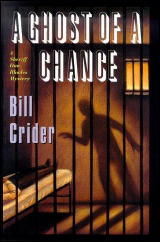
      10. A Ghost of a Chance (2000)

BILL CRIDER Sheriff Dan Rhodes

      11. A Romantic Way to Die (2001)
      12. Red, White, and Blue Murder (2003)
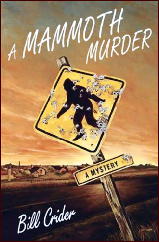
      13. A Mammoth Murder (2006)

BILL CRIDER Sheriff Dan Rhodes

      14. Murder Among the O.W.L.S. (2007)
      15. Of All Sad Words (2008)
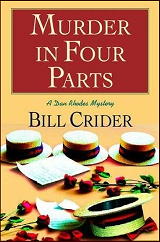
      16. Murder in Four Parts (2009)

BILL CRIDER Sheriff Dan Rhodes

      17. Murder in the Air (2010)

REVIEWED BY WALTER ALBERT:         


LAWRENCE BLOCK Keller

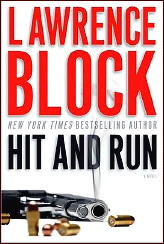
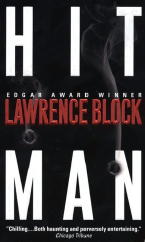
LAWRENCE BLOCK – Hit and Run. William Morrow, hardcover, June 2008. Harper, paperback, June 2009.

   Block’s sympathetic hitman Keller returns for a fourth outing. As he’s waiting for the go ahead to carry out a job in Des Moines, a charismatic African-American governor is assassinated and a photograph of Keller is widely disseminated as the face of the assassin.

   You might say that it’s poetic justice, but Keller’s been set up, and we always have the sense that the people who hire him are the real villains, with Keller the competent professional who’s just doing his job. His life in ruins, Keller goes on the run.

   With the help of a new person who comes into his life and the ever faithful Dot, he eventually recovers but the momentum of the series has been seriously damaged. Much of the novel finds him just marking time, and that new person seems nothing more than a plot device to rescue Keller from an almost impossible situation.

   As far as I’m concerned, this series has run its course, and if this is indeed meant to conclude Keller’s saga, it’s a lame resolution.

       The Keller series —

   1. Hit Man (1998)

LAWRENCE BLOCK Keller

   2. Hit List (2000)
   3. Hit Parade (2006)
   4. Hit and Run (2008)

REVIEWED BY TINA KARELSON:         


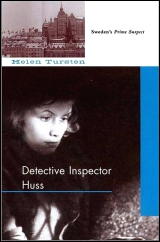
HELENE TURSTEN – Detective Inspector Russ. Soho Press, hardcover, US, January 2003; trade paperback, May 2004. Translated by Steven T. Murray.

HELENE TURSTEN Inspector Huss

   Irene Huss is a police inspector in Goteborg, Sweden, and her story is a character-driven semi-procedural flavored with a strong dose of domestic life, reminiscent of Peter Robinson’s and Donna Leon’s police series.

   Private life is less idealized in Tursten’s book, although Irene’s chef-husband Krister is a little too good to be true. As she investigates the mysterious death of wealthy Richard von Knecht, the reader is also shown her household’s twice-monthly cleaning routine and a crisis with one of the daughters slipping into skinhead culture.

   There’s just enough of this sort of thing to provide a strongly realistic atmosphere, heightened by vivid descriptions of nasty weather and long hours of darkness during the weeks before Christmas. Despite the domestic detail, including a lovable dog, this is rather hardboiled, including, for example, a nasty run-in with a group of Hell’s Angels.

   Originally published in Sweden in 1998, this came out in English from Soho Press in 2003. Recommended, but not to those of you who have already tried and disliked Scandinavian crime fiction. This book won’t change your mind.

       The Inspector Huss series:

Translated into English:

   1. Detective Inspector Huss (2003)
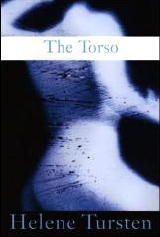
   2. The Torso (2006)

HELENE TURSTEN Inspector Huss

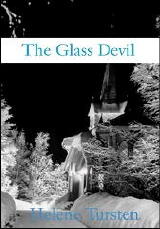
   3. The Glass Devil (2007)

Published in Sweden:

   * 1998 – Den krossade tanghästen, English title: Detective Inspector Huss (2003)
   * 1999 – Nattrond
   * 1999 – Tatuerad torso. English title: The Torso (2006)
   * 2002 – Kallt mord
   * 2002 – Glasdjävulen. English title: The Glass Devil (2007)

HELENE TURSTEN Inspector Huss

   * 2004 – Guldkalven
   * 2005 – Eldsdansen
   * 2007 – En man med litet ansikte
   * 2008 – Det lömska nätet

HELENE TURSTEN Inspector Huss

   Six films based on the series has appeared in Sweden and are available on the Internet as a six-DVD boxed set. Playing Inspector Huss is Angela Kovàcs. Contained in the set are:

   1. The Torso
   2. The Horse Figurine
   3. The Fire Dance
   4. The Night Round
   5. The Glass Devil
   6. The Gold Digger

   Swedish titles: Glasdjävulen / Guldkalven / Eldsdansen / Nattrond / Den Krossade tanghästen / Tatuerad torso.

   A trailer for The Torso can be seen here on YouTube.

Reviewed by DAVID L. VINEYARD:         


CARROLL JOHN DALY – Murder From the East. Frederick A. Stokes, hardcover, 1935. Previously serialized (as individual stories) in Black Mask, May-June, August 1934. Paperback reprint: International Polygonics, 1978.
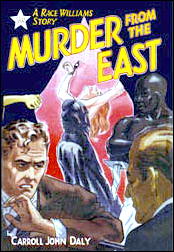
CARROLL JOHN DALY Race Williams

   Some books have everything — or nearly everything. Murder From the East is one of those. It has a bit of everything — the yellow peril, beautiful adventuresses, and tough guy private eyes.

   And as the latter goes, there was never anyone tougher than Race Williams. And if you don’t believe it, just ask him.

    “I just wanted to be sure that both your hands were occupied and that you were Race Williams. So — take that.”

    His right hand, that was under his jacket, flashed into view. For the moment the hard square surface of a black automatic showed; jerked up so that I looked down the blue barrel of a German Luger.

    Hard, red knuckles tightened and showed white. And — I shot him five times. Five times smack in the stomach, before he could ever squeeze the trigger.

    Surprised? He was amazed.
CARROLL JOHN DALY Race Williams

   So are we. But we shouldn’t be. Race Williams is the first private eye. True, Daly’s own Three Gun Terry Mack beat Race to the game, but Terry wasn’t a private eye, or a least never identified himself as one. He was an adventurer like Gordon Young’s tough gambler Don Everhard.

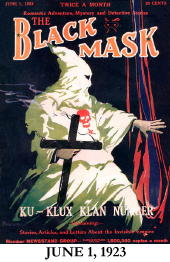
   Race is the first of his breed (not the first private detective, but the first in the hard-boiled mode) making his debut in the Ku Klux Klan issue of The Black Mask in “Knights of the Open Palm.” Some of the stories were pro Klan — Daly’s was anti.

   In Murder From the East Gregory Ford, who runs the biggest private detective agency in the city, is working for the government, and wants to hire Race to knock off a gunman who is gunning for Race anyway. But Race isn’t having any.

    “Same old Race,” he nodded. “Still trying to pose as a detective and not as a gunman.”

   But before the day is over the gunman has run down Race and met his just end. Then the man who hired the gunman shows up in Race’s office.
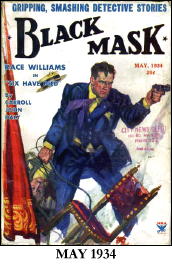
CARROLL JOHN DALY Race Williams

    Tall, thin, slightly bent at the shoulders and dressed to play the Avenue …His face! Well, it was pointed, with a sharp but certainly not protruding chin. I don’t know if it was the color of his skin or the peculiar narrowness of those yellowish brown eyes that gave the impression he was Oriental.

   His name is Count Jehdo, and he turns out to be from Astran, a country that is making trouble in Europe and Asia. He’s also involved in the “Torture Murders” the papers are screaming about.

   Pretty soon Race is in the pay of the General, the man behind Gregory Ford, and the trail leads Mark Yarrow, the man behind the torture murders and Astran’s crimes but even he doesn’t know about the Number 7 man, the General’s man inside the organization, and Race’s job is to destroy Yarrow while the Number 7 man brings down Jehdo.

   Then, who should show up but —
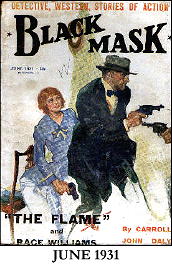
CARROLL JOHN DALY Race Williams

    “Florence!” I said. “Florence Drummond — the Flame!”

   The Flame and Race have been at this game for a while. She’s up to her neck in this new game and wants Race out of her way.

    “This racket,” she nodded and her lips were very thin; very set. “A billion dollar racket!” She came to her feet, walked across the room, pushed aside the curtains by the window, and stood there a moment. There was sarcasm in her words. “I was always one for romance, Race. Let us say a man took my hand, bent forward, kissed it and promised that the day would come when I would sit in the palaces of those who ruled the world.”

   But she has taken on more than a lover. She is now the Countess Jedho.

   The rest of the book precedes in a hail of gun smoke as Race thins the numbers of the organization and generally makes a nuisance of himself. He’s captured and tortured, but escapes thanks to the Flame and eventually smashes Yarrow and Jehdo and reveals the Number 7 man.
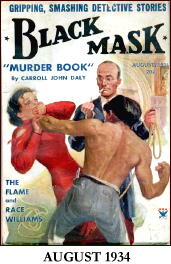
CARROLL JOHN DALY Race Williams

    “You made use of what you always make use of. It’s not your head; it’s the animal in you. The courage in you; the thing that drives you on. You’re licked — licked a dozen times, over and over. Everybody knows it but you! No, it’s not your head.”

   Much has been written about Daly’s shortcomings as a writer, and most of it is true, but what is also true is that he wrote at a sort of white hot level straight from the hip, like the hot lead pouring from is blazing .45’s, and for all the melodrama, cliches and corn, there is a conviction to his best work that few writers ever managed.

   In terms of style and literary considerations he is a pale shadow of Hammett and Chandler, and he could never plot or even created characters as well as Erle Stanley Gardner, but he was the most popular writer at the famed Black Mask, and his name on the cover drove sales up every month.

   Time passed Daly and Race by. For a time his tales of Satan Hall, a Dirty Harry style cop, surpassed Race, and Race eventually fell from the Mask to lesser pulps as Daly’s career sagged. By his death in the 1950’s his books couldn’t find an American publisher.
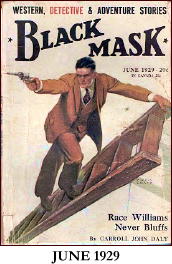
CARROLL JOHN DALY Race Williams

   For a time Race Williams and Carroll John Daly were kings of the hard-boiled private eyes. If they lacked the graces of the better writers they still offered their own brand of thrills and action, and in their wake marched the Dan Turner’s, Mike Hammer’s, and Shell Scott’s that followed. If nothing else Daly influenced Mickey Spillane, and in Spillane had a lasting impact on the genre.

   Race and his creator are fairly insubstantial figures now, but once they were giants, and traces of their footprints still leave a trail. Park a few of your critical judgments and you can still find a good deal of enjoyment in Race’s adventures.

   You may not applaud the writing, but you are likely to stay for the sheer entertainment. Perhaps more than many of the better writers from Black Mask, the true voice of the pulps thunders in the exploits of the one of a kind Race Williams.
THE BACKWARD REVIEWER
William F. Deeck


ARTHUR D. GOLDSTEIN – A Person Shouldn’t Die Like That. Random House, hardcover, 1972. Hardcover reprint: Detective Book Club, 3-in-1 edition, September 1972.

   Several days after his chess-and-checkers-playing friend, Jacob Schneider, fails to show up at the New York City park where they play, Max Guttman visits him to see if all is well. Unfortunately it isn’t, for Guttman finds him in his apartment, beaten to death.

   Realizing that he knew little about Schneider other than that he had survived a concentration camp, Guttman begins trying to find out why a man should have to die like Schneider did. Guttman is also pressured, only a little bit externally but very much internally, to see what he can do to keep a presumably innocent black drug addict from being convicted of the crime.

   The police don’t care for Guttman’s inquiries, nor apparently does the murderer, who may have struck again.

   In Synod of Sleuths, edited by Jon L. Breen and Martin H. Greenberg, James Yaffe discusses the Jewish detective and Jewish characters in mystery novels — Guttman isn’t literally a detective, merely a not-very-well educated but definitely intelligent immigrant who wants to know why — and contends:

    “Most Jewish fictional detectives are as secular, as unaffiliated,’ or at best as casual about their adherence to Judaism as most American Jews. In considering them, we find ourselves wondering if they really have to be Jewish at all. Does their Jewishness have anything to do with their character, the way they operate as detectives, or the atmosphere of the novels in which they appear? Or is it simply a thin coating of local color, daubed on the surface?”

   At least in this novel — the first of three — Guttman, seventy-two-year-old widower, is not a practicing Jew. Indeed, he has not kept Kosher since his wife died. Is his Jewishness “simply a thin coating of local color?”

   Not a question I can answer, and Yaffe does not deal with Goldstein’s novels in his essay. What I can say is that Guttman is an amusing, thought-provoking and complex character whom it was it pleasure to spend time with.

– From The MYSTERY FANcier, Vol. 13, No. 3, Summer 1992.


Bibliography:    [Taken from the Revised Crime Fiction IV, by Allen J. Hubin.]

GOLDSTEIN, ARTHUR D(avid). 1937- . Pseudonym: Albert Ross. Series character: Max Guttman, in all three titles below.
    A Person Shouldn’t Die Like That (n.) Random House, 1972. Nominated for an Edgar, Best First Mystery Novel, 1973.
    You’re Never Too Old to Die (n.) Random House, 1974.
    Nobody’s Sorry He Got Killed (n.) Random House, 1976.

ROSS, ALBERT. Pseudonym of Arthur D. Goldstein.
    If I Knew What I Was Doing (n.) Random House, 1974.

REVIEWED BY TINA KARELSON:         


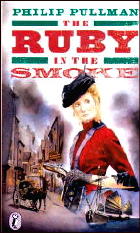
PHILIP PULLMAN The Ruby in the Smoke

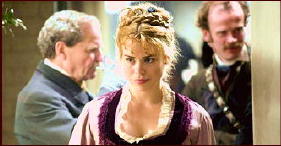
PHILIP PULLMAN – The Ruby in the Smoke: A Sally Lockhart Mystery. Oxford University Press, hardcover, 1985. Reprinted many times, in both hardcover and soft. TV movie: BBC, 2006 (with Billie Piper as Sally).

   First published in the U.K. in 1985, this was published in the U.S. in 2008, after the success of Pullman’s “His Dark Materials” trilogy. It’s more of an adventure story taking place in London, 1852, than a mystery, in the vein of the penny dreadfuls that the character Jim devours.

   In this first book in the series, 16-year-old Sally receives a mysterious note related to the death of her father, a shipping agent who drowned in the South China Sea. As she begins to investigate the note, Sally tumbles headlong into a mystery involving opium, pirates, Chinese secret societies, the seamiest areas of Victorian London, a legendary ruby and the truth about her own identity.

   It’s a quick read, awash in Pullman’s wonderful writing. Here’s the sailor Bedwell describing how the sea looked the night Sally’s father died:

PHILIP PULLMAN The Ruby in the Smoke

    “Our wake and our bowwave were great swirling tracks made up of billions of spots of white light, and all the sea on both sides was full of deep glowing movements — fishes darting through the depths, great shimmering clouds and veils of shadowy color, little surges and whirlpools of light far below — once or twice in your life you get a night like that, and it’s a sight to leave you breathless.”

   Recommended for craft and atmosphere.

    Bibliographic Data:

       The Sally Lockhart series —

    1. The Ruby in the Smoke (1985)
    2. The Shadow in the Plate (1986) aka The Shadow in the North (US)
    3. The Tiger in the Well (1990)
    4. The Tin Princess (1994)

« Previous PageNext Page »