Characters


Reviewed by DAVID L. VINEYARD:         


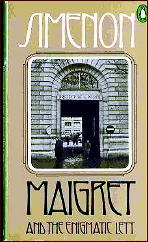
GEORGES SIMENON – Maigret and the Enigmatic Lett.

First published as The Strange Case of Peter the Lett: Hurst, UK. hardcover, 1933. First US edition: Covici Friede, hardcover, 1933. Translation of “Pietr-le-Letton” (Fayard: Paris, 1931). Also published as: Maigret and the Enigmatic Lett, Penguin, pb, 1963.

GEORGES SIMENON

   Superintendent Maigret, of No. 1 Flying Squad, looked up from his desk; he had the impression that the iron stove which stood in the middle of his office, with its thick black pipe sloping up to the ceiling, was not roaring as loudly as it should. He pushed aside the paper he had been reading, rose ponderously to his feet, adjusted the damper and threw in shovelfuls of coal.

    Then standing with his back to the stove, he filled a pipe, and tugged at his shirt collar; it was a low one, but felt too tight.

   And so we meet Jules Maigret in his too small office in the Quai des Orfevres, a large and deliberate man who always seems a little outside of his environment, a little uncomfortable in it.

   The first of Maigret’s cases finds the good Commissar at the top of his game. Pietr the Lett is an international criminal that Interpol identifies as headed for Paris. Maigret heads for the train station at the Gare du Nord to intercept Pietr only to find a man fitting his description dead in the train toilet.

   Inside the dead man’s pocket Maigret finds a photograph and a lock of red hair. Maigret and his man Torrence lunch at the Brasserie Dauphine behind the Place de Justice for the first time and discuss the case. It will become a familiar scene. Is Pietr dead, or two men — or more? Soon a virtual army of Pietr’s aliases present themselves.
GEORGES SIMENON

   With the help of the police lab at Quai de Orfevres, Maigret is lead to a couple, the Mortimer-Levinson’s, staying at the Hotel Majestic, millionaires and friends of one Oswald Oppington, and he follows the trail of one Olaf Swann, a Norwegian merchant marine officer to Mme Bertha Swann living in Fecamp.

   Maigret has his man Torrence posted at the hotel and he travels to Fecamp where he follows a Russian, Fedor Yurovich, a Russian drunk, back from Mme Swann’s to the Jewish Quarter of Paris where he is living with a dancer, Anna Gorskin, physical age 25, but with a much older and more tarnished soul:

   Her hair was greasy and unkempt, hanging down to her shoulders in thick strands. She wore a shabby dressing gown, which hung open, showing her underwear. Her stockings were rolled down past her podgy knees.

   For the first time we see Maigret in his familiar form, cold, wet, and tired, even his famous pipe wet watching the goings and comings of the criminal classes. He is watching and waiting. He is biding his time, and soon he will act. But only when the time is right.

   Later Maigret is wounded while following the Mortimer-Levinson’s from a night club. He rushes to the Hotel Majestic to find Torrence murdered, both attacks the work of the dancer Anna Gorskin.

   Now Maigret tightens his web in the pursuit of the Lett, who has re-emerged, and finally tracks down the killer, revealing the mystery of the enigmatic criminal known as Pietr the Lett. Maigret, taking a note from the classical detective novel, allows the defendant an easy out.

    The second bottle had a little rum left in it. The Superintendent picked it up. It clinked against the glass as he poured.

    He drank slowly. Or rather he pretended to drink. He was holding his breath.

    At last the report came. He drained the glass at one gulp.

   And then he goes home to Mme Maigret. Until the next case.
GEORGES SIMENON

   From the beginning Maigret is something different. The writing is controlled and succinct. There is little extra verbiage, and Maigret himself is not given to colorful action or dress. He is a drab policeman enshrouded in a fog of pipe smoke, sipping Calvados, a beer, or a glass of Pernod at some small brassierie, steady, patient, and as inevitable as the dawn as he moves forward toward the truth through the lies, self delusion, and human frailties of the men and women he must investigate and pursue.

   It would perhaps be an exaggeration to suggest in the course of an enquiry, cordial relations often develop between the police and the individual from whom they are trying to obtain a confession.

   But unless the criminal is a soulless brute, a kind of intimacy almost always grows up.

   This is the famous method of Maigret, the gradual cajoling, bullying, empathizing with the suspect as he uncovers the truth one layer at a time.

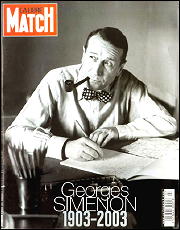
   This is Maigret as Hemingway first encountered him, writing as Sim or sometimes Simenon, a Belgian journalist whose stories flowed from his pen in seeming endless progression growing darker, deeper, and more psychologically complex as time passes.

   The Maigret novels invite us into a world that is at once familiar and foreign. Like Holmes’s London or Chandler’s L.A., Maigret’s Paris is a living place, a character itself, and realized so deftly that though in the background it is ever present in our unconscious mind.

   But few debuts in crime fiction are as assured and complete as this one, and the remarkable thing is that it is the same voice and the same character we will know so much more about some eighty books later. Maigret, unlike many great fictional characters, comes to life fully formed sprung from the forehead of Simenon complete and instantly recognizable.
GEORGES SIMENON

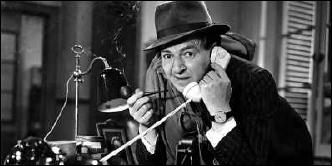
   Few great detectives emerge so fully imagined on their first outing. For most there are stumbles, missteps, false starts. But Maigret, pipe puffing away, is here, as always, one with his world and ours, patiently nursing a glass of Calvados, his pipe smoke curling about him, his overcoat a bit too heavy for the weather, his great mind waiting to leap upon the truth, his great soul ready to embrace the frailties of the human beings he must deal with on a daily basis. This, too, is the method of Maigret.

   Note:   While I don’t think this book was adapted as one of the Maigret films. it was adapted as as an episode of at least three of the many international television series based on the character, including the best known British series with Rupert Davies (see above).

SHELLEY SINGER – Following Jane. Signet, paperback original; 1st printing, March 1993.

SHELLEY SINGER

   I suppose everybody in the crime-reading world has wondered — momentarily, at least? — what it would be like to throwaway your day job and become a licensed PI. (Or unlicensed. In a dream world, who cares about technicalities?)

   Here’s a book in which Barrett Lake, female, 40 and an unmarried high school teacher, does exactly that. When one of her students suddenly disappears, two weeks after a bloody knife murder in the supermarket where she works, Barrett asks the PI investigating the case (the disappearance, not the murder), if she could be of assistance. Surprisingly — or maybe not — he says yes.

   Of course the murder and the disappearance are connected, and Barrett quickly discovers she has a knack for her new job. Not that the case takes much Sherlock Holmesian deductive ability — only slog-it-out detective work. Her mentor, Francis “Tito” Broz, stays intriguingly in the background, and I agree — he’s of far more interest there than if he played any other role in discovering what happened to Jane.

   While Shelley Singer is a good writer, she’s not quite good enough to disguise the fact that this first case of Barrett Lake’s is little more than fluff. Nonetheless, in spite of the more-than-hints of the double-edged threats of incest and child abuse, she makes the pages fly by in rapid sequential fashion.

   Barrett’s next case will be Picture of David, coming next October.

– This review first appeared in Deadly Pleasures, Vol. 1, No. 2, Summer 1993 (very slightly revised).


      The Barrett Lake series:

    1. Following Jane (1993)
    2. Picture of David (1993)

SHELLEY SINGER

    3. Searching for Sara (1994)
    4. Interview With Mattie (1995)

SHELLEY SINGER

Reviewed by DAVID L. VINEYARD:         


JOHN CREASEY Meet the Baron

ANTHONY MORTON (JOHN CREASEY) – Meet the Baron. Harrap, UK, hardcover, 1937. US title: The Man in the Blue Mask, Lippincott, hc, 1937.

   As 1935 rounded to an end, John Creasey was broke and out of work — not unusual in those days — but there was a writing contest offering a handsome prize, and Creasey had his eyes on it.

   He had already had some success with the adventures of Gordon Craigie of Z5 and the Toff at Monty Hayden’s Thriller , and he knew he could win that prize if he could finish the book he had in mind.

   But he only had six days left.

   For anyone else this might have been hopeless, but we are talking John Creasey, so I can’t wring much suspense from that end.

   What’s remarkable is the book he churned out in those six days.

   John Mannering, the Baron, is perhaps the most unusual of the gentleman crooks who dominated British thriller fiction between the wars. He is no swashbuckling Saint or decadent Raffles. He has a code, but it is unique to him, as is his sense of justice. He is the only one of the gentleman crooks who would have been perfectly at home in Black Mask (though The Saint did make it there, he didn’t really fit) along side Erle Stanley Gardner’s Phantom Crook, Ed Jenkins.

JOHN CREASEY Meet the Baron

   John Mannering stole for one very simple reason — he needed the money. He is an upper middle class gentleman who has a small income and a little land, and he would like to keep his comfortable life exactly as it is.

   He could never find a job that would support that lifestyle, but crime… And true to his nature, he pursues his new career with a practical and no nonsense application of common sense.

   No avenger he, though he does have a sense of justice that will give him trouble at times.

   Mannering had been engaged to a well-to-do socialite, but when his money ran out she dumped him peremptorily without a second thought. Something changed in John Mannering, and the Baron was born.

   The Baron began his new career even while he was hunting down old lags to teach him the skills he would need. He preyed only on those who could afford the loss, but unlike Raffles he didn’t mind stealing from his host. In fact it was a specialty of his. He even robs his ex-fiancee. At one point he steals a valuable wedding present, and then reminds the policeman guarding it to check the gifts while he tells the host.

   The Baron persona is only born when an innocent man is accused of one of Mannering’s crimes. He writes the police a hectoring letter in the style of Arsene Lupin, and signs himself the Baron. Then he strikes again to prove his point.

JOHN CREASEY Meet the Baron

    Scotland Yard in the form of Bill Briscoe is drawn in. Briscoe is no helpless Ganimard (Arsene Lupin’s nemesis) or Claude Eustace Teal. He is a bright policeman, and he is soon on the trail of the Baron — whom he suspects is his friend Mannering.

   Thus begins a long history of suspicion. Even in later years when Briscoe leaves the Yard to work for Mannering at Quinns, the exclusive auction house the Baron acquires after marrying his love, the portrait artist Lorna, and going straight, he still suspects his old friend of being the notorious Baron.

   But he never proves it, despite Mannering’s seeming inability to stay out of trouble and his insistence on using the skills of the Baron to extricate himself and others from danger. Even at the end of Meet The Baron, when Mannering is wounded and risks his neck and freedom to rescue Briscoe, he manages to keep the Baron’s secrets.

   Most of the gentleman crooks went into intelligence work when WW II came along. Mannering was a desk sergeant at an RAF base. It somehow seems fitting.

   The Baron was the first of Creasey’s heroes to reach the American shores — for some reason called Blue Mask here — and a huge success in France and Italy where he became film auteur’s Jean Cocteau’s favorite crime fiction character. Umberto Eco made a special nod toward the Baron in his recent novel The Mysterious Flame of Queen Lorna (2005).

JOHN CREASEY Meet the Baron

   The ITV television series The Baron had little to do with Creasey’s creation, with Mannering becoming American oil baron Steve Forrest who acquires Quinns and is drawn into adventures via that. Sue Lloyd and Barry Morse co-starred.

   A forty year run is pretty good for any gentleman crook, forty seven outings from Meet the Baron (1937) to Love for the Baron (1979).

   Creasey always seemed to put a little extra effort into the Baron’s adventures. Mannering reformed, but he never felt any angst or guilt about his past, and he was always willing to break out the Baron’s bag of tricks in the pursuit of justice — not terribly patient with police work, this fellow.

   Meet the Baron by all means. He’s something a bit different from the usual run of gentleman crooks. But be warned, like candy, one calls for another, and there are forty-two years of adventures to catch up with.

Some Mixed Hybrids [1982], Part 1
Reviews by GEORGE KELLEY:


    Mixing genres is a risky enterprise, and the works I’ll be reviewing in this series blend mystery and science fiction/fantasy with mixed results.

1.)   RANDALL GARRETT – Lord Darcy Investigates.

Ace, paperback original; 1st printing, September 1981.

RANDALL GARRETT Lord Darcy

   Randall Garrett has been writing about Lord Darcy, Chief Investigator for the Duke of Normandy, since 1964. Lord Darcy investigates impossible crimes but the twist is the setting of the stories: an alternate world where magic works while science is looked upon with suspicion.

   The “magic” is actually psi powers developed by the Laws of Magic. The semi-medieval, twentieth-century civilization Garrett develops is convincing both for the primitive science the aristocratic society scorns and for the sophisticated magic most characters possess.

   The interesting point here is that Lord Darcy possesses no psi powers — for that he relies on his sorcerous assistant, Sean O’Lochlainn. Instead, Lord Darcy uses induction and deduction to pull off amazing Sherlockian solutions to the incredible puzzles Garrett presents him with.

   Lord Darcy Investigates is a collection of four novelettes: “A Matter of Gravity,” “The Ipswich Phial,” “The Sixteen Keys,” and “The Napoli Express.”

   In “A Matter of Gravity,” Lord Darcy solves a locked-room murder with a double twist ending. In “The Ipswich Phial,” Lord Darcy becomes involved in an espionage mission featuring a beautiful Polish spy, a murdered British agent, and a missing secret weapon. This is the best story in the volume.

RANDALL GARRETT Lord Darcy

    “The Sixteen Keys” presents the puzzle of a dead man in a house with sixteen locked doors. And “The Napoli Express” has more deception than Agatha Christie’s Murder on the Orient Express.

   I highly recommend Lord Darcy Investigates and the other Lord Darcy volumes, Too Many Magicians (Doubleday, 1967; Ace 1981), a novel, and Murder and Magic (Ace, 1979, 1981), a collection of four more novelettes.

– From The MYSTERY FANcier, Vol. 6, No. 2, March/April 1982


      The Lord Darcy series

* Randall Garrett:

     Too Many Magicians (n.) Doubleday, hc, 1967.
     Murder and Magic (co) Ace, pbo, 1979.

RANDALL GARRETT Lord Darcy

     Lord Darcy Investigates (co) Ace, pbo, 1981.
     Lord Darcy (co) SFBC, 1983. [A omnibus edition containing all of the above plus additional short stories.]

* Michael J. Kurland:

     Ten Little Wizards (n.) Ace, pbo, 1988.

MICHAEL KURLAND Study in Sorcery

     A Study in Sorcery (n.) Ace, pbo, 1989.

MICHAEL KURLAND Study in Sorcery

A 1001 MIDNIGHTS Review
by Robert J. Randisi & Bill Pronzini:


LOREN D. ESTLEMAN – Kill Zone. Mysterious Press, hardcover, 1984. Paperback reprint: Fawcett, 1986.

   In Kill Zone, Loren Estleman, who is best known for his rough-and-tumble, Chandleresque private-eye novels, introduces Peter Macklin, “efficiency expert” — a euphemism for hit man.

LOREN D. ESTLEMAN

   Macklin is the toughest character — hero or antihero — to arrive in crime fiction since Richard Stark’s Parker; and Estleman’ s prose the hardest-boiled since the days of Paul Cain and Cap Shaw’s Black Mask. Macklin and Estleman, in fact, would probably have been too grimly realistic even for the pioneering Shaw and his magazine.

   A terrorist group takes control of a Lake Erie excursion boat with 800 passengers, rigging it as a floating bomb. They demand the release of three prisoners within ten days. Michael Boniface, the head of the Detroit mob, offers his assistance from his prison cell in return for parole, but it is not until the FBI discovers that one of the passengers on the boat is a cabinet member’s daughter that they take him up on it.

   Boniface’s assistance is in the form of his top “efficiency expert,” Peter Macklin. Macklin tries to concentrate on the business at hand while dealing with an alcoholic wife, the knowledge that someone close to him has betrayed him, and the fact that he is being stalked by a killer working for Charles Maggiore, acting head of the mob, who does not want Boniface to get out of prison.

   Estleman takes an expertise previously displayed in PI and western novels (one of his westerns, Aces and Eights, won the Western Writers of America Golden Spur Award for Best Novel of 1982) and in applying it to a different type of novel has once again scored high marks.

   Fans of hard-boiled fiction won’t want to miss it — or subsequent Peter Macklin titles: Kill Zone is the first of at least three.

         ———
   Reprinted with permission from 1001 Midnights, edited by Bill Pronzini & Marcia Muller and published by The Battered Silicon Dispatch Box, 2007.   Copyright © 1986, 2007 by the Pronzini-Muller Family Trust.

    Bibliographic Data: There was a long delay between the first three and the fourth and fifth:

       The Peter Macklin series:

Kill Zone (1984)
Roses Are Dead (1985)
Any Man’s Death (1986)

LOREN D. ESTLEMAN

Something Borrowed, Something Black (2002)
Little Black Dress (2005)

LOREN D. ESTLEMAN

LOREN D. ESTLEMAN – Angel Eyes. Houghton Mifflin, hardcover, 1981. Paperback reprints: Pinnacle, 1984; Fawcett Crest, 1987; Ibooks, 2000.

LOREN D. ESTLEMAN

   As is the case with all good private eyes, Amos Walker is a man with an unswerving code of honor. When his client, a girl singer with unforgettable eyes, disappears, as she had predicted she would, shaking him from the case is as easy as sneaking a steak from a hungry dog.

   The scene is Detroit, and union politics combine with and merge inevitably into the background of a city in slow decay. To perk things up and to keep the case moving, Estleman is a current master of the well-tuned metaphor. He is also better at mood than he is at plot, and there is enough plot in the second half of the story to choke a full-grown horse.

   The longer the trail becomes, the more it insists on turning incestuously back upon itself. Not surprisingly, there are also plenty of guns to go around.

– From The MYSTERY FANcier, Vol. 6, No. 2, March/April 1982 (slightly revised). This review also appeared earlier in the Hartford Courant.


Editorial Comment: This is the second book in Loren Estleman’s “Amos Walker” series. How many of the PI series being written when he began are still being written today? That’s “enough said” to say it all.

   The Amos Walker series:

Motor City Blue (1980)

LOREN D. ESTLEMAN

Angel Eyes (1981)
The Midnight Man (1982)
The Glass Highway (1983)

LOREN D. ESTLEMAN

Sugartown (1984)
Every Brilliant Eye (1985)
Lady Yesterday (1987)

LOREN D. ESTLEMAN

Downriver (1988)
General Murders: Ten Amos Walker Mysteries (1988)
Silent Thunder (1989)

LOREN D. ESTLEMAN

Sweet Women Lie (1990)
Never Street (1996)
The Witchfinder (1998)
The Hours of the Virgin (1999)

LOREN D. ESTLEMAN

A Smile on the Face of the Tiger (2000)
Sinister Heights (2002)
Poison Blonde (2003)
Retro (2004)
Nicotine Kiss (2006)

LOREN D. ESTLEMAN

American Detective (2007)
The Left-Handed Dollar (2010)

THE BACKWARD REVIEWER
William F. Deeck


GREGORY DEAN – Murder on Stilts. Hillman-Curl, 1939; Detective Novel Classic No. 17, no date stated [1943].

   There are several things to be sought in a mystery novel. Style, to this reader, is foremost. When the author on page one writes, “He trajected his mind back,” it is a pointer that style will not be found.

GREGORY DEAN Murder on Stilts

   Characterization comes next, and the author fails here, too.

   Finally — though to many readers the most important aspect of a book — comes plot. In this area Dean gives good value for the money, particularly if you actually paid a Quarter for the reprint.

   A good, kindly, thoughtful rich man — most unusual in mystery novels — is murdered in a locked room. Although the murderer’s intent was to have the man’s death appear to be suicide, the murderer botched this aspect rather badly. The rich man was supposed to appear to have shot himself through his blanket while in bed, but there are no powder marks on the blanket.

   The window locks have been wiped clean of fingerprints, as has the safe in the room. Dirty work has obviously been afoot.

   Fourth Deputy Commissioner Benjamin Simon is the investigator here. It is he who deduces murder rather than suicide. He also figures out early on how and who. He doesn’t reveal it, thus being responsible for another murder. At the end of the novel when he finds out why, all is belatedly revealed.

   Unfortunately, the explanation for the murder in the locked room, and a later appearance of the murderer there — while the room again is locked and a policemen is in it — is rather lame.

   This novel will be of interest only to those who collect locked-room puzzles. It also may be of interest to another type of collector, but reviewers’ rules do not allow that information to be divulged.

   (If anyone is curious about the title, which is the only reason I bought the book, the murdered man lived in what was called “the house on stilts,” a dwelling apparently constructed on a concrete arch. I say “apparently” because this is not mentioned in the novel; it is information provided by the paperback publisher.)

– From The MYSTERY FANcier, Vol. 9, No. 5, Sept-Oct 1987.


Bibliographic Data: From Bill’s review, it is difficult to imagine that there were additional cases in Commissioner Simon’s career, but it is true. There were two others, as a quick reference to the Revised Crime Fiction IV, by Allen J. Hubin, will immediately show:

DEAN, GREGORY. Pseudonym of Jacob D. Posner, 1883-?
      The Case of Marie Corwin. Covici Friede, hc, 1933. [Dep. Commissioner Benjamin Simon]
      The Case of the Fifth Key. Covici Friede, hc, 1934. [Dep. Commissioner Benjamin Simon]
      Murder on Stilts. Hillman-Curl, hc, 1939. [Dep. Commissioner Benjamin Simon]

THE BACKWARD REVIEWER
William F. Deeck


E. X. FERRARS – Murder of a Suicide. Doubleday Crime Club, hardcover, 1941. Paperback reprint: Curtis Books, no date. British edition: Hodder & Stoughton, 1941, as Death in Botanist’s Bay, as by Elizabeth Ferrars (her standard byline in the UK).

E. X. FERRARS

   Edgar Prees, director of the Botanical Gardens In Asslington, is a man of such regular habits that when he is two hours late coming home one evening his daughter becomes quite alarmed. And rightly so, for Prees has, or so It seems, tried to commit suicide by trying to throw himself off a cliff.

   He is stopped, but the next morning, even as he still seems to be thinking about killing himself, he is murdered. Or does he kill himself?

   Officially, Inspector Tingey investigates. Tingey “liked simple virtues and was sympathetic to a few simple vices. He liked to be thought a simple man who believed what people told him.”

   Unofficially, Toby Dyke and his rather odd companion George, of apparently fixed abode but no last name, both of whom had aided in keeping Prees from hurling himself off the cliff, try to help Prees’s daughter, who is a possible suspect.

   Most of the characters, with the possible exception of Prees’s neurotic former secretary, are believable, including Gerald Hyland, an author who achieves a reasonable Income by writing about “sex and religion in the desert” and who is the complete faddist.

   There are wheels within wheels here. A plausible solution is offered at the end, and then it is overridden by an even more plausible solution.

   For reasons that I cannot recall, I had thought that Ferrars was essentially a suspense writer. This, however, is a fair-play mystery.

– From The MYSTERY FANcier, Vol. 9, No. 5, Sept-Oct 1987.


Bibliographic Data: I believe Bill Deeck’s assertion to be correct. Between 1940 and 1995 E. X. Ferrars wrote over 70 detective and mystery novels or story collections, and my impression is also that those written toward the end of her career were more inclined to be romantic suspense in nature than they were “traditional” detective fiction.

   But in each of the first five books she wrote, her leading character was the same Toby Dyke as in Murder of a Suicide; and I have a strong feeling that in these books, as was common for most detective fiction in the early 1940s, “fair play” deduction was the order of the day.

TOBY DYKE. [Taken from the Revised Crime Fiction IV, by Allen J. Hubin] —

       Give a Corpse a Bad Name (n.) Hodder 1940. [No US edition.]
       Remove the Bodies (n.) Hodder 1940. [US title: Rehearsals for Murder, Doubleday, 1941.
       Death in Botanist’s Bay (n.) Hodder 1941. [US title: Murder of a Suicide, Doubleday, 1941]
       Don’t Monkey with Murder (n.) Hodder 1942 [US title: The Shape of a Stain, Doubleday, 1942]

E. X. FERRARS

       Your Neck in a Noose (n.) Hodder 1942. [US title: Neck in a Noose, Doubleday, 1943]

A Review by JOE R. LANSDALE:          


PETE HAMILL – Dirty Laundry. Bantam, paperback original; 1st printing, October 1978.

PETER HAMILL Sam Briscoe

   The first in a planned series of at least three Sam Briscoe adventures, and if this one is any example of the books to follow, it is indeed a welcome addition to the roster of private eye like novels.

   Technically, Briscoe is not a private eye, but instead a freelance journalist. No matter. His actions are very private eye like. He’s a Charlie Parker fan, an ex-art student and a damn mean customer. Dirty Laundry shows its linen right from the start, gets it out quick and the action rolls.

   Briscoe’s ex-girlfriend, Anne Fletcher, calls him greatly in need of his help, but refuses to explain over the telephone for fear of bugs. He agrees to meet her and talk, but his feelings are mixed. He still carries a torch for her but feels like the whole thing should stay finished.

   He need not have worried. She’s killed in a car accident Or is it an accident? .

   Briscoe’s investigation of her death leads him to a very Chandler-like woman named Moya Vargas. (Compare Dolores Gonzales right down to the wide, white part in the middle of her scalp.) From there, it’s involvement with the now classical, fumbling F.B.I. man.

PETER HAMILL Sam Briscoe

   Of course, Briscoe outwits him at every turn. But what’s the stake so important that the F.B.I. is interested? Could it be Anne’s past interest in Cuban affairs, her involvement in the revolution?

   So Briscoe is off and running, or rather flying, to Mexico. His descriptions of Mexico are so full of vivid detail you can almost smell the city streets. Having never been to Mexico City, I can only guess at how accurate Briscoe (Hamill) is, but it certainly has a realistic feel.

   Actually, at this point there is little detection left. The novel falls more correctly into the suspense category, but there are still very obvious “Chandler” highlights. There’s the body in the bath tub; Briscoe is as given corpses to the descriptions of corpses and the finding of corpses, as Chandler.

   Briscoe immediately surmises, and correctly, that he has been set up to take a murder rap, if for no other reason than to get him off the case. Like any good private eye or private eye type, that’s merely incentive to lock in with the jaws and bulldog it out to the end.

   And what an end! Full of surprises — Hamill twists the tail of the genre a bit. Not so much as to upset a staunch traditionalist, but enough to keep from making it all seem old hat.

   Nice climax. Nice atmosphere. Nice debut.

PETER HAMILL Sam Briscoe

   Looking forward to more Briscoe adventures. According to the little note in the back of the book, the next Sam Briscoe adventure is scheduled for early in ’79.

– Reprinted from The Not So Private Eye
#4
, February-March 1979.


Bibliographic Update:   There were two additional Sam Briscoe novels by real-life journalist Pete Hamill, The Dirty Piece (Bantam, pbo, 1979), and The Guns of Heaven (Bantam, pbo, 1983, recently reprinted by Hard Case Crime in August 2006). Alas, there were no others.

A MOVIE REVIEW BY DAVID L. VINEYARD:         


DICK BARTON STRIKES BACK. Hammer Films, 1949. Don Stannard, Sebastian Cabot, Jean Lodge, Bruce Walker. Based on the BBC Radio serial Dick Barton Special Agent, created by Geoffrey Webb and Edward J. Mason. Director: Godfrey Grayson.

DICK BARTON

   In 1947 listeners to the early evening BBC tuned in to hear the voice of the ‘Beeb’ intone, “The time is a quarter past seven. This is the BBC Light Programme …” followed by Charles Williams’s “The Devil’s Gallop” thundering over the airwaves.

   With a gasp of anticipation ten year old boys of all ages in post-Second World War England gathered to hear the daily fifteen minute edition of the adventures of ex-commando Captain Dick Barton M.C., and his pals Snowey and Jock as they made their on air debut.

   Somewhere between Jack Armstrong, All American Boy and Carleton E. Morse’s I Love an Mystery, the Dick Barton series captured the imaginations of young boys (and girls) in the dreary days of post-WWII England with tales of derring-do, adventure, and dastardly villains. Dick was played by Noel Johnson early on and later Gordon Davies and Duncan Carse.

DICK BARTON

   Dick and his pals found themselves at odd ends in Post War England, so when their ex-commander approached them to act as semi-official agents investigating matters that were too delicate for Special Branch or MI5, it seemed the perfect solution to their post war blues. So Dick Barton Special Agent was born

   Which is why the then fledgling Hammer Studios (yes, that Hammer, of Dracula fame) grabbed up the rights to the series and churned out three quick programmers starring handsome Don Stannard in the lead role. These were Dick Barton Special Agent (1948), Dick Barton Strikes Back (1949), and Dick Barton Bay (1950).

   Dick Barton Strikes Back was filmed third but released as the second in the series. Hammer intended to continue the series, but Don Stannard was killed in a car wreck in 1949. Sebastian Cabot was in the car with him but emerged without fatal injuries. Since the films had improved with each new entry, we may well have missed the definitive screen Dick Barton.

DICK BARTON

   The opening of Strikes Back could easily come from one of Nigel Kneale’s Quatermass serials or an episode of The Avengers (Patrick McNee ironically plays a British agent in the opening scenes of the film Dick Barton at Bay ). A remote English village lies silent, everyone and every thing in it lies dead. And no bird sang.

   Dick Barton and his pal Snowey are called in. Their investigation leads to a group of gypsies and the evil Alfonso Delmonte Fourcada (Sebastian Cabot), second in command of the mad scientist whose deadly sonic ray has wiped out two English villages and now is ready for the attack on London.

   Dick and Snowey battle Fourcada and his goons, escape, evade, hunt, and in general chase around in solid thriller tradition. In one particularly good sequence they are left in a snake house, and all the glass shatters with Dick and Snowey suddenly knee deep in deadly serpents.

   Will the boys escape?

   Tune in tomorrow …

   Same time same place …

   The climax is an exciting chase up the famous BBC radio tower in Blackpool where the madman plans to broadcast his sonic weapon and destroy London. Someone must have found the irony of Dick’s final film adventure ending on the very tower that broadcast his adventures all too delicious.

DICK BARTON

   While no masterpieces, the Barton films are well done programmers, with some nice noirish photography and good if hammy performances. Stannard may proclaim his lines in all capital letters, but he certainly looks like what we expect of ex-commando Dick Barton.

In 1979 Dick returned to the small screen in Dick Barton Special Agent, a series with Tony Vogel as Dick that ran four seasons. Done tongue in cheek, the series was a good deal of fun and spawned a series of paperback adventures. In recent years a series of Dick Barton plays have been a great success mixing nostalgia, camp, and theatrical thrills.

   The creators of Dick Barton, Geoffrey Webb and Edward J. Mason (creators of the long running soap The Archers) issued a collection of short illustrated never broadcast Dick Barton adventures, Dick Barton Special Agent (Contact Publicaions) for Dick’s fans. In addition the television series was featured in annual albums of comic books stories and photos from the series as well as the paperback adaptations.

   Several sites of Old Time Radio collections have the first Barton radio serial (ten episodes) available to listen to for free on your computer or download to your MP3 player. They hold up pretty well all things considered. A good example of the charms of the form.

DICK BARTON

   The Barton phenomena was popular enough that Eric Ambler sent it up in his screenplay for Roy Ward Baker’s Highly Dangerous (1951) where his heroine, Margaret Lockwood, believes she is Frances Conway Special Agent, after her nephews favorite radio serial, Francis Conway, when a blow to the head while she is on a dangerous mission behind the Iron Curtain leaves her confused.

   But if you still thrill to the William Tell Overture and the sounds of a great white horse’s hoofbeats on the vast plains of the airwaves, to the mysterious Valle Triste and a voice intoning I Love a Mystery, or ever the catchy tune of Little Orphan Annie, then you will fully understand the appeal of the “Devil’s Gallop” on ten year old boys everywhere.

   And now back to today’s episode of Dick Barton Special Agent. As you know Dick and Snowey had just entered the elevator at Professor X’s secret lair when suddenly …

« Previous PageNext Page »