Characters


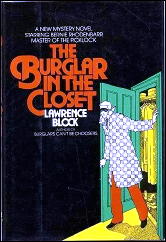
LAWRENCE BLOCK – The Burglar in the Closet. Random House, hardcover, 1978. Paperback reprints include: Pocket, 1981; Signet, 1997. Film: Warner, 1987, as Burglar, with Whoopi Goldberg as Bernie (as in short for Bernice).

LAWRENCE BLOCK The Burglas in the Closet

   In Burglars Can’t Be Choosers, when last we met our favorite breaking-and-entering expert, Bernie Rhodenbarr, he was nabbed red-handed in an apartment which, quite unknown to him, came complete with a corpse in the bedroom.

   This time, he checks around first. While the murder’s being committed, he finds himself accidentally locked up in a closet instead. The victim? No one important, only his dentist’s not-so-favorite ex-wife.

   So, in the midst of the comedy routines provided by dentistry and other irreverent views of the world, Bernie is forced once again to become a detective on the run — burglars find it terribly difficult to get policemen to be sympathetic to their job-related problems. The end result is fast, fresh, breezy, and wow, was I slow on the clues!

– From The MYSTERY FANcier, Vol. 3, No. 3, May-June 1979
            (very slightly revised).


Bernie Rhodenbarr novels:

1. Burglars Can’t Be Choosers (1977)
2. The Burglar in the Closet (1978)
3. The Burglar Who Liked to Quote Kipling (1979)
4. The Burglar Who Studied Spinoza (1980)
5. The Burglar Who Painted Like Mondrian (1983)
6. The Burglar Who Traded Ted Williams (1994)
7. The Burglar Who Thought He Was Bogart (1995)
8. The Burglar in the Library (1997)
9. The Burglar in the Rye (1999)
10. The Burglar on the Prowl (2004)

Short stories:

“Like a Thief in the Night.” Cosmopolitan, May 1983.
“The Burglar Who Dropped In On Elvis.” Playboy, April 1990
“The Burglar Who Smelled Smoke.” Mary Higgins Clark Mystery Magazine, Summer/Fall 1997.

    Peeking ahead at next November’s schedule, I found a bonanza of “Falcon” movies coming up on Turner Classic Movies. Synchronize your calendars!

      Friday November 20

6:00 AM Gay Falcon, The (1942)
   A society sleuth tries to break up an insurance scam. Cast: George Sanders, Wendy Barrie, Gladys Cooper. Dir: Irving Reis. BW-67 mins, TV-G, CC

7:15 AM Date With The Falcon, A (1941)
   The gentleman detective postpones his wedding to find a cache of stolen diamonds. Cast: George Sanders, Wendy Barrie, James Gleason. Dir: Irving Reis. BW-63 mins, TV-G

8:30 AM Falcon Takes Over, The (1942)
   A society sleuth and a lady reporter try to track down a murderous thug’s lost girlfriend. Cast: George Sanders, Lynn Bari, Ward Bond. Dir: Irving Reis. BW-63 mins, TV-G

9:45 AM Falcon’s Brother, The (1942)
   A gentlemanly detective calls on his brother to help him stop the Nazis from assassinating a key diplomat. Cast: George Sanders, Tom Conway, Jane Randolph. Dir: Stanley Logan. BW-63 mins, TV-G. [Screenplay by Craig Rice and Stuart Palmer.]

11:00 AM Falcon Strikes Back, The (1943)
   A society sleuth is framed for murder by criminals running a war-bond racket. Cast: Tom Conway, Harriet Hilliard, Edgar Kennedy. Dir: Edward Dmytryk. BW-66 mins, TV-G

12:15 PM Falcon In Danger, The (1943)
   A society sleuth tracks a lost plane carrying $100,000. Cast: Tom Conway, Jean Brooks, Elaine Shepard. Dir: William Clemens. BW-70 mins, TV-G

1:30 PM Falcon And The Co-Eds, The (1944)
   A society sleuth investigates murder at a girls’ school. Cast: Tom Conway, Jean Brooks, Isabel Jewell. Dir: William Clemens. BW-68 mins, TV-G

2:45 PM Falcon Out West, The (1944)
   A society sleuth turns cowboy to investigate a Texas murder. Cast: Tom Conway, Carole Gallagher, Barbara Hale. Dir: William Clemens. BW-64 mins.

4:00 PM Falcon In Mexico, The (1944)
   A society sleuth travels South of the border to investigate an art dealer’s murder. Cast: Tom Conway, Mona Maris, Martha MacVicar. Dir: William Berke. BW-70 mins, TV-G

5:15 PM Falcon In Hollywood, The (1944)
   A society sleuth tours the movie capital, where he uncovers an actor’s murder. Cast: Tom Conway, Barbara Hale, Sheldon Leonard. Dir: Gordon Douglas. BW-67 mins, TV-G, CC

6:30 PM Falcon In San Francisco, The (1945)
   A society sleuth enlists a little girl’s help in nabbing a mob of silk smugglers. Cast: Tom Conway, Rita Corday, Sharyn Moffett. Dir: Joseph H. Lewis. BW-66 mins, TV-G.

             —

   These, of course, have played many times over on TCM, but if you’ve never seen or taped them before, here’s a great chance to obtain them all at once. There are two more in which Conway appeared, followed by three starring John Calvert. You may have to hunt a while on the collector’s market for some or all of these.

THE FALCON’S ALIBI. (1946, RKO) Tom Conway, Elisha Cook, Jr.

THE FALCON’S ADVENTURE. (1946, RKO) Tom Conway.

THE DEVIL’S CARGO. (1948, Film Classics) John Calvert, Rochelle Hudson, Roscoe Karns, Lyle Talbot, Tom Kennedy, Theodore Van Eltz, Paul Regan

APPOINTMENT WITH MURDER. (1948, Film Classics) John Calvert, Catherine Craig, Lyle Talbot, Jack Reitzzen, Peter Brocco

SEARCH FOR DANGER. (1949, Film Classics) John Calvert, Albert Dekker, Myrna Dell, Douglas Fowley, Ben Welden

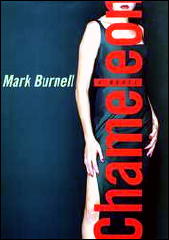
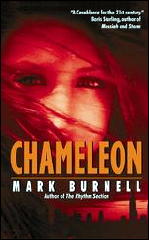
MARK BURNELL – Chameleon. Avon; reprint paperback, March 2003. HarperCollins hardcover, 2002.

MARK BURNELL

   A spy thriller about a female assassin, the best in the business that there is. She’s Stephanie Patrick a/k/a Stephanie Schneider a/k/a Petra Reuter and quite a few others as the book goes on, and at the beginning of this 400-plus page novel, she’s burned out, in hiding from her British overseers, and (more significantly) from herself.

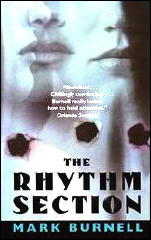
   This retreat may be caused in large part, by events, in an earlier novel, The Rhythm Section, but since I seem to have missed the book completely, that’s only a strong conjecture.

   But adding to a theory I’m still in the process of developing, there’s something I’ve decided to call the Heinz test. The precise numerical value is still subject to empirical study, and hence revision, but at the present time it goes something like this. If after reading 57 pages, and nothing in the book has happened that makes you really want to keep reading, why should you?

   On page 57 Stephanie is the midst of being involuntarily rehabilitated, being fitted up for service again. And even though the problem she’s being groomed to tackle, something to do with plutonium being smuggled out of somewhere into somewhere, was moderately non-interesting, the reclamation project she’s being forced to undergo was engaging and challenging enough for me to give the book a tentative and conditional go-ahead.

   There’s a re-evaluation stage that comes next, and I’ll call this one the Dalmatian test. When I got to this point, I stopped, and I stalled out again. If I may, I’ll quote for you a paragraph from page 101:

MARK BURNELL

   The largest fraud that Komarov had been associated with had been perpetrated by the Tsentralnaya crime syndicate. It was well known that Russian criminal organizations targeted governments because they tended to be the largest generators of money. Moreover, they were usually very poor at monitoring it. Tsentralnaya had run a highly lucrative petroleum products fraud against the Czech government during the immediate aftermath of the Velvet Revolution. Relaxed laws had allowed foreigners to invest with confidence in the Czech Republic. No one took greater advantage of the new liberal atmosphere than Russia’s most powerful criminal organization.

   There’s more immediately following, three or more paragaphs in a similar vein. Information dumps like these occur far too often. Every minor character seems to have his or her own long history, and in turgid detail. Also making the book unappealing is that it’s also difficult to root for an assassin, whether she’s on “our side” or not. A writer like Donald Westlake can pull it off, a lesser author can not.

   (Note to self: It’s obviously time to put Westlake on the to-be-read list, and maybe Eric Ambler too. See below.)

   Ambler’s early heroes were ordinary people, as I recall, caught up in events beyond their control, and managing somehow to still survive. Stephanie has too many contacts, too much money, and even with all the psychological baggage she carries with her, and the love affair that’s all-too-apparently going nowhere, she’s far too competent at what she does for the reader to care.

   Not this reader, at least. Not this time.

— April 2003


          Bibliographic Data:

      The Stephanie Patrick series:

The Rhythm Section. HarperCollins, UK, hc, 1999. HarperCollins, US, hc, 2000; Avon, pb, 2000.

MARK BURNELL

Chameleon. HarperCollins, UK, hc, 2002. HarperCollins, US, hc, 2002; Avon, pb, 2003.

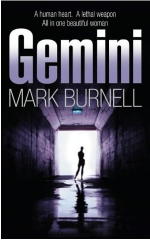
Gemini. HarperCollins, UK, pb, 2003.

MARK BURNELL

The Third Woman. HarperCollins, UK, hc, 2005.

REVIEWED BY GEOFF BRADLEY:         


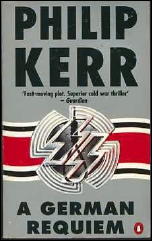
PHILIP KERR – A German Requiem. Viking, UK/US, hardcover, 1991. Paperback edition: Penguin, 1993 (shown), with many later printings.

PHILIP KERR

    I’ve already read the fourth and fifth books in Kerr’s series about German investigator Bernie Gunther. When I started to read the fourth I had thought that I had read the first three in the series but came to realise that I hadn’t read the third. I’ve now rectified this and I’m glad in did.

    It’s set in 1947 and Bernie, struggling with a rather bleak existence in Berlin, is hired by a Russian Colonel to go to Vienna to help one of his, Gunther’s, old police colleagues who is to be tried on charges of murdering an American officer.

    Bernie takes the case and finds a world of subterfuge where everyone has things to hide and where the Russians and Americans are vying for control and each are anxious to harness the abilities of ex-German military leaders, even if they are wanted for war crimes.

    The situation is bleak and the overwhelming emotion of many is despair, and the cynical, but moral, Gunther tries to work his way to a just conclusion to the case. This is an excellent series and I’m glad I took the time to fill in this gap in my reading of it.

The Bernard Gunther novels:

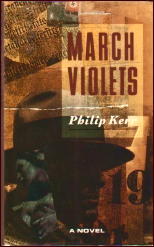
      1. March Violets (1989)

PHILIP KERR

      2. The Pale Criminal (1990)
      3. A German Requiem (1991)
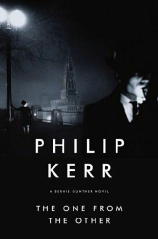
      4. The One from the Other (2006)

PHILIP KERR

      5. A Quiet Flame (2008)
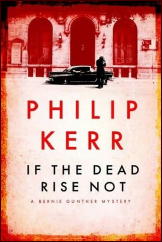
      6. If the Dead Rise Not (2009)

PHILIP KERR

REVIEWED BY WALTER ALBERT:         


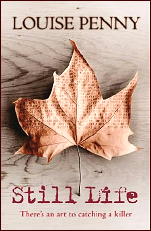
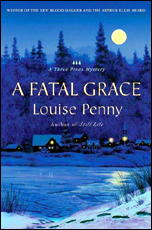
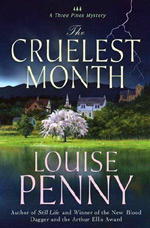
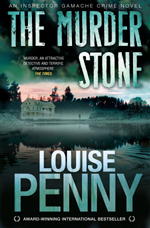
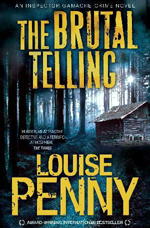
LOUISE PENNY – Still Life. St. Martin’s Press, hardcover, July 2006; paperback reprint, May 2007. First published in Canada & the UK: Headline, hc & pb, 2005.

   A Canadian rural mystery, with Chief Inspector Armand Gamache of the Quebec Sûreté and his team called in to investigate the suspicious death of Jane Neal, a reclusive resident of Three Pines, felled by an arrow.

   The strength of the novel is in its portrait of the town and its colorful inhabitants, but Gamache and his team are also nicely portrayed, with Gamache’s sharply observant eye seldom missing a significant detail in the convoluted relationships that make the investigation difficult to pursue. A promising debut for the series.

Bibliographic data:   The Chief Inspector Gamache mysteries.

1. Still Life.

LOUISE PENNY

2. Dead Cold (UK/Canada), A Fatal Grace (US).

LOUISE PENNY

3. The Cruelest Month.

LOUISE PENNY

4. The Murder Stone (UK/Canada), A Rule Against Murder (US).

LOUISE PENNY

5. The Brutal Telling.

LOUISE PENNY

THE BACKWARD REVIEWER
William F. Deeck

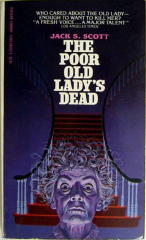
JACK S. SCOTT – The Poor Old Lady’s Dead.

Harper & Row, US, hardcover, 1976. Reprint paperback: Popular Library, 1980. First published in the UK: Robert Hale, hc. 1976.

JACK S. SCOTT

   The Chief Inspector had come down with a bug and the Superintendent was not aware of it until Detective Inspector Rosher had taken over the investigation. So the tumble down the stairs by a little old lady at the Haven, an old folks’ home, remains in the ham-fisted hands of Old Blubbergut, as he is unaffectionately known to his colleagues and his underlings.

   Rosher has to deal with an alderman who is the dead lady’s nephew and quite influential in the town, and finesse and subtlety are not Rosher’s strong points, if they are points of his at all.

   A subplot involves Rosher’s unhappy and hapless assistant, who has to suffer not only from his superior’s taunts but from the demands of a pregnant mistress who, quite reasonably, wants him to leave his wife and marry her.

   Rosher can be compared with [Joyce Porter’s] Chief Inspector Wilfrid Dover in some ways, only Dover is a caricature, a grotesque, and funny. Rosher is unfunny and very close to real.

   He toadies to his superiors. As for his underlings, “Strangely, he was not unpopular with the rank and file, provided they were on a lowly rung and unlikely to rise far above it.” Like Dover, he cadges meals and drinks from the unfortunate juniors who have to work with him. His personal habits aren’t very pleasant, either.

   As some other authors before him have discovered when they made their main character unpleasant, a continuing character must receive some empathy from the reader or be a burlesque like Dover. Otherwise, the normal reader will not buy further books in the series.

   Scott made Rosher more appealing and more human, though still not particularly pleasant, as the series advanced. Read this first recorded case of Rosher for a good investigation, some rather bitter humor, and to discover what he was like in the beginning.

   Then read the rest of Scott’s novels featuring Rosher. They become even more enjoyable as Rosher mellows somewhat.

– From The MYSTERY FANcier, Vol. 10, No. 3, Summer 1988.


      Bibliographic Data:     [Taken from the Revised Crime Fiction IV, by Allen J. Hubin.]

ROSHER, INSP. (Sgt.) ALFRED STANLEY “ALF”.   Series character created by Jack S. Scott.

      The Poor Old Lady’s Dead (n.) Hale 1976; Harper, 1976.
      The Shallow Grave (n.) Hale 1977; Harper, 1978.

JACK S. SCOTT

      A Clutch of Vipers (n.) Collins 1979; Harper, 1979.

JACK S. SCOTT

      The Gospel Lamb (n.) Collins 1980; Harper, 1980.

JACK S. SCOTT

      A Distant View of Death (n.) Collins 1981; Ticknor, 1981, as The View from Deacon Hill.
      The Local Lads (n.) Collins 1982; Dutton, 1983.
      An Uprush of Mayhem (n.) Collins 1982; Ticknor, 1982.
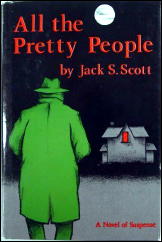
      All the Pretty People (n.) Collins 1983; St. Martin’s, 1984.

JACK S. SCOTT

      A Death in Irish Town (n.) Collins 1984; St. Martin’s, 1985.
      A Knife Between the Ribs (n.) Collins 1986; St. Martin’s, 1987.

Editorial Comment:

   I may be wrong, but I don’t have any strong feeling that either Inspector Rosher or his creator Jack S. Scott are remembered by more than a handful of mystery readers today, some 20 or 30 years later. Back in the 1970s and early 80s, I’m fairly sure that Joyce Porter’s Inspector Dover’s books were more popular than Rosher’s, and I’m sure that even the obnoxious Dover is now little more than a fading memory, alas.

A REVIEW BY DAVID L. VINEYARD:         


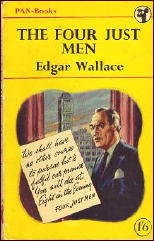
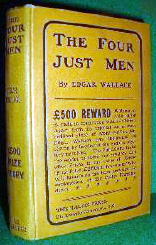
EDGAR WALLACE – The Four Just Men. The Tallis Press, UK, hardcover 1905; Tallis, UK, 1906, with the solution to the mystery. Small Maynard, US, hc, 1920. Reprinted many times.

    Citizens,
EDGAR WALLACE The Four Just Men

   The Government is about to pass into law a measure which will place in the hands of the most evil Government of modern times men who are patriots and who are destined to be the saviours of their countries. We have informed the Minister in charge of this measure, the title of which appears in the margin, that unless he withdraws this Bill we will surely slay him.

   We are loath to take this extreme step, knowing that otherwise he is an honest and brave gentleman, and it is with a desire to avoid fulfilling our promise that we ask the members of the Mother of Parliaments to use their every influence to force the withdrawal of this Bill.

   Were we common murderers or clumsy anarchists we could with ease wreak a blind and indiscriminate vengeance on the members of this assembly, and in proof thereof, and as an earnest that our threat is no idle one, we beg you to search beneath the table near the recess in this room. There you will find a machine sufficiently charged to destroy the greater portion of this building.

      (Signed) Four Just Men

   Postscript. –We have not placed either detonator or fuse in the machine, which may therefore be handled with impunity.
EDGAR WALLACE The Four Just Men

   The Four Just Men is the book that put Edgar Wallace name on the front page, and kept it there, thanks to an ingenious news paper promotion in the Daily Mail in which he challenged the readers to solve the mystery for a big reward.

   Wikipedia has a good account of the mess this led to. Unfortunately for Wallace, too many came up with the solution, and he had to swiftly change his ending and even then he ended up losing money, but by then his name was made. Money always went through his fingers like that — often at the racetrack. But whatever the circumstance, The Four Just Men was a sensation, and Edgar Wallace was off to his own literary races.

   The plot involves what I call ‘the great vote,’ a particularly British invention wherein for some reason a Minister, MP, or member of the House of Lords must be stopped from introducing a bill (usually involving defense funds) or making a key vote.

   As far as I know, it first showed up in a story by Lord Dunsany, and its most famous incarnation before Wallace may have been in American Richard Harding Davis’s novel In the Fog (really a collection of related novellas in the mode of Stevenson’s Arabian Nights or Andrew Lang’s The Disentanglers), both well known and popular. (The Davis is worth finding just for the beautiful color illustrations by American Sherlock Holmes illustrator Frederic Dorr Steele). The Four Just Men stands as the best known version of the plot today.
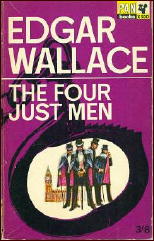
EDGAR WALLACE The Four Just Men

   In Wallace’s case his heroes, who call themselves the Just Men, announce that if Cabinet Minister Sir Philip Ramon doesn’t withdraw his upcoming bill that will send many honest revolutionaries to certain death at the hands of their homelands dictator, they will be forced to kill him. A brief summary of their career is compiled by the police:

    “…we are assured, both by our own police and the continental police, that the writers are men who are in deadly earnest. The ‘Four just men’, as they sign themselves, are known collectively in almost every country under the sun.

    “Who they are individually we should all very much like to know. Rightly or wrongly, they consider that justice as meted out here on earth is inadequate, and have set themselves about correcting the law. They were the people who assassinated General Trelovitch, the leader of the Servian Regicides: they hanged the French Army Contractor, Conrad, in the Place de la Concorde — with a hundred policemen within call. They shot Hermon le Blois, the poet-philosopher, in his study for corrupting the youth of the world with his reasoning.”

   Scotland Yard draws in its forces, the Minister refuses to budge on his bill, and in due course the Just Men strike. The Just Men, Leon Gonzallez, George Manfred, Raymond Poiccart, and Thiery plan their move and the nations holds its breath, the question being how will they managed the feat.
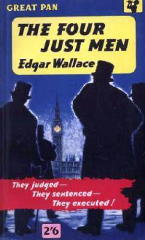
EDGAR WALLACE The Four Just Men

   The Just Men win out, but at the cost of one of their lives. Notably Wallace doesn’t make the case clean cut. Ramon is a good man who will not be the victim of extortion, and the Just Men swear to kill him for the greater cause of justice, not because he is evil.

   Few thrillers today deal with such moral quandaries, much less any in the Wallace class of popular fiction. Though Wallace spends precious little time on the moral question (it’s a fairly short book), the fact that it comes up at all in a newspaper serial designed as a thriller is a tribute to Wallace’s instincts as a writer. It doesn’t hurt that the solution to how they kill Ramon is clever in itself and well handled by Wallace.

   The Just Men are what Robert Sampson called Justice Figures in his survey of the pulps, Yesterday’s Faces (published in six volumes by Bowling Green Press), avengers who operate outside the law for the public good. Their name derives from the Jewish tradition that to each generation forty just Gentiles are born who treat the Jewish people fairly and with justice.
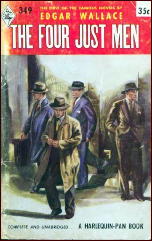
EDGAR WALLACE The Four Just Men

   The Just Men have led dangerous lives before the book begins, and will continue for several volumes, one dying, one retiring, the two survivors eventually opening a sort of detective agency after receiving pardons for their past crimes.

   It has probably already dawned on you that by modern standards the Just Men are political terrorists — at least in this first book — but by the standards of the day such a passionate love of country and justice could be justified, and Wallace goes out of his way to portray his gentlemen as good men of high moral and political fiber who believe theirs is the only way to prevent a dangerous threat to moral good.

   This was the heyday of anarchists, nihilists, and the Fenians, and it was still possible to romanticize figures of social justice such as the Just Men. The mass killing of WWI and the Russian Revolution would change the milieu which they operated in, however.
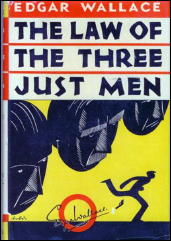
EDGAR WALLACE The Four Just Men

   Still, in today’s world it is hard not to think of modern terrorism and the ‘excuses’ given for its atrocities when reading the book. If you can park that modern sensibility, The Four Just Men is a classic that deserves to be read, and the sequels among Wallace’s best works. But you may find it makes you think more than Wallace ever intended when he wrote it.

   Whatever its politics, The Four Just Men is a compelling and entertaining Edwardian tale (it was published the year Queen Victoria died), with a quartet of interesting heroes and enough invention and suspense for a much longer book. Though it does reveal its origin somewhat as a newspaper serial, it is still highly enjoyable today.

   Wallace was never one to miss out on a money maker, and the Just Men would return throughout his career in books like The Three Just Men, The Just Men of Cordova, The Council of Justice, and The Law of the Three Just Men.

   It’s only speculation, but they may have been inspired in part by Eugene Sue’s Prince Rodolfe in The Mysteries of Paris, and E.W. Hornung’s Mr. Justice Raffles, which both deal with heroes who set up their own underworld court systems to hand down justice to those the law can’t touch. (No doubt a little of the thieves court from Hugo’s Hunchback of Notre Dame and Balzac’s Thirteen Men also contributed.)
EDGAR WALLACE The Four Just Men

   Whatever their origin the book became an instant classic, still in print, and at one point even issued by Oxford University Press. Pretty good company for a newspaper serial.

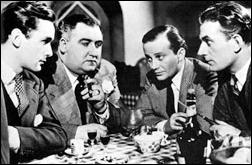
   The Four Just Men came to the big screen in 1939. Known as The Secret Four in the US, the plot was moved up to a contemporary setting but was otherwise faithful. Francis L. Sullivan, Hugh Sinclair, Griffith Jones, and Frank Lawton were the Just men. Walter Forde directed from an Angus McPhail script.

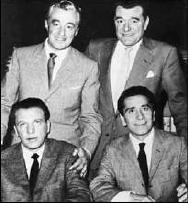
   In 1959 thirty-nine episodes of a syndicated television show starred Dan Dailey, Richard Conte, Vittorio de Sica, Jack Hawkins, and a semi-regular Honor Blackman as modern variations on the characters ran and was seen worldwide.

   Paul Gallico later penned a novel about a group of aging Resistance fighters who behaved much the same way as the Just Men, The Zoo Gang (Coward, 1971). A summer replacement series that was based upon it starred Brian Keith, John Mills, Barry Morse, and Lili Palmer, running for six episodes in 1975.
EDGAR WALLACE The Four Just Men

   The Four Just Men isn’t great literature by any means, but it is one of the high points of Edgar Wallace’s career, and one of the most important books in the genre.

   It’s a quick and easy read, and one that has entertained for over a century. As far as I know it is still in print, and in any case it is fairly easy to find and available as a free e-book as well.

   The film, The Secret Four can be found on the gray market, and may be available from a legitimate source as well. Wallace fans who don’t know it, genre historians, lovers of Victorian and Edwardian detective fiction, and readers who like to be entertained should all give it a chance. All the Saints, Shadows, Spiders, and the like who came afterward are in the shadow of Wallace and the Just Men.
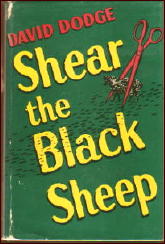
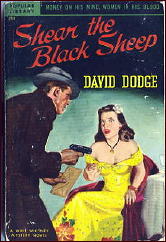
DAVID DODGE – Shear the Black Sheep.   Popular Library 202, paperback reprint; no date stated, but circa 1949. Hardcover edition: The Macmillan Co., 1942. Magazine appearance: Cosmopolitan, July 1942.

   After I finished reading this, the second murder mystery adventure of accountant detective Jim “Whit” Whitney, I went researching as I usually do, and it didn’t come as any surprise to learn (from a website devoted to David Dodge) that Dodge was also a CPA by profession, and that he started writing mystery fiction only on a dare from his wife.

   Although Dodge went on to another series (one with private eye Al Colby) and after that several standalones, there were only four books in the Whit Whitney series, to wit:

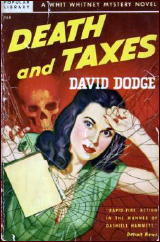
Death and Taxes. Macmilllan, hc, 1941. Popular Library 168, pb, 1949.

DAVID DODGE

   
Shear the Black Sheep. Macmillan, hc, 1942. Popular Library 202, pb, 1949.

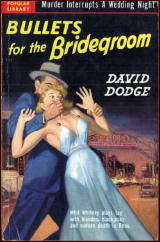
Bullets for the Bridegroom. Macmillan, hc, 1944. Popular Library 252, pb, 1950.

DAVID DODGE

   
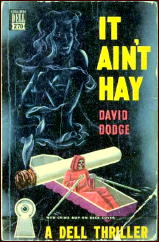
It Ain’t Hay. Simon & Schuster, hc, 1946. Dell 270, pb, mapback edition, 1949.

DAVID DODGE

   
   You can find much more detailed entries for each of these books at the David Dodge website, which includes a complete bibliography of all of his other books, both fiction and non-fiction. Not to mention his plays, his magazine stories, the articles he wrote and all of the radio, TV and movie adaptations of his work, the most well-known of which is To Catch a Thief, the Cary Grant and Grace Kelly film from 1955. Comprehensive is an understatement, and it’s definitely worth looking into, just to see a bibliography done right.

   As for Whit Whitney, his home base is San Francisco, but in Shear the Black Sheep he is talked into taking a case in Los Angeles over the New Year’s Eve holiday weekend. Against his better judgment, he agrees to check into the activities of a client’s son, who seems to be spending too much of his father’s money in the business they’re in. They’re a wool brokerage firm — hence the title. The son has also left his wife and new-born baby. Is there another woman?

DAVID DODGE

   Assisting Whitney — or making her way down to LA on her own to spend the holiday with him, or as much of it as there is left after Whit’s investigative duties are over– is Kitty MacLeod, “the best-looking girl in San Francisco, and pretty clever as well,” as she’s described on page 12.

   I’ve not read the first book in the series, and make no doubt about it, I will, but in that book (according the short recap on just about the same page) Whit’s former partner was murdered and at the time, Kitty was his wife.

   It’s now six months later, and Whit and Kitty have become very close. Whit is beginning to worry that some of his colleagues are starting to talk. There had even been some talk at the time that Whit had had something to do with Kitty’s ex’s departure from life, and getting out of the jam at the time seems to be the gist of the story in Death and Taxes.

   But that was then, and this is now. There is indeed a woman involved, as suspected — getting back to the case that Whit was hired to do — and the woman leads to a hotel room, and in the hotel room are … gamblers. A crooked card game, and the black sheep is getting sheared.

   It is all sort of a light-hearted tale, in a way, but then a murder occurs, and a screwy case gets even screwier — in a hard-boiled kind of fashion. Let me quote from page 160. Whit is talking to his client, who speaks first:

    “I don’t think it’s wise to interfere with the police, Whitney.”

   “I won’t interfere with them. I’d cooperate with them except that they’ve told me to keep out of it. I want you to know how I feel, Mr. Clayton. You hired me to find out what Bob was doing with your money, and to stop it. I found out what was going on, but I thought the best way to stop it was to let these crooks get out on a limb, and then saw it off behind them. I thought I could protect your money and show Bob what was happening at the same time. I guessed wrong. I don’t know who killed […] or why he was killed, and I don’t think I’m responsible for his death, but I’m in a bad spot and I’d like to bail out of it by myself — for my own satisfaction. The police needn’t know what I’m doing. I don’t have to tell you that I don’t want to be paid for it, but if you haven’t any objection, I’ll try to find out who killed […] and get your money back.”

   
DAVID DODGE

   Here are a few lines from page 170, at which point things are not going so well:

    He got off the bed and prowled thoughtfully around the room in his stocking feet, still holding the beer glass. What would Sherlock Holmes do with a case like this? Probably give himself a needleful in the arm — Whit drained his beer glass — and deduce the hell out of the case.

   Whit tried deduction.

   
   Those were the days when mystery thrillers were also detective novels. After a long paragraph in which Whit tries out his best logic on the tangled threads of the plot, and who was where and when and why:

    It was a pretty wormy syllogism. As a deducer Whit knew he was a lemon when it came to logic, and he was an extra-sour lemon because he didn’t know enough about Bob Clayton to figure out what he might do in a given set of circumstances. Such as having a pair of football tickets to dispose of, for example. Ruth Martin might have known where they went, but didn’t, ditto Mrs. Clayton, ditto John Clayton. Jack Morgan was the next one to try.

   
   What’s interesting is that Kitty has more to do with solving the case than Whit does. Things happen rather quickly at the end, and if all of the loose ends are (or are not) all tied up, no one other than I seems to think it matters, as long as the killer is caught — who was not someone I suspected, or did I? I probably suspected everyone at one point or another.

   I also wonder if what happens on the last page has anything to do with the title of Whit Whitney’s next adventure in crime-solving. Read it, I must. And I will.

— March 2006.

   
[UPDATE] 06-24-09.   That’s a promise to myself that I haven’t kept yet, alas, and re-reading this review (and looking at those paperback covers) gives me all the resolve I need to follow through. You can count on that and take it to the bank. Non-negotiable.

REVIEWED BY WALTER ALBERT:         


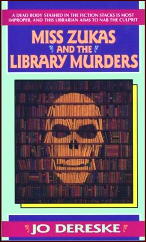
JO DERESKE – Miss Zukas and the Library Murders. Avon, paperback, 2006. Originally published by Avon as a paperback original in 1994.

JO DERESKE Miss Zukas

   Miss Zukas is a middle-aged, spinsterish librarian in Bellehaven, Washington, a transplanted Lithuanian from the upper Midwest. She’s fairly rigid, certain of her “rightness,” and largely intolerant of the masses, who include most of the people she works with or comes into contact with.

   She reminded me of a librarian in the Little Rock Public Library who — without saying a word — communicated her disapproval of a Peter Arno collection with one of Arno’s scantily clad females on the book’s jacket that I checked out from the Little Rock Public Library when I was a warty teenager.

   In spite of Miss Zukas’ thorny personality (or maybe because of it), I rather enjoyed this low-key mystery. The library setting and staff seem real, and I reflected that a protagonist who irritates me probably suggests the writer has some skill at characterization.

   There’s a cop who’s somewhat attracted to Miss Z. (whether she’s attracted to him is not very clear, but she doesn’t come across as introspective), a bohemian artist friend (Ruth) whose track record in men is deplorable, and a tendency in Miss Z. to withhold vital evidence from the police that puts both her and Ruth and the solving of the case at risk.

   Will I read another in the series? I’m not sure.

           Editorial Comment:

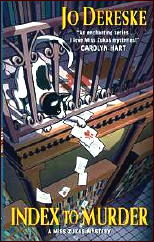
   There are eleven books in the Miss Zukas series, of which Library Murders is the first. There’s a complete bibliography for Jo Dereske’s mystery fiction on this blog back here where I reviewed #6, Final Notice.

JO DERESKE Miss Zukas

   I called reading it a “sneaky pleasure,” and otherwise agreeing in all essentials to all of Walter’s observations. Although I’ve not read more than two or three books in the series myself, I fully intend to get to all of them, eventually.

   When I sent a copy of that earlier review to Jo Dereske, I also asked her about the rumors I’d heard that #11, Index to Murder (2008) was going to be the last appearance of Miss Zukas.

   Here’s her reply, in part:

    “As to what you’ve heard about Miss Zukas’s future, you are correct. At the moment, there isn’t another contract for more adventures, but who knows what the future may bring. She’s been such a fun character to portray. I’m currently working on another series which my agent is shopping around.

    “Congratulations on your blog. I’ll put a link to it in my next website update.”

Neil McNeil’s Tony Costaine and Bert McCall Series

by DAVID L. VINEYARD

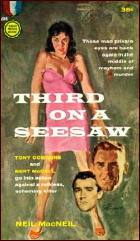
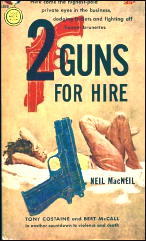
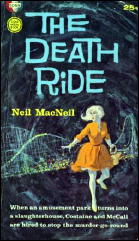
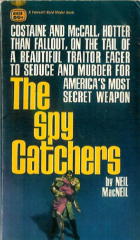
   Between 1959 and 1966 Black Mask veteran Willis Todhunter Ballard penned seven books as Neil McNeil for the Gold Medal line of paperback originals about a pair of private eyes named Tony Costaine and Bert McCall:

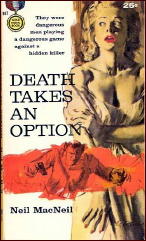
Death Takes an Option. Gold Medal 807, pbo, September 1958.
Third on a Seesaw. Gold Medal s844, pbo, January 1959.

NEIL McNEIL

2 Guns for Hire. Gold Medal s898, pbo, July 1959.

NEIL McNEIL

Hot Dam. Gold Medal 964, pbo, January 1960.
The Death Ride. Gold Medal 1055, pbo, November 1960.

NEIL McNEIL

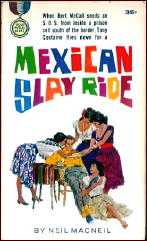
Mexican Slayride. Gold Medal s1182, pbo, January 1962.
The Spy Catchers. Gold Medal d1658; pbo, 1966.

NEIL McNEIL

   Though the series was never a major hit, they are highly entertaining superior light private eye fiction much in the mood and style of such popular series as 77 Sunset Strip and Peter Gunn on television. Costaine and McCall are the epitome of the cool, hip, buttoned-down PI’s of the period, distilled through the Rat Pack school of middle aged hipster, a group of slick eyes that rode the wave between Mike Hammer and James Bond.

   Anthony “Tony” Costaine is the brains of the outfit, slick, smart and tough, the button-down collar Brooks Brothers suit half of the team, who first teamed up with McCall back in their FBI and OSS days, six lean feet of muscle and brains.

   Bert McCall, a giant handsome Scot (born in Scotland) and topping six feet six in his stocking feet is the other half of the team, a born hedonist with an eye for the ladies, and a penchant for finding trouble and playing the bagpipes. Between the two of them they are the highest paid eyes of their day — so as you can imagine their clients tend to be rich, powerful, and in big trouble.

NEIL McNEIL

   In Death Takes an Option Marcus Cadby has hired them to find out why the auditor of MidContinental Mine and Machine commited suicide, but not before his younger and very sexy wife has tried to pry information out of Costaine.

   Then no sooner than their plane touches down in Los Angeles someone takes a pot shot at them, and before long they are involved with murder, a trip to Vegas, and a slick plot twist you will have to read for yourself.

   The trip to Vegas is important, because Costaine and McCall are, as I suggested above, Frank and Dino in not very subtle guise. McCall even calls Costaine “Dad.”

   Third on a Seesaw takes them to Reesedale PA, home of Reese Steel and Tube Company where they clean up the town and a murder — once McCall can be pried away from his bagpipes.

   2 Guns for Hire involves the boys with the car industry and a beautiful woman who paints nudes, and in Hot Dam they encounter a whole community of distant relatives of McCall who are sabotaging a power company by trying to build a dam that will flood their homes in upper New York state.

NEIL McNEIL

   The Death Ride takes them into the business of amusement parks, and in Mexican Slay Ride McCall ends up in jail south of the border as the boys take on a job involving fraud and the Mexican government. The Spy Catchers mixes them in with the government and treason in the aerospace industry and secret weapons.

   To be fair, Ballard could do this kind of book in his sleep, but thankfully he doesn’t. The boys are cool and smart, McCall just dumb enough to get them in trouble and Costaine just smart enough to get them out.

   There is a parade of attractive women varying from willing to murderous (and sometimes both), and a wide variety of action. The books aren’t major works or anything, but they are good and well worth discovering. Plotting is better than it had to be, and Costaine and McCall are always fun to be around.

●    McCall liked his women to be married as long as they weren’t married to him.

●    Tony Costaine was surprised. He could not remember being as surprised since the night the Chinese girl had walked into his Singapore apartment carrying a Tommy gun.

●    “In that case it’s simple,” McCall licked his lips. “We make motions, we find nothing, and we trot back to Cadby and say we are sorry.”
    “And lose the twenty thousand he’ll owe us when we come up with his answer? Besides it wouldn’t be ethical.”
    McCall opened his eyes very wide. “I don’t dig the word, Dad. Where’d you ever hear it?”

NEIL McNEIL

●    Wearing a black flat topped Mexican hat with tiny read balls dangling and dancing from its brim, Norbert McCall, Scotland’s contribution to the atomic age, did not look like a man who was out on fifty thousand dollars’ bail.

●    “I’m never in trouble,” Anthony Costaine said with conviction. He had had five drinks. He sounded as if he meant it.

●    “Whoever’s got it (the secret weapon) is playing for keeps, and the price is the peace of the world.”
   McCall yawned. “Aw, it’s probably only Goldfinger.”

   Ballard was one of the original Black Mask Boys with his tales of movie studio troubleshooter Bill Lennox (who also featured in three novels published as by Ballard and John Shepard), and a frequent collaborator with Robert Leslie Bellem and Cleve Adams.

   He wrote for early television (Dick Tracy) and even wrote a non genre novel about his experiences. Under his own name and as P.D. Ballard and Todhunter Ballard, among others, he wrote well-received westerns, and under the W.T. Ballard name, three books about Lt. Max Hunter of the Las Vegas police.

   His last novel, Murder in Las Vegas, about private eye Mark Foran, is one of the better hardboiled paperback originals of its period.

   That Todhunter is a family name. He was a cousin of Rex Todhunter Stout.

   Costaine and McCall may not be in the top tier of private eyes, but they are well worth discovering. The writing is lean and slick, and the action comes fast and furious. A little action, a soupcon of sex, and a twist or two in the tale are more than enough to recommend these.

   They make good company, and fit right in with Shell Scott and Chet Drum. Make the effort to meet them, but first lock up the Scotch and the women. You just can’t trust that McCall with either.

« Previous PageNext Page »