Characters


FRANK G. PRESNELL – No Mourners Present.

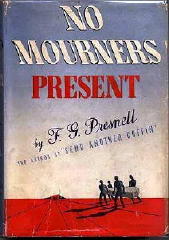
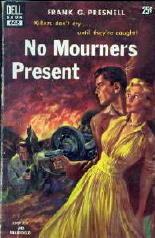
Dell 646, paperback reprint; no date stated, but circa 1953. (Cover by Robert Stanley.) Hardcover edition: William Morrow & Co., 1940.
FRANK G. PRESNELL No Mourners Present

   The jacket of the hardcover edition suggests that the book may have been published as by “F. G. Presnell,” but any final judgment on that would have to wait until the title page has been examined, the final and only arbitrator on matters of bibliographic importance such as this.

   Looking for more information about Mr. Presnell (1906-1967), I’ve not found anything on the Internet that either discusses him or his three mysteries in any way that’s significant. At the moment, all I can tell you about him personally is what Al Hubin says in Crime Fiction IV:

    “Born in Mexico; educated at Antioch College and Ohio State Univ.; designer and engineer; lived in Ohio for 40 years, then in Los Angeles.”

   Which is a start, but what it doesn’t say is why Mr. Presnell wrote two good books in 1939 and 1940, both with high-powered (and hard-boiled) practicing attorney John Webb, but then not another novel until 1951, and alas, Webb is not in it.

   For the record, here is a list of Presnell’s only contributions to the world of crime fiction:

      Send Another Coffin. Morrow, hc, 1939. Detective Book Magazine, Winter 1939-40. Handi-Book #39, pb, 1945.

      No Mourners Present. Morrow, hc, 1940. Dell 646, pb, 1953.

      Too Hot to Handle. M. S. Mill / Morrow, hc, 1951. Dell 593, pb, 1952.

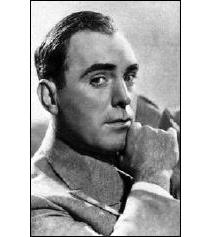
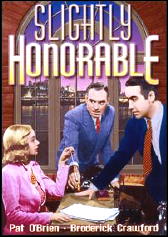
   I had not known until I looked it up, but a movie was made of Send Another Coffin, one I’ve never seen, but I believe I shall have to purchase it. The title of the movie is Slightly Dishonorable (United Artists, 1940), and besides Pat O’Brien and Ruth Terry, whom you see below, as the two leading characters – I’ll get to that in the next paragraph – Edward Arnold and Broderick Crawford are also in the film, big names both.

FRANK G. PRESNELL No Mourners Present              
FRANK G. PRESNELL No Mourners Present

   These photos were taken at different times, and neither time may coincide with the movie, but they will give you an idea at least of what Hollywood thought the characters looked like. (Since I was reading the Dell paperback, you can tell what I thought they looked like, when I was reading it. The scene on the cover, which you’ll see somewhere below, is in the book.)

   In the movie, Ruth Terry is credited only as “Night Club Singer,” but in the book she has a name: Anne Seymour. In the followup book, the one at hand, she has a brand new name, that of Anne Webb. A substantial part of No Mourners Present is the mystery novel, of course – and I’ll get to that in moment too – but another significant portion of it, one mixed up one with the other, concerns the domestic life of the two newlyweds.

   As it happens, the tough attorney John Webb is deeply in love with his wife. That much is apparent right away. He also seems to wonder how it is that he is so lucky to have her in love with him. Her background as a singer seems to be a concern to him as well: how well will she fit in with the wealthy set that he sometimes hangs around with?
FRANK G. PRESNELL No Mourners Present

   Without revealing too much, I think Anne Webb is smarter in many ways than he thinks she is, and that she can hold her own in his world very well indeed, and maybe even better. John has nothing to worry about in that regard.

   Of course there is no way of knowing. Two books with the Webbs, and that was all there were. As for Mr. Presnell, perhaps we must assume that the war intervened, and life and a family and earning a living.

   The town in which John Webb as an attorney also has considerable political clout is not named, I don’t believe, and since Hubin doesn’t suggest a setting (I just checked) neither do I believe it is a matter of my missing it.

   With very few preliminaries, the mystery gets into action right away, with Jake Barman’s murder taking place on page 15, one page after Webb very nearly slugs a radio news commentator for a remark he makes about Anne. Anne takes him to task reproachfully afterward. “Listen,” she says. “You’ve got to stop hitting people.”
FRANK G. PRESNELL No Mourners Present

   This fellow Barman is a partner in a building firm, or he was, and he also had ambitions of being elected governor. He is on the outs with his wife, however, which is a liability, especially since everyone knows that Julie Gilson, his secretary, is also his mistress. She’s also the leading suspect as well, especially after she disappears completely from sight after Barman’s death.

   Without a client, Webb is only incidentally involved until Julie’s brother comes to town are hires him to help protect her name. Once hired, Webb goes immediately into Perry Mason mode. See page 40, and you will see exactly what I mean.

   If you’re only in your 30s or 40s, it may not realize it – it’s probably too long ago – but in 1940 if your company bucked either the gangs or the unions, people were maimed for life. This is the sort of thing that gets Webb’s blood boiling as well. Here’s a long quote from page 45. He’s talking to the man he’s working for in charge of operations at a chain of cleaning establishments.
    “… In the second place, even if I didn’t give a good Goddamn whether Acme ever makes another nickel or not, I’ve got a front to keep up. Why do you think people pay me fancy prices to do things for them? Because they think I’m going to lie down and let myself be walked on? Like hell they do! They hire me because they know they’ll get grade-A effort, anyhow. And how come I usually give them results besides? Because the other side knows they’ll sweat for anything they get. […] If anybody from this damn cleaning-and-dyeing-trades racket comes around here, you tell ’em to talk to me.”

FRANK G. PRESNELL No Mourners Present

   I mentioned Perry Mason a short while back. Perry was tough in his early days, but not as tough as John Webb. Here is a portions of his thoughts, his philosophy of action, you might say, taken from page 61:

   Cabash was tough and vicious, but he wasn’t smart. He’d start trying to bluff us, and when he did, it was up to me to give him a chance to do nothing but wonder what hit him. I didn’t know how I was going to work it, but you can always figure out ways if you’re willing to use them.

   As a word of warning, the book is a little too talky to be this tough all the way through, but when it is, it is. It earns high points as a detective novel as well, or at least it did with me, with plenty of twists and turns in the plot to keep Webb’s brain (and mine) working in as finely-tuned a fashion as his brawn.

   The solution is not nearly as finely worked out as one of Perry Mason’s, though, containing as it does one small gap I haven’t quite yet figured out.

   Nonetheless, even if the mystery itself is not a classic that anyone will remember for very long, if there’s any in mourning at the moment, it’s me, wishing that there were a next one to read, and as much for the characters, I would advise you, as for anything else. Sadly to say, one more time, there wasn’t a next one to read at the time, and there isn’t now.
— March 2006

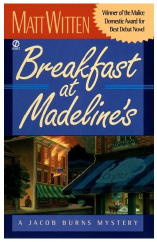
MATT WITTEN – Breakfast at Madeline’s.

Signet, paperback original; 1st printing, May 1999.

   I don’t what the following data signifies, probably nothing, since a book’s sales ranking on Amazon can fluctuate wildly. There are so many books listed there, all in competition with each other, and except for the top 100 or so, all so closely packed together, they should called tied. One sale and the ranking can go up by a million, just like that.

   In any case, as a writer of mystery novels, all of Matt Witten’s books are out of print, but as of tonight (01 May 2009) two of them are doing awfully well. (Relatively speaking, of course. Also note that rankings go down as far as the seven millions.) The fellow doing the sleuthing in all four is a struggling screenwriter living in Sarasota Springs NY named Jacob Burns:

         The Jacob Burns mysteries –

      Breakfast at Madeline’s. Signet, pbo, May 1999. Amazon.com Sales Rank: #172,411
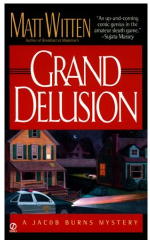
      Grand Delusion. Signet, pbo, Jan 2000. Sales Rank: #1,700,960

MATT WITTEN

      Strange Bedfellows. Signet, pbo, Nov 2000. Sales Rank: #172,444
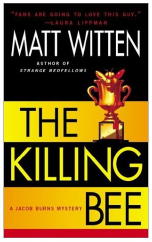
      The Killing Bee. Signet, pbo, Nov 2001. Sales Rank: #1,601,905

MATT WITTEN


   I’ve read only this first one, Breakfast at Madeline’s, so I don’t know what the future holds for Jacob Burns, but I’d better take back the “struggling” part of the description above. He’s struck oil, figuratively speaking, Hollywood style, having just earned a million dollars for doing the screen adaption for an “epic” called Gas, about “deadly fumes seeping out of the earth’s core after an earthquake and threatening to destroy the entire population of San Francisco.”

   One thing I do know, is that there are four books in the series, and there isn’t likely to be any more, not right away anyway. Matt Witten is not a big name on the tip of the general public’s collective tongue, but right now he’s certainly a big man in high-rise Hollywood circles, and that’s what counts. Writing mystery paperback originals is not anything he’s going to need to do for a long time to come:

MATT WITTEN

   Credits on IMDB since 2002: Producer or supervising producer for CSI: Miami, JAG, House M.D., Supernatural, Women’s Murder Club and Medium.

   If you see what I mean. Witten is probably still a nice guy, though, since Jacob Burns, his leading character certainly is, and guys who aren’t so nice would find it, I suspect, awfully hard to create characters who really are. Nice, that is. And still living in Sarasota Springs NY.

   Burns is also happily married, and even though he comes awfully close to straying in this book, he says no and walks away, just before the point of no return. Burns also has two lovable little boys named (well, nicknamed) Gretzy and Babe Ruth, with whom he has a lot of fun, and likewise the same.

   Dead is an old man who hung out at Madeline’s Espresso Bar, a loner who spent most of his time scribbling on paper but known to all of the usual habitues, artsy types all, most of them members of the Sarasota Council Arts Councils and whom seem to get all of the available grant money, but Donald Penn (the dead man), no.

   Just before he died, Penn gave Burns the key to a safety deposit box, and inside? That’s the story, and all of the aforementioned artsy types want to know, too.

   Told in a friendly but wise-ass sort of way, there are probably too many F-words used for this to properly be called a cozy, but it is anyway. At least there’s no graphic violence, as long as you don’t count all of Jacob Burns’ very narrow escapes. There’s only a small amount of actual detection involved, but (come to think of it) there’s enough to form the basis of a pretty good TV series out of Burns’ adventures.

   I wonder if Matt Witten knows anyone who might be interested.

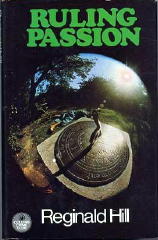
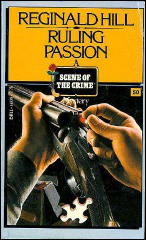
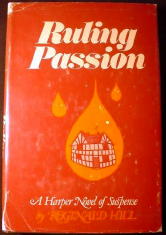
REGINALD HILL – Ruling Passion.   Dell, paperback reprint; Scene of the Crime #51; first printing, August 1982. Hardcover editions: Collins/Crime Club, UK, 1973; Harper & Row, US, 1977. Reprinted many times, both hardcover and soft.

REGINALD HILL Ruling Passion

   Chronologically the third of the Superintendent Dalziel–Sergeant Pascoe novels, of at least 20 and still counting, and only the second that I’ve managed to sit down and read. The first one is lost to memory — to mine, at least. I could hazard a guess as to which one it was, but that’s all it would be, a guess.

   But even so, I could tell that the uneasy rapport (of sorts) between Pascoe and Dalziel was still going through some growing pains in Ruling Passion, the overweight (fat) Dalziel thinking of himself as a mentor, and Pascoe, if indeed a student, often wishing that he had a different master.

   If you’re a long-time reader of the series, feel free to chip in. How has their relationship grown and changed over the years?

   The two cases in Ruling Passion are really both Pascoe’s. The one in which he’s more deeply involved is the more interesting of the pair, and he’s not even the investigating officer. He and Ellie Soper, a friend from college days with whom he’s been recently reunited, getting together with four other friends from that time of their life, shockingly find three of them dead — murdered. Missing, and presumably the killer (although not to Pascoe’s way of thinking) is the husband of one of the three.

REGINALD HILL Ruling Passion

   The other case, the one to which he’s officially been assigned, is that of a series of house break-in’s that have recently taken place while the owners have been away. A fairly innocuous case, but there are signs that — as opposed to the usual burglar — this one will put up a fight if he’s cornered.

   This was a long book in 1973, unusually so, with over 300 pages of small print in the paperback edition I read; while it may run closer to today’s norms, I still found it long. The big question (to mystery readers) is whether or not the two cases are connected. Hill’s books can be difficult to get a good read on, or so I’ve been told, so it’s not so clear cut that the two cases are really one — and I won’t tell you.

   But as possibly an experiment in story-telling technique, what these means is that there are two distinct circles of major characters for the reader to keep track of, and for me in particular, it meant that the case I found less interesting — the one involving the break-in’s — got the short end of the stick, as far as paying the attention I should have to it. (Looking back, though, having finished the book, I think that case number two as well as the characters really WERE less interesting.)

   Hill also has a way of starting scenes somewhat after they’ve begun, hiding what happened at the end of one scene, only to come back to it later and off the beat. While Pascoe does a lot of detective work (Dalziel, while a central figure, stays rather in the background, if that makes sense) I don’t think he (Pascoe) did any detecting: just thinking and putting a lot of jumbled facts together, in a common sense sort of way, sometimes to good advantage and sometimes not.

REGINALD HILL Ruling Passion

   Nor does Pascoe have all the facts, as it turns out. This is a detective novel in which the characters and the relationships between them are as interesting to watch and follow as the unraveling of the case(s) itself/themselves — if not more so.

   Ellie, in particular, not sure in the beginning that she really likes having a policeman as a boy friend, and detesting Dalziel in particular, finds herself warming to him, gradually and very much to her surprise.

   As for Pascoe, he is pleased to learn along the way that he’s been promoted to Inspector. Does that mean that there’s life, he wonders, after Dalziel?

[POSTSCRIPT]   I haven’t mention the long-running BBC TV show based on the series, but obviously, since it did run so long (60 episodes in all, between 1996-2007), it must have had quite a bit going for it. Comments and/or comparisons, anyone?

REVIEWED BY WALTER ALBERT:         


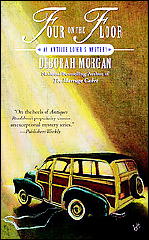
DEBORAH MORGAN – Four on the Floor. Berkley, paperback original; 1st printing, October 2004.

DEBORAH MORGAN

   Jeff Talbot, former FBI agent and now an antiques “picker,” continues to be one of the more personable protagonists in the flourishing antiques mystery sub-genre, although my lack of interest in antique cars (or, indeed, of cars of any kind except as a way of getting from one bookstore to another) kept me from enjoying this as much as earlier entries.

   Well, I didn’t really care about the subjects in a couple of the other entries either, but I figure that Morgan will hit one of my very limited interests one of these years.

   When Jeff goes to pick up his restored vintage automobile, he finds four dead bodies that at first appear to be the result of an industrial accident. Of course, you won’t be surprised to hear that murder is the explanation and Jeff becomes a somewhat unwilling participant in the investigation.

   A second, apparently unrelated case, is a mystery involving his parents, who were killed in an automobile accident when he was quite young, an enigma that suggests they were involved in a crime.

   I must say that the conclusion Jeff leapt to initially here seemed off-the-wall to me, as indeed he is to learn that it was. The truth is more mundane, but a bit more interesting and changes the way he views his family and himself.

   Smooth and entertaining. If you’re into antique cars, you may think this is the cat’s meow.

      The JEFF TALBOT Antique-Lover’s Mystery Series —

1. Death Is a Cabaret. Berkley, pbo, November 2001.

DEBORAH MORGAN

2. The Weedless Widow. Berkley, pbo, October 2002.

3. The Marriage Casket. Berkley, pbo, October 2003.

4. Four on the Floor. Berkley, pbo, October 2004.

5. The Majolica Murders. Berkley, pbo, April 2006.

DEBORAH MORGAN

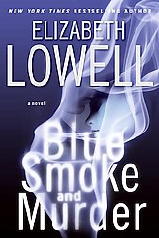
ELIZABETH LOWELL – Blue Smoke and Murder.

Avon, paperback reprint; 1st printing, April 2009. Hardcover edition: William Morrow, June 2008.

   This is one of those long (over 400 pages) novels of romantic suspense that I often buy because they look interesting and end up never reading because they simply look too long and maybe not so interesting after all when I get them home and out of the Barnes & Noble bag.

ELIZABETH LOWELL

   This one’s an exception – by which I do not mean exceptional, but it’s in many ways quite acceptable – because I did start reading it late one evening and didn’t put it down until I’d read about a quarter of the way through. Quite acceptable, that is, until … and I’ll get to that soon.

   The background is what intrigued me at first – that being an inside look at the puffery and other hi-jinks (mostly illegal) that go on in the art business, or at least the auction end of it — which is maybe the most of it, at least as far as the where the money is.

   Hence the “blue smoke” of the title, and there is quite a bit of it, since over 400 pages is quite a large number of pages to fill – but not in an uninteresting fashion, mind you.

   The story: when Jill Breck, who is one of those highly efficient and independent young women who may appear more often in fiction than they do in the real world – she has a degree in art but spends her days as a rapid-river travel guide on the Colorado River – but when she finds herself in a jam, she calls on the highly expensive St. Kilda Consulting agency, whose operatives have figured in several other of Ms Lowell’s earlier books.

   Jill’s great-aunt has died, under semi-suspicious circumstances, as it happens, although the authorities do not think so, but when Jill tries to investigate the value of a painting her great-aunt had had for a long time, she is both poopoohed badly and threatened, also badly.

   It is the latter, the threat, this is, that has her concerned. St. Kilda sends Zach Balfour to act as her bodyguard and to otherwise give her all-around assistance. Bodyguards in novels like these often end up getting closer to the bodies they are guarding than would be professionally correct, and this novel is no exception — but without the abundance of graphic details that may inhabit other books of this same genre.

   From a masculine perspective, I thought Jill would be a good person to learn to known, but that the two leading males were far too shallow: too much macho, not enough finesse. (Truth in Lending: I have neither.)

   Nonetheless, the story is OK, if not more than adequate, until the action begins, which is when it goes off the track entirely. Why let the leading lady go off by herself into such an obvious trap? And what really happened anyway, other than the villain simply going nutso?

   I’d have thought that a much more subtle ending was in order — there should have been a way to get some actual auction action involved. That’s what I was waiting for — not the usual TV stuff with cars, planes, police cars, guns and a dumpy sex ranch with a convenient ravine behind it. I can watch that sort of stuff on the boob tube almost every night in the week.

   When I read a book I want something a tad more clever than this. More than a tad, in fact.

      St. Kilda Consulting

1. Always Time to Die. Morrow, 2005; Avon, 2006.
2. The Wrong Hostage. Morrow, 2006; Avon, 2007.
3. Innocent as Sin. Morrow, 2007; Avon, 2008.

ELIZABETH LOWELL

4. Blue Smoke and Murder. Morrow, 2008; Avon, 2009.

A 1001 MIDNIGHTS Review
by Francis M. Nevins:


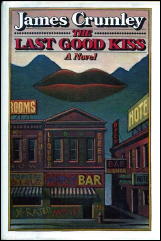
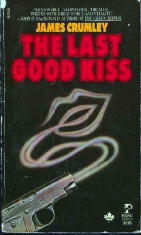
JAMES CRUMLEY – The Last Good Kiss.  Random House, hardcover, 1978.  Reprint paperback: Pocket, 1981.  Vintage Books, trade ppbk, 1988.

   Since the death of Ross Macdonald and on the basis of just three novels, James Crumley has become the foremost living writer of private-eye fiction. Carrying on the Macdonald tradition in which the PI is no longer macho but a man sensitive to human needs, torn by inner pain, and slow to use force, Crumley has moved the genre into the Vietnam and post-Vietnam era.

JAMES CRUMLEY

   His principal setting is not the big city as in Hammett and Chandler nor the affluent suburbs as in Macdonald, but the wilderness and bleak magnificence of western Montana. His prevailing mood is a wacked out empathy with dopers, dropouts, losers, and loonies, the human wreckage of the institutionalized butchery we call the “real world.” Nobility resides in the land, in wild animals, and in a handful of outcasts — psychotic Viet vets; Indians, hippies; rumdums; and love-seekers — who can’t cope with life.

   Crumley’s detective characters have one foot in either camp. Milodragovitch, the protagonist of The Wrong Case (1975) and Dancing Bear (1983), is a cocaine addict and boozer, the child of two suicides, a compulsive womanizer like his wealthy Hemingwayesque father; a man literally marking time until he will turn fifty-two and inherit the family fortune, which his pioneer ancestors legally stole from the Indians.

   Sughrue from The Last Good Kiss has a background as a Nam war criminal and an army spy on domestic dissidents and he’s drinking himself to death by inches. Yet these are two of the purest figures in the history of detective fiction, and the most reverent toward the earth and its creatures.

   Crumley has minimal interest in plot and even less in explanations, but he’s so uncannily skillful with character, language, relationship, and incident that he can afford to throw structure overboard. His books are an accumulation of small, crazy encounters, full of confusion and muddle, disorder and despair, graphic violence and sweetly casual sex, coke snorting and alcohol guzzling, mountain snowscapes and roadside bars.

JAMES CRUMLEY

   When he does have to plot, he tends to borrow from Raymond Chandler. In The Wrong Case, Milodragovitch becomes obsessed by a young woman from Iowa who hires him to find her missing brother, a situation clearly taken from Chandler’s Little Sister (1949).

   The Last Good Kiss, perhaps the best of Crumley’s novels, traps Sughrue among the tormented members of the family of a hugely successful writer, somewhat as Philip Marlowe was trapped in Chandler’s masterpiece, The Long Goodbye (1954).

   In Dancing Bear, which pits Milodragovitch against a multinational corporation dumping toxic waste into the groundwater, the detective interviews a rich old client in a plant-filled solarium just like Marlowe in the first chapter of Chandler’s Big Sleep (1939).

   None of these borrowings matter in the least, for Chandler’s tribute to Dashiell Hammett is no less true of Crumley: He writes scenes so that they seem never to have been written before. What one remembers from The Last Good Kiss is the alcoholic bulldog and the emotionally flayed women and the loneliness and guilt.

   What is most lasting in Dancing Bear is the moment when Milodragovitch finds a time bomb in his car on a wilderness road and tosses it out at the last second into a stream and weeps for the exploded fish that died for him, and dozens of other moments just as powerful.

         ———
   Reprinted with permission from 1001 Midnights, edited by Bill Pronzini & Marcia Muller and published by The Battered Silicon Dispatch Box, 2007.   Copyright © 1986, 2007 by the Pronzini-Muller Family Trust.

   Bibliographic data [updated]:

MILO MILODRAGOVITCH   [James Crumley]

      The Wrong Case. Random House, 1975.
      Dancing Bear. Random House, 1983.
      Border Snakes. Dennis McMillan, 1996. Note: Crumley’s other PI character, C. W. Sughrue, also appears in this book.

JAMES CRUMLEY

      The Final Country. Mysterious Press, 2002.

JAMES CRUMLEY – The Last Good Kiss. Random House, hardcover, 1978. Reprint paperback: Pocket, 1981. Vintage Books, trade ppbk, 1988.

JAMES CRUMLEY

   Most private eyes work out of huge metropolitan cities like New York, Los Angeles and San Francisco. Through the years a handful of others have based their somewhat seedier operations in midwestern population centers such as Chicago, Cleveland and Indianapolis.

   On television this season there is an example of how a Las Vegas detective goes about his business, but you’d have to admit that the glamor and glitter of that particular show is far from typical of mainstream America, and so it remains far more reminiscent of that old stand-by of the pulp magazines, the Hollywood private eye story.

   C. W. Sughrue’s home is Montana, however, and his outlook on life and happiness, or the pursuit thereof, is correspondingly closer to a segment of American demographics long ignored by other authors, obsessed with the bizarre vagaries of life in southern California, for example.

   Rocky Mountain jade. Sughrue is often dirty and unshaven, and a good deal of the time he’s drunk, or close to it, but never obnoxiously so. He’s as much a combination of hippie and redneck as either variety of humanity could ever recognize as possible. He mixes affably with both, and yet he has the same moral obligation to himself that all the great private detectives of literature have had to have hidden inside.

JAMES CRUMLEY

   The story, as it strips his character carefully away in layers, is so intensely revealing that for him to become yet another series creation would be close to pointless.

   As muddled — or even more so — as any in real life, the story begins with a hunt for a famous bar-hopping poet and novelist who takes him on a binge through several states before he’s found, but before he can return home Sughrue is sidetracked into chasing down a runaway girl, lost and not found in the pornographic environs of San Francisco ten years earlier.

   Lives are muddled as well, and revelations are painfully hard to come by. The tale that Crumley has to tell builds slowly and easily into a climax that explodes with all the emotional thrill of a gut-satisfying revenge about to be released.

   Crumley is not the new Hammett. He’s closer to Chandler, if names must be dropped, but in several ways he’s the equal of both, their peer. In fact, he’s that rarity, an authentic rough-hewn original, and they don’t happen along very often.

— Reprinted from The MYSTERY FANcier, Vol. 3, No. 3, May-June 1979 (very slightly revised). This review also appeared earlier in the Hartford Courant.


[UPDATE] 04-14-09.   Some comments from me, thirty years later. I have not re-read the book at any time between then and now.

(1) Here’s the first line of the book, still one of the more memorable ones of hard-boiled crime fiction, in my opinion:

    “When I finally caught up with Abraham Trahearne, he was drinking beer with an alcoholic bulldog named Fireball Roberts in a ramshackle joint just outside of Sonoma, California, drinking the heart right out of a fine spring afternoon.”

(2) I do not know what TV show I was referring to in the second paragraph. I could look it up, but if you know without resorting to a reference book, leave a comment. I have no prizes to offer to the first one to come up with the correct answer, I’m sorry to say.

(3) It is difficult, sometimes, for a reviewer to say exactly why he or she likes a book. It is far more easy to say why you don’t. Reading this review for the first time in the same 30 years, I’m disappointed (but not surprised) that I wasn’t more clear as to what I read that produced this rave review. (In the MYSTERY FANcier version, but not the one in the Courant, you might like to know that I included a rating: A Plus.)

(4) Somewhere in the middle I suggested that it would be difficult for Crumley to continue using C. W. Sughrue as a series character. As we know now, there were other books, but as I recall none of them knocked my socks off as much as this one. I’ll add a complete list below. (It did take 15 years for Crumley to write about Sughrue again.)

(5) At the end of the review, I compared Crumley to both Hammett and Chandler, saying he was their equal. In the long run, while the author and his books are both cult favorites, I don’t think his career was anywhere near as successful (or known today) as I thought it might. Am I wrong about this?

C. W. SUGHRUE.   [James Crumley]

       * The Last Good Kiss. Random House, 1978.
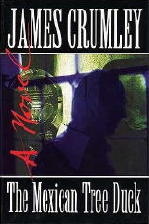
       * The Mexican Tree Duck. Mysterious Press, 1993.

JAMES CRUMLEY

       * Border Snakes. Mysterious Press, 1996. Note: Crumley’s other PI character, Milo Milodragovitch, also appears in this book.
       * The Right Madness. Viking, 2005.

REVIEWED BY WALTER ALBERT:         


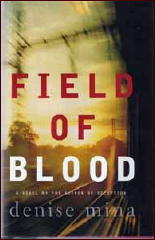
DENISE MINA – Field of Blood. Little, Brown; hardcover, July 2005; Bantam, pb, April 2006.

DENISE MINA

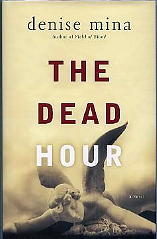
       — The Dead Hour. Little, Brown; hardcover, July 2006; Back Bay Books, trade pb, February 2008.

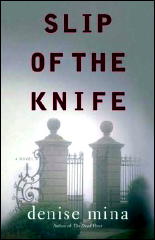
       — Slip of the Knife. Little, Brown; hardcover, Februray 2008. First published as The Last Breath (UK, Bantam Press, 2008).

    I thought that Denise Mina’s Garnethill (Carroll & Graf, 1999) marked the debut of a outstanding crime writer. I was less taken with her stand-alone novel Deception (Little, Brown, 2004). But her new series with neophyte reporter Paddy Meehan has, for me, validated the promise of her early work.

DENISE MINA

    Paddy, a bright young woman obsessed with a negative self-image, establishes a tentative hold on the bottom rung of the journalistic ladder in a small Scottish newspaper in Field of Blood, her first appearance, while in The Dead Hour she has risen to full-time employment on the night shift, hoping to get the story that will gain her the respect of her colleagues, and make her career.

    She lucks into it but with bent cops trying to effect a coverup and both Paddy’s life and career on the line, she follows leads that could prove her suspicions or kill her.

DENISE MINA

    In Slip of the Knife she’s achieved her journalistic ambition with a position as a newspaper columnist that brings her recognition if not the complete personal satisfaction that is the more elusive goal. When she learns that a close friend and sometime lover has been murdered and that she has inherited his scrubby estate, she finds she has also inherited his troubled history and deadly secrets that now threaten her.

    This still developing series has the drive of the early Rankin Rebus outings, with a potentially self-destructive protagonist who rivals Rebus in her ability to court disaster without falling prey to it. She may not ask for the reader’s attention, but the power of her narrative voice demands it.

JOHN W. VANDERCOOK and the BERTRAM LYNCH Mysteries
by David L. Vineyard.


   Between 1933 and 1959 John W(omak) Vandercook (1903-1963) penned four mysteries featuring his remarkably unremarkable sleuth Bertram Lynch and his Watson, Yale history professor Robert Deane.

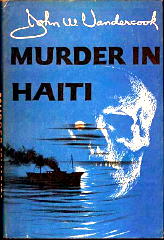
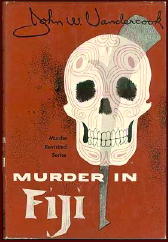
   The books, Murder in Trinidad (1933), Murder in Fiji (1936), Murder in Haiti (1956), and Murder in New Guinea (1959) were all well-written detective tales possessing a sense of adventure sometimes missing in more formal works of mystery fiction.

JOHN W. VANDERCOOK

   And little wonder, as they reflected Vandercook’s life and career as a novelist, biographer (including Black Majesty: The Life of Henri Christophe, King of Haiti, illustrated by noted Edgar Rice Burrough’s illustrator Mahon Blaine), anchorman, and war correspondent.

   You can go to the The Authentic History Center website, and listen to Vandercook’s full December 8, 1941 broadcast on the NBC Red Network of the Pearl Harbor attack. In all, Vandercook wrote more than fourteen volumes of history, biography, and travel including Tom-Tom, Dark Islands, and Caribee Cruise.

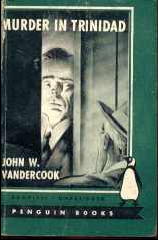
   Bertram Lynch, the hero of the series, is a special agent variously of the British and the League of Nations, who is invariably sent in alone on the most dangerous of assignments. In Murder in Trinidad, for example, Lynch has been sent to Trinidad to break the back of the opium smuggling trade. While traveling to his mission on a tramp steamer he draws the attention of Robert Deane, a Yale History professor who is first attracted to Lynch’s ordinariness, but spots something unique about the quiet middle class Englishman:

    The trouble was that Bertram Lynch was too typical, too unspecial, His ordinariness had a hint in it somewhere of overstudiedness … Then, twenty four hours before we landed, I witnessed an extraordinary thing.

   Lynch’s hat blew off.

   Because of that trivial event and because of his astonishing reaction to it, my curiosity was redoubled… Lynch was standing by the port rail, and I happened to glance toward him just as the ship’s nose was turned and a sudden breeze flicked around the deck. It lifted Lynch’s hat.

   His left hand rose, retrieved the vagrant felt from midair and returned it accurately to its place. One smooth single gesture, and that was all.

   Except for the swift movement of that precise left arm not a single muscle of Lynch’s body or face had stirred. He had not jumped, flung his arms out, even showed that he was startled — nothing. The gesture was as startling, as exquisite in its unruffled accuracy, as the stroke of a cobra’s head.

JOHN W. VANDERCOOK

   Shortly after they land, Deane interrupts an attempt on Lynch’s life by a knife-throwing assassin and witnesses Lynch coolly retrieve the knife and throw it back wounding his assailant — again without ruffling a feather. Now Deane is drawn into the hunt, and when Lynch’s contact is murdered, the mystery deepens.

   Before the game is over, Deane will have indulged in a bit of romance, a murder from the past will have been uncovered, and the two will penetrate a dangerous swamp to uncover the mastermind behind the crimes — the man Lynch has suspected all along, as he shows with a series of deductions worthy of Sherlock Holmes. So ends the first mystery featuring Lynch and Deane.

   Anthony Boucher said: “It’s at once a rousing novel of tropic adventure .. and an unusually tight and satisfying deductive puzzle …”

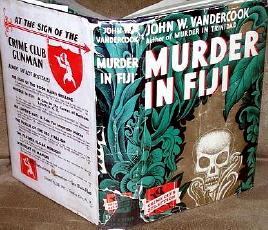
   In Murder in Fiji, Deane is summoned by his friend Lynch who is now an agent of the Permanent Central Board of the League of Nations. A wave of murders has stuck the Fiji islands. After finding dead flies under the eyes of a corpse, witnessing the bizarre murder of a native chief and discovering the connection between the crimes and the sections of the map marked in lavender, Lynch cracks the case, despite a less than cooperative local Chief Constable who asks:

    “I am informed you have made a tentative arrest?”

    “I have already half-killed the prisoner and I categorically guarantee to hang him. If you regard that as a tentative arrest, Colonel, you have been correctly informed.”

   Again Deane romances an attractive and lively lady and Lynch plays a sort of unwanted cupid. The dialogue is sprightly, the action intense, and the mystery more than fair. Overall, another excellent entry in the series with local color, geography, and culture playing major roles in the mystery rather than merely acting as a colorful background. The murder of the native chief is a well handled scene done with a nice understated feeling for the macabre.

   Boucher said of this one: “As before, the local color is well handled, and the relationship of detective Bertram Lynch and his narrator, Robert Deane continues to be a sheer delight.”

JOHN W. VANDERCOOK

   Deane and Lynch don’t return again for almost twenty years, but in 1956’s Murder in Haiti, they are back in action. By now Lynch is a sort of private detective, and Deane joins him on the deluxe yacht Vittoria, owned by a financial czar determined to recover millions in stolen pirate booty.

   But when they reach Haiti, it becomes clear the gold isn’t pirate loot, but more recent in origin: stolen Nazi gold. Lynch as usual plays his cards close to his vest, risks Deane’s neck, and encourages the professor to romance an attractive blonde — all in the name of duty.

   The locations are well-drawn and the action well-conceived. Vandercook knew Haiti particularly well, and it shows in his use of the islands unique history and culture as a background.

   Murder in New Guinea is the last of the Lynch and Deane mysteries. This time Lynch and Deane have been summoned by the Governor of New Guinea to find four explorers who have gone missing among the gold rich Murray Range and it’s dangerous Stone Age tribes.

   Of course things are never that simple, and natives and gold prove the least of the duo’s problems, as they uncover something more valuable than gold and worth killing for in the mountains of New Guinea. They thwart an international plot, and we last see the duo as Lynch takes a much deserved nap after their exertions. Whether Vandercook intended that to be the duo’s last teaming we’ll never know. He died in 1963 before any further entries could be written.

   Barzun and Taylor didn’t care much for the series and were hard on this one in Catalogue of Crime, and to be fair, Vandercook makes one major blunder about a key factor in the novel, but it hardly spoils the pleasure over all.

   Likely the average reader isn’t going to be a geologist so it probably doesn’t matter all that much. Conan Doyle once had Watson identify rabbit bones as human, makes major geographical mistakes about Dartmoor, and has the trains running out of Victoria Station in the wrong direction, but no one seem to care.

   For that matter, Dumas has a street in The Three Musketeers named for one of Napoleon’s marshals. In these matters nits should be picked carefully. If minor matters bother you then this one likely will, but if you can overlook them it’s an enjoyable finale to a good series of books.

JOHN W. VANDERCOOK

   There is nothing revolutionary about the Lynch and Deane novels, but they are all well written, fast paced, and interesting. Vandercook is no threat to Agatha Christie in the spinning of cunning plots, but he writes well, and the books are surprisingly readable, with Lynch an unassuming yet satisfying great detective, and Deane is one of the more intelligent, useful, and likable Watsons in the genre.

   Lynch is a believable figure, cool in action despite his ordinary facade and ruthless when need be. He is well-balanced by the sane and intelligent Deane, who for once proves an able assistant, despite Lynch’s Holmes like insistence on keeping him in the dark.

   Murder in Trinidad, the first entry in the series has a colorful history. It was first filmed in 1934 under the same title; it was directed by Louis King with a script by Seton I. Miller. Nigel Bruce (for once neither blathering nor blundering) played Lynch, and Heather Angel and Victor Jory were featured.

   Deane didn’t appear, at least not as Deane. You can read the review from The New York Times here online. William K. Everson also has much to say in praise of the film in The Detective in Film. Bruce’s slovenly ordinary detective is somewhat mindful of the later Columbo with Peter Falk in both his appearance and appeal.

JOHN W. VANDERCOOK

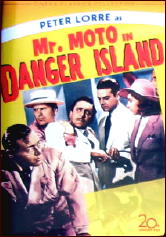
   In 1939 the book was the basis of Mr. Moto on Danger Island, with Peter Lorre subbing for Lynch, Jean Hersholt, and Warren Hymer co-starring, and directed by Herbert Leeds with a script by Peter Milne and story by John Reinhardt and George Brickner. In 1945 the book was again filmed as The Caribbean Mystery, with James Dunn and Sheila Ryan, again minus Lynch and Deane by name.

   The first two Lynch and Deane books were reprinted in hardcover form in the mid-1950s, and two appeared in the US in paperback, and they sold well enough that they aren’t all that rare. They are well worth reading, and if you sometimes would like to get away from the more cozy British country house or village crime without sacrificing the fun of a formal mystery, the books offer thrills, and solid detection.

   Vandercook knew the places he wrote of and his style is clean and painless, all the virtues of a good travel guide to exotic ports, and Lynch and Deane are good company for a little armchair adventuring.

   These aren’t great novels, they won’t change your life or the way you think about the genre, but they deserve to be read and remembered. Among all the mediocre and worse books that fill the genre that’s reason enough to appreciate Lynch and Deane and their creator for their accomplishments.

         Bibliographic data:

Murder in Trinidad. Doubleday Crime Club, hardcover, 1933. William Heinemann, UK, hc, 1934. Hardcover reprint: Macmillan Reissue “Murder Revisited” series, 1955. US paperback reprints: Penguin 552, 1944; Collier, 1961. Also appeared as Star Weekly Complete Novel, Toronto, 1 October 1955.

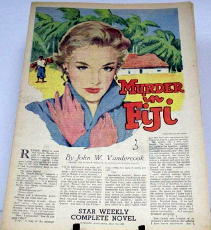
Murder in Fiji. Doubleday Crime Club, hardcover, 1936. William Heinemann, UK, hc, 1936. Hardcover reprint: Macmillan “Murder Revisited” series, 1955. Also appeared as Star Weekly Complete Novel, Toronto, 26 May 1956.

JOHN W. VANDERCOOK

Murder in Haiti. Macmillan, A Cock Robin Mystery, hardcover, 1956. Eyre & Spottiswoode, UK, hc, 1956. Paperback reprint: Avon T-278, 1958, as Out for a Killing. Also appeared in Bestseller Mystery Magazine, February 1961.

Murder in New Guinea. Macmillan, A Cock Robin Mystery, hardcover, 1959. W. H. Allen, UK, hc, 1960.

A Review by MIKE TOONEY:


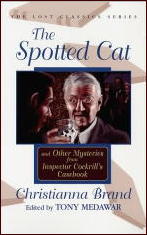
CHRISTIANNA BRAND – The Spotted Cat and Other Mysteries from Inspector Cockrill’s Casebook.  Crippen & Landru, hardcover & trade paperback, November 2002. Edited by Tony Medawar.

CHRISTIANNA BRAND Spotted Cat

   Christianna Brand’s Inspector Cockrill appeared in almost a score of novels, short stories, and even a play, most of which were published in her lifetime. Crippen & Landru have done us a service in preserving all of the short stories that saw publication — and more.

   From the back cover blurb:

INSPECTOR COCKRILL INVESTIGATES

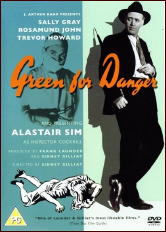
    “Christianna Brand (the pseudonym of Mary Christianna Milne Lewis, 1907-1988) was a supreme mistress of the classic detective story, with twists and turns, and all the clues fairly given to the reader. The wizened, bird-like Inspector Cockrill of the Kent police starred in Green for Danger, one of the greatest detective novels to emerge from World War II, but The Spotted Cat is the first collection of all of the short stories about him. Five of the stories have never previously appeared in a Brand volume, and one of them is published here for the first time. The book also includes a genuine find, a previously unpublished three-act detective drama featuring Cockrill.”

* * * * * * * * * * * * * * *

         CONTENTS:

Introduction (“In and Out of Darkness”) by Tony Medawar: A well researched article about Brand’s life and progress as a writer.

1. “Inspector Cockrill” (1978) by Christianna Brand: The author writes an amusing but affectionate biographical sketch of her most famous character, patterned closely after her father-in-law, a medical doctor.

    “He [Cockie] is not one for the physical details of an investigation: ‘meanwhile his henchmen pursued their ceaseless activities’ writes his creator, not too sure herself exactly what those would be; and he is content to leave fingerprint powder and magnifying glass to the experts, using their findings in a process of elimination, to get down to the nitty-gritty from there on.

    “He has acute powers of observation, certainly; a considerable understanding of human nature, a total integrity and commitment, much wisdom; and as we know a perhaps overlong experience of the criminal world …. Above all — he has patience.” True, “he will have compassion for the guilty”; nevertheless, “he can be forthright and stern …. There is no false sentiment about Chief Inspector Cockrill, none at all.”

2. “After the Event” (from Ellery Queen Mystery Magazine, January 1958 as “Rabbit out of Hat”)

   In a famous play by Shakespeare, Othello strangles his (reputedly) faithless wife; back in the 1920s, an actor playing Othello at the time apparently did the same thing in the lady’s dressing room backstage. An unnamed Great Detective reminisces about the case to a group of acquaintances, among them Inspector Cockrill, who predictably pokes holes in the speaker’s handling of the situation, much to the Great Man’s chagrin. And one should always remember, as Cockrill does, that theatrical people have been known to put on an act ….

   Note: Inspector Cockrill, cracking walnuts and irritating the Great Man, is an armchair detective in this story.

CHRISTIANNA BRAND Spotted Cat

3. “Blood Brothers” (from EQMM: September 1965)

   Brotherly love, like all relationships, seems to have its limits. Two siblings, identical twins, have been with the same girl, competing for her affections; but now, it seems, she is pregnant by one of them. The situation is further complicated by several factors: The girl knows that one of the brothers has killed a small boy in a hit-and-run; she is also married to a huge brute doing time in one of HM’s prisons but due soon for release; and one of the siblings harbors enough hatred to let the other take the fall for first-degree murder.

   Inspector Cockrill — who enters in the last third of the story — simply lets things take their natural and inevitable course, as David and Jonathan rapidly degenerate into Cain and Abel … with a twist.

   Note: Instead of being told in the third person, this story is narrated by one of the brothers.

CHRISTIANNA BRAND Spotted Cat

4. “The Hornet’s Nest” (from EQMM: May 1967 as “Twist for Twist”)

   When wealthy Cyrus Caxton — a nasty piece of work, that one — does a Brodie face first into his half-eaten peach, no one of his acquaintance is moved to shed a tear, save his attractive wife. Inspector Cockrill is called in and confronts a fine set of likely suspects; in the end, the Inspector, Ellery Queen-like, has proposed two plausible solutions before pouncing on a third, actual one.

   Elizabeth comments on Cockie’s method: “He’s — he’s sort of teasing us; needling us, trying to make us say something.” Presciently, the Inspector early in his investigation remarks: “There has been a plan here, doctor: no simple matter of a lick of poison scraped out of a fortuitous tin, smeared on to a fortuitous peach-in-liqueur; but a very elaborate, deep-laid, long-thought-out, absolutely sure-fire plan.”

5. “Poison in the Cup” (from EQMM: February 1969)

   CASE HISTORY: Stella Harrison is a small-town doctor’s wife more than a little bored with her lot in life; her husband Richard, a painfully honest individual, seems oblivious to her incipient disaffection — and equally unaware of her secret love for his partner, Frederick Graham. A nurse at the hospital, Ann Kelly, however, makes no secret of her undying love for Stella’s husband… Ann makes a fatal mistake, though, when she decides to stage a bogus suicide attempt in Dr. Harrison’s surgery …. DIAGNOSIS: Murder. PROGNOSIS: Life in prison for a killer who remembers every detail but one ….

   Note: The murderer’s identity is never in doubt; we see the crime committed. The interest lies in how Chief Inspector Cockrill, a la TV’s Columbo, will trip up the perp — because this killer uses the truth as a cover.

6. “The Telephone Call” (from EQMM: January 1973 as “The Last Short Story”)

   The best-laid plans do often go off the tracks, don’t they? A young man short of money conceives an intricate plot to acquire a lot of it in a hurry; his girlfriend half-jokingly suggests it: “You’ll have to murder your rich Aunt Ellen”; and he improves it: “Yes, and let Cousin Peter swing for it; if he did, I’d scoop the lot.”

   And so he carefully begins building two alibis, one for himself and a negative one for the hapless Peter… And it all works beautifully — except for one thing, and you don’t have to be Detective Inspector Cockrill to figure it out.

   Note: The bulk of this story is told in the form of a written confession.

7. “The Kissing Cousin” (from Woman: June 2, 1973)

   Cranky old Aunt Adela has millions, but true to form she is parsimonious and secretive about her wealth; her niece Franca doesn’t really care if she inherits — but there’s someone she knows who is greatly interested in the old lady’s money, someone willing to kill for it. When Aunt Adela is found dead, her house ransacked for a missing will, Chief Inspector Cockrill zeroes in on Franca: “You inherit,” he says. “And you hold the only key to the door.” But the killer already has Franca marked for murder, and knows as well the secret Keeper, the cowardly mastiff, is harboring ….

   Note: It seems Cockie doesn’t really solve this one, and takes no active part in apprehending the murderer; he is a secondary character here.

CHRISTIANNA BRAND Spotted Cat

8. “The Rocking-Chair” (from The Saint Magazine: August 1984)

   Taking a break from a village fete “on a boiling hot afternoon” to have “a little booze-up”, the Duchess of St. Martha’s Island retires to her castle with Miss Maud Trumble, “rich and famous author of dozens of really quite terrible books”, and Chief Inspector Cockrill.

   Seemingly gripped by a feeling of guilt, Miss Trumble, “mildly squiffy,” relates her involvement in the unresolved Case of the Three Dead Ladies: “three women lying dead, spread out like a trefoil clover-leaf, their poor heads forming the centre point…” Cockie and the Duchess both prove able armchair detectives by “solving” this fifteen-year-old case.

    “It was like a detective story, thought the Duchess, where the clues are placed not so much squarely before the reader as slightly obliquely, so that they come out as not quite what in fact they are.” Just so.

CHRISTIANNA BRAND Spotted Cat

9. “The Man on the Roof” (from EQMM: October 1984)

   English village life is normally uneventful, but not today: The much-despised and suicidal Duke of Hawksmere seems at long last to have followed through with his oft-delayed promise to do himself in: “a good, straight-forward suicide,” thinks Chief Inspector Cockrill, “heralded by the gentleman himself….”

   If only it were that simple. The dearly deceased, consistent with the burdensome pattern of his life, has managed to die under most perplexing circumstances that suggest he was murdered; to wit, he seems to have expired in a classic “locked room.”

   Cockie, in frustration, says: “The locked room is the lodge, locked in, as it were in all that untrodden snow. A man dead in the lodge, very recently dead, death instantaneous, from a gun-shot wound at close range. And the mystery is very easy to state and not at all easy to answer. The mystery is — where is the gun? — because it isn’t lying there close to his right hand where it ought to be, and it isn’t anywhere else in the lodge and it isn’t anywhere outside in all the snow.”

   As in “The Hornet’s Nest,” Cockie devises two plausible scenarios — but the actual solution, one not of his devising, comes as an exasperating — and exasperatingly simple — surprise to both him and the unsuspecting reader.

CHRISTIANNA BRAND Spotted Cat

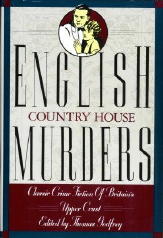
   Note: “The Man on the Roof” can also be found in Thomas Godfrey’s English Country House Murders, 1989.

10. “Alleybi” (“This story, published in this volume for the first time, was probably written in the mid-1950s.”)

   A short-short story (one and a half pages) that should serve as a warning to all investigating officers not to get tunnel vision whenever someone’s alibi is in doubt.

11. “The Spotted Cat: A Play in Three Acts” (“Previously unpublished; written in 1954-1955. Brand considered turning it into a novel but abandoned the idea.”)

   Things aren’t going particularly well for barrister Graham Frere these days: His legal prowess is failing, he’s experiencing problems with alcohol, and he is beginning to think he’s going crazy.

   At first he doesn’t realize that not all of his troubles are of his own making, that people close to him — under his very roof — are subtly pushing him towards madness, or possibly suicide; they have already murdered once, however, so even that option isn’t off the table. The conspirators themselves share a love-hate relationship, as evidenced by one telling the other:

    “We’re bound together for ever now, you and I.”

    “Nothing binds us.”

    “Fear binds us.”

    “It doesn’t bind me.”

CHRISTIANNA BRAND Spotted Cat

    and: “When I look at you — coldly and sanely — I’d as soon put my love and trust in a cobra.”

    Nice people! But the conspiracy falters when the worm turns and murder is prescribed ….

   This play is a mixture of Gaslight and Double Indemnity with just a dash of Patricia Highsmith. Brand spoofs herself in one exchange:

    “London Particular was a book — that woman who wrote Green for Danger.”

    “I know it was. I couldn’t read a word of it.”

*****

   Despite a few typos (e.g., “does” for “dose,” “desert” for “dessert”) and some problematic punctuation, this book can be highly recommended.

« Previous PageNext Page »