Characters


REVIEWED BY BARRY GARDNER:


STEPHEN SOLOMITA – Damaged Goods. Stanley Moodrow #6. Scribner, hardcover, 1996.

   Solomita writes New York City crime novels that are as down and dirty as you’re likely to find. His protagonist, Stanley Moodrow, was a Big Apple cop for the first few books, but is now a private eye of sorts. At nearly 60 he’s still a pretty bad dude, too.

   Jilly Sappone was one of the wiseguys who was a little too much of a mad dog for them, even, and they allowed him to be sent to prison. His wife testified against him, and he hasn’t forgiven them or her. Now he’s been paroled after 14 long ones, still crazy after all these years, and he starts off by putting his wife in the hospital with a beating and then kidnapping her child by another man.

   A woman’s organization comes to Moodrow for help in finding the child before Sappone kills her, and soon he’s tracking through his old East Side haunts in hot pursuit. Jilly’s just starting, though, and the dying’s about to begin.

   I keep reading these because I like Stanley Moodrow. He’s violent and profane — which is a pretty good description of the books — but still one of the good guys. Solomita does really good over-the-top psychos and hoods, and peoples his stories with characters that you wouldn’t want to know but are fun to read about These aren’t for the delicate of sensibilities or the faint of heart, but I like ’em. Sometimes, anyway.

— Reprinted from Ah Sweet Mysteries #22, November 1995


      The Stanley Moodrow series

1. A Twist of the Knife (1988)
2. Force of Nature (1989)
3. Forced Entry (1990)
4. Bad to the Bone (1991)
5. A Piece of the Action (1992)
6. Damaged Goods (1996)

REVIEWED BY DOUG GREENE:

   
NIGEL MORLAND – Mrs. Pym of Scotland Yard. Mrs. Palmyra Pym #13. Vallancey, UK, hardcover, 1946. No US edition.

   In his anthology The Female of the Species, Ellery Queen disapprovingly quotes some unnamed “students of the genre” to the effect that “Edgar Wallace never wrote a first-rate story.” Whatever the case about Wallace, I think that the criticism is valid for Wallace’s friend and follower Nigel Morland. I have yet to read a memorable story by Morland, but he did maintain a high level of competence — despite having written one novel that received attention in Bill Pronzini’s Gun in Cheek.
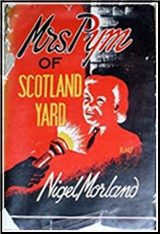
   Mrs. Pym of Scotland Yard   contains nine short stories in very small type — Vallencey press seems to have continued the “raid” pamphlets in cloth, and with the post-war paper shortage Vallencey crammed as many words as possible onto each page.

   The first two stories, though not first rate, are quite clever. In “The Perfect Valet,” Mrs. Palmyra Pym (Scotland Yard’s only woman Inspector) uses her knowledge of bath-salts and syphons to solve a case of drowning. “The Rotherhithe Miracle” explains how there can be constant sounds of commotion in a room occupied only by a paralyzed woman. The other tales are less original.

   What is most interesting about Mrs. Pym of Scotland Yard is Morland’s contribution to the concept of a female detective. In the 19th and early 20th centuries, the idea that a woman would actually lower herself to become a professional  sleuth was almost unthinkable.

   Many authors, therefore, said that their female detectives had been forced into that occupation by family reverses or by unfair accusations against a husband; certainly they wouldn’t have detected if they had any other choice. In this pattern, we have among others Mrs. Paschal (1864), Lady Molly (1910), and Constance Dunlap (1916).

   The main exception is Fergus Hume’s Hagar Stanley, the gypsy detective (1898). The authors emphasize the femininity of their detectives, as the cases are solved by intuition or, as in F. Tennyson Jesse’s Solange Stories (1931), by an innate feeling for the presence of evil. (Not even Jesse’s writing ability masks the silliness of that concept.)

   Much more convincing and perhaps the best woman detective of all time is Agatha Christie’s Miss Marple (1930). All of these sleuths are distinguished by, as Mrs, Paschal’s anonymous chronicler put it, their “ladylike conduct.” Mrs. Pym represents the other extreme from these feminine ferrets, intuitive investigators, and ladylike Lecoqs.

   When Nigel Morland, with Edgar Wallace’s assistance, invented Pym around 1930, the detective was first a “he,” one “Ignatius Pym.” “Ignatius” became “Palmyra,” but his/her masculine characteristics still predominated. Although Morland mentions her “dormant maternal instincts” and “feminine illogicality,” it is difficult to find any stereotypical womanly characteristics in her actions.

   She is “as hard as nails” and “her tongue’s rough on both sides.” She uses such phrases as ”Let’s grill Ma Forrest; she looks like a talker,” and when she is disgusted she “snorts malevolently.” She obtains a confession by threats of torture, and she allows an innocent suspect to be executed because she is certain that he is guilty of unpunished crimes. It is difficult to know why Torquemada in The Observer described her as “that perfection of a woman.”

   In his article about Mrs. Pym in Murderess Ink, Morland describes “her often ruthless ways” as “a curious sign-post to a slowly emerging woman’s lib.” Certainly Mrs. Pym needs no assertiveness training.

   Mrs, Pym is indeed an important development toward the modern female sleuth, but her aping of men seems to me less a signpost than a detour. The current direction is toward capable women who have not given up all womanliness, by whatever definition.In the traditional detective story we have finally gotten the proper balance in P.D. James’ Cordelia Gray, and in the private-eye story a similar balance is maintained in Sara Paretsky’s V. I. Warshawski. Neither of these sleuths would be cowed by Mrs. Pym.

– Reprinted from The Poison Pen, Volume 6, Number 1 (Spring 1984). Permission granted by Doug Greene.


   Contents (alphabetically) —

The Curious Death
The Golden West
The Hungry Duchess
The Missing Forger
The Obvious Flaw
The Perfect Valet
The Rotherhithe Miracle
The Sorrowful Duke
The Stolen Heart

REVIEWED BY DOUG GREENE:

   
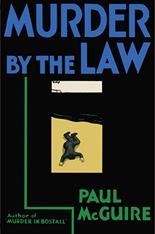
PAUL McGUIRE – Murder by the Law. Supt. Fillinger #2. Skeffington, UK, hardcover, 1932. No US edition.

TECH DAVIS

   Paul McGuire is known almost exclusively for his classic, A Funeral in Eden, taking place on an imaginary island. Many of his other novels, set in more prosaic locales, deserve better than the almost complete neglect which has been their fate.

   A case in point is Murder by the Law. The crime – -murder of a thoroughly detestable author – is standard, but the book is enlivened by the setting, the character of the detective, and McGuire’s sardonic writing style, The events take place at a meeting of The New Health and Eugenist Conference, and McGuire so thoroughly punctures the movement that even R. Austin Freeman, had he read the book, might have had second thoughts about Eugenics.

   The narrator, Richard Tibbetts, wonders whether a convinced Eugenist might have killed Harold Ambrose simply because the world would be a better place without him. There are, of course, additional suspects, as Ambrose was writing a novel which would embarrass every woman with whom be had an affair.

   The case is competently handled by Superintendent Fillinger, McGuire’s series detective who also appeared in at least two other books, Daylight Murder and The Tower Mystery (which Tibbetts calls “an odd, queer volume”). Fillinger, at more than 400 pounds, may put even Dr. Fell and Nero Wolfe almost literally in the shade. But he is not so eccentric as those worthies. The investigation is straightforward. And it is not until the final four lines that the murderer is revealed.

– Reprinted from The Poison Pen, Volume 6, Number 3 (Fall 1985). Permission granted by Doug Greene.

   
Bibliographic Update: As it so happens, there are now known to be seven recorded adventures in Fillinger’s case file, to wit:

Three Dead Men. Skeffington 1931.
Murder by the Law. Skeffington 1932.
The Tower Mystery. Skeffington 1932.
Death Fugue. Skeffington 1933.
There Sits Death. Skeffington 1933.
Daylight Murder. Skeffington 1934.
Murder in Haste. Skeffington 1934.

   
   As for Australian-born Paul McGuire (1903-1978), he has sixteen works of mystery and detection listed in Hubin, all between 1931-1940, including the seven above. Five of his novels have been published in the US, but as noted above, not this one.

   And, not surprisingly, while Al Hubin reviewed this one here earlier on this blog, there is not a single copy to be found offered for sale. But also by Paul McGuire and  previously reviewed here is Murder in Bostall (US: The Black Rose Murder), this time by Bill Deeck.

REVIEWED BY BARRY GARDNER:


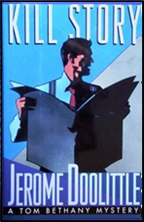
JEROME DOOLITTLE – Kill Story. Tom Bethany #6. Pocket Books, hardcover, 1995; paperback, 1996.

   Doolittle had told me in a letter that this was going to be called Spread Eagle. but said at EyeCon that Pocket Books had decided the original title might be offensive. He didn’t really understand why, and neither do I. Oh, well.

   Tom Bethany lives in Cambridge, Massachusetts, and makes his living doing … well, sort of whatever comes to hand. He’s managed to extract himself from all the databases most of us are in, and officially he doesn’t really exist But he’s real, and an old friend asks for his help when one of her old friends is found dead, an apparent suicide.

   She’s not sure it is, but if it was feels the woman was driven to it by the newspaper publishing baron who bought her newspaper, and then fired many of her old friends. The man is known as “the Cobra” in the business, and not because of his looks. Bethany doesn’t know if there’s anything there, but a friend’s a friend and he agrees to poke around in the rubble.

   I think Doolittle is one of consistently best storytellers in the business. Sometimes his plots requite a little suspension of disbelief, but never more than I’ve been able to handle. Bethany, the ex-college wrestler and ex-government pilot in Southeast Asia, is simply a tremendously appealing (and irreverent) character. The first person narration is smooth and witty, but not burdened with a wisecrack every other sentence.

   Doolittle’s books are not “heavy,” and are notably free of angst. What they are is entertaining, and readable, and very much worth your time and mine.

— Reprinted from Ah Sweet Mysteries #21, August-September 1995

   
      The Tom Bethany series

1. Body Scissors (1990)
2. Strangle Hold (1991)

3. Bear Hug (1992)
4. Head Lock (1993)

5. Half Nelson (1994)
6. Kill Story (1995)

IT IS PURELY MY OPINION
Reviews by L. J. Roberts


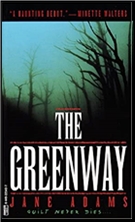
JANE ADAMS – The Greenway. Det. Inspector Mike Croft #1. Macmillan, UK, hardcover, 1995. Fawcett Gold Medal, US, paperback, 1997. Setting: Contemporary England.

   Cassie Maltham’s cousin disappeared while they were taking a short-cut home through the Greenway, an ancient passageway in Norfolk. Cassie couldn’t remember what had happened, but has suffered from depression and nightmares ever since. Now, 20 years later, Cassie has returned to Norfolk trying to let go of the past. But when another young girl disappears, it draws Cassie back into her nightmares. Detective Inspector Mike Croft, through the urging of Sergeant Bill Enfield, elicits the help of John Tynan, the retired detective who investigated the disappearance of Cassie’s cousin.

   Ms. Adams has written a haunting, yet very human book about guilt and loss. Cassie suffers survivor’s guilt; why did her cousin disappear rather than she. Croft knows the anguish of losing a child, although his son had been killed in a hit-and-run. The story was absorbing with good twists along the way and touches of the supernatural. I shall definitely read more of Ms. Adams’ work.

Rating: Good Plus

— Reprinted from the primary Mystery*File website, January 2006.


      The Det. Inspector Mike Croft series –

1. The Greenway (1995)
2. Cast the First Stone (1996) aka The Secrets
3. Fade to Grey (1998) aka Their Final Moments / Final Frame
4. The Liar (2019)

IT IS PURELY MY OPINION
Reviews by L. J. Roberts


PAUL ADAM – Sleeper. Gianni Castiglione #1. Time Warner, UK, paperback, 2005. Published in the US as The Rainaldi Quartet (St. Martin’s, hardcover, 2006; Felony & Mayhem, paperback, 2007).

   Giovanni “Gianni” Castiglioni is a luthier – a violin maker – at whose home his friends – a policeman, Guastafeste, a priest, Father Arrigh, and a fellow luthier, Rainaldi – gather each month as an informal string quartet. After one of their sessions, Guastafeste and Gianni find Rainaldi murdered in his studio nearby. His widow tells them he was searching for “The Messiah’s Sister,” the twin to a perfect, unplayed, priceless violin made by Stradivari. Gianni is asked by Guastafeste to help in the investigation.

   This book is being released in hardcover by St. Martin’s as The Rainaldi Quartet in February 2006. No matter the title, I thoroughly enjoyed this book. The character of Gianni, the supporting characters and the settings in Italy were well done. The killer, and the motive, weren’t ones I anticipated. But it was the history of violins and violin making I found fascinating. The information enhanced, rather than detracted, from the story. If this is an example of Mr. Adam’s writing, I should definitely read another book by him.

Rating: Good Plus

— Reprinted from the primary Mystery*File website, January 2006.


      The Gianni Castiglione series

1. Sleeper (2004) aka The Rainaldi Quartet
2. Paganini’s Ghost (2010)
3. The Hardanger Riddle (2019)The Gianni Castiglione series —

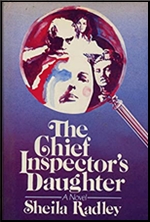
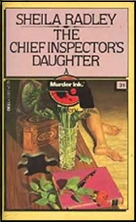
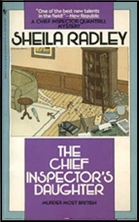
SHEILA RADLEY – The Chief Inspector’s Daughter. Inspector Quantrill #2. Scribner’s, US, hardcover, 1980. Constable, UK, hardcover 1981. Dell / Murder Ink, paperback, 1981. Bantam, paperback, 1987. Felony & Mayhem, trade paperback, 2007.

   The inspector’s name is Quantrill, and you may have met him before in Death in the Morning. That one I haven’t read myself, but I’m going to. This one’s a good one.

   To tell you the truth, though, I wasn’t so sure it was going to be when I started. The first couple of chapters are not all that promising. Stories involving British policemen and their dreary home lives I find more-or-less depressing. A little bit of it, at least, usually goes a long way.

   Apparently, vital communications between Quantrill and his wife have been gradually breaking down over the years, and to compound the problem, their younger daughter has just arrived home from London after a break-up with her lover. Nothing like a good case of murder to bring a family together, hmmm?

   But that’s just what it does. Daughter Alison takes a job as an assistant to Jasmine Woods, a well-known writer of romantic fiction. When Alison finds her employer brutally murdered one morning, she goes into shock, and then she disappears before revealing the important clue she knows.

   Some of the best clues in this story are provided by the simple expedient of omission, however, and you as reader are going to have to stay on your toes to stay ahead of the game. The plotting is rather cleverly done, but Sheila Radley does play fair. And you really do have good chance of beating Quantrill to the killer.

   I liked the ending. While it has nothing to do with the mystery, per se, I think by story’s end the characters have indeed become reasonable facsimiles of human beings for it to considered on of the better cliffhanger finales I’ve read in quite some time.

Rating: B plus.

–Very slightly revised from The MYSTERY FANcier, Vol. 5, No. 2, March/April 1981.


      The Chief Inspector Douglas Quantrill series —

Death and the Maiden (n.) H. Hamilton 1978.
The Chief Inspector’s Daughter (n.) Constable 1981.
A Talent for Destruction (n.) Constable 1982.
Blood on the Happy Highway (n.) Constable 1983.
Fate Worse Than Death (n.) Constable 1985.
Who Saw Him Die? (n.) Constable 1987.
This Way Out (n.) Constable 1989.
Cross My Heart and Hope to Die (n.) Constable 1992.
Fair Game (n.) Constable 1994.

REVIEWED BY DOUG GREENE:


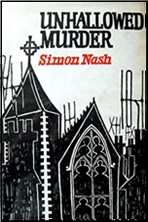
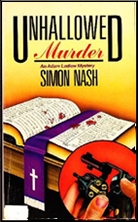
SIMON NASH – Unhallowed Murder. Adam Ludlow #5. Geoffrey Bles, UK, hardcover, 1966. Roy Publishers, US, hardcover, 1966. Perennial P758, US, paperback, 1985.

   In 1951, Edmund Crispin and his detective don, Gervase Fen, disappeared from the scene (except for an occasional short story) for more than 25 years. But at least for the early 1960S, their places were more than adequately filled by Simon Nash, a pseudonym of Raymond Chapman, and his detective don Adam Ludlow.

   Indeed, Ludlow is basically a new incarnation of Fen, with the same curiosity, the same humor, the same fund of miscellaneous (but literate) information. But imitation is not necessarily bad, especially when it’s done by a fine stylist and plotmonger like Nash. In short, this, the fifth and apparently final book by Nash, is very good indeed. As the title indicates, the setting is a church, whose vicar proceeds to get murdered. There are plenty of possible motives:

   Is someone after the vicar’s accumulation of rare books (which he absentmindedly hid?) Is it significant that the parish council is planning to throw a working family out of a house to be occupied by the curate? Are the desecrations of the altar the responsibility of a group of Satanists.? Did low churchmen, fearing that the parish is “going over to Rome” commit the murder?

   Much of the book is filled with humorous descriptions of parish life, including the high churchmen of the Guild of Saint Cyprian and Severus (“Ah my friend, when will the sweet savour of incense again be sent up in every parish church throughout the land”) opposed by the League for Confuting and Suppressing the Errors of the Tractarians (“Things haven’t been the same since the Roman hierarchy was restored”).

   The detective problem itself is well-handled, but whether the “Romanizers” or the “zealous heretics” would be more pleased with the solution is a moot point.

– Reprinted from The Poison Pen, Volume 4, Number 2 (April, 1981). Permission granted by Doug Greene.


      The Adam Ludlow series —

Dead of a Counterplot (n.) Bles 1962.
Killed by Scandal (n.) Bles 1962 .
Death Over Deep Water (n.) Bles 1963.
Dead Woman’s Ditch (n.) Bles 1964.
Unhallowed Murder (n.) Bles 1966.

REVIEWED BY DOUG GREENE:


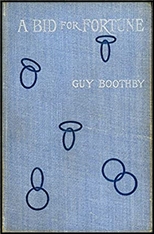
GUY BOOTHBY – A Bid for Fortune. Dr. Nikola #1.  Appleton, hardcover, 1895. Published earlier in the UK by Ward Lock, hardcover, 1895. Reprinted as Enter Dr. Nikola. Newcastle, UK, paperback, 1975. Later reprinted by Oxford University Press, US, paperback, 1996; then many POD editions. Silent film: Unity-Super, 1917.

   Searching for books is often a frustrating task, not merely because (as we all know) some books simply won’t be found but also because those that are located often turn out to be disappointments. In my experience, many highly touted classics have not lived up to their publicity. That is not the case, I’m glad to report, with Guy Boothby’s first novel about Dr. Nikola.

   I leave it to others to discover whether Dr. Nikola is fiction’s first arch-criminal (is Moriarty in the same category?), but it seems likely that the Nikola books form the first sustained series featuring such a nefarious malefactor. A Bid for Fortune has coincidences galore and occasional purple prose (“Oh, my girlie! my poor little girlie! what have I brought you to through my. obstinacy?”), but it is generally well-told and well-plotted. Boothby keeps the reader interested not by overwhelming use of violence – indeed, I don’t recall a single murder in it – but by a sense of mystery.

   The book opens with Dr. Nikola meeting 3 co-conspirators who plan, for an unnamed reason and by unspecified means, to ruin a man named Wetherell: “My toils are closing on you … you will find yourself being slowly but surely ground into powder. Then you may be sorry you thought fit to baulk Dr. Nikola.” The scene then shifts to Australia, to young Dick Hatteras who has made a fortune pearling and who plans to visit his ancestral home in England. He falls in love with Wetherell’s daughter, and on shipboard they pledge their troth (as they used to do; nowadays they just shack up).

   Once in London, his fiancee is forced to 1eave him; he meets Dr. Nikola, and befriends a young nobleman whom he agrees to guide to Australia. The plot becomes steadily more complicated, as Nikola’s minions kidnap Hatteras and the young Lord in Cairo. Eventually, they return to Australia, and rescue all in distress, but Dr. Nikola obtains what he has sought from Wetherell. Nevertheless, the veil of mystery remains even in the final paragraph: “What gigantic coup [Nikola] intends to accomplish … is beyond my power to tell.”

   Boothby, an Australian, had not only a sense of mystery but also a talent for description of 19th century England, Australia and Egypt. A Bid for Fortune is an excellent example of leisurely but engrossing fin de siecle storytelling.

– Reprinted from The Poison Pen, Volume 4, Number 2 (April, 1981). Permission granted by Doug Greene.

   
      The Dr. Nikola series

A Bid for Fortune; or, Dr. Nikola’s Vendetta. Ward 1895.
Doctor Nikola. Ward 1896.
The Lust of Hate. Ward 1898.
Dr. Nikola’s Experiment. Hodder 1899.
Farewell Nikola. Ward 1901.

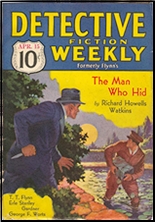
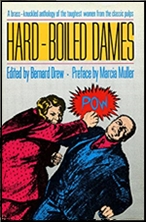
T. T. FLYNN “The Deadly Orchid.” Trixie Meehan & Mike Harris #1. First published in Detective Fiction Weekly, April 15, 1933. Reprinted in The Pulps, edited by Tony Goldstone (Chelsea House, hardcover, 1970) and Hard-Boiled Dames, edited by Bernard Drew (St. Martin’s Press, hardcover, 1986).

   I have written about the bickering pair of PI’s by the name of Trixie Meehan and Mike Harris before. You can find my review of “Barred Doors,” the seventh in the series, here. To recap quickly, though, they both work for the Blaine Agency and are always casting barbs at each other – in a friendly way, you know —  or at least I think so.

   In this, their first appearance, they go undercover in a plush hotel disguised as husband and wife (but in a suite of adjoining rooms, with a lock on the door between them). With the benefit of an unlimited expense account, they also are pretending to be a fabulously wealthy pair of Texans (oil money), and living it up greatly.

   Their target: a incredulously beautiful wisp of a girl, nicknamed the Orchid, who is also a notorious blackmailer who has also been known to kill her victims when things don’t work out perfectly with one of her schemes.

   Mike is the one who tells the story and the one who works up the plan to discover where the love letters she is holding over her latest victim are located, but Trixie is no slouch either when she is needed to take part in the action.

   There’s not a lot of depth to the tale, but it’s smoothly told, in something of a screwball story sort of way. Somebody really ought to put together a complete collection of their adventures together.
   

      The Mike Harris & Trixie Meehan stories –

The Deadly Orchid (ss) Detective Fiction Weekly Apr 15 1933
Falling Death (nv) Detective Fiction Weekly Oct 28 1933
Murder’s Masquerade (nv) Detective Fiction Weekly Mar 31 1934
The Yin Shee Dragon (na) Detective Fiction Weekly Sep 29 1934
Murder Harbor (nv) Detective Fiction Weekly Dec 1 1934
The City Hall Murders (na) Detective Fiction Weekly Mar 23 1935
Barred Doors (na) Detective Fiction Weekly May 18 1935
Nitro! Nitro! (na) Detective Fiction Weekly Apr 4 1936
The Letters and the Law (na) Detective Fiction Weekly Jun 27 1936
Abbey of the Damned (na) Detective Fiction Weekly Oct 30 1937
Murder Circus (na) Detective Fiction Weekly May 21 1938
The Secret of the Swamp (na) Detective Fiction Weekly Feb 25 1939
Brother Murder (na) Detective Fiction Weekly Dec 2 1939
Mike Finds Trouble (sl) Detective Fiction Weekly Aug 17 1940, etc.
Build Up for Murder (nv) Detective Fiction Aug 20 1941
Killer in the Clouds (ss) Detective Tales Mar 1951


« Previous PageNext Page »