Characters


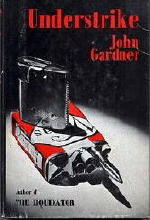
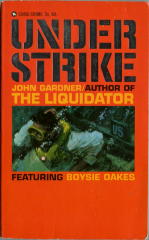
JOHN GARDNER – Understrike.

Corgi; UK paperback reprint, 1966. Hardcover editions: Muller, UK, 1965; Viking, US, 1965. US paperback reprint: Fawcett Crest d1126, 1968

JOHN GARDNER Understrike

   I didn’t purchase too many paperbacks at last weekend’s Windy City show, and only four pulp magazines. Most of the paperbacks I bought came from one dealer very early on, the lot consisting of British espionage thrillers from the 1960s and 70s and written by authors such as James Leasor, James Mayo, Colin Forbes, Alan Williams and so on, all of them pretty much hard to find in this country.

   The author most highly represented in this assortment was perhaps also the one most known in the US, John Gardner, his reputation here most likely based on the James Bond books he wrote in 1980s and early 90s. For a complete checklist of his novels and story collections, see Jim Doherty’s obituary for him here when he died in August 2007.

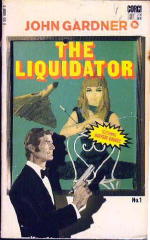
      Gardner’s earlier series character was a fellow by the name of Boysie Oakes, a most reluctant spy extraordinaire, and I’ll get back to him in a moment. First, however, here’s a chronological list of the novel length fiction that he appeared in:

BOYSIE OAKES – The Novels.

      o The Liquidator. Muller, 1964; Viking, 1964. US pb: Fawcett Crest d856, 1965.

JOHN GARDNER Understrike

      o Understrike. Muller, 1965; Viking, 1965. US pb: Crest, 1968.
      o Amber Nine. Muller. 1966; Viking, 1966. US pb: Crest R1173, 1968.
      o Madrigal. Muller, 1967; Viking, 1968. US pb: Berkley, 1969.
      o Founder Member. Muller, 1969. No US edition.
      o Traitor’s Exit. Muller, 1970. No US edition.
      o The Airline Pirates. Hodder, 1970; U.S. title: Air Apparent, Putnam, 1971. US pb: Berkley, 1973.
      o A Killer for a Song. Hodder, 1975. No US edition.

JOHN GARDNER Understrike

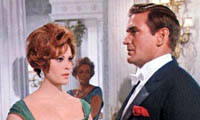
   The first of these was made into a film starring Rod Taylor as Boysie, and Jill St. John as his leading lady. The comments on IMDB are fairly positive, and in fact Variety says “Peter Yeldham’s screenplay and Jack Cardiff’s direction combine plenty of action and some crisp wisecracking,” but it doesn’t appear to be available on DVD. I’ll have to see if I can’t track down a copy, maybe on VHS.

   The gimmick in the Boysie Oakes books, as I alluded to earlier, is that as a spy, he’s supposedly inept, a coward who’s wracked with fear and stomach cramps at the thought of confronting the enemy, and a consummate womanizer. Or in other words, the direct opposite of Bond, save maybe the last category, although Bond usually stuck to one girl per book (didn’t he?). In Understrike, Oakes strikes up dalliances with two, neither being Elizabeth, his girl friend back home.

   It must be a British thing, the sense of humor that enjoys spoofs like this, as there never was a second movie, and many of the books never had US editions. I read The Liquidator, the first in the series, long ago, so I’m relying only on the book at hand, Understrike, and no, the book didn’t quite jell with me, either.

JOHN GARDNER Understrike

   Oakes is a pitiful creature on one page, then (sometimes accidentally) fully capable and in charge on the next. Not having read the first one in so long, it was also never clear to me how he became a secret agent in the first place. It doesn’t seem as though it would to be a position that he’d actively seek out. There’s a story there, obviously, but without it being told in this second tale, there’s something actively missing.

   Plot line: The Russian spy apparatus has created an exact double of Boysie, down to the fear and cowardice, as it turns out, with a switch planned to be made shortly before a demonstration of a new US submarine missile off the coast of San Diego, a show of rocket power that Boysie is traveling (under some duress) across country to attend and bear witness to.

   Much hilarity is intended to follow, which sounds more sarcastic than I mean to be, but it’s a dry hilarity, British-style, and I do not mean Benny Hill, even though one hugely fortuitous bedroom switch has a large role in the proceeding. Let’s put it this way. I smiled a lot, but I did not burst out loud in guffaws.

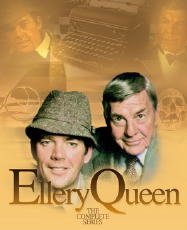
   One of the people I wanted to see at the Windy City pulp and paperback show this past weekend was Martin Grams, Jr., who with Mike Nevins, is the co-author of The Sound of Detection: Ellery Queen’s Adventures in Radio, which is in turn a revision of an earlier book from 1981 by Nevins and Ray Stanich.

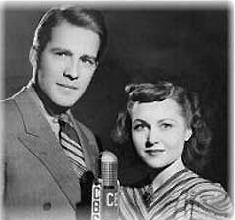
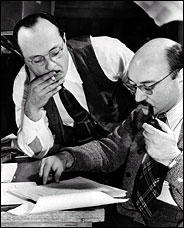
Ellery Queen radio stars

   Martin’s just over 30 years old, but as a radio historian, he’s probably the best there’s ever been, already having 15 books on Old Time Radio (and TV) to his credit, including ones on Sam Spade, Inner Sanctum, Suspense, Gang Busters, and (upcoming) The Green Hornet.

   Besides the fact that he always has several tables filled with DVDs of old TV show at these affairs, to the dismay of my credit card balance, a major reason I wanted to see him was to ask him about this photo I used in Mike Nevins’ most recent column. It’s a photo of two of the stars of the Ellery Queen radio program. Mike didn’t know I was going to use it – I found it on the Internet somewhere – and neither he nor I could identify who either of them were.

   The CBS logo on the microphone helped narrow it down, but not enough to be sure. Martin would know, Mike said, and so he did, at least in part. Right there on the floor of the dealers’ room, Martin whipped out his laptop, fired up his Internet access, took a look at the image on my blog, and said, “That’s Hugh Marlowe, but I’m not sure who the woman is.” She’s the one who (presumably) played Nikki Porter, Ellery’s assistant on the radio shows. (She also appeared in some of the EQ novels and short stories, but not on the regular basis that she was in the radio shows.)

    “I think that it’s Marian Shockley, but I’m not positive,” said Martin, and he sent off some emails to some friends of his who might want to chip in on the question. In reply Jim Widner confirmed Hugh Marlowe, but again, he wasn’t positive about Marian Shockley. Which is where the question lies, at the moment, almost but not quite solved.

   But as long as we’re talking Ellery Queen here, I’ve found a copy of the Ellery Queen book that Mike was talking about in his column that brought about this question in the first place.

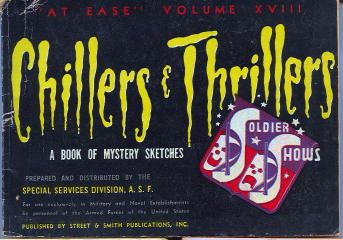
Ellery Queen: Chillers and Thrillers

   It’s Chillers and Thrillers: A Book of Mystery Sketches. No editor is stated, but as you see, it was published in oblong softcover format by Street & Smith Publications. Prepared and distributed by the Special Services Division, A.S.F. [Army Service Forces], this is Volume XVIII in a series of “At Ease” paperbacks.

   The date as stated on the title page: 1945; it is a short 128 pages long.

   You can go back and re-read Mike’s column for his discussion of the contents, but since they don’t seem to be documented elsewhere, here’s a complete index. All of the plays are copyright 1945.

* 5 * Part One: “Quick As a Flash” series * introduction & instructions

* 7 * The Mysterious Mr. Harris * Eugene Wang & Harry Kleiner * radio play [Big Town D.A. Steve Wilson]

* 13 * The Rise and Fall of Rome * Eugene Wang & Harry Kleiner * radio play [Pamela North]

* 21 * The Man No One Believed * * Eugene Wang & Harry Kleiner * radio play [Charlie Chan]

* 29 * Murder in the Afternoon * Eugene Wang & Harry Kleiner * radio play [Dr. Ordway, the “Crime Doctor.”]

* 36 * Murder on the Houseboat * Eugene Wang & Harry Kleiner * radio play [Mr. and Mrs. North]

* 41 * The Mystery of the Horse Pistol * Eugene Wang & Harry Kleiner * radio play [Dr. Ordway, the “Crime Doctor.”]

* 47 * Part Two: “Solve a Mystery” series * introduction & instructions

* 51 * The Adventure of the Blue Chip * Ellery Queen * radio play [Ellery Queen]

* 72 * The Adventure of the Foul Tip * Ellery Queen * radio play [Ellery Queen]

* 90 * The Adventure of the Glass Ball * Ellery Queen * radio play [Ellery Queen]

* 108 * The Orderly Room Murder * Anonymous * radio play

* 121 * The Shadow That Walked * Eugene Wang & Harry Kleiner * radio play [Lamont Cranston / The Shadow]

Notes: (1) Quick As a Flash was a radio quiz program on Mutual running on Sundays and later Saturdays from July 16, 1944 to December 17, 1949. As a portion of contest between various contestants, “a fully dramatized short mystery play provided the clues. These plays featured stars of popular detective series, performing as their well known characters.” (The link leads to a webpage listing all of the radio quiz programs hosted by Bill Cullen. Quick As a Flash was one of them.)

(2) On the Big Town radio program, Steve Wilson was not the D.A., but rather the crime-fighting editor of The Illustrated Press.

(3) Jerry North does not appear in the first of the two Mr. & Mrs. North plays.

[UPDATE.] 05-02-08. I received an email from Mark Murphy last night that seems to settle the Marian Shockley question:

   This Web page from eBay has what is apparently a picture of Ms. Shockley from Abie’s Irish Rose. See what you think.

   Some additional digging reveals that she was married to To Tell the Truth host Bud Collyer.

   Hope this helps.

            Mark Murphy

   >>>   And indeed it does. Thanks, Mark. Martin and I are in agreement that the women in the two photos are one and the same. The image is copyright protected, so I won’t show it here. And since it’s an eBay auction, it won’t appear on the Web forever. But it’s there now; take a look while you can.

   The news of mystery writer Arthur Lyons’s unexpected death appeared quickly on the mystery blogs today. First to report was Jiro Kimura’s The Gumshoe Site, followed up soon after by Jeff Pierce at The Rap Sheet, with a long and personal homage to Mr. Lyons. The latter died on March 21st of complications from pneumonia and a stroke; he was only 62.

   Arthur Lyons’s primary character, the one who appeared in all the novels he wrote on his alone and not as part of a twosome, was a LA-based private eye named Jacob Asch. Borrowing Kevin Burton Smith’s words:

    “JACOB ASCH was a glib, cynical, half-Jewish reporter for the L.A. Chronicle until he got sent to jail for refusing to reveal a source. He did six months on a contempt of court beef, and when he was sprung, the glamour of journalism, for some reason, had lost its appeal for him. So now he’s a glib, cynical, half-Jewish LA private dick who gets involved in some very nasty murders, instead.”

   From an interview that Jeff Pierce did with Arthur Lyons some time ago, here’s the author’s take on his character:

    “You’ll never find Asch doing anything unlikely. He will not usually find stuff through coincidence. He’s a plodder. That’s what private detection is, going through papers. All of Asch’s cases come out of paper. He works with paper more than he does people, whereas in Ross Macdonald and with most of those guys, they do it with information people tell them. But there aren’t too many people out there who are going to spill their guts to an investigator, unless the guy has a handle on what’s going on.”

    Here’s a complete list of Arthur Lyons’s work, at least in printed form. Taken and expanded upon from Crime Fiction IV, by Allen J. Hubin, I’ve been able to find covers from all but one of the Jacob Asch books. I apologize that it’s a mixture of hardcovers and paperbacks, nor have I made note of the various reprint editions in which his books have appeared.

LYONS, ARTHUR (Jr.) (1946-2008)

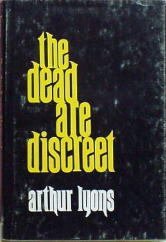
* The Dead Are Discreet (n.) Mason/Charter 1974 [Jacob Asch; Los Angeles, CA]

ARTHUR LYONS The Dead Are Discreet

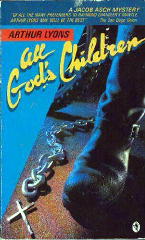
* All God’s Children (n.) Mason/Charter 1975 [Jacob Asch; Los Angeles, CA]

ARTHUR LYONS All God's Children

* The Killing Floor (n.) Mason/Charter 1976 [Jacob Asch; Los Angeles, CA]

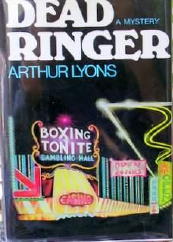
* Dead Ringer (n.) Mason/Charter 1977 [Jacob Asch]

ARTHUR LYONS Dead Ringer

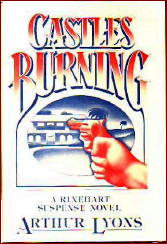
* Castles Burning (n.) Holt 1980 [Jacob Asch; Los Angeles, CA]

ARTHUR LYONS Castles Burning

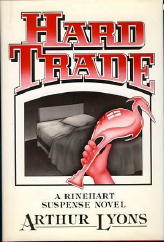
* Hard Trade (n.) Holt 1981 [Jacob Asch; Los Angeles, CA]

ARTHUR LYONS Hard Trade

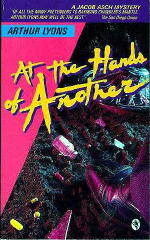
* At the Hands of Another (n.) Holt 1983 [Jacob Asch; California]

ARTHUR LYONS At the Hands of Another

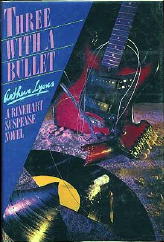
* Three with a Bullet (n.) Holt 1985 [Jacob Asch; Los Angeles, CA; Idaho]

ARTHUR LYONS Three with a Bullet

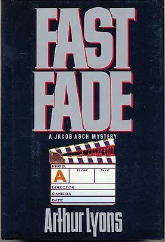
* Fast Fade (n.) Mysterious Press 1987 [Jacob Asch; California]

ARTHUR LYONS Fast Fade

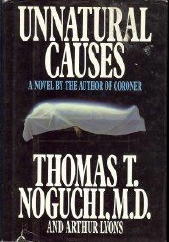
* Unnatural Causes [with Thomas T. Noguchi, M.D.] (n.) Putnam 1988 [Los Angeles, CA; Dr. Eric Parker]

ARTHUR LYONS Unnatural Causes

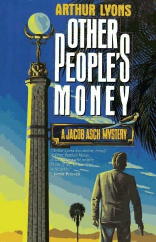
* Other People’s Money (n.) Mysterious Press 1989 [Jacob Asch; Los Angeles, CA]

ARTHUR LYONS Other People's Money

* Physical Evidence [with Thomas T. Noguchi, M.D.] (n.) Putnam 1990 [Los Angeles, CA; Dr. Eric Parker]

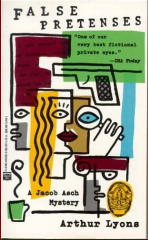
* False Pretenses (n.) Mysterious Press 1994 [Jacob Asch; Los Angeles, CA]

ARTHUR LYONS False Pretenses

Films:

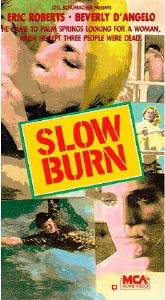
       Slow Burn, based on Castles Burning. Starring Eric Roberts as Jacob Asch.

ARTHUR LYONS Slow Burn

Non fiction:

       The Second Coming: Satanism in America (1970)
       Satan Wants You: The Cult of Devil Worship in America (1971)
       The Blue Sense: Psychic Detectives and Crime (1991) (with Marcello Truzzi)
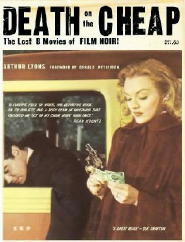
       Death on the Cheap: The Lost B Movies of Film Noir (2000)

ARTHUR LYONS Death on the Cheap


[UPDATE] 03-26-08. For an insightful essay by Jeff Pierce on both Lyons and Jacob Asch, may I suggest a return visit to The Rap Sheet. It was written in 1981 or thereabouts, but its age does not diminish the timeliness of this followup post in any way whatsoever.

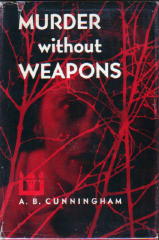
A. B. CUNNINGHAM – Murder Without Weapons.

E. P. Dutton & Co.; hardcover first edition, 1949. No US paperback edition.

A. B. CUNNINGHAM Murder Without Weapons

   The backwoods region of the Deer Lick country is pretty nearly an alien world to me, a city feller for most of my life. (The exact state doesn’t seem to have been mentioned, but presumably it’s somewhere in Appalachia.) Even the title is one that makes more sense to an outdoorsman, seeing as the murder occurs with the death of a young girl going over the edge of a logging chute, a drop of all of fifty feet, frightened by the snuffling sounds of an approaching bear. A nonexistent bear, as it turns out, since dogs are not so easily fooled.

   Sheriff Jess Roden is the reluctant detective — reluctant, that is, to claim there’d been murder done if in fact there hadn’t. To the trained, inquisitive mind of the inveterate mystery reader, there’s a surprising lack of questions asked, both by those who find the body and by her family, but in many ways the roles of country folks are as fixed, as categorized, as those of us city people, and things do work out a little more slowly and in their own way.

   Roden does do a fine, though irrelevant, piece of detective work to impress an inquiring reporter, but I was disappointed with the ending. All the traipsing around at the top of the cliff where the dirty work was done seems highly unlikely, and at best, it needs a bit more explanation. The killer was fairly obvious, but even now I’m not convinced I know why he did it.   [C]

— From The MYSTERY FANcier, Vol. 3, No. 2, Mar-Apr 1979. (Slightly revised.)


[UPDATE] 03-05-08. This book is one that was published as part of Dutton’s Guilt Edged series of mysteries, and as such it’s included in the online article that Victor Berch, Bill Pronzini and I did on them.

   It’s still the only book by Cunningham that I’ve read, but I hope my comments didn’t suggest that such would always be the case. In fact, now that I’m (much) older, I have the feeling that I might enjoy one of Sheriff Jess Roden’s adventures even more than I did back then, in my youthful 30s.

A. B. CUNNINGHAM Death Haunts the Dark Lane

   Most of his cases I’m more likely to have in paperback. Many of them were published as Dell mapbacks, others as digest-sized softcovers from Detective Novel Classics and so on. None are particularly collectable — after all Jess Roden is not a detective that anybody brings up in conversation very often today — so unless you want them in Fine or better condition, they should be relatively easy to find.

   And oh, one last thing. I didn’t know then, and apparently in the book it was never stated or made clear, but Deer Lick is in Kentucky. Not only that, but it’s a real town, just up the road from Lewisburg. The population today is about 1400.

   Which leads me to a question. Is there a smaller town in the US with as many mysteries taking place in the immediately surrounding area as Deer Lick? According to Crime Fiction IV, by Allen J. Hubin, there were 20 of them, plus one Roden adventure set in Texas, all published by Dutton:

# Murder at Deer Lick, 1939.
# Murder at the Schoolhouse, 1940.
# The Strange Death of Manny Square, 1941.
# The Bancock Murder Case, 1942.
# Death at “The Bottoms”, 1942.
# The Affair of the Boat Landing, 1943.
# The Great Yant Mystery, 1943.
# The Cane-Patch Mystery, 1944.
# Death Visits the Apple Hole, 1945.
# Murder Before Midnight, 1945.
# Death Rides a Sorrel Horse, 1946.
# One Man Must Die, 1946.
# Death of a Bullionaire, 1947. [Takes place in Texas.]
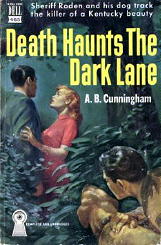
# Death Haunts the Dark Lane, 1948.
# The Death of a Worldly Woman, 1948.
# Murder Without Weapons, 1949.
# The Hunter Is the Hunted, 1950.
# The Killer Watches the Manhunt, 1950.
# Skeleton in the Closet, 1951.
# Who Killed Pretty Becky Low? 1951
# Strange Return, 1952.

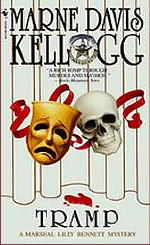
MARNE DAVIS KELLOGG – Tramp.

Bantam; paperback reprint, October 1998. Hardcover first edition: Doubleday, 1997.

MARNE DAVIS KELLOGG Tramp

   This is the third of what has turned out to be a five-book series, one in which Lilly Bennett in essence tells us some of her memoirs, the stories being told in first person, you see. Coming in at the middle may have caused me some confusion, but in her home town of Bennett’s Fort, Wyoming, Lilly is both a U.S. Marshal and a private eye.

   I think some of the confusion was due to the act that I never really had the feeling that she was doing either job very well. Entertaining, yes, but organized, she is not. Lilly is soon to be 50, rather outspoken, and a member of a very wealthy family with her own helicopter that takes her from ranch to town. She also wears designer clothes, at least when she’s forced to.

   Dead – or at least the first victim – is a millionaire letch named Cyrus Vaile, who collapses and dies at his 90th birthday party. What he’d asked Lilly to do when he’d hired her just before the party was to find the $20 million which had disappeared from the endowment he’d bestowed upon the local Roundup Repertory Company earlier that year.

   While it takes a while to sort through all of Lilly’s back story – her family, friends, employees, and friendly rivals – the members of the theatrical company are easy to identify. Most of Kellogg’s descriptions are right on target.

   And once you get to know them, the recurring players are sketched in equally well. Besides the mystery and the detective work that has to be done, a goodly portion of the story’s 320 pages are devoted to the upcoming wedding of Lilly’s goddaughter – and Lilly’s ongoing angst over her good friend Jack’s failure to pop the question himself, no matter how compatible they may happen to be.

   As I suggested earlier, Lilly’s detective work takes second place to all of the other events in her life – or it seems to. Lilly does not tell the reader all, which is annoying at least once when it is the most obvious, and awkwardly so. But it also turns out that there was a clue – or indeed two – well-hidden and cleverly done, in the fashionable clutter of the life of one of the more interesting private eyes who lives in Wyoming I have ever read about. (No, really.)

   Additional comment: Following the Lilly Bennett series was Insatiable, a stand-alone mystery coming out in 2001. Since then Ms. Kellogg has switched to relating the misadventures of Kick Kewswick, a high-class jewelry thief turned sleuth, specializing in – jewel thefts. There are now four books in this series, which I will be giving a try one of these days. Check back later and see if I don’t.

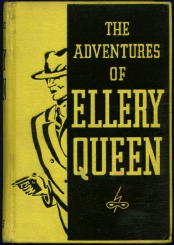
ELLERY QUEEN – The Adventures of Ellery Queen.

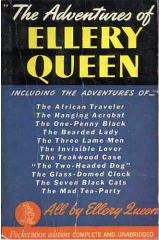
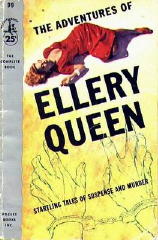
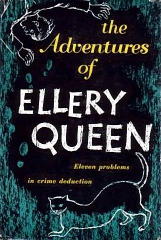
Pocket 99; paperback reprint; 1st printing, March 1941. Earlier editions: Frederick A. Stokes, hardcover, November 1, 1934. Grosset & Dunlap, hardcover, July 1936. Mercury Bestseller Library #1, digest paperback (abridged), February 1940. Triangle, hardcover, June 1940.
The Adventures of ELLERY QUEEN

      And of course the book has appeared from many another publisher over the years. I’ll add cover images for some of them along the way.

      This will be a long review. Over the years I’ve never known exactly how to review collections or anthologies of short stories. I have the need, I guess, to cover each story in detail. I don’t have knack that other reviewers have of keeping the review crisp and concise with a quick summing up of the book’s overall qualities.

      So this will be a long post. I read these stories at a pace of one or two an evening, then wrote up each one the next day in a diary sort of format. I may do some summarizing at the other end, but perhaps not. In any event, here are the comments that came to mind as I read them, with all story titles beginning with “Adventure of …”

    “The African Traveler.”   First publication. As the opening story, it’s based on an intriguing premise. Ellery has agreed teach a course in Applied Criminology at a local (unnamed) University. From the students who’ve applied, 63 in all, he’s chosen only two, John Burrows and Walter Crane, both with high academic achievements. Wheedling her own way into the course is the fawn-eyed Miss Ickthorpe, thanks to the fact that her father, Professor Ickthorpe, is the fellow on the faculty who inveigled Ellery into giving the course in the first place.
The Adventures of ELLERY QUEEN

      Their first assignment, a field trip to the scene of a crime: a murdered man alone in his bedroom, where all four see the body still lying on the carpet. Nothing like getting your feet wet upon a moment’s notice!

      After seeing all of the clues, each of the three sleuths-in-training come up with a different solution – and choice of killer – from each of the others. And equally, of course, all three are wrong. Ellery probably has the inside edge, but I’d have graded the students almost as highly.

      I have one quibble about the wristwatch, a fact that Ellery tosses off lightly but doesn’t make sense to me, but of course (once again) having a case with three partial and one full solution like this is what EQ the author was at one time known best for.

      As far as I know, this is the only assignment the three students have had that was ever recorded. Too bad; they seemed to work well together, if not entirely successfully. (It may be my imagination, but Ellery seemed a little nonplussed at having an unexpected student to deal with, and primarily because she was female.)
The Adventures of ELLERY QUEEN

    “The Hanging Acrobat.”    First published in Mystery magazine, May 1934, as “The Girl on the Trapeze.” The female half of a husband-and-wife pair of circus acrobats is found hanged to death inside of the theatre where the show still manages to go on the next day, as distraught as the male half, the rather slow-minded Hugo Brinkerhof, may be.

      In rather macabre fashion, the possible suspects – most of them other performers who had made time with the dead woman at one time or another – are interviewed at the scene of the crime before the coroner has come with the rope around her neck creaking and the body swaying gently back and forth. Erggh.

      The primary clue has to do with the kind of knot that was used. There was a bit of misdirection involved right about here, but at least in my case as a reader, it didn’t succeed. My eye stayed on the pea. The slightness of the detective work makes the overall tale appear all the more inadequate. Not one of EQ’s better efforts.

    “The One-Penny Black.”    First published in Great Detective magazine, April 1933. This is the oldest story in the collection, and one that at best I found only mildly enjoyable. It begins with old Uneker’s horrible German accent, as he tells Ellery about the recent happenings in his mid-Manhattan book shop, and ends with one of the more absurd endings to a detective story I’ve ever read.
The Adventures of ELLERY QUEEN

      It turns out that a thief who stole a rare stamp from a neighboring store made his getaway from a neighboring store, and now someone is buying – or stealing – every copy of Europe in Chaos that Uneker had on the shelf at the time.

      Sgt. Velie doesn’t get it, but I think every reader will. That part’s fine, but Ellery’s subsequent deductions depends on a man’s snuff habit – an abominable inclination shared by Ellery’s father – and won’t mean a lot to modern readers. After registering this one mild complaint, I’ll return to the ending, wherein Ellery triumphantly discloses where the stamp is.

      I don’t believe that either half of the EQ writing partnership understands collectors at all, and therefore I don’t believe a word of it!

    “The Bearded Lady.”   First published in Mystery magazine, August 1934. One of the greatest strengths of the early EQ repertoire was the “dying message” story that helps define their approach to their 1930s detective fiction: the pure puzzle aspect. In this one, a dying artist (also a doctor, making both professions important, paints a beard on a woman in the painting he was last working on. Question: Which of several suspects was the message referring to?

      That there are only a few suspects in the house should have made it easier, but I found that keeping track of them difficult to do, forcing me to go back and re-read several passages several times. There is a huge to-do about estates and who gets what when who dies, and maybe it was late at night, because that was hard to follow also.

      But, and a big but, if you’re a fan of “dying message” detective puzzles, as contrived as they are – and this one I cheerfully admit is contrived – this is a good one.
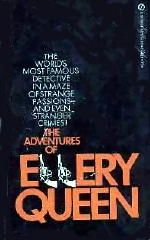
The Adventures of ELLERY QUEEN

    “The Three Lame Men.”   First published in Mystery magazine, April 1934. A kidnapped businessman, his ex-gang girl slash showgirl mistress dead of suffocation in the closet of her apartment, and the muddy footprints of three men – all of whom limped – and no means of getting the man out of the window.

      When you look back at the story, you realize that it’s a minor one – no one’s going to remember its solution as being remarkable or outlandish in any way – but it still works as a puzzle, thanks primarily to the nifty build-up and the rather outre trappings. Or if the word bizarre works for you, then use that instead.

       “The Invisible Lover.”   First published in Mystery magazine, September 1934. Ellery makes his way out of Manhattan for this one, to a small town upstate called Corsica NY (population 745), where a young man is in jail for killing the rival to his girl friend’s hand. The bullet that killed the man, a recent newcomer to the village, turns out to have fired by the young man’s gun.

      When Ellery meets Iris Scott he understands why the bees have been buzzing. She is Circe and Vesta in one, he thinks. It takes a trip to the graveyard and digging up the dead man’s body to prove the young man’s innocence, but mildly macabre settings like this have been occurring all book long, and it fits right in.

      It does the trick, too. A good story with a solution to match.
The Adventures of ELLERY QUEEN

    “The Teakwood Case.”   First published in Mystery magazine, May 1933. I’m beginning to see a pattern here, and it’s hardly a surprising one. The earlier the story was written, the more rigid the format and presentation. As time went on, the EQ partners seemed more and more adept at avoiding stereotyped characterizations and letting Ellery’s detective work appear smoother and more skillful, instead of being forced.

      This is an early one, having to do with a dead man in an apartment apparently mistaken for its owner, his brother. Inspector Queen does his usual routine with the snuff, and the rest of the case revolves around a pair of cigarette cases, each of the brothers owning one of them. The killer comes as a fairly good surprise, but the telling is dull.
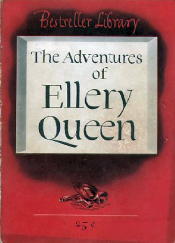
The Adventures of ELLERY QUEEN

    “The Two-Headed Dog.”    First published in Mystery magazine, June 1934. Another aspect of these early EQ stories that I haven’t mentioned before is the oblique way they often begin, sometimes abruptly – in the sense that the story has already begun before the reader is invited in – but sometimes more conventionally, as this one does, standing out in comparison to some of the others which didn’t.

      Either way, I’ve discovered that the openings are tough for me to handle. They’ve often overwritten or overcharged – that’s the best word I’ve come up with so far to describe the phenomenon – and it takes a while for the story to settle down and begin to pull itself together and into shape.

      This is not a complaint. I chalk it up to sheer literary exuberance – the love of words and telling a tale. Reading their early stories now, I can sense the joy the EQ cousins must have had in writing them, and the overall effect has been contagious. My complaints, as you’ve been reading them, seem minor in comparison.

      This story, with its roots based on Greek mythology (Cerberus), is a good one. It’s a ghost story about a Cape Cod roadside inn with a haunted cabin for rent, and it’s up to Ellery to deduce why and by whom. Genuinely spooky, but perhaps too much so, as some questions are left unanswered in the denouement.
The Adventures of ELLERY QUEEN

    “The Glass-Domed Clock.”    First published in Mystery League Magazine, Oct 1933. This particular “dying message” mystery story was written even before the previously mentioned one, “The Bearded Lady.” It also features what had been a standard ingredient in the half dozen or so Ellery Queen novels published up this time, a Challenge to the Reader…

      …with one difference. This one comes right at the beginning, reporting as it does that Ellery had stated: “Anyone with common sense could have solved that crime. It’s as basic as five minus four leaves one.”

      Didn’t do me a bit good. I didn’t read carefully enough. A murdered curio dealer leaves a trail from a broken glass-domed clock to a jewel whose position was far back in the case he took it from, making it obvious that the jewel was a key to the message as well as the clock, as there were many other clocks he could have chosen to break.

      This is a very finely – and fairly – plotted story. And yet, it’s also a little too fussy. And more than that, the EQ stories don’t seem to have aged well, and the significance of the clock is a case in point. In contrast, the Sherlock Holmes stories seem ready to last another century, and EQ’s don’t. Maybe Ellery needed a Watson to “uncomplicate” the stories he was in. (I know. My spell-checker knows that that’s not a word also.)

The Adventures of ELLERY QUEEN

    “The Seven Black Cats.”   First published in Mystery magazine, October 1934, as “The Black Cats Vanished.” There is yet another young unattached woman whom Ellery meets in this story who is fascinated by either his appearance or his reputation in solving crimes, or both.

      Nothing seems to come of these brief, cursory attachments, as the lady in question never appears again in another story. While Ellery seems to welcome the attention, he also seems uneasy about it – until, that is, he’s solving the mystery at hand takes the full focus of his abilities.

      Take Miss Curleigh, for example. She’s the pet store owner who poses Ellery the problem in this tale: why a woman who hates cats keeps buying another one week after week, each almost identical to the one before.

      The woman’s name is Euphemia Tarkle, and she is also bedridden, an invalid. I haven’t been keeping note of unusual names in the previous stories, but this one is, well, unusual. Unusual enough for Ellery to be take notice of it himself, when he hears it.

      One other aspect of a common EQ trait occurs in this one, otherwise about average for the stories in this collection. The killer’s name – and yes, of course, there is one – is revealed until the last two words in the story.
The Adventures of ELLERY QUEEN

    “The Mad Tea-Party.”   First appeared in Red Book Magazine, October 1934. EQ has been saving the best for last, although I liked the first one and quite a few others too. I’ve always liked mysteries that connect themselves in wacky ways with nursery rhymes and childrens’ stories, and this is among the best of them.

      The cousins must also enjoyed theatrics among their repertoire of mystery tricks, for for when Ellery manages to reach an isolated friend’s home in the hinterlands on Long Island – on a dark and rainy night, yet – he’s confronted with the other guests acting out their roles in a scene from Alice in Wonderland.

      And when the host mysteriously disappears during the night, and mysterious packages beginning arriving – all connected with Alice once again – it makes for one of the cleverest detective stories in the entire collection. Did I mention one scene in which the entire party is drugged and falls asleep for several hours? I should have.

      I don’t think that many people will catch on to what’s going on in this one. It’s a beauty.

      Whew. This review is long enough already, so don’t expect a long summary, after all. If you’re a fan of detective stories with a capital D, then either you’ve read this book already, or you should – and posthaste. If you don’t particularly care for the contrivances that make detective puzzles work, then you’re not probably reading what I’m saying right here, either.
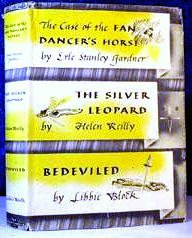
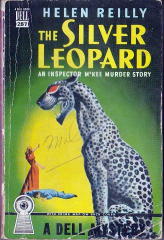
HELEN REILLY – The Silver Leopard

Detective Book Club; hardcover reprint, 3-in-1 edition, July 1947. Hardcover first edition: Random House, 1946. First magazine appearance: Mystery Book Magazine, January 1947. Paperback reprint: Dell 287, mapback, 1949.

HELEN REILLY The Silver Leopard

   This is a post-war society mystery novel — a different life than most of ours (I would imagine), but real people are involved. In her books, Reilly’s main detective is Inspector McKee, head of the Manhattan Homicide; of the 35 to 40 mysteries she wrote, he appeared in all but two or three. New York City was her most favored locale, though excursions to suburban Connecticut were common, as so it happens in this novel.

   I’ve not read many of her books, but in the ones I have, McKee — while eventually on the scene — is not the primary protagonist. He seems to have been content to stay in observer status: looking in on the affair from without, balancing the facts he knows with the people he sees.

   In this book, to take a handy example, we follow the actions of Catherine Lister, whose uncle had died several years ago, but whose life is still very much centered about her aunt and her two cousins (not her aunt’s children). There was recently a broken romance in Catherine’s life (due primarily to Harriet, called Hat, one of the two cousins) but now there is a new fiancé (Nicky, who has just been invalided out of the war).

   But when Catherine’s aunt announces her own plans to re-marry, events begin to snowball — and somehow the silver leopard that Catherine’s uncle had sent her just before his untimely death is intricately involved.

HELEN REILLY The Silver Leopard

   I don’t quite understand the last attack on Catherine’s life — I don’t think it’s quite enough to say that the killer was perhaps slightly crazed — but otherwise this tangled web of mystery and romance was a lot of fun to read, in observer status, in much the same way that McKee does.

— August 2000 [slightly revised]


[UPDATE] 02-26-08. For a lot more on Helen Reilly’s career, see Michael Grost’s long article about her on the main Mystery*File website, followed by a complete bibliography and lots of additional covers.

   It was interesting to note that while I assume the book was popular when it first appeared, it has not been reprinted since 1949. As I said in a followup comment to the preceding review of Last Seen Hitchhiking by Brett Halliday, some books (and authors) are very much a product of their own time and era, and I’m sure that The Silver Leopard is one of them.

   In my opening sentence, I referred to this as a “post-war society” mystery novel. I think you can often learn more history from mystery fiction — at least very small slices of it — than you can anywhere else. And that includes high school and grade school textbooks, from which — other than their parents — most people learn about the world that came before them.

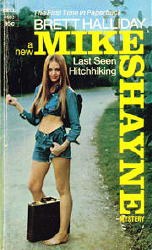
BRETT HALLIDAY – Last Seen Hitchhiking

Dell 4683; paperback original. 1st printing, August 1974.

   By this date in the career of famed private investigator Mike Shayne, all of his adventures were appearing as paperback originals and (unknown to unwary buyers) were ghost-written by other writers. Brett Halliday — as I’m sure you know, but I’ll mention it anyway — was the pseudonym of Davis Dresser. After 1960 or so Dresser started to contract out the stories to authors such as Robert Terrall (mostly) and Ryerson Johnson (once or twice). What the circumstances were, I don’t know, but in any case Terrall was the man who wrote this one.

HALLIDAY Last Seen Hitchhiking

   Which makes difficult such judgments as comparisons in style between this and Halliday’s Tickets for Death, reviewed here (by me) not too long ago. Dresser’s books were written in the 40s and 50s, though, and the 60s and 70s were a different era altogether.

   Mike Shayne was still a tough private eye based in Miami, but society itself had changed, and sexual freedom had come to a large sectors of it. The F-word is used with no inhibitions in this book, for example, and that a fairly graphic description of sexual perversions (you might say) is included seems to say that this is not your grandfather’s brand of mystery tale. (Well, maybe yours, but certainly not mine.)

   Shayne is called in by a fellow (female) detective, who needs his help in tracking down a missing (female) grad student, who disappeared while (probably) hitchhiking away from the scene of a crime — the theft of an extremely valuable Central American artifact.

   We (the reader) know that she was indeed the captive of a certain kind of predator — again fairly graphically. We don’t (quite) know her final fate, but that that it’s tied rather intricately with each of the two cases Shayne is working on certainly comes as no surprise, a near no-brainer.

   There is also a rather unique way in which Shayne solves them: by doing a live broadcast from a radio talk show, trying to entice a killer out of hiding as well as the captor of his lady friend — the killer and the captor are perhaps the same person, but we suspect not — plus any witnesses who believe they have anything else of interest to share.

   All in all, this is a solid, suspenseful mystery, unraveled in part by the intelligence, believe it or not, of the detective at work. As a bonus — depending on your point of view, perhaps — hippies, LSD and free sex are elements of this country’s cultural history, and this is definitely a jolt back into time, describing a huge capsule chunk of our past only now getting into schoolbooks. (And some of this never will.)

– August 2000 [slightly revised]


[UPDATE] 02-25-08. Since the review was already written, and it has been for seven and a half years, I didn’t see any reason for having you wait any longer for it.

   For the best one page coverage of Mike Shayne and all of the venues he’s appeared in, along with the authors who wrote about him, you really ought to go to this portion of Kevin Burton Smith’s “Thrilling Detective” website.

   If that’s not enough, then there’s more: an entire website devoted to the red-headed Irishman. Check it out at http://www.mikeshayne.com/.

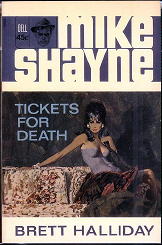
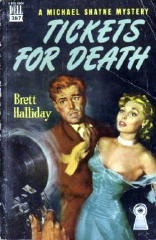
    BRETT HALLIDAY – Tickets for Death.

HALLIDAY Tickets for Murder

Dell 8885; paperback reprint. 1st printing, new Dell edition, July 1965; cover art by Robert McGinnis. Hardcover first edition: Henry Holt & Co., 1941. Several other paperback editions, including Dell 387 (mapback); cover art by Robert Stanley.

   It’s been a long time since I’ve read a Mike Shayne private eye novel, and I think I’d forgotten how hard-boiled a guy he was. Back in 1941, Shayne was a two-fisted detective in the Dashiell Hammett-Black Mask mode, a bit derivative, maybe, but by no means a fellow to mess around with.

   Take pages 24 and 25, for example — a very early event in this case centered around a sudden influx of counterfeit racetrack tickets. Shayne and his wife have just registered in a hotel, when he’s called down to another room. Something triggers his suspicions, and he goes in ready for action. Within four paragraphs the two hoodlums in the room are slumped on the floor dead. Shayne himself is injured, but “It was only a flesh wound.” Naturally.

   Nor does the wound hamper his range of action for the remainder of the night. And there is a lot of action, and during the midst of it, Shayne runs into a lot of characters that both he and the reader have to keep constant track of:

   There is a pint-sized newspaper editor who seems to delight on rousing up stories. There is the owner of a disreputable night club just outside the city limits. There is a cop who, while not perhaps crooked, is heavily beholden to the criminal elements in town. There is the manager of the race track, and there is a girl who tries to frame Shayne up in the old badger game. There is another girl who knows something and tries to entice Shayne into paying her for what she knows. There is a shyster of a lawyer who is trying (among other activities) is trying to get the inventor of a new camera gimmick to sign the rights over to him.

HALLIDAY Tickets for Murder

   And there is Phyllis, who (at the time of this story) is married to Mike Shayne. Having a wife on hand is an interesting twist added to a tale of a hard-drinking private investigator, but (apparently) there are only so many twists that an author can manufacture from the concept — and marriage vows really have to tie a guy down a lot — and Phyllis soon disappeared from Shayne’s long life in fiction.

   What’s remarkable is not so much any of the above, but that out of the tangled morass of a plot (as indicated above) the author Brett Halliday makes a coherent mystery novel out of it. Most (if not all) of the confusion that the tangled non-stop motion and literary sleight-of-hand is eventually unraveled, and neatly so. Good work all around.

— August 2000 [slightly revised]


[UPDATE.] 02-24-08. I’ve read a few other Mike Shayne novels since Tickets for Death. In fact, the very next book I read (back in the year 2000) was one. Look for my comments about it here sometime within the next couple of days.

   As for Phyllis, I’ve done some investigating on my own, and I have the answer. In Brett Halliday’s own words (well in the words of Davis Dresser, who ought to know), taken from The Great Detectives, by Otto Penzler (Little, Brown, 1978):

    “20th Century Fox bought The Private Practice of Michael Shayne as a movie to star Lloyd Nolan and gave me a contract for a series of movies starring Nolan as Shayne. For this they paid me a certain fee for each picture starring Shayne, promising me an additional sum for each book of mine used in the series.

    “But they didn’t use any of my stories in the movies. Instead, they went out and bought books from my competitors, changing the name of the lead character to Michael Shayne. I was surprised and chagrined by this because I thought my books were as good or better than the ones they bought from others, and I was losing a substantial sum of money each time they made a picture.

HALLIDAY Tickets for Murder

    “I finally inquired as to the reason from Hollywood and was told it was because Shayne and Phyllis were married and it was against their policy to use a married detective.

    “Faced with this fact of life, I decided to kill off Phyllis to leave Shayne a free man for succeeding movies. This I did between Murder Wears a Mummer’s Mask and Blood on the Black Market (later reprinted in soft cover as Heads You Lose).

    �I had her die in childbirth between the two books, but alas! Fox decided to drop the series of movies before Blood on the Black Market was published, and the death of Phyllis had been in vain. I have hundreds of fan letters asking what became of Phyllis, and now the unsavory truth is told.

    “With the movies no longer a factor, in my next book, Michael Shayne’s Long Chance, I took Shayne on a case to New Orleans where he met Lucile Hamilton and she took the place of Phyllis as a female companion. I brought her back to Miami with Shayne as his secretary, and in that position she has remained since.”

    “I don’t know exactly what the situation is between Shayne and Lucy Hamilton. They are good comrades and she works with him on most of his cases, but I don’t think Shayne will ever marry again. He often takes Lucy out to dinner, and stops by her apartment for a drink and to talk, and she always keeps a bottle of his special cognac on tap.”

[BONUS.] From a website called www.bookscans.com I have found an image of the back cover I will add here at the end. Why have a map of the mystery available, and not use it?

HALLIDAY Tickets for Murder

LESLIE CHARTERIS – The Last Hero.

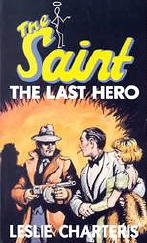
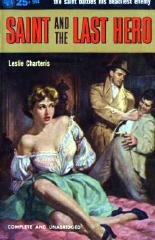
International Polygonics Library; paperback reprint, November 1988. Previous editions: Hodder & Stoughton, UK, hc, 1930. Doubleday Doran & Co./The Crime Club, US, hc, 1931. Plus: Ace/Charter, pb, 1982. Also published as: The Saint Closes the Case, Sun Dial, 1941; Fiction Publishing Co., pb, 1967. And as: The Saint and the Last Hero, Avon #544, 1953.

CHARTERIS The Last Hero

   A fairly complicated publishing history, in other words, and it’s far from complete. But it’s not nearly as complex as the history of The Saint as a character himself. This has generally been considered the second Saint novel, but after reading the Wikipedia entry (under Simon Templar) I am certainly willing to go along with the now accepted chronology: that Meet – the Tiger! was first, and Enter the Saint (consisting of three novellas) was second.

   My own exposure to The Saint was through the stories that appeared in every issue of The Saint Detective Magazine when I was in my teens and shortly beyond. The stories came from every time period and in no order whatsoever, so thinking of how The Saint first came on the scene and developed as a character would have been impossible, even if I’d have seriously considered doing so.

   From reading The Last Hero at this much later date, and matching my thoughts up with several of the online histories of The Saint, it’s clear in retrospect that Charteris was still tinkering with the character, revising and improvising details as he went along, creating as he did a back story that may (or may not) have stayed constant all the way through the remaining books and collections — nearly a hundred in all.

   I’ll not bore you with details, as I’d probably get them wrong, and besides, there’s a book by Burl Barer called The Saint: A Complete History in Print, Radio, Film and Television 1928-1992. (MacFarland, 1992, 2003) that if you’re interested, will get them right. I don’t have a copy, and I will have to get one.

   There is also a humongous website devoted only to The Saint that deserves more exploring than I’ve had a chance to do so far.

CHARTERIS The Last Hero

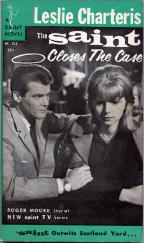
   You may remember the IPL cover to the left as one that has appeared here before. The cover from Avon edition (below right) features Patricia Holm, the love of Simon’s life, fairly prominently. The third one (above right) is from a set of Saint novels that came out when the Roger Moore TV show was playing in the US.

   I don’t particularly believe that the title The Saint Closes the Case is apt at all, since the villain, a wealthy arms dealer named Dr. Rayt Marius, manages to survive, only to appear in a few more of the Saint’s adventures, along with his patron, the brutally ambitious Crown Prince of some small unnamed European country.

   I said brutally ambitious, and I meant it. In 1930, the clouds of war were beginning to form once again, and it was easy for readers of the day to believe that ruthless profiteers like Marius and the Prince did for a fact exist. Once Simon Templar learns of a mad scientist’s new invention, a veritable death ray machine, he knows that if it were to fall into the wrong hands, or even the right hands, the world would not be likely to survive.

   The solution? Kidnap Professor Vargan, confiscate his plans, persuade him to destroy his weapon – or suffer the consequences. There is no bluff on The Saint’s part. He may have his usual devil-may-care attitude about him, but he’s not joking. He and his small group of comrades in arms are deadly serious.

   This group of friends includes the previously mentioned Patrica Holm, who gets kidpanned in return, to The Saint’s dismay; Roger Conway, new to the business and prone to error; and Norman Kent, the titular hero:

   From the prelude, page 13: “…and it is also the story of one Norman Kent, who was his friend, and how in one moment in that adventure held the fate to two nations, if not of all Europe, in his hands; how he accounted for that stewardship; and how, one quiet summer evening, in a house by the Thames, with no melodrama and no heroics, he fought and died or an idea.”

   From Caroline Whitehead and Geroge McLeod, Knights Errant of the Nineeteenth and Early Twentieth Centuries, Chapter 5:

    “Norman Kent is an archetypal knight errant. Though formally a man of 20th Century England, he lives (and dies) by the Code of Chivalry. He loves totally his Lady, Particia Holm – who, like Don Quixote’s Dulcinea, is not aware of that love. He is totally loyal to his Liege Lord, Simon Templar. Like Sir Gawain in “Sir Gawain and the Green Knight”, Norman Kent takes on the threats to his Lord. Not only physicial threats to life and limb, but also the sometimes inavoidable need to take dishourable acts which would have reflected badly on the reputation of King Arthur/Simon Templar is taken on, wholly and without reservation, by Sir Gawain/Norman Kent.”

CHARTERIS The Last Hero

   Heady stuff that, then and now, although there are things here about which the reader is not totally aware while the book is in progress. [Nothing essential, but to ease my mind, please forget that you just read it.] After a slow beginning – as the author sorts out his primary character’s affairs, for perhaps the benefit of himself as much as more the reader – this is an adventure nearly without equal. The prose simply sings. On his way to rescue Pat, taken from pages 152-153:

    “He smashed through the traffic grimly, seizing every opportunity that offered, creating other opportunities of his own in defiance of every law and principle and point of etiquette governing the use of His Majesty’s highway, winning priceless seconds where and how he could.

    “Other drivers cursed him; two policemen called on him to stop, were ignored, and took his number; he scraped a wing in a desperate rush through a gap that no one else would ever have considered a gap at all; three times he missed death by a miracle while overtaking on a blind corner; and the pugnacious driver of a baby car who ventured to insist on his rightful share of the road went white as the Hirondel forced him on to the kerb to escape annihilation.

    “It was an incomparable exhibition of pure hogging, and it made everything of that kind that Roger Conway had been told to do earlier in the evening look like a child’s game with a push-cart; but the Saint didn’t care. He was on his way; and if the rest of the population objected to the manner of his going, they could do one of two things with their objections.

    “Some who saw the passage of the Saint that night will remember it to the end of their lives; for the Hirondel, as though recognising the hand of a master at its wheel, became almost a living thing. King of the Road its makers called it, but that night the Hirondel was more than a king: it was the incarnation and apotheosis of all cars. For the Saint drove with the devil at his shoulder, and the Hirondel took its mood from his. If this had been a superstitious age, those who saw it would have crossed themselves and sworn that it was no car at all they saw that night but a snarling silver fiend that roared through London on the wings of an unearthly wind.”

   If you can’t read that without getting the least bit of thrill, please try taking your pulse again.

[UPDATE] 02-23-08:    I thought you might like to see this:

Hirondel

« Previous PageNext Page »