Characters


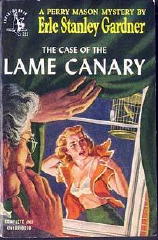
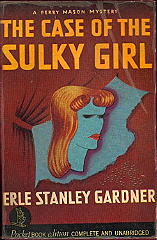
   I was looking over the previous post here on the M*F blog this morning, the one on Gardner paperbacks, wondering if I need tweak anything here or there, and it occurred to me that that last cover was the only one that I could remember having a portrayal of Perry Mason on it.

   Perhaps I could have you just go back and take a look, but since it’s handy, why don’t I simply show it to you again:

Perry Mason

   The covers on the earliest Pocket paperbacks, going back to the early 1940s, always seemed to me to be attempts to imitate the art on hardcover jackets, rather subdued and far from lurid:

Perry Mason

   Later on toward the end of 1940s, the covers at Pocket seemed more and more designed to do their job properly, to catch the eye of the guy (usually) at the newsstand:

Perry Mason

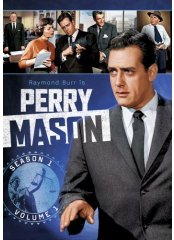
   That cover at the top of this page must have come from the end of the Pocket era. If that’s Perry Mason who’s pictured on it, it certainly doesn’t look like Raymond Burr, who was perfect in the part, but very much an establishment figure. He was a whole lot younger when he started, though. Here’s the cover of the recent box set, which I’ve bought but (all together now) I haven’t started to watch yet:

Perry Mason

   To me, the guy on the Pocket cover looks more like Monte Markham, who had the role for about half a season, 1973-74, before they pulled the plug on him. To TV viewers, it was Raymond Burr who was Perry Mason, and no one else. Even though he may not have been playing Mason at the time, this is what Markham looked like then:

Perry Mason

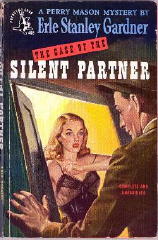
   But getting back to covers with Mason himself on them, I think I may have found an earlier one after all. It’s from the late 1940s era, and as a character, I don’t think all of his rough edges had rubbed off yet. Mason was a tougher guy at the beginning, his roots (as well as Gardner’s) being solidly in the pulp era, and more specifically Black Mask and Dime Detective.

   I think those roots are still showing here:

Perry Mason

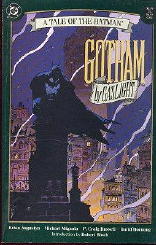
BRIAN AUGUSTYN – Gotham by Gaslight: An Alternative History of the Batman.

DC Comics; graphic novel; 1st printing, 1989. Script: Brian Augustyn; pencils: Michael Mignola; inks: P. Craig Russell. Introduction by Robert Bloch.

   What it is that makes (and establishes) a cultural icon is difficult if completely impossible to predict, but with plenty of hindsight at our command, it is absolutely certain that both the Batman and Jack the Ripper each and individually most definitely are.

   Did they ever meet? Of course not, but on the other hand, why not? This particular graphic novel (or sophisticated comic book, if you prefer, with sturdy cardstock covers, glossy pages and no ads) was not designated with the “Elseworlds” label, but according the various comic sites on the Internet, it was the first, and it was so successful that an entire series of such novels followed.

Gotham by Gaslight

   So what is (or are) Elseworlds? Allow me to quote from the equivalent of the DC handbook: “In Elseworlds, heroes are taken from their usual settings and put into strange times and places – some that have existed, and others that can’t, couldn’t or shouldn’t exist. The result is stories that make characters who are as familiar as yesterday seem as fresh as tomorrow.”

   After Robert Bloch’s introduction, supplied just in case an unwary comic book reader does happen to be unfamiliar with Jack the Ripper – and a nice touch, at that – comes a retelling of the origin of the Batman: the holdup man who guns down Bruce Wayne’s parents before his very eyes; the young lad then devoting his life to take up the cause of justice against criminals and the underworld behind a mask, a costume and a long, free-flowing cape. Except this time it is the late 1880s, and this is not the current Batman at all.

   At the same time as Bruce Wayne is taking up his new career, a horrible slayer of prostitutes in London seems to have made his way to Gotham, a city well-known to comic book readers as the home stomping grounds of the Batman, Inspector Gordon and all of the other characters of current legend (and so it appears) no matter what universe they may happen to be in.

   The coincidence in timing is far too obvious for some, and Bruce Wayne, unable to account for his whereabouts and not being home at night, is first confronted, then arrested and convicted of being the Ripper. In his jail cell, going over the piles of documents, photos and other evidence against him, provided by Gordon, not convinced of his guilt, it is Bruce Wayne the detective that spots the clue that will nail the killer, if only he were not scheduled to be executed for the crimes himself in the morning.

   Truthfully, however, while this certainly qualifies Gotham by Gaslight as an entry in Al Hubin’s Crime Fiction IV – it is not there now, but other Batman graphic novels are – the detection, if not minor, is hardly of the fair play variety. In terms of the reader playing detective him- or herself, this is also mere child’s play, as it were, there being only one other suspect and that being one who only appears in one previous panel.

   The attraction here is the small delights provided by viewing the Batman legend from another perspective in an unexpected context – as if with new eyes – and the delightful art from Mignola and Russell. Grays and blues and browns dominate, as well as exquisite details in Victorian-era architecture, wearing apparel and facial foliage.

   You have to be a Batman fan, perhaps – and if you’re not, it’s sure as shouting that I’m not going to make you one – but if you are, this is a sure-fire classic must-read.

— May 2006


[UPDATE] 09-22-07. I’ve reprinted this review, of course, because of the coverage of the original Batman in the previous post. Other than that, there’s been no attempt to rewrite it to make it more of a followup than this. It’s as I wrote it when it first appeared. But as I suggested, though, this particular book now does appear in the Addenda to the Revised CFIV.

   In his search for completeness in compiling his bibliography of the field, Crime Fiction IV, Al Hubin has cast a wider net than you might have imagined. In this particular blog entry, I offer two cases in point to illustrate this.

   Most observers, for example might not consider Batman as a character whose exploits would be included in CFIV, but indeed they are, and quite extensively too, as long as they appeared in book form, including (more recently) graphic novels. Batman has gone several phases in his nearly 70-year-long career in fighting crime, and you could do no worse than to check out his Wikipedia entry for more information.

   The current incarnation is an crime-obsessed, near-crazed madman with few friends, even among his fellow superheroes. More likeable was the Batman of the early 1950s, which is when he was one of my favorites, my old Golden Age. He never had superpowers, but besides being agile and athletic, neither of which I was, he also solved crimes by the use of his brains, an ability which I could much more easily identify with.

   And of course his never-leave-home-without-it utility belt, one of which I always wished I had. For some reason, though, it never showed up in the yearly Sears Christmas catalog, no matter how hard I looked.

   The entries for Batman in Part 19 of the Addenda are for a series of paperback originals from the 1960s, reprinting some of his adventures from my “Golden Age” of the 1950s.

KANE, BOB. 1916-1998. Noted comic book artist and writer. Add: Born Robert Kahn, he is said to have legally changed his name to Bob Kane at age 18. Note: In at least the three books indicated with a (*) below, Bob Kane is credited only as the creator of Batman as a character. Different writers and artists were in fact largely responsible for the original comic book stories.

   * Batman. Signet, pb, 1966. Add: Collects the following Batman comic book stories, plus introduction:

The Legend of the Batman (Six page introduction: Batman #1, 1940; reprinted from Detective Comics #33, November 1939)
The Crazy Crime Clown! (Batman #74, December 1952-January 1953)
The Crime Predictor (Batman #77, June-July 1953)
Fan-Mail of Danger (Batman #92, June 1955)
The Man Who Could Change Fingerprints! (Batman #82, March 1954)
The Testing of Batman! (Batman #83, April 1954)
The Web of Doom! (Batman #90, March 1955)

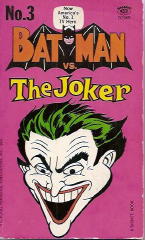
   * Batman vs. The Joker. Signet, pb, 1966. SC: Batman. Collects the following Batman comic book stories. Correction: There are only five, not six stories in this collection.

Batman vs. The Joker

Batman – Clown of Crime! (Batman #85, August 1954)
The Challenge of the Joker (Batman #136, December 1960)
The Joker’s Journal (Detective Comics #193, March 1953)
The Joker’s Millions (Detective Comics #180, February 1952)
The Joker’s Winning Team (Batman #86, September 1954)

   * Batman vs. the Penguin. Signet, pb, 1966. Add: Collects the following Batman comic book stories:

The Golden Eggs (Batman #99, April-May 1956)
The Parasols of Plunder (Batman #70, April-May 1952)
The Penguin’s Fabulous Fowls! (Batman #76, April-May 1953)
The Return of the Penguin (Batman #155, May 1963)
The Sleeping Beauties of Gotham City (Batman #84, June 1954)


   This next character with a mention in Part 19 of the Addenda is more immediately recognizable as a detective, of course, that being Dick Tracy, star of comic strip, radio, TV, and more recently, the big screen. I grew up in a town where Tracy was the front page attraction on the Sunday comics section, but strangely enough, I never followed his adventures. I’m not sure why, but I think I always thought the artwork was a little too crude, the villains too outrageously unbelievable, or a combination of both.

   No matter. Dick Tracy was, and probably still is, the epitome of a good guy, big city cop.

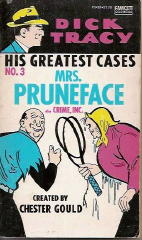
GOULD, CHESTER. 1900-1985. Cartoonist and creator of the long-running Dick Tracy newspaper comic strip. While his entry in the (Revised) Crime Fiction IV includes several other books based on the character, the three paperback originals listed below constitute three books in the “Dick Tracy: His Greatest Cases” series, one requiring a correction and one newly added.

   Add: Mrs. Pruneface plus Crime, Inc. Gold Medal, pb, 1976. SC: Dick Tracy. Two stories in comic strip form.

Dick Tracy

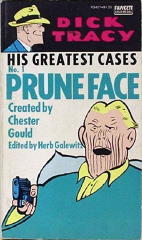
   Pruneface. Gold Medal, pb, 1975. SC: Dick Tracy. Comic strip reprints.

Dick Tracy

   Snowflake and Shaky plus The Black Pearl. Gold Medal, pb, 1975. SC: Dick Tracy. Correction of title; two stories in comic strip form.

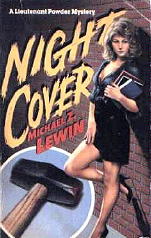
MICHAEL Z. LEWIN – Night Cover

Detective Book Club; reprint hardcover, three-in-one edition. First edition hardcover: Alfred A. Knopf, 1976. Paperback reprints: Berkley, January 1980; Perennial Library, 1984; Foul Play Press, September 1995.

Called by a Panther

   For those who are interested, there is a slew of information about Michael Z. Lewin on his website, located at www.michaelzlewin.com. The first of his novels that I remember reading was one of the first three cases tackled by his private eye character, Albert Samson. I enjoyed them, and maybe I read all three, but the particulars? Right now, I couldn’t tell you.

      Ask the Right Question. Putnam, 1971.
      The Way We Die Now. Putnam, 1973.   [Note: My review appears in the preceding post.]
      The Enemies Within. Knopf, 1974

   A gap of few years was filled in by the book I just read (1976), followed by five other Samson novels, with a hiatus of 13 years between the last two:

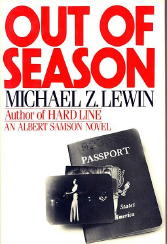
Out of Season

      The Silent Salesman. Knopf, 1978.
      Missing Woman. Knopf, 1981.
      Out of Season. Morrow, 1984.
      Called by a Panther. Mysterious Press, 1991.
      Eye Opener. Five Star, 2004.

   As for the aforementioned book in hand, it’s the first title in Lewin’s Lt. Roy (Leroy) Powder series:

      Night Cover. Knopf, 1976.
      Hard Line. Morrow, 1982.
      Late Payments. Morrow, 1986.

   In addition to his own series, however, Samson also makes a small but significant appearance in Night Cover. Al Hubin, in Crime Fiction IV, does not mention Samson as having any role in the other two books, so with no first-hand knowledge of my own, it may be safe to assume that he does not.

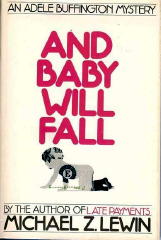
   But on the other hand, maybe not. Not only does (Mrs.) Adele Buffington, a probation officer, appear in Night Cover, but she has a solo adventure of her own:

And Baby Will Fall

      And Baby Will Fall. Morrow, 1988.

      And not only that, a description I found of this book suggests that in it Adele is Samson’s girl friend, which puts a totally different light on something I was going to mention when I got to the review itself. Now that I think about it, I will anyway, but in any case, some further investigation is going to be needed. What I would like to know is simple. Which series characters are in which books?    [See the UPDATE below.]

   All three are in Night Cover, that much I do know, but there is no doubt that this is Powder’s book. He’s the lieutenant in charge of the Indianapolis police squad’s night squad (Homicide and Robbery), and I confess that I had him pegged wrong from the start. Powder is loud and obnoxious, his private life is a mess (married but not divorced), bullies his subordinates with exactitude, and only occasionally does he allow a hint of solicitude to creep in. Tough love? Maybe. As for civilians, watch out. They’re on their own when they deal with him.

   I also pictured him as somewhat obese, with a sagging belly, caused by too many doughnuts from being out on the streets on too many cases on too many nights.

Night Cover

   And yet. He’s fit enough to be attracted to the aforementioned Adele Buffington, the probation officer for the missing teen-aged girl that Powder is (in desultory fashion) looking for. And (more importantly) she to him.

   You can credit author Michael Z. Lewin for this. Looking back over the first couple of chapters, I can find no reference to Powder’s outward appearance. We learn about him only through what he says and what he does. Which is plenty. Up close and personal – but no physical description.

   In this book he meets private eye Albert Samson for the first time, and they definitely do not get along. If – and this is a big if – if Adele is Samson’s girl friend at the time – it is not so revealed, so I could easily be way out on a limb here, even in bringing it up – it puts a completely different slant on their later interactions, Samson, Powder and Adele. A twist in the plot that only those in the know would know about, if indeed there is anything to know.

   But surely I digress. When a Mao-quoting teen-aged boy comes in with a complaint about his teacher and his (questionable) grading policies, Powder indulges him (surprisingly) for a while. When the boy mentions a girl he knows who seems to have disappeared, Powder asks around and shunts him off to Samson.

   As a police procedural, which is what Night Cover is, there are a small multitude of other cases to be investigated and solved. Powder’s intuition on cases far exceeds those who work under him, to his great disappointment and frustration. Besides the missing girl, a sequence of murders suggests a copy-cat killer at work, requiring a vigorous search through back records to uncover patterns before the culprit(s) is/are nabbed.

   There are parts of this tale which are amusing, if not at times laugh-out-loud funny. Lewin has a knack for understated humor, a wry look at the world that you should experience for yourself. But there’s a serious side of the story as well. As Powder’s life story becomes more and more clear, he finds himself looking at himself and his career with a greater intensity than he ever has before.

   Being able to keep track of series characters in their daily life as they go from book to book is rather common in mystery fiction published today. Watching one change before one’s eyes from the beginning of one book to the end is not so common, neither now nor thirty years ago, when this book was first written.

— September 2005


[UPDATE] November 2005.    I forwarded the review to Mr. Lewin, and received the following replies, interrupted by a question from me:

    “Thanks for letting me know about the review you did of Night Cover, and for paying attention to such a venerable volume.

    “As for your questions, Powder was not in the first three Samson books, but he has appeared in the five later Samson books including the current one, Eye Opener (Five Star, 2004).

Eye Opener

    “Adele appeared in Samson’s first seven novels as his woman friend – so she was in her relationship with Samson during Night Cover. I doubt I mentioned it. That was her issue and the book was Powder’s.

    “In the new book Adele appears, but she is no longer Samson’s amour. She also had her own book, And Baby Will Fall (Child Proof in the UK). I think Samson was in that; Powder may have been mentioned.

    “The subsequent Powder novels have included Samson but not, as far as I recall, Adele. Powder has also appeared in another Indianapolis novel, Underdog (Mysterious Press, 1993), and two short stories published in Ellery Queen’s Mystery Magazine – “Night Shift” and “911.” The latter was earlier this year.

    “Mind you, I haven’t exactly read the books lately, so if I’ve gotten details wrong here and there, I won’t faint.”

    Steve: Not identifying Adele Buffington as being involved with Samson at the same time she had her brief affair with Powder is what you call “her issue” and what I considered considerable constraint on your part. Other authors may have made quite a to-do about it, intensifying the relationship between the three of them immensely, but in very usual ways.

    “As I said earlier, Adele was Samson’s woman friend from the beginning and through the first seven novels. Your concern is that she got close to Powder briefly. Well, Samson might have been upset, at least for a while, if he’d ever known about it, but she would never have told him, and neither would Powder. Adele’s subsequent relationship with and affection for Samson was unchanged; how she handled it or justified it was her business.

    “I might have gone into that more if I’d ever written more books about her but, for various reasons, that didn’t happen and is unlikely to happen now. Depending, of course, on the size of the check you’re offering me to write them. I think it would have to be pretty large…”

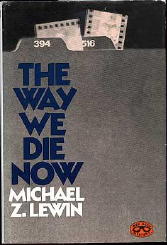
MICHAEL Z. LEWIN – The Way We Die Now.

Putnam’s, hardcover, 1973. Paperback reprints: Berkley, 1979; Harper Perennial, 1984; Mysterious Press, June 1991.

The Way We Die Now

   Albert Samson is a rather sensitive soul to be a private detective. Not only that, but the only reason that he gets this case is because he’s the cheapest one listed in the Indianapolis telephone directory.

   No wisecracks, please. The key word here is “sensitive”, not “cheap,” and Indianapolis has enough crimes and other divorce work to keep more than a couple of private eyes on the street. This isn’t a divorce case, however. A troubled Viet Nam veteran with a history of psychiatric treatment is in jail, accused of murder. Samson, hired in quiet desperation by the man’s wife, has only one question: With his past record, why was this innocent Childe Ralph hired as an armed guard?

   I liked the homey Midwestern atmosphere, and I liked Albert Samson. However, it seems only fair to point out that his slow, casual approach to the investigation can be awfully frustrating to a reader who has a lot of unanswered questions. Still, it’s the police who are guilty of taking the simple explanation, while Samson’s appraisal of Ralph Tomanek as one of the children of the world convinces both himself and the reader very early on that the job he took as a watchman was but a part of a much broader scheme.

   In short, good characters nicely scaled down to earth, in a plot stretched precariously thin.    [B minus]

– From The MYSTERY FANcier, Vol. 3, No. 2, Mar-Apr 1979.


The Way We Die Now

  [UPDATE] 09-10-07. I didn’t happen to mention that this was Samson’s second case, the first being Ask the Right Question (Putnam’s, 1971), which was also Lewin’s first mystery novel. Reading through the review right now, almost thirty years later, I can’t say that the story comes back to me any more than what’s there and with no more insight than you can gather for yourself. The phrase “homey Midwestern atmosphere” evokes more feeling in me than any of the specific details. That must mean something, I’ve been telling myself, and I’m sure it does.

   I’ll have more to say about the author, Michael Z. Lewin, in a review I wrote much more recently. If you don’t see it here next, it’ll show up soon.

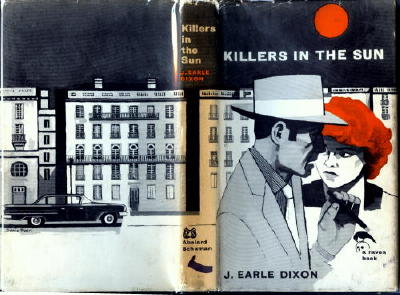
    Mr. Dixon has but one title to his credit in Crime Fiction IV, by Allen J. Hubin. His entry, as it presently stands, is as follows:

   DIXON, J. EARLE
       Killers in the Sun (London: Abelard-Schuman, 1960, hc) [Spain] Abelard-Schuman (New York), 1961.

   The book was published as part of Abelard-Schuman’s largely unknown and vastly under-rated “Raven Book” line of mysteries. You should be able to pick out the logo on the lower right portion of the front cover — that of a raven standing (and pecking) on a human skull.

Killers in the Sun


   Story synopsis, from inside the front cover:

    “Spain is a country of slums, green groves, blue skies, castanets, nightingales, cats and the most beautiful women you will find anywhere. You can have your big-eyed, blue-eyed blonde. Give me the black-eyed, swarthy Spanish maid. For preference in the middle-twenties. When she has perfected her poise and sun hasn’t begun to ravage her skin. To see a lady of Spain ride in the evening, with a rose in her hair and heaven in her eyes, is something a lover of nature shouldn’t miss.

    “But then I was only in their midst a little while.

    “This Larrabee case which brought me to Spain kept me there a matter of thirty days. That isn’t much time in which to study a nation. But I didn’t go there as a student; my job was to save First National (Australia) being gypped for three hundred thousand pounds. Which in my currency, is twenty-five per cent over sterling and is more than I earn in a month …”

    But thirty days were long enough for insurance man Dixon to involve himself in the world of the bull ring, of the glamour of the peerless bull-fighter Senorita Rosita Romero, of failed matador Martelli and the more deadly world of the luscious Faith Larrabee, of the mysterious painter Ramsey, worlds which overlapped and which provided the answer to the riddle of Clive Larrabee’s suicide in this tough, fast-moving story.

   If you couldn’t quite tell, or if you really weren’t sure, telling the story is Earle Dixon himself, a brash young insurance investigator from Sydney, which in essence qualifies him as a Private Eye in almost anyone’s book. That the author and the main character are one and the same makes one wonder about the author — a pen name?

   Author information, from inside the back cover:

    The author of Killers in the Sun is an Australian who made up his mind at an early age to see the rest of the world first. He has travelled since he was fifteen; has been twice round the world and, since he was twenty, has each year visited at least one “foreign” country. J.E.D. lives on the Blue Mountain ridge, near Katoomba, where exists, he says, one of the most exciting views in New South Wales.

    J. Earle Dixon writes of insurance because he knows it; he began his working career with a South African insurance concern in his youth. He has been married three times but isn’t working at it now; he claims women are unpredictable and unreliable.

    He has two paramount desires — to direct films and write for the Saturday Evening Post.

   Unfortunately, so far as I’ve been able to discover, he hasn’t, neither one, or at least not under that name. As usual, more information, if you have it, would be welcome.

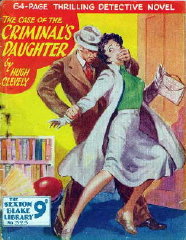
HUGH CLEVELY – The Case of the Criminal’s Daughter

Sexton Blake Library #323; The Amalgamated Press. Paperback. No date given.

   As it says, this slim (if not flimsy) 64-page digest-sized paperback comes with no bibliographic information, but luckily for those with Internet access, help is just a few keystrokes away. There is a website devoted to all things Sexton Blakian, and where the link will take you, you will discover that this is #323 of the Third Series of the Sexton Blake Library. The stories appeared monthly; this is the one that came out in November, 1954. And the illustrator responsible for the cover art was none other than Reginald (Heade) Webb.

TCOT Criminal's Daughter

   This being only the first Sexton Blake novel I’ve read in some 20 years, and the second overall, there’s no way I will talk in any general way about the character, nor should I, except to say that he, Sexton Blake, appeared as a character in over 3000 stories written by some 200 authors over a period of well over a century.

   As for Hugh Clevely, well, first of all, he was one of the 200 authors who wrote stories about Sexton Blake, but of course you knew that, or you should have. According to Hubin’s Crime Fiction IV, however, he only wrote 10 other Sexton Blakes, at least in novel form. His overall writing career spanned the years from 1928 to 1955 and includes a list of 35 novels under his own name, one co-written with Edgar Jepson. Only four of these novels have been published in the US.

   As Tod Claymore, he wrote another eight mysteries, all with a series character named Tod Claymore. According to W. O. G. Lofts and Derek Adley’s website The Crime Fighters, “He [Claymore] had been a Wimbledon tennis player and a wing commander during the war, then switched to writing, with detection as a hobby.” Some of these books were imported or published in this country as Penguin paperbacks, the green ones.

   Returning to the books Clevely wrote under his own name, the series characters that appeared in them were Chief Inspector Williams, Maxwell Archer, J. D. Peters, and John Martinson. According to a New York Times review of a film based on one of the Maxwell Archer books, the latter was a “famed fictional private detective whose greatest pleasure in life is to second guess Scotland Yard…” The occupations of the other series characters remain either unknown or quite guessable.

   So Clevely was an experienced mystery writer when he started doing the Sexton Blake books, which were all written toward the end of his career. All eleven of them appeared in the four-year period from1952 to 1955. Does the experience show? It does and as the saying goes, it doesn’t.

   The plot of the case in point, that is to say the book in hand, is a complicated one, and the pace is a lively one, but there’s a considerable amount of what is generically called sloppiness in the details, making you wonder if it were written too fast for a market that didn’t offer very much in compensation.

   The criminal in the title is a circus performer (billed as The Great Costello) who once spent some time in jail, but who now is worth a considerable amount of legitimate money. His brother is a ne’er-do-well who is currently in a jam with some British style hoodlums. Add in the fact that Pat Costello, the acrobat, does not know he has an American daughter, but after his death by misadventure – deliberate – the fact of her existence – and that she is on a schoolgirls’ trip in Europe – means a lot to everyone who’s involved. There is also a not-so-small matter of some missing diamonds, and there (without going into further details) you have the basis for a decent if not overly rousing mystery for private enquiry agent Sexton Blake, his assistant Tinker, and Inspector Fosdyke to solve.

   The details that the author works into the story, a rather pulp-like yarn, help to make the story more of a something than it is, along with a few twists in the tale that I frankly didn’t see coming. It was more than enough for me to start searching out more of the entries in Sexton Blake’s long history, but –

Martello tower

   – some of the details don’t fit, or they clash with other ones. The conversation that Blake has with newspaper journalist Peter Grayson on page 26, for example, makes it seem that he had never heard of the girl Josie Benson before, whereas on page 23 the same two gentleman had a long conversation about the very same girl, and what Grayson should do to contrive to meet her. On page 53 Grayson and the girl are being held captive in a Martello Tower, he in a handcuff that severely restricts his range of motion – yes, that’s the kind of thriller this is – but the handcuff is never mentioned again, nor is there any restriction on his range of motion, when it comes time to attempt an escape.

   And yes, of course, such a point in time does come, and not too soon at that.

— May 2006

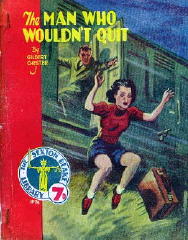
GILBERT CHESTER – The Man Who Wouldn’t Quit.

Sexton Blake Library #74; Amalgamated Press. Paperback. No date stated.

   Once again the Sexton Blake website comes galloping to the rescue. This is #74 of the Third Series, published in June, 1944. The date being in the midst of World War II, and by some reckoning among the darkest days of the war, I wondered how scarce this book (thin, digest-sized, but 100 pages long) might be. I was right. There are no other copies to be found anywhere on the Internet, and while I do apologize, mine’s not for sale.

   Gilbert Chester was the pseudonym of one H. H. Clifford Gibbons (1888-1958), whose total criminous output totaled approximately 100 novels, all but a handful of them Sexton Blakes, either anonymously or under his pen name, beginning in 1923 and continuing on through 1949.

   And if I knew more, I’d tell you, but I don’t, so I’ll get right to the story this time. And what a great first chapter this story has! It’s one that’s designed to grab the reader right in from the start, or maybe I’m just a sucker for stories taking place on trains, beginning with a frightened girl who enters Fenton’s compartment just as the train is leaving the station. She hurriedly tells him that she’s going to bale out before the next stop and furthermore requests that if he’s ever asked, he should say that never saw her.

The Man Who Wouldn't Quit

   From page 4:

       “Forget you’ve ever seen me.”

       “I’m not the type to quit, I assure you.”

       “Then you’re asking for trouble, sure enough. Well, are you going to play up?”

   She jumps, and so (without much hesitation) does he. And of course he has no idea where they are or into what kind of trouble he’s leapt into.

   Chapter Two can hardly compete with this, but it nearly does. Dropped off by the mysterious girl at Professor Barton’s home (where he had been heading) after a short hike and a longish drive in the dark, Fenton (a research scientist) is surprised to find himself in the morning a prisoner, with another young girl holding the key to his cell-like room.

   Chapter Three. We have nearly forgotten about Sexton Blake by this time, speaking collectively for myself alone, but the author hadn’t. Another young lady calls on Blake to solve a problem for her – her bungalow is being tampered with. Someone has been entering and prowling about while she is away. By an invisible man, she claims. No one has seen anyone enter or leave.

   It seems like a minor problem, but Blake takes the case, thinking her recitation too theatrical and wondering what could be behind such a fanciful tale. And of course, there is a surprise in store, and not only to Sexton Blake. On page 22 they discover a body in her locked and sealed home, riddled with lead – the body, that is.

   If some care had been taken, this could have been quite a mystery to unravel, but Blake makes it look easy. With only a cursory examination, Blake suggests a solution – and a rather ingenious one – to Inspector Briggan after he shows up, and of course Blake’s right and I have no idea how he did it. But it certainly is ingenious.

   In any case, no more details from me. You will have a find a copy of this book for yourself, if you’d like to know more. Suffice it to say that the opening three chapters are the best, but Chester certainly makes a more than competent story out of the rest of it.

   Some additional comments, though: Chapter Six is a long, ten-page conversation between two of the characters (already alluded to) which manages to both be informative and entertaining and moves the plot along while at the same time not being a mere recitation of topics and events that each of the two participants already know. It’s a neat trick, if you (as an author) can do it. Try it sometime and see.

   The weakest links in the chain of the narrative are (I sadly acknowledge) Sexton Blake’s own deductions, which consist almost entirely of whole cloth and gauze and mirrors, which is (I also admit) one heck of a way to run a railroad, um, detective novel. The gaps could have been fixed, but it is entirely to Mr. Chester’s credit that the story is still is as enjoyable as it is, even if they weren’t, and they never will be.

— June 2006

   Apparently it’s been common knowledge to Sexton Blake fans and collectors for some time now, but I didn’t know it until yesterday, and I don’t think that most Gold Medal collectors in this country do either.

   What seems to have happened back in 1956 or 1957 is that three Gold Medal books were published by Amalgamated Press, the folks who published the Sexton Blake books at the time, and had them rewritten to become, you guessed it, adventures of Sexton Blake instead.

   For the full story, you can go here, but here’s a brief recap. The three Gold Medal books were the following:

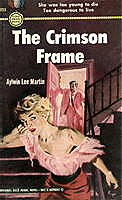
The Crimson Frame, by Aylwin Lee Martin, Gold Medal 253, pbo, August 1952.

The Crimson Flame

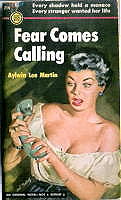
Fear Comes Calling, by Aylwin Lee Martin, Gold Medal 214, pbo, 1952.

Fear Comes Calling

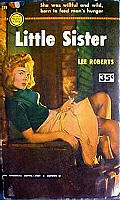
Little Sister, by Lee Roberts (Robert Martin), Gold Medal 229, pbo, March 1952. (The cover shown is that of the Canadian printing.)

Little Sister

   A fellow named Arthur Maclean was the chap who was asked to do the conversion, which was not a very easy job, as he describes it. (“Maclean” was actually a writer named George Paul Mann, which is another tale altogether, one told in the comments in this earlier post. But I digress.) Changing the hero’s name was the least of it. Locales had to changed, Blake’s assistant Tinker had to be written in, and if Amalgamated thought they were saving either time or money, they were sadly mistaken, and they never tried such a short cut again.

   For the record, also included in Part 18 of the online Addenda for the Revised Crime Fiction IV, here are the adventures of Sexton Blake that each of the above were transformed into:

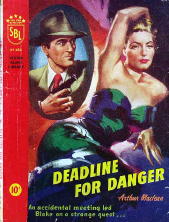
The Crimson Frame
==> Deadline for Danger, by Arthur Maclean (George Paul Mann), 4th series #380, April 1957.

Deadline for Danger

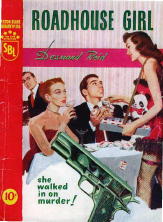
Fear Comes Calling ==> Roadhouse Girl, by Desmond Reid (George Paul Mann), 4th series #386, July 1957.

Roadhouse Girl

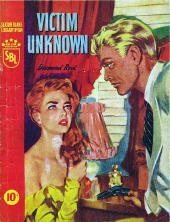
Little Sister ==> Victim Unknown, by Desmond Reid (George Paul Mann), 4th series, #384, June 1957.

Victim Unknown


   Collectors of hard-boiled Gold Medal paperbacks who think they have them all may have another think coming. For them and everyone else, for that matter, tracking down copies of each of two versions and comparing them might provide a thesis for someone – or who knows? – a doctoral dissertation. (Probably not, but I’ll leave the suggestion on the table for anyone who wants it.)

   Morton Wolson, 1913-2003, or Peter Paige, as he was known when he was writing for the detective pulps, has come up for discussion several times in these pages. The first time was a review I did of his only full-length novel, Nightmare Blonde (Pocket, 1988). In the course of the review I included everything I knew about the author at the time.

   The second time came soon thereafter, when Morton’s son Peter spotted the review and sent me an email that provided quite a bit more information about him.

   After reading both of these entries on the blog, pulp enthusiast and collector Walker Martin emailed me to tell the story of how he tracked down Morton Wolson in the 1980s and had a long afternoon’s conversation with him about his days in the pulps.

   Peter has kept in touch with me in the weeks since, and he recently sent me a couple of photos of his father, which of course I’m very pleased to be able to show you here.

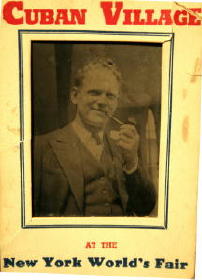
   This first one was taken when he was a bouncer at the Cuban Village in the New York 1939 World’s Fair, as he looked when he wrote his first piece for Black Mask, “I Guard Nudes.”

Peter Paige

   Peter adds that this occurred shortly after he returned from fighting against Franco in the Spanish Civil war, in which he was a member of the Lincoln Brigade, had been appointed Chief Cadre officer, and then was a partisan fighter in the Basque country, blowing bridges and trains, as depicted in Hemingway’s For Whom the Bell Tolls.

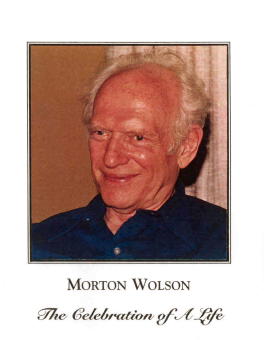
   This next one is the one used at his memorial services at the time of his death.

Peter Paige

   If you follow the links back to the previous entries, you’ll find that Morton’s stories under his own name have been discussed previously. This time around you’ll find a complete list of all of the pulp fiction that he wrote as Peter Paige, beginning with the previously mentioned “I Guard Nudes,” (Black Mask, Sept 1939) a story about security measures at a NY World’s Fair sideshow featuring scantily clad exotic dancers.

   Paige’s primary series character was Cash Wale, a hardboiled New York City private eye in the Race Williams vein. His sidekick, Sailor Duffy, is an ex-pug with “scrambled brains” whom Wale watches out for. Lots of violent action, tough talk, and wisecracks, says Bill Pronzini, when I asked him what he recalled about the pair. Dime Detective was the primary venue for the Cash Wale series, but Wale’s very first appearance was in the January 1940 issue of Black Mask, the only time he showed up in that magazine.

   The primary source of the data below is the two volume index Mystery, Detective, and Espionage Fiction, by Michael L. Cook and Stephen T. Miller. (Garland, 1988). Additional input came from Bill Pronzini, who provided much of the story information above and assistance when Cook-Miller produced questions I could not answer.

Peter Paige


      THE PETER PAIGE STORIES —

“I Guard Nudes,” Black Mask, September 1939.
     Reprinted in Big Double Feature Magazine, 1#1, circa 1940 as “I Guard Dudes”
         FOOTNOTE #1.
“Swastika Scorge,” Black Mask, December 1939.
“Voodoo Frame,” Black Mask, January 1940. CW = Cash Wale.
“The Fatherland of Otto Bloch,” Detective Fiction Weekly, Jan 27 1940.
“Blackout!” Black Mask, February 1940.
“Counterfeit Citizen,” Black Mask, March 1940.
“The Friends of Papa Valdes,” Black Mask, April 1940.
“The Corpse Promoter,” Detective Tales, April 1940.
“My Pop, the Cop,” Detective Fiction Weekly, Apr 27 1940.
“And God Won’t Tell,” Black Mask, July 1940.
“Pick’s Last Crime,” Detective Fiction Weekly, Aug 10 1940.
“Lotta Had a Husband,” Dime Detective, September 1940. CW.
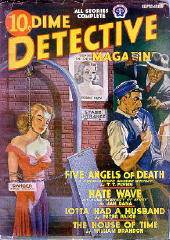
Dime Detective Sept 1940

“Pick’s Last Crime,” Detective Fiction Weekly, Oct 26 1940.    FOOTNOTE #2.
“Blitzkrieg Bankroll,” Fifth Column Stories, November, 1940.
“They Refuse to Understand,” Detective Fiction Weekly, Dec 7 1940.
“Dopey and theDevil,” Detective Fiction Weekley, Dec 21 1940.
“Treachery Goes to School,” Fifth Column Stories, January, 1941.
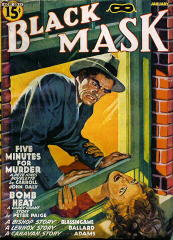
“Bomb Heat,” Black Mask, January 1941.

Black Mask Jan 1941

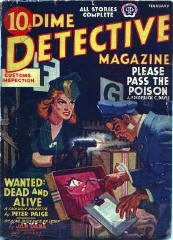
“Wanted: Dead and Alive” Dime Detective, February 1941. CW.

Dime Detective Feb 1941

“The Bullet from Nowhere,” Dime Detective, April 1941. CW.
“Lady, Can You Spare a Corpse?” Dime Detective, June 1941. CW.
“Picture Me Dead!” Black Mask, November 1941.
“Local Corpse Makes Good,” Dime Detective, November 1941. CW.
“The Night You Shot Hitler,” Black Mask, February 1942.
“Death Is from Hunger,” Dime Detective, April 1942. CW.
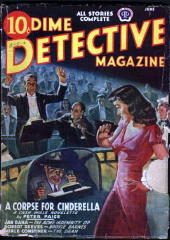
“A Corpse for Cinderella,” Dime Detective, June, 1942. CW.

Dime Detective June 1942

“Death Is a Souvenir,” Black Mask, August 1942.
“Berlin Papers, Please Copy,” Black Mask, September 1942.
“Joe Is Dead,” New Detective, January 1943.
“Death Stands By,” Dime Detective, February 1943. CW.
“Just a Sample,” Short Stories, May 1943.
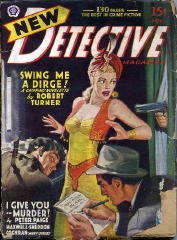
“I Give You – Murder!” New Detective, November 1943.

New Detective Nov 1943

“The Riddle of Papa Rio,” Dime Detective, August 1945. CW.
“Twelve Dead Mice,” Dime Detective, January 1946.
“Guilt-Edged Frame,” Dime Detective, September 1946.
“A Little Corpse Who Wasn’t There,” Dime Detective, December 1946. CW
“Cash in the Chips,” Dime Detective, January 1947. CW
“When a Man Murders,” Dime Detective, March 1947. CW
“Meet Me in Death Alley,” Detective Tales, May 1947. CW
“Death – on the House,” Dime Detective, June 1947. CW
“Softly Creep and Softly Kill!” Detective Tales, August 1947.
    Reprinted in Triple Detective, Summer 1953
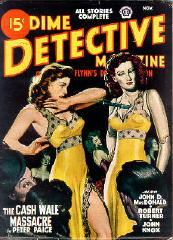
“The Cash Wale Massacre,” Dime Detective, November, 1947. CW

Dime Detective Nov 1947

“The Merry Wives of Murder,” Detective Tales, February 1948.
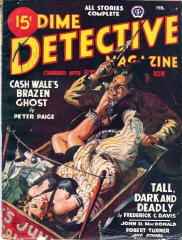
“Cash Wale’s Brazen Ghost,” Dime Detective, February 1948. CW

Dime Detective Feb 1948

“Die, Little Lady,” Detective Tales, March 1948.
“The Sweetest Corpse in Town!” Detective Tales, April 1948
    Reprinted in Triple Detective, Fall 1953.
“House in Silence,” Dime Detective, June 1948.
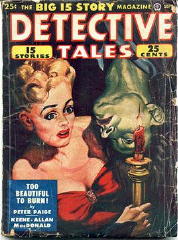
“Too Beautiful to Burn,” Detective Tales, September 1948.

Detective Tales Sept 1948

“Cash Wale’s Lethal Lulu,” Dime Detective, October 1948. CW
“The Corpse and I,” Dime Detective, January 1949.
“That Mad, Mean Murder Man,” Detective Tales, March 1949.
“Cash Wale’s Carnival Kill,” Dime Detective, May 1949. CW
“Coffin Cure,” Dime Detective, July 1949.
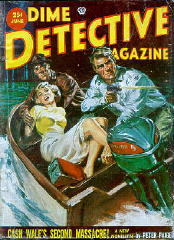
“Cash Wale’s Second Massacre!” Dime Detective, June 1953. CW

Dime Detective June 1953

“Adam and Evil!” Detective Tales, August 1953.
“The Watcher” Manhunt, November 1953.

   Stories as by MORTON WOLSON:     [FOOTNOTE #3]

“The Attacker” Ellery Queen’s MM, January 1954.
“The Glass Room” Ellery Queen’s MM, September 1957.
Nightmare Blonde, novel, Pocket, 1988.

FOOTNOTE #1. Bill Pronzini and I suspect that the altered title is a slip of the finger on the part of Cook-Miller. The single issue of Big Double Feature Magazine consisted of nothing but reprint stories, the westerns from Ranch Romances, the mysteries from Black Mask.

FOOTNOTE #2. The title of this story is the same as that for the August 10, 1940, issue of Detective Fiction Weekly. Neither Bill nor I have either magazine, but one possibility that he suggests is that Paige’s “You’re the Jury” in the November 16, 1940 issue of DFW is listed as #3 in a series of true stories. It could be that “Pick’s Last Crime” was both #1 and #2, a two-parter despite the two-month gap or maybe a followup piece.

   [UPDATE] 08-27-08. In the comment he left early this morning after checking his set of DFW, Walker Martin reports that, surprisingly enough, what the magazine did was to publish two separate stories by Paige having the very same title.

FOOTNOTE #3. The first version of this list included only the stories written by Morton Wolson as Peter Paige for the pulp magazines, and somehow the story he did for Manhunt, a digest, was missed. Thanks to Jiro Kimura for catching this. See his comment that follows. Having added the one missing story, I decided to include the three other stories he did under his own name. Compleatness is the goal, after all!
   One online commentator describes Roger Bennion, the detective character created by Herbert Adams, thusly: “… amateur sleuth and son of a wealthy baronet. He is more amoral than is usual for the period, often willing to obstruct justice to help a pretty damsel in distress, but basically a decent and charming chap.”

   A list of all of Roger Bennion’s appearances will follow Mary’s review of the very last case he solved.

   The character’s creator, Herbert Adams, 1874-1958, is probably best remembered (and collected) for his golfing mysteries, eight of them in all. You can find them listed and commented upon here, for example.

   As for Death of a Viewer, I apologize for the very limited image I’ve been able to find for the book. There seems to be only one copy available for sale on the Internet. The asking price is just under $500.

   On the other hand, you may read it online for free.

– Steve


HERBERT ADAMS – Death of a Viewer.

Macdonald, UK, hc, 1958.

   Since it was published in the 1950s, Death of a Viewer hangs its toes over the precipice marking the end of the Golden Age period, but what the hay, the Roger Bennion series began in the 1930s so let’s agree this entry is grandfathered into my general area of discussion.

Death of a Viewer

   Captain Oswald Henshaw tells his lovely young wife Sandra their financial resources are gone — but suggests if he sees her in comprising circumstances with Ewen Jones, Member of Parliament for an East London constituency, there could well be financial benefits. Ewen’s father is Lord Bethesda and his stepmother is worth half a million. Naturally they’d want to keep scandal — such as Hensaw bringing an action for alienation of affection against Ewen — from breathing nastily on the family name.

   Major Bennion becomes involved because Ewen lives in one of the houses built by Bennion Senior near the London docks. These homes are intended for disabled servicemen, old age pensioners, and the like and Bennion Senior wishes the better-off MP, who became a tenant due to a loophole, to move out so Lord Bethesda’s elderly gardener can retire and live there.

   Ewen refuses but asks Bennion to visit the family home of Welton Priory “in that charming part of the country where Sussex joins Hampshire.” Several Labour MPs are meeting there that weekend to secretly discuss plans to make the party more Socialist. Bennion’s presence will suggest the gathering is the usual sort of house party — and while he’s there perhaps he’ll persuade Ewen’s father to buy him, Ewen, a house or give him an allowance! The Henshaws will also be attending as Ewen’s guests, and thus the wheels of the plot begin to turn.
   Before too long there are interesting conversations overheard, furtive visits to bedrooms, and fiery political rhetoric that does not go down too well with the MPs. The viewer’s death occurs in a room full of people during a TV play about the Battle of Britain, and with very little to initially go on except a scrap of paper and a house full of suspects Bennion and Scotland Yard’s Superintendent Yeo and Inspector Allenby cooperate to solve the crime.

   My verdict: Ewen gets on his soapbox and in doing so reminds readers of the unrest in the air in the 1950s, including calls for the abolition of hereditary titles, Church and union reform, disgust at the possibilities of easier divorce, and legalisation of what is quaintly described as the sin of Sodom and Gomorrah. These references will make the legendary Cheltenham colonels who so often write to the editor of The Times weep with joy, but alas they tend to swamp parts of the earlier part of the novel and do not add very much to the plot.

   However, once we get to the actual detecting the story runs along nicely. More than one house guest has what they might see as good reason to act against the deceased, so most of them are suspected at one time or another and the solution roars up after an unexpected twist which certainly caught me by surprise. I reget to say however that on the whole this novel is not one of the best I have read.

Etext: http://gutenberg.net.au

            Mary R

http://home.epix.net/~maywrite/


THE ROGER BENNION NOVELS. Taken from Crime Fiction IV, by Allen J. Hubin. Quite surprisingly, although a few were reprinted in paperback in Canada, none of these were ever published in the US. As you will see, there is some overlap with Adams’ golfing mysteries, as indicated.

# Death Off the Fairway (n.) Collins 1936    (Golf)
# The Old Jew Mystery (n.) Collins 1936
# A Single Hair (n.) Collins 1937
# Black Death (n.) Collins 1938
# The Bluff! (n.) Collins 1938
# The Damned Spot (n.) Collins 1938
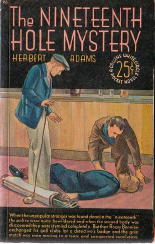
# The Nineteenth Hole Mystery (n.) Collins 1939    (Golf)

Nineteenth Hole Mystery

# The Case of the Stolen Bridegroom (n.) Collins 1940
# The Chief Witness (n.) Collins 1940
# Roger Bennion’s Double (n.) Collins 1941
# Stab in the Back (n.) Collins 1941
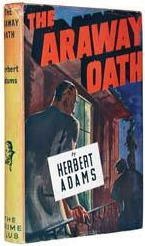
# The Araway Oath (n.) Collins 1942

The Araway Oath

# Signal for Invasion (n.) Collins 1942
# Victory Song (n.) Collins 1943
# Four Winds (n.) Collins 1944
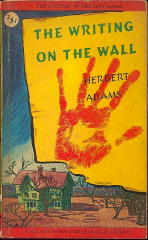
# The Writing on the Wall (n.) Collins 1945

The Writing on the Wall

# Welcome Home! (n.) Macdonald 1946
# Diamonds Are Trumps (n.) Macdonald 1947
# Crime Wave at Little Cornford (n.) Macdonald 1948
# One to Play (n.) Macdonald 1949    (Golf)
# The Dean’s Daughters (n.) Macdonald 1950
# The Sleeping Draught (n.) Macdonald 1951
# Exit the Skeleton (n.) Macdonald 1952
# The Spectre in Brown (n.) Macdonald 1953
# Slippery Dick (n.) Macdonald 1954
# The Judas Kiss (n.) Macdonald 1955
# Death on the First Tee (n.) Macdonald 1957    (Golf)
# Death of a Viewer (n.) Macdonald 1958

« Previous PageNext Page »