Characters


   Here’s both a private eye and a private eye author you’re not too likely to have heard of before. Sam Carroll is the PI, and Robert Leigh is the author. Both of two books were published in England, one of them was published here in the US, and neither of them ever appeared in paperback. Once upon a time private eye novels were always published in paperback, and often paperback only. Not any more.

   Here, before going to the books themselves, is the author’s entry in Crime Fiction IV, by Allen J. Hubin:
      
LEIGH, ROBERT (1933- )
      * The Cheap Dream (London: Macmillan, 1982, hc) [Sam Carroll; London] U.S. title (?): First and Last Murder. St. Martin’s, 1983.
      * _First and Last Murder (St. Martin’s, 1983, hc) See: The Cheap Dream (Macmillan (London) 1982).
      * The Girl with the Bright Head (London: Macmillan, 1982, hc) [Sam Carroll]

   We can make some additions and correction to that entry right away. The US novel entitled First and Last Murder is not The Cheap Dream, as conjectured, but the The Girl with the Bright Head, which happens to be Leigh’s second novel. The setting is London, the same as the first one.

THE CHEAP DREAM
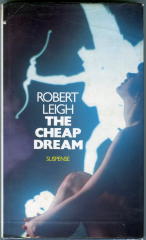
The Cheap Dream

      From the front inside DJ flap:

    “I reached for a cigarette and then heard the rhythmic pocking of the record player. As I looked down at it I saw that the record was still spinning. The machine hadn’t been damaged in all the violence. There was blood on it and one drop had stayed in a groove. It spun around with the record like a rose in a whirlpool.”

    Sam Carroll was good at finding out what really goes on behind the neon glitter of modern London. He aspires to the highest level of the ‘crusader’ private eye. His world is bounded by central London, and focussed on Soho. This is a London of the most depraved character, of sex in many forms, drugs, gambling, reckless and dissolute extravagance. It is peopled by pop stars, models, prostitutes, negroes, journalists, a fringe world of night-birds awash with money and frenetic for ‘happiness’ or release.

    A man of wealth, a publisher of shady magazines, wants Carroll to investigate the circumstances of the death of a girl called Valentine: a drug addict, she appeared to have died from an overdose. But an ‘open verdict’ had been returned so there seemed to be something worth investigating.

   As he wades through the expensive twilight of the city, Carroll runs into an assortment of other characters who don’t wish him well and soon finds himself on the floor in a Pimlico basement next to a small black corpse.

   An exciting and weird story is told with clarity and elegance in this unusual first novel.

      From the inside back DJ flap:
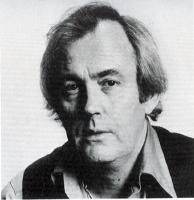
Robert Leigh

ROBERT LEIGH was born in 1933. His first job was as a junior reporter on the Kent Messenger and he subsequently worked in Paris (carrying sandwich boards for the Jean Cocteau cinema), in Soho and Victoria (selling ice cream, writing for literary magazines), in Holland (writing a column for a Dutch daily newspaper), in Spain (coaching a local village football team, writing articles for the New York Times) and is now back in London running an advertising consultancy.

He still plays a lot of sport from Sunday morning football to canoeing and badminton, and has plans for further Sam Carroll novels.

      Review excerpts (from the back cover of The Girl with the Bright Head):

“A fresh talent stirs.” The Guardian.

“Does more than pass muster.” The Observer.

“Undoubted talent.” Catholic Herald.

“Augurs well for subsequent thrillers.” Manchester Evening News.

THE GIRL WITH THE BRIGHT HEAD
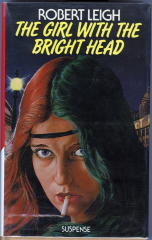
Girl with the Bright Head

      From the inside DJ flap:

   In his first novel, The Cheap Dream, Robert Leigh introduced the private investigator Sam Carroll. Carroll belongs to the ‘crusader’ school of private eyes and his first recorded adventure took place amid the candy-floss glitter and deepest vice that stains a spectrum of society not far below the surface of London, and Soho in particular.

   It is in the same setting – all too realistically described – that Carroll now sets out to rescue the ‘girl with the bright head.’

    “The thing you might have noticed about her was that her hair was parted in the middle and that one wing of it was red while the other was bright green.”

   She was trying (rather ineptly) to set up as a whore, but Carroll detected an innocence in her: he was also reminded of another girl who said that ‘she was going to sin until she died.’

   This bit of rescue work involves Carroll with Charlene’s complicated family, also with some pretty callous thugs, then a messy murder and then the police. In fact Carroll is in deep trouble.

   Violence and evil pervade these events, but Carroll is his own man. In the end, he fights his way through to survival, only to discover a weird twist at the end.

   Robert Leigh’s second novel is a ‘good read,’ but something more serious is at issue in its depiction of an aspect of London life and in Carroll’s own attitudes to these corrupt and wicked people.

FIRST AND LAST MURDER (aka THE GIRL WITH THE BRIGHT HEAD)
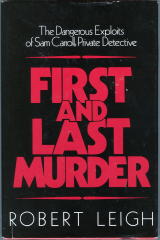
First and Last Murder

      The blurb on the DJ flaps is an abridged version of the one above, with the last paragraph replaced by:

   In the tradition of Raymond Chandler and Dashiell Hammett, Robert Leigh writes with the vividness and precision of a worldly poet, demonstrating that he is a new detective novelist of extraordinary promise.

   [There is no indication of the book’s previous title. As I’m sure you’ll agree, the cover is hardly designed to catch a would-be buyer’s eye. The book was published back in the day when 90% of the hardcover mysteries produced were sold directly to libraries.]
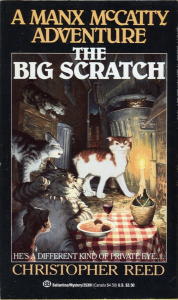
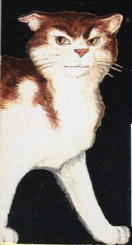
   So much for putting this blog on vacation, you might be thinking. But I can explain. It’s been too hot this August to do much but rearrange the boxes in the garage. No heavy lifting, in other words, but I have been peeking in and recording the contents of a large number of these boxes, some of which haven’t been peeked into since I came home from whatever bookstore, garage sale or library sale I’d been to that day.

   And once in a while I come across something that catches my eye more than usual, and I make myself a note to the effect, here’s something I have to tell you about and I can’t wait.

Manx McCatty

   Case in point. Here’s the entry as it is in Crime Fiction IV, by Allen J. Hubin:

      REED, CHRISTOPHER; Playwright and musical comedy lyricist and composer; living in Oregon.
         * The Big Scratch (Ballantine, 1988, pb) [San Francisco, CA]

   Nothing more. Nothing to indicate that this is a private eye novel, and in fact the PI in this novel is so novel that he is not even included in Kevin Burton Smith’s thrillingdetective.com website: One Manx McCatty.

   The actual title, and I must tell Al this, is A Manx McCatty Adventure: The Big Scratch. You’ve already peeked at the cover, so you already know, or you’ve guessed, but in case not, or even if you have, read on. From the back cover:

MANX McCATTY

INSTANT I.D.: Cool cat from the docks.

STRENGTHS: Thinks fast on his paws.

WEAKNESSES: Fresh-caught fish and a silver-gray Persian named Pasha.

DAILY ROUTINE: Keeps the bad guys in line, snags a cat-sized snooze.

   Evil lurks along the mean streets of San Francisco – Fisherman’s Wharf, North Beach, the fog-enshrouded waterfronts. And, as usual, hardboiled hero Manx McCatty is outnumbered by blackguards: low-life hoods, stoolies, extortionists, and Gato Nostro kingpin Tabby Tonelli.

   But dastardly villains haven’t stopped the superior snooper cat before. He’s too smart to trip into their traps; far too cagey to be caught in their web of danger. A cat’s cat, Manx McCatty is one feisty feline who licks his chops at a challenge … the tougher the odds, the sweeter the prize.


   And from instead the front cover:

    “I was nosing into the notorious Gato Nostro, a powerful organization of sleazeball felines who specialize in various forms of terror, extortion, protection, black marketeering, and, most recently, the exportation of cats to different parts of the world.

    “The news caused such an uproar that an investigation was called for, and, as always, I was elected to prowl around and find out what I could. That didn’t bother me. Investigation is my game.

    “I flexed my paws and hit the street.”

Manx McCatty

   I’ve not been able to find out very much about the author, Christopher Reed. Nothing on Google, though admittedly I haven’t yet done an exhaustive search. All that’s known, at the moment, is what’s found at the end of the book:

ABOUT THE AUTHOR –

A MANX McCATTY ADVENTURE: THE BIG SCRATCH marks the debut of CHRISTOPHER REED as a novelist. He is, principally, a playwright and musical comedy lyricist. His theatre works, including THE FINAL ACT and (in collaboration with Ron Martell and Cynthia Carle) SHOOTIN’ STARS, have been performed in New York and other cities. Mr. Reed lives in Ashland, Oregon, where he has recently completed a second novel featuring Manx McCatty.

   If the book was written, it was never published, and perhaps there’s a story behind that. In the meantime, the book’s not hard to find online – there are only six copies on ABE, but most are not pricey – so grab one while you, and sit back and relax and begin reading:

    “The fog dropped in like a huge, soggy pancake. As I wound my way along the deserted waterfront, I wondered how air could ever get so wet. Just being near the piers made me nervous, but the eerie glow of the naked dock lights and the lapping of the waves against the creaking pilings really ruffled my fur.

    “Something moved and I sprang. The little garbage mouse didn’t have time for even a quick regret before I served him up like the blue plate special down at Sylvester’s any Tuesday night.”

   The book is illustrated, too, and by the same fellow who did the cover artwork. He really ought to be mentioned, so I will: Tom Newsom.

   Before beginning the interview below, you may want to go back and read a previous post entitled The Compleat Cases of MORGAN TAYLOR. Morgan Taylor was the actress-sleuth created by Susan Sussman and Sarajane Avidon who appeared in two well-regarded mystery novels before the death of Sarajane in 2006.

Susan Sussman

   After the profile of the Morgan Taylor the detective had been completed, I got in touch with Susan Sussman, who quickly agreed to answer a few questions for me:

Q. Can you say something about your friendship and collaborative work with Sarajane Avidon, especially the Morgan Taylor books? And my most sincere condolences on the loss of someone who appears to have been a best friend.

A. I met Sarajane many years back, between our junior and senior year of high school, when we were both enrolled in the Cherub Program at Northwestern University — Sarajane was in theater, and I was in Radio/TV/Film. I was from Chicago and she was from Parkersburg, West Virginia.

   The books came about when Sarajane was battling cancer, unable to act for a while. She was feeling depressed and I suggested that, since she was sprawled on the sofa not doing much of anything, perhaps she’d like to write a book with me about a Chicago actress. It was the perfect creative outlet for her at the perfect time.

Q. As I understand it, her input was largely, but not limited to, that of providing and describing the background of being an actor and the world of the stage, would that be correct?

Sarajane Avidon

A. How we worked was, I’d write a scene or chapter, and Sarajane would read it. Then we’d discuss it over refreshments (there was always food involved) and she would say something like “You didn’t mention theater dust. You must mention theater dust.” Then she’d arrange for us to go backstage someplace so I could smell and experience theater dust and describe it in the book.

   She was a brilliant and careful reader and brought a richness to the theatrical and angst-riddled world of Morgan Taylor.

Q. Are you a long-time mystery reader yourself?

A. I’ve been reading mysteries since I was very little. Cut my teeth on Nancy Drew mysteries. (The original old ones. She was much more independent and inventive in those years.) I love mysteries, always have, although the books on my nightstand run a wide gambit.

Q. What authors from the past or present are and have been your favorites?

A. For true-to-life characters, Stephen King; for humanity, Ray Bradbury; for humor, Susan Isaacs and Elaine Viets; for razor-sharp political commentary, Carl Hiaasen; for scary stuff, Tess Garritsen…. the list goes on and on. My nightstand is piled high with fiction and non-fiction, screenplays, plays and some sheet music I keep promising myself I’ll learn to play.

Q. Was Morgan Taylor based on any real life person? If so, was this person aware of this?

A. Morgan was entirely a figment of my imagination. As a writer, I much prefer life behind the scenes. Sarajane, the consummate actress, was all about finding the brightest spotlight in which to stand. Sarajane told me that, after the first book was published, she received calls from friends of hers who were convinced they were one character or another in the book. She never told them otherwise. But this happens with many books. Friends think they are my heroes and heroines and are certain they know the villains.

Joan Cusak

Q. If the Morgan Taylor stories were to be picked up by Hollywood for movies or TV, what actress would you most enjoy see playing her in the role?

A. I would love to see Joan Cusack in the role. In fact, I think she’d be knock-out in a weekly series based on Morgan Taylor (…sort of a Murder, She Wrote for the younger set.) Joan has the humor, the vulnerability and the talent to bring Morgan alive and make us care what happens to her.

Q. The books were received quite well, from the excerpts from the reviews. Would you agree?

A. We were blessed with wonderful and lively reviews, and our appearances in bookstores were always a great hit. What we did was act a scene from the book. Sarajane was a gifted actress and I was a superb straightman.

Q. A third book was mentioned as being in progress. Is there a chance that it will be completed?

A. At the moment, a play Sarajane and I wrote — Woman Standing — is in the hands of a Chicago theater. It was a labor of love for us both and was based on the life of Chicago artist Shelly Canton. I’m waiting to hear from the theater on that. Meanwhile, I’ve just published a children’s book and am under contract for another. I have all the research for the next Morgan Taylor book, and have outlined two others.

   But at this moment I can’t honestly say what will happen. I’m just taking things as they seem to be ready for me to do. The play was a really big push — Sarajane died soon after our second reading done with professional actors — and I’ve just recently finished incorporating her ‘notes’ from the reading into the final play. So these children’s books are like a breather for me before I gear up for the next novel.

Q. Is there anything you’d like to say or add in closing?

A. I haven’t yet been able to access your blog, so I hope my angle of response is what you were looking for. Sarajane Avidon was a fabulous actress and friend and those of us who knew her are richer for it.

Q. Your responses were exactly what I was looking for. Thanks very much for taking the time to reply.

A. You’re welcome!

   Even though acting was what she did for a living, Morgan Taylor somehow also managed to find herself solving two cases of murder in her short-lived career as a detective fiction character. She was the creation of two longtime friends who lived in Chicago, Susan Sussman and Sarajane Avidon.

   A former journalist, Susan Sussman is the more prolific writer of the pair, as a visit to her website will show. A third book in the series, A Voice for Murder, is mentioned as being in preparation, but alas, it appears it was never completed.

   Sarajane Avidon, a professional actress and award-winning artist, was born in 1941 as Sara Jane Levey, and died in 2006 after a long struggle with cancer. See a photo of her here, along with a brief account of her battle with the disease.

   Their combined entry in Crime Fiction IV, by Allen J. Hubin, reads as follows, slightly revised and expanded:

      SUSSMAN, SUSAN with AVIDON, SARAJANE
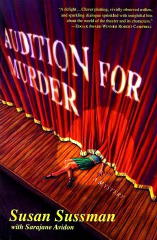
         * Audition for Murder. St. Martin’s, hc, January 1999. Worldwide, pb, June 2000. SC: Morgan Taylor. Setting: Chicago, IL; Theatre
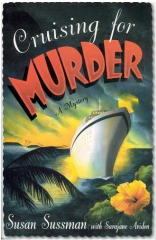
         * Cruising for Murder. St. Martin’s, hc, July 2000. Worldwide, pb, May 2002. SC: Morgan Taylor. Setting: Ship

AUDITION FOR MURDER

      Book Description:

Audition for Murder

   Welcome to the world of Morgan Taylor, a thirty-something struggling actress who is dying for a juicy role in a prestigious revival on the Chicago stage. She hasn’t had a role in months, and the chance to work with the esteemed director Martin Wexler has her practically salivating.

   Though Morgan shows up right on time for the audition, Lily London, her assigned auditioning partner and a cantankerous older woman Morgan has never really liked, seems to have forgotten. Morgan gets more and more anxious until it seems that nothing can salvage this chance. Her mood is shot, her nerves are frazzled, she’s got the stage manager for an auditioning partner. When it’s all over, of course, Morgan finally comes across Lily–dead, lying cold on the floor of the theater bathroom….

   The character of Morgan Taylor is fresh and thoroughly entertaining; she’s as dramatic as the most talented actresses and as shrewd as the most calculating investigator–in short, a perfect amateur sleuth. Her debut, Audition for Murder, peopled by a delightful supporting cast, including Morgan’s best friend, Beth, who suffers from MS, and Beth’s finicky dog, Hamlet, is one of those rare mysteries that delivers a wonderfully written story and an engaging, suspenseful puzzle.

      Review Excerpts:

Publishers Weekly: “From novelist Sussman […] and actress Avidon comes a sparkling first mystery, told in the present tense, that displays no opening night jitters as Chicago actress Morgan Taylor makes her memorable sleuthing debut. […] Even the bit players make notable contributions in Sussman’s entertaining and witty romp, which will have readers applauding for an encore.”

Booklist: “Anyone interested in the theater will especially appreciate this hilarious look at the mounting of a 40-year-old play in Chicago. Playing the lead in both the novel and the play is Morgan Taylor, a funny, smart-mouthed, totally endearing character who never forgets to thank the “theater gods” for her successes. […] Although this is Morgan’s first outing, one strongly hopes that Sussman and Avidon will give her an encore.”

Audition for Murder


CRUISING FOR MURDER

      Book Description:

Cruising for Murder

   Now that the touring production of Rent has just closed and a Chicago winter has descended, dancer/singer Morgan Taylor impulsively accepts a gig on a Caribbean cruise ship, anticipating three weeks of show tunes and suntans — not a stage set for murder.

   Her friend Kathy, the show’s production director, neglected to tell Morgan that the entertainer she’s replacing died under mysterious circumstances. And when Morgan’s beautiful, backstabbing roommate is found floating in the turquoise waters of the Bahamas — neatly zipped into a garment bag — things look ominous indeed.

   Neatly sidestepping a stalker, dangerous threats and a sinister shipboard mystery, Morgan remains, as always, a seasoned performer. She may be in a killer’s spotlight, but the show must go on. Morgan just hopes it continues to be a live performance.

      Review Excerpts:

Publishers Weekly: “In her second appearance […] as an amateur sleuth, wisecracking Chicago actress Morgan Taylor grabs center stage and never lets go in this frothy, high seas murder mystery. […] The solution to the two murders that the authors conjure up hardly registers, since their heroine’s overwhelming personality has upstaged even the plot long before the end. A subplot involving Morgan’s Uncle Leo, who turns up on the cruise accompanied not by his wife, Bertha, but by a gorgeous blonde, presumably will be resolved another time Morgan hits the boards.”

Kirkus Reviews: “A bouncy, self-deprecating heroine holds the plot together with wisecracks. Not quite up to Stephanie Plum’s high jinks but still, like Audition for Murder, very cute.”

School Library Journal: “The first-person narration, lively and contemporary, quickly draws readers into the mind and world of the funny, feisty protagonist. Some unlikely plot devices and a rather complicated solution won’t detract from most readers’ enjoyment of this light and finely rendered diversion, and teens will probably come hurrying back for the first Morgan Taylor adventure, Audition for Murder.”

Cruising for Murder


[UPDATE] 08-14-07. An interview with Susan Sussman, including her answers to several of my questions about Morgan Taylor and Sarajane Avidon, appears in this later post on the M*F blog.

  Steve,

   Your blog entry on John Creasey and the Toff served as a pleasant reminder of the madly-prolific yet now almost-forgotten Creasey. There seemed a time (1960s/1970s) when the shelves on London bookshops were weighed down with Creasey’s Hodder & Stoughton paperbacks.

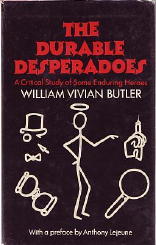
   I was very interesting to read that William Vivian Butler penned the post-1973 Creasey novels. I reached for Butler’s ‘critical study of some enduring heroes’, The Durable Desperadoes (Macmillan, 1973), a warmly nostalgic overview of British gentleman-adventurer literature from the early part of the last century, and discovered the following special note at the beginning of this work:

Durable Desperados

    “John Creasey’s sad death took place while this book was in production. This gives me an additional opportunity to express my gratitude for all his help, and to emphasise that both the book and its preface were shown to him, and met with his warm approval.

    “Nothing that I have written about the Toff and the Baron is invalidated by their creator’s death — not even the statement that, while so many similar heroes have fallen by the wayside, they still “stroll nonchalantly on”. John Creasey has left so much posthumous material that new novels in both the Toff and the Baron series will continue to appear until at least 1975, and possibly 1977.”

June 1973

   W.V.B.

   It is indeed unfortunate that while the Toff books seemed destined to trail in the shadow of Charteris’s The Saint novels (a little unfairly, I always thought), so have two little-known (of course) cinematic adventures featuring Creasey’s calm and daring character.

   Released to cinemas merely months apart in 1952 (in the UK), Salute the Toff and Hammer the Toff (both directed by Maclean Rogers for producer Ernest G. Roy at Nettlefold Films), starring the seemingly ever-resilient John Bentley as the Hon. Richard Rollison, seem to have disappeared into B-movie limbo. But during their short existence, Valentine Dyall’s Inspector Grice observed as the Toff traced a missing person (in Salute the Toff) and became involved with a stolen metal formula (in Hammer the Toff). Of course, there is the likelihood that the word ‘dreadful’ is primed for reactivation here.

   However, the truly fascinating aspect to these two rarely-seen films is that Creasey himself is credited with adapting the screenplays from his own novels (the 1941 Salute, the 1947 Hammer).

   Much like the still-elusive Paul Temple films of the same period (from works by Francis Durbridge), one hopes that the continual scraping of the bottom of barrels for new DVD movie properties may unearth the Toff duo for viewing evaluation in the near future.

   Thanks again for an interesting and informative Toff/Creasey piece.

Regards,

   Tise


   From Crime Fiction IV, by Allen J. Hubin:

BUTLER, WILLIAM VIVIAN (1927-1987); see pseudonym Vivian Butler.

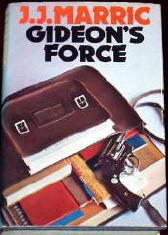
Gideon's Force   * Clampdown (London: Macmillan, 1971, hc) [England]
   * Gideon’s Fear (Hodder, 1990, hc) [Commander George Gideon; England]
   * Gideon’s Force (Hodder, 1978, hc) [Commander George Gideon; England] Stein, 1985.
   * Gideon’s Law (Hodder, 1981, hc) [Commander George Gideon; England] Stein, 1985.
   * Gideon’s Raid (Hodder, 1986, hc) [Commander George Gideon; England] Stein, 1986.
   * Gideon’s Way (Hodder, 1983, hc) [Commander George Gideon; England] Stein, 1986.
   * The Lie Witnesses (London: Macmillan, 1971, hc) [England]
   * Scare Power (London: Macmillan, 1969, hc) [England]
   * The Toff and the Dead Man’s Finger (Hodder, 1978, hc) [Richard Rollison (The Toff); England]

BUTLER, VIVIAN; pseudonym of William Vivian Butler
   * Guy for Trouble (Crowther, 1945, hc)

   As an introduction to this review and why I picked it out of my ‘archives,’ I recently reprinted a review I wrote in 1979 of another in John Creasey’s long series of “Toff” books, The Toff Among the Millions. I wasn’t entirely favorable in my comments, so when I remembered that I’d written this one not too long ago (2005), I thought what I said more recently might allay somehow what my younger self said. Whether it does or not, you may judge for yourself.


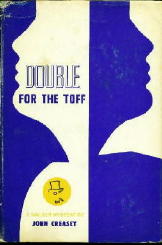
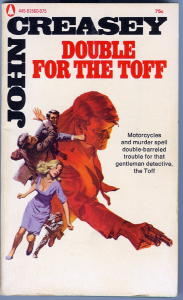
JOHN CREASEY – Double for the Toff.

Popular Library, paperback reprint; no date stated, but circa 1972. Hardcover editions: Hodder & Stoughton (UK), 1959. Walker (US), 1965. UK paperback editions: Hodder/Coronet, 1963,1973; Sphere, 1967. Earlier US paperback edition: Pyramid R-1221, Aug 1965.

Double for the Toff

   I’ll make no attempt here to do a general bibliographic discussion of John Creasey and the multitude of mysteries he produced. While that will have to wait for another time, this is certainly the place. As for the Toff, in real life Richard Rollison, I don’t believe it was ever a matter of a secret identity, only an honorific nomenclature.

   England seems to have had a long history of gentleman adventurers that did not seem to ever have been as popular in the United States as they were over there. The Toff, like Simon Templar, aka the Saint, before him (adventures recorded by Leslie Charteris), was merely another in a lengthy line of swashbucklers, figuratively speaking.

   And again, someone else may be better to write the history of such British adventurers, although again, this is certainly the place. In fact what I know about the Toff is minimal, but of course I will tell you what I know anyway.

   Let’s begin with a list of the books. These are in more or less the order in which they appeared in England. A hyphen (-) indicates the lack of an US edition. A star (*) means that there was one. A double star (**) indicates that the first US edition was a paperback. Alternate US titles are also included, if first appearances. (Thanks to Al Hubin’s Crime Fiction IV for most of this information.)

Introducing the Toff. 1938. (-)
The Toff Goes On. 1939. (-)
The Toff Steps Out. 1939. (-)
Here Comes the Toff. 1940. (*) 1967.
The Toff Breaks In. 1940. (-)
Salute the Toff. 1941. (*) 1971.
The Toff Proceeds. 1941. (*) 1968.
The Toff Goes to Market. 1942. (*) 1967.
The Toff Is Back. 1942. (*) 1974.
The Toff on the Trail. 1942. (-)
Accuse the Toff. 1943. (*) 1975.
The Toff Among the Millions. 1943. (*) 1976.
The Toff and the Curate. 1944. (*) 1969.
The Toff and the Great Illusion. 1944. (*) 1967.
Feathers for the Toff. 1945. (*) 1970.
The Toff and the Lady. 1946. (*) 1975.
Hammer the Toff. 1947. (-)
The Toff on Ice. 1947. (** – Poison for the Toff) 1965.
The Toff and Old Harry. 1948. (*) 1970.
The Toff in Town. 1948. (*) 1977.
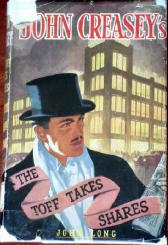
The Toff Takes Shares. 1948. (*) 1972.

Toff Takes Shares

The Toff on Board. 1949. (*) 1973.
Fool the Toff. 1950. (*) 1966.
Kill the Toff. 1950. (*) 1966.
A Knife for the Toff. 1951. (**) 1964.
The Toff Goes Gay. 1951. (* – A Mask for the Toff) 1966.
Hunt the Toff. 1952. (*) 1969.
Call the Toff. 1953. (*) 1969.
Murder Out of the Past. 1953. (-)
The Toff Down Under. 1953. (*) 1969.
The Toff at Butlin’s. 1954. (*) 1976.
The Toff at the Fair. 1954. (*) 1968.
A Six for the Toff. 1955. (*) 1969.
The Toff and the Deep Blue Sea. 1955. (*) 1967.
Make-Up for the Toff. 1956. (*) 1967.
The Toff in New York. 1956. (**) 1964.
Model for the Toff. 1957. (**) 1965.
The Toff on Fire. 1957. (*) 1966.
The Toff and the Stolen Tresses. 1958. (*) 1965.
The Toff on the Farm. 1958. (*) 1964.
A Doll for the Toff. 1959. (*) 1965.
Double for the Toff. 1959. (*) 1965.
The Toff and the Runaway Bride. 1959. (*) 1964.
A Rocket for the Toff. 1960. (**) 1964.
The Toff and the Kidnapped Child. 1960. (*) 1965.
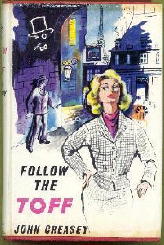
Follow the Toff. 1961. (*) 1967.

Follow the Toff

The Toff and the Teds. 1961. (* – The Toff and theToughs) 1968.
Leave It to the Toff. 1963. (**) 1964.
The Toff and the Spider. 1965. (*) 1966.
The Toff in Wax. 1966. (*) 1966.
A Bundle for the Toff. 1967. (*) 1968.
Stars for the Toff. 1968. (*) 1968.
The Toff and the Golden Boy. 1969. (*) 1969.
The Toff and the Fallen Angels. 1970. (*) 1970.
Vote for the Toff. 1971. (*) 1971.
The Toff and the Trip-Trip-Triplets. 1972. (*) 1972.
The Toff and the Terrified Taxman. 1973. (*) 1973.
The Toff and the Sleepy Cowboy. 1974. (*) 1975.
The Toff and the Crooked Copper. 1977. (-)

   There was even a three-act play in which the Toff was a leading character: “The Toff.” UK, 1963.

   Creasey died in 1973, so the final three books had been written and were still awaiting publication when he passed away. The Toff was popular enough in England that when his publisher (Hodder & Stoughton) ran out of Toff books to sell, they hired William Vivian Butler to write a very last one: The Toff and the Dead Man’s Finger (1978; no US publication).

   Besides three books of his own, Butler also wrote the final five Commander George Gideon novels, Gideon being Creasey’s Scotland Yard detective whose adventures he wrote as J. J. Marric.

   In creating this list of Toff books, there are several things I discovered that I hadn’t known before. First, I didn’t realize how many of the books were published in the US. If that were the question, the answer would be “almost all of them.” I also didn’t realize that the Toff was introduced to American readers in paperback form when Pyramid published a number of them in 1964-65, even though I purchased my copies when they did. They must have done quite well, since Walker soon took over and all of the rest of them came out in hardcover first. (Paperback editions of the Toff stories that appeared from Lancer and Popular Library were all reprints, although occasionally they altered the titles to suit editorial or marketing whims. These are not noted in the list above.)

   I also suspect (but so far I have not investigated) that the early Toff books were revised and/or updated when published in this country. I understand that it was a common habit for Creasey to revise his books for whatever his current market might be, and I do not expect the Toff books to have been an exception to this general rule.

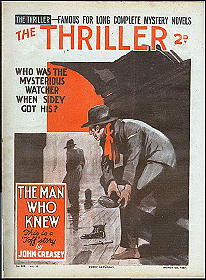
John Creasey in The Thriller

   A little Googlizing on the Internet reveals that the Toff first appeared in the two-penny weekly The Thriller in 1933, so the gent with a bent for crime was really around for quite a long while. (As a useful frame of reference, the Saint first appeared in the novel Meet — The Tiger! in 1928, while several of his earliest short story cases were told in The Thriller in the years from 1929 to 1931. Simon Templar, once again, was there first, in other words.)

   The issue shown is #422, March 6, 1937, and includes the Toff story “The Man Who Knew.”

   On the same website as above, but on another page, is a description of the Toff’s first book-length adventure, Introducing the Toff:

    “A little road rage was not unusual even in the 1940s, but the Toff was not expecting bullets to be a part of the argument when his Allard blocked the path of an oncoming Daimler in an English country lane.

    “What had been a pleasant day playing cricket became the start of a lethal fight against cocaine rings, gangsters and the criminal empire of The Black Circle.

    “Introducing The Toff is a typical John Creasey mystery; a ripping yarn and a fascinating document of social history as it dances between high society and the East End of London.”

   This seems to have come from the back cover of a recent British paperback edition, which perhaps explains the confusion over the date, but other than that, this blurb typifies exactly what I would have imagined the Toff’s early adventures to have been like.

Double for the Toff

   Returning to the book at hand, however, one can certainly read it without knowing all of the baggage that earlier stories might have brought along. One does get the sense that many of the secondary cast has been around for a while, but just as Della Street and Paul Drake were with Perry from the beginning, you can pick one of Erle Stanley Gardner’s books from the last 1960s as the first one in the series you read and not miss a beat.

   Creasey does not do a lot in terms of describing Richard Rollison. I made a few notes as I went along: he’s very handsome, a head taller than average, and in admirable physical condition. That’s about it. He’s on good terms with Scotland Yard, with Superintendent Bill Grice, apparently an old friend and only a semi-antagonist, willing to give the Toff a free hand whenever he sees a reason for it.

   The title comes from the fact that the Toff is handed two separate cases almost at one time, and after mulling over the possibilities, he decides he can handle both of them. Are they two separate cases? The reader knows better, but only the better reader will figure out how they are related before the Toff does.

   Which is due to two factors, the first being that even though this is a pretty good detective story, Creasey is determined to tell it as if it were a thriller, with lots of action and close calls for the Toff and his friends before it is over, and doing his best to keep the reader’s eyes away from the clues. The second factor is that the time table of events is wrong, or at least, let’s put it this way. The Toff’s reactions and apparent enlightenment on page 174 do not seem to match up with his deductions. In particular, please take note of his explanation to Grice on page 187 why he did something on page 168, well before he learned what he did that put the connections together on page, yes, 174.

   Inconsistencies are something you may have to learn to put up with when you read Creasey. On page 14 it is impossible to read the registration number on a motor-cycle, but on page 51 the Toff somehow knows that the motor-cycle had false number-plates. On pages 120-121 two men (bad guys) who have been gassed suddenly turn into three.

   Things like these used to drive me nutty when I was younger. I try not to let them any more. The book could have (and should have) been better. But taken as a given that you have to put your mind into a lower gear when you read his tales, Creasey was certainly a grand storyteller, with (as it turns out) a kind and sentimental streak in his books (or in this one, at least) a yard wide.

— November 2005

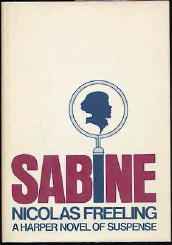
NICOLAS FREELING – Sabine.

Harper & Row, hardcover, 1976. Paperback reprint: Vintage V-553, 1980. First published in England as Lake Isle, William Heinemann Ltd., hardcover, 1976; Penguin, paperback, 1980.

Sabine

   The sights and sounds of small-town France are put on display as provincial policeman Henri Castang investigates the untimely death of an elderly poetess who had earlier come to him with some uneasy feelings concerning her adopted son and only heir. An intellectual affair, in fine Gallic tradition, as we’re shown how political and judicial pressures influence everyday policework, and not at all for the action-minded among us. (C)

      – From The MYSTERY FANcier, Vol. 3, No. 2, Mar-Apr 1979. This review also appeared earlier in the Hartford Courant.

[UPDATE] 07-18-07. When I was writing for the Courant, I was usually working under severe space restrictions, so some of my reviews were a whole lot shorter than they are today. I don’t believe I’ve ever read another book by Freeling, I regret to say, neither the Castang books nor the cases given to Inspector Van Der Valk to solve.

   Thanks to Crime Fiction IV, by Allen J. Hubin, here’s a list of all of the Henry Castang books. I do have many of these in paperback editions, and just in case you were wondering, I do plan to read them. I don’t keep anything I don’t intend to read.

o A Dressing of Diamond (n.) Harper & Row, 1974.
o The Bugles Blowing (n.) Harper & Row, 1976.
o Sabine (n.) Harper & Row, 1978.
o The Night Lords (n.) Pantheon, 1978.
o Castang’s City (n.) Pantheon, 1980.
o Wolfnight (n.) Pantheon, 1982.
o The Back of the North Wind (n.) Viking, 1983.
o No Part in Your Death (n.) Viking, 1984.
o Cold Iron (n.) Viking,1986.
o Lady MacBeth (n.) Deutsch, UK, 1988. [No US edition.]
o Not As Far As Velma (n.) Mysterious Press, 1989.
o Those in Peril (n.) Mysterious Press, 1991.
o Flanders Sky (n.) Mysterious Press,1992.
o You Know Who (n.) Mysterious Press,1994.
o The Seacoast of Bohemia (n.) Mysterious Press, 1995.
o A Dwarf Kingdom (n.) Mysterious Press, 1996.

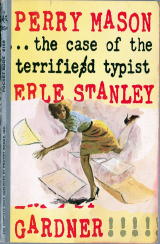
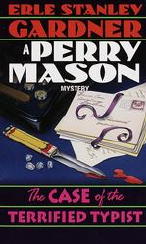
ERLE STANLEY GARDNER – The Case of the Terrified Typist

Pocket 6108, paperback reprint; 1st printing, November 1961. Hardcover edition: William Morrow, January 1956. Detective Book Club [3-in-1 edition], February 1956. Other paperback editions: Pocket Cardinal C-275, August 1958. Pocket, 1967, October 1975. Ballantine, March 1987, July 1999. Other editions are likely.

   There are certain authors who are so well known that there is very little chance that a review of one of their books is going to convince a would-be reader to read that author or not, even if that would-be reader has never even read that author. Sometimes one’s mind is made up, and there’s nothing that I could say that could change their opinion, either one way or the other.

Terrified Typist

   Case in point: Erle Stanley Gardner, and in particular the Perry Mason stories that he is known around the world for writing. In an unusal split in personality, fiction-wise, a number of people say that they like Gardner in his guise as A. A. Fair, but not when he’s writing under his own name, but stylistically, they read the same to me.

   I recognize, of course, the various reasons why someone might not care for Gardner’s books. Maybe you (well, not necessarily you) don’t like courtroom dramas, especially those that you know pretty much when the courtroom scenes are going to take place, soon after about halfway through, with a break in the action while the courtroom’s in recess while Perry calls on his stalwart private eye Paul Drake to dig up the necessary evidence he suddenly realizes that he needs.

   Those readers who like their detective figures to have personal lives have little to look forward to in the Perry Mason books. What do Perry and his faithful secretary do after their frequent dinners out together? It was never said, and it never will be. Gardner’s narratives and the dialogue from the mouths of his characters are of one piece, wooden, for the most part, and I suspect, repetitive in cadence and phrasing from book to book.

   I recognize all of the above, and groan sometimes when an especially awkward bit of repartee between Perry, Paul and Della takes place, and sometimes — believe it or not — the clueing is not entirely is as seamless and tidied up as completely at the end as it should be. But once started one of the Perry Mason books, I simply cannot stop.

   They usually begin with some strange, unusual occurrence that somehow happens to Perry or catches his eye in the newspaper or from his incoming mail, and The Case of the Terrified Typist is certainly no exception. Needing an ultra-efficient typist for some reason, Perry’s office is expecting one from an employment agency. When she arrives, she is very nervous, but she also proves to be one of the best typists they’ve ever had — until she disappears.

Terrified Typist

   Until another office — a jewel importing firm — in the same building is found to have been vandalized. Until a wad of gum under the typist’s table is found to be concealing two diamonds. Until Perry is hired by the firm’s head office to represent one of the two men in charge of the local branch — he’s accused of killing the smuggler who brought the gems into the country but whose body has never been found.

   Twist after new revelation after twist occurs, and trying to keep track of all of the participants and who’s telling the truth and who’s not will simply make one’s head swim. I know. It did mine. This is also one of the few cases in which Perry’s client is found guilty, until of course, the final twist and the final revelation that I guarantee you no one — no one, I tell you — no one will see coming, unless they just happen to have had their eyes fixed on the shell that contains the pea all along.

   That is to say, one of the participants is telling the truth and the whole truth, and maybe if you identify which one of them it is, you will have a chance of pulling this one out. As for me, I never came close.

— July 2007


[PostScript] It was a coincidence only, but I’d just finished writing this review and was in the process of editing it when I saw on Bill Crider’s blog that today’s the 118th anniversary of Erle Stanley Gardner’s date of birth. He was born on this day in 1889.

   So the review was rushed into (electronic) print, with some of the rough edges still showing, since smoothed away, I hope. For a fine overview of Gardner’s career as well as that of Perry Mason, you could do no better than visit The Rap Sheet, where Jeff Pierce discusses in great detail Ken Corning, Mason’s early counterpart in Black Mask magazine; the 1930s movies Mason was in; and above all, the superb choice made in casting Raymond Burr as Perry Mason, and in doing so, transforming the character into one of the immortals in the history of detective fiction.

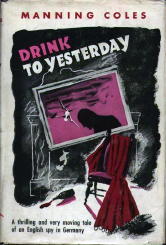
   Following up on my comments after Steve’s review of Manning Coles’ No Entry:

   In Drink to Yesterday, as Hambledon and Saunders/Kingston are escaping toward Ostend, they stop to requisition gas and oil from a German depot of some sort. There are some British POWs at the depot making pointed remarks, and one of them refers to Hambledon as a “wee fat man.” Now, he’s dressed as a German major and is probably wearing a greatcoat, so he may not be all that portly, but still…

Drink to Yesterday

   Earlier, Saunders describes a non-existent bad guy as someone taller than himself, and says the man was five-eight or five-ten, which would imply that Saunders was of average height; that might make Hambledon sound shorter in the scene described above. But Saunders was impersonating the major’s driver, so he may have been seated the entire time, in which case the POW would not have used him as a reference for Hambledon’s height. Who knows? My guess would be Tommy was about five-seven or five-eight and well-fed; the POWs were pretty skinny, I’d imagine, so anyone who wasn’t in their condition would probably appear heavier than he really was.

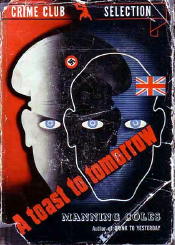
   On page 1 of A Toast to Tomorrow Hambledon as Lehman is described as “short and cheerful.” Several pages later, after he’s surfaced to British Intelligence (without identifying his job in Germany) he’s described by the agent he’s put across the Belgian border as “a nondescript little man, grey eyes, rather ginger hair going grey, short but not fat, thin face with duelling scars across his right cheek, quick, energetic walk, rather a pleasant voice, cheerful-looking fellow, looked as though he could see a joke. Short nose, wide mouth, rather thin-lipped, square jaw.” Both those descriptions are in 1933.

Toast to Tomorrow

   When he is recovering from the near-drowning in hospital in 1918 the doctor thought he was in his late twenties.

   I think that’s as much as we’re gonna get.

— Steve Timberlake

LIGHTS, CAMERA, MURDER – John Shepherd.

Belmont 215, paperback original, 1960.

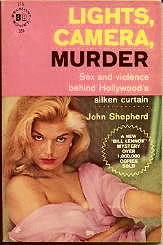
   This book is advertised on the front cover as “a new Bill Lennox mystery – over 1,000,000 copies sold.” That might have puzzled many a would-be buyer, trying to think back as to when he’d seen a book by John Shepherd before. And to tell you the truth, he wouldn’t have, as this was the first book that John Shepherd ever wrote.

Lights, Camera, Murder

   I’d better take that back. John Shepherd is a common enough name that it could have easily been the byline of plenty of books. In the interest of utmost accuracy, I’ll rephrase what I just said. This was the first mystery that any John Shepherd ever wrote.

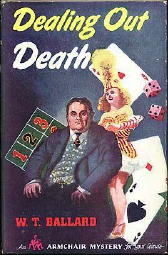
   What about Bill Lennox? Was he a mystery character who’d be immediately recognized as a hot sales commodity in 1960? He could have been, but if you’d like my best guess, probably not. Bill Lennox had last appeared in mystery form a mere six years before, in a book called Dealing Out Death, published as a paperback reprint in 1954 by an obscure company called Graphic Books. The byline? Not John Shepherd. The byline for Dealing Out Death was W. T. Ballard. It would have taken a lot of rather esoteric knowledge on the part of a would-be buyer before this book would have snapped up off the newsstand on the basis of this particular sales pitch.

   Of course, maybe you know all of this, and I’m berating the unberatable, not now, not almost 50 years later. (And by the way, my spell-checker doesn’t know that word either.) Both Bill Lennox and W. T. Ballard have come up for discussion here on the Mystery*File blog not too long ago, mostly, as you’ll recall, in relation to his pulp magazine appearances in Black Mask between 1933 and 1942.

   As mentioned then, but it’s worth repeating now, when he stopped writing about him for the pulp fiction magazines, Ballard took his character over to book-length hardcover cases, but unlike Erle Stanley Gardner, neither he nor Bill Lennox managed to succeed very well in making the transition. While putting together a more comprehensive, detailed list of the books that Bill Lennox, the Hollywood trouble-shooter, appeared in, I decided to go all out and using Al Hubin’s Crime Fiction IV as a guide, come up with a list of all of Ballard’s crime fiction in book length form:

The Bill Lennox books:

      Say Yes to Murder. Putnam, 1942. Penguin 566, pb, October 1945. Reprinted as The Demise of a Louse, as by John Shepherd. Belmont 91-248, pb, 1962.
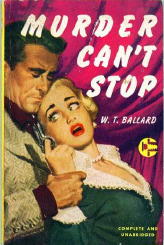
      Murder Can’t Stop. McKay. 1946. Graphic #26, pb, 1950.

Murder Can't Stop

      Dealing Out Death. McKay, 1948. Graphic #72, pb, 1954.
      Lights, Camera, Murder, as by John Shepherd. Belmont 215, pbo, 1960.

The Tony Costaine/Bert McCall books, as by Neil MacNeil:

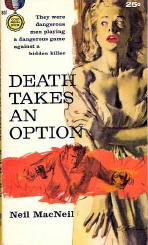
      Death Takes an Option. Gold Medal 807, pbo, September 1958.

Death Takes an Option

      Third on a Seesaw. Gold Medal s844, pbo, January 1959.
      Two Guns for Hire. Gold Medal s898, pbo, July 1959.
      Hot Dam. Gold Medal 964, pbo, January 1960.
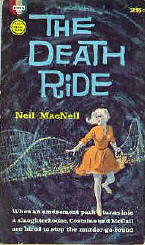
      The Death Ride. Gold Medal 1005, pbo, November 1960.

The Death Ride

      Mexican Slay Ride. Gold Medal s1182, pbo, January 1962.
      The Spy Catchers. Gold Medal d1658, pbo, 1966.

The Lt. Max Hunter books:

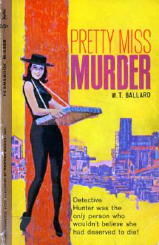
      Pretty Miss Murder. Permabook M-4228, pbo, December 1961.

Pretty Miss Murder

      The Seven Sisters. Permabook M-4258, pbo, October 1962.
      Three for the Money. Permabook M-4297, pbo, November 1963.

Non-series books:

      Murder Picks the Jury, as by Harrison Hunt. [Co-written with Norbert Davis.] Samuel Curl/Mystery House, 1947.
      Walk in Fear. Gold Medal 259, pbo, September 1952. [Based on “I Could Kill You,” a story that appeared in The Shadow magazine in 1948.]
      Chance Elson. Cardinal C-277; pbo, November 1958.
      Age of the Junkman, as by P. D. Ballard. Gold Medal d1352, pbo, 1963.
      End of a Millionaire, as by P. D. Ballard. Gold Medal d1486, pbo, 1964.
      Murder Las Vegas Style. Tower 42-778, pbo, 1967.
      Brothers in Blood, as by P.D. Ballard. Gold Medal T2563, pbo, 1972.
      The Kremlin File, as by Nick Carter. Award AN1165, pbo, 1973.
      The Death Brokers, as by P.D. Ballard. Gold Medal M2867, pbo, 1973.

   After World War II, W. T. Ballard seems to have been more successful in writing westerns than he was with his mystery fiction, but I haven’t taken the time to do any research in that particular direction. And this review is nominally of Lights, Camera, Murder, so let’s get back to that, shall we?

   Sadly to say, however, and I’ll say this upfront, this is a book that’s little more than ordinary, and in some ways less. It is, after all, as Bill Pronzini has pointed out to me, a book that was published under a never-before-used pseudonym and put out by a second-rate publisher. On the other hand, I read the book all the way through, and I can’t say that about every book I pick up to read.

   The greatest appeal this book probably has today is to completists: those who want every Bill Lennox story there is to read; or those who want every novel that W. T. Ballard wrote; or simply those who collect everything that Belmont ever published. (These completists have been arranged in order of decreased (although not negligible) likelihood. My spell-checker doesn’t recognize the word completist either, but we know you’re out there, don’t we?)

   To begin at the beginning, though, the story begins when Lennox is called upon to salvage a movie that’s in production down in Mexico, where one of the leading male stars has been found knifed to death in his room. The leading female star is in jail for the crime, having been seen leaving his room quietly the night before. This is the kind of disastrous situation in which a legendary trouble-shooter is always called upon to save the day, and quickly.

Dealing Out Death

   In quick order we are re-introduced to Sol Spurk, the head of the studio and the only man that Lennox reports to. In the pulp stories, though, I am sure he spelled his last name as Spurck, and sure enough, on page 97, it is spelled that way too. We also meet Lennox’s steady girl friend, a movie columnist named Nancy Hobbs, although very briefly. Their relationship is a loose one, meaning that neither places any restrictions on the other.

   Which is a good thing, one realizes quickly on, as Lennox does not offer much resistance, first of all, to the leading star (Sylvia Armstrong) who is in jail for the crime she did not commit, or so she says, even though she was seen leaving his room during the night the murder was committed. Since she is in essence a victim of nymphomania, perhaps what she says may not entirely be the truth, even though the dead man was said to be homosexual.

   But it is the beautiful and unsullied Candy Kyle, new to motion pictures, motion picture making and motion picture people, whom Lennox finds himself falling for. On her part, she serves as his assistant in crime-solving by keeping tabs of people, knowing where they are or should be, being shot at together, and being rammed on the open sea by power craft together.

   This is, as you fully well realize, the way that bad guys have of warning detectives off. It is also the approach which of course never works, even with high rolling gamblers and drug kingpins calling the shots, and is rather typical of the clichés and not-very-involving story line that ensue as soon as Lennox crosses the Mexican border.

   Lennox’s past, which began back in 1933, as you may recall, has been updated into the TV era and the age of beatnicks (sic) and the aforementioned drug-pushing industry. On page five, past history irregardless, it is said that he has had a ten year’s tenure working for Spurk. The usual time compression procedure is at play here, and don’t get me wrong. It’s happened to the best of fictional detectives, from Perry Mason, Hercule Poirot on down, though perhaps their creators were less blatant about it.

   The plot itself is not very interesting, as I suggested before. If anything, I was more interested in the players themselves. Even though some come from solid stock companies, some, including Lennox, came to life, including Candy Kyle, and some more than others.

   Speaking of which, the ending is a wowser, one of those endings that really make you wonder what is going to happen next. Except, of course, there was no “next.” This is all he wrote.

— June 2007

« Previous PageNext Page »